Mechanics of three-dimensional micro-architected interpenetrating phase composites
Pith reviewed 2026-05-19 14:19 UTC · model grok-4.3
The pith
A continuous matrix surrounding 3D architected networks distributes stress and delocalizes failure to raise composite strength and energy absorption.
A machine-rendered reading of the paper's core claim, the machinery that carries it, and where it could break.
Core claim
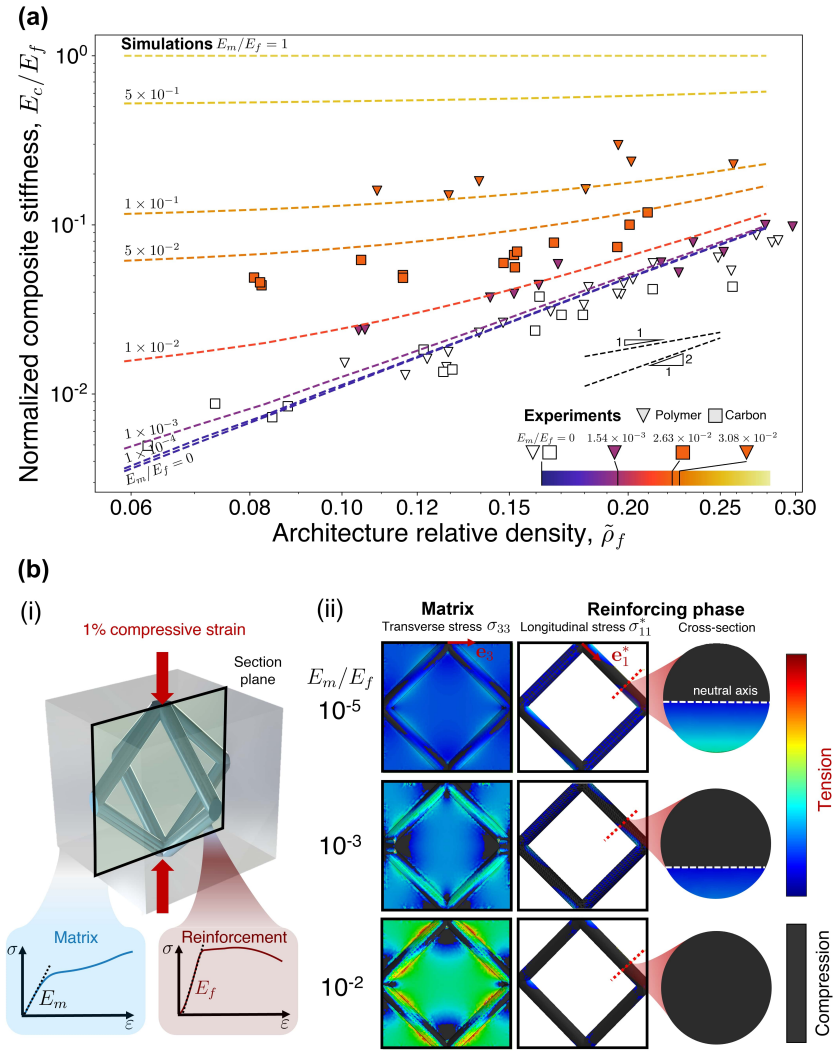
In an interpenetrating phase composite formed by a continuous three-dimensional architected network surrounded by a load-bearing matrix across length scales, the matrix distributes stress effectively. This distribution produces a high-strength, stable mechanical response. Failure becomes delocalized rather than localized, which raises energy dissipation to levels that match those measured in wound fiber tubes. The internal stress state can be adjusted by changing the geometry of the architected phase.
What carries the argument
The interpenetrating phase composite (IPC) structure, a continuous 3D micro-architected network embedded in and surrounded by a load-bearing matrix at all relevant scales.
If this is right
- The matrix phase produces high-strength and stable mechanical responses through effective stress distribution.
- Failure delocalization raises energy dissipation to values comparable with wound fiber tubes.
- Geometric design parameters can be used to tune the stress state inside an architected composite.
- The approach connects the load-transfer efficiency of traditional composites with the tunability of single-material architected lattices.
Where Pith is reading between the lines
- The same geometry-tuning strategy could be applied to control other properties such as thermal conductivity or electrical percolation once additional phases are introduced.
- Delocalized failure may translate to improved impact tolerance in lightweight structural components where sudden load drops are undesirable.
- Validation of the models at larger scales would allow direct use of the geometric parameters to optimize parts for specific loading conditions.
Load-bearing premise
Fabrication consistently produces continuous, defect-free interpenetrating phases at all length scales and the models correctly predict stress distribution and failure without large unaccounted discrepancies.
What would settle it
Fabricated samples that exhibit catastrophic localized failure or specific energy absorption values substantially below model predictions and below those of wound fiber tubes would show that the matrix does not distribute stress or delocalize failure as claimed.
Figures



read the original abstract
Composite materials are used across engineering applications for their superior mechanical performance, a result of efficient load transfer between the structure and matrix phases. However, the inherently two-dimensional structure of laminated composites reduces their robustness to shear and out-of-plane loads, while unpredictable interlaminar failure and fiber pull-out can cause a catastrophic loss of load capacity. Meanwhile, advances toward uncovering structure-property relations in architected materials have led to highly tunable mechanical properties, deformation, and even failure. Some of these architected materials have reached near-theoretical limits; however, the majority of current work focuses on describing the response of a single-material network in air, and the effect of adding a load-bearing second phase to a three-dimensional architecture is not well understood. Here, we develop facile fabrication methods for realizing centimeter-scale polymer- and carbon-based architected interpenetrating phase composite (IPC) materials, i.e., two-phase materials consisting of a continuous 3D architecture surrounded by a load-bearing matrix across length scales, and determine the effect of geometry and constituent material properties on the mechanics of these architected IPCs. Using these experiments together with computational models, we show that the matrix phase distributes stress effectively, resulting in a high-strength, stable response. Notably, failure delocalization enhances energy dissipation of the composite, achieving specific energy absorption (SEA) values comparable to those of wound fiber tubes. Finally, we demonstrate that the stress state in an IPC can be tuned using geometric design and introduce an example in an architected composite. Altogether, this work bridges the gap between mechanically efficient composites and tunable architected materials.
Editorial analysis
A structured set of objections, weighed in public.
Referee Report
Summary. The manuscript develops facile fabrication methods for centimeter-scale polymer- and carbon-based three-dimensional micro-architected interpenetrating phase composites (IPCs). Using experiments combined with computational models, it claims that the matrix phase distributes stress effectively to produce a high-strength, stable response; that failure delocalization enhances energy dissipation, yielding specific energy absorption (SEA) values comparable to those of wound fiber tubes; and that the stress state can be tuned via geometric design.
Significance. If the central claims hold after validation, the work meaningfully bridges architected materials and load-bearing composites by demonstrating how a continuous matrix phase can delocalize failure and improve energy absorption in 3D architectures. The reported SEA comparability to established wound-fiber benchmarks and the geometric tunability of stress state would constitute a useful design advance for robust, high-dissipation materials.
major comments (2)
- [Computational modeling section] Computational modeling section (near the discussion of stress distribution and failure paths): the models are invoked to support the central claim that the matrix distributes stress and produces delocalized failure. However, the description indicates use of idealized geometries with perfect bonding; no quantitative comparison to experimental interface behavior, crack paths, or strain fields is shown to confirm that fabrication-induced voids or imperfect phase continuity do not alter the predicted load transfer. This assumption is load-bearing for the SEA and delocalization conclusions.
- [Results section on SEA values] Results section on SEA values: the claim that IPC SEA matches wound fiber tubes is central to the significance statement, yet the manuscript provides no tabulated numerical values, error bars, specimen dimensions, or direct baseline comparisons that would allow assessment of the quantitative match or statistical robustness.
minor comments (2)
- [Abstract and Methods] The abstract states that 'facile fabrication methods' are developed, but the main text should include a brief discussion of yield, defect statistics, and scalability limits at the reported length scales to aid reproducibility.
- [Figures] Figure captions for experimental and simulated stress fields should explicitly state the boundary conditions, mesh convergence criteria, and any assumed interface properties.
Simulated Author's Rebuttal
We thank the referee for their constructive and insightful comments, which have helped us identify opportunities to strengthen the clarity and rigor of our manuscript. We address each major comment in detail below and will revise the manuscript accordingly.
read point-by-point responses
-
Referee: [Computational modeling section] Computational modeling section (near the discussion of stress distribution and failure paths): the models are invoked to support the central claim that the matrix distributes stress and produces delocalized failure. However, the description indicates use of idealized geometries with perfect bonding; no quantitative comparison to experimental interface behavior, crack paths, or strain fields is shown to confirm that fabrication-induced voids or imperfect phase continuity do not alter the predicted load transfer. This assumption is load-bearing for the SEA and delocalization conclusions.
Authors: We agree that the computational models rely on idealized geometries and perfect bonding, and that a more explicit validation against experimental data would strengthen the support for our claims regarding stress distribution and failure delocalization. The models were intentionally simplified to isolate the role of architecture and phase continuity. Our experimental results show consistent qualitative agreement in terms of stable load response and distributed cracking. In the revised manuscript, we will add a dedicated paragraph discussing the limitations of the perfect-bonding assumption, including potential effects of fabrication-induced voids, and provide side-by-side qualitative comparisons of simulated failure paths with post-mortem experimental images and any available strain-field data. revision: yes
-
Referee: [Results section on SEA values] Results section on SEA values: the claim that IPC SEA matches wound fiber tubes is central to the significance statement, yet the manuscript provides no tabulated numerical values, error bars, specimen dimensions, or direct baseline comparisons that would allow assessment of the quantitative match or statistical robustness.
Authors: We acknowledge that the current presentation of specific energy absorption (SEA) results lacks the tabulated numerical detail needed for full assessment. In the revised manuscript, we will insert a new table that reports mean SEA values with standard deviations, the number of tested specimens, specimen dimensions, and direct numerical comparisons to representative literature values for wound-fiber tubes, including the corresponding references. This addition will allow readers to evaluate the quantitative match and statistical robustness of the claim. revision: yes
Circularity Check
No significant circularity; claims rest on new experiments and models
full rationale
The paper develops fabrication methods for 3D architected IPCs, performs mechanical testing, and uses computational models to show matrix-induced stress distribution and failure delocalization leading to high SEA. No load-bearing step reduces by the paper's own equations to a fitted parameter renamed as prediction, nor does any central result derive from a self-citation chain or ansatz smuggled via prior work by the same authors. The derivation chain is self-contained against external benchmarks of fabrication and simulation fidelity, with claims grounded in direct observation rather than internal redefinition.
Axiom & Free-Parameter Ledger
Lean theorems connected to this paper
-
IndisputableMonolith/Cost/FunctionalEquation.leanwashburn_uniqueness_aczel unclear?
unclearRelation between the paper passage and the cited Recognition theorem.
the composite out-performs the sum of its constituent parts... specific energy absorption (SEA) values comparable to those of wound fiber tubes
What do these tags mean?
- matches
- The paper's claim is directly supported by a theorem in the formal canon.
- supports
- The theorem supports part of the paper's argument, but the paper may add assumptions or extra steps.
- extends
- The paper goes beyond the formal theorem; the theorem is a base layer rather than the whole result.
- uses
- The paper appears to rely on the theorem as machinery.
- contradicts
- The paper's claim conflicts with a theorem or certificate in the canon.
- unclear
- Pith found a possible connection, but the passage is too broad, indirect, or ambiguous to say the theorem truly supports the claim.
Reference graph
Works this paper leans on
-
[1]
E. Garcia, B. Wardle, A. J. Hart, N. Yamamoto, Fabrication and multifunctional prop- erties of a hybrid laminate with aligned carbon nanotubes grown in situ, Composites Sci- ence and Technology 68 (9) (2008) 2034–2041. doi:10.1016/j.compscitech.2008.02.028. URLhttp://dx.doi.org/10.1016/j.compscitech.2008.02.028
-
[2]
R. J. D’Mello, A. M. Waas, Inplane crush response and energy absorption of circu- lar cell honeycomb filled with elastomer, Composite Structures 106 (2013) 491–501. doi:10.1016/j.compstruct.2013.05.054. URLhttp://dx.doi.org/10.1016/j.compstruct.2013.05.054
-
[3]
B. Han, Z.-J. Zhang, Q.-C. Zhang, Q. Zhang, T. J. Lu, B.-H. Lu, Recent advances in hybrid lattice-cored sandwiches for enhanced multifunctional performance, Extreme Mechanics Letters 10 (2017) 58–69. doi:10.1016/j.eml.2016.11.009. URLhttp://dx.doi.org/10.1016/j.eml.2016.11.009
-
[4]
M. R. Wisnom, S. R. Hallett, The role of delamination in strength, failure mech- anism and hole size effect in open hole tensile tests on quasi-isotropic laminates, Composites Part A: Applied Science and Manufacturing 40 (4) (2009) 335–342. doi:10.1016/j.compositesa.2008.12.013. URLhttp://dx.doi.org/10.1016/j.compositesa.2008.12.013
-
[5]
J. Xiong, A. Vaziri, R. Ghosh, H. Hu, L. Ma, L. Wu, Compression behavior and en- ergy absorption of carbon fiber reinforced composite sandwich panels made of three- dimensional honeycomb grid cores, Extreme Mechanics Letters 7 (2016) 114–120. doi:10.1016/j.eml.2016.02.012. URLhttp://dx.doi.org/10.1016/j.eml.2016.02.012
-
[6]
N. A. Fleck, V. S. Deshpande, M. F. Ashby, Micro-architectured materials: past, present and future, Proceedings of the Royal Society A: Mathematical, Physical and Engineering Sciences 466 (2121) (2010) 2495–2516. doi:10.1098/rspa.2010.0215. URLhttp://dx.doi.org/10.1098/rspa.2010.0215
-
[7]
C. Crook, J. Bauer, A. Guell Izard, C. Santos de Oliveira, J. Martins de Souza e Silva, J. B. Berger, L. Valdevit, Plate-nanolattices at the theoretical limit of stiffness and strength, Nature Communications 11 (1) (2020) 1579. doi:10.1038/s41467-020-15434-2. URLhttp://dx.doi.org/10.1038/s41467-020-15434-2 http://www.nature.com/articles/s41467-020-15434-2
-
[8]
J. Bauer, A. Schroer, R. Schwaiger, O. Kraft, Approaching theoretical strength in glassy carbon nanolattices, Nature Materials 15 (4) (2016) 438–443. doi:10.1038/nmat4561. URLhttp://www.nature.com/doifinder/10.1038/nmat4561 http://www.nature.com/articles/nmat4561
-
[9]
A. Guell Izard, J. Bauer, C. Crook, V. Turlo, L. Valdevit, Ultrahigh energy absorption multifunctional spinodal nanoarchitectures, Small 15 (45) (Sep. 2019). 33 doi:10.1002/smll.201903834. URLhttp://dx.doi.org/10.1002/smll.201903834
-
[10]
L. R. Meza, S. Das, J. R. Greer, Strong, lightweight, and recoverable three-dimensional ceramic nanolattices, Science 345 (6202) (2014) 1322–1326. doi:10.1126/science.1255908. URLhttp://www.sciencemag.org/cgi/doi/10.1126/science.1255908
-
[11]
J. Bauer, L. R. Meza, T. A. Schaedler, R. Schwaiger, X. Zheng, L. Valdevit, Nanolat- tices: An emerging class of mechanical metamaterials, Advanced Materials 29 (40) (Sep. 2017). doi:10.1002/adma.201701850. URLhttp://dx.doi.org/10.1002/adma.201701850
-
[12]
X. Zheng, W. Smith, J. Jackson, B. Moran, H. Cui, D. Chen, J. Ye, N. Fang, N. Ro- driguez, T. Weisgraber, C. M. Spadaccini, Multiscale metallic metamaterials, Nature Materials 15 (10) (2016) 1100–1106. doi:10.1038/nmat4694. URLhttp://dx.doi.org/10.1038/nmat4694
-
[13]
A. J. D. Shaikeea, H. Cui, M. O’Masta, X. R. Zheng, V. S. Deshpande, The toughness of mechanical metamaterials, Nature Materials 21 (3) (2022) 297–304. doi:10.1038/s41563- 021-01182-1. URLhttp://dx.doi.org/10.1038/s41563-021-01182-1
-
[14]
P. Serles, J. Yeo, M. Hach´ e, P. G. Demingos, J. Kong, P. Kiefer, S. Dhulipala, B. Kumral, K. Jia, S. Yang, T. Feng, C. Jia, P. M. Ajayan, C. M. Portela, M. We- gener, J. Howe, C. V. Singh, Y. Zou, S. Ryu, T. Filleter, Ultrahigh specific strength by bayesian optimization of carbon nanolattices, Advanced Materials (Jan. 2025). doi:10.1002/adma.202410651. ...
-
[15]
D. Scida, A micromechanics model for 3d elasticity and failure of woven-fibre composite materials, Composites Science and Technology 59 (4) (1999) 505–517. doi:10.1016/s0266-3538(98)00096-7. URLhttp://dx.doi.org/10.1016/S0266-3538(98)00096-7
-
[16]
L. R. Meza, J. M. Schormans, J. J. Remmers, V. S. Deshpande, Shear response of 3d non-woven carbon fibre reinforced composites, Journal of the Mechanics and Physics of Solids 125 (2019) 276–297. doi:10.1016/j.jmps.2018.12.019. URLhttp://dx.doi.org/10.1016/j.jmps.2018.12.019
-
[17]
L. Wegner, L. Gibson, The mechanical behaviour of interpenetrating phase composites – i: modelling, International Journal of Mechanical Sciences 42 (5) (2000) 925–942. doi:10.1016/s0020-7403(99)00025-9. URLhttps://doi.org/10.1016/s0020-7403(99)00025-9
-
[18]
I. Seetoh, K. Markandan, C. Q. Lai, Effect of reinforcement bending on the elastic properties of interpenetrating phase composites, Mechanics of Materials 136 (2019) 103071. doi:10.1016/j.mechmat.2019.103071. URLhttp://dx.doi.org/10.1016/j.mechmat.2019.103071 34
-
[20]
T. Li, Y. Chen, L. Wang, Enhanced fracture toughness in architected interpenetrating phase composites by 3d printing, Composites Science and Technology 167 (2018) 251–
work page 2018
-
[21]
URLhttps://doi.org/10.1016/j.compscitech.2018.08.009
doi:10.1016/j.compscitech.2018.08.009. URLhttps://doi.org/10.1016/j.compscitech.2018.08.009
-
[22]
O. Al-Ketan, M. A. Assad, R. K. A. Al-Rub, Mechanical properties of periodic interpen- etrating phase composites with novel architected microstructures, Composite Structures 176 (2017) 9–19. doi:10.1016/j.compstruct.2017.05.026. URLhttps://doi.org/10.1016/j.compstruct.2017.05.026
-
[23]
J. Carlsson, A. Kuswoyo, A. Shaikeea, N. Fleck, Compression of filled, open- cell, 3d-printed kelvin lattices, Mechanics of Materials 188 (2024) 104851. doi:10.1016/j.mechmat.2023.104851. URLhttp://dx.doi.org/10.1016/j.mechmat.2023.104851
-
[24]
X. Wang, Z. Li, J. Deng, T. Gao, K. Zeng, X. Guo, X. Li, W. Zhai, Z. Wang, Unprecedented strength enhancement observed in interpenetrating phase compos- ites of aperiodic lattice metamaterials, Advanced Functional Materials (Jul. 2024). doi:10.1002/adfm.202406890. URLhttp://dx.doi.org/10.1002/adfm.202406890
-
[25]
A. Singh, O. Al-Ketan, N. Karathanasopoulos, Mechanical performance of solid and sheet network-based stochastic interpenetrating phase composite materials, Composites Part B: Engineering 251 (2023) 110478. doi:10.1016/j.compositesb.2022.110478. URLhttp://dx.doi.org/10.1016/j.compositesb.2022.110478
-
[26]
R. Raj, A. Kumar, J.-Y. Jeng, Additive manufacturing of biphasic architectured struc- ture and analysis of its mechanical and functional response, The International Journal of Advanced Manufacturing Technology (Oct. 2024). doi:10.1007/s00170-024-14587-4. URLhttp://dx.doi.org/10.1007/s00170-024-14587-4
- [27]
-
[28]
A. Singh, O. Al-Ketan, N. Karathanasopoulos, Highly strain-rate sensitive and duc- tile composite materials combining soft with stiff tpms polymer-based interpenetrating phases, Composite Structures 328 (2024) 117646. doi:10.1016/j.compstruct.2023.117646. URLhttp://dx.doi.org/10.1016/j.compstruct.2023.117646
-
[29]
S. Sharma, C. N. Shyam Kumar, J. G. Korvink, C. K¨ ubel, Evolution of glassy carbon microstructure: In situ transmission electron microscopy of the pyrolysis process, Sci- entific Reports 8 (1) (Nov. 2018). doi:10.1038/s41598-018-34644-9. URLhttp://dx.doi.org/10.1038/s41598-018-34644-9 35
-
[30]
V. S. Deshpande, M. F. Ashby, N. A. Fleck, Foam topology: Bending versus stretching dominated architectures, Acta Materialia 49 (6) (2001) 1035–1040. doi:10.1016/S1359- 6454(00)00379-7
-
[31]
N. A. Fleck, An overview of the mechanical properties of foams and periodic lattice materials, Cellular Metals and Polymers 2004 (8585858585) (2004) 1–4
work page 2004
-
[32]
M. F. Ashby, The properties of foams and lattices., Philosophical transactions. Series A, Mathematical, physical, and engineering sciences 364 (1838) (2006) 15–30. doi:10.1098/rsta.2005.1678. URLhttp://rsta.royalsocietypublishing.org/cgi/doi/10.1098/rsta.2005.1678
-
[33]
L. J. Gibson, M. F. Ashby, Cellular Solids: Structure and Properties, 2nd Edition, Cambridge University Press, Cambridge, 1999. URLhttps://doi.org/10.1017/CBO9781139878326
-
[34]
C. M. Portela, J. R. Greer, D. M. Kochmann, Impact of node geometry on the effective stiffness of non-slender three-dimensional truss lattice architectures, Extreme Mechanics Letters 22 (2018) 138–148. doi:10.1016/j.eml.2018.06.004. URLhttps://doi.org/10.1016/j.eml.2018.06.004 https://linkinghub.elsevier.com/retrieve/pii/S2352431618300725
-
[35]
L. R. Meza, G. P. Phlipot, C. M. Portela, A. Maggi, L. C. Montemayor, A. Comella, D. M. Kochmann, J. R. Greer, Reexamining the mechanical property space of three-dimensional lattice architectures, Acta Materialia 140 (2017) 424–432. doi:10.1016/j.actamat.2017.08.052. URLhttp://dx.doi.org/10.1016/j.actamat.2017.08.052 https://linkinghub.elsevier.com/retrie...
-
[36]
Q. Ma, Z. Yan, L. Zhang, M. Y. Wang, The family of elastically isotropic stretching- dominated cubic truss lattices, International Journal of Solids and Structures 239–240 (2022) 111451. doi:10.1016/j.ijsolstr.2022.111451. URLhttp://dx.doi.org/10.1016/j.ijsolstr.2022.111451
-
[37]
S. Pellegrino, C. R. Calladine, Matrix Analysis of Statically and Kinematically Inde- ternimate Frameworks, International Journal of Solids and Structures 22 (4) (1986) 409–428
work page 1986
-
[38]
Weaire, Kelvin's ideal foam structure, Journal of Physics: Conference Series 158 (2009) 012005
D. Weaire, Kelvin's ideal foam structure, Journal of Physics: Conference Series 158 (2009) 012005. doi:10.1088/1742-6596/158/1/012005. URLhttps://doi.org/10.1088/1742-6596/158/1/012005
-
[39]
A. Y. Chen, A. Chen, A. Fitzhugh, A. Hartman, P. Kaiser, I. Nwaogwugwu, J. Zeng, G. X. Gu, Multi jet fusion printed lattice materials: characterization and prediction of mechanical performance, Materials Advances 4 (4) (2023) 1030–1040. doi:10.1039/d2ma00972b. URLhttp://dx.doi.org/10.1039/D2MA00972B 36
-
[40]
E. Wang, C. Chen, G. Zhang, Q. Luo, Q. Li, G. Sun, Multiaxial mechanical charac- terization of additively manufactured open-cell kelvin foams, Composite Structures 305 (2023) 116505. doi:10.1016/j.compstruct.2022.116505. URLhttp://dx.doi.org/10.1016/j.compstruct.2022.116505
-
[41]
I. Arretche, K. H. Matlack, On the interrelationship between static and vibration mit- igation properties of architected metastructures, Frontiers in Materials 5 (Nov. 2018). doi:10.3389/fmats.2018.00068. URLhttps://doi.org/10.3389/fmats.2018.00068
-
[42]
Y. Wang, X. Zhang, Z. Li, H. Gao, X. Li, Achieving the theoretical limit of strength in shell-based carbon nanolattices, Proceedings of the National Academy of Sciences 119 (34) (Aug. 2022). doi:10.1073/pnas.2119536119. URLhttp://dx.doi.org/10.1073/pnas.2119536119
-
[43]
X. Zhang, A. Vyatskikh, H. Gao, J. R. Greer, X. Li, Lightweight, flaw-tolerant, and ultrastrong nanoarchitected carbon, Proceedings of the National Academy of Sciences 116 (14) (2019) 6665–6672. doi:10.1073/pnas.1817309116. URLhttp://dx.doi.org/10.1073/pnas.1817309116
-
[44]
B. C. White, A. Garland, R. Alberdi, B. L. Boyce, Interpenetrating lattices with enhanced mechanical functionality, Additive Manufacturing 38 (2021) 101741. doi:10.1016/j.addma.2020.101741. URLhttp://dx.doi.org/10.1016/j.addma.2020.101741
-
[45]
S. Das, K. Kandan, S. Kazemahvazi, H. Wadley, V. Deshpande, Compressive response of a 3d non-woven carbon-fibre composite, International Journal of Solids and Structures 136–137 (2018) 137–149. doi:10.1016/j.ijsolstr.2017.12.011. URLhttp://dx.doi.org/10.1016/j.ijsolstr.2017.12.011
-
[46]
Y. Zhang, M.-T. Hsieh, L. Valdevit, Mechanical performance of 3d printed interpen- etrating phase composites with spinodal topologies, Composite Structures 263 (2021) 113693. doi:https://doi.org/10.1016/j.compstruct.2021.113693. URLhttps://www.sciencedirect.com/science/article/pii/S0263822321001549
-
[47]
M. Rezapourian, I. Jasiuk, M. Saarna, I. Hussainova, Selective laser melted ti6al4v split-p tpms lattices for bone tissue engineering, International Journal of Mechanical Sciences 251 (2023) 108353. doi:10.1016/j.ijmecsci.2023.108353. URLhttp://dx.doi.org/10.1016/j.ijmecsci.2023.108353
-
[48]
T. Tancogne-Dejean, X. Li, M. Diamantopoulou, C. C. Roth, D. Mohr, High strain rate response of additively-manufactured plate-lattices: Experiments and modeling, Journal of Dynamic Behavior of Materials 5 (3) (2019) 361–375. doi:10.1007/s40870-019-00219- 6. URLhttp://dx.doi.org/10.1007/s40870-019-00219-6
-
[49]
Y. Ren, Y. Nie, W. Ran, Z. Liu, L. Wang, C. Lou, W. Chen, Mechanical proper- ties and energy absorption of soft–hard dual phase lattice structures manufactured 37 via selective laser melting, Metals and Materials International 30 (2) (2023) 303–314. doi:10.1007/s12540-023-01502-x. URLhttp://dx.doi.org/10.1007/s12540-023-01502-x
-
[50]
H. Lei, C. Li, J. Meng, H. Zhou, Y. Liu, X. Zhang, P. Wang, D. Fang, Evaluation of compressive properties of slm-fabricated multi-layer lattice structures by experimental test andµ-ct-based finite element analysis, Materials & Design 169 (2019) 107685. doi:10.1016/j.matdes.2019.107685. URLhttp://dx.doi.org/10.1016/j.matdes.2019.107685
-
[51]
Y. Alvandi-Tabrizi, A. Rabiei, Use of composite metal foam for improving absorption of collision forces, Procedia Materials Science 4 (2014) 377–382. doi:10.1016/j.mspro.2014.07.577. URLhttp://dx.doi.org/10.1016/j.mspro.2014.07.577
-
[52]
X. Wendy Gu, J. R. Greer, Ultra-strong architected cu meso-lattices, Extreme Mechan- ics Letters 2 (2015) 7–14. doi:10.1016/j.eml.2015.01.006. URLhttp://dx.doi.org/10.1016/j.eml.2015.01.006
-
[53]
S. Kumar, J. Ubaid, R. Abishera, A. Schiffer, V. S. Deshpande, Tunable en- ergy absorption characteristics of architected honeycombs enabled via additive manufacturing, ACS Applied Materials & Interfaces 11 (45) (2019) 42549–42560. doi:10.1021/acsami.9b12880. URLhttp://dx.doi.org/10.1021/acsami.9b12880
-
[54]
A. Kudo, K. Kanamaru, J. Han, R. Tang, K. Kisu, T. Yoshii, S. Orimo, H. Nishi- hara, M. Chen, Stereolithography 3d printed carbon microlattices with hierarchi- cal porosity for structural and functional applications, Small 19 (47) (Aug. 2023). doi:10.1002/smll.202301525. URLhttp://dx.doi.org/10.1002/smll.202301525
-
[55]
Z. Ye, B. Zhao, Q. Wang, K. Chen, M. Su, Z. Xia, L. Han, M. Li, X. Kong, Y. Shang, J. Liang, A. Cao, Crack-induced superelastic, strength-tunable car- bon nanotube sponges, Advanced Functional Materials 33 (44) (Jun. 2023). doi:10.1002/adfm.202303475. URLhttp://dx.doi.org/10.1002/adfm.202303475
-
[56]
M.-T. Hsieh, C. S. Ha, Z. Xu, S. Kim, H. F. Wu, V. Kunc, X. Zheng, Stiff and strong, lightweight bi-material sandwich plate-lattices with enhanced energy absorption, Jour- nal of Materials Research 36 (18) (2021) 3628–3641. doi:10.1557/s43578-021-00322-2. URLhttp://dx.doi.org/10.1557/s43578-021-00322-2
-
[57]
X. Wang, X. Li, Z. Li, Z. Wang, W. Zhai, Superior strength, toughness, and damage- tolerance observed in microlattices of aperiodic unit cells, Small 20 (23) (Jan. 2024). doi:10.1002/smll.202307369. URLhttp://dx.doi.org/10.1002/smll.202307369 38
-
[58]
N. K. Choudhry, B. Panda, S. Kumar, Enhanced energy absorption performance of 3d printed 2d auxetic lattices, Thin-Walled Structures 186 (2023) 110650. doi:10.1016/j.tws.2023.110650. URLhttp://dx.doi.org/10.1016/j.tws.2023.110650
-
[59]
G. L. Farley, Relationship Between Mechanical-Property and Energy-Absorption Trends for Composite Tubes, NASA Langley Technical Report Server, 1999
work page 1999
-
[60]
I. Masters, K. Evans, Models for the elastic deformation of honeycombs, Composite Structures 35 (4) (1996) 403–422. doi:10.1016/s0263-8223(96)00054-2. URLhttp://dx.doi.org/10.1016/S0263-8223(96)00054-2
-
[61]
K. E. Evans, A. Alderson, Auxetic materials: Functional materials and structures from lateral thinking!, Advanced Materials 12 (9) (2000) 617–628. doi:10.1002/(sici)1521- 4095(200005)12:9¡617::aid-adma617¿3.0.co;2-3. URLhttp://dx.doi.org/10.1002/(SICI)1521-4095(200005)12:9<617::AID-ADMA617>3.0.CO;2-3
-
[62]
R. C. Huang, L. Anand, Non-linear mechanical behavior of the elastomer polydimethyl- siloxane (pdms) used in the manufacture of microfluidic devices, 2005. URLhttp://hdl.handle.net/1721.1/7456
work page 2005
-
[63]
L. Anand, K. Kamrin, S. Govindjee, Introduction to Mechanics of Solid Materials, Oxford University Press, 2022. doi:10.1093/oso/9780192866073.001.0001. URLhttps://doi.org/10.1093/oso/9780192866073.001.0001
-
[64]
W. Oliver, G. Pharr, An improved technique for determining hardness and elastic mod- ulus using load and displacement sensing indentation experiments, Journal of Materials Research 7 (6) (1992) 1564–1583. doi:10.1557/jmr.1992.1564. URLhttp://dx.doi.org/10.1557/JMR.1992.1564
-
[65]
Y. M. Eggeler, K. C. Chan, Q. Sun, A. D. Lantada, D. Mager, R. Schwaiger, P. Gumbsch, R. Schr¨ oder, W. Wenzel, J. G. Korvink, M. Islam, A review on 3d architected pyrolytic carbon produced by additive micro/nanomanufacturing, Advanced Functional Materials 34 (20) (Jun. 2023). doi:10.1002/adfm.202302068. URLhttp://dx.doi.org/10.1002/adfm.202302068
-
[66]
M. F. Ashby, D. R. Jones, Mechanical Properties of Polymers, Elsevier, 2013, p. 419–440. doi:10.1016/b978-0-08-096668-7.00025-5. URLhttp://dx.doi.org/10.1016/B978-0-08-096668-7.00025-5
-
[67]
ASTM D695-15, Standard Test Method for Compressive Properties of Rigid Plastics, ASTM International, West Conshohocken, PA, 2015. doi:10.1520/d0695-15. URLwww.astm.org
-
[68]
M. Danielsson, D. Parks, M. Boyce, Three-dimensional micromechanical modeling of voided polymeric materials, Journal of the Mechanics and Physics of Solids 50 (2) (2002) 351–379. doi:10.1016/s0022-5096(01)00060-6. URLhttp://dx.doi.org/10.1016/S0022-5096(01)00060-6 39
-
[69]
M. Okereke, A. Akpoyomare, A virtual framework for prediction of full-field elastic response of unidirectional composites, Computational Materials Science 70 (2013) 82–
work page 2013
-
[70]
URLhttps://doi.org/10.1016/j.commatsci.2012.12.036
doi:10.1016/j.commatsci.2012.12.036. URLhttps://doi.org/10.1016/j.commatsci.2012.12.036
-
[71]
A. Sadezky, H. Muckenhuber, H. Grothe, R. Niessner, U. P¨ oschl, Raman microspec- troscopy of soot and related carbonaceous materials: Spectral analysis and structural information, Carbon 43 (8) (2005) 1731–1742. doi:10.1016/j.carbon.2005.02.018. URLhttp://dx.doi.org/10.1016/j.carbon.2005.02.018
-
[72]
L. Gong, S. Kyriakides, Compressive response of open cell foams part ii: Initiation and evolution of crushing, International Journal of Solids and Structures 42 (5–6) (2005) 1381–1399. doi:10.1016/j.ijsolstr.2004.07.024. URLhttp://dx.doi.org/10.1016/j.ijsolstr.2004.07.024
-
[73]
L. Kucherov, M. Ryvkin, Fracture toughness of open-cell kelvin foam, International Journal of Solids and Structures 51 (2) (2014) 440–448. doi:10.1016/j.ijsolstr.2013.10.015. URLhttp://dx.doi.org/10.1016/j.ijsolstr.2013.10.015 40
discussion (0)
Sign in with ORCID, Apple, or X to comment. Anyone can read and Pith papers without signing in.