REVIEW 4 major objections 5 minor 32 references
Discretization-free Multicalibration through Loss Minimization over Tree Ensembles
T0 review · 4 major / 5 minor · reviewed 2026-08-07 · deepseek-v4-flash
Pith's one-line read One squared-loss fit over depth-2 trees multicalibrates a predictor if its loss is saturated.
desk verdict A practical discretization-free multicalibration method worth reviewing, with an honestly-labeled conditional guarantee and empirical evidence that is slightly weaker than the paper claims. read the letter →
The pith
A machine-rendered reading of the paper's core claim, the machinery that carries it, and where it could break.
The reading
What carries the argument
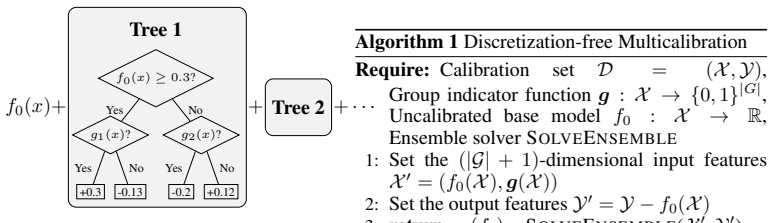
The load-bearing mechanism is the fixed-point status of the post-processing map \(p_G\). \(p_G\) is a square-loss empirical risk minimization over depth-2 trees whose features are \(f_0(x)\) and \(g(x)\); each tree adds a constant to one of four leaves determined by whether the base prediction exceeds a threshold and whether a group indicator is 1. Three equivalences carry the proof: post-processing a continuous predictor is no worse than post-processing any of its discretizations (Lemma 4.2); on a finite-range predictor, tree-ensemble post-processing coincides with adding a group-linear function inside each level set (Lemma 4.3); and a multicalibration error above \(\$\alpha$\) implies a group-linear correction that cuts squared loss by more than \(\$alpha^{2}$\) (Lemma 4.4). Assumption 4.5, the loss-saturation condition, asserts that running \(p_G\) on its own output \(f_{\mathrm{cal}}\) improves loss by at most \(\epsilon_{\mathrm{loss}}\), which is what makes the three equivalences yield the square-root bound on multicalibration error.
What would settle it
On a held-out dataset with a non-constant base predictor, compute both the second-round loss improvement \(\ell(f_{\mathrm{cal}})-\ell(p_G(f_{\mathrm{cal}}))\) and the multicalibration error of an \(m\)-discretized output. If the discretization error is small and the multicalibration error exceeds \(\sqrt{\epsilon_{\mathrm{loss}}+\epsilon_{\mathrm{round}}}\), Theorem 4.6's logic is contradicted; if the inequality holds but \(\epsilon_{\mathrm{loss}}\) is far from negligible, the empirical claim that loss saturation holds in practice is the part to scrutinize.
Extended reading notes
Core claim
Formally, with \(f_0\) the base predictor and \(g\) the group indicator, the algorithm returns \(p_G(f_0)=\arg\min_{T\subseteq\mathcal{T}(f_0,G)}\ell(f_0+\sum_{t\in T}t,D)\), where \(\mathcal{T}(f_0,G)\) contains depth-2 trees whose two split conditions are thresholds of \(f_0\) and group membership. Theorem 4.6 states that if Assumption 4.5 holds with gap \(\epsilon_{\mathrm{loss}}\), and an \(m\)-discretized version of the output has rounding error \(\epsilon_{\mathrm{round}}\), then the multicalibration error of that discretized predictor is at most \(\sqrt{\epsilon_{\mathrm{loss}}+\epsilon_{\mathrm{round}}}\). The proof chain is: for a predictor with finite range, tree-ensemble post-processing is exactly per-level-set linear correction by group indicators (Lemma 4.3); a multicalibration violation of size \(\$\alpha$\) supplies such a correction reducing squared loss by more than \(\$alpha^{2}$\) (Lemma 4.4); and loss saturation says no such reduction is available. The authors view the contribution as a constructive, practically implementable version of the principle that loss minimization can yield multicalibration, with the saturation condition validated empirically rather than proved.
Load-bearing premise
Everything in the guarantee depends on the assumption that re-running the same square-loss fit on the calibrated predictor lowers the loss by at most a tiny amount, a condition the paper calls loss saturation and validates empirically rather than proving.
Editorial extensions
If this is right
- Multicalibration can be certified and achieved by one squared-loss regression, provided the saturation condition is checked, rather than by iterative auditing over discretized level sets.
- The calibrated predictor stays continuous, and discretization becomes an evaluation-time choice whose contribution to the error is only the rounding error \(\epsilon_{\mathrm{round}}\).
- Practitioners can implement the method with standard tree-boosting software, and the single regression replaces a per-granularity hyperparameter search.
- In the finite-sample setting an excess-risk term enters the bound, and the appendix derives sample-complexity rates for reaching a target multicalibration error \(\alpha\) under the saturation assumption.
Reading between the lines
- A practical monitoring rule suggested by the analysis is to hold out data, rerun the same regression on the fitted predictor, and use the observed second-round loss drop as a certificate for how large the multicalibration guarantee actually is.
- The argument is more general than tree ensembles: any regression class that can represent per-level-set group-linear corrections would convert square-loss saturation into multicalibration, so the tree ensemble is a concrete instantiation of a broader recipe.
- The constant-predictor XOR example in the appendix suggests that saturation should be expected to degrade when the base model carries little predictive signal; formalizing the dependence of \(\epsilon_{\mathrm{loss}}\) on the base predictor's information content is a natural next step.
- Because the guarantee applies to any post-hoc \(m\)-discretization, the method is especially suited to settings with multiple downstream decision makers who need different output granularities.
Editorial analysis
A structured set of objections, weighed in public.
Referee Report
Summary. The paper proposes a discretization-free multicalibration method: post-process a base predictor by regressing residuals on the base prediction and group indicators using an ensemble of depth-2 trees, implemented with LightGBM. It defines a 'loss saturation' assumption (Assumption 4.5) requiring that the squared loss of the calibrated predictor cannot be substantially reduced by applying the same post-processing again. The main theorem (Theorem 4.6) proves that if this assumption holds and the m-discretized output has small rounding error, then the multicalibration error is at most sqrt(epsilon_loss + epsilon_round). The paper validates the assumption empirically on six datasets and compares favorably to MCBoost and LSBoost on multicalibration error and worst-group smooth ECE. The conclusion and Appendix B acknowledge that Assumption 4.5 is a heuristic with known counterexamples.
Significance. If the central conditional theorem and its supporting lemmas are fully repaired, this paper makes a useful practical contribution: it shows that a single ERM step over a simple tree-ensemble class can replace iterative discretization-based multicalibration post-processing, and it demonstrates competitive empirical performance on tabular, image, and text tasks. The paper is commendably explicit about the role of the loss-saturation assumption, including a concrete counterexample and a limitation statement. The main weakness is that the load-bearing Assumption 4.5 is not directly tested: Table 1 only lower-bounds the exact fixed-point improvement, and the two appendix proofs contain repairable but real errors. The experiments are suggestive but do not by themselves establish the 'always met in practice' claim in the abstract.
major comments (4)
- [§5.3.1, Table 1] Table 1 and Observation 1 do not validate Assumption 4.5 as stated. The assumption requires the exact post-processing operator pG of Eq. (5) to satisfy ℓ(f_cal,D) ≤ ℓ(pG(f_cal),D)+epsilon_loss, but the table reports hat_epsilon_loss = ℓ(f_cal,D) − ℓ(hat_pG(f_cal),D) for an approximate early-stopped LightGBM solution. Since pG minimizes exactly, ℓ(f_cal,D) − ℓ(pG(f_cal),D) ≥ hat_epsilon_loss, so the reported values (several negative) are only lower bounds on the quantity the theorem needs; the remark that epsilon_loss = hat_epsilon_loss + epsilon_opt gives no bound on epsilon_opt. The six datasets therefore do not establish the fixed-point condition, and Appendix B shows the condition can fail (epsilon_loss = γ²/4) even for a simple three-group XOR problem. I ask the authors to either measure or certify the exact fixed-point improvement on small problems where the tree-ensemble minimization can be solved exactly, or explicitly reframe the contribution as a heuristic with a conditional guarantee.
- [Appendix A, proof of Lemma 4.4] After Eq. (12), the proof claims that the definition of multicalibration error implies Σ_j Pr[f=v_j]|α_j| > α/Pr[g_k=1]. Definition 3.2 supplies only Σ_j Pr[f=v_j, g_k=1]|α_j| > α, with the group membership inside the probability; the displayed inequality replaces the joint probability with the unconditional Pr[f=v_j] and is not valid. The subsequent Cauchy-Schwarz step therefore uses the wrong weights. The lemma is repairable: using weights Pr[f=v_j,g_k=1] gives Pr[g_k=1] Σ_j Pr[f=v_j] α_j² > α², which still yields the loss reduction claimed in Eq. (8). The proof must be corrected before Theorem 4.6 can be regarded as fully established.
- [Appendix A, proof of Lemma 4.3] The first inclusion in Lemma 4.3 uses an incorrect telescoping decomposition. The text writes h = f + Σ_j I{f≥v_j}(h_j − Σ_{i<j} h_i), but the correct identity is I{f=v_j} = I{f≥v_j} − I{f≥v_{j+1}} (equivalently h'_j = h_j − h_{j-1} with h_0=0). Subtracting all previous h_i is wrong for m>2. The lemma statement is true and the reverse inclusion is fine, but the proof of the forward direction needs to be rewritten with the correct telescoping.
- [Appendix E] The finite-sample analysis does not cover the solver used in the experiments. Algorithm 1 is instantiated with LightGBM in Sections 5, but Theorem E.10 and Corollary E.11 analyze SquareLev.R and assume an edge lower bound epsilon_min that is not verified for the tree-ensemble class or for LightGBM. As a result, the appendix does not bound epsilon_opt, the gap between the exact pG used in Theorem 4.6 and the approximate hat_pG used in Table 1, so the finite-sample claim 'the main conclusion still holds' is not justified for the implemented algorithm. The paper should either restrict the finite-sample claim to solvers with matching optimization guarantees or provide a concrete bound on epsilon_opt for LightGBM.
minor comments (5)
- [§1, contributions] The sentence 'even when baselines are tuned baselines are tuned using the same discretization scheme used for evaluation' contains a duplicated phrase; delete the second 'baselines are tuned'.
- [§5.3.1] The displayed definition of hat_epsilon_loss in the text has the opposite sign from the Table 1 header; align the two definitions (Table 1 uses ℓ(f_cal) − ℓ(pG(f_cal)) while the text says ℓ(hat_pG(f)) − ℓ(f)).
- [Table 1] In the Table 1 header, pG(f_cal) should be written as hat_pG(f_cal) to make explicit that the second run is an approximate solver output, not the exact minimizer of Eq. (5).
- [Equation (5)] Equation (5) writes the arg min over subsets T ⊆ T(f,G), which does not allow repeated trees in the ensemble; since LightGBM builds additive ensembles with repeated structures, the formalism should allow multisets or bounded cardinality (as F_{N_T} in Appendix E does).
- [Appendix B] The counterexample's notation 'g1 ⊕ g2 ⊕ g3' should state explicitly that this is the XOR (parity) of the three binary group indicators to avoid ambiguity.
Circularity Check
The main theorem is a conditional implication with independent mathematical content; the loss-saturation assumption is not defined in terms of the target metric, and the paper's caveats show no circular reduction.
full rationale
The derivation is a conditional implication, not a circular reduction. Theorem 4.6 assumes Assumption 4.5 (loss saturation) and derives a multicalibration bound via Lemma 4.4, which proves the contrapositive: if the multicalibration error exceeds alpha, then the post-processing operator pG reduces squared loss by more than alpha^2. This is a substantive mathematical relationship between two distinct quantities; loss saturation is neither defined in terms of multicalibration error nor fitted to it. The empirical validation of Assumption 4.5 is indirect: Table 1 reports \hat{epsilon}_loss = ell(f_cal) - ell(p_hatG(f_cal)) with an approximate LightGBM solver, and as the paper notes, the true loss gap is \hat{epsilon}_loss + epsilon_opt with epsilon_opt >= 0, so the table provides a lower bound on the true improvement and therefore does not by itself establish the exact fixed-point condition. This is a validation gap already acknowledged in Section 6 and Appendix B, not a circularity: the theorem is explicitly conditional and would fail if the assumption fails, as Appendix B's XOR example shows. No fitted parameter is renamed as a prediction, and no load-bearing claim rests on a self-citation. Hence no circular step is present.
Assumptions & free parameters
assumptions (6)
- domain assumption Labels Y are in [0,1].
- domain assumption The group family G is finite and known to the algorithm.
- ad hoc to paper Assumption 4.5 (loss saturation): the post-processed predictor is an approximate fixed point of pG, with ℓ(f_cal,D) ≤ ℓ(pG(f_cal),D) + ϵloss.
- ad hoc to paper Discretization in Definition A.1 is monotone and right-continuous.
- ad hoc to paper The ensemble solver approximately minimizes the population squared loss over T(f,G).
- standard math Standard Rademacher complexity tools (Massart, Talagrand contraction, sum rule) apply to the tree ensemble class.
Cite this review
Pith. "Pith review of Discretization-free Multicalibration through Loss Minimization over Tree Ensembles." pith.science (2026). https://pith.science/paper/JKVDFSC5
@misc{pith2026250517435,
  author       = {Pith},
  title        = {Pith review of: Discretization-free Multicalibration through Loss Minimization over Tree Ensembles},
  year         = {2026},
  howpublished = {\url{https://pith.science/paper/JKVDFSC5}},
  note         = {Machine review of arXiv:2505.17435}
}
read the original abstract
In recent years, multicalibration has emerged as a desirable learning objective for ensuring that a predictor is calibrated across a rich collection of overlapping subpopulations. Existing approaches typically achieve multicalibration by discretizing the predictor's output space and iteratively adjusting its output values. However, this discretization approach departs from the standard empirical risk minimization (ERM) pipeline, introduces rounding error and additional sensitive hyperparameter, and may distort the predictor's outputs in ways that hinder downstream decision-making. In this work, we propose a discretization-free multicalibration method that directly optimizes an empirical risk objective over an ensemble of depth-two decision trees. Our ERM approach can be implemented using off-the-shelf tree ensemble learning methods such as LightGBM. Our algorithm provably achieves multicalibration, provided that the data distribution satisfies a technical condition we term as loss saturation. Across multiple datasets, our empirical evaluation shows that this condition is always met in practice. Our discretization-free algorithm consistently matches or outperforms existing multicalibration approaches--even when evaluated using a discretization-based multicalibration metric that shares its discretization granularity with the baselines.
Figures

Reference graph
Works this paper leans on
-
[1]
write newline
" write newline "" before.all 'output.state := FUNCTION n.dashify 't := "" t empty not t #1 #1 substring "-" = t #1 #2 substring "--" = not "--" * t #2 global.max substring 't := t #1 #1 substring "-" = "-" * t #2 global.max substring 't := while if t #1 #1 substring * t #2 global.max substring 't := if while FUNCTION format.date year duplicate empty "emp...
-
[2]
Nuanced metrics for measuring unintended bias with real data for text classification
Borkan, D., Dixon, L., Sorensen, J., Thain, N., and Vasserman, L. Nuanced metrics for measuring unintended bias with real data for text classification. In Companion Proceedings of The 2019 World Wide Web Conference, 2019
work page 2019
-
[3]
Błasiok, J. and Nakkiran, P. Smooth ece: Principled reliability diagrams via kernel smoothing, 2023. URL https://arxiv.org/abs/2309.12236
arXiv 2023
-
[4]
Loss Minimization Yields Multicalibration for Large Neural Networks
Błasiok, J., Gopalan, P., Hu, L., Kalai, A. T., and Nakkiran, P. Loss minimization yields multicalibration for large neural networks, 2023. URL https://arxiv.org/abs/2304.09424
work page Pith review arXiv 2023
-
[5]
Chen, T. and Guestrin, C. Xgboost: A scalable tree boosting system. In Proceedings of the 22nd ACM SIGKDD International Conference on Knowledge Discovery and Data Mining, pp.\ 785--794. ACM, 2016
work page 2016
-
[6]
Codella, N. C. F., Gutman, D. A., Celebi, M. E., Helba, B., Marchetti, M. A., Dusza, S. W., Kalloo, A., Liopyris, K., Mishra, N. K., Kittler, H., and Halpern, A. Skin lesion analysis toward melanoma detection: A challenge at the 2017 international symposium on biomedical imaging (isbi), hosted by the international skin imaging collaboration (ISIC) . CoRR,...
arXiv 2017
-
[7]
Combalia, M., Codella, N. C. F., Rotemberg, V., Helba, B., Vilaplana, V., Reiter, O., Carrera, C., Barreiro, A., Halpern, A. C., Puig, S., and Malvehy, J. Bcn20000: Dermoscopic lesions in the wild, 2019. URL https://arxiv.org/abs/1908.02288
arXiv 2019
-
[8]
Happymap : A generalized multicalibration method
Deng, Z., Dwork, C., and Zhang, L. Happymap : A generalized multicalibration method. In Information Technology Convergence and Services, 2023. URL https://api.semanticscholar.org/CorpusID:256504829
work page 2023
Show all 32 references
-
[9]
Retiring adult: New datasets for fair machine learning
Ding, F., Hardt, M., Miller, J., and Schmidt, L. Retiring adult: New datasets for fair machine learning. Advances in Neural Information Processing Systems, 34, 2021
2021
-
[10]
and Helmbold, D
Duffy, N. and Helmbold, D. P. Boosting methods for regression. Machine Learning, 47 0 (2--3): 0 153--200, May 2002. doi:10.1023/A:1013685603443. URL https://doi.org/10.1023/A:1013685603443
2002 doi
-
[11]
Fuster, A., Goldsmith-Pinkham, P., Ramadorai, T., and Walther, B. Z. Predictably unequal? the effects of machine learning on credit markets. The Journal of Finance, 77 0 (1): 0 5--47, 2022
2022
-
[12]
Multicalibration as boosting for regression
Globus-Harris, I., Harrison, D., Kearns, M., Roth, A., and Sorrell, J. Multicalibration as boosting for regression. In Krause, A., Brunskill, E., Cho, K., Engelhardt, B., Sabato, S., and Scarlett, J. (eds.), Proceedings of the 40th International Conference on Machine Learning,...
2023
-
[13]
T., Reingold, O., Sharan, V., and Wieder, U
Gopalan, P., Kalai, A. T., Reingold, O., Sharan, V., and Wieder, U. Omnipredictors, 2021. URL https://arxiv.org/abs/2109.05389
2021 arXiv
-
[14]
P., Singhal, M
Gopalan, P., Kim, M. P., Singhal, M. A., and Zhao, S. Low-degree multicalibration. In Loh, P.-L. and Raginsky, M. (eds.), Proceedings of Thirty Fifth Conference on Learning Theory, volume 178 of Proceedings of Machine Learning Research, pp.\ 3193--3234. PMLR, 02--05 Jul 2022. ...
2022
-
[15]
A unifying perspective on multi-calibration: Game dynamics for multi-objective learning
Haghtalab, N., Jordan, M., and Zhao, E. A unifying perspective on multi-calibration: Game dynamics for multi-objective learning. In Oh, A., Naumann, T., Globerson, A., Saenko, K., Hardt, M., and Levine, S. (eds.), Advances in Neural Information Processing Systems, volume 36, p...
2023
-
[17]
Multicalibration: Calibration for the ( C omputationally-identifiable) masses
Hebert-Johnson, U., Kim, M., Reingold, O., and Rothblum, G. Multicalibration: Calibration for the ( C omputationally-identifiable) masses. In Dy, J. and Krause, A. (eds.), Proceedings of the 35th International Conference on Machine Learning, volume 80 of Proceedings of Machine...
1939
-
[18]
Batch multivalid conformal prediction, 2022
Jung, C., Noarov, G., Ramalingam, R., and Roth, A. Batch multivalid conformal prediction, 2022. URL https://arxiv.org/abs/2209.15145
2022 arXiv
-
[19]
Lightgbm: A highly efficient gradient boosting decision tree
Ke, G., Meng, Q., Finley, T., Wang, T., Chen, W., Ma, W., Ye, Q., and Liu, T.-Y. Lightgbm: A highly efficient gradient boosting decision tree. In Guyon, I., Luxburg, U. V., Bengio, S., Wallach, H., Fergus, R., Vishwanathan, S., and Garnett, R. (eds.), Advances in Neural Inform...
2017
-
[20]
P., Kern, C., Goldwasser, S., Kreuter, F., and Reingold, O
Kim, M. P., Kern, C., Goldwasser, S., Kreuter, F., and Reingold, O. Universal adaptability: Target-independent inference that competes with propensity scoring. Proceedings of the National Academy of Sciences, 119 0 (4): 0 e2108097119, 2022. doi:10.1073/pnas.2108097119
2022 doi
-
[21]
W., Sagawa, S., Marklund, H., Xie, S
Koh, P. W., Sagawa, S., Marklund, H., Xie, S. M., Zhang, M., Balsubramani, A., Hu, W., Yasunaga, M., Phillips, R. L., Gao, I., Lee, T., David, E., Stavness, I., Guo, W., Earnshaw, B. A., Haque, I. S., Beery, S., Leskovec, J., Kundaje, A., Pierson, E., Levine, S., Finn, C., and...
2021
-
[22]
Foundations of Machine Learning, second edition
Mohri, M., Rostamizadeh, A., and Talwalkar, A. Foundations of Machine Learning, second edition. Adaptive Computation and Machine Learning series. MIT Press, 2018. ISBN 9780262351362. URL https://books.google.com/books?id=dWB9DwAAQBAJ
2018
-
[23]
W., Zhang, L., Jerfel, G., and Tran, D
Nixon, J., Dusenberry, M. W., Zhang, L., Jerfel, G., and Tran, D. Measuring calibration in deep learning. In Proceedings of the IEEE/CVF Conference on Computer Vision and Pattern Recognition (CVPR) Workshops, June 2019
2019
-
[24]
D., Corrado, G., and Chin, M
Rajkomar, A., Hardt, M., Howell, M. D., Corrado, G., and Chin, M. H. Ensuring fairness in machine learning to advance health equity. Annals of internal medicine, 169 0 (12): 0 866--872, 2018
2018
-
[25]
Uncertain: Modern topics in uncertainty quantification, 2022
Roth, A. Uncertain: Modern topics in uncertainty quantification, 2022. URL https://www.cis.upenn.edu/ aaroth/uncertainty-notes.pdf
2022
-
[26]
Distilbert, a distilled version of bert: smaller, faster, cheaper and lighter, 2020
Sanh, V., Debut, L., Chaumond, J., and Wolf, T. Distilbert, a distilled version of bert: smaller, faster, cheaper and lighter, 2020. URL https://arxiv.org/abs/1910.01108
2020 arXiv
-
[27]
The HAM10000 dataset, a large collection of multi-source dermatoscopic images of common pigmented skin lesions
Tschandl, P., Rosendahl, C., and Kittler, H. The HAM10000 dataset, a large collection of multi-source dermatoscopic images of common pigmented skin lesions. Sci. Data, 5 0 (1): 0 180161, August 2018
2018
-
[28]
Bridging multicalibration and out-of-distribution generalization beyond covariate shift
Wu, J., Liu, J., Cui, P., and Wu, S. Bridging multicalibration and out-of-distribution generalization beyond covariate shift. In The Thirty-eighth Annual Conference on Neural Information Processing Systems, 2024. URL https://openreview.net/forum?id=bOS6WPV0Jf
2024
-
[29]
Fair risk control: A generalized framework for calibrating multi-group fairness risks, 2024
Zhang, L., Roth, A., and Zhang, L. Fair risk control: A generalized framework for calibrating multi-group fairness risks, 2024. URL https://arxiv.org/abs/2405.02225
2024 arXiv
-
[30]
Age progression/regression by conditional adversarial autoencoder, 2017
Zhang, Z., Song, Y., and Qi, H. Age progression/regression by conditional adversarial autoencoder, 2017. URL https://arxiv.org/abs/1702.08423
2017 arXiv
-
[31]
@esa (Ref
\@ifxundefined[1] #1\@undefined \@firstoftwo \@secondoftwo \@ifnum[1] #1 \@firstoftwo \@secondoftwo \@ifx[1] #1 \@firstoftwo \@secondoftwo [2] @ #1 \@temptokena #2 #1 @ \@temptokena \@ifclassloaded agu2001 natbib The agu2001 class already includes natbib coding, so you should ...
-
[32]
\@lbibitem[] @bibitem@first@sw\@secondoftwo \@lbibitem[#1]#2 \@extra@b@citeb \@ifundefined br@#2\@extra@b@citeb \@namedef br@#2 \@nameuse br@#2\@extra@b@citeb \@ifundefined b@#2\@extra@b@citeb @num @parse #2 @tmp #1 NAT@b@open@#2 NAT@b@shut@#2 \@ifnum @merge>\@ne @bibitem@firs...
-
[33]
swap regret
@open @close @open @close and [1] URL: #1 \@ifundefined chapter * \@mkboth \@ifxundefined @sectionbib * \@mkboth * \@mkboth\@gobbletwo \@ifclassloaded amsart * \@ifclassloaded amsbook * \@ifxundefined @heading @heading NAT@ctr thebibliography [1] @ \@biblabel @NAT@ctr \@bibset...
2025 arXiv
Reviewed August 7, 2026 · model on record in the stance chip above.
Discussion (0). Sign in to comment.