REVIEW 4 major objections 6 minor 21 references
How Knowledge Popularity Influences and Enhances LLM Knowledge Boundary Perception
T0 review · 4 major / 6 minor · reviewed 2026-08-07 · deepseek-v4-flash
Pith's one-line read Popularity of a fact predicts how well an LLM knows it.
desk verdict Correlation findings are worthwhile; the headline 5.24% calibration gain is undercut by a missing same-classifier control. read the letter →
The pith
A machine-rendered reading of the paper's core claim, the machinery that carries it, and where it could break.
The reading
What carries the argument
The central machinery is a three-part popularity measure built from external corpora: entity popularity of the question entity, entity popularity of the answer entity, each counted as Wikidata sitelinks, and relation popularity, counted as co-occurrences of the two entities in a Wikipedia dump. The paper links these to the model's behavior through Spearman correlations with binary accuracy, generation-probability confidence, and the alignment score $1 - |\text{acc} - c|$. The calibration stage then turns popularity into a correctness predictor: a threshold on a single popularity score, or a three-layer MLP over combined features, trained to classify whether the generated answer contains the ground truth; the same features can be replaced by the model's self-reported familiarity on a 1-to-10 scale.
What would settle it
Compute, for a sample of the entities and entity pairs in the three datasets, the actual frequencies and co-occurrence counts in the pretraining corpora of Llama-3-8B and Qwen2-7B, and compare their ranking with the Wikidata-sitelink and Wikipedia-dump proxies. If the rank orders diverge substantially, or if the popularity–accuracy correlation disappears after controlling for true training exposure, the paper's central explanation and its 5.24% calibration gain would not generalize.
Extended reading notes
Core claim
On entity-centric factual questions drawn from Wikidata (movie directors, song performers, birthplace cities), the paper claims that knowledge popularity—the number of Wikipedia language editions in which an entity appears and the number of Wikipedia documents in which the question and answer entities co-occur—systematically tracks how well an LLM knows a fact. Llama3-8B-Instruct, Qwen2-7B-Instruct, and ChatGPT all answer more popular knowledge more accurately, express higher generation-probability confidence, and show confidence that agrees more closely with actual accuracy; relation popularity shows the strongest correlation in most cases. The paper also claims that when models hallucinate, they tend to over-generalize, generating more popular answer entities that co-occur less with the question entity than the ground-truth answers do. Because these popularity signals predict correctness, the paper augments probabilistic confidence with them and reports an average 5.24% improvement in answer-correctness prediction across all models and datasets, with model self-estimated familiarity as a viable external-corpus-free substitute.
Load-bearing premise
The load-bearing premise is that Wikidata sitelink counts and Wikipedia document co-occurrence counts faithfully reflect how often each fact actually appeared in the training data of Llama3, Qwen2, and ChatGPT; if these proxies diverge from true training exposure, the reported correlations and the 5.24% calibration gain would not generalize.
Editorial extensions
If this is right
- Adding question, generated-answer, and relation popularity to probabilistic confidence raises answer-correctness prediction accuracy by an average of 5.24% across all models and datasets, and the combination of all three beats any single signal.
- Relation popularity between the question entity and the generated answer is the strongest single calibration signal, outperforming all baselines in six of nine model–dataset settings.
- Because question popularity correlates more strongly with confidence than with accuracy, LLMs can be overconfident purely from question familiarity, and popularity-aware calibration corrects part of that overconfidence.
- Model-estimated familiarity on a 10-point scale substitutes for corpus-based popularity without external corpora, and zero-shot self-estimation performs as well as few-shot prompting.
- When hallucinating, models over-generalize by selecting more popular answers that co-occur less with the question entity, which explains why generated-answer relation popularity discriminates correct from incorrect outputs better than answer popularity alone.
Reading between the lines
- If the proxy-popularity assumption holds, the same three-feature calibration recipe should transfer to other entity-centric QA domains and to newer open-weight models; the expected transfer is measurable as the PC versus PC+ALL gap on held-out data.
- The correlations suggest a retrieval policy the paper does not explicitly propose: trigger adaptive retrieval when the question entity is unpopular or when the generated answer co-occurs rarely with the question entity, rather than only when confidence is low.
- Self-estimated familiarity may tap the same latent signal as verbalized confidence, so combining the two self-reports could narrow the remaining gap between corpus-based and model-generated calibration.
- For non-entity knowledge, popularity could be represented by n-gram document frequency or relation-schema frequency; whether the 5.24% gain survives such representations is a direct, untested extension.
Editorial analysis
A structured set of objections, weighed in public.
Referee Report
Summary. This paper studies how knowledge popularity, measured via Wikidata sitelink counts and Wikipedia co-occurrence, relates to LLM QA performance, confidence, and confidence-accuracy alignment on three entity-centric QA datasets (Movies, Songs, Basketball) using Llama3-8B-Instruct, Qwen2-7B-Instruct, and ChatGPT. It reports positive correlations between popularity and accuracy/confidence/alignment, with relation popularity (co-occurrence of question and answer entities) generally strongest, and proposes using PopQ, PopGe, and RPopGe to improve answer-correctness prediction, claiming an average 5.24% improvement over probabilistic confidence. It also tests prompting the models themselves to estimate popularity, finding this a viable but weaker alternative to corpus-based popularity.
Significance. If the claims withstand the controls I describe below, this is a useful empirical contribution: external corpus popularity is an independent, cheap signal for predicting when an LLM answer can be trusted, with potential applications to selective prediction and adaptive retrieval. The paper's strengths include using popularity features derived from Wikidata/Wikipedia that are external to the tested models, covering three datasets and three model families, providing code, and explicitly probing a self-estimated popularity variant, which it correctly ranks below the corpus-based variant. The correlational story is plausible, but it currently lacks inferential support and the headline calibration gain is not yet attributable to popularity features because of a classifier-family confound.
major comments (4)
- [Section 6.4, Eqs. (3)-(4), Table 5] The headline 5.24% improvement compares a threshold-based PC baseline (Eq. 3) with an MLP-based PC+ALL model (Eq. 4). This changes the classifier family, capacity, and feature scaling simultaneously, and no MLP trained on PC alone (d=1) is reported. The gain could therefore reflect the MLP's nonlinear decision boundary rather than the popularity features. Please add an MLP-only PC control, and use the same classifier for all feature sets, or otherwise show that the improvement is not a classifier-family artifact.
- [Appendix A and Tables 2 and 4] The document-count threshold of 6,000 is hand-chosen, and the filtering removes about 60% of the Songs dataset (2,157 to 852 samples) and 25% of the Movies dataset (10,964 to 8,184 samples). Since all correlations and calibration results are computed on the filtered data, the paper should provide a sensitivity analysis over this threshold and justify it independently of the observed results; otherwise the main correlations may depend on the specific filtering choice.
- [Tables 2, 4, and 7] Spearman correlations are reported without confidence intervals or significance tests, and several cells are near zero or negative: for example, PopGe versus accuracy for ChatGPT on Basketball is -0.164 (Table 4), and PopQ versus accuracy for Qwen2 on Basketball is 0.014 (Table 2). These cells contradict the blanket claim that all three popularity measures positively correlate with performance, confidence, and perception. Please report significance levels or confidence intervals, and separate the general trend from dataset- and model-specific exceptions.
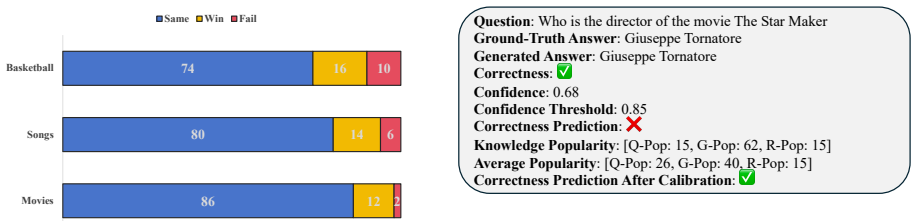
- [Appendix D and Table 5] For the Basketball dataset, the MLP experiments for Llama3 and Qwen2 use a rebalanced subset consisting of all correctly answered samples plus an equal number of randomly sampled incorrect ones (seed 0). It is unclear whether the PC threshold baseline is evaluated on the same rebalanced test set or on the original highly imbalanced test set. If baselines and proposed method are evaluated on different test distributions, the reported gains for Basketball and the 5.24% average are not directly comparable. Please clarify the evaluation protocol and, if necessary, report results on both the balanced and the original distributions.
minor comments (6)
- [Abstract] The phrase "Cause knowledge popularity shows strong correlation" should be "Because knowledge popularity shows a strong correlation".
- [Section 6.4, Eq. (3)] The word "formualted" in the sentence introducing Eq. (3) should be "formulated".
- [Figures 9 and 10 captions] The captions refer to the "Moveis" dataset; this should be "Movies".
- [Section 5.2, Figure 4 legend] The legend labels "Acc=1 & GT Ans" and "Acc=0 & GT Ans" are confusing; please spell out the correct/incorrect distinction and the ground-truth/generated answer distinction.
- [Section 4.1 and Table 1] The dataset name appears as "Song" in Table 1 but as "Songs" elsewhere; please standardize the name.
- [Section 6.1] The sentence "familiarity with a given the entity or the relation" contains a grammatical error; it should be "a given entity or relation".
Circularity Check
No significant circularity: popularity features are external (Wikidata/Wikipedia) and calibration is fit/evaluated on a proper train/test split; the 5.24% attribution is confounded by a threshold-vs-MLP comparison, but no equation reduces a prediction to its input.
full rationale
Walking the paper's derivation chain, no step reduces a predicted quantity to an input by construction. Popularity features are defined externally and independently of the model and the correctness labels: entity popularity is the Wikidata sitelink count and relation popularity is the Wikipedia document co-occurrence count (Section 4.1); self-estimated popularity is a prompted familiarity score (Section 6.1). None of these is defined in terms of confidence (Eq. 1), accuracy, alignment, or the binary correctness label, so the correlations in Tables 2/4 and the calibration gains in Table 5 are empirical findings rather than tautologies. The calibration pipeline (Section 6.4) fits a threshold (Eq. 3) or an MLP (Eq. 4) on a random half of each dataset and reports accuracy on the held-out half, so the 5.24% gain is a genuine out-of-sample result, not a fitted parameter renamed as a prediction. The paper's self-citations (Ni et al. 2024a, 2024b, 2025) support the choice of probabilistic confidence and the RAG motivation, but they are not the load-bearing premise: the popularity-performance correlations hold in the paper's own experiments, and the calibration baselines include external methods (Verb, Consis, PC from Kumar et al. 2024). These are at most minor, non-load-bearing self-citations, which is why the score sits at 2 rather than 0. Two concerns are genuine but are not circularity: (1) the headline 5.24% compares a threshold-based PC baseline with an MLP-based PC+ALL model and never reports an MLP trained on PC alone, so part of the gain may reflect classifier capacity or the Basketball rebalancing (Appendix D) rather than the popularity features; (2) Section 4.1's sentence 'This reflects relation popularity in the model's training data, as it shows a strong correlation with QA performance' uses the paper's own Table 2 correlation to validate the training-frequency interpretation of the proxy, a rhetorical validation loop rather than a definitional reduction, since the proxy is defined independently. The stated limitation that actual training data 'would likely yield greater improvements' confirms the proxy assumption is acknowledged, not suppressed.
Assumptions & free parameters
free parameters (4)
- Document count threshold (6000) =
6000
- Basketball class-balancing seed =
0
- Single-feature threshold lambda =
chosen to maximize training accuracy
- MLP weights =
learned (3-layer, 64-32-2)
assumptions (4)
- domain assumption Wikidata sitelink count is a valid proxy for entity frequency in LLM training data
- domain assumption Wikipedia document co-occurrence reflects relation popularity in training data
- domain assumption Average generation probability of answer tokens is a valid confidence measure
- domain assumption Entity-centric Wikidata QA data is representative of factual knowledge
Cite this review
Pith. "Pith review of How Knowledge Popularity Influences and Enhances LLM Knowledge Boundary Perception." pith.science (2026). https://pith.science/paper/BBJV4RCY
@misc{pith2026250517537,
  author       = {Pith},
  title        = {Pith review of: How Knowledge Popularity Influences and Enhances LLM Knowledge Boundary Perception},
  year         = {2026},
  howpublished = {\url{https://pith.science/paper/BBJV4RCY}},
  note         = {Machine review of arXiv:2505.17537}
}
read the original abstract
Large language models (LLMs) often fail to recognize their knowledge boundaries, producing confident yet incorrect answers. In this paper, we investigate how knowledge popularity affects LLMs' ability to perceive their knowledge boundaries. Focusing on entity-centric factual question answering (QA), we quantify knowledge popularity from three perspectives: the popularity of entities in the question, the popularity of entities in the answer, and relation popularity, defined as their co-occurrence frequency. Experiments on three representative datasets containing knowledge with varying popularity show that LLMs exhibit better QA performance, higher confidence, and more accurate perception on more popular knowledge, with relation popularity having the strongest correlation. Cause knowledge popularity shows strong correlation with LLMs' QA performance, we propose to leverage these signals for confidence calibration. This improves the accuracy of answer correctness prediction by an average of 5.24% across all models and datasets. Furthermore, we explore prompting LLMs to estimate popularity without external corpora, which yields a viable alternative.
Figures


Figures from the paper (23 more)







Reference graph
Works this paper leans on
-
[4]
Retrieve only when it needs: Adaptive retrieval augmentation for hallucination mit- igation in large language models.arXiv preprint arXiv:2402.10612. Abhimanyu Dubey, Abhinav Jauhri, Abhinav Pandey, Abhishek Kadian, Ahmad Al-Dahle, Aiesha Letman, Akhil Mathur, Alan Schelten, Amy Yang, Angela Fan, et al
-
[5]
Chuan Guo, Geoff Pleiss, Yu Sun, and Kilian Q Wein- berger
The llama 3 herd of models.arXiv preprint arXiv:2407.21783. Chuan Guo, Geoff Pleiss, Yu Sun, and Kilian Q Wein- berger
-
[7]
arXiv preprint arXiv:2302.09664
Semantic uncertainty: Linguistic invariances for un- certainty estimation in natural language generation. arXiv preprint arXiv:2302.09664. Abhishek Kumar, Robert Morabito, Sanzhar Umbet, Jad Kabbara, and Ali Emami
-
[8]
arXiv preprint arXiv:2405.16282
Confidence under the hood: An investigation into the confidence- probability alignment in large language models. arXiv preprint arXiv:2405.16282. Stephanie Lin, Jacob Hilton, and Owain Evans
-
[9]
Alex Mallen, Akari Asai, Victor Zhong, Rajarshi Das, Daniel Khashabi, and Hannaneh Hajishirzi
Teaching models to express their uncertainty in words.arXiv preprint arXiv:2205.14334. Alex Mallen, Akari Asai, Victor Zhong, Rajarshi Das, Daniel Khashabi, and Hannaneh Hajishirzi
-
[10]
Shiyu Ni, Keping Bi, Jiafeng Guo, and Xueqi Cheng
Selfcheckgpt: Zero-resource black-box hal- lucination detection for generative large language models.arXiv preprint arXiv:2303.08896. Shiyu Ni, Keping Bi, Jiafeng Guo, and Xueqi Cheng. 2024a. When do llms need retrieval augmentation? mitigating llms’ overconfidence helps retrieval aug- mentation.arXiv preprint arXiv:2402.11457. Shiyu Ni, Keping Bi, Jiafen...
-
[12]
arXiv preprint arXiv:2210.09150
Prompting gpt-3 to be reliable. arXiv preprint arXiv:2210.09150. Weihang Su, Changyue Wang, Qingyao Ai, Yiran Hu, Zhijing Wu, Yujia Zhou, and Yiqun Liu
-
[13]
Unsu- pervised real-time hallucination detection based on the internal states of large language models.arXiv preprint arXiv:2403.06448. Katherine Tian, Eric Mitchell, Allan Zhou, Archit Sharma, Rafael Rafailov, Huaxiu Yao, Chelsea Finn, and Christopher D Manning
Show all 21 references
-
[14]
Yanling Wang, Haoyang Li, Hao Zou, Jing Zhang, Xin- lei He, Qi Li, and Ke Xu
Just ask for cali- bration: Strategies for eliciting calibrated confidence scores from language models fine-tuned with human feedback.arXiv preprint arXiv:2305.14975. Yanling Wang, Haoyang Li, Hao Zou, Jing Zhang, Xin- lei He, Qi Li, and Ke Xu
-
[15]
An Yang, Baosong Yang, Binyuan Hui, Bo Zheng, Bowen Yu, Chang Zhou, Chengpeng Li, Chengyuan Li, Dayiheng Liu, Fei Huang, et al
Can llms express their uncertainty? an empirical evaluation of confidence elicitation in llms.arXiv preprint arXiv:2306.13063. An Yang, Baosong Yang, Binyuan Hui, Bo Zheng, Bowen Yu, Chang Zhou, Chengpeng Li, Chengyuan Li, Dayiheng Liu, Fei Huang, et al
-
[16]
Yuqing Yang, Ethan Chern, Xipeng Qiu, Graham Neu- big, and Pengfei Liu
Qwen2 technical report.arXiv preprint arXiv:2407.10671. Yuqing Yang, Ethan Chern, Xipeng Qiu, Graham Neu- big, and Pengfei Liu
-
[17]
arXiv preprint arXiv:2312.07000
Alignment for honesty. arXiv preprint arXiv:2312.07000. Zhangyue Yin, Qiushi Sun, Qipeng Guo, Jiawen Wu, Xipeng Qiu, and Xuanjing Huang
-
[18]
Mert Yuksekgonul, Varun Chandrasekaran, Erik Jones, Suriya Gunasekar, Ranjita Naik, Hamid Palangi, Ece Kamar, and Besmira Nushi
Do large language models know what they don’t know?arXiv preprint arXiv:2305.18153. Mert Yuksekgonul, Varun Chandrasekaran, Erik Jones, Suriya Gunasekar, Ranjita Naik, Hamid Palangi, Ece Kamar, and Besmira Nushi
-
[19]
Hanning Zhang, Shizhe Diao, Yong Lin, Yi Fung, Qing Lian, Xingyao Wang, Yangyi Chen, Heng Ji, and Tong Zhang
Attention satis- fies: A constraint-satisfaction lens on factual errors of language models.arXiv preprint arXiv:2309.15098. Hanning Zhang, Shizhe Diao, Yong Lin, Yi Fung, Qing Lian, Xingyao Wang, Yangyi Chen, Heng Ji, and Tong Zhang. 2024a. R-tuning: Instructing large lan- gua...
2024 arXiv
-
[20]
Yuji Zhang, Sha Li, Jiateng Liu, Pengfei Yu, Yi R Fung, Jing Li, Manling Li, and Heng Ji
Sac3: Reliable hallucination detection in black-box language models via semantic-aware cross-check consistency.arXiv preprint arXiv:2311.01740. Yuji Zhang, Sha Li, Jiateng Liu, Pengfei Yu, Yi R Fung, Jing Li, Manling Li, and Heng Ji. 2024b. Knowl- edge overshadowing causes ama...
-
[27]
Accuracy Confidence Alignment Datasets Models Q-Pop G-Pop Co-Occ Q-Pop G-Pop Co-Occ Q-Pop G-Pop Co-Occ Movies Llama3-8B 0.317 0.1000.6370.404 0.3240.6530.404 0.2310.667 Qwen2-7B 0.433 0.0870.7560.413 0.3450.6790.386 0.0210.607 ChatGPT 0.134 0.0830.2080.210 0.2330.3040.211 0.23...
-
[2020]
Hanxing Ding, Liang Pang, Zihao Wei, Huawei Shen, and Xueqi Cheng
Calibra- tion of pre-trained transformers.arXiv preprint arXiv:2003.07892. Hanxing Ding, Liang Pang, Zihao Wei, Huawei Shen, and Xueqi Cheng
2003 arXiv
-
[2022]
Lorenz Kuhn, Yarin Gal, and Sebastian Farquhar
Language models (mostly) know what they know.arXiv preprint arXiv:2207.05221. Lorenz Kuhn, Yarin Gal, and Sebastian Farquhar
-
[2023]
arXiv preprint arXiv:2303.08774
Gpt-4 technical report. arXiv preprint arXiv:2303.08774. Chao Chen, Kai Liu, Ze Chen, Yi Gu, Yue Wu, Mingyuan Tao, Zhihang Fu, and Jieping Ye
-
[2024]
Shrey Desai and Greg Durrett
Inside: Llms’ internal states retain the power of hallu- cination detection.arXiv preprint arXiv:2402.03744. Shrey Desai and Greg Durrett
-
[2025]
Shiyu Ni, Keping Bi, Lulu Yu, and Jiafeng Guo
Towards fully exploiting llm internal states to enhance knowledge boundary perception.arXiv preprint arXiv:2502.11677. Shiyu Ni, Keping Bi, Lulu Yu, and Jiafeng Guo. 2024b. Are large language models more honest in their prob- abilistic or verbalized confidence?arXiv preprint a...
Reviewed August 7, 2026 · model on record in the stance chip above.
Discussion (0). Sign in to comment.