REVIEW 5 major objections 5 minor 78 references
USTBench: Benchmarking and Dissecting Spatiotemporal Reasoning of LLMs as Urban Agents
T0 review · 5 major / 5 minor · reviewed 2026-08-07 · deepseek-v4-flash
Pith's one-line read LLMs can read a city but not think ahead in it: USTBench decomposes urban spatiotemporal reasoning into understanding, forecasting, planning, and reflection, and finds the higher-order abilities lagging.
desk verdict USTBench is a genuinely useful diagnostic resource, but its headline planning/reflection deficit rests on a simulator reward model that the paper never validates. read the letter →
The pith
A machine-rendered reading of the paper's core claim, the machinery that carries it, and where it could break.
The reading
What carries the argument
The load-bearing object is UAgentEnv, an interactive city environment that verbalizes geospatial structures (road networks, adjacency, connectivity) and temporal dynamics (traffic flow, trajectories, socio-economic series) as textual observations with data schemas. On top of it, USTBench builds four QA families: understanding QAs over eight spatial and temporal pattern types; forecasting QAs from real-world prediction tasks; planning QAs whose ground truth is computed by a feedback-driven exploratory process that rolls out all action sequences over a horizon of $H=5$ with discount factor $\gamma=0.9$ and picks the action with the highest expected cumulative reward; and reflection QAs that pair a previous action or prediction with environmental feedback. This machinery converts outcome-level urban tasks into process-level diagnostics.
What would settle it
Recompute the planning ground truth with a one-step greedy policy ($H=1$) and with the full $H=5$ rollouts; if the chosen optimal actions coincide on most QA instances, the benchmark is not actually measuring long-horizon planning. Alternatively, replay the selected actions in a high-fidelity traffic simulator or on logged real-world data; if the $H=5$ choices are not better than simple heuristics on real outcomes, the planning scores are an artifact of UAgentEnv's reward model.
Extended reading notes
Core claim
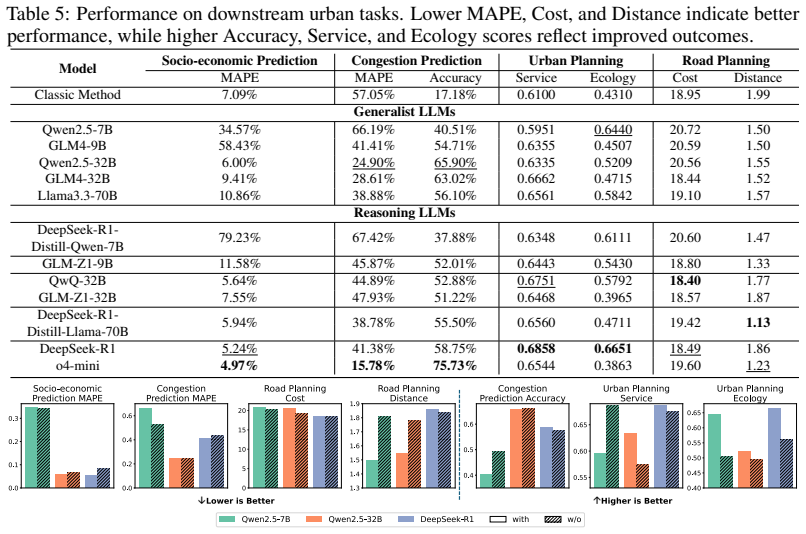
On its own terms, the paper's central discovery is that LLM spatiotemporal reasoning is not a single capability but a stack with an uneven profile. When the four processes are measured separately, current LLMs reach above-chance and often high accuracy on spatial and temporal understanding and on short-horizon forecasting, but planning accuracy drops substantially and reflection-with-feedback accuracy stays below 50 percent for most models. The paper presents planning as a higher-order ability that presupposes understanding and forecasting, and reflection as the mechanism an agent needs to adapt as urban dynamics shift. It further reports that reasoning-specialized models such as DeepSeek-R1 do not consistently beat generalist LLMs on these urban tasks, which the authors read as evidence that general mathematical and logical post-training does not automatically transfer to urban spatiotemporal reasoning.
Load-bearing premise
The planning and reflection scores stand on UAgentEnv's simulator being a faithful stand-in for real city dynamics, because the ground-truth optimal actions come from rollouts in that simulator and would be biased if its transition and reward models do not match a real city.
Editorial extensions
If this is right
- An urban LLM deployment that only checks final metrics may report success while missing systematic planning and reflection failures; USTBench's process QA can expose them.
- Reasoning-intensive post-training on math and logic should not be assumed to improve urban agents; domain-specific spatiotemporal data is a more direct route, as the paper's post-training experiment on Qwen2.5-7B indicates.
- Long-horizon planning is a bottleneck: models that forecast well still choose actions poorly when the objective spans multiple steps.
- Reflection with feedback is measurable and currently weak; agents that cannot convert environmental feedback into corrected reasoning will not adapt to shifting urban conditions.
- The 62,466 QA pairs and nine tasks give the community a standardized way to compare future urban LLM agents process by process.
Reading between the lines
- The four-process decomposition is a general protocol: the same understanding, forecasting, planning, and reflection split could be applied to other sequential-decision settings such as delivery fleets or factory robotics, though the paper does not claim this.
- A direct testable extension is that fine-tuning specifically on trend, periodicity, and chronology data, the weakest temporal skills, should improve forecasting more than equal-size general reasoning fine-tuning; the paper shows one supporting example but does not systematically compare.
- The reflection results imply a production risk: adding reflection modules to agents with weak reflection ability can degrade performance, so such components should be gated or trained rather than always-on in deployed systems.
- Because the planning ground truth comes from a simulator, benchmark scores upper-bound real planning skill only if the simulator reward matches real urban objectives; a real-world validation set would strengthen the result.
Editorial analysis
A structured set of objections, weighed in public.
Referee Report
Summary. The paper introduces USTBench, a benchmark for evaluating the spatiotemporal reasoning of LLMs as urban agents, together with an interactive city environment, UAgentEnv, that supports five decision-making and four prediction tasks. The benchmark decomposes reasoning into spatiotemporal understanding, forecasting, planning, and reflection with feedback, and evaluates thirteen LLMs on 62,466 (claimed) structured QA pairs as well as end-to-end task metrics. The central empirical claims are that LLMs perform reasonably on understanding and forecasting but struggle with long-horizon planning and reflective adaptation, and that general-purpose reasoning models do not consistently outperform non-reasoning models on urban tasks.
Significance. If validated, USTBench would be a useful contribution: it moves beyond outcome-only urban LLM evaluation, provides process-level diagnostics, covers multiple real-world task types, includes reflection with environment feedback, and reports results across a broad model suite. Strengths include the use of public data sources, explicit QA examples, confidence intervals for representative models, and a post-training experiment connecting understanding to downstream reasoning. The central finding that planning and reflection are bottlenecks is plausible and worth pursuing. However, the benchmark's validity rests on several methodological details that are currently underspecified or unvalidated, so the significance is conditional on those being resolved.
major comments (5)
- [Abstract, Section 4.1, Table 2] The stated total of 62,466 QA pairs is inconsistent with Table 2: the four category counts (27,000 + 15,336 + 15,000 + 8,130) sum to 65,466. Please correct the total or explain the discrepancy, since the benchmark scale is part of the paper's central claim.
- [Section 4.1.4, Eq. (2), Appendix E.2] The planning ground truth is computed as the action maximizing expected discounted reward in UAgentEnv with H=5 and gamma=0.9, but no sensitivity analysis or validation against an independent objective is reported. Because the headline planning and reflection deficits are measured against these labels, the paper should show that the rankings are stable under reasonable variations of H, gamma, and the reward model, and, if possible, that the proxy reward correlates with a task-level performance metric.
- [Section 4.1.2, Tables 14 and 16] The ground-truth labeling procedures for Trend and Periodicity QAs are not specified. Section 4.1.2 lists the pattern types but does not give the algorithm or criteria used to label a series as 'Increase first, then decrease' or to determine the period length, and the examples show options that are not obviously uniquely determined by the data. Please document the labeling protocol, including handling of ambiguous cases, and report label-quality checks such as multiple annotators or algorithmic verification.
- [Section 4.1.5] The construction and scoring of Reflection QA are underspecified. It is not stated whose previous action or prediction is used as the input, how the environmental feedback is generated for each QA, or how a model's reflection output is scored (e.g., whether both the is_correct judgment and the revised answer must be correct). This matters directly for the claimed reflection deficit, so the protocol needs to be defined precisely.
- [Section 5.3] The reported 'relative performance improvements of up to 337.31% in forecasting accuracy and 53.48% in decision outcomes' are not traced to a specific baseline or table row. Please provide the exact comparison points so readers can verify the magnitude of the claimed improvements.
minor comments (5)
- [Table 3] The heading 'DeepSeek-R1-0.4386' and the value '0.67172' appear to be formatting or typographical errors; please clean up the table.
- [Appendix G.4.3, Figures 8–10] Several example figures contain model responses copied from a different QA; for instance, Figure 8 shows a distance-ranking response under an adjacency question. These duplicated or mismatched examples should be replaced with correct outputs.
- [Appendix C] The runtime table mentions 'GPT-4o-mini' although the evaluated model list includes 'o4-mini'; please clarify which models were actually used.
- [Section 5.3] The phrases 'forecasting accuracy' and 'decision outcomes' should be defined with the exact metrics used, since Table 5 mixes MAPE, accuracy, cost, distance, service, and ecology scores.
- [Abstract and Section 1] Minor grammatical issues such as 'evaluating urban LLM agent' should be corrected throughout.
Circularity Check
No significant circularity: USTBench's reasoning QA labels come from real data and an explicit simulator rollout objective, not from model-fitted parameters; cited prior work is non-load-bearing.
full rationale
USTBench is an evaluation benchmark rather than a fitted derivation. The forecasting QA labels are read directly from real-world historical data (Section 4.1.3), the planning labels are produced by an explicit feedback-driven rollout over the UAgentEnv simulator with stated H=5 and gamma=0.9 (Section 4.1.4, Eq. 2), and the reflection labels pair prior model outputs with environmental feedback (Section 4.1.5). No parameter of UAgentEnv or any reward function is fitted to the thirteen LLMs being evaluated, so the reported planning and reflection deficits are measurements against an externally specified objective rather than reductions to the models' own outputs. The benchmark's self-citations (e.g., LLMLight [21] and CoLLMLight [63] for traffic-signal-control settings) are configuration references in the environment construction and are not load-bearing for the central claim about LLM reasoning abilities. The paper's own limitation statement that evaluations are conducted mainly in simulated environments and that real-world validation is needed (Section 7) is a validity caveat about the proxy reward model, not evidence of circularity. No load-bearing step reduces to its own inputs.
Assumptions & free parameters
free parameters (4)
- Exploration coefficient epsilon =
0.1
- Planning horizon H =
5
- Discount factor gamma =
0.9
- Observation and prediction window sizes =
task-dependent (e.g., 12-step traffic, 6-year GDP)
assumptions (4)
- domain assumption The UAgentEnv simulators (CityFlow, SUMO, etc.) faithfully represent real urban dynamics and reward functions.
- domain assumption The ground-truth labels for Trend, Periodicity, and other pattern QAs are unambiguous and correctly derived from the raw time series.
- domain assumption Multiple-choice accuracy is a valid measure of reasoning ability.
- domain assumption LLMs are evaluated under a fixed temperature and single prompt templates, so results are representative of each model's ability.
Cite this review
Pith. "Pith review of USTBench: Benchmarking and Dissecting Spatiotemporal Reasoning of LLMs as Urban Agents." pith.science (2026). https://pith.science/paper/4I32KD7B
@misc{pith2026250517572,
  author       = {Pith},
  title        = {Pith review of: USTBench: Benchmarking and Dissecting Spatiotemporal Reasoning of LLMs as Urban Agents},
  year         = {2026},
  howpublished = {\url{https://pith.science/paper/4I32KD7B}},
  note         = {Machine review of arXiv:2505.17572}
}
read the original abstract
Large language models (LLMs) have shown emerging potential in spatiotemporal reasoning, making them promising candidates for building urban agents that support diverse urban downstream applications. Despite these benefits, existing studies primarily focus on evaluating urban LLM agent on outcome-level metrics (e.g., prediction accuracy, traffic efficiency), offering limited insight into their underlying reasoning processes. As a result, the strengths and limitations of urban LLM agents in spatiotemporal reasoning remain poorly understood. To this end, we introduce USTBench, the first benchmark to evaluate LLMs' spatiotemporal reasoning abilities as urban agents across four decomposed dimensions: spatiotemporal understanding, forecasting, planning, and reflection with feedback. Specifically, USTBench supports five diverse urban decision-making and four spatiotemporal prediction tasks, all running within our constructed interactive city environment UAgentEnv. The benchmark includes 62,466 structured QA pairs for process-level evaluation and standardized end-to-end task assessments, enabling fine-grained diagnostics and broad task-level comparison across diverse urban scenarios. Through extensive evaluation of thirteen leading LLMs, we reveal that although LLMs show promising potential across various urban downstream tasks, they still struggle in long-horizon planning and reflective adaptation in dynamic urban contexts. Notably, recent advanced reasoning models (e.g., DeepSeek-R1) trained on general logic or mathematical problems do not consistently outperform non-reasoning LLMs. This discrepancy highlights the need for domain-specialized adaptation methods to enhance urban spatiotemporal reasoning. Overall, USTBench provides a foundation to build more adaptive and effective LLM-based urban agents and broad smart city applications.
Figures


Figures from the paper (11 more)



Reference graph
Works this paper leans on
-
[1]
Simon Elias Bibri and John Krogstie. Smart sustainable cities of the future: An extensive interdisciplinary literature review.Sustainable cities and society, 31:183–212, 2017
work page 2017
-
[2]
Box and jenkins: time series analysis, forecasting and control
George Box. Box and jenkins: time series analysis, forecasting and control. InA Very British Affair: Six Britons and the Development of Time Series Analysis During the 20th Century, pages 161–215. Springer
-
[3]
TEMPO: Prompt-based generative pre-trained transformer for time series forecasting
Defu Cao, Furong Jia, Sercan O Arik, Tomas Pfister, Yixiang Zheng, Wen Ye, and Yan Liu. TEMPO: Prompt-based generative pre-trained transformer for time series forecasting. InThe Twelfth International Conference on Learning Representations, 2024
work page 2024
-
[4]
Ma Chang, Junlei Zhang, Zhihao Zhu, Cheng Yang, Yujiu Yang, Yaohui Jin, Zhenzhong Lan, Lingpeng Kong, and Junxian He. Agentboard: An analytical evaluation board of multi-turn llm agents.Advances in Neural Information Processing Systems, 37:74325–74362, 2024
work page 2024
-
[5]
Graphwiz: An instruction-following language model for graph computational problems
Nuo Chen, Yuhan Li, Jianheng Tang, and Jia Li. Graphwiz: An instruction-following language model for graph computational problems. InProceedings of the 30th ACM SIGKDD Conference on Knowledge Discovery and Data Mining, pages 353–364, 2024
2024
-
[6]
Deeptransport: Learning spatial-temporal dependency for traffic condition forecasting
Xingyi Cheng, Ruiqing Zhang, Jie Zhou, and Wei Xu. Deeptransport: Learning spatial-temporal dependency for traffic condition forecasting. In2018 International Joint Conference on Neural Networks (IJCNN), pages 1–8. IEEE, 2018
work page 2018
-
[7]
Zheng Chu, Jingchang Chen, Qianglong Chen, Weijiang Yu, Haotian Wang, Ming Liu, and Bing Qin. Timebench: A comprehensive evaluation of temporal reasoning abilities in large language models.arXiv preprint arXiv:2311.17667, 2023
arXiv 2023
-
[8]
On the evolution of random graphs.Publ
Paul Erdos, Alfréd Rényi, et al. On the evolution of random graphs.Publ. math. inst. hung. acad. sci, 5(1):17–60, 1960
work page 1960
Show all 78 references
-
[9]
Test of time: A benchmark for evaluating llms on temporal reasoning.arXiv preprint arXiv:2406.09170, 2024
Bahare Fatemi, Mehran Kazemi, Anton Tsitsulin, Karishma Malkan, Jinyeong Yim, John Palowitch, Sungyong Seo, Jonathan Halcrow, and Bryan Perozzi. Test of time: A benchmark for evaluating llms on temporal reasoning.arXiv preprint arXiv:2406.09170, 2024
2024 arXiv
-
[10]
Citygpt: Empowering urban spatial cognition of large language models.arXiv preprint arXiv:2406.13948, 2024
Jie Feng, Yuwei Du, Tianhui Liu, Siqi Guo, Yuming Lin, and Yong Li. Citygpt: Empowering urban spatial cognition of large language models.arXiv preprint arXiv:2406.13948, 2024
2024 arXiv
-
[11]
Citybench: Evaluating the capabilities of large language model as world model.arXiv preprint arXiv:2406.13945, 2024
Jie Feng, Jun Zhang, Junbo Yan, Xin Zhang, Tianjian Ouyang, Tianhui Liu, Yuwei Du, Siqi Guo, and Yong Li. Citybench: Evaluating the capabilities of large language model as world model.arXiv preprint arXiv:2406.13945, 2024
2024 arXiv
-
[12]
Pygad: An intuitive genetic algorithm python library.Multimedia tools and applications, 83(20):58029–58042, 2024
Ahmed Fawzy Gad. Pygad: An intuitive genetic algorithm python library.Multimedia tools and applications, 83(20):58029–58042, 2024
2024
-
[13]
Chatglm: A family of large language models from glm-130b to glm-4 all tools.arXiv preprint arXiv:2406.12793, 2024
Team GLM, Aohan Zeng, Bin Xu, Bowen Wang, Chenhui Zhang, Da Yin, Dan Zhang, Diego Rojas, Guanyu Feng, Hanlin Zhao, et al. Chatglm: A family of large language models from glm-130b to glm-4 all tools.arXiv preprint arXiv:2406.12793, 2024
2024 arXiv
-
[14]
The llama 3 herd of models.arXiv preprint arXiv:2407.21783, 2024
Aaron Grattafiori, Abhimanyu Dubey, Abhinav Jauhri, Abhinav Pandey, Abhishek Kadian, Ahmad Al-Dahle, Aiesha Letman, Akhil Mathur, Alan Schelten, Alex Vaughan, et al. The llama 3 herd of models.arXiv preprint arXiv:2407.21783, 2024
2024 arXiv
-
[15]
Deepseek-r1: Incentivizing reasoning capability in llms via reinforcement learning.arXiv preprint arXiv:2501.12948, 2025
Daya Guo, Dejian Yang, Haowei Zhang, Junxiao Song, Ruoyu Zhang, Runxin Xu, Qihao Zhu, Shirong Ma, Peiyi Wang, Xiao Bi, et al. Deepseek-r1: Incentivizing reasoning capability in llms via reinforcement learning.arXiv preprint arXiv:2501.12948, 2025
2025 arXiv
-
[16]
Language models represent space and time.arXiv preprint arXiv:2310.02207, 2023
Wes Gurnee and Max Tegmark. Language models represent space and time.arXiv preprint arXiv:2310.02207, 2023
2023 arXiv
-
[17]
The scoot on-line traffic signal optimisation technique.Traffic Engineering & Control, 23(4), 1982
PB Hunt, DI Robertson, RD Bretherton, and M Cr Royle. The scoot on-line traffic signal optimisation technique.Traffic Engineering & Control, 23(4), 1982. 10
1982
-
[18]
Gpt-4o system card.arXiv preprint arXiv:2410.21276, 2024
Aaron Hurst, Adam Lerer, Adam P Goucher, Adam Perelman, Aditya Ramesh, Aidan Clark, AJ Ostrow, Akila Welihinda, Alan Hayes, Alec Radford, et al. Gpt-4o system card.arXiv preprint arXiv:2410.21276, 2024
2024 arXiv
-
[19]
Openai o1 system card.arXiv preprint arXiv:2412.16720, 2024
Aaron Jaech, Adam Kalai, Adam Lerer, Adam Richardson, Ahmed El-Kishky, Aiden Low, Alec Helyar, Aleksander Madry, Alex Beutel, Alex Carney, et al. Openai o1 system card.arXiv preprint arXiv:2412.16720, 2024
2024 arXiv
-
[20]
Towards mitigating LLM hallucination via self reflection
Ziwei Ji, Tiezheng Yu, Yan Xu, Nayeon Lee, Etsuko Ishii, and Pascale Fung. Towards mitigating LLM hallucination via self reflection. In Houda Bouamor, Juan Pino, and Kalika Bali, editors, Findings of the Association for Computational Linguistics: EMNLP 2023, Singapore, Decembe...
2023
-
[21]
Llmlight: Large language models as traffic signal control agents
Siqi Lai, Zhao Xu, Weijia Zhang, Hao Liu, and Hui Xiong. Llmlight: Large language models as traffic signal control agents. InProceedings of the 31th ACM SIGKDD Conference on Knowledge Discovery and Data Mining, 2025
2025
-
[22]
Reframing spatial reasoning evaluation in language models: A real-world simulation benchmark for qualitative reasoning.arXiv preprint arXiv:2405.15064, 2024
Fangjun Li, David C Hogg, and Anthony G Cohn. Reframing spatial reasoning evaluation in language models: A real-world simulation benchmark for qualitative reasoning.arXiv preprint arXiv:2405.15064, 2024
2024 arXiv
-
[23]
Repetition in repetition out: Towards understanding neural text degeneration from the data perspective.Advances in Neural Information Processing Systems, 36:72888–72903, 2023
Huayang Li, Tian Lan, Zihao Fu, Deng Cai, Lemao Liu, Nigel Collier, Taro Watanabe, and Yixuan Su. Repetition in repetition out: Towards understanding neural text degeneration from the data perspective.Advances in Neural Information Processing Systems, 36:72888–72903, 2023
2023
-
[24]
Towards alleviating traffic congestion: Optimal route planning for massive-scale trips
Ke Li, Lisi Chen, and Shuo Shang. Towards alleviating traffic congestion: Optimal route planning for massive-scale trips. InProceedings of the Twenty-Ninth International Conference on International Joint Conferences on Artificial Intelligence, pages 3400–3406, 2021
2021
-
[25]
Stbench: Assessing the ability of large language models in spatio-temporal analysis.arXiv preprint arXiv:2406.19065, 2024
Wenbin Li, Di Yao, Ruibo Zhao, Wenjie Chen, Zijie Xu, Chengxue Luo, Chang Gong, Quanliang Jing, Haining Tan, and Jingping Bi. Stbench: Assessing the ability of large language models in spatio-temporal analysis.arXiv preprint arXiv:2406.19065, 2024
2024 arXiv
-
[26]
Urbangpt: Spatio-temporal large language models
Zhonghang Li, Lianghao Xia, Jiabin Tang, Yong Xu, Lei Shi, Long Xia, Dawei Yin, and Chao Huang. Urbangpt: Spatio-temporal large language models. InProceedings of the 30th ACM SIGKDD Conference on Knowledge Discovery and Data Mining, pages 5351–5362, 2024
2024
-
[27]
Timecma: Towards llm-empowered multivariate time series forecasting via cross-modality alignment
Chenxi Liu, Qianxiong Xu, Hao Miao, Sun Yang, Lingzheng Zhang, Cheng Long, Ziyue Li, and Rui Zhao. Timecma: Towards llm-empowered multivariate time series forecasting via cross-modality alignment. InProceedings of the AAAI Conference on Artificial Intelligence, volume 39, page...
2025
-
[28]
Knowledge-infused contrastive learning for urban imagery-based socioeconomic prediction
Yu Liu, Xin Zhang, Jingtao Ding, Yanxin Xi, and Yong Li. Knowledge-infused contrastive learning for urban imagery-based socioeconomic prediction. InProceedings of the ACM web conference 2023, pages 4150–4160, 2023
2023
-
[29]
Simulation of urban mobility (sumo), February 4 2025
Pablo Alvarez Lopez, Angelo Banse, Mirko Barthauer, Michael Behrisch, Benjamin Couéraud, Jakob Erdmann, Yun-Pang Flötteröd, Robert Hilbrich, Ronald Nippold, and Peter Wagner. Simulation of urban mobility (sumo), February 4 2025
2025
-
[30]
Scats, sydney co-ordinated adaptive traffic system: A traffic responsive method of controlling urban traffic
PR Lowrie. Scats, sydney co-ordinated adaptive traffic system: A traffic responsive method of controlling urban traffic. 1990
1990
-
[31]
Spartqa:: A textual question answering benchmark for spatial reasoning.arXiv preprint arXiv:2104.05832, 2021
Roshanak Mirzaee, Hossein Rajaby Faghihi, Qiang Ning, and Parisa Kordjmashidi. Spartqa:: A textual question answering benchmark for spatial reasoning.arXiv preprint arXiv:2104.05832, 2021
2021 arXiv
-
[32]
Transfer learning with synthetic corpora for spatial role labeling and reasoning.arXiv preprint arXiv:2210.16952, 2022
Roshanak Mirzaee and Parisa Kordjamshidi. Transfer learning with synthetic corpora for spatial role labeling and reasoning.arXiv preprint arXiv:2210.16952, 2022
2022 arXiv
-
[33]
Towards understanding the spatial literacy of chatgpt
PETER MOONEY , WENCONG CUI, BOYUAN GUAN, and LEVENTE JUHÁSZ. Towards understanding the spatial literacy of chatgpt. InACM SIGSPATIAL International Conference, 2023. 11
2023
-
[34]
Tlc trip record data, 2025
New York City Taxi and Limousine Commission. Tlc trip record data, 2025. Accessed: 2025-05-08
2025
-
[35]
Dima: An llm-powered ride-hailing assistant at didi.arXiv preprint arXiv:2503.04768, 2025
Yansong Ning, Shuowei Cai, Wei Li, Jun Fang, Naiqiang Tan, Hua Chai, and Hao Liu. Dima: An llm-powered ride-hailing assistant at didi.arXiv preprint arXiv:2503.04768, 2025
2025
-
[36]
Urbankgent: A unified large language model agent framework for urban knowledge graph construction.arXiv preprint arXiv:2402.06861, 2024
Yansong Ning and Hao Liu. Urbankgent: A unified large language model agent framework for urban knowledge graph construction.arXiv preprint arXiv:2402.06861, 2024
2024 arXiv
-
[37]
Openstreetmap planet data, 2025
OpenStreetMap contributors. Openstreetmap planet data, 2025. Accessed: 2025-03-31
2025
-
[38]
Self-reflection in llm agents: Effects on problem-solving performance.arXiv preprint arXiv:2405.06682, 2024
Matthew Renze and Erhan Guven. Self-reflection in llm agents: Effects on problem-solving performance.arXiv preprint arXiv:2405.06682, 2024
2024 arXiv
-
[39]
Sparc and sparp: Spatial reasoning char- acterization and path generation for understanding spatial reasoning capability of large language models
Md Imbesat Rizvi, Xiaodan Zhu, and Iryna Gurevych. Sparc and sparp: Spatial reasoning char- acterization and path generation for understanding spatial reasoning capability of large language models. InProceedings of the 62nd Annual Meeting of the Association for Computational L...
2024
-
[40]
Proximal policy optimization algorithms.arXiv preprint arXiv:1707.06347, 2017
John Schulman, Filip Wolski, Prafulla Dhariwal, Alec Radford, and Oleg Klimov. Proximal policy optimization algorithms.arXiv preprint arXiv:1707.06347, 2017
2017 arXiv
-
[41]
Stepgame: A new benchmark for robust multi- hop spatial reasoning in texts
Zhengxiang Shi, Qiang Zhang, and Aldo Lipani. Stepgame: A new benchmark for robust multi- hop spatial reasoning in texts. InProceedings of the AAAI conference on artificial intelligence, volume 36, pages 11321–11329, 2022
2022
-
[42]
Towards benchmarking and improving the temporal reasoning capability of large language models.arXiv preprint arXiv:2306.08952, 2023
Qingyu Tan, Hwee Tou Ng, and Lidong Bing. Towards benchmarking and improving the temporal reasoning capability of large language models.arXiv preprint arXiv:2306.08952, 2023
2023 arXiv
-
[43]
Cityflow: A city-scale benchmark for multi-target multi-camera vehicle tracking and re-identification
Zheng Tang, Milind Naphade, Ming-Yu Liu, Xiaodong Yang, Stan Birchfield, Shuo Wang, Ratnesh Kumar, David Anastasiu, and Jenq-Neng Hwang. Cityflow: A city-scale benchmark for multi-target multi-camera vehicle tracking and re-identification. InProceedings of the IEEE/CVF confere...
2019
-
[44]
Qwq-32b: Embracing the power of reinforcement learning, 2025
Qwen Team. Qwq-32b: Embracing the power of reinforcement learning, 2025. Accessed: 2025-03-26
2025
-
[45]
Air quality prediction with physics-guided dual neural odes in open systems.ICLR, 2025
Jindong Tian, Yuxuan Liang, Ronghui Xu, Peng Chen, Chenjuan Guo, Aoying Zhou, Lujia Pan, Zhongwen Rao, and Bin Yang. Air quality prediction with physics-guided dual neural odes in open systems.ICLR, 2025
2025
-
[46]
Applications of artificial intelligence and machine learning in smart cities.Computer Communications, 154:313– 323, 2020
Zaib Ullah, Fadi Al-Turjman, Leonardo Mostarda, and Roberto Gagliardi. Applications of artificial intelligence and machine learning in smart cities.Computer Communications, 154:313– 323, 2020
2020
-
[47]
Robust extrema features for time-series data analysis.IEEE transactions on pattern analysis and machine intelligence, 35(6):1464–1479, 2012
Pramod K Vemulapalli, Vishal Monga, and Sean N Brennan. Robust extrema features for time-series data analysis.IEEE transactions on pattern analysis and machine intelligence, 35(6):1464–1479, 2012
2012
-
[48]
Reinforcement learning-based placement of charging stations in urban road networks
Leonie von Wahl, Nicolas Tempelmeier, Ashutosh Sao, and Elena Demidova. Reinforcement learning-based placement of charging stations in urban road networks. InProceedings of the 28th ACM SIGKDD Conference on Knowledge Discovery and Data Mining, pages 3992–4000, 2022
2022
-
[49]
A survey on large language model based autonomous agents.Frontiers of Computer Science, 18(6):186345, 2024
Lei Wang, Chen Ma, Xueyang Feng, Zeyu Zhang, Hao Yang, Jingsen Zhang, Zhiyuan Chen, Jiakai Tang, Xu Chen, Yankai Lin, et al. A survey on large language model based autonomous agents.Frontiers of Computer Science, 18(6):186345, 2024
2024
-
[50]
Global gridded gdp data set consistent with the shared socioeco- nomic pathways.Scientific data, 9(1):221, 2022
Tingting Wang and Fubao Sun. Global gridded gdp data set consistent with the shared socioeco- nomic pathways.Scientific data, 9(1):221, 2022
2022
-
[51]
Where would i go next? large language models as human mobility predictors.arXiv preprint arXiv:2308.15197, 2023
Xinglei Wang, Meng Fang, Zichao Zeng, and Tao Cheng. Where would i go next? large language models as human mobility predictors.arXiv preprint arXiv:2308.15197, 2023. 12
2023 arXiv
-
[52]
From news to forecast: Integrating event analysis in llm-based time series forecasting with reflection.Advances in Neural Information Processing Systems, 37:58118–58153, 2024
Xinlei Wang, Maike Feng, Jing Qiu, Jinjin Gu, and Junhua Zhao. From news to forecast: Integrating event analysis in llm-based time series forecasting with reflection.Advances in Neural Information Processing Systems, 37:58118–58153, 2024
2024
-
[53]
Tram: Benchmarking temporal reasoning for large language models
Yuqing Wang and Yun Zhao. Tram: Benchmarking temporal reasoning for large language models. InFindings of the Association for Computational Linguistics ACL 2024, pages 6389– 6415, 2024
2024
-
[54]
Colight: Learning network-level cooperation for traffic signal control
Hua Wei, Nan Xu, Huichu Zhang, Guanjie Zheng, Xinshi Zang, Chacha Chen, Weinan Zhang, Yanmin Zhu, Kai Xu, and Zhenhui Li. Colight: Learning network-level cooperation for traffic signal control. InProceedings of the 28th ACM international conference on information and knowledge...
1913
-
[55]
Chain-of-thought prompting elicits reasoning in large language models
Jason Wei, Xuezhi Wang, Dale Schuurmans, Maarten Bosma, Fei Xia, Ed Chi, Quoc V Le, Denny Zhou, et al. Chain-of-thought prompting elicits reasoning in large language models. Advances in neural information processing systems, 35:24824–24837, 2022
2022
-
[56]
Coverage location models: alternatives, approximation, and uncertainty.International Regional Science Review, 39(1):48–76, 2016
Ran Wei. Coverage location models: alternatives, approximation, and uncertainty.International Regional Science Review, 39(1):48–76, 2016
2016
-
[57]
Worldpop hub, 2025
WorldPop. Worldpop hub, 2025
2025
-
[58]
Large language models can learn temporal reasoning
Siheng Xiong, Ali Payani, Ramana Kompella, and Faramarz Fekri. Large language models can learn temporal reasoning. InProceedings of the 62nd Annual Meeting of the Association for Computational Linguistics (Volume 1: Long Papers), pages 10452–10470, 2024
2024
-
[59]
Evaluating spatial understanding of large language models.arXiv preprint arXiv:2310.14540, 2023
Yutaro Yamada, Yihan Bao, Andrew K Lampinen, Jungo Kasai, and Ilker Yildirim. Evaluating spatial understanding of large language models.arXiv preprint arXiv:2310.14540, 2023
2023 arXiv
-
[60]
An Yang, Baosong Yang, Beichen Zhang, Binyuan Hui, Bo Zheng, Bowen Yu, Chengyuan Li, Dayiheng Liu, Fei Huang, Haoran Wei, et al. Qwen2. 5 technical report.arXiv preprint arXiv:2412.15115, 2024
2024 arXiv
-
[61]
Foursquare dataset
Dingqi Yang. Foursquare dataset. https://sites.google.com/site/yangdingqi/home/ foursquare-dataset, 2014. Accessed: 2025-05-19
2014
-
[62]
Unist: A prompt-empowered universal model for urban spatio-temporal prediction
Yuan Yuan, Jingtao Ding, Jie Feng, Depeng Jin, and Yong Li. Unist: A prompt-empowered universal model for urban spatio-temporal prediction. InProceedings of the 30th ACM SIGKDD Conference on Knowledge Discovery and Data Mining, pages 4095–4106, 2024
2024
-
[63]
Collmlight: Cooperative large language model agents for network-wide traffic signal control.arXiv preprint arXiv:2503.11739, 2025
Zirui Yuan, Siqi Lai, and Hao Liu. Collmlight: Cooperative large language model agents for network-wide traffic signal control.arXiv preprint arXiv:2503.11739, 2025
2025 arXiv
-
[64]
Agenttuning: Enabling generalized agent abilities for llms.arXiv preprint arXiv:2310.12823, 2023
Aohan Zeng, Mingdao Liu, Rui Lu, Bowen Wang, Xiao Liu, Yuxiao Dong, and Jie Tang. Agenttuning: Enabling generalized agent abilities for llms.arXiv preprint arXiv:2310.12823, 2023
2023 arXiv
-
[65]
Open3dvqa: A benchmark for comprehensive spatial reasoning with multimodal large language model in open space.arXiv preprint arXiv:2503.11094, 2025
Weichen Zhan, Zile Zhou, Zhiheng Zheng, Chen Gao, Jinqiang Cui, Yong Li, Xinlei Chen, and Xiao-Ping Zhang. Open3dvqa: A benchmark for comprehensive spatial reasoning with multimodal large language model in open space.arXiv preprint arXiv:2503.11094, 2025
2025
-
[66]
Reinforcement learning for traffic signal control
Huichu Zhang, Siyuan Feng, Chang Liu, Yaoyao Ding, Yichen Zhu, Zihan Zhou, Weinan Zhang, Yong Yu, Haiming Jin, and Zhenhui Li. Reinforcement learning for traffic signal control. http://traffic-signal-control.github.io, 2023. Accessed on 1 December 2023
2023
-
[67]
Urbanvideo-bench: Benchmarking vision- language models on embodied intelligence with video data in urban spaces.arXiv preprint arXiv:2503.06157, 2025
Baining Zhao, Jianjie Fang, Zichao Dai, Ziyou Wang, Jirong Zha, Weichen Zhang, Chen Gao, Yue Wang, Jinqiang Cui, Xinlei Chen, et al. Urbanvideo-bench: Benchmarking vision- language models on embodied intelligence with video data in urban spaces.arXiv preprint arXiv:2503.06157, 2025
2025
-
[68]
Where to go next: A spatio-temporal gated network for next poi recommendation.IEEE Transactions on Knowledge and Data Engineering, 34(5):2512–2524, 2020
Pengpeng Zhao, Anjing Luo, Yanchi Liu, Jiajie Xu, Zhixu Li, Fuzhen Zhuang, Victor S Sheng, and Xiaofang Zhou. Where to go next: A spatio-temporal gated network for next poi recommendation.IEEE Transactions on Knowledge and Data Engineering, 34(5):2512–2524, 2020. 13
2020
-
[69]
Cityeqa: A hierarchical llm agent on embodied question answering benchmark in city space.arXiv preprint arXiv:2502.12532, 2025
Yong Zhao, Kai Xu, Zhengqiu Zhu, Yue Hu, Zhiheng Zheng, Yingfeng Chen, Yatai Ji, Chen Gao, Yong Li, and Jincai Huang. Cityeqa: A hierarchical llm agent on embodied question answering benchmark in city space.arXiv preprint arXiv:2502.12532, 2025
2025 arXiv
-
[70]
Llamafactory: Unified efficient fine-tuning of 100+ language models
Yaowei Zheng, Richong Zhang, Junhao Zhang, Yanhan Ye, Zheyan Luo, Zhangchi Feng, and Yongqiang Ma. Llamafactory: Unified efficient fine-tuning of 100+ language models. In Proceedings of the 62nd Annual Meeting of the Association for Computational Linguistics (Volume 3: System ...
2024
-
[71]
Spatial planning of urban communities via deep reinforcement learning.Nature Computational Science, 3(9):748– 762, 2023
Yu Zheng, Yuming Lin, Liang Zhao, Tinghai Wu, Depeng Jin, and Yong Li. Spatial planning of urban communities via deep reinforcement learning.Nature Computational Science, 3(9):748– 762, 2023
2023
-
[72]
Urbanplanbench: A comprehensive urban planning benchmark for evaluating large language models.arXiv preprint arXiv:2504.21027, 2025
Yu Zheng, Longyi Liu, Yuming Lin, Jie Feng, Guozhen Zhang, Depeng Jin, and Yong Li. Urbanplanbench: A comprehensive urban planning benchmark for evaluating large language models.arXiv preprint arXiv:2504.21027, 2025
2025 arXiv
-
[73]
Road planning for slums via deep reinforcement learning
Yu Zheng, Hongyuan Su, Jingtao Ding, Depeng Jin, and Yong Li. Road planning for slums via deep reinforcement learning. InProceedings of the 29th ACM SIGKDD Conference on Knowledge Discovery and Data Mining, pages 5695–5706, 2023
2023
-
[74]
going on a vacation
Ben Zhou, Daniel Khashabi, Qiang Ning, and Dan Roth. “going on a vacation” takes longer than “going for a walk”: A study of temporal commonsense understanding. InProceedings of the 2019 Conference on Empirical Methods in Natural Language Processing and the 9th International Jo...
2019
-
[75]
aha moments
Zhilun Zhou, Yuming Lin, Depeng Jin, and Yong Li. Large language model for participatory urban planning.arXiv preprint arXiv:2402.17161, 2024. 14 A Limitations Exploration on Enhancement Methods: USTBench is designed primarily as a comprehensive benchmark to rigorously evaluat...
2024 arXiv
-
[76]
answer":
But even then, the total distance is way larger. The data doesn’t have any other connections from crosswalk 3 to other entities except school 1. Therefore, school 1 is directly adjacent and very close, making it the stronger candidate. Wait, but the problem is about which (sch...
-
[77]
Miscellaneous Shop
is later. So the Day 30’s 6:02 PM is more recent than any entries in previous Sundays, because Day 30 is a later day. Therefore, the most recent event is Miscellaneous Shop 13944 at 06:02 PM on Sunday. So the answer would be "Miscellaneous Shop". Wait, in the data entry for Da...
-
[78]
answer":
30.5 2. 30.25 (-0.25) 3. 29.8 (-0.45) 4. 29.7 (-0.1) 5. 29.45 (-0.25) 6. 28.2 (-1.25) 7. 27.05 (-1.15) 8. 26.65 (-0.4) 9. 26.4 (-0.25) 10. 25.9 (-0.5) 11. 25.35 (-0.55) 12. 24.6 (-0.75) So the rate of decrease varies. For instance, steps 6 and 7 have larger drops (like -1.25 a...
Reviewed August 7, 2026 · model on record in the stance chip above.
Discussion (0). Sign in to comment.