REVIEW 3 major objections 5 minor 45 references
SeaLion: Semantic Part-Aware Latent Point Diffusion Models for 3D Generation
T0 review · 3 major / 5 minor · reviewed 2026-08-07 · deepseek-v4-flash
Pith's one-line read SeaLion claims that jointly predicting noise and part-segmentation labels inside a latent point diffusion model, with label-conditioned decoding, produces point clouds whose geometry and semantic part labels are both accurate and…
desk verdict Solid, honest extension of latent point diffusion to labeled generation; the new p-CD metric is useful but under-validated, and the SOTA claim needs more baselines and error bars. read the letter →
The pith
A machine-rendered reading of the paper's core claim, the machinery that carries it, and where it could break.
The reading
What carries the argument
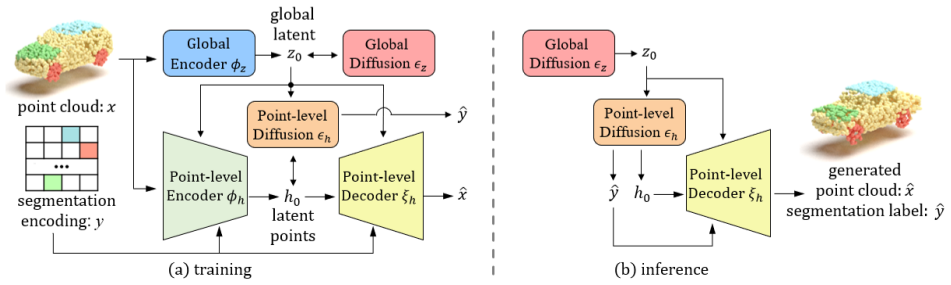
The central machinery is the semantic part-aware latent point diffusion module $\epsilon_h$: a modified Point-Voxel CNN with one down-sampling path extracting shared representations and two parallel up-sampling paths that respectively predict the noise $\hat{\epsilon}_t$ and the segmentation encoding $\hat{y}_t$ for perturbed latent points $h_t$ at each diffusion step. The companion mechanism is part-aware Chamfer distance (p-CD), defined as the sum over parts of the bidirectional Chamfer distance between corresponding parts, with infinite distance when the part sets differ; feeding p-CD into 1-NNA is what lets the evaluation reward shapes whose parts are individually faithful and coherently joined. The diffusion module carries the generation and label prediction; p-CD carries the claim that a low score certifies both geometry and segmentation rationality.
What would settle it
Take SeaLion-generated point clouds, randomly permute their part labels, and recompute 1-NNA (p-CD) against the real test set; if the permuted clouds score nearly the same as the originals, p-CD is insensitive to label correctness and the segmentation claim is unsupported.
Extended reading notes
Core claim
The central discovery, as the paper states it, is that semantic part awareness can be built directly into latent-point diffusion: rather than factorizing generation part by part as DiffFacto does, SeaLion diffuses all latent points jointly and uses a shared down-sampling path with two parallel up-sampling branches so that one network emits both the predicted noise and the predicted segmentation labels at every denoising step. At inference, an exponential moving average over label predictions conditions the decoder, strengthening the alignment between coordinates and labels. The authors claim this design avoids the part-to-part incoherence of DiffFacto, yields state-of-the-art 1-NNA (p-CD), COV (p-CD), and MMD (p-CD) on ShapeNet and IntrA, and does not hurt unlabeled generation quality relative to Lion when the segmentation branch is ignored. They further claim that low p-CD between a generated cloud and a real cloud implies both geometric quality and reasonable part structure, because p-CD only vanishes when every generated part aligns with the corresponding real part.
Load-bearing premise
The result hinges on p-CD being a valid proxy for label correctness: if a generated cloud whose parts are geometrically plausible but mislabeled could still achieve a low p-CD to a real cloud, then the headline 1-NNA improvements would not prove that SeaLion generates accurate segmentation labels.
Editorial extensions
If this is right
- Generated labeled point clouds no longer require a separate pretrained segmentation model to assign pseudo-labels.
- Part-aware editing becomes a latent-space operation: freeze the latent points of a chosen part and diffuse the remaining points.
- Generated samples can enlarge labeled training sets for downstream point-cloud segmentation models, including in domains with scarce labels such as medical imaging.
- Semi-supervised training works with the same architecture by zeroing the label conditioning and dropping the segmentation loss term on unlabeled samples.
- Evaluation metrics that previously ignored labels can be upgraded simply by replacing Chamfer distance with p-CD.
Reading between the lines
- p-CD could plausibly be used as a training-time objective or editing guidance signal, not only as a post-hoc metric, since it directly rewards coherent part alignment.
- The two-branch design suggests a general recipe: any latent point diffusion model can gain a discriminative label head with little architectural change, without degrading generation quality.
- The paper's implicit equation of low p-CD with correct labels is worth stress-testing on fine-grained part sets where geometric alignment and label identity can diverge.
- If the semi-supervised result extends, the same model could be pushed toward discovering parts with no labels at all, with segmentation annotations applied only at inference.
Editorial analysis
A structured set of objections, weighed in public.
Referee Report
Summary. The paper presents SeaLion, a latent point diffusion model that generates 3D point clouds with per-point semantic part labels. The method builds on Lion's hierarchical latent diffusion: a point-level encoder/decoder is conditioned on segmentation encodings, and the point-level diffusion module is trained to jointly predict the noise and the segmentation labels from the same down-sampled representation. At inference, the predicted labels are smoothed by EMA and used to condition the decoder, producing a labeled point cloud. The paper also proposes a pairwise distance, part-aware Chamfer distance (p-CD), and redefines 1-NNA, COV, and MMD using p-CD. Experiments on ShapeNet and IntrA compare SeaLion with DiffFacto and with two-step baselines (Lion plus a pretrained segmenter), and additional experiments address semi-supervised training, generative data augmentation for segmentation, and part-aware editing.
Significance. If the results hold, SeaLion offers a practical single-stage alternative to generating semantically labeled point clouds without an external post-hoc segmenter, and p-CD is a natural extension of Chamfer distance to labeled clouds. The paper is strong on reproducibility: architecture hyperparameters are tabulated in the supplementary, code is released, and the ablation in Table 7 explicitly checks that the auxiliary segmentation branch does not degrade unlabeled generation quality. The downstream data-augmentation experiment (Table 5) provides an independent, practically meaningful check that the generated labels are useful. The main weakness is that the headline claim of generating 'accurate segmentation labels' is supported primarily by p-CD-based metrics, which are proposed by the authors and not directly validated against any reference label field on generated shapes; the comparison to DiffFacto also rests on a single baseline and on four ShapeNet categories. These issues are addressable but require additional evaluation before the central claim is fully established.
major comments (3)
- [§3.4, §A.2] The paper's central claim that SeaLion generates point clouds with accurate part labels is supported mainly by 1-NNA (p-CD), whose validity as a proxy for label correctness rests on Argument 3 in Supplementary A.2. Argument 3 asserts that a small per-part Chamfer distance to a real cloud implies that the generated cloud is segmented well, but this is not empirically validated. p-CD is a per-part geometric distance, so it does not directly measure semantic correctness of the label field in cases where part geometry is ambiguous, part boundaries are slightly shifted, or a generated part is broken into multiple components that still have small per-part distance to a single real part. The paper provides no direct comparison of the final predicted label field y_hat against any reference on generated shapes, and Figure 5 reports mIoU only for intermediate diffusion steps on a single class. Please add a direct label-accuracy evaluation: for real point clouds, compute the accuracy/mIoU of y_hat against ground-truth labels (extending Figure 5 to all categories and to the final smoothed prediction); for generated clouds, report agreement between the output labels and labels assigned by a strong pretrained segmenter on the same geometry, or a label-consistency metric. This would directly support the 'accurate segmentation labels' claim and also validate p-CD as a proxy.
- [§4.2, Table 1] The headline state-of-the-art claim ('outperforming the existing state-of-the-art model, DiffFacto, by 13.33% and 6.52% on 1-NNA (p-CD)') is based on a single baseline and on only four ShapeNet categories, and the paper reports no variance or significance information. Since 1-NNA is computed on a finite set of generated samples, the observed difference could be within sampling noise, especially for categories with small test sets. Please report standard deviations over multiple generation runs or bootstrap confidence intervals, and either add additional labeled-generation baselines (e.g., a VAE/GAN-based part-label generator) or temper the claim to 'outperforms the compared baselines'.
- [§4.3, Table 4] The semi-supervised experiment shows that adding unlabeled data improves over using 10% labels alone, but it does not include a fully supervised upper bound (SeaLion trained with 100% labeled data). Without this bound, the claim that SeaLion 'reduces the demand for labeling efforts' is not quantified: the reader cannot tell whether the semi-supervised model approaches fully supervised performance or remains far below it. Please add the 100%-labeled result for the same car category.
minor comments (5)
- [§3.1, Eq. (6), Eq. (8)] The values of the balancing hyperparameters λseg, λz, and λh are not given in the paper or in the supplementary material; please provide them for reproducibility.
- [§4.2, Table 1] Please state explicitly how many point clouds are generated per category for evaluation, since 1-NNA and COV are sensitive to the size of the generated set G.
- [Figure 5] The caption says 'Evolution of predictive performance measured by mIoU for different diffusion steps t on airplane class,' but it does not specify the dataset split (train or test) or whether the mIoU is computed between the predicted y_t and ground-truth labels of real point clouds; please clarify.
- [§3.4] The statement that p-CD is infinite for point clouds with different part sets could make 1-NNA degenerate if a generated cloud is missing a part; please discuss how this case is handled in the evaluation and whether any generated samples were excluded for this reason.
- [References] The paper cites ShapeNet as [37] (Yi et al.) for the segmentation-labeled subset and [3] (Chang et al.) for the larger ShapeNet repository; consider adding a sentence clarifying the relationship between these two references to avoid reader confusion.
Circularity Check
No significant circularity: the generation and evaluation claims are self-contained, and the p-CD metric is not fitted to the model.
full rationale
The paper's central derivation chain consists of the SeaLion training objective (Eqs. 6–8) and the p-CD pairwise distance (Eq. 11). These do not reduce to each other. The model is trained with a VAE ELBO, a diffusion noise-prediction loss, and a cross-entropy segmentation term; p-CD is never used as a training loss, and no parameter is fitted to it. The headline SOTA numbers are obtained by applying p-CD to held-out generated sets and real test sets, which is a post-hoc evaluation rather than a construction. The main same-author element is the introduction of p-CD itself, but the paper defines it explicitly as a sum of per-part Chamfer distances and provides an external argument for its behavior in Suppl. A.2. Introducing a metric is not circular unless the metric is used as a training objective or its definition already encodes the target result; neither is the case here. The downstream data augmentation experiment (Table 5) provides an independent check that the generated labels are useful, since improved mIoU on real test data cannot be manufactured by the metric alone. No equation in the paper is equivalent by construction to another, and no uniqueness theorem is imported from the authors' prior work. The concern that p-CD may not fully verify semantic label accuracy is a validity or correctness issue, not a circularity reduction. Therefore the paper is self-contained and receives a circularity score of 0.
Assumptions & free parameters
free parameters (4)
- λseg (segmentation loss weight)
- λz and λh (KL divergence weights)
- EMA smoothing factor α =
0.1
- Edit perturbation steps τ
assumptions (5)
- standard math DDPM training and sampling procedures are valid as described by Ho et al. 2020.
- domain assumption Lion's latent point diffusion framework (global latent z0 and point-latents h0) provides an effective representation for 3D generation.
- domain assumption Intermediate features of diffusion models capture semantic information that transfers to segmentation (Baranchuk et al. 2021).
- ad hoc to paper p-CD is a valid proxy for both geometric quality and semantic label correctness.
- domain assumption The decoder conditioned on predicted labels y improves alignment between geometry and labels.
Cite this review
Pith. "Pith review of SeaLion: Semantic Part-Aware Latent Point Diffusion Models for 3D Generation." pith.science (2026). https://pith.science/paper/ZPZBDV5R
@misc{pith2026250517721,
  author       = {Pith},
  title        = {Pith review of: SeaLion: Semantic Part-Aware Latent Point Diffusion Models for 3D Generation},
  year         = {2026},
  howpublished = {\url{https://pith.science/paper/ZPZBDV5R}},
  note         = {Machine review of arXiv:2505.17721}
}
read the original abstract
Denoising diffusion probabilistic models have achieved significant success in point cloud generation, enabling numerous downstream applications, such as generative data augmentation and 3D model editing. However, little attention has been given to generating point clouds with point-wise segmentation labels, as well as to developing evaluation metrics for this task. Therefore, in this paper, we present SeaLion, a novel diffusion model designed to generate high-quality and diverse point clouds with fine-grained segmentation labels. Specifically, we introduce the semantic part-aware latent point diffusion technique, which leverages the intermediate features of the generative models to jointly predict the noise for perturbed latent points and associated part segmentation labels during the denoising process, and subsequently decodes the latent points to point clouds conditioned on part segmentation labels. To effectively evaluate the quality of generated point clouds, we introduce a novel point cloud pairwise distance calculation method named part-aware Chamfer distance (p-CD). This method enables existing metrics, such as 1-NNA, to measure both the local structural quality and inter-part coherence of generated point clouds. Experiments on the large-scale synthetic dataset ShapeNet and real-world medical dataset IntrA demonstrate that SeaLion achieves remarkable performance in generation quality and diversity, outperforming the existing state-of-the-art model, DiffFacto, by 13.33% and 6.52% on 1-NNA (p-CD) across the two datasets. Experimental analysis shows that SeaLion can be trained semi-supervised, thereby reducing the demand for labeling efforts. Lastly, we validate the applicability of SeaLion in generative data augmentation for training segmentation models and the capability of SeaLion to serve as a tool for part-aware 3D shape editing.
Figures


Figures from the paper (13 more)



Reference graph
Works this paper leans on
-
[1]
Learning representations and generative models for 3d point clouds
Panos Achlioptas, Olga Diamanti, Ioannis Mitliagkas, and Leonidas Guibas. Learning representations and generative models for 3d point clouds. In International conference on machine learning, pages 40–49. PMLR, 2018. 2, 5, 11
work page 2018
-
[2]
Label-efficient se- mantic segmentation with diffusion models
Dmitry Baranchuk, Ivan Rubachev, Andrey V oynov, Valentin Khrulkov, and Artem Babenko. Label-efficient se- mantic segmentation with diffusion models. arXiv preprint arXiv:2112.03126, 2021. 2, 3, 7
arXiv 2021
-
[3]
Shapenet: An information-rich 3d model repository
Angel X Chang, Thomas Funkhouser, Leonidas Guibas, Pat Hanrahan, Qixing Huang, Zimo Li, Silvio Savarese, Manolis Savva, Shuran Song, Hao Su, et al. Shapenet: An information-rich 3d model repository. arXiv preprint arXiv:1512.03012, 2015. 13
arXiv 2015
-
[4]
Generative pre- training from pixels
Mark Chen, Alec Radford, Rewon Child, Jeffrey Wu, Hee- woo Jun, David Luan, and Ilya Sutskever. Generative pre- training from pixels. In International conference on machine learning, pages 1691–1703. PMLR, 2020. 3
work page 2020
-
[5]
A comprehensive survey for generative data augmentation
Yunhao Chen, Zihui Yan, and Yunjie Zhu. A comprehensive survey for generative data augmentation. Neurocomputing, page 128167, 2024. 8
work page 2024
-
[6]
Gen- erative adversarial networks: An overview
Antonia Creswell, Tom White, Vincent Dumoulin, Kai Arulkumaran, Biswa Sengupta, and Anil A Bharath. Gen- erative adversarial networks: An overview. IEEE signal pro- cessing magazine, 35(1):53–65, 2018. 1
work page 2018
-
[7]
Ccd-3dr: Consistent conditioning in diffusion for single-image 3d reconstruction
Yan Di, Chenyangguang Zhang, Pengyuan Wang, Guangyao Zhai, Ruida Zhang, Fabian Manhardt, Benjamin Busam, Xi- angyang Ji, and Federico Tombari. Ccd-3dr: Consistent conditioning in diffusion for single-image 3d reconstruction. arXiv preprint arXiv:2308.07837, 2023. 1
arXiv 2023
-
[8]
Large scale adversar- ial representation learning
Jeff Donahue and Karen Simonyan. Large scale adversar- ial representation learning. Advances in neural information processing systems, 32, 2019. 3
work page 2019
Show all 45 references
-
[9]
Ad- versarial feature learning
Jeff Donahue, Philipp Kr ¨ahenb¨uhl, and Trevor Darrell. Ad- versarial feature learning. arXiv preprint arXiv:1605.09782,
-
[10]
A point set generation network for 3d object reconstruction from a single image
Haoqiang Fan, Hao Su, and Leonidas J Guibas. A point set generation network for 3d object reconstruction from a single image. In Proceedings of the IEEE conference on computer vision and pattern recognition, pages 605–613, 2017. 1
2017
-
[11]
Diffusion mod- els and representation learning: A survey
Michael Fuest, Pingchuan Ma, Ming Gui, Johannes S Fis- cher, Vincent Tao Hu, and Bjorn Ommer. Diffusion mod- els and representation learning: A survey. arXiv preprint arXiv:2407.00783, 2024. 12
2024 arXiv
-
[12]
Mrgan: Multi-rooted 3d shape representation learning with unsupervised part disentanglement
Rinon Gal, Amit Bermano, Hao Zhang, and Daniel Cohen- Or. Mrgan: Multi-rooted 3d shape representation learning with unsupervised part disentanglement. In Proceedings of the IEEE/CVF International Conference on Computer Vi- sion, pages 2039–2048, 2021. 1, 2
2021
-
[13]
Deep residual learning for image recognition
Kaiming He, Xiangyu Zhang, Shaoqing Ren, and Jian Sun. Deep residual learning for image recognition. In Proceed- ings of the IEEE conference on computer vision and pattern recognition, pages 770–778, 2016. 5
2016
-
[14]
Spaghetti: Editing implicit shapes through part aware generation.ACM Transactions on Graph- ics (TOG), 41(4):1–20, 2022
Amir Hertz, Or Perel, Raja Giryes, Olga Sorkine-Hornung, and Daniel Cohen-Or. Spaghetti: Editing implicit shapes through part aware generation.ACM Transactions on Graph- ics (TOG), 41(4):1–20, 2022. 2
2022
-
[15]
Denoising dif- fusion probabilistic models
Jonathan Ho, Ajay Jain, and Pieter Abbeel. Denoising dif- fusion probabilistic models. Advances in neural information processing systems, 33:6840–6851, 2020. 1, 3
2020
-
[16]
Pf-net: Point fractal network for 3d point cloud completion
Zitian Huang, Yikuan Yu, Jiawen Xu, Feng Ni, and Xinyi Le. Pf-net: Point fractal network for 3d point cloud completion. In Proceedings of the IEEE/CVF conference on computer vi- sion and pattern recognition, pages 7662–7670, 2020. 1
2020
-
[17]
Gal: Geometric adversarial loss for single-view 3d-object recon- struction
Li Jiang, Shaoshuai Shi, Xiaojuan Qi, and Jiaya Jia. Gal: Geometric adversarial loss for single-view 3d-object recon- struction. In Proceedings of the European conference on computer vision (ECCV), pages 802–816, 2018. 1
2018
-
[18]
Auto-encoding varia- tional bayes
Diederik P Kingma and Max Welling. Auto-encoding varia- tional bayes. arXiv preprint arXiv:1312.6114, 2013. 1
2013 arXiv
-
[19]
Your diffusion model is secretly a zero-shot classifier
Alexander C Li, Mihir Prabhudesai, Shivam Duggal, Ellis Brown, and Deepak Pathak. Your diffusion model is secretly a zero-shot classifier. In Proceedings of the IEEE/CVF Inter- national Conference on Computer Vision, pages 2206–2217,
-
[20]
Sp- gan: Sphere-guided 3d shape generation and manipulation
Ruihui Li, Xianzhi Li, Ka-Hei Hui, and Chi-Wing Fu. Sp- gan: Sphere-guided 3d shape generation and manipulation. ACM Transactions on Graphics (TOG), 40(4):1–12, 2021. 2
2021
-
[21]
Editvae: Unsupervised parts-aware controllable 3d point cloud shape generation
Shidi Li, Miaomiao Liu, and Christian Walder. Editvae: Unsupervised parts-aware controllable 3d point cloud shape generation. In Proceedings of the AAAI Conference on Arti- ficial Intelligence, pages 1386–1394, 2022. 1, 2
2022
-
[22]
Point- voxel cnn for efficient 3d deep learning
Zhijian Liu, Haotian Tang, Yujun Lin, and Song Han. Point- voxel cnn for efficient 3d deep learning. Advances in Neural Information Processing Systems, 32, 2019. 4, 14
2019
-
[23]
Diffusion probabilistic models for 3d point cloud generation
Shitong Luo and Wei Hu. Diffusion probabilistic models for 3d point cloud generation. In Proceedings of the IEEE/CVF Conference on Computer Vision and Pattern Recognition , pages 2837–2845, 2021. 1, 2
2021
-
[24]
SDEdit: Guided image synthesis and editing with stochastic differential equa- tions
Chenlin Meng, Yutong He, Yang Song, Jiaming Song, Jia- jun Wu, Jun-Yan Zhu, and Stefano Ermon. SDEdit: Guided image synthesis and editing with stochastic differential equa- tions. In International Conference on Learning Representa- tions, 2022. 5
2022
-
[25]
Difffacto: Controllable part-based 3d point cloud generation with cross diffusion
George Kiyohiro Nakayama, Mikaela Angelina Uy, Jiahui Huang, Shi-Min Hu, Ke Li, and Leonidas Guibas. Difffacto: Controllable part-based 3d point cloud generation with cross diffusion. In Proceedings of the IEEE/CVF International Conference on Computer Vision, pages 14257–14267...
2023
-
[26]
3d part segmentation on shapenet-part
Papers with Code. 3d part segmentation on shapenet-part. https://paperswithcode.com/sota/3d-part- segmentation - on - shapenet - part, 2024. Ac- cessed: 2024-11-14. 6
2024
-
[27]
Self-positioning point-based transformer for point cloud understanding
Jinyoung Park, Sanghyeok Lee, Sihyeon Kim, Yunyang Xiong, and Hyunwoo J Kim. Self-positioning point-based transformer for point cloud understanding. In Proceedings of the IEEE/CVF conference on computer vision and pattern recognition, pages 21814–21823, 2023. 6, 8, 12, 14, 17
2023
-
[28]
Pointnet++: Deep hierarchical feature learning on point sets in a metric space
Charles Ruizhongtai Qi, Li Yi, Hao Su, and Leonidas J Guibas. Pointnet++: Deep hierarchical feature learning on point sets in a metric space. Advances in neural information processing systems, 30, 2017. 4, 6, 12, 14 9
2017
-
[29]
The earth mover’s distance as a metric for image retrieval
Yossi Rubner, Carlo Tomasi, and Leonidas J Guibas. The earth mover’s distance as a metric for image retrieval. In- ternational journal of computer vision, 40:99–121, 2000. 2, 5
2000
-
[30]
3d point cloud generative adversarial network based on tree structured graph convolutions
Dong Wook Shu, Sung Woo Park, and Junseok Kwon. 3d point cloud generative adversarial network based on tree structured graph convolutions. In Proceedings of the IEEE/CVF international conference on computer vision , pages 3859–3868, 2019. 1, 2
2019
-
[31]
Repurposing gans for one-shot se- mantic part segmentation
Nontawat Tritrong, Pitchaporn Rewatbowornwong, and Su- pasorn Suwajanakorn. Repurposing gans for one-shot se- mantic part segmentation. In Proceedings of the IEEE/CVF conference on computer vision and pattern recognition , pages 4475–4485, 2021. 3
2021
-
[32]
Linear semantics in genera- tive adversarial networks
Jianjin Xu and Changxi Zheng. Linear semantics in genera- tive adversarial networks. In Proceedings of the IEEE/CVF Conference on Computer Vision and Pattern Recognition , pages 9351–9360, 2021
2021
-
[33]
Generative hierarchical features from synthe- sizing images
Yinghao Xu, Yujun Shen, Jiapeng Zhu, Ceyuan Yang, and Bolei Zhou. Generative hierarchical features from synthe- sizing images. In Proceedings of the IEEE/CVF Conference on Computer Vision and Pattern Recognition , pages 4432– 4442, 2021. 3
2021
-
[34]
Pointflow: 3d point cloud generation with continuous normalizing flows
Guandao Yang, Xun Huang, Zekun Hao, Ming-Yu Liu, Serge Belongie, and Bharath Hariharan. Pointflow: 3d point cloud generation with continuous normalizing flows. In Proceed- ings of the IEEE/CVF international conference on computer vision, pages 4541–4550, 2019. 2, 5, 6, 11
2019
-
[35]
Dsg-net: Learning disentangled structure and geometry for 3d shape generation
Jie Yang, Kaichun Mo, Yu-Kun Lai, Leonidas J Guibas, and Lin Gao. Dsg-net: Learning disentangled structure and geometry for 3d shape generation. ACM Transactions on Graphics (TOG), 42(1):1–17, 2022. 2
2022
-
[36]
Intra: 3d intracranial aneurysm dataset for deep learning
Xi Yang, Ding Xia, Taichi Kin, and Takeo Igarashi. Intra: 3d intracranial aneurysm dataset for deep learning. In CVPR, pages 2656–2666, 2020. 2, 6, 7, 12, 13
2020
-
[37]
A scalable active framework for region annotation in 3d shape collections.ACM Transactions on Graphics (ToG), 35(6):1–12, 2016
Li Yi, Vladimir G Kim, Duygu Ceylan, I-Chao Shen, Mengyan Yan, Hao Su, Cewu Lu, Qixing Huang, Alla Shef- fer, and Leonidas Guibas. A scalable active framework for region annotation in 3d shape collections.ACM Transactions on Graphics (ToG), 35(6):1–12, 2016. 2, 5, 6, 7, 8, 12, 13, 14
2016
-
[38]
Pointr: Diverse point cloud comple- tion with geometry-aware transformers
Xumin Yu, Yongming Rao, Ziyi Wang, Zuyan Liu, Jiwen Lu, and Jie Zhou. Pointr: Diverse point cloud comple- tion with geometry-aware transformers. In Proceedings of the IEEE/CVF international conference on computer vision, pages 12498–12507, 2021. 1
2021
-
[39]
Lion: Latent point diffusion models for 3d shape generation
Xiaohui Zeng, Arash Vahdat, Francis Williams, Zan Gojcic, Or Litany, Sanja Fidler, and Karsten Kreis. Lion: Latent point diffusion models for 3d shape generation. In Advances in Neural Information Processing Systems (NeurIPS), 2022. 1, 2, 3, 4, 5, 6, 7, 12, 13, 14, 17
2022
-
[40]
Point cloud part editing: Segmentation, generation, assembly, and selection
Kaiyi Zhang, Yang Chen, Ximing Yang, Weizhong Zhang, and Cheng Jin. Point cloud part editing: Segmentation, generation, assembly, and selection. In Proceedings of the AAAI Conference on Artificial Intelligence , pages 7187– 7195, 2024. 1
2024
-
[41]
Datasetgan: Efficient labeled data factory with minimal human effort
Yuxuan Zhang, Huan Ling, Jun Gao, Kangxue Yin, Jean- Francois Lafleche, Adela Barriuso, Antonio Torralba, and Sanja Fidler. Datasetgan: Efficient labeled data factory with minimal human effort. In Proceedings of the IEEE/CVF Conference on Computer Vision and Pattern Recognitio...
2021
-
[42]
3d shape generation and completion through point-voxel diffusion
Linqi Zhou, Yilun Du, and Jiajun Wu. 3d shape generation and completion through point-voxel diffusion. In Proceed- ings of the IEEE/CVF International Conference on Com- puter Vision, pages 5826–5835, 2021. 1, 2, 5 10 SeaLion: Semantic Part-Aware Latent Point Diffusion Models f...
2021
-
[43]
Semantic Part-Aware Latent Point Diffusion
Methodology 3 3.1. Semantic Part-Aware Latent Point Diffusion . 3 3.2. Model Architecture of SeaLion . . . . . . . 4 3.3. Part-aware 3D Shape Edition Tool . . . . . . 5 3.4. Evaluation Metrics . . . . . . . . . . . . . . 5
-
[44]
Experimental Setup
Experiments 6 4.1. Experimental Setup . . . . . . . . . . . . . . 6 4.2. Experimental Results . . . . . . . . . . . . . 6 4.3. Experimental Analysis . . . . . . . . . . . . 7 4.4. Applications . . . . . . . . . . . . . . . . . 8
-
[45]
ground truth
Conclusion 8 A . Evaluation Metrics 11 A.1 . Calculation Formulas . . . . . . . . . . . . . 11 A.2 . More Discussions about Part-aware Metrics . 11 B . Pseudo-code of Part-aware 3D Editing 12 C . Additional Experimental Details and Results 12 C.1. Two-step Method on IntrA Data...
Reviewed August 7, 2026 · model on record in the stance chip above.
Discussion (0). Continue with ORCID to comment.