REVIEW 3 major objections 4 minor 63 references
Generative Data Augmentation for Object Point Cloud Segmentation
T0 review · 3 major / 4 minor · reviewed 2026-08-07 · deepseek-v4-flash
Pith's one-line read This paper claims that a diffusion-based generative data augmentation pipeline, trained semi-supervised on roughly 10% labeled point clouds, generates new labeled variants and filters pseudo-labels by reconstruction fidelity, and that…
desk verdict A solid, well-validated pipeline for 3D segmentation augmentation, but the pseudo-label filter is under-validated and the 10% results rely on a curated subset. read the letter →
The pith
A machine-rendered reading of the paper's core claim, the machinery that carries it, and where it could break.
The reading
What carries the argument
The machinery is a part-aware version of the latent point diffusion model Lion. Segmentation masks are fed into the global encoder, the global diffusion module (as a per-part point-count vector), and every layer of the point-level network through segmentation-conditioning modules; the point-level backbone is upgraded to a part-aware PVCNN with global attention at all layers so small parts stay represented. This generator powers two operations: a $\tau$-step diffuse-denoise run on labeled clouds creates new labeled variants, and a $\tau'$-step conditional diffuse-denoise run on pseudo-labeled clouds produces the reconstruction whose per-part voxelized IoU defines the CRD filter. The CRD is the load-bearing mechanism for deciding which pseudo-labels can safely join the training set.
What would settle it
Use a held-out split with ground-truth labels, assign pseudo-labels via the temporary segmentation model, compute each sample's conditional reconstruction discrepancy, and check whether CRD separates correct from incorrect labels; if many wrong labels reconstruct as faithfully as correct ones, the filtering premise fails.
Extended reading notes
Core claim
The central discovery claimed is that conditioning a 3D latent diffusion model on per-part segmentation masks lets it generate both novel shape variants and reliable pseudo-labeled samples, and that the reliability of pseudo-labels can be judged automatically by a conditional reconstruction discrepancy: diffuse an unlabeled point cloud partway under its predicted label, denoise it, and measure the voxelized per-part intersection-over-union between input and reconstruction; labels that produce faithful reconstructions are kept. With roughly 10% hand labels, this generative data augmentation pipeline improves mean IoU over traditional augmentation and over contrastive-learning and self-supervised pretraining baselines on three benchmarks, with the gap widening when objects are arbitrarily rotated. The paper also claims the pipeline is model-agnostic, helping PointNet, PointNet++, Point Transformer, and SPoTr alike.
Load-bearing premise
Everything rests on the assumption that the conditional reconstruction discrepancy—how much an unlabeled shape changes when diffused and denoised under its predicted label—faithfully tracks whether that predicted label is correct.
Editorial extensions
If this is right
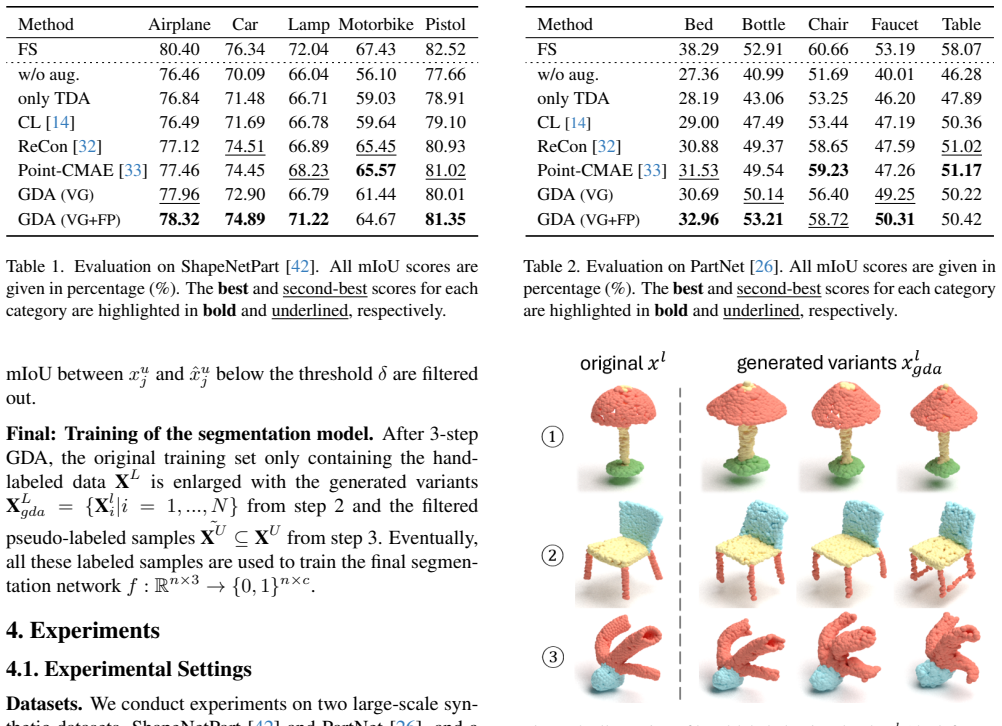
- With 10% hand labels, GDA beats traditional augmentation by 3.50 mean IoU points on ShapeNetPart, 5.41 on PartNet, and 6.38 on IntrA, and edges out the strongest tested self-supervised baseline, Point-CMAE, by 0.74, 1.38, and 1.46 points respectively.
- GDA lifts segmentation accuracy across four architectures—PointNet, PointNet++, Point Transformer, and SPoTr—so the benefit is not tied to one segmentation model.
- When objects are arbitrarily rotated, GDA's advantage over traditional augmentation grows to 20.76 mean IoU points on average, suggesting the generated variants add pose-robust shape knowledge.
- The diffusion-based pseudo-label filter outperforms both no filtering and a confidence-based filter (PseudoAugment) on the car class, showing that reconstruction fidelity is a more useful label-quality signal than prediction confidence.
- GDA is sensitive to errors in hand-labeled data: unchecked label noise causes a larger performance drop than it does for traditional augmentation, because bad labels also corrupt the generative model's variants.
Reading between the lines
- Beyond the paper, the CRD filter could serve as a general pseudo-label-quality estimator for other generative models and tasks, decoupling label validation from prediction confidence.
- Beyond the paper, the diffuse-denoise variant generation effectively interpolates between labeled and unlabeled shape manifolds, suggesting a semi-supervised augmentation recipe that might transfer to 2D images or scene-level point clouds.
- Beyond the paper, the consistent optimality of threshold $\delta = 0.7$ across categories hints at a calibration-free heuristic for pseudo-label filtering, though tests on more datasets would be needed to confirm it.
- Beyond the paper, since GDA amplifies label errors through the generative model, an obvious extension is to use CRD not only to filter pseudo-labels but also to screen hand-labeled samples before training the generator.
Editorial analysis
A structured set of objections, weighed in public.
Referee Report
Summary. The paper proposes a three-step generative data augmentation (GDA) pipeline for 3D point cloud part segmentation. It extends the Lion latent diffusion model with part-level conditioning by injecting segmentation labels into both the global encoder/diffusion and a modified part-aware PVCNN. The pipeline (Step 1) trains this generative model semi-supervised on 10% labeled and 90% unlabeled shapes, (Step 2) generates labeled variants by diffuse-denoising the labeled samples conditioned on their ground-truth masks, and (Step 3) pseudo-labels the unlabeled shapes with a temporary segmentation network and filters the pseudo-labeled samples using a novel conditional reconstruction discrepancy (CRD) measured by voxelized mIoU after a conditional diffuse-denoise pass. The authors report that GDA with variants and filtered pseudo-labels (VG+FP) outperforms traditional augmentation, the contrastive baseline CL, and the self-supervised baselines ReCon and Point-CMAE on ShapeNetPart, PartNet, and IntrA, across several backbones, and they include ablations on diffusion steps, label ratios, label quality, and arbitrary object orientations.
Significance. If the claims hold, the paper makes a useful practical contribution: it demonstrates that a label-conditioned diffusion model can generate diverse, part-labeled point clouds from very few manual annotations and that such synthetic data improves downstream segmentation. The empirical study is broad — three datasets, four segmentation backbones, comparisons with semi-supervised and self-supervised alternatives, and ablations on several factors — and the supplementary material documents the architecture in unusual detail. The central novelty, however, rests on the CRD-based pseudo-label filter, whose validity as a proxy for label correctness is asserted rather than demonstrated; the manual curation of the 10% labeled subset and category-level tuning of hyperparameters further qualify the reported advantage. The work is therefore significant but conditional: the main claims are plausible and experimentally extensive, yet the key filtering mechanism needs a direct calibration test before the pseudo-label-filtering contribution can be accepted as stated.
major comments (3)
- [Section 3.3, Step 3; Figure 1(b); Supplementary A.3] The load-bearing assumption of the paper is that CRD — the voxelized mIoU between x_u and its reconstruction after a τ′-step conditional diffuse-denoise guided by pseudo-label ŷ_u — is a valid ordering of pseudo-label correctness. The currently provided support is qualitative (Figure 5) plus a threshold search on the airplane and car categories (Supplementary A.3). Because the same generative model was trained on the same unlabeled set X_U with zero padding, and because τ′=200 leaves much of the input geometry intact, it is possible that CRD selects for shape typicality or reconstruction ease rather than for label correctness. Please add a calibration experiment on samples with known label correctness: take held-out labeled samples, corrupt a known fraction of their part labels, compute CRD for correct versus corrupted labels, and report the separation, AUC, or precision-recall of the resulting filter. Such an experiment is needed to attribute the VG+FP gains over VG in Tables 1–3 to the claimed 'validated pseudo-labeled samples' rather than to the incidental removal of atypical shapes.
- [Section 4.3, 'Quality of hand-labeled and generated data'; Table 6; Section 4.1] The main experiments use a manually curated 10% labeled subset: the paper states that the authors inspected ShapeNetPart labels and excluded problematic samples when selecting X_L. It is not reported whether the same curation was applied to the baselines (TDA, CL, ReCon, Point-CMAE), so the comparison may systematically favor GDA. Since the advertised setting is 'only a small amount of labeled samples,' the main tables should either use a random 10% subset for all methods or report paired results for both random and curated subsets. Table 6 shows that GDA drops from 67.43 to 59.27 mIoU on the arbitrarily oriented car class under random selection, so this is not a negligible effect; it directly bears on the strength of the central claim.
- [Supplementary A.3; Figure 6; Tables 1–2] The pseudo-label filtering threshold δ is selected on the airplane and car categories (Supplementary A.3), and the filtering diffusion steps τ′ are selected on the car and chair categories (Figure 6). Both sets of categories appear in the main evaluation tables, so the reported mIoU numbers for those categories are partially the result of tuning on the evaluation categories. To support the claim that GDA outperforms the baselines without category-specific tuning, please either fix δ and τ′ a priori across all categories (e.g., based on a validation split or on a non-evaluated category) or report the sensitivity of the final mIoU to these parameters for every category in Tables 1–2.
minor comments (4)
- [Section 4.2] Only the car class is repeated (10 runs, 71.49±0.27 vs. 74.92±0.46). Given that some differences in Tables 1–2 are small (e.g., GDA VG+FP vs. Point-CMAE on motorbike and table), reporting standard deviations or seeds for the closest comparisons would make the empirical claims more robust.
- [Section 4.3, 'Quality of generated labeled data'; Supplementary D.1] The L1/L2/L3 quality categorization of generated samples is based on the authors' visual inspection, and the boundary between levels is not defined quantitatively. Please provide annotation instructions, inter-rater agreement, or an automatic proxy so that the reported distribution (49/46/5, 36/50/14, 44/49/7) is reproducible.
- [Section 3.3, Step 3] The definition of CRD uses 'voxelized IoU' but does not specify the voxel resolution or the alignment/ordering of points between x_u and x̂_u. Please state the voxel grid size and any normalization used before computing the per-part IoU.
- [Equation (2), Section 3.3] The VAE balancing weights λ_z and λ_h appear in the objective but their values are not given in the main text or the implementation-details tables in the supplementary material; please report them.
Circularity Check
No significant circularity: the pipeline is evaluated against held-out ground-truth test sets and no claimed result reduces to a fitted value or a self-citation chain.
full rationale
The paper's central result, that GDA (VG+FP) improves segmentation mIoU over TDA and semi-/self-supervised baselines, is established empirically on held-out test splits of ShapeNetPart, PartNet, and IntrA. Each load-bearing stage is an independently testable operation: Step 1 trains a generative model with an ELBO plus diffusion objectives (Eqs. 2-4) on labeled data and zero-padded unlabeled data; Step 2 generates variants by diffuse-denoising labeled samples and transfers the source labels; Step 3 produces pseudo-labels with a temporary segmentation network and filters them by CRD, defined as voxelized mIoU between x_u and its pseudo-label-conditioned reconstruction. None of these equations defines its output in terms of the claimed result: CRD is a consistency heuristic, not a fitted parameter, and the final mIoU is measured against ground-truth labels not used in training. The threshold delta=0.7 is selected by a search over downstream performance, which is hyperparameter tuning rather than a prediction forced by construction. The paper's self-citations ([51]-[54]) are not load-bearing; the technical foundation is the external Lion model [45]. The assumption that CRD monotonically tracks pseudo-label correctness is an empirical premise that could fail (e.g., via shape memorization or input-dominated reconstruction), and the paper supports it only qualitatively and via threshold search; that is a correctness/robustness concern, not evidence of circularity. No equation or citation chain in the manuscript reduces a claimed contribution to its own input.
Assumptions & free parameters
free parameters (5)
- Pseudo-label filtering threshold delta =
0.7
- Diffusion steps for pseudo-label filtering tau-prime =
200
- Variant generation diffusion steps tau =
All values from 100 to 1000 in increments of 100
- Labeled sample curation =
10% of each class, manually inspected
- VAE balancing weights lambda_z and lambda_h =
Not reported
assumptions (5)
- domain assumption The diffuse-denoise process on a labeled shape conditioned on its own mask yields new shapes whose part labels remain correct.
- ad hoc to paper CRD, computed as voxelized mIoU after conditional diffusion, is a valid ordering of pseudo-label quality.
- domain assumption Zero-padding labels for unlabeled samples lets one generative model learn both labeled and unlabeled distributions without hurting reconstruction.
- ad hoc to paper The 10% labeled subset is representative enough for the pipeline, and manual curation removes artifacts without biasing the comparison.
- domain assumption Diffusion model training with 8k and 24k epochs converges to a shape prior adequate for both variant generation and pseudo-label filtering.
Cite this review
Pith. "Pith review of Generative Data Augmentation for Object Point Cloud Segmentation." pith.science (2026). https://pith.science/paper/YMTFZKWN
@misc{pith2026250517783,
  author       = {Pith},
  title        = {Pith review of: Generative Data Augmentation for Object Point Cloud Segmentation},
  year         = {2026},
  howpublished = {\url{https://pith.science/paper/YMTFZKWN}},
  note         = {Machine review of arXiv:2505.17783}
}
read the original abstract
Data augmentation is widely used to train deep learning models to address data scarcity. However, traditional data augmentation (TDA) typically relies on simple geometric transformation, such as random rotation and rescaling, resulting in minimal data diversity enrichment and limited model performance improvement. State-of-the-art generative models for 3D shape generation rely on the denoising diffusion probabilistic models and manage to generate realistic novel point clouds for 3D content creation and manipulation. Nevertheless, the generated 3D shapes lack associated point-wise semantic labels, restricting their usage in enlarging the training data for point cloud segmentation tasks. To bridge the gap between data augmentation techniques and the advanced diffusion models, we extend the state-of-the-art 3D diffusion model, Lion, to a part-aware generative model that can generate high-quality point clouds conditioned on given segmentation masks. Leveraging the novel generative model, we introduce a 3-step generative data augmentation (GDA) pipeline for point cloud segmentation training. Our GDA approach requires only a small amount of labeled samples but enriches the training data with generated variants and pseudo-labeled samples, which are validated by a novel diffusion-based pseudo-label filtering method. Extensive experiments on two large-scale synthetic datasets and a real-world medical dataset demonstrate that our GDA method outperforms TDA approach and related semi-supervised and self-supervised methods.
Figures


Figures from the paper (13 more)


Reference graph
Works this paper leans on
-
[53]
Sealion: Semantic part-aware latent point diffusion models for 3d generation
Dekai Zhu, Yan Di, Stefan Gavranovic, and Slobodan Ilic. Sealion: Semantic part-aware latent point diffusion models for 3d generation. In Proceedings of the Computer Vision and Pattern Recognition Conference , pages 11789–11798, 2025
work page 2025
-
[13]
Lpcg: A self-conditional architecture for labeled point cloud generation
Dongshuo Huang, Xiaoshui Huang, Chengdong Zhang, and Yilei Shi. Lpcg: A self-conditional architecture for labeled point cloud generation. In Proceedings of the AAAI Confer- ence on Artificial Intelligence, pages 3635–3643, 2025. 1
work page 2025
-
[1]
Synthetic data from diffusion models improves imagenet classification
Shekoofeh Azizi, Simon Kornblith, Chitwan Saharia, Mo- hammad Norouzi, and David J Fleet. Synthetic data from diffusion models improves imagenet classification. arXiv preprint arXiv:2304.08466, 2023. 2, 3
arXiv 2023
-
[2]
Segmentor: Obtaining efficient operating room semantics through temporal propa- gation
Lennart Bastian, Daniel Derkacz-Bogner, Tony D Wang, Benjamin Busam, and Nassir Navab. Segmentor: Obtaining efficient operating room semantics through temporal propa- gation. In International Conference on Medical Image Com- puting and Computer-Assisted Intervention , pages 57–67. Springer, 2023. 2
work page 2023
-
[3]
Shape self-correction for unsupervised point cloud understanding
Ye Chen, Jinxian Liu, Bingbing Ni, Hang Wang, Jiancheng Yang, Ning Liu, Teng Li, and Qi Tian. Shape self-correction for unsupervised point cloud understanding. In Proceedings of the IEEE/CVF International Conference on Computer Vi- sion, pages 8382–8391, 2021. 1
work page 2021
-
[4]
Bae-net: Branched autoencoder for shape co-segmentation
Zhiqin Chen, Kangxue Yin, Matthew Fisher, Siddhartha Chaudhuri, and Hao Zhang. Bae-net: Branched autoencoder for shape co-segmentation. In Proceedings of the IEEE/CVF International Conference on Computer Vision, pages 8490– 8499, 2019. 1, 2
work page 2019
-
[5]
Sspc-net: Semi-supervised semantic 3d point cloud segmentation net- work
Mingmei Cheng, Le Hui, Jin Xie, and Jian Yang. Sspc-net: Semi-supervised semantic 3d point cloud segmentation net- work. In Proceedings of the AAAI conference on artificial intelligence, pages 1140–1147, 2021. 1
work page 2021
-
[6]
ShapeMatcher: Self-Supervised Joint Shape Canonicalization, Segmentation, Retrieval and Deformation
Yan Di, Chenyangguang Zhang, Chaowei Wang, Ruida Zhang, Guangyao Zhai, Yanyan Li, Bowen Fu, Xiangyang Ji, and Shan Gao. Shapemaker: Self-supervised joint shape canonicalization, segmentation, retrieval and deformation. arXiv preprint arXiv:2311.11106, 2023. 1
work page Pith review arXiv 2023
Show all 63 references
-
[7]
Generative adversarial networks
Ian Goodfellow, Jean Pouget-Abadie, Mehdi Mirza, Bing Xu, David Warde-Farley, Sherjil Ozair, Aaron Courville, and Yoshua Bengio. Generative adversarial networks. Commu- nications of the ACM, 63(11):139–144, 2020. 2
2020
-
[8]
Deep residual learning for image recognition
Kaiming He, Xiangyu Zhang, Shaoqing Ren, and Jian Sun. Deep residual learning for image recognition. In Proceed- ings of the IEEE conference on computer vision and pattern recognition, pages 770–778, 2016. 4, 13
2016
-
[9]
Is synthetic data from generative models ready for image recognition? arXiv preprint arXiv:2210.07574, 2022
Ruifei He, Shuyang Sun, Xin Yu, Chuhui Xue, Wenqing Zhang, Philip Torr, Song Bai, and Xiaojuan Qi. Is synthetic data from generative models ready for image recognition? arXiv preprint arXiv:2210.07574, 2022. 3
2022 arXiv
-
[10]
Denoising dif- fusion probabilistic models
Jonathan Ho, Ajay Jain, and Pieter Abbeel. Denoising dif- fusion probabilistic models. Advances in neural information processing systems, 33:6840–6851, 2020. 2, 3
2020
-
[11]
Squeeze-and-excitation net- works
Jie Hu, Li Shen, and Gang Sun. Squeeze-and-excitation net- works. In Proceedings of the IEEE conference on computer vision and pattern recognition, pages 7132–7141, 2018. 13
2018
-
[12]
Sqn: Weakly-supervised semantic segmentation of large-scale 3d point clouds
Qingyong Hu, Bo Yang, Guangchi Fang, Yulan Guo, Ale ˇs Leonardis, Niki Trigoni, and Andrew Markham. Sqn: Weakly-supervised semantic segmentation of large-scale 3d point clouds. In European Conference on Computer Vision, pages 600–619. Springer, 2022. 1, 2
2022
-
[14]
Guided point contrastive learn- ing for semi-supervised point cloud semantic segmentation
Li Jiang, Shaoshuai Shi, Zhuotao Tian, Xin Lai, Shu Liu, Chi-Wing Fu, and Jiaya Jia. Guided point contrastive learn- ing for semi-supervised point cloud semantic segmentation. In Proceedings of the IEEE/CVF international conference on computer vision, pages 6423–6432, 2021. 1,...
2021
-
[15]
Elucidating the design space of diffusion-based generative models
Tero Karras, Miika Aittala, Timo Aila, and Samuli Laine. Elucidating the design space of diffusion-based generative models. Advances in Neural Information Processing Sys- tems, 35:26565–26577, 2022. 2
2022
-
[16]
Semi-supervised learning with deep gen- erative models
Durk P Kingma, Shakir Mohamed, Danilo Jimenez Rezende, and Max Welling. Semi-supervised learning with deep gen- erative models. Advances in neural information processing systems, 27, 2014. 2
2014
-
[17]
3d- vfield: Adversarial augmentation of point clouds for domain generalization in 3d object detection
Alexander Lehner, Stefano Gasperini, Alvaro Marcos- Ramiro, Michael Schmidt, Mohammad-Ali Nikouei Mahani, Nassir Navab, Benjamin Busam, and Federico Tombari. 3d- vfield: Adversarial augmentation of point clouds for domain generalization in 3d object detection. In Proceedings o...
2022
-
[18]
3d adversarial augmentations for robust out-of-domain predictions
Alexander Lehner, Stefano Gasperini, Alvaro Marcos- Ramiro, Michael Schmidt, Nassir Navab, Benjamin Busam, and Federico Tombari. 3d adversarial augmentations for robust out-of-domain predictions. International Journal of Computer Vision, 132(3):931–963, 2024. 3
2024
-
[19]
Pseudoaugment: Learning to use unla- beled data for data augmentation in point clouds
Zhaoqi Leng, Shuyang Cheng, Benjamin Caine, Weiyue Wang, Xiao Zhang, Jonathon Shlens, Mingxing Tan, and Dragomir Anguelov. Pseudoaugment: Learning to use unla- beled data for data augmentation in point clouds. In ECCV, pages 555–572. Springer, 2022. 7
2022
-
[20]
Less: Label-efficient semantic segmentation for lidar point clouds
Minghua Liu, Yin Zhou, Charles R Qi, Boqing Gong, Hao Su, and Dragomir Anguelov. Less: Label-efficient semantic segmentation for lidar point clouds. InEuropean Conference on Computer Vision, pages 70–89. Springer, 2022. 2
2022
-
[21]
Point- voxel cnn for efficient 3d deep learning
Zhijian Liu, Haotian Tang, Yujun Lin, and Song Han. Point- voxel cnn for efficient 3d deep learning. Advances in Neural Information Processing Systems, 32, 2019. 2, 4, 13
2019
-
[22]
One thing one click: A self-training approach for weakly supervised 3d semantic segmentation
Zhengzhe Liu, Xiaojuan Qi, and Chi-Wing Fu. One thing one click: A self-training approach for weakly supervised 3d semantic segmentation. In Proceedings of the IEEE/CVF Conference on Computer Vision and Pattern Recognition , pages 1726–1736, 2021. 2
2021
-
[23]
Project to adapt: Domain adaptation for depth completion from noisy and sparse sensor data
Adrian Lopez-Rodriguez, Benjamin Busam, and Krystian Mikolajczyk. Project to adapt: Domain adaptation for depth completion from noisy and sparse sensor data. In Proceed- ings of the Asian Conference on Computer Vision, 2020. 3
2020
-
[24]
Diffusion probabilistic models for 3d point cloud generation
Shitong Luo and Wei Hu. Diffusion probabilistic models for 3d point cloud generation. In Proceedings of the IEEE/CVF Conference on Computer Vision and Pattern Recognition , pages 2837–2845, 2021. 2, 3
2021
-
[25]
SDEdit: Guided image synthesis and editing with stochastic differential equa- tions
Chenlin Meng, Yutong He, Yang Song, Jiaming Song, Jia- jun Wu, Jun-Yan Zhu, and Stefano Ermon. SDEdit: Guided image synthesis and editing with stochastic differential equa- tions. In International Conference on Learning Representa- tions, 2022. 3
2022
-
[26]
Partnet: A large- scale benchmark for fine-grained and hierarchical part-level 9 3d object understanding
Kaichun Mo, Shilin Zhu, Angel X Chang, Li Yi, Subarna Tripathi, Leonidas J Guibas, and Hao Su. Partnet: A large- scale benchmark for fine-grained and hierarchical part-level 9 3d object understanding. In Proceedings of the IEEE/CVF conference on computer vision and pattern rec...
2019
-
[27]
An overview of deep semi-supervised learning
Yassine Ouali, C ´eline Hudelot, and Myriam Tami. An overview of deep semi-supervised learning. arXiv preprint arXiv:2006.05278, 2020. 2
2006 arXiv
-
[28]
3d part segmentation on shapenet-part
Papers with Code. 3d part segmentation on shapenet-part. https://paperswithcode.com/sota/3d-part- segmentation - on - shapenet - part, 2025. Ac- cessed: 2025-03-06. 6, 8
2025
-
[29]
Lee, Si Hyeon Kim, Yunyang Xiong, and Hyunwoo J
Jinyoung Park, S. Lee, Si Hyeon Kim, Yunyang Xiong, and Hyunwoo J. Kim. Self-positioning point-based transformer for point cloud understanding. 2023 IEEE/CVF Conference on Computer Vision and Pattern Recognition (CVPR), pages 21814–21823, 2023. 2, 6, 7, 8, 12
2023
-
[30]
Qi, Hao Su, Kaichun Mo, and Leonidas J
C. Qi, Hao Su, Kaichun Mo, and Leonidas J. Guibas. Point- net: Deep learning on point sets for 3d classification and seg- mentation. 2017 IEEE Conference on Computer Vision and Pattern Recognition (CVPR), pages 77–85, 2016. 2, 4, 6, 12, 14, 23
2017
-
[31]
C. Qi, L. Yi, Hao Su, and Leonidas J. Guibas. Pointnet++: Deep hierarchical feature learning on point sets in a metric space. In Neural Information Processing Systems, 2017. 2, 4, 6, 7, 8, 12, 13
2017
-
[32]
Contrast with reconstruct: Contrastive 3d representation learning guided by generative pretraining
Zekun Qi, Runpei Dong, Guofan Fan, Zheng Ge, Xiangyu Zhang, Kaisheng Ma, and Li Yi. Contrast with reconstruct: Contrastive 3d representation learning guided by generative pretraining. In International Conference on Machine Learn- ing, pages 28223–28243. PMLR, 2023. 1, 2, 6, 7
2023
-
[33]
Bringing masked autoencoders explicit con- trastive properties for point cloud self-supervised learning
Bin Ren, Guofeng Mei, Danda Pani Paudel, Weijie Wang, Yawei Li, Mengyuan Liu, Rita Cucchiara, Luc Van Gool, and Nicu Sebe. Bringing masked autoencoders explicit con- trastive properties for point cloud self-supervised learning. In Proceedings of the Asian Conference on Compute...
2024
-
[34]
Diffuscene: Scene graph denoising diffusion probabilistic model for generative indoor scene synthesis
Jiapeng Tang, Yinyu Nie, Lev Markhasin, Angela Dai, Jus- tus Thies, and Matthias Nießner. Diffuscene: Scene graph denoising diffusion probabilistic model for generative indoor scene synthesis. arXiv preprint arXiv:2303.14207, 2023. 3
2023 arXiv
-
[35]
Effective data augmentation with diffusion models
Brandon Trabucco, Kyle Doherty, Max Gurinas, and Ruslan Salakhutdinov. Effective data augmentation with diffusion models. arXiv preprint arXiv:2302.07944, 2023. 3
2023 arXiv
-
[36]
Few-shot learning of part-specific probability space for 3d shape segmentation
Lingjing Wang, Xiang Li, and Yi Fang. Few-shot learning of part-specific probability space for 3d shape segmentation. In Proceedings of the IEEE/CVF Conference on Computer Vision and Pattern Recognition, pages 4504–4513, 2020. 1
2020
-
[37]
Group normalization
Yuxin Wu and Kaiming He. Group normalization. In Pro- ceedings of the European conference on computer vision (ECCV), pages 3–19, 2018. 13, 14
2018
-
[38]
Pointcontrast: Unsupervised pre- training for 3d point cloud understanding
Saining Xie, Jiatao Gu, Demi Guo, Charles R Qi, Leonidas Guibas, and Or Litany. Pointcontrast: Unsupervised pre- training for 3d point cloud understanding. In Computer Vision–ECCV 2020: 16th European Conference, Glasgow, UK, August 23–28, 2020, Proceedings, Part III 16 , pages...
2020
-
[39]
Weakly supervised semantic point cloud segmentation: Towards 10x fewer labels
Xun Xu and Gim Hee Lee. Weakly supervised semantic point cloud segmentation: Towards 10x fewer labels. InPro- ceedings of the IEEE/CVF conference on computer vision and pattern recognition, pages 13706–13715, 2020. 2
2020
-
[40]
An mil-derived transformer for weakly supervised point cloud segmentation
Cheng-Kun Yang, Ji-Jia Wu, Kai-Syun Chen, Yung-Yu Chuang, and Yen-Yu Lin. An mil-derived transformer for weakly supervised point cloud segmentation. In Proceed- ings of the IEEE/CVF Conference on Computer Vision and Pattern Recognition, pages 11830–11839, 2022. 2
2022
-
[41]
Intra: 3d intracranial aneurysm dataset for deep learning
Xi Yang, Ding Xia, Taichi Kin, and Takeo Igarashi. Intra: 3d intracranial aneurysm dataset for deep learning. In CVPR, pages 2656–2666, 2020. 2, 6, 7, 12
2020
-
[42]
Yi, Vladimir G
L. Yi, Vladimir G. Kim, Duygu Ceylan, I-Chao Shen, Mengyan Yan, Hao Su, Cewu Lu, Qi-Xing Huang, Alla Sheffer, and Leonidas J. Guibas. A scalable active frame- work for region annotation in 3d shape collections. ACM Transactions on Graphics (TOG), 35:1 – 12, 2016. 2, 4, 6, 7, 8...
2016
-
[43]
Diffusion models and semi-supervised learners benefit mutually with few labels
Zebin You, Yong Zhong, Fan Bao, Jiacheng Sun, Chongx- uan Li, and Jun Zhu. Diffusion models and semi-supervised learners benefit mutually with few labels. In Proc. NeurIPS,
-
[44]
Legonet: A fast and exact unlearning architecture
Sihao Yu, Fei Sun, Jiafeng Guo, Ruqing Zhang, and Xueqi Cheng. Legonet: A fast and exact unlearning architecture. arXiv preprint arXiv:2210.16023, 2022. 3
2022 arXiv
-
[45]
Lion: Latent point diffusion models for 3d shape generation
Xiaohui Zeng, Arash Vahdat, Francis Williams, Zan Gojcic, Or Litany, Sanja Fidler, and Karsten Kreis. Lion: Latent point diffusion models for 3d shape generation. In Advances in Neural Information Processing Systems (NeurIPS), 2022. 2, 3, 4, 12, 14
2022
-
[46]
Echoscene: Indoor scene generation via information echo over scene graph diffusion
Guangyao Zhai, Evin Pinar ¨Ornek, Dave Zhenyu Chen, Ruo- tong Liao, Yan Di, Nassir Navab, Federico Tombari, and Benjamin Busam. Echoscene: Indoor scene generation via information echo over scene graph diffusion. In European Conference on Computer Vision, 2024. 3
2024
-
[47]
Commonscenes: Generating commonsense 3d indoor scenes with scene graphs
Guangyao Zhai, Evin Pınar ¨Ornek, Shun-Cheng Wu, Yan Di, Federico Tombari, Nassir Navab, and Benjamin Busam. Commonscenes: Generating commonsense 3d indoor scenes with scene graphs. Advances in Neural Information Process- ing Systems, 36, 2024. 3
2024
-
[48]
Point transformer
Hengshuang Zhao, Li Jiang, Jiaya Jia, Philip HS Torr, and Vladlen Koltun. Point transformer. In Proceedings of the IEEE/CVF international conference on computer vision, pages 16259–16268, 2021. 2, 6, 7, 8
2021
-
[49]
Toward understanding generative data augmentation
Chenyu Zheng, Guoqiang Wu, and Chongxuan Li. Toward understanding generative data augmentation. Advances in Neural Information Processing Systems, 36, 2024. 2, 3
2024
-
[50]
3d shape generation and completion through point-voxel diffusion
Linqi Zhou, Yilun Du, and Jiajun Wu. 3d shape generation and completion through point-voxel diffusion. In Proceed- ings of the IEEE/CVF International Conference on Com- puter Vision, pages 5826–5835, 2021. 2, 3
2021
-
[51]
Ipcc-tp: Utilizing incre- mental pearson correlation coefficient for joint multi-agent trajectory prediction
Dekai Zhu, Guangyao Zhai, Yan Di, Fabian Manhardt, Hendrik Berkemeyer, Tuan Tran, Nassir Navab, Federico Tombari, and Benjamin Busam. Ipcc-tp: Utilizing incre- mental pearson correlation coefficient for joint multi-agent trajectory prediction. In Proceedings of the IEEE/CVF Co...
2023
-
[52]
Multi-vehicle trajectory prediction and control at intersections using state 10 and intention information
Dekai Zhu, Qadeer Khan, and Daniel Cremers. Multi-vehicle trajectory prediction and control at intersections using state 10 and intention information. Neurocomputing, 574:127220, 2024
2024
-
[54]
Spiral: Semantic- aware progressive lidar scene generation
Dekai Zhu, Yixuan Hu, Youquan Liu, Dongyue Lu, Lingdong Kong, and Slobodan Ilic. Spiral: Semantic- aware progressive lidar scene generation. arXiv preprint arXiv:2505.22643, 2025. 1 11 Generative Data Augmentation for Object Point Cloud Segmentation Supplementary Material Contents
2025
-
[55]
Preliminaries
Methodology 3 3.1. Preliminaries . . . . . . . . . . . . . . . . . 3 3.2. Part-aware Generative Model . . . . . . . . 3 3.3. Three-step GDA Pipeline . . . . . . . . . . . 4
-
[56]
Experimental Settings
Experiments 6 4.1. Experimental Settings . . . . . . . . . . . . 6 4.2. Main Results . . . . . . . . . . . . . . . . . 7 4.3. Ablation Studies . . . . . . . . . . . . . . . 7
-
[57]
More Experimental Results 12 A.1
Conclusion 8 A . More Experimental Results 12 A.1 . GDA for Various Segmentation Models on IntrA Dataset . . . . . . . . . . . . . . . . 12 A.2 . Ratio of Labeled Samples in the Training Set 12 A.3 . Impact of mIoU Threshold for Pseudo-label Filtering . . . . . . . . . . . . ....
-
[58]
GDA (VG+FP) 48.67 PointNet++ only TDA 47.15
-
[59]
GDA for PointNet [30], PointNet++ [31], and SPoTr [29] on IntrA [41] dataset
GDA (VG+FP) 51.10 SPoTr [29] only TDA 48.62 GDA (VG+FP) 53.48 Table 8. GDA for PointNet [30], PointNet++ [31], and SPoTr [29] on IntrA [41] dataset. Label Ratio TDA GDA 5% 27.42 55.31 10% 31.09 67.43 20% 40.72 69.15 Table 9. The impact of label ratio on TDA and GDA in the car ...
-
[60]
Although the level 2 samples contain artifacts of jittering points or non-uniformly distributed points, it gener- ally maintains a reasonable shape and segmentation labels
The level 1 samples exhibit high-quality shapes and accurate point-wise labels. Although the level 2 samples contain artifacts of jittering points or non-uniformly distributed points, it gener- ally maintains a reasonable shape and segmentation labels. On the level 3 samples, ...
-
[61]
only using traditional data augmentation (TDA),
-
[62]
using a semi-supervised method based on contrastive learning (CL) [14],
-
[63]
The segmentation results on cars and airplanes from ShapeNetPart [42] are demonstrated in Fig
using generative data augmentation (GDA) based on variant generation and filtered pseudo labels. The segmentation results on cars and airplanes from ShapeNetPart [42] are demonstrated in Fig. 21 and Fig. 22 respectively. The segmentation results on tables and chairs from PartN...
Reviewed August 7, 2026 · model on record in the stance chip above.
Discussion (0). Sign in to comment.