REVIEW 4 major objections 7 minor 25 references
Counting Cycles with AI: Counting Cycles with AI: Computationally Efficient Equivalent Forms with Applications
T0 review · 4 major / 7 minor · reviewed 2026-08-07 · deepseek-v4-flash
Pith's one-line read This paper proves that cycle count statistics of any order have explicit finite-sum formulas.
desk verdict Genuinely new formulas for high-order cycle counts, but the paper's central IFS claim is explicitly conjectural and the AI-generated coefficients aren't shipped. read the letter →
The pith
A machine-rendered reading of the paper's core claim, the machinery that carries it, and where it could break.
The reading
What carries the argument
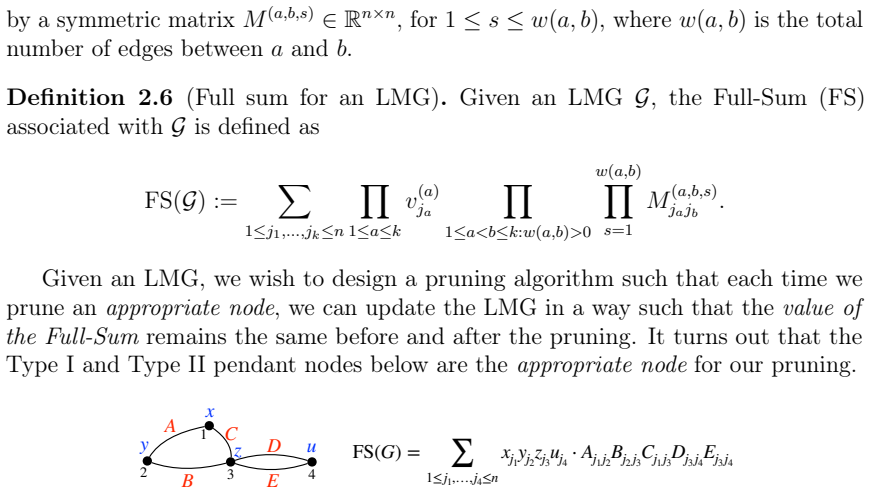
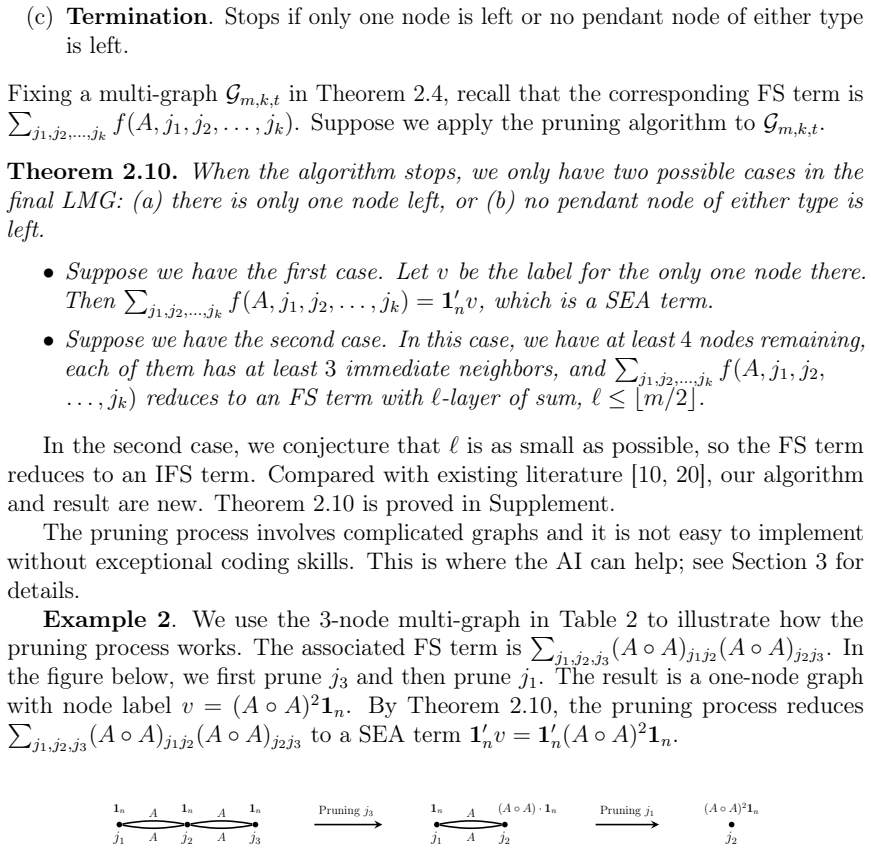
The machinery is a two-step reduction built on partitions and labeled multi-graphs. First, a merging process collapses the $m$ distinct summation indices according to a partition of the index set, producing induced multi-graphs; the Möbius function on the partition poset supplies the explicit coefficients that convert the distinct-index sum of Lemma 2.3 into the unrestricted full-sum form of Theorem 2.4. Second, each full sum is attached to a labeled multi-graph whose nodes are summation layers and whose edges are matrix entries, and a recursive pruning algorithm removes one node at a time. A Type I pendant node (one neighbor) is absorbed into its hinge by entrywise multiplication of edge labels and node labels; a Type II pendant node (two neighbors) is replaced by a new edge between its hinges computed as a diagonal-matrix product. The value of the full sum is unchanged by either update, and termination yields either a one-node graph, whose full sum is a SEA term, or a pendant-free graph with at least four nodes, whose full sum is an IFS term.
What would settle it
Take the published formulas for $m=9,\dots,12$, evaluate them on randomly generated symmetric matrices with continuous entries, and compare each result with a direct brute-force computation of $C_m$ for small $n$; any coefficient error in any term would produce a mismatch. A symbolic re-derivation of a single $m=12$ term from the stated Möbius and pruning rules that disagrees with the published formula would also settle the claim.
Extended reading notes
Core claim
On the paper's own terms, the central discovery is that the distinct-index cycle sum $C_m$ can be replaced by unrestricted full sums without changing the statistic, provided the coefficients are taken from the Möbius function of the partition poset (Theorem 2.4). Each full-sum term is represented as the full sum of a labeled multi-graph, and a recursive pruning process removes pendant nodes while preserving the value of the sum (Theorem 2.10). When pruning stops, either a one-node graph remains and the term collapses to a succinct algebraic (SEA) term of the form $\mathbf{1}_n^T v$, or an irreducible graph with at least four nodes and no pendants remains and the term is an incompressible full-sum (IFS) term. The paper presents these formulas explicitly for $m=3,\dots,12$ and describes the human-guided AI pipeline that produced the code for enumerating multi-graphs, checking isomorphism, computing coefficients, and applying the pruning rules.
Load-bearing premise
The load-bearing premise is that the AI-generated code that enumerates partition-induced multi-graphs, checks isomorphism, computes the Möbius coefficients, and applies the pruning rules is correct for every $m$; the paper validates that code only against binary-case formulas for $m$ up to $13$ and brute-force checks for small $n$, not with a formal proof of the code.
Editorial extensions
If this is right
- For any symmetric matrix $A$ and any $m$, $C_m$ can be evaluated with far fewer summation layers than the brute-force $m$-layer loop; the paper's $m=8$ formula, for instance, runs in $O(n^4)$ instead of $O(n^8)$.
- High-order cycle count statistics become practical for large-scale network and matrix data, since the paper's formulas make computing $C_m$ feasible where direct enumeration is not.
- The same decomposition framework extends to related counting problems, including paths between two nodes and cycles in asymmetric matrices, as the paper notes in Remark 3.
- The formulas reproduce the known binary-case cycle counts for $m=3,\dots,13$, matching the best existing results for undirected graphs in that range.
Reading between the lines
- Editorial inference: if the pruning rules are complete, then the irreducible graphs left after pruning provide a canonical classification of incompressible cycle-sum terms, so the $m=8$ IFS term is not an anomaly but the first member of an infinite family indexed by pendant-free multi-graphs.
- Editorial inference: the same Möbius-plus-pruning pipeline could be applied to related statistics such as sums over closed walks with repeated vertices or cycles in directed graphs; a direct next step would be to generate formulas for a directed analogue and compare them with brute force for small $n$.
- Editorial inference: because the published formulas were produced by AI-generated code rather than by a fully formal derivation, a meaningful reproducibility test is to ship the exact code and prompts and regenerate the $m=12$ formula independently; non-binary random-matrix checks would be the strongest evidence that the formulas hold beyond the binary validation range.
Signed reviews
Editorial analysis
A structured set of objections, weighed in public.
Referee Report
Summary. The paper proposes a human-AI collaborative method to derive Computationally Efficient Equivalent Forms (CEEF) for the order-m cycle count statistic C_m, defined as the sum over distinct indices of products of entries of a symmetric matrix A. The main theoretical steps are Theorem 2.4, which expresses C_m as a linear combination of full-sum terms with coefficients given by Möbius inversion and explicit combinatorial factors, and Theorem 2.10, which provides a pruning algorithm that rewrites each full-sum term as either a succinct expressive algebraic (SEA) term or an incompressible full-sum (IFS) term. The authors report explicit formulas for m=3,...,12 generated by DeepSeek-R1, validate them against the binary-case formulas of Perepechko and Voropaev [20] for m<=13 and against brute-force computation for small n, and give a small simulation study indicating that higher-order C_m improve performance in a low-rank matrix detection problem. The paper also discusses the division of labor between humans and AI and compares five large language models on the subtasks.
Significance. If the formulas are correct, the paper would be a significant computational contribution: it would provide explicit polynomial-complexity expressions for cycle count statistics of arbitrary order for general symmetric matrices, going well beyond the binary-case formulas in [20] and the hand-derived cases in [10, 4, 19, 13]. The m=8 example in Table 1 illustrates a reduction from O(n^8) to O(n^4) complexity. The approach itself, combining Möbius inversion on set partitions with a graph-pruning algorithm, appears novel and is clearly distinct from prior work. The paper is also methodologically valuable as a documented case study of human-guided AI for research-level combinatorics, including a comparison of five LLMs and a transparent account of prompt design. However, these strengths are tempered by two load-bearing gaps: the IFS part of the advertised CEEF solution is explicitly left as a conjecture in Theorem 2.10, and the explicit formulas are produced by AI-generated code that is not shipped in the preprint and is validated only against binary-case results and small-n brute force.
major comments (4)
- [Section 2.2, Theorem 2.10] The theorem's second case only proves that, when no pendant remains, the surviving full-sum term has at most floor(m/2) layers; the text immediately adds 'we conjecture that l is as small as possible, so the FS term reduces to an IFS term.' Since the CEEF problem is defined by a decomposition into SEA or IFS terms, the paper's central claim of solving the CEEF problem is not established for any m with non-SEA terms. Moreover, the numerical validation in Section 3 checks equality of C_m, not the incompressibility of individual FS terms, so it cannot detect a violation of the IFS condition. The authors should either prove the incompressibility conjecture or explicitly state that the full CEEF result is conditional on it.
- [Section 3, 'Results and validation'] The correctness of the explicit formulas for m=3,...,12 rests on AI-generated Python code that is not included in the submission (the paper says the code and formulas are in the Supplement, which is not provided). The validation against [20] concerns only binary A, and the brute-force checks are reported only for small n. Consequently, the enumerated coefficients and the claimed SEA/IFS forms for general non-binary A cannot be independently verified from the preprint. Please include the code and the complete list of formulas, or describe a machine-checkable certificate for the enumeration and the pruning outputs.
- [Introduction and Discussion vs. Section 2.2] The Introduction states that 'we are able to solve the problem' and the Discussion says 'we solved a long-lasting open problem', but Section 2.2 leaves the IFS reduction as a conjecture, and all proofs (Lemma 2.3, Theorem 2.4, Lemma 2.8, Theorem 2.10) are deferred to a Supplement that is not included. The claims in the paper should be scaled to what is actually proved in the manuscript, with the unresolved conjecture clearly flagged as a limitation of the central claim rather than as a completed part of the solution.
- [Section 2.1, Theorem 2.4 proof status] While the m=4 example and the validation against [20] support the plausibility of Theorem 2.4, the proof is not present in the manuscript; the text only says it is proved in the Supplement. For a result that is the foundation of all subsequent formulas, the referee cannot check the Möbius coefficient derivation, the treatment of the distinct-index constraint, or the one-to-one correspondence between partitions and induced multi-graphs. The authors should include the full proof in the main text or provide the Supplement with the submission.
minor comments (7)
- [Title and abstract] The abstract and the full text carry different titles ('Counting Cycles with AI: Counting Cycles with AI: ...' versus 'Counting Cycles with Deepseek') and different author lists; the duplicated phrase in the abstract title and the discrepancy need to be corrected.
- [Equation (1)] The notation 'dist' is used without definition; please state explicitly that the sum is over pairwise distinct indices i1,...,im.
- [Section 1, notation] The symbol '1_n' (transpose of the all-ones vector) is used in Table 1 and elsewhere but is not defined in the notational paragraph; define it together with d(v) and the Hadamard product.
- [Example 3] The text says 'the corresponding LGM has no pendant of either form'; this should be 'LMG' (labeled multi-graph) for consistency with Definition 2.5.
- [Section 2.2, step (b)] The sentence 'prune it and and update the LMG' contains a duplicated 'and'.
- [Section 4] The simulation reports only 100 replications with no error bars or standard errors; the statement that 'optimal statistical performance is achieved by using high-order cycle count statistics' is stronger than what the reported experiment supports and should be reworded as an empirical illustration.
- [Typo in Section 2.1] The text refers to the 'Möbius function' in one place; this should be 'Möbius'.
Circularity Check
The derivation is self-contained: Möbius-inversion coefficients and pruning identities are derived from first principles, and the unproved IFS conjecture is a gap in the proof, not a circular step.
full rationale
The paper's central derivation does not reduce to its inputs. Theorem 2.4 obtains coefficients a_{m,k,t} = (-1)^{m-k} d_{m,k,t} h_{m,k,t} via the Möbius function on the partition lattice (Definitions 2.1-2.2), a standard inclusion-exclusion inversion, so the full-sum decomposition is not fitted to C_m. Lemma 2.8 states algebraic updating rules (Type I: u_new = u composed with the Hadamard product of edge matrices times v; Type II: new edge label E = (Q^(1) composed with ... composed with Q^(s)) times d(y) times (R^(1) composed with ... composed with R^(t))) that preserve FS(G) exactly; repeated pruning therefore gives the SEA term 1'_n v as an identity, not as a prediction from data. Validation against the independent binary-case formulas of Perepechko and Voropaev [20] and against brute-force computation for small n is external evidence, not circular. Self-citations [13]-[16] occur only in the motivation and applications sections and are not load-bearing for the formula derivation. The paper itself flags a genuine limitation at Theorem 2.10: in the no-pendant case it proves only ell <= floor(m/2) and then says 'we conjecture that ell is as small as possible, so the FS term reduces to an IFS term'; this makes the IFS part of the advertised CEEF solution conditional. The AI-generated enumeration code is also not shipped, so its correctness for general non-binary A is numerically validated rather than formally proved. These are verifiability and completeness gaps, not circularity.
Assumptions & free parameters
assumptions (3)
- domain assumption A is symmetric with zero diagonal entries (Aii=0).
- domain assumption Multi-graphs with self-loops are excluded from the decomposition because the corresponding products are zero under Aii=0.
- standard math The Möbius function on the partition lattice satisfies mu(0,sigma)=(-1)^{m-|sigma|} prod_i (|S_i|-1)!, as in Stanley's Enumerative Combinatorics.
Cite this review
Pith. "Pith review of Counting Cycles with AI: Counting Cycles with AI: Computationally Efficient Equivalent Forms with Applications." pith.science (2026). https://pith.science/paper/VO37QUIJ
@misc{pith2026250517964,
  author       = {Pith},
  title        = {Pith review of: Counting Cycles with AI: Counting Cycles with AI: Computationally Efficient Equivalent Forms with Applications},
  year         = {2026},
  howpublished = {\url{https://pith.science/paper/VO37QUIJ}},
  note         = {Machine review of arXiv:2505.17964}
}
read the original abstract
Cycle count statistics are fundamental tools in statistics and engineering, with applications in motif counting, channel coding, and statistical inference of network and matrix data. However, how to compute high-order cycle count statistics efficiently is still an open problem. In this paper, we aim to derive Computationally Efficient Equivalent Forms (CEEF) for cycle count statistics of any given order, where we express each cycle count statistic equivalently as a linear combination of finitely many terms. Using the CEEF, we provide a much more efficient way to compute the cycle count statistics. The CEEF problem has no known general solution and requires delicate combinatorial arguments together with extensive calculations. While this task is hard to accomplish by humans alone, it provides an ideal setting in which Artificial Intelligence (AI) can be useful. We solve the problem by combining several theorems we derive with powerful coding skills of modern AI systems. Our results leverage graph-theoretic arguments and yield new formulas for general cases that were previously unknown. We find that, although AI cannot solve the problem independently, it becomes highly effective when guided by humans through theorems we derive as well as a clear derivation strategy, step-by-step instructions, and carefully-written prompts. We consider several statistical applications, including spiked matrix testing, estimation of weak spike eigenvalues, and pairwise network comparison. For each problem, we demonstrate that optimal statistical performance is achieved by using high-order cycle count statistics, and our CEEF formulas make their computation feasible on large-scale data sets.
Figures

Figures from the paper (2 more)


Reference graph
Works this paper leans on
-
[20]
The number of fixed length cycles in an undirected graph
Sergey Perepechko and Anton Voropaev. The number of fixed length cycles in an undirected graph. explicit formulae in case of small lengths.Mathematical Modeling and Computational Physics (MMCP2009), 148, 2009
work page 2009
-
[1]
Global lyapunov func- tions: A long-standing open problem in mathematics with symbolic transformers
Alberto Alfarano, François Charton, and Amaury Hayat. Global lyapunov func- tions: A long-standing open problem in mathematics with symbolic transformers. InAdvances in Neural Information Processing Systems 38, 2024. Poster
work page 2024
-
[2]
A.J. Bondy and U.S.R. Murty.Graph Theory with Applications. Wiley, 1991
work page 1991
-
[3]
Language models are few-shot learners
Tom Brown, Benjamin Mann, Nick Ryder, Melanie Subbiah, Jared D Kaplan, Prafulla Dhariwal, Arvind Neelakantan, Pranav Shyam, Girish Sastry, Amanda Askell, Sandhini Agarwal, Ariel Herbert-Voss, Gretchen Krueger, Tom Henighan, Rewon Child, Aditya Ramesh, Daniel Ziegler, Jeffrey Wu, Clemens Winter, Chris Hesse, Mark Chen, Eric Sigler, Mateusz Litwin, Scott Gr...
work page 1901
-
[4]
Y.C. Chang and H.L. Fu. The number of 6-cycles in a graph.Bulletin of the Institute of Combinatorics and its Applications, 39, 01 2003
work page 2003
-
[5]
Advancing mathematics by guiding human intuition with AI.Nature, 600(7887):70–74, 2021
Alex Davies, Petar Veličković, Lars Buesing, Sam Blackwell, Daniel Zheng, Nenad Tomašev, Richard Tanburn, Peter Battaglia, Charles Blundell, András Juhász, Marc Lackenby, Geordie Williamson, Demis Hassabis, and Pushmeet Kohli. Advancing mathematics by guiding human intuition with AI.Nature, 600(7887):70–74, 2021
work page 2021
-
[6]
Patti, Jayson Lynch, Avi Shporer, Nakul Verma, Eugene Wu, and Gilbert Strang
Iddo Drori, Sarah Zhang, Reece Shuttleworth, Leonard Tang, Albert Lu, Eliza- beth Ke, Kevin Liu, Linda Chen, Sunny Tran, Newman Cheng, Roman Wang, Nikhil Singh, Taylor L. Patti, Jayson Lynch, Avi Shporer, Nakul Verma, Eugene Wu, and Gilbert Strang. A neural network solves, explains, and generates univer- sity math problems by program synthesis and few-sho...
work page 2022
-
[7]
Evgenii Evstafev. Token-hungry, yet precise: Deepseek r1 highlights the need for multi-step reasoning over speed in math.ArXiv, 2024
work page 2024
Show all 25 references
-
[8]
Testing for global network structure using small subgraph statistics.arXiv preprint arXiv:1710.00862, 2017
Chao Gao and John Lafferty. Testing for global network structure using small subgraph statistics.arXiv preprint arXiv:1710.00862, 2017. 17
2017 arXiv
-
[9]
Deepseek-r1: Incen- tivizing reasoning capability in llms via reinforcement learning.arXiv preprint arXiv:2501.12948, 2025
Daya Guo, Dejian Yang, Haowei Zhang, Junxiao Song, Ruoyu Zhang, Runxin Xu, Qihao Zhu, Shirong Ma, Peiyi Wang, Xiao Bi, et al. Deepseek-r1: Incen- tivizing reasoning capability in llms via reinforcement learning.arXiv preprint arXiv:2501.12948, 2025
2025 arXiv
-
[10]
Harary.Graph Theory
F. Harary.Graph Theory. Addison-Wesley Series in Mathematics. Addison- Wesley Longman, Incorporated, 1969
1969
-
[11]
On the number of cycles in a graph.Matem- aticky casopis, 21(1):55–63, 1971
Frank Harary and Bennet Manvel. On the number of cycles in a graph.Matem- aticky casopis, 21(1):55–63, 1971
1971
-
[12]
Measuring mathematical problem solving with the MATH dataset
Dan Hendrycks, Collin Burns, Saurav Kadavath, Akul Arora, Steven Basart, Eric Tang, Dawn Song, and Jacob Steinhardt. Measuring mathematical problem solving with the MATH dataset. InAdvances in Neural Information Processing Systems 34 (Datasets & Benchmarks Track), 2021
2021
-
[13]
Optimal adaptivity of signed- polygon statistics for network testing.The Annals of Statistics, 49(6):3408–3433, 2021
Jiashun Jin, Zheng Tracy Ke, and Shengming Luo. Optimal adaptivity of signed- polygon statistics for network testing.The Annals of Statistics, 49(6):3408–3433, 2021
2021
-
[14]
Optimal estimation of the number of network communities.Journal of the American Statistical Association, 118(543):2101–2116, 2023
Jiashun Jin, Zheng Tracy Ke, Shengming Luo, and Minzhe Wang. Optimal estimation of the number of network communities.Journal of the American Statistical Association, 118(543):2101–2116, 2023
2023
-
[15]
Network goodness-of-fit for the block-model family.Journal of the American Statistical Association, pages 1–27, 2025
Jiashun Jin, Zheng Tracy Ke, Jiajun Tang, and Jingming Wang. Network goodness-of-fit for the block-model family.Journal of the American Statistical Association, pages 1–27, 2025
2025
-
[16]
Spectrum estimation from samples.The Annals of Statistics, 45(6):2218–2247, 2017
Weihao Kong and Gregory Valiant. Spectrum estimation from samples.The Annals of Statistics, 45(6):2218–2247, 2017
2017
-
[17]
Hypertree proof search for neural theorem proving
Guillaume Lample, Marie-Anne Lachaux, Thibaut Lavril, Xavier Martinet, Amaury Hayat, Gabriel Ebner, Aurélien Rodriguez, and Timothée Lacroix. Hypertree proof search for neural theorem proving. InAdvances in Neural Information Processing Systems 35, 2022
2022
-
[18]
Two sample tests for high-dimensional covariance matrices.The Annals of Statistics, 40(2):908–940, 2012
Jun Li and Song Xi Chen. Two sample tests for high-dimensional covariance matrices.The Annals of Statistics, 40(2):908–940, 2012
2012
-
[19]
On the number of cycles in a graph
Nazanin Movarraei and Samina Boxwala. On the number of cycles in a graph. Open Journal of Discrete Mathematics, 6:41–49, 03 2016. 18
2016
-
[21]
Pawan Kumar, Emilien Dupont, Francisco J
Bernardino Romera-Paredes, Mohammadamin Barekatain, Alexander Novikov, Matej Balog, M. Pawan Kumar, Emilien Dupont, Francisco J. R. Ruiz, Jordan S. Ellenberg, Pengming Wang, Omar Fawzi, Pushmeet Kohli, and Alhussein Fawzi. Mathematical discoveries from program search with larg...
2024
-
[22]
Stanley.Enumerative Combinatorics
Richard P. Stanley.Enumerative Combinatorics. Cambridge Studies in Advanced Mathematics. Cambridge University Press, 2 edition, 2011
2011
-
[23]
Trinh andet al
Trieu H. Trinh andet al. Solving olympiad geometry without human demonstra- tions.Nature, 625(7995):4760–482, 2024
2024
-
[24]
Chain-of-thought prompting elicits reasoning in large language models
Jason Wei, Xuezhi Wang, Dale Schuurmans, Maarten Bosma, brian ichter, Fei Xia, Ed Chi, Quoc V Le, and Denny Zhou. Chain-of-thought prompting elicits reasoning in large language models. In S. Koyejo, S. Mohamed, A. Agarwal, D. Belgrave, K. Cho, and A. Oh, editors,Advances in Ne...
2022
-
[25]
miniF2F: A cross-system benchmark for formal olympiad-level mathematics
Kunhao Zheng, Jesse Michael Han, and Stanislas Polu. miniF2F: A cross-system benchmark for formal olympiad-level mathematics. InInternational Conference on Learning Representations, 2022. 19
2022
Reviewed August 7, 2026 · model on record in the stance chip above.
Discussion (0). Continue with ORCID to comment.