REVIEW 4 major objections 6 minor 58 references
TRACE for Tracking the Emergence of Semantic Representations in Transformers
T0 review · 4 major / 6 minor · reviewed 2026-08-07 · deepseek-v4-flash
Pith's one-line read TRACE claims that transformer models cross a measurable phase transition, marked by a Hessian-curvature/intrinsic-dimensionality intersection, where they shift from memorising to abstracting linguistic structure.
desk verdict The paper's assets—ABSynth, the C(H) score, honest MI reporting—are real, but its central phase-transition claim rests on the crossing of two curves with arbitrary scales, and the probing evidence is confounded by token names that encode the labels. read the letter →
The pith
A machine-rendered reading of the paper's core claim, the machinery that carries it, and where it could break.
The reading
What carries the argument
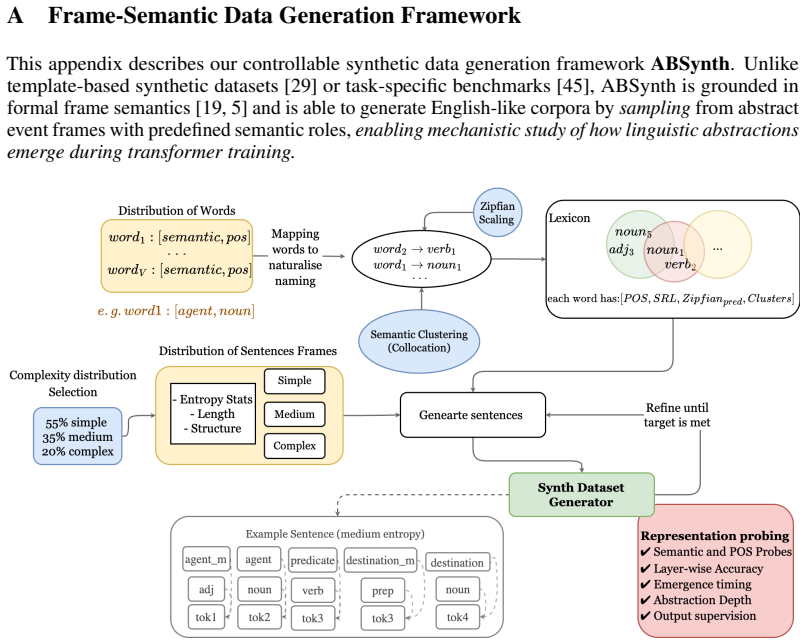
The argument is carried by three coordinated instruments. The first is the curvature complexity score C(H) = Tr(H)/sqrt(reff), computed from the top eigenvalues of the Hessian, where reff is the entropy-based effective rank of the spectrum; this score combines overall curvature magnitude with its concentration. The second is the TWO-NN intrinsic dimensionality estimator, which infers local manifold dimension from the ratio of first-to-second nearest-neighbour distances and is averaged across layers. The third is ABSynth, a frame-semantic corpus generator whose sentences carry ground-truth syntactic and semantic role labels, so probes can be trained at every training step. The paper reads the crossing of the first two curves as the phase-transition marker and validates it by the rise in probe confidence.
What would settle it
Take the same checkpoint sequence and divide either C(H) or the layer-averaged ID by a constant (or normalise both curves to a common vertical range), then re-locate the intersection; if the reported transition step changes continuously with the rescaling, the crossing is a plotting artefact. A second decisive check is to run the same three models on a natural-language corpus with approximate annotations; the claimed universal signature would predict a coordinated intersection and probe surge there too.
Extended reading notes
Core claim
The paper's central discovery is that transformer training on structured linguistic input exhibits a consistent two-phase dynamic: an early phase of rising intrinsic dimensionality and elevated, concentrated curvature, followed by a transition in which curvature flattens, intrinsic dimensionality stabilises, and probe confidence for syntactic and semantic categories rises. The authors identify the transition as the intersection between C(H) and the layer-averaged ID, and report that this intersection occurs sharply around step 5000 for the large model, later and noisier for the small model, and that it persists when feedforward networks are removed and when attention heads are reduced. They interpret this as evidence that abstraction emerges through a phase transition rather than gradual accumulation, and that the geometric signature is a fundamental property of transformer optimisation on sequential data rather than an artefact of a specific architectural component.
Load-bearing premise
The load-bearing premise is that the intersection of two curves with different units—a curvature score and a dimension count—marks a real event; if either curve is rescaled arbitrarily, the crossing moves along the training axis, and the paper gives no invariance argument that fixes the scales.
Editorial extensions
If this is right
- Curvature and intrinsic dimensionality could be used as cheap, training-time signals for when a model begins to form abstractions, independent of downstream evaluation.
- Removing feedforward networks does not eliminate the phase transition; it mainly adds volatility, so the transition does not depend on FFN capacity.
- Reducing attention heads delays and dampens the transition in the small model but not in larger ones, so attention expressivity matters most at smaller scale.
- Mutual information estimates are too variable in this setting to serve as a reliable abstraction indicator, so TRACE excludes them from its core signature.
- The same geometric markers should transfer to pre-trained models and fine-tuning regimes, where curvature and dimensionality can be measured without annotated corpora.
Reading between the lines
- The quantitative transition times (for instance, step 5000 for the large model) should be treated as reports of a particular plotting scale; an invariance-respecting version of the criterion would need to normalise C(H) and ID on a common scale before claiming exact step numbers.
- Because ABSynth is fully labelled and grammatically clean, the framework tests learning dynamics in an idealised language; whether the same coordinated intersection appears on noisy natural text is a testable open question the paper does not settle.
- If the crossover is a genuine optimisation-geometry event, it suggests interventions such as changing the learning-rate schedule or pruning at the transition step could control abstraction onset, an engineering consequence the paper does not pursue.
Editorial analysis
A structured set of objections, weighed in public.
Referee Report
Summary. The manuscript presents TRACE, a diagnostic framework that tracks spectral Hessian curvature, intrinsic dimensionality, and linguistic probe accuracy during training of small decoder-only transformers. The data come from ABSynth25K, a synthetic, fully annotated frame-semantic corpus. The authors report a consistent phase transition in which curvature collapses and intrinsic dimensionality stabilizes, marked by an intersection of the C(H) and ID curves, and claim this coincides with the emergence of syntactic and semantic category structure, with the pattern robust across model scales and architectural ablations. The main contributions are the C(H) curvature score, the ABSynth generator, and the multi-signal monitoring protocol.
Significance. TRACE's multi-signal design and the ABSynth corpus are potentially useful resources, and the paper is transparent about the failure of mutual information as a diagnostic. However, the headline finding is not established: the phase-transition time is defined as the crossing of two quantities with different units and arbitrary axis scalings, so the reported step-5000 transition for the large model is not an invariant property of training dynamics. The probe evidence is also confounded because ABSynth labels are deterministically derived from token names, and the probe architecture description is internally inconsistent. As a result, the paper currently provides a collection of observations rather than a validated method for detecting abstraction onset.
major comments (4)
- [§4.1, Eqs. (1)-(2), Fig. 2] The central phase transition is defined by the intersection of C(H) = Tr(H)/√r_eff and the mean TWO-NN intrinsic dimensionality. These quantities are not commensurable: C(H) carries the scale of the Hessian trace, while ID is a count of local degrees of freedom. In Fig. 2 they are plotted on separate vertical axes with ranges chosen for visual clarity. A positive rescaling of either curve moves the intersection time monotonically, and because C(H) decays while ID rises, an intersection is essentially guaranteed. The paper gives no normalization rule or invariance argument, and no computational criterion for locating the intersection. Consequently, the reported transition times (e.g., 'around step 5000' for the large model) are artifacts of the twin-axis scaling rather than independently measured events. The authors should define the transition by a scale-invariant criterion applied to each metric separately and then test for temporal coordination, or demonstrate that the crossing is invariant under renormalization.
- [§3.3, Appendix B.6] The probing results are confounded by the data-generation scheme. Appendix B.6 states that 'both POS and semantic labels are deterministically derived from token names,' and token names such as 'noun3' explicitly encode the POS category. A probe trained on hidden states can therefore achieve high accuracy by relying on surface token identity, without representing any abstraction over roles or categories. The random-initialization control in Appendix B.9 only shows that untrained embeddings do not support this readout; it does not distinguish memorization of token names from abstraction over category structure. The interpretation in §3.3 that probes reveal 'alignment with underlying semantic functions rather than memorised token identities' is therefore unsupported. The authors should test whether probe accuracy transfers to held-out token names that realize the same categories (e.g., unseen noun tokens) or otherwise control for token identity.
- [§3.3, Appendix B.6] There is an internal contradiction about the probe model. Section 3.3 defines p^{(ℓ)}_c as a linear classifier and motivates the analysis in terms of linear separability, but Appendix B.6 describes a three-layer feedforward network with ReLU activations and dropout. A nonlinear MLP probe can fit features that are not linearly accessible, so the evidence for 'linear' representational abstraction is weaker than claimed. The authors should either use true linear probes for the main claims or explicitly describe and justify the nonlinear probe.
- [Appendix B.8, Tables 4-6] The text introducing Tables 4-6 says they report average POS probe performance 'for the small, medium, and large models, respectively,' but all three table captions identify the Large Model (Layer 0, Layer 1, Layer 2). As printed, the cross-scale probe evidence is not present in these tables; the captions or the tables need to be corrected, and the claimed scale-dependence of probe accuracy must be verifiable.
minor comments (6)
- [§3.2] The display equation for the layer-averaged ID contains a stray double comma; also use a distinct symbol for the layer-averaged quantity to avoid confusion with the layerwise estimator.
- [§B.3] 'Grokking phoneme' should be 'grokking phenomenon.'
- [Appendix B.10] 'matplotlib' is listed twice in the software environment list.
- [Abstract and §5] The abstract and Section 5 still list mutual information among the coordinated signals, while Section 3.4 and Section 4.4 state that MI was too volatile to use; the narrative should be aligned.
- [Table 1] The heading 'V ocabulary' should be 'Vocabulary.'
- [§B.8] 'receptively' should be 'respectively.'
Circularity Check
The central 'phase transition' claim is forced by defining the transition as the crossing of two arbitrarily scaled curves with different units.
-
self definitional
[Section 4.1, Eq. (1), Eq. (2), Fig. 2 and caption]
"Across all model configurations, we observe a robust two-phase training dynamic: an initial regime of rising ID and elevated curvature, followed by a transition into flatter curvature and stabilised representational complexity (Fig. 2). This transition is marked by a consistent intersection between the Hessian curvature score (blue) and ID trajectories (red), which we interpret as a phase shift in learning dynamics."
C(H) from Eq. (1) is Tr(H)/sqrt(r_eff), a quantity with units of a Hessian trace divided by a dimensionless effective rank, while ID from Eq. (2) is a dimensionless estimated local dimension. The two are plotted on separate vertical axes with independently chosen ranges in Fig. 2. A decreasing C(H) curve and an increasing ID curve will cross somewhere whenever the chosen axis ranges overlap, and the crossing step can be moved monotonically by multiplying either curve by a positive constant, equivalently by changing either twin-axis scale. The paper gives no normalization rule or invariance argument, so the reported intersection at 'around step 5000' for the large model is a property of the plot's scale, not an independently measured event.
-
other
[Appendix B.6 (Probing Framework and Label Construction) and Section 3.3]
"Due to the synthetic nature of our dataset, both POS and semantic labels are deterministically derived from token names. For example, a token such as noun3 is assigned the POS label NOUN and may additionally be annotated with semantic roles such as AGENT or ENTITY, depending on the symbolic structure of the task."
Section 3.3 defines abstraction as internalizing role-based generalizations 'that extend beyond surface lexical forms—for example, recognising the ARG2 role regardless of whether it is realised as "noun3", or "location22".' But because every token name deterministically encodes its POS and semantic labels, a linear probe can achieve high confidence by memorizing the surface token identity noun3, verb2, and so on. The rising probe-confidence curves used as evidence of 'emerging syntactic and semantic accuracy' are therefore confounded with surface-form memorization by construction of the label scheme; they do not by themselves separate abstraction over category structure from recognition of token-name identity.
full rationale
The central result of the paper is that phase transitions are 'marked by a consistent intersection' between the Hessian curvature score C(H) and the intrinsic dimensionality ID. This intersection is not an invariant observable: C(H) and ID have different units, are plotted on separate axes with free ranges, and the crossing time is movable by rescaling either curve. Without a stated normalization or invariance criterion, the reported transition step is an artifact of plotting scale rather than an independent measurement, so the main claim reduces to the paper's own definition of the transition marker. The linguistic alignment claims are further weakened because the probe labels are deterministic functions of token names, so probe accuracy can reflect surface token memorization rather than the cross-token abstraction the paper defines. There is a self-citation to Aljaafari et al. [3] in Section 4.4, but it concerns only the discarded mutual-information signal and is not load-bearing. The experiments are otherwise self-contained and reproducible, but the central phase-transition identification is forced by the chosen definition and axis scaling.
Assumptions & free parameters
free parameters (4)
- ABSynth Zipf exponent alpha =
1.05
- Cluster association strength intervals =
intra [0.4, 0.7]; inter [0.05, 0.2]
- Entropy tier boundaries and complexity mix =
low 0.5-1.5, medium 1.5-3.0, high 3.0-4.5 bits; 55/35/10 simple/medium/complex
- Training epoch count =
500 epochs for all models
assumptions (5)
- domain assumption The top-K Lanczos Hessian spectrum is a faithful summary of loss-landscape curvature relevant to abstraction.
- domain assumption Flat minima with concentrated curvature correspond to generalisation and abstraction.
- ad hoc to paper The crossing point of unnormalized C(H) and mean ID curves marks a real phase transition.
- domain assumption Linear probes on frozen hidden states measure internal abstraction rather than surface token statistics.
- domain assumption The ABSynth synthetic corpus captures the relevant properties of natural language for abstraction emergence.
Cite this review
Pith. "Pith review of TRACE for Tracking the Emergence of Semantic Representations in Transformers." pith.science (2026). https://pith.science/paper/S6TQ2AMI
@misc{pith2026250517998,
  author       = {Pith},
  title        = {Pith review of: TRACE for Tracking the Emergence of Semantic Representations in Transformers},
  year         = {2026},
  howpublished = {\url{https://pith.science/paper/S6TQ2AMI}},
  note         = {Machine review of arXiv:2505.17998}
}
read the original abstract
Modern transformer models exhibit phase transitions during training, distinct shifts from memorisation to abstraction, but the mechanisms underlying these transitions remain poorly understood. Prior work has often focused on endpoint representations or isolated signals like curvature or mutual information, typically in symbolic or arithmetic domains, overlooking the emergence of linguistic structure. We introduce TRACE (Tracking Representation Abstraction and Compositional Emergence), a diagnostic framework combining geometric, informational, and linguistic signals to detect phase transitions in Transformer-based LMs. TRACE leverages a frame-semantic data generation method, ABSynth, that produces annotated synthetic corpora with controllable complexity, lexical distributions, and structural entropy, while being fully annotated with linguistic categories, enabling precise analysis of abstraction emergence. Experiments reveal that (i) phase transitions align with clear intersections between curvature collapse and dimension stabilisation; (ii) these geometric shifts coincide with emerging syntactic and semantic accuracy; (iii) abstraction patterns persist across architectural variants, with components like feedforward networks affecting optimisation stability rather than fundamentally altering trajectories. This work advances our understanding of how linguistic abstractions emerge in LMs, offering insights into model interpretability, training efficiency, and compositional generalisation that could inform more principled approaches to LM development.
Figures


Figures from the paper (9 more)



Reference graph
Works this paper leans on
-
[1]
Intrinsic dimensionality explains the effectiveness of language model fine-tuning
Armen Aghajanyan, Sonal Gupta, and Luke Zettlemoyer. Intrinsic dimensionality explains the effectiveness of language model fine-tuning. In Proceedings of the 59th Annual Meeting of the Association for Computational Linguistics and the 11th International Joint Conference on Natural Language Processing (Volume 1: Long Papers), pages 7319–7328, Online, 2021....
work page 2021
-
[2]
How to escape sharp minima with random perturbations
Kwangjun Ahn, Ali Jadbabaie, and Suvrit Sra. How to escape sharp minima with random perturbations. In Proceedings of the 41st International Conference on Machine Learning , ICML’24. JMLR.org, 2024
work page 2024
-
[3]
Nura Aljaafari, Danilo S Carvalho, and André Freitas. Carma: Enhanced compositional- ity in llms via advanced regularisation and mutual information alignment. arXiv preprint arXiv:2502.11066, 2025
arXiv 2025
-
[4]
Intrinsic dimension of data representations in deep neural networks
Alessio Ansuini, Alessandro Laio, Jakob H Macke, and Davide Zoccolan. Intrinsic dimension of data representations in deep neural networks. Advances in Neural Information Processing Systems, 32, 2019
2019
-
[5]
Collin F. Baker, Charles J. Fillmore, and John B. Lowe. The Berkeley FrameNet project. In 36th Annual Meeting of the Association for Computational Linguistics and 17th International Conference on Computational Linguistics, Volume 1, pages 86–90, Montreal, Quebec, Canada, August 1998. Association for Computational Linguistics. doi: 10.3115/980845.980860. U...
arXiv 1998
-
[6]
Mutual information neural estimation
Mohamed Ishmael Belghazi, Aristide Baratin, Sai Rajeshwar, Sherjil Ozair, Yoshua Bengio, Aaron Courville, and Devon Hjelm. Mutual information neural estimation. In Jennifer Dy and Andreas Krause, editors, Proceedings of the 35th International Conference on Machine Learning, volume 80 of Proceedings of Machine Learning Research, pages 531–540. PMLR, 10–15 ...
work page 2018
-
[7]
Visualizing high-dimensional loss landscapes with hessian directions
Lucas Böttcher and Gregory Wheeler. Visualizing high-dimensional loss landscapes with hessian directions. Journal of Statistical Mechanics: Theory and Experiment, 2024(2):023401, 2024
work page 2024
-
[8]
Algorithms for manifold learning
Lawrence Cayton et al. Algorithms for manifold learning. eScholarship, University of California, 2005
work page 2005
Show all 58 references
-
[9]
Bridging information-theoretic and geometric compression in language models
Emily Cheng, Corentin Kervadec, and Marco Baroni. Bridging information-theoretic and geometric compression in language models. In Houda Bouamor, Juan Pino, and Kalika Bali, editors, Proceedings of the 2023 Conference on Empirical Methods in Natural Language Processing, pages 1...
2023 doi
-
[10]
Emergence of a high-dimensional abstraction phase in language transformers
Emily Cheng, Diego Doimo, Corentin Kervadec, Iuri Macocco, Lei Yu, Alessandro Laio, and Marco Baroni. Emergence of a high-dimensional abstraction phase in language transformers. In The Thirteenth International Conference on Learning Representations, 2025. URL https: //openrevi...
2025
-
[11]
Information-theoretic progress measures reveal grokking is an emergent phase transition
Kenzo Clauw, Daniele Marinazzo, and Sebastiano Stramaglia. Information-theoretic progress measures reveal grokking is an emergent phase transition. In ICML 2024 Workshop on Mecha- nistic Interpretability, 2024. URL https://openreview.net/forum?id=Q4NH6hEPIX
2024
-
[12]
The devil is in the detail: Simple tricks improve systematic generalization of transformers
Róbert Csordás, Kazuki Irie, and Jürgen Schmidhuber. The devil is in the detail: Simple tricks improve systematic generalization of transformers. In Proc. Conf. on Empirical Methods in Natural Language Processing (EMNLP), Punta Cana, Dominican Republic, November 2021
2021
-
[13]
Sparse autoen- coders find highly interpretable features in language models
Hoagy Cunningham, Aidan Ewart, Logan Riggs, Robert Huben, and Lee Sharkey. Sparse autoen- coders find highly interpretable features in language models. arXiv preprint arXiv:2309.08600, 2023. 10
2023 arXiv
-
[14]
Knowledge neurons in pretrained transformers
Damai Dai, Li Dong, Yaru Hao, Zhifang Sui, Baobao Chang, and Furu Wei. Knowledge neurons in pretrained transformers. arXiv preprint arXiv:2104.08696, 2021
2021 arXiv
-
[15]
The generalized ratios intrinsic dimension estimator
Francesco Denti, Diego Doimo, Alessandro Laio, and Antonietta Mira. The generalized ratios intrinsic dimension estimator. Scientific Reports, 12(1):20005, 2022
2022
-
[16]
A complexity- based theory of compositionality
Eric Elmoznino, Thomas Jiralerspong, Yoshua Bengio, and Guillaume Lajoie. A complexity- based theory of compositionality. arXiv preprint arXiv:2410.14817, 2024
2024 arXiv
-
[17]
Estimating the intrinsic dimension of datasets by a minimal neighborhood information
Elena Facco, Maria d’Errico, Alex Rodriguez, and Alessandro Laio. Estimating the intrinsic dimension of datasets by a minimal neighborhood information. Scientific reports, 7(1):12140, 2017
2017
-
[18]
Not all layers of llms are necessary during inference
Siqi Fan, Xin Jiang, Xiang Li, Xuying Meng, Peng Han, Shuo Shang, Aixin Sun, Yequan Wang, and Zhongyuan Wang. Not all layers of llms are necessary during inference. CoRR, abs/2403.02181, 2024. URL https://doi.org/10.48550/arXiv.2403.02181
-
[19]
Fillmore
Charles J. Fillmore. Frame semantics. In Linguistics in the Morning Calm, pages 111–137. Hanshin Publishing Co., Seoul, 1982
1982
-
[20]
Studying large language model generalization with influence functions
Roger Grosse. Studying large language model generalization with influence functions. In Proceedings of the 38th Conference on Neural Information Processing Systems, NeurIPS ’24,
-
[21]
Visualizing and understanding the effectiveness of bert
Yaru Hao, Li Dong, Furu Wei, and Ke Xu. Visualizing and understanding the effectiveness of bert. arXiv preprint arXiv:1908.05620, 2019
1908 arXiv
-
[22]
An empirical analysis of compute-optimal large language model training
Jordan Hoffmann, Sebastian Borgeaud, Arthur Mensch, Elena Buchatskaya, Trevor Cai, Eliza Rutherford, Diego de Las Casas, Lisa Anne Hendricks, Johannes Welbl, Aidan Clark, et al. An empirical analysis of compute-optimal large language model training. Advances in neural informat...
2022
-
[23]
The developmental landscape of in-context learning
Jesse Hoogland, George Wang, Matthew Farrugia-Roberts, Liam Carroll, Susan Wei, and Daniel Murfet. The developmental landscape of in-context learning. arXiv preprint arXiv:2402.02364, 2024
2024 arXiv
-
[24]
Compositionality decomposed: How do neural networks generalise? Journal of Artificial Intelligence Research, 67:757–795, 2020
Dieuwke Hupkes, Verna Dankers, Mathijs Mul, and Elia Bruni. Compositionality decomposed: How do neural networks generalise? Journal of Artificial Intelligence Research, 67:757–795, 2020
2020
-
[25]
Are sparse autoencoders useful? a case study in sparse probing
Subhash Kantamneni, Joshua Engels, Senthooran Rajamanoharan, Max Tegmark, and Neel Nanda. Are sparse autoencoders useful? a case study in sparse probing. arXiv preprint arXiv:2502.16681, 2025
2025 arXiv
-
[26]
On large-batch training for deep learning: Generalization gap and sharp minima
Nitish Shirish Keskar, Dheevatsa Mudigere, Jorge Nocedal, Mikhail Smelyanskiy, and Ping Tak Peter Tang. On large-batch training for deep learning: Generalization gap and sharp minima. arXiv preprint arXiv:1609.04836, 2016
2016 arXiv
-
[27]
Flow of information in feed- forward denoising neural networks
Pejman Khadivi, Ravi Tandon, and Naren Ramakrishnan. Flow of information in feed- forward denoising neural networks. In 2018 IEEE 17th International Conference on Cognitive Informatics and Cognitive Computing (ICCI*CC) , pages 166–173, 2018. doi: 10.1109/ICCI-CC.2018.8482098
2018
-
[28]
Kingma and Jimmy Ba
Diederik P. Kingma and Jimmy Ba. Adam: A method for stochastic optimization. In 3rd International Conference on Learning Representations, ICLR 2015, San Diego, CA, USA, May 7-9, 2015, Conference Track Proceedings, 2015. URL http://arxiv.org/abs/1412.6980
2015 arXiv
-
[29]
Generalization without systematicity: On the compositional skills of sequence-to-sequence recurrent networks
Brenden Lake and Marco Baroni. Generalization without systematicity: On the compositional skills of sequence-to-sequence recurrent networks. In International conference on machine learning, pages 2873–2882. PMLR, 2018
2018
-
[30]
An iteration method for the solution of the eigenvalue problem of linear differential and integral operators
Cornelius Lanczos. An iteration method for the solution of the eigenvalue problem of linear differential and integral operators. Journal of research of the National Bureau of Standards, 45 (4):255–282, 1950. 11
1950
-
[31]
Geometric signa- tures of compositionality across a language model’s lifetime
Jin Hwa Lee, Thomas Jiralerspong, Lei Yu, Yoshua Bengio, and Emily Cheng. Geometric signa- tures of compositionality across a language model’s lifetime. arXiv preprint arXiv:2410.01444, 2024
2024 arXiv
-
[32]
Break it down: Evidence for structural compositionality in neural networks
Michael Lepori, Thomas Serre, and Ellie Pavlick. Break it down: Evidence for structural compositionality in neural networks. Advances in Neural Information Processing Systems, 36: 42623–42660, 2023
2023
-
[33]
Systematic generalization and emergent structures in transformers trained on structured tasks, 2023
Yuxuan Li and James McClelland. Systematic generalization and emergent structures in transformers trained on structured tasks, 2023. URL https://openreview.net/forum?id= pXDmbfVL_SB
2023
-
[34]
Multiscale geometric methods for data sets i: Multiscale svd, noise and curvature
Anna V Little, Mauro Maggioni, and Lorenzo Rosasco. Multiscale geometric methods for data sets i: Multiscale svd, noise and curvature. Applied and Computational Harmonic Analysis, 43 (3):504–567, 2017
2017
-
[35]
Deep double descent: Where bigger models and more data hurt.Journal of Statistical Mechanics: Theory and Experiment, 2021(12):124003, 2021
Preetum Nakkiran, Gal Kaplun, Yamini Bansal, Tristan Yang, Boaz Barak, and Ilya Sutskever. Deep double descent: Where bigger models and more data hurt.Journal of Statistical Mechanics: Theory and Experiment, 2021(12):124003, 2021
2021
-
[36]
Progress mea- sures for grokking via mechanistic interpretability
Neel Nanda, Lawrence Chan, Tom Lieberum, Jess Smith, and Jacob Steinhardt. Progress mea- sures for grokking via mechanistic interpretability. In The Eleventh International Conference on Learning Representations, 2023. URL https://openreview.net/forum?id=9XFSbDPmdW
2023
-
[37]
In-context learning and induction heads
Catherine Olsson, Nelson Elhage, Neel Nanda, Nicholas Joseph, Nova DasSarma, Tom Henighan, Ben Mann, Amanda Askell, Yuntao Bai, Anna Chen, et al. In-context learning and induction heads. arXiv preprint arXiv:2209.11895, 2022
2022 arXiv
-
[38]
Lisa: Layerwise importance sampling for memory-efficient large language model fine-tuning
Rui Pan, Xiang Liu, Shizhe Diao, Renjie Pi, Jipeng Zhang, Chi Han, and Tong Zhang. Lisa: Layerwise importance sampling for memory-efficient large language model fine-tuning. In A. Globerson, L. Mackey, D. Belgrave, A. Fan, U. Paquet, J. Tomczak, and C. Zhang, editors, Advances...
2024
-
[39]
The geometry of categorical and hierarchical concepts in large language models
Kiho Park, Yo Joong Choe, Yibo Jiang, and Victor Veitch. The geometry of categorical and hierarchical concepts in large language models. In ICML 2024 Workshop on Mechanistic Interpretability, 2024. URL https://openreview.net/forum?id=KXuYjuBzKo
2024
-
[40]
Zipf’s word frequency law in natural language: A critical review and future directions
Steven T Piantadosi. Zipf’s word frequency law in natural language: A critical review and future directions. Psychonomic bulletin & review, 21:1112–1130, 2014
2014
-
[41]
Grokking: Gen- eralization beyond overfitting on small algorithmic datasets
Alethea Power, Yuri Burda, Harri Edwards, Igor Babuschkin, and Vedant Misra. Grokking: Gen- eralization beyond overfitting on small algorithmic datasets. arXiv preprint arXiv:2201.02177, 2022
2022 arXiv
-
[42]
The shape of learning: Anisotropy and intrinsic dimen- sions in transformer-based models
Anton Razzhigaev, Matvey Mikhalchuk, Elizaveta Goncharova, Ivan Oseledets, Denis Dim- itrov, and Andrey Kuznetsov. The shape of learning: Anisotropy and intrinsic dimen- sions in transformer-based models. In Yvette Graham and Matthew Purver, editors, Find- ings of the Associat...
2024
-
[43]
The effective rank: A measure of effective dimensionality
Olivier Roy and Martin Vetterli. The effective rank: A measure of effective dimensionality. In 2007 15th European signal processing conference, pages 606–610. IEEE, 2007
2007
-
[44]
A deeper look at the hessian eigenspectrum of deep neural networks and its applications to regularization
Adepu Ravi Sankar, Yash Khasbage, Rahul Vigneswaran, and Vineeth N Balasubramanian. A deeper look at the hessian eigenspectrum of deep neural networks and its applications to regularization. In Proceedings of the AAAI Conference on Artificial Intelligence, volume 35, pages 948...
2021
-
[45]
Analysing mathematical reasoning abilities of neural models
David Saxton, Edward Grefenstette, Felix Hill, and Pushmeet Kohli. Analysing mathematical reasoning abilities of neural models. In International Conference on Learning Representations,
-
[46]
Analytic insights into structure and rank of neural network hessian maps
Sidak Pal Singh, Gregor Bachmann, and Thomas Hofmann. Analytic insights into structure and rank of neural network hessian maps. Advances in Neural Information Processing Systems, 34: 23914–23927, 2021
2021
-
[47]
Layer by layer: Uncovering hidden representations in language models
Oscar Skean, Md Rifat Arefin, Dan Zhao, Niket Patel, Jalal Naghiyev, Yann LeCun, and Ravid Shwartz-Ziv. Layer by layer: Uncovering hidden representations in language models. arXiv preprint arXiv:2502.02013, 2025
2025 arXiv
-
[48]
Negative results for saes on downstream tasks and deprioritising sae research (gdm mech interp team progress up- date #2), March 2025
Lewis Smith, Senthooran Rajamanoharan, Arthur Conmy, Callum McDougall, János Kramár, Tom Lieberum, Rohin Shah, and Neel Nanda. Negative results for saes on downstream tasks and deprioritising sae research (gdm mech interp team progress up- date #2), March 2025. URL https://www...
2025
-
[49]
The geometry of hidden representations of large transformer models
Lucrezia Valeriani, Diego Doimo, Francesca Cuturello, Alessandro Laio, Alessio Ansuini, and Alberto Cazzaniga. The geometry of hidden representations of large transformer models. Advances in Neural Information Processing Systems, 36:51234–51252, 2023
2023
-
[50]
Attention is all you need
Ashish Vaswani, Noam Shazeer, Niki Parmar, Jakob Uszkoreit, Llion Jones, Aidan N Gomez, Łukasz Kaiser, and Illia Polosukhin. Attention is all you need. Advances in Neural Information Processing Systems, 30, 2017
2017
-
[51]
Loss landscape geometry reveals stagewise development of transformers
George Wang, Matthew Farrugia-Roberts, Jesse Hoogland, Liam Carroll, Susan Wei, and Daniel Murfet. Loss landscape geometry reveals stagewise development of transformers. In High-dimensional Learning Dynamicsß: The Emergence of Structure and Reasoning , 2024. URL https://openre...
2024
-
[52]
Penalizing gradient norm for efficiently improving generalization in deep learning
Yang Zhao, Hao Zhang, and Xiuyuan Hu. Penalizing gradient norm for efficiently improving generalization in deep learning. In International conference on machine learning , pages 26982–26992. PMLR, 2022
2022
-
[53]
Algorithmic capabilities of random transformers
Ziqian Zhong and Jacob Andreas. Algorithmic capabilities of random transformers. In The Thirty-eighth Annual Conference on Neural Information Processing Systems , 2024. URL https://openreview.net/forum?id=plH8gW7tPQ
2024
-
[54]
Susskind, Samy Bengio, and Preetum Nakkiran
Hattie Zhou, Arwen Bradley, Etai Littwin, Noam Razin, Omid Saremi, Joshua M. Susskind, Samy Bengio, and Preetum Nakkiran. What algorithms can transformers learn? a study in length generalization. In The Twelfth International Conference on Learning Representations,
-
[55]
noun2 verb3 noun5
George Kingsley Zipf. Human Behavior and the Principle of Least Effort. Addison-Wesley, 1949. 13 A Frame-Semantic Data Generation Framework This appendix describes our controllable synthetic data generation framework ABSynth. Unlike template-based synthetic datasets [29] or ta...
1949
-
[57]
URL https://openreview.net/forum?id=AssIuHnmHX
-
[2019]
URL https://openreview.net/forum?id=H1gR5iR5FX. 12
-
[2024]
Workshop on Scalable Continual Learning for Lifelong Foundation Models
Reviewed August 7, 2026 · model on record in the stance chip above.
Discussion (0). Sign in to comment.