REVIEW 4 major objections 7 minor 49 references
Reward Model Generalization for Compute-Aware Test-Time Reasoning
T0 review · 4 major / 7 minor · reviewed 2026-08-07 · deepseek-v4-flash
Pith's one-line read A process reward model's generalization error dictates the test-time compute needed for reliable reasoning.
desk verdict The core theory doesn't hold up—Theorem 4.5's independence assumption is invalid—but CATS is a sensible method worth a serious look. read the letter →
The pith
A machine-rendered reading of the paper's core claim, the machinery that carries it, and where it could break.
The reading
What carries the argument
The load-bearing object is the reward gap $\gamma(q) = R^*(q,h^*) - \max_{h \ne h^*} R^*(q,h)$, the difference in true reward between the best candidate path and the runner-up; the argument shows that a mis-ranking happens only when the PRM's bounded errors let a competitor overcome this gap. That mis-ranking tail is carried by the exponential term $\exp(-\gamma(q)^2/(8\varepsilon^2))$ in Theorem 4.5, where $\varepsilon$ is the uniform bound on the PRM's absolute deviation. The generalization bound that supplies $\varepsilon$ is the PAC-Bayes inequality of Theorem 4.2, which upper-bounds the expected absolute reward error by $\sqrt{(\mathrm{KL}(Q\|P) + \log(n/\delta))/(2(n-1))}$; the paper then proposes parameter sparsity, through the bound $\varepsilon \le \sqrt{(c\|\hat\phi\|_0 \log d + \log(n/\delta))/(2(n-1))}$, as an observable proxy for that error. CATS is the mechanism that operationalizes the bound: an actor-critic controller whose reward function penalizes compute, rewards reward-gap widening, and rewards high PRM scores.
What would settle it
Sample candidate sets from a fixed policy model, score them with a PRM, and compute the empirical uniform deviation $\hat\varepsilon = \sup_{h\in H}|R_\varphi(q,h) - R^*(q,h)|$ on held-out questions with known per-step labels; also measure the correlation of deviations across paths that share a prefix. If $\hat\varepsilon$ routinely exceeds the value used in Theorem 4.5, or if the deviations are strongly correlated, the stated accuracy floor cannot be expected to hold.
Extended reading notes
Core claim
The paper's central claim, stated as Theorem 4.5, is that for a fixed question $q$ with $N$ independently sampled reasoning paths, the probability that the PRM-selected path gives the correct answer is at least $p_{N,\tau}(q)[1 - \delta - (N-1)\exp(-\gamma(q)^2/(8\varepsilon^2))]$, where $p_{N,\tau}(q)$ is the probability that at least one sampled path has true reward above threshold $\tau$, $\gamma(q)$ is the gap between the true-best and the second-best path rewards, and $\varepsilon$ is a uniform bound on $|R_\varphi(q,h) - R^*(q,h)|$ over the candidate set. The argument bounds the mis-ranking event: with deviations bounded by $\varepsilon$, a competitor must overcome a gap of roughly $\gamma(q) - 2\varepsilon$, and a standard tail bound for bounded independent deviations produces the exponential term. Corollary 4.6 turns this into a budget statement: guaranteeing accuracy $\alpha$ forces the sampling coverage $p_{N,\tau}(q)$ to be at least $\alpha/[1 - \delta - (N-1)\exp(-\gamma(q)^2/(8\varepsilon^2))]$. The paper's conclusion is that smaller PRM generalization error and larger reward gap are the two levers that cut required test-time compute, and it builds CATS to widen the reward gap while using sparsity as a proxy for the error.
Load-bearing premise
The argument relies on treating the theoretical bound on the reward model's average error as a bound on the worst-case error for every candidate reasoning path, and on assuming those path-wise errors are independent and centered; that equivalence is asserted, not proven.
Editorial extensions
If this is right
- Tightening the PRM generalization bound $\varepsilon$ raises the accuracy floor exponentially in $1/\varepsilon^2$ for a fixed number of sampled paths $N$.
- To reach a target accuracy $\alpha$, the required sampling coverage grows like $\alpha/[1 - \delta - (N-1)\exp(-\gamma(q)^2/(8\varepsilon^2))]$, so better-generalizing PRMs translate directly into a smaller compute budget.
- The reward gap $\gamma(q)$ is the controllable lever at inference: adjusting sampling hyperparameters such as top-$p$, top-$k$, and temperature to separate good from bad paths improves accuracy without changing the PRM.
- Parameter sparsity can serve as an observable proxy for the unobservable generalization error, enabling adaptation at test time.
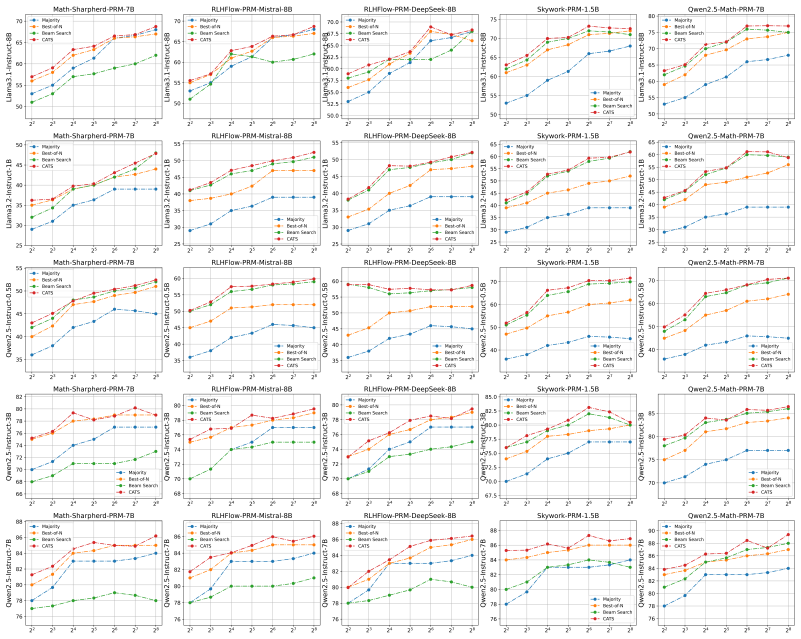
- CATS, as an actor-critic policy over sampling and retention actions, is reported to outperform Best-of-N, beam search, and majority voting on MATH-500 and AIME24 across the tested policy and PRM combinations.
Reading between the lines
- My inference: the authors could test the theory directly by artificially degrading a strong PRM (for example, adding calibrated label noise) and checking whether the required number of paths grows roughly as predicted by the $\exp(-\gamma(q)^2/(8\varepsilon^2))$ term.
- My inference: because the theorem assumes deviations for different candidate paths are independent, it likely understates mis-ranking risk when candidates share reasoning prefixes; an experiment on prefix-sharing candidate sets would show whether practical margins need to be wider than the formula suggests.
- My inference: the reward-gap argument should transfer beyond math word problems to other verifier-guided planning settings, since the proof uses only sampled paths, true rewards, and gaps, not any language-model-specific structure.
Editorial analysis
A structured set of objections, weighed in public.
Referee Report
Summary. The paper studies how the generalization error of a process reward model (PRM) affects test-time compute optimality in external test-time reasoning for large language models. The authors first derive a PAC-Bayes generalization bound for PRMs (Theorem 4.2), then use it to state an answer-accuracy lower bound in terms of the reward gap, coverage probability, and a uniform error bound ε (Theorem 4.5), and from this derive a target-accuracy constraint on the sampling budget (Corollary 4.6). They then propose Compute-Aware Tree Search (CATS), an actor-critic method that uses PRM parameter sparsity as a proxy for generalization error and adaptively controls search hyperparameters. Experiments on MATH-500 and AIME24 with several policies and PRMs report that CATS outperforms Best-of-N, beam search, and majority voting across budgets.
Significance. The question addressed is timely and important: understanding how verifier quality controls the compute-accuracy trade-off in inference-time scaling. If the theoretical results were valid, the connection between PAC-Bayes generalization bounds, reward margin, and the number of sampled paths would be a useful contribution. The empirical component is substantial: CATS is a well-motivated controller, the experiments cover multiple policy models and PRMs, and the appendices include ablations for the sparsity proxy, reward coefficients, and discount factor, as well as pseudocode. However, the load-bearing steps of the theory are not sound: the proof of Theorem 4.2 contains an incorrect optimization, the assumptions of Theorem 4.5 are incompatible with the actual random structure of a fixed PRM, and the bridge from the PAC-Bayes expected-loss bound to the per-candidate uniform error ε is not justified. These problems undermine the central claim that a smaller PRM generalization error provably reduces the number of candidate paths required for a target accuracy.
major comments (4)
- [Appendix B, proof of Theorem 4.2] The λ optimization in the proof is incorrect. Equation (21) gives λ E_Q[L_D − L_S] ≤ λ²/(8n) + KL(Q∥P) + log(1/δ). For this inequality the optimal λ is λ* = 4n E_Q[L_D − L_S], not the claimed λ* = 4√((n−1)/2). Substituting the claimed value leaves an uncancelled term √((n−1)/2)/(2n), and the final bound with denominator 2(n−1) and log(n/δ) does not follow from the preceding algebra. The theorem may be repairable by citing a standard PAC-Bayes bound, but the derivation as written does not prove Eq. (4).
- [Section 4.2, Theorem 4.5 assumptions] The assumption that, conditioned on H, the deviations Δ_h = R_φ(q,h) − R*(q,h) are independent and mean-zero is not justified for the setting of the paper. For a fixed trained PRM, φ is a single parameter vector, so conditioned on H the deviations are deterministic; unconditionally, the Δ_{h_i} are independent only because the h_i are independent, but they need not be mean-zero since E_{h∼π_θ}[R_φ(q,h) − R*(q,h)] is not zero in general. If φ is instead drawn from the PAC-Bayes posterior Q, all paths share the same draw of φ, so the deviations are coupled. Consequently, the Hoeffding bound in Appendix C has no valid target, and the exponential term (N−1)exp(−γ(q)²/(8ε²)) in Eq. (6) is unsupported.
- [Section 4.2, Eq. (5) to Theorem 4.5] The sentence 'Define this upper-bound as ε' is not a valid step. Equation (5) bounds the expected absolute loss E_{φ∼Q}[L_D(φ) − L_S(φ)] averaged over the data distribution D, whereas Theorem 4.5 requires a high-probability uniform error bound ε on sup_{h∈H}|R_φ(q,h) − R*(q,h)| over a finite candidate set for a single question q. No argument is given that the PAC-Bayes bound controls this sup-norm quantity or that the event G has probability at least 1−δ. This missing bridge is load-bearing: it is precisely the link that would support the claim that smaller PRM generalization error reduces the required number of samples, and it is not established.
- [Appendix C, proof of Theorem 4.5] The final algebra of the proof does not match the statement. The derivation gives Pr(E1 ∪ E2) ≤ (1 − p) + p(N−1)exp(−γ²/8ε²) + δ, which yields success probability at least p − p(N−1)exp(−γ²/8ε²) − δ, i.e., p[1 − (N−1)exp(−γ²/8ε²)] − δ, not p[1 − δ − (N−1)exp(−γ²/8ε²)] as stated in Eq. (6). In addition, the intermediate statement that a competitor must overcome a gap of at least γ(q) − 2ε is not the quantity that appears in the Hoeffding exponent. The stated bound therefore does not follow from the proof as written.
minor comments (7)
- [Section 5.1, Eq. (8)] The dimension d in the term log d is never defined, and the constant c is introduced without explanation or calibration; the formal step from a sparsity-based prior to this specific bound is omitted.
- [Section 4.2, Assumption 4.4] The notation is inconsistent: Assumption 4.4 states lim_{N→∞} p_N(q) = 1, but the quantity used throughout the rest of the section is p_{N,τ}(q).
- [Section 5.2 and Algorithm 1] The PRM parameters and the critic parameters are both denoted φ (R_φ and V_φ), which is confusing; the critic should use a different symbol, e.g., V_ξ as in Eq. (10).
- [Section 6.2] The comparison with Best-of-N and Beam Search uses the number of candidate paths as the shared budget, but CATS's adaptive tree search may consume different amounts of compute per path; the paper should state how the budget is matched and ideally report token counts or wall-clock time.
- [Appendix H.2] The text says 'using Qwen2.5-Math-PRM-7B as the policy model,' which appears to be a typo; the policy in the corresponding experiments is Qwen2.5-Instruct-7B, and the intended model should be clarified.
- [Figures 1–2 and Tables 3–6] The empirical results are reported without error bars or significance tests; given that several ablations show differences of about one percentage point, the claim of consistent improvement would be stronger with variance estimates or multiple seeds.
- [Appendix A] The Limitations section asserts that the assumptions 'do not undermine the validity of the analysis,' but in light of Major Comments 2 and 3 this assertion is not supported; the appendix should be expanded to address the independence and uniform-error assumptions rather than dismissing them.
Circularity Check
No circularity: the theory is conditional and CATS is a design motivated by it; the central weaknesses are unsupported bridges and proof gaps, not equivalence to inputs.
full rationale
The paper's derivation chain is conditional: Theorem 4.2 is a standard PAC-Bayes bound proved in Appendix B from Hoeffding and Donsker–Varadhan; Theorem 4.5 is stated under explicit assumptions (sup-norm error event G, independent mean-zero deviations, coverage and threshold assumptions) and its conclusion is a function of those assumed quantities. ε is an assumption parameter, not a value fitted to accuracy data, so the bound is not an output that has been fed back as an input. The informal claim that Eq. (5) 'Define this upper-bound as ε' is an unsupported identification (the PAC-Bayes bound controls an expectation, not a sup-norm over H), and the independence of Δ_h for a fixed φ is questionable; these are correctness gaps, not circularity. The sparsity proxy of Section 5.1 is introduced as a heuristic surrogate with empirical support in Appendix G, not as a fitted prediction. CATS's use of a margin term in its reward is design motivation from Theorem 4.5, and the method is evaluated against external benchmarks (MATH-500, AIME24) with no fitted parameter renamed as a prediction. No load-bearing self-citation or imported uniqueness theorem appears. The Limitations appendix asserts assumptions may not hold but are not undermining; that is an unsupported limitation claim, but it does not make the derivation circular.
Assumptions & free parameters
free parameters (4)
- λ_c, λ_m, λ_r =
0.2, 0.5, 0.3
- discount factor γ =
0.9
- constant c in sparsity bound =
not specified
- sparsity threshold =
1e-4
assumptions (6)
- domain assumption Data samples (q, h, y) are drawn i.i.d. from distribution D.
- domain assumption There exists threshold τ such that R*(q,h) ≥ τ implies a(h,q) = a*(q).
- domain assumption As N grows, probability of sampling at least one high-reward path tends to 1.
- domain assumption Conditioned on H, deviations Δ_h = R_φ - R* are independent, mean-zero, and |Δ_h| ≤ ε a.s.
- standard math PAC-Bayes machinery: Donsker-Varadhan inequality and Hoeffding's inequality.
- ad hoc to paper log(1/P(φ)) can be approximated by c·||φ||_0·log d.
invented entities (1)
-
R* (ground-truth reward function)
Cite this review
Pith. "Pith review of Reward Model Generalization for Compute-Aware Test-Time Reasoning." pith.science (2026). https://pith.science/paper/S6UOY474
@misc{pith2026250518065,
  author       = {Pith},
  title        = {Pith review of: Reward Model Generalization for Compute-Aware Test-Time Reasoning},
  year         = {2026},
  howpublished = {\url{https://pith.science/paper/S6UOY474}},
  note         = {Machine review of arXiv:2505.18065}
}
read the original abstract
External test-time reasoning enhances large language models (LLMs) by decoupling generation and selection. At inference time, the model generates multiple reasoning paths, and an auxiliary process reward model (PRM) is used to score and select the best one. A central challenge in this setting is test-time compute optimality (TCO), i.e., how to maximize answer accuracy under a fixed inference budget. In this work, we establish a theoretical framework to analyze how the generalization error of the PRM affects compute efficiency and reasoning performance. Leveraging PAC-Bayes theory, we derive generalization bounds and show that a lower generalization error of PRM leads to fewer samples required to find correct answers. Motivated by this analysis, we propose Compute-Aware Tree Search (CATS), an actor-critic framework that dynamically controls search behavior. The actor outputs sampling hyperparameters based on reward distributions and sparsity statistics, while the critic estimates their utility to guide budget allocation. Experiments on the MATH and AIME benchmarks with various LLMs and PRMs demonstrate that CATS consistently outperforms other external TTS methods, validating our theoretical predictions.
Figures


Figures from the paper (1 more)

Reference graph
Works this paper leans on
-
[1]
Jason Wei, Xuezhi Wang, Dale Schuurmans, Maarten Bosma, Fei Xia, Ed Chi, Quoc V . Le, and Denny Zhou. Chain-of-thought prompting elicits reasoning in large language models.Advances in neural information processing systems, 35:24824–24837, 2022
work page 2022
-
[2]
Large language models are zero-shot reasoners.Advances in neural information processing systems, 35:22199–22213, 2022
Takeshi Kojima, Shixiang Shane Gu, Machel Reid, Yutaka Matsuo, and Yusuke Iwasawa. Large language models are zero-shot reasoners.Advances in neural information processing systems, 35:22199–22213, 2022
2022
-
[3]
Griffiths, Yuan Cao, and Karthik R
Shunyu Yao, Dian Yu, Jeffrey Zhao, Izhak Shafran, Thomas L. Griffiths, Yuan Cao, and Karthik R. Narasimhan. Tree of Thoughts: Deliberate Problem Solving with Large Language Models. InThirty-Seventh Conference on Neural Information Processing Systems, November 2023
work page 2023
-
[4]
OpenAI. Learning to reason with llms. https://openai.com/index/ learning-to-reason-with-llms/, 2024. Accessed: 2025-04-29
work page 2024
-
[5]
DeepSeek-R1: Incentivizing Reasoning Capability in LLMs via Reinforcement Learning, January 2025
DeepSeek-AI. DeepSeek-R1: Incentivizing Reasoning Capability in LLMs via Reinforcement Learning, January 2025
2025
-
[6]
Kimi Team, Angang Du, Bofei Gao, Bowei Xing, Changjiu Jiang, Cheng Chen, Cheng Li, Chenjun Xiao, Chenzhuang Du, Chonghua Liao, Chuning Tang, Congcong Wang, Dehao Zhang, Enming Yuan, Enzhe Lu, Fengxiang Tang, Flood Sung, Guangda Wei, Guokun Lai, Haiqing Guo, Han Zhu, Hao Ding, Hao Hu, Hao Yang, Hao Zhang, Haotian Yao, Haotian Zhao, Haoyu Lu, Haoze Li, Haoz...
work page 2025
-
[7]
Scaling LLM Test-Time Compute Optimally Can be More Effective than Scaling Parameters for Reasoning
Charlie Victor Snell, Jaehoon Lee, Kelvin Xu, and Aviral Kumar. Scaling LLM Test-Time Compute Optimally Can be More Effective than Scaling Parameters for Reasoning. InThe Thirteenth International Conference on Learning Representations, October 2024
work page 2024
-
[8]
Can 1B LLM Surpass 405B LLM? Rethinking Compute-Optimal Test-Time Scaling, February 2025
Runze Liu, Junqi Gao, Jian Zhao, Kaiyan Zhang, Xiu Li, Biqing Qi, Wanli Ouyang, and Bowen Zhou. Can 1B LLM Surpass 405B LLM? Rethinking Compute-Optimal Test-Time Scaling, February 2025
work page 2025
Show all 49 references
-
[9]
Inference Scaling Laws: An Empirical Analysis of Compute-Optimal Inference for LLM Problem-Solving
Yangzhen Wu, Zhiqing Sun, Shanda Li, Sean Welleck, and Yiming Yang. Inference Scaling Laws: An Empirical Analysis of Compute-Optimal Inference for LLM Problem-Solving. In The Thirteenth International Conference on Learning Representations, October 2024. 10
2024
-
[10]
Graph of thoughts: Solving elaborate problems with large language models
Maciej Besta, Nils Blach, Ales Kubicek, Robert Gerstenberger, Michal Podstawski, Lukas Gianinazzi, Joanna Gajda, Tomasz Lehmann, Hubert Niewiadomski, and Piotr Nyczyk. Graph of thoughts: Solving elaborate problems with large language models. InProceedings of the AAAI Conferenc...
2024
-
[11]
Yuxiao Qu, Matthew Y . R. Yang, Amrith Setlur, Lewis Tunstall, Edward Emanuel Beeching, Ruslan Salakhutdinov, and Aviral Kumar. Optimizing Test-Time Compute via Meta Reinforce- ment Fine-Tuning, March 2025
2025
-
[12]
Let’s Verify Step by Step, May 2023
Hunter Lightman, Vineet Kosaraju, Yura Burda, Harri Edwards, Bowen Baker, Teddy Lee, Jan Leike, John Schulman, Ilya Sutskever, and Karl Cobbe. Let’s Verify Step by Step, May 2023
2023
-
[13]
Peiyi Wang, Lei Li, Zhihong Shao, R. X. Xu, Damai Dai, Yifei Li, Deli Chen, Y . Wu, and Zhifang Sui. Math-Shepherd: Verify and Reinforce LLMs Step-by-step without Human Annotations, February 2024
2024
-
[14]
Measuring mathematical problem solving with the math dataset
Dan Hendrycks, Collin Burns, Saurav Kadavath, Akul Arora, Steven Basart, Eric Tang, Dawn Song, and Jacob Steinhardt. Measuring mathematical problem solving with the math dataset. NeurIPS, 2021
2021
-
[15]
AIME 2024
AI-MO. AIME 2024. https://huggingface.co/datasets/AI-MO/ aimo-validation-aime, July 2024. Accessed 2024-07
2024
-
[16]
An Yang, Baosong Yang, Beichen Zhang, Binyuan Hui, Bo Zheng, Bowen Yu, Chengyuan Li, Dayiheng Liu, Fei Huang, Haoran Wei, et al. Qwen2. 5 technical report.arXiv preprint arXiv:2412.15115, 2024
2024 arXiv
-
[17]
The llama 3 herd of models.arXiv preprint arXiv:2407.21783, 2024
Aaron Grattafiori, Abhimanyu Dubey, Abhinav Jauhri, Abhinav Pandey, Abhishek Kadian, Ahmad Al-Dahle, Aiesha Letman, Akhil Mathur, Alan Schelten, Alex Vaughan, et al. The llama 3 herd of models.arXiv preprint arXiv:2407.21783, 2024
2024 arXiv
-
[18]
Llama 3 to connect 2024: Vision, edge, and mobile devices.https://ai.meta.com/ blog/llama-3-2-connect-2024-vision-edge-mobile-devices/ , 2024
Meta AI. Llama 3 to connect 2024: Vision, edge, and mobile devices.https://ai.meta.com/ blog/llama-3-2-connect-2024-vision-edge-mobile-devices/ , 2024. Accessed: 2025-05-12
2024
-
[19]
The Lessons of Developing Process Reward Models in Mathematical Reasoning, January 2025
Zhenru Zhang, Chujie Zheng, Yangzhen Wu, Beichen Zhang, Runji Lin, Bowen Yu, Dayiheng Liu, Jingren Zhou, and Junyang Lin. The Lessons of Developing Process Reward Models in Mathematical Reasoning, January 2025
2025
-
[20]
Rlhf workflow: From reward modeling to online rlhf
Hanze Dong, Wei Xiong, Bo Pang, Haoxiang Wang, Han Zhao, Yingbo Zhou, Nan Jiang, Doyen Sahoo, Caiming Xiong, and Tong Zhang. Rlhf workflow: From reward modeling to online rlhf. arXiv preprint arXiv:2405.07863, 2024
2024 arXiv
-
[21]
Skywork-o1 open series
Skywork o1 Team. Skywork-o1 open series. https://huggingface.co/Skywork, Novem- ber 2024. Accessed: 2025-05-12
2024
-
[22]
Towards Reasoning Era: A Survey of Long Chain-of-Thought for Reasoning Large Language Models, April 2025
Qiguang Chen, Libo Qin, Jinhao Liu, Dengyun Peng, Jiannan Guan, Peng Wang, Mengkang Hu, Yuhang Zhou, Te Gao, and Wanxiang Che. Towards Reasoning Era: A Survey of Long Chain-of-Thought for Reasoning Large Language Models, April 2025
2025
-
[23]
Self- Refine: Iterative Refinement with Self-Feedback
Aman Madaan, Niket Tandon, Prakhar Gupta, Skyler Hallinan, Luyu Gao, Sarah Wiegreffe, Uri Alon, Nouha Dziri, Shrimai Prabhumoye, Yiming Yang, Shashank Gupta, Bodhisattwa Prasad Majumder, Katherine Hermann, Sean Welleck, Amir Yazdanbakhsh, and Peter Clark. Self- Refine: Iterati...
2023
-
[24]
Self-critiquing models for assisting human evaluators.arXiv preprint arXiv:2206.05802, 2022
William Saunders, Catherine Yeh, Jeff Wu, Steven Bills, Long Ouyang, Jonathan Ward, and Jan Leike. Self-critiquing models for assisting human evaluators.arXiv preprint arXiv:2206.05802, 2022
2022 arXiv
-
[25]
Zhihong Shao, Peiyi Wang, Qihao Zhu, Runxin Xu, Junxiao Song, Xiao Bi, Haowei Zhang, Mingchuan Zhang, Y . K. Li, Y . Wu, and Daya Guo. DeepSeekMath: Pushing the Limits of Mathematical Reasoning in Open Language Models, April 2024. 11
2024
-
[26]
Algorithm of Thoughts: Enhancing Exploration of Ideas in Large Language Models
Bilgehan Sel, Ahmad Tawaha, Vanshaj Khattar, Ruoxi Jia, and Ming Jin. Algorithm of Thoughts: Enhancing Exploration of Ideas in Large Language Models. InForty-First International Conference on Machine Learning, June 2024
2024
-
[27]
Automatic Chain of Thought Prompting in Large Language Models, October 2022
Zhuosheng Zhang, Aston Zhang, Mu Li, and Alex Smola. Automatic Chain of Thought Prompting in Large Language Models, October 2022
2022
-
[28]
Le, Christopher Ré, and Azalia Mirhoseini
Bradley Brown, Jordan Juravsky, Ryan Ehrlich, Ronald Clark, Quoc V . Le, Christopher Ré, and Azalia Mirhoseini. Large Language Monkeys: Scaling Inference Compute with Repeated Sampling, December 2024
2024
-
[29]
Solving math word problems with process-and outcome-based feedback.arXiv preprint arXiv:2211.14275, 2022
Jonathan Uesato, Nate Kushman, Ramana Kumar, Francis Song, Noah Siegel, Lisa Wang, Antonia Creswell, Geoffrey Irving, and Irina Higgins. Solving math word problems with process-and outcome-based feedback.arXiv preprint arXiv:2211.14275, 2022
2022 arXiv
-
[30]
Self-Evaluation Guided Beam Search for Reasoning, October 2023
Yuxi Xie, Kenji Kawaguchi, Yiran Zhao, Xu Zhao, Min-Yen Kan, Junxian He, and Qizhe Xie. Self-Evaluation Guided Beam Search for Reasoning, October 2023
2023
-
[31]
Le, Ed H
Xuezhi Wang, Jason Wei, Dale Schuurmans, Quoc V . Le, Ed H. Chi, Sharan Narang, Aakanksha Chowdhery, and Denny Zhou. Self-Consistency Improves Chain of Thought Reasoning in Language Models. InThe Eleventh International Conference on Learning Representations, September 2022
2022
-
[32]
Sparsity-aware generalization theory for deep neural networks
Ramchandran Muthukumar and Jeremias Sulam. Sparsity-aware generalization theory for deep neural networks. InThe Thirty Sixth Annual Conference on Learning Theory, pages 5311–5342. PMLR, 2023
2023
-
[33]
Pac-bayes compression bounds so tight that they can explain generalization
Sanae Lotfi, Marc Finzi, Sanyam Kapoor, Andres Potapczynski, Micah Goldblum, and An- drew G Wilson. Pac-bayes compression bounds so tight that they can explain generalization. Advances in Neural Information Processing Systems, 35:31459–31473, 2022
2022
-
[34]
Efficient content-based sparse attention with routing transformers.Transactions of the Association for Computational Linguistics, 9:53–68, 2021
Aurko Roy, Mohammad Saffar, Ashish Vaswani, and David Grangier. Efficient content-based sparse attention with routing transformers.Transactions of the Association for Computational Linguistics, 9:53–68, 2021
2021
-
[35]
Minference 1.0: Accelerating pre-filling for long-context llms via dynamic sparse attention.arXiv preprint arXiv:2407.02490, 2024
Huiqiang Jiang, Yucheng Li, Chengruidong Zhang, Qianhui Wu, Xufang Luo, Surin Ahn, Zhenhua Han, Amir H Abdi, Dongsheng Li, Chin-Yew Lin, et al. Minference 1.0: Accelerating pre-filling for long-context llms via dynamic sparse attention.arXiv preprint arXiv:2407.02490, 2024
2024 arXiv
-
[36]
Policy gradient meth- ods for reinforcement learning with function approximation.Advances in neural information processing systems, 12, 1999
Richard S Sutton, David McAllester, Satinder Singh, and Yishay Mansour. Policy gradient meth- ods for reinforcement learning with function approximation.Advances in neural information processing systems, 12, 1999
1999
-
[37]
Pac-bayesian model averaging
David A McAllester. Pac-bayesian model averaging. InProceedings of the twelfth annual conference on Computational learning theory, pages 164–170, 1999
1999
-
[38]
Pac-bayesian generalisation error bounds for gaussian process classification
Matthias Seeger. Pac-bayesian generalisation error bounds for gaussian process classification. Journal of machine learning research, 3(Oct):233–269, 2002
2002
-
[39]
Training verifiers to solve math word problems.arXiv preprint arXiv:2110.14168, 2021
Karl Cobbe, Vineet Kosaraju, Mohammad Bavarian, Mark Chen, Heewoo Jun, Lukasz Kaiser, Matthias Plappert, Jerry Tworek, Jacob Hilton, Reiichiro Nakano, Christopher Hesse, and John Schulman. Training verifiers to solve math word problems.arXiv preprint arXiv:2110.14168, 2021
-
[40]
Olympiadbench: A challenging benchmark for promoting agi with olympiad-level bilingual multimodal scientific problems, 2024
Chaoqun He, Renjie Luo, Yuzhuo Bai, Shengding Hu, Zhen Leng Thai, Junhao Shen, Jinyi Hu, Xu Han, Yujie Huang, Yuxiang Zhang, Jie Liu, Lei Qi, Zhiyuan Liu, and Maosong Sun. Olympiadbench: A challenging benchmark for promoting agi with olympiad-level bilingual multimodal scienti...
2024
-
[41]
Technical report: Enhancing llm reasoning with reward-guided tree search.arXiv preprint arXiv:2411.11694, 2024
Jinhao Jiang, Zhipeng Chen, Yingqian Min, Jie Chen, Xiaoxue Cheng, Jiapeng Wang, Yiru Tang, Haoxiang Sun, Jia Deng, Wayne Xin Zhao, et al. Technical report: Enhancing llm reasoning with reward-guided tree search.arXiv preprint arXiv:2411.11694, 2024. 12
2024 arXiv
-
[42]
Litesearch: Efficacious tree search for llm.arXiv preprint arXiv:2407.00320, 2024
Ante Wang, Linfeng Song, Ye Tian, Baolin Peng, Dian Yu, Haitao Mi, Jinsong Su, and Dong Yu. Litesearch: Efficacious tree search for llm.arXiv preprint arXiv:2407.00320, 2024
2024 arXiv
-
[43]
Alphamath almost zero: process supervision without process.arXiv preprint arXiv:2405.03553, 2024
Guoxin Chen, Minpeng Liao, Chengxi Li, and Kai Fan. Alphamath almost zero: process supervision without process.arXiv preprint arXiv:2405.03553, 2024
2024 arXiv
-
[44]
Monte carlo tree search boosts reasoning via iterative preference learning
Yuxi Xie, Anirudh Goyal, Wenyue Zheng, Min-Yen Kan, Timothy P Lillicrap, Kenji Kawaguchi, and Michael Shieh. Monte carlo tree search boosts reasoning via iterative preference learning. arXiv preprint arXiv:2405.00451, 2024
2024 arXiv
-
[45]
Numinamath: The largest public dataset in ai4maths with 860k pairs of competition math problems and solutions.Hugging Face repository, 13:9, 2024
Jia Li, Edward Beeching, Lewis Tunstall, Ben Lipkin, Roman Soletskyi, Shengyi Huang, Kashif Rasul, Longhui Yu, Albert Q Jiang, Ziju Shen, et al. Numinamath: The largest public dataset in ai4maths with 860k pairs of competition math problems and solutions.Hugging Face repositor...
2024
-
[46]
Llama-berry: Pairwise optimization for o1-like olympiad-level mathematical reasoning.arXiv preprint arXiv:2410.02884, 2024
Di Zhang, Jianbo Wu, Jingdi Lei, Tong Che, Jiatong Li, Tong Xie, Xiaoshui Huang, Shufei Zhang, Marco Pavone, Yuqiang Li, et al. Llama-berry: Pairwise optimization for o1-like olympiad-level mathematical reasoning.arXiv preprint arXiv:2410.02884, 2024
-
[47]
Accessing gpt-4 level mathematical olympiad solutions via monte carlo tree self-refine with llama-3 8b.arXiv preprint arXiv:2406.07394, 2024
Di Zhang, Xiaoshui Huang, Dongzhan Zhou, Yuqiang Li, and Wanli Ouyang. Accessing gpt-4 level mathematical olympiad solutions via monte carlo tree self-refine with llama-3 8b.arXiv preprint arXiv:2406.07394, 2024
2024 arXiv
-
[48]
Booststep: Boosting mathematical capability of large language models via improved single-step reasoning.arXiv preprint arXiv:2501.03226, 2025
Beichen Zhang, Yuhong Liu, Xiaoyi Dong, Yuhang Zang, Pan Zhang, Haodong Duan, Yuhang Cao, Dahua Lin, and Jiaqi Wang. Booststep: Boosting mathematical capability of large language models via improved single-step reasoning.arXiv preprint arXiv:2501.03226, 2025. 13 Appendix A Lim...
2025 arXiv
-
[49]
Subtracting from 1 yields the bound Equation 6
+ Pr(G c) ≤(1−p N,τ (q)) +p N,τ (q) (N−1)e −γ(q) 2/8ε2 +δ. Subtracting from 1 yields the bound Equation 6. The asymptotic form for ε/γ(q)→0 follows by observing thatexp(−γ(q) 2/8ε2)→0. 15 D Proof of Corollary 4.6 Corollary D.1(Target Accuracy Constraint on Sampling and Margin)...
Reviewed August 7, 2026 · model on record in the stance chip above.
Discussion (0). Sign in to comment.