REVIEW 2 major objections 4 minor 1 cited by
Pessimism Principle Can Be Effective: Towards a Framework for Zero-Shot Transfer Reinforcement Learning
T0 review · 2 major / 4 minor · reviewed 2026-08-07 · deepseek-v4-flash
Pith's one-line read This paper shows that optimizing a pessimistic lower-bound proxy—not an optimistic one—guarantees a bounded suboptimality gap for zero-shot transfer reinforcement learning and inherently avoids negative transfer.
desk verdict Solid conservative-proxy construction with a correct lower-bound lemma, but the advertised monotonic no-negative-transfer claim does not follow from the math. read the letter →
The pith
A machine-rendered reading of the paper's core claim, the machinery that carries it, and where it could break.
The reading
What carries the argument
The load-bearing object is the pessimistic proxy: a functional $f(\pi) \le V^\pi_{P_0}$ whose optimization bounds the target gap through $\max_\pi (V^\pi_{P_0} - f(\pi))$. Concretely, the paper uses robust Bellman operators $T_k^\pi$ for each source domain with $(s,a)$-rectangular uncertainty sets containing the target kernel; the averaged-operator proxy is the fixed point of $T^\pi_{AO} = (1/K)\sum_k T^\pi_k$, and the minimal-pessimism proxy is the fixed point of $T^\pi_{MP} = \max_k T^\pi_k$. Both operators are $\gamma$-contractions, so their fixed points exist and can be approached by iterative updates, and the max operator's fixed point serves as a 'minimal pessimism' selector that up-weights informative sources. The distributed algorithms alternate local Q-table updates with global aggregation (average or max), which is enough because the averaged and maxed operators factor through per-source updates.
What would settle it
Run an exact tabular search over small MDPs: enumerate target kernels $P_0$ and source kernels $P_1,\dots,P_K$ satisfying $D(P_0,P_k)\le\Gamma$ for a known $\Gamma$, compute the true target values $V^\pi_{P_0}$ exactly, and check whether the optimal policy of the averaged-operator proxy ever violates the central conservatism claim $V^\pi_{AO}\le V^\pi_{P_0}$ for some policy $\pi$; any single violation would refute Theorem 5.2.
Extended reading notes
Core claim
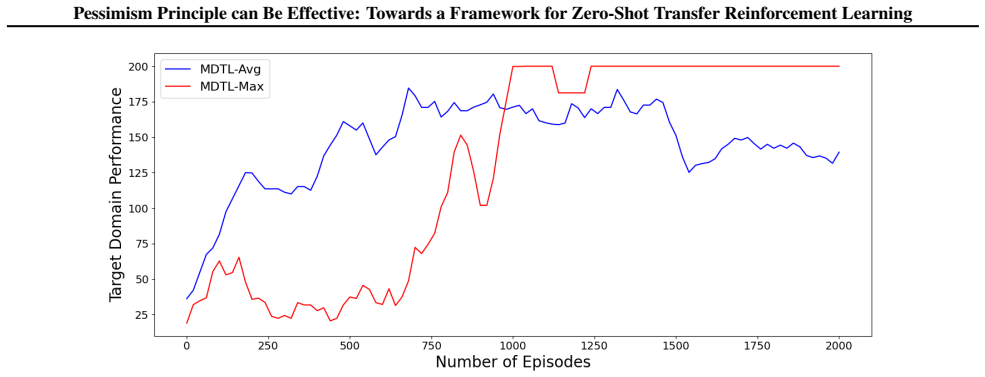
On its own terms, the paper establishes a theorem about proxy optimization: whenever a proxy $f$ satisfies $f(\pi) \le V^\pi_{P_0}$ for every policy $\pi$, the policy $\pi_f$ that maximizes $f$ is within $\|\zeta\| = \max_\pi (V^\pi_{P_0} - f(\pi))$ of the target-optimal policy, a gap that shrinks monotonically as the proxy becomes more accurate. It then shows that robust value functions under $(s,a)$-rectangular uncertainty sets centered at the source kernels are concrete conservative proxies whenever the target kernel $P_0$ lies inside every local uncertainty set. The averaged-operator proxy $V^\pi_{AO}$, defined as the unique fixed point of the average of the source robust Bellman operators, is provably conservative, dominates proximal robust domain randomization, and can be optimized by a distributed algorithm with rate $\tilde{O}(1/(TK) + (E-1)\Gamma/T)$. The minimal-pessimism proxy $V^\pi_{MP}$, the fixed point of a max of robust Bellman operators, is shown to dominate both the averaged proxy and every single-source robust value, so maximizing it selects the most informative source domains and thereby avoids negative transfer. Distributed algorithms MDTL-Avg and MDTL-Max converge to these fixed points with partial linear speedup, and an unbiased multilevel Monte-Carlo aggregation scheme makes the max operator stochastically unbiased.
Load-bearing premise
The load-bearing premise is that the learner knows a number $\Gamma$ with $D(P_0, P_k) \le \Gamma$ for every source $k$, so the target kernel $P_0$ lies inside each local uncertainty set; if $\Gamma$ is unknown or set too loosely, the conservative guarantee becomes vacuous or extremely conservative, and the theory also assumes identical rewards across source and target domains.
Editorial extensions
If this is right
- Deploying the MDTL-Avg policy guarantees the target value is at least the optimized conservative proxy, with the optimality gap bounded by the level of pessimism.
- With the known bound $\Gamma$ on source-target kernel distance, both algorithms converge at $\tilde{O}(1/(TK) + (E-1)\Gamma/T)$, giving partial linear speedup in the number of source domains.
- Because $V^\pi_{AO} \le V^\pi_{MP} \le V^\pi_{P_0}$, switching from the averaged proxy to the minimal-pessimism proxy can only improve or preserve the transfer guarantee.
- The minimal-pessimism proxy automatically down-weights dissimilar sources, so adding a poor source domain cannot degrade the transferred policy.
- With the model-free variant, the same guarantee holds with high probability at rate $\tilde{O}((E-1)\Gamma/(T(1-\gamma)^3) + \sqrt{\log(SATK/\delta)}/((1-\gamma)^3\sqrt{TK}))$.
- The monotonic gap bound suggests a practical adaptive scheme: any small amount of target data or a tighter estimate of $\Gamma$ can be fed back to shrink the uncertainty-set radii, improving the transferred policy's worst-case gap without changing the algorithm family.
- The known-$\Gamma$ assumption could be replaced by an online estimation procedure that starts conservative and tightens the radii as similarity information accumulates; the paper's monotonicity guarantee implies such tightening never hurts.
- The same operator-level pessimism recipe—average or max of robust Bellman operators—could apply to other transfer settings, such as sim-to-real with a family of simulators, where each simulator is a source domain and the real environment is the unobserved target.
Reading between the lines
- The monotonic gap bound suggests a practical adaptive scheme: any small amount of target data or a tighter estimate of $\Gamma$ can be fed back to shrink the uncertainty-set radii, improving the transferred policy's worst-case gap without changing the algorithm family.
- The known-$\Gamma$ assumption could be replaced by an online estimation procedure that starts conservative and tightens the radii as similarity information accumulates; the paper's monotonicity guarantee implies such tightening never hurts.
- The same operator-level pessimism recipe—average or max of robust Bellman operators—could apply to other transfer settings, such as sim-to-real with a family of simulators, where each simulator is a source domain and the real environment is the unobserved target.
- There is a direct tie to offline RL: pessimism there fights distribution shift in data, while here it fights model mismatch across domains, so a unified 'pessimism level' calculus could connect both literatures.
Editorial analysis
A structured set of objections, weighed in public.
Referee Report
Summary. The paper proposes a pessimism-based framework for zero-shot transfer reinforcement learning. It constructs conservative proxies f(pi) that lower-bound the target-domain value V^pi_P0, proves a suboptimality bound in Lemma 4.1 in terms of the maximum pessimism, and builds two distributed algorithms (MDTL-Avg and MDTL-Max) around averaged and max-aggregated robust Bellman operators. The manuscript claims that this framework guarantees an optimized lower bound on target performance and, crucially, that it exhibits monotonic improvement with source-domain quality, thereby avoiding negative transfer. Convergence rates of order O~(1/(TK)+(E-1)Gamma/T) are stated for both algorithms, with experiments on recycling robot, FrozenLake, CartPole, HPC, and DVRP domains.
Significance. The lower-bound perspective is a natural and potentially useful way to connect robust RL with transfer learning, and the fixed-point results for the averaged and max operators (Theorems 5.2, 5.6, 6.1) are correctly argued given the assumption that the target kernel lies in every local uncertainty set. The distributed formulations and the explicit convergence proofs are also valuable: they go beyond the informal guarantees typical of domain randomization and provide a concrete algorithmic template. However, the paper's headline claim of monotonic improvement and avoidance of negative transfer is not supported by the proven results, and the convergence theorem contains a constraint that makes the advertised communication-efficiency tradeoff vacuous for K>=2. The framework's genuine contribution is the conservative lower-bound guarantee plus the algorithmic machinery; the stronger transfer-improvement claims need either additional assumptions or removal.
major comments (2)
- [Section 4.2 (Lemma 4.1), abstract] The claim that Lemma 4.1 establishes a 'monotonic dependence' between the pessimism level and the transferred policy's target performance is not implied by the lemma, and it is false as a general statement. Lemma 4.1 only bounds V^pi*_P0 - V^pi_f_P0 by max_pi (V^pi_P0 - f(pi)); it does not say that if f2 >= f1 pointwise, then the argmax of f2 has higher V_P0 than the argmax of f1. A concrete counterexample: let target values be V_P0(A)=1 and V_P0(B)=0.95, with f1(A)=0.5, f1(B)=0.2, f2(A)=0.7, f2(B)=0.9. Then f1 <= f2 <= V_P0 pointwise, argmax f1 is A with target value 1, argmax f2 is B with target value 0.95, while max_pi (V_P0 - f) drops from 0.75 to 0.3. Thus the bound in Lemma 4.1 can improve while the deployed policy's target value worsens. Consequently, the statements in Section 4.2, Section 6, and the abstract that a less conservative proxy 'directly translates into better performance' and that the method 'avoids negative transfer' are unsupported by the theory. The paper needs either a strictly stronger theorem (e.g., under additional structure on the proxy family) or a reformulation of the contribution as a lower-bound guarantee only, with negative-transfer avoidance supported empirically.
- [Theorems 5.7 and 6.4] The stated conditions on the number of local update steps make the claimed communication-efficiency tradeoff vacuous. Both theorems require E-1 <= min{ (1/lambda) * gamma/(1-gamma), 1/K } with lambda = 4 log^2(TK)/(T(1-gamma)). For any K>=2, the second term is at most 1/2, and since E is an integer, the condition forces E=1. The convergence bound then reduces to O~(1/(TK)) with no (E-1)Gamma/T term, and the 'reduce the aggregation frequency by E times' claim in Section 5.2 is not permitted under the theorem's own assumptions. As written, this is an internal inconsistency in the load-bearing convergence result; the constraint set or the rate expression must be corrected before the partial linear speedup and communication-efficiency claims can be evaluated.
minor comments (4)
- [Section 2.1] The notation for the domain-similarity assumption is inconsistent: the text writes Gamma >= D(P0||Pk) in one place and D(P0, Pk) elsewhere; the divergence should be defined once in the preliminaries and used consistently.
- [Section 4.1 (Lemma 4.1)] The proof of Lemma 4.1 is deferred to 'Appendix 4.1', but the proof actually appears in Appendix C; the cross-reference should be corrected.
- [Algorithm 1 and Section 6] The pseudocode line for MDTL-Max simply says 'Max-Aggregation' and the accompanying text refers to Appendix E.1 for the MLMC construction. For a self-contained paper, it would help to either state the MLMC estimator in the main text or give a precise pointer in the algorithm box.
- [Section 7 (Theorem 7.2)] Theorem 7.2 is labeled 'Informal' and then followed by a formal statement in Corollary G.7; the numbering and presentation could be aligned so that the main text states the formal result directly.
Circularity Check
No significant circularity: the central lower-bound guarantee follows from the stated conservatism assumption, and the cited external results are supporting rather than load-bearing; the monotonic-improvement claim is an inference gap, not a circular reduction.
full rationale
The paper's derived claims are consequences of the assumptions it states, not of the conclusions it advertises. Lemma 4.1 defines the pessimism slack as zeta^pi = V^pi_P0 - f(pi), assumes f(pi) <= V^pi_P0 for all pi, and takes pi_f to maximize f. Appendix C then proves V^pi*_P0 - V^pi_f_P0 <= V^pi*_P0 - f(pi*) <= max_pi zeta^pi using only these definitions and optimality of pi_f. This is a valid algebraic consequence, not a circular use of the conclusion. Theorem 5.2 and Theorem 6.1 establish V^pi_AO <= V^pi_P0 and V^pi_MP <= V^pi_P0 from the construction of uncertainty sets with P0 in each P_k; the robust-value definition already gives V^pi_Pk <= V^pi_P0, and the proofs for the averaged and max operators add contraction arguments that do not presuppose the theorem. The convergence theorems (5.7, 6.4, 7.2) are proved from the stated unbiased-estimator assumption and explicit recursion analyses; citations to Wang et al. 2023b, Kumar et al. 2023b, Yang et al. 2023, and Liu et al. 2022 support existence of unbiased robust Bellman estimators but are not the sole justification, and the self-cited items are not load-bearing for the paper's central transfer guarantee. No parameter is fitted to data and then renamed as a prediction, no uniqueness theorem is imported from the authors' prior work to force a choice, and no ansatz is disguised through citation. The paper does contain a logical overreach when it infers monotonic improvement and avoidance of negative transfer from the upper bound in Lemma 4.1; that pointwise increases in f can fail to increase the deployed value is a correctness concern rather than a circularity, so it does not affect the circularity score.
Assumptions & free parameters
free parameters (1)
- Uncertainty radius Gamma =
Unknown; assumed known or set to 1
assumptions (5)
- domain assumption The target MDP shares the same state/action spaces and reward function with the source domains.
- domain assumption An upper bound Gamma >= D(P0||Pk) is known for all source domains k.
- domain assumption The uncertainty sets are (s,a)-rectangular and the distance D is total variation, Wasserstein, or l_p norm for the main results.
- domain assumption Unbiased estimators of the robust Bellman operators are available to each local agent.
- standard math Contraction and fixed-point properties of robust Bellman operators are taken as known from standard RMDP theory.
Cite this review
Pith. "Pith review of Pessimism Principle Can Be Effective: Towards a Framework for Zero-Shot Transfer Reinforcement Learning." pith.science (2026). https://pith.science/paper/DHNV5S3T
@misc{pith2026250518447,
  author       = {Pith},
  title        = {Pith review of: Pessimism Principle Can Be Effective: Towards a Framework for Zero-Shot Transfer Reinforcement Learning},
  year         = {2026},
  howpublished = {\url{https://pith.science/paper/DHNV5S3T}},
  note         = {Machine review of arXiv:2505.18447}
}
read the original abstract
Transfer reinforcement learning aims to derive a near-optimal policy for a target environment with limited data by leveraging abundant data from related source domains. However, it faces two key challenges: the lack of performance guarantees for the transferred policy, which can lead to undesired actions, and the risk of negative transfer when multiple source domains are involved. We propose a novel framework based on the pessimism principle, which constructs and optimizes a conservative estimation of the target domain's performance. Our framework effectively addresses the two challenges by providing an optimized lower bound on target performance, ensuring safe and reliable decisions, and by exhibiting monotonic improvement with respect to the quality of the source domains, thereby avoiding negative transfer. We construct two types of conservative estimations, rigorously characterize their effectiveness, and develop efficient distributed algorithms with convergence guarantees. Our framework provides a theoretically sound and practically robust solution for transfer learning in reinforcement learning.
Figures


Figures from the paper (6 more)



Forward citations
Cited by 1 Pith paper
-
Diagnosing Simulation and Hardware Barriers to Cross-Size Transfer in Equivariant Quantum Reinforcement Learning
Abstract claims zero-shot 5-to-10-city EQC transfer beats target-size training only in exact simulation, degrading by 31.3% under sampling noise and 45.3% on hardware; the supplied body omits these experiments.
Reference graph
Works this paper leans on
-
[1]
write newline
" write newline "" before.all 'output.state := FUNCTION n.dashify 't := "" t empty not t #1 #1 substring "-" = t #1 #2 substring "--" = not "--" * t #2 global.max substring 't := t #1 #1 substring "-" = "-" * t #2 global.max substring 't := while if t #1 #1 substring * t #2 global.max substring 't := if while FUNCTION format.date year duplicate empty "emp...
-
[2]
Provable benefits of representational transfer in reinforcement learning
Agarwal, A., Song, Y., Sun, W., Wang, K., Wang, M., and Zhang, X. Provable benefits of representational transfer in reinforcement learning. In The Thirty Sixth Annual Conference on Learning Theory, pp.\ 2114--2187. PMLR, 2023
2023
-
[3]
Arivazhagan, M. G., Aggarwal, V., Singh, A. K., and Choudhary, S. Federated learning with personalization layers. arXiv preprint arXiv:1912.00818, 2019
arXiv 1912
-
[4]
R., Schmidhuber, J., and Srivastava, R
Arulkumaran, K., Ashley, D. R., Schmidhuber, J., and Srivastava, R. K. All you need is supervised learning: From imitation learning to meta-rl with upside down rl. arXiv preprint arXiv:2202.11960, 2022
arXiv 2022
-
[5]
Badrinath, K. P. and Kalathil, D. Robust reinforcement learning using least squares policy iteration with provable performance guarantees. In Proc. International Conference on Machine Learning (ICML), pp.\ 511--520. PMLR, 2021
2021
-
[6]
Contextualize me--the case for context in reinforcement learning
Benjamins, C., Eimer, T., Schubert, F., Mohan, A., D \"o hler, S., Biedenkapp, A., Rosenhahn, B., Hutter, F., and Lindauer, M. Contextualize me--the case for context in reinforcement learning. arXiv preprint arXiv:2202.04500, 2022
arXiv 2022
-
[7]
Dynamics generalisation in reinforcement learning via adaptive context-aware policies
Beukman, M., Jarvis, D., Klein, R., James, S., and Rosman, B. Dynamics generalisation in reinforcement learning via adaptive context-aware policies. Advances in Neural Information Processing Systems, 36, 2024
2024
-
[8]
F., Eimer, T., Hutter, F., and Lindauer, M
Biedenkapp, A., Bozkurt, H. F., Eimer, T., Hutter, F., and Lindauer, M. Dynamic algorithm configuration: Foundation of a new meta-algorithmic framework. In ECAI 2020, pp.\ 427--434. IOS Press, 2020
2020
Show all 100 references
-
[9]
Blanchet, J. H. and Glynn, P. W. Unbiased M onte C arlo for optimization and functions of expectations via multi-level randomization. In 2015 Winter Simulation Conference (WSC), pp.\ 3656--3667. IEEE, 2015
2015
-
[10]
H., Glynn, P
Blanchet, J. H., Glynn, P. W., and Pei, Y. Unbiased multilevel M onte C arlo: Stochastic optimization, steady-state simulation, quantiles, and other applications. arXiv preprint arXiv:1904.09929, 2019
1904 arXiv
-
[11]
Understanding domain randomization for sim-to-real transfer
Chen, X., Hu, J., Jin, C., Li, L., and Wang, L. Understanding domain randomization for sim-to-real transfer. arXiv preprint arXiv:2110.03239, 2021
2021 arXiv
-
[12]
Provable benefit of multitask representation learning in reinforcement learning
Cheng, Y., Feng, S., Yang, J., Zhang, H., and Liang, Y. Provable benefit of multitask representation learning in reinforcement learning. Advances in Neural Information Processing Systems, 35: 0 31741--31754, 2022
2022
-
[13]
Near-optimal distributionally robust reinforcement learning with general l\_p norms
Clavier, P., Shi, L., Le Pennec, E., Mazumdar, E., Wierman, A., and Geist, M. Near-optimal distributionally robust reinforcement learning with general l\_p norms. Advances in Neural Information Processing Systems, 37: 0 1750--1810, 2024
2024
-
[14]
M., and Mahdavi, M
Deng, Y., Kamani, M. M., and Mahdavi, M. Adaptive personalized federated learning. arXiv preprint arXiv:2003.13461, 2020
2003 arXiv
-
[15]
Twice regularized MDP s and the equivalence between robustness and regularization
Derman, E., Geist, M., and Mannor, S. Twice regularized MDP s and the equivalence between robustness and regularization. In Proc. Advances in Neural Information Processing Systems (NeurIPS), 2021
2021
-
[16]
An imitation from observation approach to transfer learning with dynamics mismatch
Desai, S., Durugkar, I., Karnan, H., Warnell, G., Hanna, J., and Stone, P. An imitation from observation approach to transfer learning with dynamics mismatch. Advances in Neural Information Processing Systems, 33: 0 3917--3929, 2020
2020
-
[17]
Online policy optimization for robust mdp
Dong, J., Li, J., Wang, B., and Zhang, J. Online policy optimization for robust mdp. arXiv preprint arXiv:2209.13841, 2022
2022 arXiv
-
[18]
Personalized federated learning: A meta-learning approach
Fallah, A., Mokhtari, A., and Ozdaglar, A. Personalized federated learning: A meta-learning approach. arXiv preprint arXiv:2002.07948, 2020
2002 arXiv
-
[19]
Contextual markov decision processes
Hallak, A., Di Castro, D., and Mannor, S. Contextual markov decision processes. arXiv preprint arXiv:1502.02259, 2015
2015 arXiv
-
[20]
Learning for a robot: Deep reinforcement learning, imitation learning, transfer learning
Hua, J., Zeng, L., Li, G., and Ju, Z. Learning for a robot: Deep reinforcement learning, imitation learning, transfer learning. Sensors, 21 0 (4): 0 1278, 2021
2021
-
[21]
Offline multitask representation learning for reinforcement learning
Ishfaq, H., Nguyen-Tang, T., Feng, S., Arora, R., Wang, M., Yin, M., and Precup, D. Offline multitask representation learning for reinforcement learning. Advances in Neural Information Processing Systems, 37: 0 70557--70616, 2024
2024
-
[22]
Iyengar, G. N. Robust dynamic programming. Mathematics of Operations Research, 30 0 (2): 0 257--280, 2005
2005
-
[23]
Variance reduced domain randomization for policy gradient, 2022
Jiang, Y., Li, C., Dai, W., Zou, J., and Xiong, H. Variance reduced domain randomization for policy gradient, 2022. URL https://openreview.net/forum?id=vnF5gDNvcKX
2022
-
[24]
Variance reduced domain randomization for reinforcement learning with policy gradient
Jiang, Y., Li, C., Dai, W., Zou, J., and Xiong, H. Variance reduced domain randomization for reinforcement learning with policy gradient. IEEE Transactions on Pattern Analysis and Machine Intelligence, 2023
2023
-
[25]
Federated reinforcement learning with environment heterogeneity
Jin, H., Peng, Y., Yang, W., Wang, S., and Zhang, Z. Federated reinforcement learning with environment heterogeneity. In International Conference on Artificial Intelligence and Statistics, pp.\ 18--37. PMLR, 2022
2022
-
[26]
Is pessimism provably efficient for offline RL ? arXiv preprint arXiv:2012.15085, 2020
Jin, Y., Yang, Z., and Wang, Z. Is pessimism provably efficient for offline RL ? arXiv preprint arXiv:2012.15085, 2020
2012 arXiv
-
[27]
Probabilistic active meta-learning
Kaddour, J., S mundsson, S., et al. Probabilistic active meta-learning. Advances in Neural Information Processing Systems, 33: 0 20813--20822, 2020
2020
-
[28]
Khodadadian, S., Sharma, P., Joshi, G., and Maguluri, S. T. Federated reinforcement learning: Linear speedup under markovian sampling. In International Conference on Machine Learning, pp.\ 10997--11057. PMLR, 2022
2022
-
[29]
Training robots without robots: deep imitation learning for master-to-robot policy transfer
Kim, H., Ohmura, Y., Nagakubo, A., and Kuniyoshi, Y. Training robots without robots: deep imitation learning for master-to-robot policy transfer. IEEE Robotics and Automation Letters, 8 0 (5): 0 2906--2913, 2023
2023
-
[30]
Understanding the effects of rlhf on llm generalisation and diversity
Kirk, R., Mediratta, I., Nalmpantis, C., Luketina, J., Hambro, E., Grefenstette, E., and Raileanu, R. Understanding the effects of rlhf on llm generalisation and diversity. arXiv preprint arXiv:2310.06452, 2023 a
2023 arXiv
-
[31]
A survey of zero-shot generalisation in deep reinforcement learning
Kirk, R., Zhang, A., Grefenstette, E., and Rockt \"a schel, T. A survey of zero-shot generalisation in deep reinforcement learning. Journal of Artificial Intelligence Research, 76: 0 201--264, 2023 b
2023
-
[32]
and Whiteson, S
Koppejan, R. and Whiteson, S. Neuroevolutionary reinforcement learning for generalized helicopter control. In Proceedings of the 11th Annual conference on Genetic and evolutionary computation, pp.\ 145--152, 2009
2009
-
[33]
Y., and Mannor, S
Kumar, N., Derman, E., Geist, M., Levy, K. Y., and Mannor, S. Policy gradient for rectangular robust markov decision processes. Advances in Neural Information Processing Systems, 36: 0 59477--59501, 2023 a
2023
-
[34]
An efficient solution to s-rectangular robust markov decision processes
Kumar, N., Levy, K., Wang, K., and Mannor, S. An efficient solution to s-rectangular robust markov decision processes. arXiv preprint arXiv:2301.13642, 2023 b
2023 arXiv
-
[35]
Deep reinforcement learning for the control of robotic manipulation: a focussed mini-review
Liu, R., Nageotte, F., Zanne, P., de Mathelin, M., and Dresp-Langley, B. Deep reinforcement learning for the control of robotic manipulation: a focussed mini-review. Robotics, 10 0 (1): 0 22, 2021
2021
-
[36]
Micro: Model-based offline reinforcement learning with a conservative bellman operator
Liu, X.-Y., Zhou, X.-H., Li, G.-T., Li, H., Gui, M.-J., Xiang, T.-Y., Huang, D.-X., and Hou, Z.-G. Micro: Model-based offline reinforcement learning with a conservative bellman operator. arXiv preprint arXiv:2312.03991, 2023
2023 arXiv
-
[37]
and Xu, P
Liu, Z. and Xu, P. Distributionally robust off-dynamics reinforcement learning: Provable efficiency with linear function approximation. arXiv preprint arXiv:2402.15399, 2024
2024 arXiv
-
[38]
Distributionally robust Q -learning
Liu, Z., Bai, Q., Blanchet, J., Dong, P., Xu, W., Zhou, Z., and Zhou, Z. Distributionally robust Q -learning. In International Conference on Machine Learning, pp.\ 13623--13643. PMLR, 2022
2022
-
[39]
Distributionally robust reinforcement learning with interactive data collection: Fundamental hardness and near-optimal algorithm
Lu, M., Zhong, H., Zhang, T., and Blanchet, J. Distributionally robust reinforcement learning with interactive data collection: Fundamental hardness and near-optimal algorithm. arXiv preprint arXiv:2404.03578, 2024
2024 arXiv
-
[40]
McMahan, B., Moore, E., Ramage, D., Hampson, S., and y Arcas, B. A. Communication-efficient learning of deep networks from decentralized data. In Artificial intelligence and statistics, pp.\ 1273--1282. PMLR, 2017
2017
-
[41]
J., and Paull, L
Mehta, B., Diaz, M., Golemo, F., Pal, C. J., and Paull, L. Active domain randomization. In Conference on Robot Learning, pp.\ 1162--1176. PMLR, 2020
2020
-
[42]
Playing Atari with deep reinforcement learning
Mnih, V., Kavukcuoglu, K., Silver, D., Graves, A., Antonoglou, I., Wierstra, D., and Riedmiller, M. Playing Atari with deep reinforcement learning. arXiv preprint arXiv:1312.5602, 2013
2013 arXiv
-
[43]
Markov decision processes with continuous side information
Modi, A., Jiang, N., Singh, S., and Tewari, A. Markov decision processes with continuous side information. In Algorithmic Learning Theory, pp.\ 597--618. PMLR, 2018
2018
-
[44]
and La, H
Nguyen, H. and La, H. Review of deep reinforcement learning for robot manipulation. In 2019 Third IEEE international conference on robotic computing (IRC), pp.\ 590--595. IEEE, 2019
2019
-
[45]
and El Ghaoui, L
Nilim, A. and El Ghaoui, L. Robustness in M arkov decision problems with uncertain transition matrices. In Proc. Advances in Neural Information Processing Systems (NIPS), pp.\ 839--846, 2004
2004
-
[46]
Dr2l: Surfacing corner cases to robustify autonomous driving via domain randomization reinforcement learning
Niu, H., Hu, J., Cui, Z., and Zhang, Y. Dr2l: Surfacing corner cases to robustify autonomous driving via domain randomization reinforcement learning. In Proceedings of the 5th International Conference on Computer Science and Application Engineering, pp.\ 1--8, 2021
2021
-
[47]
and Kalathil, D
Panaganti, K. and Kalathil, D. Sample complexity of robust reinforcement learning with a generative model. In International Conference on Artificial Intelligence and Statistics, pp.\ 9582--9602. PMLR, 2022
2022
-
[48]
Robust reinforcement learning using offline data
Panaganti, K., Xu, Z., Kalathil, D., and Ghavamzadeh, M. Robust reinforcement learning using offline data. arXiv preprint arXiv:2208.05129, 2022
2022 arXiv
-
[49]
Puterman, M. L. Markov decision processes: discrete stochastic dynamic programming. John Wiley & Sons, 2014
2014
-
[50]
Hybrid transfer reinforcement learning: Provable sample efficiency from shifted-dynamics data
Qu, C., Shi, L., Panaganti, K., You, P., and Wierman, A. Hybrid transfer reinforcement learning: Provable sample efficiency from shifted-dynamics data. arXiv preprint arXiv:2411.03810, 2024
2024 arXiv
-
[51]
A., Colmenarejo, S
Rusu, A. A., Colmenarejo, S. G., Gulcehre, C., Desjardins, G., Kirkpatrick, J., Pascanu, R., Mnih, V., Kavukcuoglu, K., and Hadsell, R. Policy distillation. arXiv preprint arXiv:1511.06295, 2015
2015 arXiv
-
[52]
Salvato, E., Fenu, G., Medvet, E., and Pellegrino, F. A. Crossing the reality gap: A survey on sim-to-real transferability of robot controllers in reinforcement learning. IEEE Access, 9: 0 153171--153187, 2021
2021
-
[53]
Sam, T., Chen, Y., and Yu, C. L. The limits of transfer reinforcement learning with latent low-rank structure. Advances in Neural Information Processing Systems, 37: 0 108262--108330, 2024
2024
-
[54]
Trajectory-wise multiple choice learning for dynamics generalization in reinforcement learning
Seo, Y., Lee, K., Clavera Gilaberte, I., Kurutach, T., Shin, J., and Abbeel, P. Trajectory-wise multiple choice learning for dynamics generalization in reinforcement learning. Advances in Neural Information Processing Systems, 33: 0 12968--12979, 2020
2020
-
[55]
Shakerimov, A., Alizadeh, T., and Varol, H. A. Efficient sim-to-real transfer in reinforcement learning through domain randomization and domain adaptation. IEEE Access, 11: 0 136809--136824, 2023
2023
-
[56]
Sharma, A. R. and Kaushik, P. Literature survey of statistical, deep and reinforcement learning in natural language processing. In 2017 International conference on computing, communication and automation (ICCCA), pp.\ 350--354. IEEE, 2017
2017
-
[57]
Pessimistic Q -learning for offline reinforcement learning: Towards optimal sample complexity
Shi, L., Li, G., Wei, Y., Chen, Y., and Chi, Y. Pessimistic Q -learning for offline reinforcement learning: Towards optimal sample complexity. International Conference on Machine Learning, pp.\ 19967--20025, 2022
2022
-
[58]
The curious price of distributional robustness in reinforcement learning with a generative model
Shi, L., Li, G., Wei, Y., Chen, Y., Geist, M., and Chi, Y. The curious price of distributional robustness in reinforcement learning with a generative model. arXiv preprint arXiv:2305.16589, 2023
2023 arXiv
-
[59]
Silver, D., Huang, A., Maddison, C. J., Guez, A., Sifre, L., van den Driessche, G., Schrittwieser, J., Antonoglou, I., Panneershelvam, V., Lanctot, M., Dieleman, S., Grewe, D., Nham, J., Kalchbrenner, N., Sutskever, I., Lillicrap, T., Leach, M., Kavukcuoglu, K., Graepel, T., a...
2016
-
[60]
Mastering the game of G o without human knowledge
Silver, D., Schrittwieser, J., Simonyan, K., Antonoglou, I., Huang, A., Guez, A., Hubert, T., Baker, L., Lai, M., Bolton, A., et al. Mastering the game of G o without human knowledge. Nature, 550 0 (7676): 0 354--359, 2017
2017
-
[61]
B., Clements, W
Slaoui, R. B., Clements, W. R., Foerster, J. N., and Toth, S. Robust domain randomization for reinforcement learning. 2019
2019
-
[62]
Multi-task reinforcement learning with context-based representations
Sodhani, S., Zhang, A., and Pineau, J. Multi-task reinforcement learning with context-based representations. In International Conference on Machine Learning, pp.\ 9767--9779. PMLR, 2021
2021
-
[63]
Sutton, R. S. and Barto, A. G. Reinforcement learning: An introduction. MIT press, 2018
2018
-
[64]
Z., Yu, H., Cui, L., and Yang, Q
Tan, A. Z., Yu, H., Cui, L., and Yang, Q. Towards personalized federated learning. IEEE transactions on neural networks and learning systems, 34 0 (12): 0 9587--9603, 2022
2022
-
[65]
M., Quan, J., Kirkpatrick, J., Hadsell, R., Heess, N., and Pascanu, R
Teh, Y., Bapst, V., Czarnecki, W. M., Quan, J., Kirkpatrick, J., Hadsell, R., Heess, N., and Pascanu, R. Distral: Robust multitask reinforcement learning. Advances in neural information processing systems, 30, 2017
2017
-
[66]
Action robust reinforcement learning and applications in continuous control
Tessler, C., Efroni, Y., and Mannor, S. Action robust reinforcement learning and applications in continuous control. In International Conference on Machine Learning, pp.\ 6215--6224. PMLR, 2019
2019
-
[67]
Domain randomization via entropy maximization
Tiboni, G., Klink, P., Peters, J., Tommasi, T., D'Eramo, C., and Chalvatzaki, G. Domain randomization via entropy maximization. arXiv preprint arXiv:2311.01885, 2023
2023 arXiv
-
[68]
Domain randomization for transferring deep neural networks from simulation to the real world
Tobin, J., Fong, R., Ray, A., Schneider, J., Zaremba, W., and Abbeel, P. Domain randomization for transferring deep neural networks from simulation to the real world. In 2017 IEEE/RSJ international conference on intelligent robots and systems (IROS), pp.\ 23--30. IEEE, 2017
2017
-
[69]
Online vs
Tommasi, T. Online vs. offline adaptive domain randomization benchmark. In Human-Friendly Robotics 2022: HFR: 15th International Workshop on Human-Friendly Robotics, volume 26, pp.\ 158. Springer Nature, 2023
2022
-
[70]
Discorl: Continual reinforcement learning via policy distillation
Traor \'e , R., Caselles-Dupr \'e , H., Lesort, T., Sun, T., Cai, G., D \' az-Rodr \' guez, N., and Filliat, D. Discorl: Continual reinforcement learning via policy distillation. arXiv preprint arXiv:1907.05855, 2019 a
1907 arXiv
-
[71]
Continual reinforcement learning deployed in real-life using policy distillation and sim2real transfer
Traor \'e , R., Caselles-Dupr \'e , H., Lesort, T., Sun, T., D \' az-Rodr \' guez, N., and Filliat, D. Continual reinforcement learning deployed in real-life using policy distillation and sim2real transfer. arXiv preprint arXiv:1906.04452, 2019 b
1906 arXiv
-
[72]
Survey on reinforcement learning for language processing
Uc-Cetina, V., Navarro-Guerrero, N., Martin-Gonzalez, A., Weber, C., and Wermter, S. Survey on reinforcement learning for language processing. Artificial Intelligence Review, 56 0 (2): 0 1543--1575, 2023
2023
-
[73]
High-dimensional probability: An introduction with applications in data science, volume 47
Vershynin, R. High-dimensional probability: An introduction with applications in data science, volume 47. Cambridge university press, 2018
2018
-
[74]
and Mahmoud, Q
Vithayathil Varghese, N. and Mahmoud, Q. H. A survey of multi-task deep reinforcement learning. Electronics, 9 0 (9): 0 1363, 2020
2020
-
[75]
Vuong, Q., Vikram, S., Su, H., Gao, S., and Christensen, H. I. How to pick the domain randomization parameters for sim-to-real transfer of reinforcement learning policies? arXiv preprint arXiv:1903.11774, 2019
1903 arXiv
-
[76]
and Wang, T
Wang, G. and Wang, T. Unbiased multilevel M onte C arlo methods for intractable distributions: Mlmc meets mcmc. arXiv preprint arXiv:2204.04808, 2022
2022 arXiv
-
[77]
Sample complexity of offline distributionally robust linear markov decision processes
Wang, H., Shi, L., and Chi, Y. Sample complexity of offline distributionally robust linear markov decision processes. arXiv preprint arXiv:2403.12946, 2024 a
2024 arXiv
-
[78]
On the convergence rates of federated q-learning across heterogeneous environments
Wang, M., Yang, P., and Su, L. On the convergence rates of federated q-learning across heterogeneous environments. arXiv preprint arXiv:2409.03897, 2024 b
2024 arXiv
-
[79]
P., and Petrik, M
Wang, Q., Ho, C. P., and Petrik, M. Policy gradient in robust mdps with global convergence guarantee, 2023 a
2023
-
[80]
and Zou, S
Wang, Y. and Zou, S. Online robust reinforcement learning with model uncertainty. In Proc. Advances in Neural Information Processing Systems (NeurIPS), volume 34, pp.\ 7193--7206, 2021
2021
-
[81]
and Zou, S
Wang, Y. and Zou, S. Policy gradient method for robust reinforcement learning. In Proc. International Conference on Machine Learning (ICML), volume 162, pp.\ 23484--23526. PMLR, 2022
2022
-
[82]
K., Prater-Bennette, A., and Zou, S
Wang, Y., Velasquez, A., Atia, G. K., Prater-Bennette, A., and Zou, S. Model-free robust average-reward reinforcement learning. In International Conference on Machine Learning, pp.\ 36431--36469. PMLR, 2023 b
2023
-
[83]
A unified principle of pessimism for offline reinforcement learning under model mismatch
Wang, Y., Sun, Z., and Zou, S. A unified principle of pessimism for offline reinforcement learning under model mismatch. In The Thirty-eighth Annual Conference on Neural Information Processing Systems, 2024 c . URL https://openreview.net/forum?id=cBY66CKEbq
2024
-
[84]
Robust average-reward reinforcement learning
Wang, Y., Velasquez, A., Atia, G., Prater-Bennette, A., and Zou, S. Robust average-reward reinforcement learning. Journal of Artificial Intelligence Research, 80: 0 719--803, 2024 d
2024
-
[85]
Finite-time analysis for conflict-avoidant multi-task reinforcement learning
Wang, Y., Xiao, P., Ban, H., Ji, K., and Zou, S. Finite-time analysis for conflict-avoidant multi-task reinforcement learning. arXiv preprint arXiv:2405.16077, 2024 e
2024 arXiv
-
[86]
Model-free robust reinforcement learning with sample complexity analysis
Wang, Y., Zou, S., and Wang, Y. Model-free robust reinforcement learning with sample complexity analysis. In The 40th Conference on Uncertainty in Artificial Intelligence, 2024 f . URL https://openreview.net/forum?id=brZRvwK58H
2024
-
[87]
Distributionally robust convex optimization
Wiesemann, W., Kuhn, D., and Sim, M. Distributionally robust convex optimization. Operations research, 62 0 (6): 0 1358--1376, 2014
2014
-
[88]
Multi-task reinforcement learning: a hierarchical bayesian approach
Wilson, A., Fern, A., Ray, S., and Tadepalli, P. Multi-task reinforcement learning: a hierarchical bayesian approach. In Proceedings of the 24th international conference on Machine learning, pp.\ 1015--1022, 2007
2007
-
[89]
The blessing of heterogeneity in federated q-learning: Linear speedup and beyond
Woo, J., Joshi, G., and Chi, Y. The blessing of heterogeneity in federated q-learning: Linear speedup and beyond. In International Conference on Machine Learning, pp.\ 37157--37216. PMLR, 2023
2023
-
[90]
Improved sample complexity bounds for distributionally robust reinforcement learning
Xu, Z., Panaganti, K., and Kalathil, D. Improved sample complexity bounds for distributionally robust reinforcement learning. In International Conference on Artificial Intelligence and Statistics, pp.\ 9728--9754. PMLR, 2023
2023
-
[91]
Multi-task reinforcement learning with soft modularization
Yang, R., Xu, H., Wu, Y., and Wang, X. Multi-task reinforcement learning with soft modularization. Advances in Neural Information Processing Systems, 33: 0 4767--4777, 2020
2020
-
[92]
Rorl: Robust offline reinforcement learning via conservative smoothing
Yang, R., Bai, C., Ma, X., Wang, Z., Zhang, C., and Han, L. Rorl: Robust offline reinforcement learning via conservative smoothing. Advances in neural information processing systems, 35: 0 23851--23866, 2022
2022
-
[93]
Towards theoretical understandings of robust M arkov decision processes: Sample complexity and asymptotics
Yang, W., Zhang, L., and Zhang, Z. Towards theoretical understandings of robust M arkov decision processes: Sample complexity and asymptotics. arXiv preprint arXiv:2105.03863, 2021
2021 arXiv
-
[94]
M., and Zhang, Z
Yang, W., Wang, H., Kozuno, T., Jordan, S. M., and Zhang, Z. Robust markov decision processes without model estimation. arXiv preprint arXiv:2302.01248, 2023
2023 arXiv
-
[95]
A gift from knowledge distillation: Fast optimization, network minimization and transfer learning
Yim, J., Joo, D., Bae, J., and Kim, J. A gift from knowledge distillation: Fast optimization, network minimization and transfer learning. In Proceedings of the IEEE conference on computer vision and pattern recognition, pp.\ 4133--4141, 2017
2017
-
[96]
and Pan, S
Yin, H. and Pan, S. Knowledge transfer for deep reinforcement learning with hierarchical experience replay. In Proceedings of the AAAI Conference on Artificial Intelligence, volume 31, 2017
2017
-
[97]
M., Khosravi, A., and Nahavandi, S
Zare, M., Kebria, P. M., Khosravi, A., and Nahavandi, S. A survey of imitation learning: Algorithms, recent developments, and challenges. IEEE Transactions on Cybernetics, 2024
2024
-
[98]
U., Atia, G
Zhang, C., Farhat, Z. U., Atia, G. K., and Wang, Y. Model-free offline reinforcement learning with enhanced robustness. In The Thirteenth International Conference on Learning Representations, 2025
2025
-
[99]
P., and Westerlund, T
Zhao, W., Queralta, J. P., and Westerlund, T. Sim-to-real transfer in deep reinforcement learning for robotics: a survey. In 2020 IEEE symposium series on computational intelligence (SSCI), pp.\ 737--744. IEEE, 2020
2020
-
[100]
Natural actor-critic for robust reinforcement learning with function approximation
Zhou, R., Liu, T., Cheng, M., Kalathil, D., Kumar, P., and Tian, C. Natural actor-critic for robust reinforcement learning with function approximation. Advances in neural information processing systems, 36: 0 97--133, 2023
2023
Reviewed August 7, 2026 · model on record in the stance chip above.
Discussion (0). Sign in to comment.