REVIEW 7 major objections 7 minor 50 references
The Prompt is Mightier than the Example
T0 review · 7 major / 7 minor · reviewed 2026-08-07 · deepseek-v4-flash
Pith's one-line read Knowledge written into a prompt substitutes for many in-context examples in LLM synthetic tabular data generation.
desk verdict Useful idea, under-supported headline numbers: the KGP reductions rest on two-point curves with no error bars, and the promised scaling law is never formulated. read the letter →
The pith
A machine-rendered reading of the paper's core claim, the machinery that carries it, and where it could break.
The reading
What carries the argument
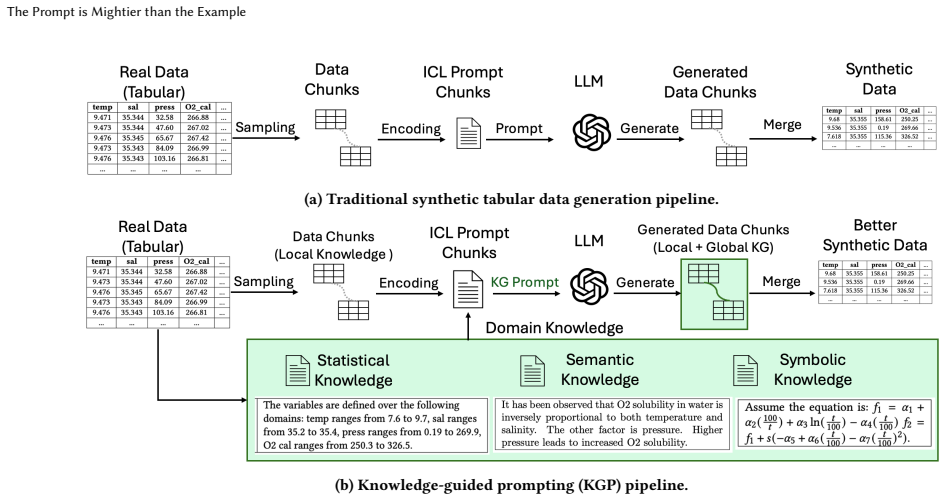
The central mechanism is the knowledge-guided prompt, an English-language statement of global data properties attached to each chunk of in-context examples. Three nested knowledge levels are used: statistical (column ranges), semantic (shape or dependency descriptions such as 'x and y coordinates depict a dinosaur'), and symbolic (the governing equation). The concentric construction means each higher level adds to the lower ones. The prompt carries the global knowledge, the chunks carry local knowledge, and together they condition the LLM's generation.
What would settle it
Run KGP on a held-out dataset using a knowledge statement produced automatically from the data (e.g., extracted column ranges and relationships) rather than one written after inspecting the data. If the 40–90% ICL reduction does not reproduce, the effect is driven by test-set-informed prompt selection, not by knowledge injection per se.
Extended reading notes
Core claim
The central claim is that in-context examples and domain knowledge are partially substitutable inputs for LLM-based tabular data generation. The paper defines knowledge-guided prompting (KGP) with three nested levels—statistical, semantic, and symbolic—and shows that adding knowledge improves generation quality at a fixed example count, and that the same quality can be reached with fewer examples. It reports that KGP also extends generation to out-of-distribution regions, with error reductions of 78–90% compared to no-knowledge prompting when exploring unobserved fields. The empirical scaling law states that quality varies with increasing domain knowledge and decreasing example count, providing a framework for predicting data requirements.
Load-bearing premise
The claimed savings rest on the authors' manually chosen English knowledge statements, which are selected after inspecting the target data; if the knowledge selection itself is a form of fitting, the reductions may not transfer to new datasets.
Editorial extensions
If this is right
- If the claim is correct, LLM-based synthetic data generation can operate with far fewer real examples, directly reducing token cost and easing data scarcity.
- KGP can be combined with ICL rather than replacing it, giving practitioners a two-knob design space in which knowledge statements are traded against example counts.
- The scaling law, if it generalizes, would let practitioners predict how many examples are needed once a knowledge level is chosen, and vice versa.
- In noisy or sparse settings, knowledge guidance helps the LLM correct errors and explore unobserved regions, enabling safer augmentation of incomplete datasets.
Reading between the lines
- The reported savings likely depend on the quality and specificity of the English knowledge statements; automatic knowledge extraction from the target dataset would be the natural test of whether the scaling law holds outside hand-crafted prompts.
- The framing suggests a broader principle for LLM prompting: declarative knowledge and exemplars are interchangeable currencies, which could extend beyond tabular data to code generation, planning, and other structured generation tasks.
- A testable extension is to measure the token-equivalence rate of a knowledge statement—how many example rows one sentence replaces—as a function of model scale, which the paper does not address.
Editorial analysis
A structured set of objections, weighed in public.
Referee Report
Summary. This paper proposes knowledge-guided prompting (KGP), a prompt optimization strategy that augments LLM prompts for synthetic tabular data generation with statistical, semantic, and symbolic domain knowledge. The central claim is that KGP can substantially reduce the number of in-context learning (ICL) examples needed to reach a given generation quality, with reported reductions of 40–90% in 'easy' and 50–80% in 'hard' data contexts, and an 'empirical scaling law' relating quality to knowledge level and example count. The experiments cover AP Calculus textbook functions, Datasaurus Dozen datasets, and an O2-sensing cyber-physical dataset, using metrics such as MSE, Hausdorff distance, NLL, KL divergence, DCR, and MLU. The paper also studies out-of-distribution generation and a noise-and-refix case study.
Significance. The question at the heart of the paper is important: if a few English sentences about the target distribution can substitute for dozens of example rows, KGP would reduce token costs and help low-data generation, and the proposed taxonomy of strong versus weak knowledge is a useful organizing device. The paper does contain some concrete positive results, such as Semantic KGP reducing the sigmoid OOD MSE from 0.11 to 0.002, and the visual comparison in Figure 2a shows a large Hausdorff improvement at the sampled point. However, the central quantitative claims, the scaling law, and the summary statements are not supported by the evidence as reported; several self-reported tables (Tables 3, 4, 6, 7) contain negative or contradictory cases. Because the core idea is plausible but the load-bearing evidence is underdetermined, the manuscript needs major revision rather than acceptance.
major comments (7)
- [Abstract, §4.2, §5] The promised 'empirical scaling law' is never formulated. The abstract and conclusion claim a scaling law that quantifies generation quality as a function of domain knowledge and example count, but Sections 4 and 5 contain no equation, no fitted parameters, no goodness-of-fit, and no stated functional form. The 40–90% reduction statements in §4.2 are descriptive comparisons of the plotted curves, not predictions from a scaling law. The authors should either state the law explicitly with fitted parameters and uncertainty, or remove the scaling-law claim from the abstract and conclusion.
- [§4.2, Figure 2] The headline reductions are underdetermined by the reported design. For AP Calculus only two ICL sizes (20 and 50) are evaluated, and for Datasaurus only two (10 and 100), with no repeated random ICL draws, no generation seeds, and no error bars. The 90% reduction on the Away dataset is inferred by matching one Semantic-KGP endpoint to one No-KGP endpoint; with two points per curve, any monotone or non-monotone behavior between the endpoints is consistent with the plot. In addition, the Figure 2 caption refers to '60 In-Context Samples' while §4.2 describes 20 and 50; this inconsistency must be resolved. The authors need more ICL sizes and repeated trials before the quantitative reduction claims can be supported.
- [§4.1 'KGP Scope'] The concentric nesting of knowledge types (Semantic = Statistical + Semantic; Symbolic = all three) means the comparison in Table 4 is not an ablation. The improvement attributed to 'Semantic KGP' over 'Statistical KGP' could be due entirely to the additional statistical range information, and 'Symbolic KGP' is always evaluated with statistical and semantic knowledge present. To answer RQ3, the authors need a condition in which only the semantic description is added, or they must re-frame the claims as comparisons of composite prompts.
- [Table 2, §4.2] The semantic KGP phrases are hand-picked per dataset with knowledge of the target shape (e.g., 'x and y coordinates of points when plotted visually depict a dinosaur', 'high lines'), and the statistical ranges in Table 2 are the exact ranges of the target datasets. No automatic knowledge-extraction method or held-out evaluation of the knowledge phrases is provided. The claimed 40–90% ICL reductions therefore conflate the effect of generalizable domain knowledge with the effect of test-set-specific hints, so the reductions may not transfer to new datasets. The authors should either supply an automatic extraction protocol, evaluate on datasets whose knowledge phrases were produced without inspecting the target distribution, or explicitly restrict the claim to the 'knowledge available' setting and discuss the leakage caveat.
- [§4.3, Table 3] The OOD generalization claim is selective. For Bohachevsky, Statistical KGP increases MSE from 1.62 to 2.23, while only Semantic KGP improves it to 0.44; the text reports only the Semantic improvement. The '78% to 90% lower error' summary also does not match the table's 98% (Sigmoid) and 73% (Bohachevsky). The authors should report both positive and negative directions and attribute the improvement to the specific knowledge type rather than to KGP as a whole.
- [§4.4, Table 4] Table 4 contradicts the claim in §4.2 that 'incorporating any form of KGP ... leads to a significant reduction in data generation error.' For y = x + 2 sin(x), Symbolic KGP produces MSE 0.57 versus 0.40 without KGP; for y = 2x^3 - 15x^2 + 36x the differences are within rounding. The manuscript's own Table 4 therefore shows that knowledge guidance is not uniformly beneficial, and the text should acknowledge and analyze these negative cases rather than only reporting the reductions.
- [§4.5, Tables 6–7] The overall finding that KGP achieves 'optimal performance across all three standard synthetic table metrics, with an average enhancement of 50%' is not supported by the tables. In Table 7, Semantic KGP worsens linear-regression MLU for AP Calculus (2.13 vs 1.61); in Table 6, AP Calculus DCR is 0 for all conditions, which the table caption itself identifies as an unacceptable data leak. The summary should be based on all rows of the tables, including the cases where KGP hurts or provides no benefit.
minor comments (7)
- [Throughout] There are numerous typos and misspellings, including 'Hustoff' for 'Hausdorff' in Figure 2, 'A way' for 'Away', 'Stastical' in §3.1, 'inconsistensies' in §3, 'taasks' in §1, and 'Dinausour' in Figure 5.
- [§4.1, Figure 2] The Figure 2 caption mentions 'MAPE' and 'Hustoff distance', but MAPE is not defined in the metrics list in §4.1, and the main text describes only Hausdorff distance and MSE. The figure and text should be reconciled.
- [§4.2] The phrase 'Figure 2a,b,c and e' for simple distributions and 'Figure 2c and 2f' for complex distributions is confusing: Figure 2 appears to contain six subfigures, and the text does not clearly map each dataset to a subfigure. Please make the subfigure references explicit.
- [§3, §4.1] Key experimental details are missing: the chunk size k and number of chunks c in the pipeline are never specified, and the generation temperature, model version/date, number of sampled rows per chunk, and number of runs are not reported. These details are needed for reproducibility.
- [Table 4] The arrows in Table 4 are ambiguous: it is unclear whether each arrow compares the current column to the previous column or to the 'W/o KGP' column, and the '∼' symbol is not defined in the caption.
- [References] Since the paper is about the tradeoff between prompts and ICL examples, it should quantitatively compare or at least discuss the findings of [19] in the tabular data setting, rather than only citing it.
- [§4.6] The 'noise-and-refix' procedure is introduced without specification; please describe how noise is added, how the LLM is prompted to fix it, and how the resulting synthetic data are evaluated against the original ground truth.
Circularity Check
The headline 40–90% ICL reductions are partly constructed: for shape and equation datasets, the KGP prompt contains the ground truth that the evaluation metric measures.
-
fitted input called prediction
[Section 4.1 (Metrics), Table 2, Section 4.2/Figure 2 (Dino, Away, High Lines); see also Symbolic KGP in Table 2 and MSE in Table 4.]
"For datasets characterized by shape-focused distributions, we employ Hausdorff distance to assess the similarity of the shapes. ... Semantic (Sem.) KGP: x and y coordinates of points when plotted visually depict a dinosaur. ... The quantitative metric Hausdorff Distance decreased from 18.54 to 7.72 indicating a significant improvement when using 60 In-Context Samples."
The Semantic KGP input is a verbatim description of the ground-truth shape, and the RQ1 evidence is Hausdorff distance to that same shape. The LLM is scored on reproducing the very information placed in the prompt; the drop from 18.54 to 7.72, and the 40–90% ICL reductions derived from such curves for Dino, Away, and High Lines, is the direct realization of the instruction rather than an independently discovered trade-off between knowledge and examples. The same holds for Symbolic KGP on AP Calculus, where the prompt is the exact equation and the metric is MSE to that equation. The 'prior' is thus posterior to the target data, so the central RQ1 finding reduces, for these datasets, to 'supplying the answer reduces the need for examples.'
full rationale
The paper's central RQ1 claim that KGP yields 40–90% (easy) and 50–80% (hard) reductions in ICL examples is, for the shape and symbolic-equation datasets, constructed by design: the semantic/symbolic prompts state the target shape or equation, and the evaluation metrics (Hausdorff distance, MSE) measure fidelity to exactly that target. This is the one identifiable partial circularity, and it justifies a score above 2. The rest of the paper contains independent empirical content: the O2-sensing case study, OOD generalization results, and MLU/NLL/DCR tables do not reduce to the prompt contents by construction, and the paper's self-citations [40,41] are background references rather than load-bearing evidence. No fitted scaling-law equation is actually presented, so there is no additional fitted-parameter-renamed-as-prediction step to flag; the abstract's 'empirical scaling law' is better characterized as an unsupported summary than as a circular derivation. Overall the derivation chain is partially circular but not wholly so, hence a score of 5.
Assumptions & free parameters
assumptions (3)
- domain assumption GPT-4o correctly interprets English statements about data ranges, shapes, and dependencies as intended by the authors.
- ad hoc to paper The concentric scope nesting (Semantic = Statistical + Semantic; Symbolic = all three) is a valid way to compare knowledge types.
- ad hoc to paper The hand-selected semantic descriptions (e.g., 'dinosaur', 'high lines') are representative of generalizable knowledge rather than dataset-specific hints.
Cite this review
Pith. "Pith review of The Prompt is Mightier than the Example." pith.science (2026). https://pith.science/paper/ROQYYI6Q
@misc{pith2026250518485,
  author       = {Pith},
  title        = {Pith review of: The Prompt is Mightier than the Example},
  year         = {2026},
  howpublished = {\url{https://pith.science/paper/ROQYYI6Q}},
  note         = {Machine review of arXiv:2505.18485}
}
read the original abstract
Numerous recent prompt optimization approaches like chain-of-thought, have been demonstrated to significantly improve the quality of content generated by large language models (LLMs). In-context learning (ICL), a recent paradigm where a few representative examples guide content generation has also led to strong improvements in generation quality of LLM generated content. This idea has been applied to great effect in synthetic tabular data generation, where LLMs, through effective use of ICL and prompt optimization, can generate data that approximate samples from complex, heterogeneous distributions based on representative examples. However, ensuring high-fidelity synthetic data often requires a very large number of ICL examples which may be unavailable or costly to obtain. At the same time, as LLMs get larger and larger, their in-built prior knowledge becomes vast and can potentially substitute for specific data examples. In this paper, we introduce Knowledge-Guided Prompting (KGP) as a new knob in prompt optimization and explore the ability of KGP-based prompt optimization to offset the cost of ICL. Specifically, we explore the question `how many examples can a prompt substitute for?' and explore knowledge-guided prompting (KGP) where domain knowledge, either inferred or available, is explicitly injected into the prompt, reducing dependence on ICL examples. Our experiments systematically explore the trade-off between ICL and KGP, revealing an empirical scaling law that quantifies how quality of generated synthetic data varies with increasing domain knowledge and decreasing example count. Our results demonstrate that knowledge-guided prompting can be a scalable alternative, or addition, to in-context examples, unlocking new approaches to synthetic data generation.
Figures


Figures from the paper (2 more)


Reference graph
Works this paper leans on
-
[1]
Nazmiye Ceren Abay, Yan Zhou, Murat Kantarcioglu, Bhavani Thuraisingham, and Latanya Sweeney. 2019. Privacy preserving synthetic data release using deep learning. In Machine Learning and Knowledge Discovery in Databases: European Conference, ECML PKDD 2018, Dublin, Ireland, September 10–14, 2018, Proceedings, Part I 18. Springer, 510–526
work page 2019
-
[2]
Chenxin An, Jun Zhang, Ming Zhong, Lei Li, Shansan Gong, Yao Luo, Jingjing Xu, and Lingpeng Kong. 2024. Why Does the Effective Context Length of LLMs Fall Short? arXiv:2410.18745 [cs.CL] https://arxiv.org/abs/2410.18745
arXiv 2024
-
[3]
H. Anton, I.C. Bivens, and S. Davis. 2011. Calculus Early Transcendentals, 10th Edition. Wiley
work page 2011
-
[4]
Vadim Borisov, Kathrin Seßler, Tobias Leemann, Martin Pawelczyk, and Gjergji Kasneci. 2022. Language models are realistic tabular data generators. arXiv preprint arXiv:2210.06280 (2022)
arXiv 2022
-
[5]
Hongjie Chen, Ryan A Rossi, Kanak Mahadik, Sungchul Kim, and Hoda Eldardiry
-
[6]
Edward Choi, Siddharth Biswal, Bradley Malin, Jon Duke, Walter F Stewart, and Jimeng Sun. 2017. Generating multi-label discrete patient records using generative adversarial networks. In Machine learning for healthcare conference . PMLR, 286–305
work page 2017
-
[7]
Damai Dai, Yutao Sun, Li Dong, Yaru Hao, Shuming Ma, Zhifang Sui, and Furu Wei. 2022. Why can gpt learn in-context? language models implicitly perform gradient descent as meta-optimizers. arXiv preprint arXiv:2212.10559 (2022)
arXiv 2022
-
[8]
Tuan Dinh, Yuchen Zeng, Ruisu Zhang, Ziqian Lin, Michael Gira, Shashank Rajput, Jy-yong Sohn, Dimitris Papailiopoulos, and Kangwook Lee. 2022. Lift: Language-interfaced fine-tuning for non-language machine learning tasks. Ad- vances in Neural Information Processing Systems 35 (2022), 11763–11784
work page 2022
Show all 50 references
-
[9]
Lun Du, Fei Gao, Xu Chen, Ran Jia, Junshan Wang, Jiang Zhang, Shi Han, and Dongmei Zhang. 2021. TabularNet: A neural network architecture for under- standing semantic structures of tabular data. In Proceedings of the 27th ACM SIGKDD Conference on Knowledge Discovery & Data Min...
2021
-
[10]
Yuntao Du and Ninghui Li. 2024. Towards principled assessment of tabular data synthesis algorithms. arXiv preprint arXiv:2402.06806 (2024)
2024 arXiv
-
[11]
Cristóbal Esteban, Stephanie L Hyland, and Gunnar Rätsch. 2017. Real-valued (medical) time series generation with recurrent conditional gans. arXiv preprint arXiv:1706.02633 (2017)
2017 arXiv
-
[12]
Xi Fang, Weijie Xu, Fiona Anting Tan, Jiani Zhang, Ziqing Hu, Yanjun (Jane) Qi, Scott Nickleach, Diego Socolinsky, "SHS" Srinivasan Sengamedu, and Christos Faloutsos. 2024. Large language models (LLMs) on tabular data: Prediction, generation, and understanding — a survey. Tran...
2024
-
[13]
Ian Goodfellow, Jean Pouget-Abadie, Mehdi Mirza, Bing Xu, David Warde-Farley, Sherjil Ozair, Aaron Courville, and Yoshua Bengio. 2020. Generative adversarial networks. Commun. ACM 63, 11 (2020), 139–144
2020
-
[14]
Haibo He and Edwardo A Garcia. 2009. Learning from imbalanced data. IEEE Transactions on knowledge and data engineering 21, 9 (2009), 1263–1284
2009
-
[15]
Rae, Oriol Vinyals, and Laurent Sifre
Jordan Hoffmann, Sebastian Borgeaud, Arthur Mensch, Elena Buchatskaya, Trevor Cai, Eliza Rutherford, Diego de Las Casas, Lisa Anne Hendricks, Jo- hannes Welbl, Aidan Clark, Tom Hennigan, Eric Noland, Katie Millican, George van den Driessche, Bogdan Damoc, Aurelia Guy, Simon Os...
-
[16]
Cheng-Ping Hsieh, Simeng Sun, Samuel Kriman, Shantanu Acharya, Dima Rekesh, Fei Jia, and Boris Ginsburg. 2024. RULER: What’s the Real Context Size of Your Long-Context Language Models?. In First Conference on Language Modeling. https://openreview.net/forum?id=kIoBbc76Sy
2024
-
[17]
Shuodi Hui, Huandong Wang, Tong Li, Xinghao Yang, Xing Wang, Junlan Feng, Lin Zhu, Chao Deng, Pan Hui, Depeng Jin, et al. 2023. Large-scale urban cellular traffic generation via knowledge-enhanced gans with multi-periodic patterns. In Proceedings of the 29th ACM SIGKDD Confere...
2023
-
[18]
James Jordon, Jinsung Yoon, and Mihaela Van Der Schaar. 2018. PATE-GAN: Generating synthetic data with differential privacy guarantees. In International conference on learning representations
2018
-
[19]
Teven Le Scao and Alexander M Rush. 2021. How many data points is a prompt worth?. In Proceedings of the 2021 Conference of the North American Chapter of the Association for Computational Linguistics: Human Language Technologies . 2627–2636
2021
-
[20]
Zinan Lin, Alankar Jain, Chen Wang, Giulia Fanti, and Vyas Sekar. 2020. Using gans for sharing networked time series data: Challenges, initial promise, and open questions. In Proceedings of the ACM Internet Measurement Conference . 464–483
2020
-
[21]
Tennison Liu, Zhaozhi Qian, Jeroen Berrevoets, and Mihaela van der Schaar
-
[22]
Andrei Margeloiu, Xiangjian Jiang, Nikola Simidjievski, and Mateja Jamnik. [n. d.]. TabEBM: A Tabular Data Augmentation Method with Distinct Class- Specific Energy-Based Models. In The Thirty-eighth Annual Conference on Neural Information Processing Systems
-
[23]
Justin Matejka and George Fitzmaurice. 2017. Same stats, different graphs: generating datasets with varied appearance and identical statistics through simulated annealing. In Proceedings of the 2017 CHI conference on human factors in computing systems. 1290–1294
2017
-
[24]
Ryan McKenna, Daniel Sheldon, and Gerome Miklau. 2019. Graphical-model based estimation and inference for differential privacy. InInternational Conference on Machine Learning. PMLR, 4435–4444
2019
-
[25]
Noseong Park, Mahmoud Mohammadi, Kshitij Gorde, Sushil Jajodia, Hongkyu Park, and Youngmin Kim. 2018. Data synthesis based on generative adversarial networks. Proceedings of the VLDB Endowment 11, 10 (2018), 1071–1083
2018
-
[26]
Neha Patki, Roy Wedge, and Kalyan Veeramachaneni. 2016. The Synthetic data vault. In IEEE International Conference on Data Science and Advanced Analytics (DSAA). 399–410. doi:10.1109/DSAA.2016.49
2016 doi
-
[27]
Alec Radford, Jeffrey Wu, Rewon Child, David Luan, Dario Amodei, Ilya Sutskever, et al. 2019. Language models are unsupervised multitask learners. OpenAI blog 1, 8 (2019), 9
2019
-
[28]
Ruifeng Ren and Yong Liu. 2024. Towards Understanding How Transformers Learn In-context Through a Representation Learning Lens. In The Thirty-eighth Annual Conference on Neural Information Processing Systems
2024
-
[29]
Nabeel Seedat, Nicolas Huynh, Boris van Breugel, and Mihaela van der Schaar
-
[30]
Ananya Singha, José Cambronero, Sumit Gulwani, Vu Le, and Chris Parnin
-
[31]
Aivin V Solatorio and Olivier Dupriez. 2023. Realtabformer: Generating realistic relational and tabular data using transformers. arXiv preprint arXiv:2302.02041 (2023)
2023 arXiv
-
[32]
Xingyou Song, Oscar Li, Chansoo Lee, Bangding Yang, Daiyi Peng, Sagi Perel, and Yutian Chen. 2024. OmniPred: Language Models as Universal Regressors. Trans. Mach. Learn. Res. 2024 (2024). https://openreview.net/forum?id=t9c3pfrR1X
2024
-
[33]
Johannes Treutlein, Dami Choi, Jan Betley, Samuel Marks, Cem Anil, Roger Grosse, and Owain Evans. 2024. Connecting the dots: Llms can infer and verbalize latent structure from disparate training data. arXiv preprint arXiv:2406.14546 (2024)
2024 arXiv
-
[34]
arXiv preprint arXiv:2310.10358 (2023)
Tabular representation, noisy operators, and impacts on table structure understanding tasks in llms. arXiv preprint arXiv:2310.10358 (2023)
2023 arXiv
-
[35]
Eason Wang, Henggang Cui, Sai Yalamanchi, Mohana Moorthy, and Nemanja Djuric. 2020. Improving movement predictions of traffic actors in bird’s-eye view models using GANs and differentiable trajectory rasterization. In Proceedings of the 26th ACM SIGKDD International Conference...
2020
-
[36]
Yun Wang, Zhida Sun, Haidong Zhang, Weiwei Cui, Ke Xu, Xiaojuan Ma, and Dongmei Zhang. 2020. DataShot: Automatic Generation of Fact Sheets from Tabular Data. IEEE Transactions on Visualization and Computer Graphics 26, 1 (2020), 895–905. doi:10.1109/TVCG.2019.2934398
2020
-
[37]
Zhiruo Wang, Haoyu Dong, Ran Jia, Jia Li, Zhiyi Fu, Shi Han, and Dongmei Zhang
-
[38]
Gomez, Lukasz Kaiser, and Illia Polosukhin
Ashish Vaswani, Noam Shazeer, Niki Parmar, Jakob Uszkoreit, Llion Jones, Aidan N. Gomez, Lukasz Kaiser, and Illia Polosukhin. 2017. Attention Is All You Need. CoRR abs/1706.03762 (2017). arXiv:1706.03762 http://arxiv.org/abs/ 1706.03762
2017 arXiv
-
[39]
Lei Xu, Maria Skoularidou, Alfredo Cuesta-Infante, and Kalyan Veeramacha- neni. 2019. Modeling tabular data using conditional gan. Advances in neural information processing systems 32 (2019)
2019
-
[40]
Shengzhe Xu, Cho-Ting Lee, Mandar Sharma, Raquib Bin Yousuf, Nikhil Mu- ralidhar, and Naren Ramakrishnan. 2024. Are LLMs Naturally Good at Synthetic Tabular Data Generation? arXiv preprint arXiv:2406.14541 (2024)
2024 arXiv
-
[41]
Shengzhe Xu, Manish Marwah, Martin Arlitt, and Naren Ramakrishnan. 2021. Stan: Synthetic network traffic generation with generative neural models. In Deployable Machine Learning for Security Defense: Second International Workshop, MLHat 2021, Virtual Event, August 15, 2021, Pr...
2021
-
[42]
Hengrui Zhang, Jiani Zhang, Balasubramaniam Srinivasan, Zhengyuan Shen, Xiao Qin, Christos Faloutsos, Huzefa Rangwala, and George Karypis. 2023. Mixed- type tabular data synthesis with score-based diffusion in latent space. arXiv preprint arXiv:2310.09656 (2023)
2023 arXiv
-
[43]
Ming-Kun Xie and Sheng-Jun Huang. 2019. Learning class-conditional gans with active sampling. In Proceedings of the 25th ACM SIGKDD International Conference on Knowledge Discovery & Data Mining . 998–1006
2019
-
[44]
Zilong Zhao, Robert Birke, and Lydia Chen. 2023. Tabula: Harnessing language models for tabular data synthesis. arXiv preprint arXiv:2310.12746 (2023)
2023 arXiv
-
[45]
Gonzalez, and Matei Zaharia
Alan Zhu, Parth Asawa, Jared Quincy Davis, Lingjiao Chen, Boris Hanin, Ion Stoica, Joseph E. Gonzalez, and Matei Zaharia. 2025. BARE: Combining Base and Instruction-Tuned Language Models for Better Synthetic Data Generation. arXiv preprint arXiv:2502.01697 (2025)
2025 arXiv
-
[48]
Tianping Zhang, Shaowen Wang, Shuicheng Yan, Li Jian, and Qian Liu. 2023. Gen- erative Table Pre-training Empowers Models for Tabular Prediction. In Proceed- ings of the 2023 Conference on Empirical Methods in Natural Language Processing . 14836–14854. Xu et al
2023
-
[2021]
In Proceedings of the 27th ACM SIGKDD Conference on Knowledge Discovery & Data Mining
Tuta: Tree-based transformers for generally structured table pre-training. In Proceedings of the 27th ACM SIGKDD Conference on Knowledge Discovery & Data Mining. 1780–1790
-
[2022]
In The Eleventh International Conference on Learning Representations
GOGGLE: Generative modelling for tabular data by learning relational structure. In The Eleventh International Conference on Learning Representations
-
[2023]
ACM Transactions on Knowledge Discovery from Data 17, 2 (2023), 1–30
Graph Deep Factors for Probabilistic Time-series Forecasting. ACM Transactions on Knowledge Discovery from Data 17, 2 (2023), 1–30
2023
-
[2024]
In Forty-first International Conference on Machine Learning
Curated LLM: Synergy of LLMs and Data Curation for tabular augmentation in low-data regimes. In Forty-first International Conference on Machine Learning
Reviewed August 7, 2026 · model on record in the stance chip above.
Discussion (0). Sign in to comment.