REVIEW 4 major objections 6 minor 23 references
Business as Rulesual: A Benchmark and Framework for Business Rule Flow Modeling with LLMs
T0 review · 4 major / 6 minor · reviewed 2026-08-07 · deepseek-v4-flash
Pith's one-line read Executable grounding via pseudo-code beats standard prompts at extracting business rules from real-world documents.
desk verdict The BREX benchmark is a real resource; the headline 'significant' claim about executable grounding is not backed by the reported numbers. read the letter →
The pith
A machine-rendered reading of the paper's core claim, the machinery that carries it, and where it could break.
The reading
What carries the argument
The load-bearing mechanism is the intermediate pseudo-code representation used in Prompt 5 of ExIde. The model first rewrites the business text into simple procedural primitives such as select_from() and execute_action(), then extracts rule tuples from that scaffold. This 'executable grounding' forces early resolution of nested conditions and control flow, and it is the component the paper credits for the consistent performance gains in Stage I. The second mechanism is the two-stage decompose-and-reason design: Stage I extracts atomic condition–action rules, and Stage II performs pairwise dependency classification over rule pairs to reconstruct a typed adjacency matrix.
What would settle it
Re-annotate a stratified sample of BREX documents with dependency-edge labels using the same three-expert protocol and compute Kappa on the edges themselves; if agreement on Conditional and Parallel edges falls substantially below 0.901, the Stage II 'reasoning gap' results rest on noisy ground truth. As a complementary check, run Prompt 5 and Prompt 1 on a subset with exact-match tuple evaluation instead of span-based NER F1 to see whether the pseudo-code advantage survives stricter scoring.
Extended reading notes
Core claim
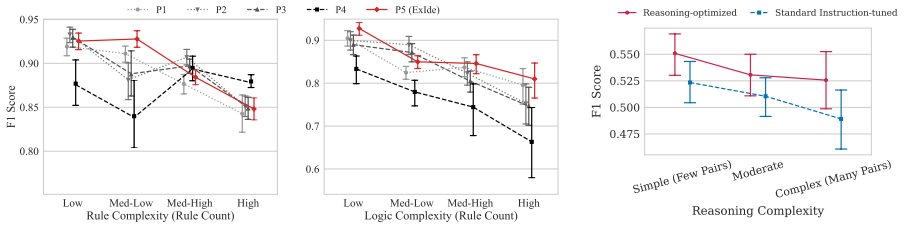
The paper's discovery, stated on its own terms, is that the 'Logic Gap' between free-form business regulations and executable, condition-dependent control flow can be partially closed by introducing intermediate executable representations during prompting. Concretely, Prompt 5, which has the LLM translate the business text into pseudo-code primitives before extracting atomic rules, achieves the highest average NER F1 (0.882) and logical-operator F1 (0.850) across 13 models, outperforming implicit alignment, explicit traceability, clarified context, and logic-definition injection. The paper also finds that reasoning-optimized models (e.g., the 'Thinking' variants) show the largest gains on Conditional and Parallel dependency identification, with the gap widening as the number of rule pairs grows, indicating that global rule-flow reconstruction requires state tracking rather than pattern matching.
Load-bearing premise
The reported expert agreement, a Fleiss' Kappa of 0.901, was measured only on named-entity spans (slot types, reference values, actions), not on the dependency edges (Sequential, Conditional, Parallel) that the Stage II results depend on.
Editorial extensions
If this is right
- If executable grounding works as described, practitioners can improve rule extraction on regulated documents without fine-tuning, simply by adding a pseudo-code step to their prompts.
- Reasoning-optimized models are the better default for dependency-heavy documents, particularly when conditions branch and rules run in parallel.
- The over-30% share of Conditional and Parallel relations in BREX suggests that action-centric benchmarks understate the logical complexity of real-world procedures.
- The observed robustness of P5 under high rule density indicates that pseudo-code scaffolding mitigates the lost-in-the-middle effect for long regulatory texts.
- The case study's failure mode—pseudo-code reifying discourse connectors into spurious meta-rules—means deployment should check precision on high-density documents.
Reading between the lines
- The pseudo-code inductive bias likely transfers to other structured extraction tasks, such as form-filling or compliance checklist generation, because it is a general way to force control-flow awareness into LLM outputs.
- The paper's dependency-graph evaluation is only as strong as the annotation of the edges; if experts disagree more on Conditional and Parallel relations than on spans, the reported reasoning gap could shrink under cleaner labels.
- A testable extension is to compare P5 against a variant that uses formal rule notation (e.g., JSON with explicit branches) instead of pseudo-code, isolating whether code syntax or execution semantics drives the gain.
- The 'reasoning-optimized' advantage may erode as instruction-tuned models improve; the 6% gap observed for Qwen3-30B suggests that structured reasoning mechanisms matter now, but the landscape is moving quickly.
Signed reviews
Editorial analysis
A structured set of objections, weighed in public.
Referee Report
Summary. This paper introduces BREX, a benchmark of 409 business documents and 2,855 expert-annotated condition–action rules with dependency relations, and ExIde, a five-prompt structure-aware framework for extracting such rules and reconstructing dependency graphs. The authors evaluate 13 LLMs and report two main findings: pseudo-code-based executable grounding (P5) outperforms other prompts in rule extraction, and reasoning-optimized models outperform instruction-tuned models on dependency identification. The dataset and code are released.
Significance. If the findings are established, BREX would be a useful resource for rule-flow extraction, and pseudo-code prompting would be a practical tuning-free intervention. The manuscript's strengths include the multi-domain expert-annotated dataset (over 30 domains), the clear decomposition into Stage I and Stage II, and the breadth of models and prompting variants. However, the headline claims rest on small average differences without statistical support, and the reliability of the dependency labels—central to the Stage II conclusion—is not directly measured. These issues must be addressed before the conclusions are fully supported.
major comments (4)
- [§5.2, Tables 2–3] The abstract and §5.2 claim that P5 'significantly outperforms' standard prompts, but the reported numbers do not demonstrate this. The average NER F1 difference between P5 (0.882) and P1/P2 (0.879) is 0.003, and the logical-operator F1 advantage over P2 is 0.004; no confidence intervals, error bars, or paired significance tests are reported. Moreover, P5 is not the best prompt for several models (e.g., Gemini-2.5-pro P1 0.916 vs. P5 0.899; GPT-5 P1 0.876 vs. P5 0.873; Qwen3-235B-Instruct P1 0.898 vs. P5 0.892; DeepSeek-3.2-exp logical-operator P2 0.896 vs. P5 0.848). A paired bootstrap or signed-rank test is needed to support the wording; if the differences are not significant, the conclusion should be tempered to a small average-rank trend.
- [§3.3, A.6] The reported Fleiss Kappa of 0.901 is computed on a NER projection of Slot Type, Reference Value, and Action spans, not on the Sequential/Conditional/Parallel dependency edges that are central to Stage II. The paper itself acknowledges that there is no established metric for graph-structured agreement. Without evidence about expert agreement on the edge labels, the Stage II 'reasoning gap' results may be built on labels whose reliability is unknown. The authors should report agreement on the dependency relations (or a defensible proxy) before drawing strong conclusions from Table 4.
- [§4.2, §5.3] It is unclear whether the Stage II dependency evaluation uses gold rule pairs or pairs extracted from Stage I outputs. The text says the prompt 'takes rule pairs as input' but does not specify the source of these pairs, and Table 4 reports only F1. If gold pairs are used, the results isolate pairwise classification and should be described as such; if predicted pairs are used, error propagation from Stage I should be discussed. This distinction materially affects the interpretation of the 'reasoning advantage' claim.
- [§5.4, Figure 4] The robustness analysis claims that P5 shows a 'relatively flat performance curve' and that reasoning-optimized models have 'significantly flatter degradation curves,' but Figure 4 shows aggregate lines without error bars or statistical tests. The claims of significance and the bucket-specific reversal for P5 should be supported by per-model inference or at least by variance estimates.
minor comments (6)
- [Title and full text] The title 'Business asRulesual' appears to be a pun; consider spelling out 'Business Rules' in the title for discoverability.
- [References] The reference list contains incomplete entries, e.g., the Gemini 2.5 entry is listed with 'and 1 others.' Please fix.
- [Table 5] Table 5 shows 2,855 rules but 3,469 dependency relations; the text could clarify that a rule can participate in multiple dependency edges.
- [§5.2] The claim that 'P4 performs worst on average' is based on Table 3, but Table 2 shows P4 is not the worst for NER (P3 is). Please make the statement consistent with both tables.
- [A.6, Table 7] The IAA example shows annotator disagreement on span boundaries, but the text says the high Kappa confirms consistent interpretation; consider discussing how boundary variations affect downstream evaluation.
- [Figure 3] The radar plot would benefit from axis labels and a legend; currently the color distinction between 'Standard Instruction-tuned' and 'Reasoning-optimized' is not defined in the caption.
Circularity Check
No material circularity: BREX/ExIde claims rest on empirical benchmark comparisons, with no fitted inputs, self-citation chains, or derivation-by-definition.
full rationale
The paper's derivation chain is empirical rather than formal. The BREX benchmark is constructed from real-world documents plus expert-filtered synthetic augmentation, and the annotations are validated with ICC and Fleiss' kappa (Sec. 3.3, A.6); these statistics are quality checks, not quantities being predicted. ExIde is a set of five prompting strategies compared across 13 LLMs against expert-annotated ground truth, and no parameter is fitted to the test data. The Stage I claim that P5 outperforms P1/P2 may be statistically under-supported, since the average NER F1 gaps are about 0.003 and no significance tests are reported, but that is a correctness/robustness concern, not circularity. No load-bearing author self-citations appear: the premises are supported by external references and by the paper's own controlled prompt comparisons. The co-design of the annotation schema and prompts creates a possible confounding factor for the pseudo-code advantage, but it does not make the result equivalent to its inputs by construction. The Limitation section explicitly acknowledges the synthetic-data, prompt-only dependency modeling, and schema-scope limits, which further supports a non-circular reading. Overall, no step reduces to its own inputs under the paper's own definitions.
Assumptions & free parameters
assumptions (4)
- ad hoc to paper Business documents can be faithfully represented as sets of atomic condition-action rules (Slot Type, Logical Operator, Reference Value) linked by Sequential/Conditional/Parallel relations.
- ad hoc to paper Three dependency types are sufficient to capture the logic in BREX.
- domain assumption LLM-generated synthetic texts, after expert filtering, are realistic enough proxies for real business regulations.
- domain assumption Inter-annotator agreement on the dependency graph can be approximated by agreement on NER span projections.
invented entities (1)
-
Atomic condition-action rule schema with three dependency types (BREX annotation schema)
Cite this review
Pith. "Pith review of Business as Rulesual: A Benchmark and Framework for Business Rule Flow Modeling with LLMs." pith.science (2026). https://pith.science/paper/ZIM2G37J
@misc{pith2026250518542,
  author       = {Pith},
  title        = {Pith review of: Business as Rulesual: A Benchmark and Framework for Business Rule Flow Modeling with LLMs},
  year         = {2026},
  howpublished = {\url{https://pith.science/paper/ZIM2G37J}},
  note         = {Machine review of arXiv:2505.18542}
}
read the original abstract
Extracting structured procedural knowledge from unstructured business documents is a critical yet unresolved bottleneck in process automation. While prior work has focused on extracting linear action flows from instructional texts, such as recipes, it has insufficiently addressed the complex logical structures, including conditional branching and parallel execution, that are pervasive in real-world regulatory and administrative documents. Furthermore, existing benchmarks are limited by simplistic schemas and shallow logical dependencies, restricting progress toward logic-aware large language models.To bridge this Logic Gap, we introduce BREX, a carefully curated benchmark comprising 409 real-world business documents and 2,855 expert-annotated rules. Unlike prior datasets centered on narrow service scenarios, BREX spans over 30 vertical domains, covering scientific, industrial, administrative, and financial regulations. We further propose ExIde, a structure-aware reasoning framework that investigates five distinct prompting strategies, ranging from implicit semantic alignment to executable grounding via pseudo-code generation. This enables explicit modeling of rule dependencies and provides an out-of-the-box framework for different business customers without finetuning their own large language models. We benchmark ExIde using 13 state-of-the-art large language models. Our extensive evaluation reveals that executable grounding serves as a superior inductive bias, significantly outperforming standard prompts in rule extraction. In addition, reasoning-optimized models demonstrate a distinct advantage in tracing long-range and non-linear rule dependencies compared to standard instruction-tuned models.
Figures


Figures from the paper (12 more)


Reference graph
Works this paper leans on
-
[4]
InProceedings of the 14th International Confer- ence on Parsing Technologies, pages 50–60
A framework for procedural text understand- ing. InProceedings of the 14th International Confer- ence on Parsing Technologies, pages 50–60. Carolyn R Miller. 1979. A humanistic rationale for technical writing.College English, 40(6):610–617. Kuntal Kumar Pal, Kazuaki Kashihara, Pratyay Baner- jee, Swaroop Mishra, Ruoyu Wang, and Chitta Baral
work page 1979
-
[10]
⟨⟨Type of leave, equal, annual leave⟩, employees need to submit the duration of their leave⟩ Good Output 1.⟨⟨Type of leave, include, personal leave, sick leave and annual leave⟩, None⟩
-
[11]
⟨⟨Type of leave, equal, personal leave⟩, employees need to submit the duration of their leave⟩
-
[12]
⟨⟨Type of leave, equal, sick leave⟩, employees need to submit the duration of their leave⟩
-
[13]
⟨⟨Type of leave, equal, annual leave⟩, employees need to submit the duration of their leave⟩ Bad Output 1.⟨⟨Type of leave, include, personal leave, sick leave and annual leave⟩, None⟩
-
[14]
⟨⟨Type of leave, equal, personal leave, sick leave and annual leave ⟩, employees need to submit the duration of their leave⟩ Table 8: Case 1: Over-merging enumerated values under theequaloperator. Distinct leave types with identical downstream actions are incorrectly collapsed into a single equality condition, violating the atomic semantics of equality an...
-
[17]
⟨⟨Type of card, equal, theme co-branded card⟩, the applicant also needs to fill in their personal basic information⟩ Good Output
-
[19]
⟨⟨Type of card, equal, standard credit card ⟩, the applicant needs to fill in their personal basic information⟩
Show all 23 references
-
[20]
⟨⟨Type of card, equal, theme co-branded card⟩, the applicant also needs to fill in their personal basic information⟩ Bad Output
-
[21]
⟨⟨Type of card, include, standard credit cards and themed co-branded cards⟩, None⟩
-
[22]
Yes” or “No,
⟨⟨Type of card, equal, standard credit card, theme co-branded card⟩, the applicant needs to fill in their personal basic information⟩ Table 9: Case 2: Over-merging enumerated values under theequaloperator. Distinct card types with identical downstream actions are incorrectly c...
-
[25]
SMS notification
⟨⟨ Notification methods , include, “SMS notification” and “email notification.”⟩, None⟩ ... Prompt 4 - Good Output
-
[26]
⟨⟨ Type of deposit, include, lump-sum deposit with lump-sum with- drawal and installment deposit with lump-sum withdrawal⟩, None⟩
-
[27]
Yes” or “No,
⟨⟨ Monthly deposit amount , >, 200,000⟩, the customer must addition- ally provide proof of the source of funds⟩ 3.⟨⟨ Automatic renewal service , include, “Yes” or “No,”⟩, None⟩
-
[28]
SMS notification
⟨⟨ Notification methods , include, “SMS notification” and “email notification.”⟩, None⟩ ... Prompt 5 - Bad Output
-
[29]
⟨⟨ Above information , include, type of deposit, the deposit currency, deposit term and monthly deposit amount⟩, customer needs to provide the specific deposit amount⟩
-
[30]
Table 10: Case 3: Abstraction-induced precision degradation in high-complexity texts
⟨⟨ The automatic renewal service and the method for receiving interest rate change notifications , include, automatic renewal service, notification methods⟩, These two services can be selected simultaneously.⟩ ... Table 10: Case 3: Abstraction-induced precision degradation in ...
-
[90]
Ron Artstein
Springer. Ron Artstein. 2017. Inter-annotator agreement.Hand- book of linguistic annotation, pages 297–313. Patrizio Bellan, Mauro Dragoni, and Chiara Ghidini. 2022a. Extracting business process entities and re- lations from text using pre-trained language models and in-contex...
2017 arXiv
-
[201]
Andrei Cosmin Redis, Mohammadreza Fani Sani, Bahram Zarrin, and Andrea Burattin
Springer. Andrei Cosmin Redis, Mohammadreza Fani Sani, Bahram Zarrin, and Andrea Burattin. 2024. Processt- bench: An LLM plan generation dataset for process mining.CoRR, abs/2409.09191. Haopeng Ren, Yushi Zeng, Yi Cai, Bihan Zhou, and Zetao Lian. 2023. Constructing procedural ...
2024 arXiv
-
[2011]
InAdvanced Information Systems En- gineering: 23rd International Conference, CAiSE 2011, London, UK, June 20-24, 2011
Process model generation from natural lan- guage text. InAdvanced Information Systems En- gineering: 23rd International Conference, CAiSE 2011, London, UK, June 20-24, 2011. Proceedings 23, pages 482–496. Springer. Wenyan Guo, Qingtian Zeng, Hua Duan, Guiyuan Yuan, Weijian Ni,...
2011
-
[2015]
In2015 IEEE 9th international conference on research challenges in information science (RCIS), pages 19–30
Automatic process model discovery from tex- tual methodologies. In2015 IEEE 9th international conference on research challenges in information science (RCIS), pages 19–30. IEEE. Fabian Friedrich, Jan Mendling, and Frank Puhlmann
-
[2020]
currency types... including RMB, USD
A comparative study on the performance of rule engines in automated ontology learning: a case study with erythemato-squamous disease (esd).In- ternational Journal of Intelligent Unmanned Systems, 8(4):267–280. Jason Wei, Xuezhi Wang, Dale Schuurmans, Maarten Bosma, Fei Xia, Ed...
2020
-
[2021]
Vira Pyrih, Adrian Rebmann, and Han van der Aa
Constructing flow graphs from procedural cy- bersecurity texts.arXiv preprint arXiv:2105.14357. Vira Pyrih, Adrian Rebmann, and Han van der Aa. 2025. Llms that understand processes: Instruction-tuning for semantics-aware process mining. In7th Interna- tional Conference on Proc...
2025 arXiv
Reviewed August 7, 2026 · model on record in the stance chip above.
Discussion (0). Continue with ORCID to comment.