REVIEW 4 major objections 5 minor 48 references
DNS and role of round-off error: Two-Dimensional Taylor-Green vortex problem
T0 review · 4 major / 5 minor · reviewed 2026-08-07 · deepseek-v4-flash
Pith's one-line read In the two-dimensional Taylor-Green vortex, round-off error seeds the instability: quadruple precision delays receptivity and changes the route to turbulence and decay.
desk verdict The precision comparison is real, but the paper's linear growth rate has a sign error—Eq (3.4) predicts decay, so the central theoretical framing is wrong. read the letter →
The pith
A machine-rendered reading of the paper's core claim, the machinery that carries it, and where it could break.
The reading
What carries the argument
The argument is carried by three ingredients working together. The first is the streamfunction-vorticity form of the 2D Navier-Stokes equations, discretized spatially with Fourier pseudospectral methods and advanced in time with fourth-order Runge-Kutta; this combination is meant to eliminate truncation, dispersion, and aliasing errors so that round-off is the only uncontrolled error. The second is the analytically known Taylor-Green equilibrium with the linearized disturbance law $\omega_d = \hat{F} e^{2t/Re} \sin x \sin y$, which predicts a log-linear growth stage against which the computed maximum disturbance vorticity is compared. The third is the precision contrast itself: two runs, double and quadruple, identical in every numerical parameter, serve as the experiment that isolates the effect of round-off. The onset location is the free saddle point at the cell center, and the named stages AB, BC, CD, and DE provide the vocabulary in which the precision effect is described.
What would settle it
Halve the time step to $dt = 0.0125$ while keeping double precision and the same de-aliasing; if the receptivity-phase onset shifts by an amount comparable to the delay caused by switching to quadruple precision at $dt = 0.025$, then temporal discretization error is contributing to the observed precision effect.
Extended reading notes
Core claim
The central claim is that the round-off error left by finite-precision arithmetic triggers receptivity in the 2D Taylor-Green vortex and that the level of precision therefore determines the instability route. Starting from the exact equilibrium $\psi_m = \sin x \sin y \, e^{-2t/Re}$, the linearized disturbance vorticity is $\omega_d = \hat{F} e^{2t/Re} \sin x \sin y$, and in the simulations this growth appears in four stages: receptivity (AB), linear growth (BC), nonlinear growth (CD), and enstrophy-driven decay (DE). When the same discretization is run in quadruple precision instead of double precision, the onset and duration of the receptivity phase shift significantly later in time, the disturbance fields differ in structure at matched amplitudes, and the decay phase is reached by a different route. The paper reads this as evidence that round-off error plays a singular role in the spatio-temporal vorticity dynamics, rather than acting as negligible noise.
Load-bearing premise
The load-bearing premise is that the Runge-Kutta time-stepping error at $dt = 0.025$ and the remaining aliasing are negligible or identical in the two precision runs, so that the only meaningful difference between them is the machine round-off; no convergence study is given to test this.
Editorial extensions
If this is right
- Any DNS that does not control or report precision may be implicitly fixing a round-off seed; changing precision can move the transition time by a large factor.
- Reported onset times for instability in the 2D TGV problem, and possibly in other receptivity problems, are precision-dependent and should be quoted with the precision used.
- The newly identified receptivity phase AB must be included in analyses of transition, since it is the stage where background numerical noise is internalized into the flow's disturbance field.
- The decay phase DE remains governed by the monotonic enstrophy decay of the 2D equations regardless of precision, so the precision effect is concentrated in the growth and receptivity stages.
Reading between the lines
- A natural test the paper does not run is to vary the time step at fixed precision; if halving $dt$ shifts the receptivity onset as much as switching precision does, the temporal truncation error is entangled with round-off and the singular role needs qualification.
- The paper's setup is unforced and uses no hyperviscosity, which suggests that earlier DNS studies using forcing or added dissipation may have masked precision effects; forced runs could be revisited in double versus quadruple precision to look for the same seed mechanism.
- If the seed is just the amplitude of the initial round-off perturbation, then deliberately rounding the initial condition to different numbers of digits in the same double-precision code should reproduce the full range of onset times seen here; that would turn the qualitative claim into a quantitative scaling law.
- A practical consequence for reproducibility is that DNS transition studies should specify precision and possibly rounding mode, since bit-level error paths could matter as much as the nominal number of digits.
Editorial analysis
A structured set of objections, weighed in public.
Referee Report
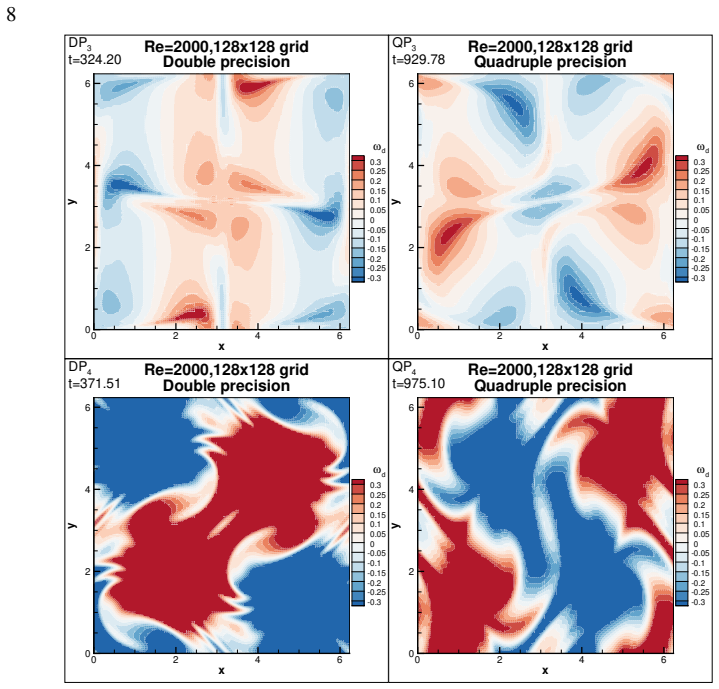
Summary. The paper reports direct numerical simulations of the two-dimensional Taylor-Green vortex at Re = 2000 on a 128x128 grid, using a Fourier pseudospectral spatial discretization and RK4 time integration in both double and quadruple precision. The authors identify four stages in the evolution of the maximum disturbance vorticity (receptivity, linear instability, nonlinear saturation, and decay) and claim that quadruple precision delays the onset of the receptivity phase and produces a qualitatively different route to turbulence. They further claim that this establishes, for the first time, a singular role of round-off error in the spatio-temporal vorticity dynamics. The main evidence is the time history in Fig. 2 and the disturbance-vorticity field comparisons in Figs. 3 and 4.
Significance. The controlled precision comparison is a worthwhile idea: changing only precision while holding all numerical parameters fixed is a clean protocol for isolating round-off effects, and the use of a Fourier pseudospectral method removes spatial truncation error. If the claimed delay and structural differences were properly established, the results would be relevant to the DNS community, where double precision is the de facto standard. However, the present analysis contains a serious error in the linearized theory and does not rule out a trivial initial-amplitude explanation for the observed delay. The significance therefore depends on a substantial revision of the theoretical framing and on additional error-quantification experiments.
major comments (4)
- [Section 3, Eqs. (3.3)-(3.4)] The sign in the linearized disturbance equation is incorrect. Substituting the same-mode ansatz (3.1)-(3.2) into the linearized vorticity transport equation (2.1) gives dF_d/dt = -2F_d/Re, because u_m · grad(omega_d) + u_d · grad(omega_m) vanishes identically for this single-mode perturbation. Consequently Eq. (3.4) predicts exponential decay, not growth, and it cannot be the mechanism behind the stage BC identified in Fig. 2. The observed log-slope between DP2 (t=214, |omega_d,max|=1e-5) and DP3 (t=324, |omega_d,max| of order 0.3) is about 0.09, not 2/Re = 0.001. The 'linear instability stage' must be derived from a correct modal or nonmodal analysis of the time-dependent base flow, or removed from the interpretation.
- [Section 1 and Section 4] The assertion that 'the only major source of error ... is related to aliasing' ignores the temporal truncation error of the RK4 scheme. With dt = 0.025, no convergence study or error estimate is provided to show that the RK4 temporal error is smaller than double-precision round-off over the integration times considered. Without such a test, the double-versus-quadruple differences cannot be attributed solely to round-off; they could reflect a different mix of round-off and temporal truncation errors. The authors should provide a dt-refinement study (for example dt, dt/2, dt/4) in both precisions and report an error budget separating spatial, temporal, and round-off contributions.
- [Section 4, Figs. 2-4] The 'significant delay' of the quadruple run is not by itself evidence of a qualitatively different route, because it is largely consistent with the same growth process starting from a much smaller round-off seed. If both runs grow at the same rate g from initial amplitudes of order eps_d and eps_q, the time to reach a given amplitude is delayed by ln(eps_d/eps_q)/g. With eps_d/eps_q of order 1e-18 and the observed rate near 0.09, this offset is about 460 time units, comparable to the observed delay between DP2 (t=214) and QP2 (t=718). To support 'qualitatively different', the authors should show that growth rates, phase durations, or disturbance structures differ after normalizing for the initial round-off amplitude, or compare the runs at equal physical phase rather than at equal disturbance amplitude.
- [Section 4, phase AB] The identification of a 'receptivity phase' is not supported by any quantitative criterion. In the hydrodynamic-stability literature, receptivity refers to the conversion of external environmental disturbances into internal instability modes; here the disturbance is numerical round-off, and the AB stage may simply be the time required for numerical noise to exceed the precision floor and begin growing under the prevailing linear dynamics. The paper should define a measurable diagnostic (for example, spectral content, projection onto a growing mode, or spatial correlation) that distinguishes AB from a numerical transient, and should justify the use of the term 'receptivity' for this process.
minor comments (5)
- [Section 3] The expression for omega_{d,epsilon} after Eq. (3.4) is garbled in the manuscript; it should be typeset as a clear expansion of the exponential and the notation F_d versus hat{F} should be unified.
- [Fig. 3 caption] The caption says 'same tolerance level of 10^-5'; this should refer to |omega_d,max| = 10^-5, not to Log(|omega_d,max|), to avoid confusion with the vertical axis of Fig. 2.
- [References] The reference 'Sengupta et al. (2022)' is listed with 'arXiv:2109.00255 10, 9-24', which appears to be an incomplete or incorrect journal citation; please verify and complete the bibliographic details.
- [Section 1] The sentence 'Buaria et al. (2020), who used 122883 periodic grids' appears to contain a typo; it should likely read 12288^3, and should be corrected.
- [Section 1] The phrase 'the truncation error is absent' should be qualified as applying to the spatial discretization; the temporal discretization still introduces truncation error, as noted in the major comments.
Circularity Check
No significant circularity: the precision-controlled DNS comparison is self-contained, and no fitted parameter is renamed as a prediction. The theoretical Eq. (3.4) contains a likely sign error and is inconsistent with the reported growth slope, but that is a correctness issue, not an input-output circularity.
full rationale
The paper's central evidence is a controlled precision experiment: double and quadruple precision runs use identical grids, Reynolds number, time step, and numerical method, so the observed differences in onset and evolution of the disturbance are directly attributable to precision rather than to a fitted parameter. The disturbance growth formula in Eq. (3.4) is presented as a linearized prediction from the vorticity transport equation; it is not fitted to the DNS output, so it is not a 'prediction' that reduces to its inputs by construction. The same-mode ansatz (3.2) is a standard modal assumption, and even though substituting it into the linearized VTE actually gives dF_d/dt = -2F_d/Re (the advective terms cancel identically and diffusion decays the mode), this is a mathematical correctness concern, not circularity: the growth rate would have been an independent analytical result if the algebra were correct. Section 4 also labels the AB portion as a 'receptivity phase'; this is a descriptive identification of the initial noise-growth interval, not a self-definitional derivation. The manuscript does rely on several citations to the authors' prior work, e.g., 'A time step of 0.025 is chosen which gives very good accuracy according to analysis by Sengupta et al. (2022)', and on assertions that truncation error is negligible, but the load-bearing conclusion about round-off effects is supported by the paper's own controlled comparison rather than by those citations alone. No uniqueness theorem is imported, and no known result is merely renamed as organization. The main weaknesses are the apparent sign error in Eq. (3.4), the mismatch between the reported observed slope (about 0.07 in natural-log units) and 2/Re = 0.001, and the lack of a temporal-convergence study to support the claim that round-off is the sole uncontrolled error; these are correctness and evidence-strength limitations, not circular reasoning. Therefore the circularity score is 0.
Assumptions & free parameters
free parameters (4)
- Reynolds number Re =
2000
- Time step dt =
0.025
- Grid size N =
128x128
- Vortex cell configuration =
2x2 cells
assumptions (4)
- domain assumption The disturbance amplitude epsilon is small enough for linearization of the vorticity transport equation.
- standard math Round-off errors are normally distributed via the central limit theorem.
- domain assumption The 2-rule zero-padding completely removes aliasing error.
- ad hoc to paper The RK4 temporal truncation error is negligible compared to round-off error.
Cite this review
Pith. "Pith review of DNS and role of round-off error: Two-Dimensional Taylor-Green vortex problem." pith.science (2026). https://pith.science/paper/M3BWB6LA
@misc{pith2026250518696,
  author       = {Pith},
  title        = {Pith review of: DNS and role of round-off error: Two-Dimensional Taylor-Green vortex problem},
  year         = {2026},
  howpublished = {\url{https://pith.science/paper/M3BWB6LA}},
  note         = {Machine review of arXiv:2505.18696}
}
read the original abstract
The role of round-off errors on the receptivity and instability of fluid flows are conclusively established for the first time using high accuracy simulations of the benchmark two-dimensional (2D) Taylor-Green vortex problem using double and quadruple precisions. Employing the fourth order Runge-Kutta (RK4) method for temporal discretization and Fourier pseudospectral method for spatial discretization enables unprecedented accuracy necessary for controlling all forms of errors, except the remaining round-off error. Results clearly show that adopting quadruple precision results in a qualitatively different receptivity route to turbulence and its subsequent decay compared to double precision. Another important observation is the identification of the receptivity phase which has never been reported before. Present study not only establishes the singular role of round-off errors but also has potential ramifications on receptivity and instability of flows due to precision of simulation.
Figures


Figures from the paper (1 more)
Reference graph
Works this paper leans on
-
[1]
, " * write output.state after.block = add.period write newline
ENTRY address author booktitle chapter edition editor howpublished institution journal key month note number organization pages publisher school series title type volume year eprint label extra.label sort.label short.list INTEGERS output.state before.all mid.sentence after.sentence after.block FUNCTION init.state.consts #0 'before.all := #1 'mid.sentence ...
-
[2]
write newline
" write newline "" before.all 'output.state := FUNCTION n.dashify 't := "" t empty not t #1 #1 substring "-" = t #1 #2 substring "--" = not "--" * t #2 global.max substring 't := t #1 #1 substring "-" = "-" * t #2 global.max substring 't := while if t #1 #1 substring * t #2 global.max substring 't := if while FUNCTION word.in bbl.in capitalize " " * FUNCT...
-
[3]
Ames, W. F. 1977 Numerical Methods for Partial Differential Equation, 2nd edn.\/ . Academic Press, New York
work page 1977
-
[4]
Fluid Dynamics Research 8 (1-4), 1
Brachet, M E 1991 Direct simulation of three-dimensional turbulence in the T aylor– G reen vortex . Fluid Dynamics Research 8 (1-4), 1
work page 1991
-
[5]
, Morf, Rudolf & Frisch, Uriel 1983 Small-scale structure of the T aylor- G reen vortex
Brachet, Marc-Etienne , Meiron, Dan , Orszag, Steven , Nickel, B. , Morf, Rudolf & Frisch, Uriel 1983 Small-scale structure of the T aylor- G reen vortex . JFM 130 , 411--452
work page 1983
-
[6]
Brachet, M. E. , Meneguzzi, M. , Politano, H. & Sulem, P. L. 1988 The dynamics of freely decaying two-dimensional turbulence . Journal of Fluid Mechanics 194 , 333–349
work page 1988
-
[7]
Brachet, M. E. , Meneguzzi, M. , Vincent, A. , Politano, H. & Sulem, P. L. 1992 Numerical evidence of smooth self‐similar dynamics and possibility of subsequent collapse for three‐dimensional ideal flows . Physics of Fluids A: Fluid Dynamics 4 (12), 2845--2854 , arXiv:arXiv: https://pubs.aip.org/aip/pof/article-pdf/4/12/2845/12442767/2845\_1\_online.pdf
work page 1992
-
[8]
Buaria, Dhawal , Pumir, Alain & Bodenschatz, Eberhard 2020 Self-attenuation of extreme events in N avier S tokes turbulence . Nature Communications 11 (1)
work page 2020
Show all 48 references
-
[9]
, Hussaini, M
Canuto, C. , Hussaini, M. Y. , Quarteroni, A. & Zang, T. A. 1991 Spectral Methods in Fluid Dynamics\/ . Springer-Verlag Berlin Heidelberg 1988
1991
-
[10]
Chapman, S. J. 2013 MATLAB Programming with Application for Engineers\/ . Cengage Learning, USA
2013
-
[11]
2012 Applied Numerical Methods with MATLAB for Engineers\/
Chapra, S. 2012 Applied Numerical Methods with MATLAB for Engineers\/ . NcGraw-Hill, USA
2012
-
[12]
& Gibbon, J
Doering, Charles R. & Gibbon, J. D. 1995 Applied Analysis of the Navier-Stokes Equations\/ . Cambridge University Press, Cambridge, UK
1995
-
[13]
& Pope, S
Eswaran, V. & Pope, S. B. 1988 An examination of forcing in direct numerical simulatios of turbulence . Comput. Fluids 16 (3), 257--278
1988
-
[14]
1950 An Introduction to Probability Theory and Its Application, vol
Feller, W. 1950 An Introduction to Probability Theory and Its Application, vol. 1\/ . Wiley, New York
1950
-
[15]
Fluid Dynamics Research 46 (3), 031410
Gau, Takayuki & Hattori, Yuji 2014 Modal and non-modal stability of two-dimensional T aylor– G reen vortices . Fluid Dynamics Research 46 (3), 031410
2014
-
[16]
& Orszag, S.A
Gottlieb, D. & Orszag, S.A. 1977 Numerical Analysis of Spectral Methods: Theory and Applications\/ . Society for Industrial and Applied Mathematics
1977
-
[17]
https://www.cs.unc.edu/ smp/COMP205/LECTURES/ERROR/lec23/node4.html
Manocha, Dinesh 1997 Patriot missile software problem. https://www.cs.unc.edu/ smp/COMP205/LECTURES/ERROR/lec23/node4.html
1997
-
[18]
, Orszag, Steven A
Morf, Rudolf H. , Orszag, Steven A. & Frisch, Uriel 1980 Spontaneous singularity in three-dimensional inviscid, incompressible flow . Phys. Rev. Lett. 44 , 572--575
1980
-
[19]
1971 a\/ Numerical simulation of incompressible flows within simple boundaries: accuracy
Orszag, S.A. 1971 a\/ Numerical simulation of incompressible flows within simple boundaries: accuracy . Journal of Fluid Mechanics 49 (1), 75–112
1971
-
[20]
1971 b\/ Numerical simulation of incompressible flows within simple boundaries
Orszag, S.A. 1971 b\/ Numerical simulation of incompressible flows within simple boundaries. i. galerkin (spectral) representations . Studies in Applied Mathematics 50 (4), 293--327 , arXiv:arXiv: https://onlinelibrary.wiley.com/doi/pdf/10.1002/sapm1971504293
1971 doi
-
[21]
Rayman, Marc 2022 How many decimals of pi do we really need? https://www.jpl.nasa.gov/edu/news/how-many-decimals-of-pi-do-we-really-need/
2022
-
[22]
1981 Numerical experiments in homogeneous turbulence
Rogallo, Robert S. 1981 Numerical experiments in homogeneous turbulence . , vol. 81315
1981
-
[23]
, Sundaram, P
Sagaut, Pierre , Suman, V.K. , Sundaram, P. , Rajpoot, M.K. , Bhumkar, Y.G. , Sengupta, Soumyo , Sengupta, A. & Sengupta, T.K. 2023 Global spectral analysis: Review of numerical methods . Computers & Fluids 261 , 105915
2023
-
[24]
, Prasannabalaji, S
Sengupta, A. , Prasannabalaji, S. & Sengupta, T. K. 2020 Nonmodal nonlinear route of transition to two-dimensional turbulence . Physical Rev. Res. 2 , 012033 (R)
2020
-
[25]
Sengupta , Aditi , Suman , V. K. , Sengupta , Tapan K. & Bhaumik , Swagata 2018 An enstrophy-based linear and nonlinear receptivity theory . Physics of Fluids 30 (5), 054106
2018
-
[26]
Sengupta, T. K. 2004 Fundamentals of Computational Fluid Dynamics\/ . Universities Press, Hyderabad
2004
-
[27]
2013 High Accuracy Computing Methods: Fluid Flows and Wave Phenomena\/
Sengupta, Tapan K. 2013 High Accuracy Computing Methods: Fluid Flows and Wave Phenomena\/ . Cambridge University Press
2013
-
[28]
Sengupta, T. K. 2021 T ransition to T urbulence: A D ynamical S ystem A pproach to R eceptivity\/ . Cam. Univ. Press, Cambridge, UK
2021
-
[29]
Sengupta, T. K. , Sarkar, A. , Joshi, B. , Prasannabalaji, S. & Suman, V. K. 2024 Direct simulation of vortex dynamics of multi-cellular Taylor–Green vortex by pseudo-spectral method . European J. Mechanics B/ Fluids 108 , 226--236
2024
-
[30]
Sengupta, T. K. , Sharma, Nidhi & Sengupta, Aditi 2018 Non-linear instability analysis of the two-dimensional N avier- S tokes equation: The T aylor- G reen vortex problem . Physics of Fluids 30 , 054105
2018
-
[31]
Sengupta, T. K. , Singh, Himanshu , Bhaumik, Swagata & Chowdhury, Rajarshi 2013 Diffusion in inhomogeneous flows: Unique equilibrium state in an internal flow . Computers & Fluids 88 , 440--451
2013
-
[32]
, Suman, Vajjala K
Sengupta, Tapan K. , Suman, Vajjala K. , Sundaram, Prasannabalaji & Sengupta, Aditi 2022 Analysis of pseudo-spectral methods used for numerical simulations of turbulence . arXiv:2109.00255 10 , 9--24
2022 arXiv
-
[33]
2019 Vorticity dynamics of the three-dimensional Taylor-Green vortex problem
Sharma, Nidhi & Sengupta, Tapan K. 2019 Vorticity dynamics of the three-dimensional Taylor-Green vortex problem . Physics of Fluids 31 (3), 035106 , arXiv:arXiv: https://pubs.aip.org/aip/pof/article-pdf/doi/10.1063/1.5083870/15729923/035106\_1\_online.pdf
2019 doi
-
[34]
Suman, V. K. , Sengupta, T. K. , Durga Prasad, C. J. , Surya Mohan, K. & Sanwalia, D. 2017 Spectral analysis of finite difference schemes for convection diffusion equation . Comput. Fluids 150 , 95--114
2017
-
[35]
Proceedings of the Royal Society of London
Taylor, Geoffrey Ingram & Green, Albert Edward 1937 Mechanism of the production of small eddies from large ones . Proceedings of the Royal Society of London. Series A - Mathematical and Physical Sciences 158 (895), 499--521 , arXiv:arXiv: https://royalsocietypublishing.org/doi...
1937
-
[36]
Vajjala, K. S. , Sengupta, T. K. & Mathur, J. S. 2020 Effects of numerical anti-diffusion in closed unsteady flows governed by two-dimensional navier-stokes equation, 201, 104479 (2020) . Comput. Fluids 201 , 104479
2020
-
[37]
& Bowles, J
Vichnevetsky, R. & Bowles, J. B. 1982 Fourier Analysis of Numerical Approximations of Hyperbolic Equations\/ . SIAM Philadelphia USA
1982
-
[38]
no dissipation and dispersion error, as the use of Fourier spectral method is equivalent to having a box filter
Direct simulation of vortex dynamics of multi-cellular Taylor–Green vortex by pseudo- The truncation error is absent, i.e. no dissipation and dispersion error, as the use of Fourier spectral method is equivalent to having a box filter. The use of 128 Fourier modes is adequate ...
-
[39]
The 2D TGV problem has been investigated by Sengupta_etal2DTGV with the help of the disturbance enstrophy transport equation (DETE)
The TGV problem in 2D or 3D form has allowed the study of the primary disturbance growth of the unsteady equilibrium flow by using near-spectral accuracy compact schemes by using nonuniform grids, reported in Sengupta_etal2DTGV, Gau_Hattori . The 2D TGV problem has been invest...
-
[40]
A model of vortex reconnection, Saffman, P. G., J. Fluid Mech., 212, 395-402 (1990)
1990
-
[41]
H., Phys
Inertial ranges in two-dimensional turbulence, Kraichnan, R. H., Phys. Fluids, 10, 1417-1423 (1967)
1967
-
[42]
K., Phys
Computation of the energy spectrum in homogeneous two-dimensional turbulence, Batchelor, G. K., Phys. Fluids, 12, Supp. II, 233-239 (1969)
1969
-
[43]
Res., 46, 031410 (2014)
Modal and non-modal stability of two-dimensional Taylor-Green vortices, Fluid Dyn. Res., 46, 031410 (2014)
2014
-
[44]
K., Sengupta T
An enstrophy-based linear and nonlinear receptivity theory - Sengupta, A., Suman, V. K., Sengupta T. K. and Bhaumik, S., Phys. Fluids, 30, 054106 (2018)
2018
-
[45]
K., Sharma N
Non-linear instability analysis of the two-dimensional Navier-Stokes equation: The Taylor-Green vortex problem- Sengupta, T. K., Sharma N. and Sengupta, A., Phys. Fluids, 30, 054105 (2018)
2018
-
[46]
and Sengupta, T
Hybrid sixth order spatial discretization scheme for non-uniform Cartesian grids - Sharma, N., Sengupta, A., Rajpoot, M.K., Samuel, R.J. and Sengupta, T. K. Comput. Fluids, 157, 208-231 (2017)
2017
-
[47]
K., Singh, H., Bhaumik, S
Diffusion in inhomogeneous flows: Unique equilibrium state in an internal flow – Sengupta, T. K., Singh, H., Bhaumik, S. and Roy Chowdhury, R. Comput. Fluids, 88, 440–451 (2013) Here, we report for the first time the effects of computing precision on the dynamics of the flow a...
2013
-
[48]
This probability distribution can be poorly approximated by any normal distribution
It has been noted Ames that when a number is rounded to m^ th decimal place, the error is never larger in magnitude than one half unit in the place of the m^ th digit of the rounded number, and the probability density function has a constant value, p = 1 2| |_ max for | | < | ...
Reviewed August 7, 2026 · model on record in the stance chip above.
Discussion (0). Continue with ORCID to comment.