REVIEW 2 major objections 5 minor 36 references
A Novel Search Technique for Low-Frequency Periodic Gravitational Waves
T0 review · 2 major / 5 minor · reviewed 2026-08-07 · deepseek-v4-flash
Pith's one-line read The paper claims that multiplying a year of gravitational-wave data with its half-year-shifted copy cancels the main Doppler modulation, doubles the signal frequency, and opens up continuous-wave searches below 10 Hz, outperforming…
desk verdict The product-method search idea is worth a serious referee, but the headline low-frequency sensitivity claim rests on an unproven white-noise approximation for the product PSD that could shift the crossover by more than they admit. read the letter →
The pith
A machine-rendered reading of the paper's core claim, the machinery that carries it, and where it could break.
The reading
What carries the argument
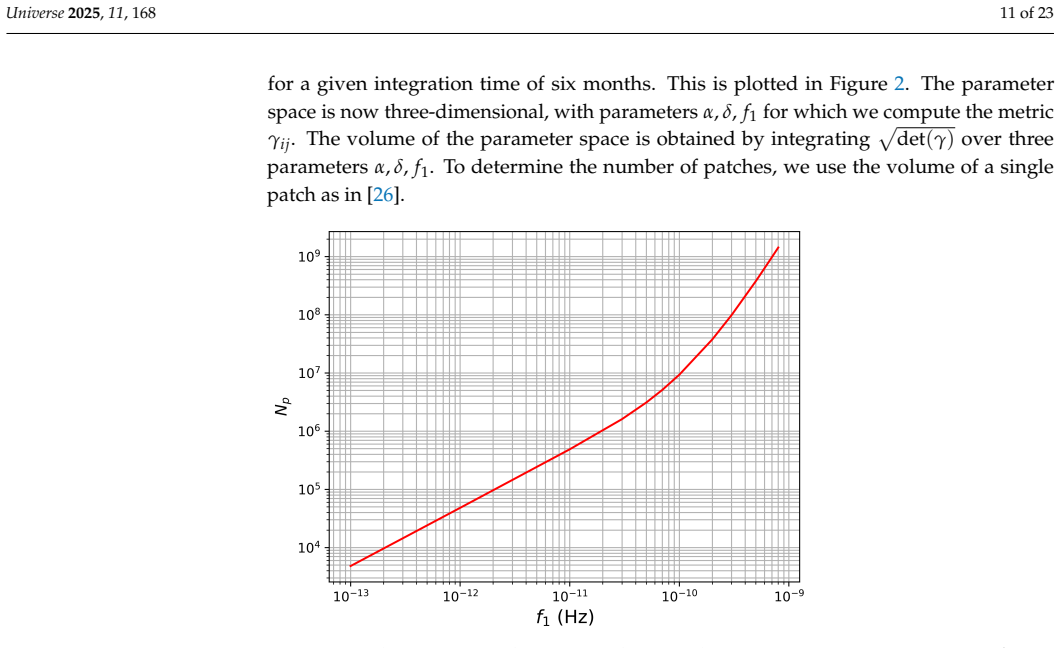
The central object is the quadratic, or product, signal $Q(t)=s(t)s(t+T_0)$ with $T_0\simeq \pi/\Omega$, roughly half a year. Its signal term $\cos(2\omega_{\rm gw}t+\Phi_0)$ has no orbital Doppler modulation, so a Fourier transform plus a five-peak matched-filter statistic, summing $|\tilde H_T(\omega+2k\omega_E)|^2$ for $k=-2,\ldots,2$, extracts the signal at $2\omega_{\rm gw}$. The search cost is controlled by a phase metric on the parameters $\{2\omega_{\rm gw},\alpha,\delta,f_1\}$, which yields the number of sky patches; the paper's estimate is about $10^4$ fewer patches than a coherent search. Sensitivity is set by comparing the coherent depth $D_{\rm coh}\simeq 385$ with the product depth $D_{\rm prod}\simeq 21.8$, where the product noise enters as $S_n^2(2f_{\rm gw})$ and the noise-curve factor $\sqrt{S_n(f_{\rm gw})/S_n(2f_{\rm gw})}$ decides the crossover.
What would settle it
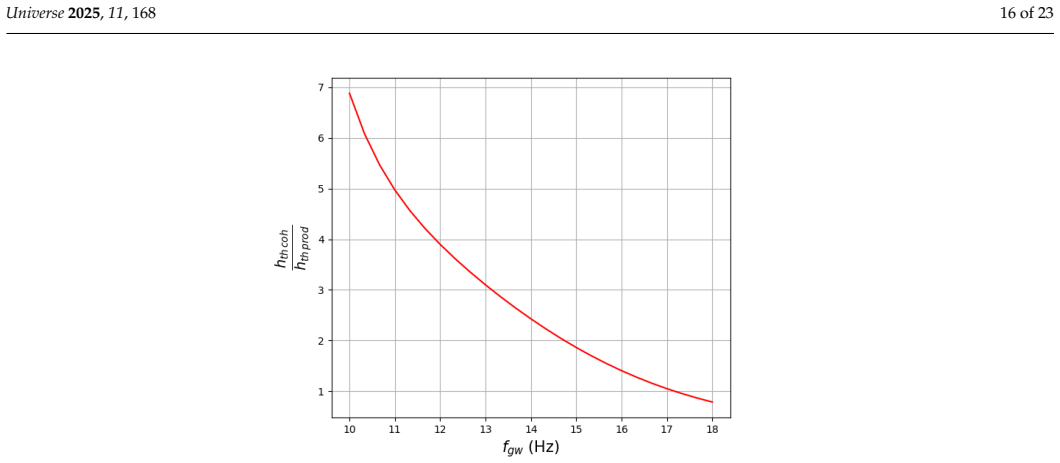
Take the O4 noise power spectrum $S_n(f)$, compute the product-noise spectrum as the convolution $\int S_n(f')S_n(f-f')\,df'$ rather than $S_n^2(2f_{\rm gw})$, and recompute the sensitivity ratio $h_{\rm th,coh}/h_{\rm th,prod}$; if the crossover frequency moves above 17 Hz or vanishes, the headline claim is refuted. An independent check would be an injection campaign at 6-15 Hz in O4 data comparing recovered thresholds.
Extended reading notes
Core claim
The paper's central claim is that the product signal $Q(t)=s(t)s(t+T_0)$, formed from data separated by $T_0\simeq$ half a year, removes the orbital Doppler modulation exactly and puts the continuous-wave signal at twice its source frequency, $2f_{\rm gw}$. That frequency doubling makes source frequencies $\leq 10$ Hz observable because the product signal falls inside the detector band even when the original signal is below the low-frequency cutoff. On the O4 sensitivity curve, the paper finds that this method outperforms the fully coherent search for $f_{\rm gw}\lesssim 17$ Hz, and it cuts the number of search patches by a factor of about $10^4$, reducing computational cost by the same factor. The authors also derive a time-dependent shift $T_E(t)$ that restores the exact Doppler cancellation for the Earth's elliptical orbit, so the circular-orbit results carry over to the real trajectory.
Load-bearing premise
The head-to-head sensitivity numbers assume that the noise in the product data has a power spectrum equal to the square of the detector noise spectrum, which requires the detector noise to be essentially flat across the search band, while the real low-frequency O4 noise rises steeply.
Editorial extensions
If this is right
- Source frequencies of 5-10 Hz become searchable in ground-based data, since the product signal sits at 10-20 Hz inside the detector band.
- On the O4 noise curve the product search is more sensitive than the fully coherent search below about 17 Hz; on the advanced-detector design curve the crossover is at about 6.5 Hz.
- The roughly $10^4$-fold reduction in search patches lowers computational cost by the same factor, letting a year-long search run on a petaflop machine in about the data acquisition time.
- The time-dependent elliptical-orbit shift $T_E(t)$ preserves exact Doppler cancellation, so the sensitivity estimates are not confined to an idealized circular orbit.
Reading between the lines
- If the product-noise spectrum really behaves as the square of the detector noise spectrum, then any future detector with steeper low-frequency noise would see the crossover frequency move upward, extending the product method's advantage to higher frequencies.
- The same half-year product construction should apply to space-based gravitational-wave detectors, whose orbital motion around the Sun shares the symmetry; the paper only announces this as future work.
- A direct test would be an injection campaign at 6-15 Hz in O4 data, comparing the amplitude thresholds recovered by the product and coherent searches.
Signed reviews
Editorial analysis
A structured set of objections, weighed in public.
Referee Report
Summary. This paper analyzes a non-linear data-processing technique for continuous gravitational-wave searches, in which the detector output is multiplied by a half-year time-shifted copy of itself. The authors show that for a circular Earth orbit the dominant Doppler modulation cancels exactly, the signal is shifted to twice the gravitational-wave frequency, and the search parameter space is reduced by a factor of about 10^4 relative to a fully coherent search. They compute the product-noise statistics, estimate the number of search patches for sky location and spin-down, and compare the sensitivity of the product method with that of a coherent search using the O4 noise PSD. They conclude that the product method is more sensitive below about 17 Hz and that it can reach gravitational-wave frequencies below 10 Hz. The paper also sketches an extension to the elliptical orbit via a time-dependent half-year shift.
Significance. If the sensitivity comparison is correct, the method offers a computationally cheap way to search for low-frequency continuous waves and extends the accessible band downward. The algebraic derivation of Doppler cancellation for the circular case is internally consistent, the metric calculation and computational-cost estimates follow standard methods, and the parameter-space reduction is clearly quantified. The paper also provides a useful matched-filter statistic for the product signal and verifies the product-noise PDF for white noise. However, the headline sensitivity claim rests on an unproven approximation for the product-noise PSD with colored noise, and the elliptical-orbit extension is not verified at the level of the noise statistic. These points need to be addressed before the main claim can be considered established.
major comments (2)
- [Section 4, paragraph beginning "In the Fourier domain"; Section 5, Eqs. (42)-(44)] The sensitivity comparison hinges on the assertion that 4⟨|Ñ(f)|²⟩ ≈ S_n(f)². This is stated in Section 4 with the remark that 'extensive simulations' support it, but no colored-noise simulation is shown; the only displayed verification (Fig. 3) is for white noise. For stationary noise the product PSD is the convolution of S_n with itself, and it reduces to S_n² only when S_n is essentially white over the convolution band. The O4 PSD used in Figs. 5-6 rises steeply at low frequencies, so at product frequencies 2f_gw in the claimed advantageous band (roughly 20-34 Hz), the convolution can be substantially larger than S_n(2f_gw)². Because the required amplitude in Eq. (42) scales as the fourth root of the true product-noise PSD, even a factor-of-several change in that PSD can shift the crossover frequency in Fig. 6 materially. The paper says 'extensive simulations' support the approximation but does not show them, so the central quantitative claim is not established. Please provide a derivation or a colored-noise simulation for the O4 curve that quantifies the ratio between the true product PSD and S_n(2f_gw)².
- [Section 6] The extension to the elliptical orbit replaces the fixed six-month shift by a time-dependent TE(t). However, the section does not recompute the statistics of the product noise N(t)=n(t)n(t+TE(t)) or the sensitivity depth D_prod; the detection threshold and the curves in Figs. 6-7 are carried over from the circular case without justification. Since TE(t) varies by about 2e/π ~ 1% over the year, the lag is not constant, and it is not shown that the product noise remains stationary with the same PSD S_n². The statement in Section 7 that the results 'remain valid' for the real orbit is therefore not demonstrated. Please show that the product PSD and the parameter-space metric are at least approximately unchanged when TE varies, or quantify the corrections.
minor comments (5)
- [Section 2, Eq. (6)] The second cosine term appears to have an argument with mismatched units (the term '- T0 - ρ0' inside the cosine); please check the expression.
- [Section 3.3.2] The text says 'Δλ1∼λ1∼10^{-11} Hz'; the spin-down parameter f1 has units of s^{-1}, so 'Hz' should be 's^{-1}' or the statement should be rephrased.
- [Section 5, Eq. (40)] The calculation uses 2σ above threshold, which corresponds to a detection probability of about 0.977 for a Gaussian, not 0.95; either use 1.645σ or state explicitly that the choice is conservative.
- [Section 3] 'quadropolar' should be 'quadrupolar'.
- [Section 5, Figures 5 and 6] The crossover condition in Fig. 6 depends on the ratio D_coh/D_prod ≈ 18; it would help to state this explicitly next to the plotted ratio in Fig. 5.
Circularity Check
No significant circularity: the low-frequency sensitivity claim follows from the O4 PSD and the frequency-doubling construction, not from a fitted or self-referential input; the main risk is an unverified product-noise PSD approximation, which is a correctness issue rather than a circular one.
full rationale
The paper's derivation chain is essentially self-contained. It re-derives the product-signal phase from the Doppler symmetry of the Earth's motion (Equations (4)-(6) and Section 3), computes the phase metric and the number of sky patches, and then compares sensitivities using the external O4 noise PSD. The only relevant self-citation is reference [22] (Tinto 2021), where the half-year product idea was introduced by one of the present authors; the current paper does not take any numerical or statistical result from [22] but re-derives the product signal and the statistics in the present text. Reference [22] is therefore historical, not load-bearing. The claimed low-frequency advantage follows from the product-signal frequency 2 f_gw and the ratio sqrt(S_n(f_gw)/S_n(2 f_gw)) of the O4 PSD, so it is not forced by a fitted parameter or by the definition of the method. The substantive weakness is that Section 4 asserts 'assuming a reasonable bandwidth, it follows that, approximately, 4<|N~(f)|^2> ≈ S_n(f)^2' and refers to 'extensive simulations with noise curves' that are not shown; the only displayed simulation (Figure 3) is white noise. For the steeply rising O4 low-frequency noise, the product-noise PSD is a convolution of S_n with itself and can differ materially from S_n(2 f_gw)^2, which could shift the quoted ~17 Hz crossover. That is an unverified approximation affecting correctness, but it is not circular: the prediction is not made true by construction through that approximation, and the paper's quantitative results otherwise use external inputs such as the O4 PSD, standard FFT cost formulas, and prior coherent-search metrics. The paper also explicitly acknowledges it could not compare with semi-coherent methods because no published results exist in this frequency regime, an honest limitation. No circular step of the enumerated kinds is present.
Assumptions & free parameters
free parameters (5)
- mismatch epsilon =
0.3
- false-alarm probability (1-alpha) =
0.01
- detection probability P_D =
0.95
- computing budget =
10^15 flops
- maximum spin-down searched =
8e-10 Hz for coherent; varied in Figure 2
assumptions (4)
- domain assumption Earth's orbit is circular with radius 1 AU and period exactly 365 days for the main analysis, with eccentricity handled approximately in Section 6.
- domain assumption Detector noise n(t) is stationary, Gaussian, zero-mean, and n(t) and n(t+T0) are independent.
- ad hoc to paper Product-noise PSD is approximately the square of the detector PSD: 4<|N(f)|^2> is about S_n(f)^2.
- standard math The generalized central limit theorem applies so the final statistic is Gaussian.
Cite this review
Pith. "Pith review of A Novel Search Technique for Low-Frequency Periodic Gravitational Waves." pith.science (2026). https://pith.science/paper/UYEDSWPT
@misc{pith2026250518721,
  author       = {Pith},
  title        = {Pith review of: A Novel Search Technique for Low-Frequency Periodic Gravitational Waves},
  year         = {2026},
  howpublished = {\url{https://pith.science/paper/UYEDSWPT}},
  note         = {Machine review of arXiv:2505.18721}
}
read the original abstract
We quantify the advantages of a recently proposed data processing technique to search for continuous gravitational wave (GW) signals from isolated rotating asymmetric neutron stars in data measured by ground-based GW interferometers. This technique relies on the symmetry of the motion around the Sun of an Earth-bound gravitational wave interferometer. By multiplying the measured data time series with a half-year time-shifted copy of it, we obtain two advantages: (i) the main Doppler phase modulation of a monochromatic gravitational wave signal is exactly removed, and (ii) the signal in the product data are located at twice the GW signal frequency. The first significantly reduces the size of the signal's parameter space over which a search is to be performed. The second is advantageous at low frequencies; we find that, with currently available computer processing speeds, this technique is capable of achieving sensitivity that is comparable to or even better than coherent and other possibly non-coherent methods. Further, since our proposed method is implemented over a year-long data segment, it requires processing time comparable to the data acquisition time of currently available computers.
Figures


Figures from the paper (4 more)



Reference graph
Works this paper leans on
-
[1]
Aasi, J.; Abbott, B.P .; Abbott, R.; Abbott, T.; Abernathy, M.R.; Ackley, K.; Adams, C.; Adams, T.; Addesso, P .; Adhikari, R.X.; et al. Advanced LIGO. Class. Quantum Grav. 2015, 32, 074001. [CrossRef]
work page 2015
-
[2]
Observation of Gravitational Waves from a Binary Black Hole Merger
Abbott, B.; Abbott, R.; Abbott, T.; Abernathy, M.; Acernese, F.; Ackley, K.; Adams, C.; Adams, T.; Addesso, P .; Adhikari, R.; et al. Observation of Gravitational Waves from a Binary Black Hole Merger. Phys. Rev. Lett. 2016, 116, 061102. [CrossRef] [PubMed]
work page 2016
-
[3]
Thorne, K.S. Gravitational Radiation. In 300 Y ears of Gravitation; Hawking, S., Israel, W., Eds.; Cambridge University Press: Cambridge, UK, 1987
work page 1987
-
[4]
Virgo: A laser interferometer to detect gravitational waves
Accadia, T.; Acernese, F.; Alshourbagy, M.; Amico, P .; Antonucci, F.; Aoudia, S.; Arnaud, N.; Arnault, C.; Arun, K.G.; Astone, P .; et al. Virgo: A laser interferometer to detect gravitational waves. J. Instrum. 2012, 7, P03012. [CrossRef]
work page 2012
-
[5]
Antenna patterns of interferometric detectors of gravitational waves—I
Schutz, B.F.; Tinto, M. Antenna patterns of interferometric detectors of gravitational waves—I. Linearly polarized waves. Mon. Not. R. Astron. Soc. 1987, 224, 131–154. [CrossRef]
work page 1987
-
[6]
Near optimal solution to the inverse problem for gravitational-wave bursts
Gürsel, Y.; Tinto, M. Near optimal solution to the inverse problem for gravitational-wave bursts. Phys. Rev. D 1989, 40, 3884–3938. [CrossRef]
work page 1989
-
[7]
Choice of filters for the detection of gravitational waves from coalescing binaries.Phys
Sathyaprakash, B.S.; Dhurandhar, S.V . Choice of filters for the detection of gravitational waves from coalescing binaries.Phys. Rev. D 1991, 44, 3819–3834. [CrossRef]
work page 1991
-
[8]
Jaranowski, P .; Krolak, A. Optimal solution to the inverse problem for the gravitational wave signal of a coalescing compact binary. Phys. Rev. D 1994, 49, 1723–1739. [CrossRef]
work page 1994
Show all 36 references
-
[9]
GW151226: Observation of Gravitational Waves from a 22-Solar-Mass Binary Black Hole Coalescence
Abbott, B.; Abbott, R.; Abbott, T.; Abernathy, M.; Acernese, F.; Ackley, K.; Adams, C.; Adams, T.; Addesso, P .; Adhikari, R.; et al. GW151226: Observation of Gravitational Waves from a 22-Solar-Mass Binary Black Hole Coalescence. Phys. Rev. Lett. 2016, 116, 241103. [CrossRef]
2016
-
[10]
GW170104: Observation of a 50-Solar-Mass Binary Black Hole Coalescence at Redshift 0.2
Abbott, B.; Abbott, R.; Abbott, T.; Acernese, F.; Ackley, K.; Adams, C.; Adams, T.; Addesso, P .; Adhikari, R.; Adya, V .; et al. GW170104: Observation of a 50-Solar-Mass Binary Black Hole Coalescence at Redshift 0.2. Phys. Rev. Lett. 2017, 118, 221101. [CrossRef]
2017
-
[11]
GW170814: A Three-Detector Observation of Gravitational Waves from a Binary Black Hole Coalescence
Abbott, B.; Abbott, R.; Abbott, T.; Acernese, F.; Ackley, K.; Adams, C.; Adams, T.; Addesso, P .; Adhikari, R.; Adya, V .; et al. GW170814: A Three-Detector Observation of Gravitational Waves from a Binary Black Hole Coalescence. Phys. Rev. Lett. 2017, 119, 141101. [CrossRef] ...
2017
-
[12]
GWTC-1: A Gravitational-Wave Transient Catalog of Compact Binary Mergers Observed by LIGO and Virgo during the First and Second Observing Runs
Abbott, B.; Abbott, R.; Abbott, T.; Acernese, F.; Ackley, K.; Adams, C.; Adams, T.; Addesso, P .; Adhikari, R.; Adya, V .; et al. GWTC-1: A Gravitational-Wave Transient Catalog of Compact Binary Mergers Observed by LIGO and Virgo during the First and Second Observing Runs. Phy...
2019
-
[13]
GW170817: Observation of Gravitational Waves from a Binary Neutron Star Inspiral
Abbott, B.; Abbott, R.; Abbott, T.; Acernese, F.; Ackley, K.; Adams, C.; Adams, T.; Addesso, P .; Adhikari, R.; Adya, V .; et al. GW170817: Observation of Gravitational Waves from a Binary Neutron Star Inspiral. Phys. Rev. Lett. 2017, 119, 161101. [CrossRef]
2017
-
[14]
Gravitational Waves and Gamma-Rays from a Binary Neutron Star Merger: GW170817 and GRB 170817A
Abbott, B.; Abbott, R.; Abbott, T.; Acernese, F.; Ackley, K.; Adams, C.; Adams, T.; Addesso, P .; Adhikari, R.; Adya, V . Gravitational Waves and Gamma-Rays from a Binary Neutron Star Merger: GW170817 and GRB 170817A. Astrophys. J. Lett. 2017, 848, L13. [CrossRef]
2017
-
[15]
Interferometer design of the KAGRA gravitational wave detector
Aso, Y.; Michimura, Y.; Somiya, K.; Ando, M.; Miyakawa, O.; Sekiguchi, T.; Tatsumi, D.; Yamamoto, H.; et al. Interferometer design of the KAGRA gravitational wave detector. Phys. Rev. D 2013, 88, 043007. [CrossRef]
2013
-
[16]
All-sky search for periodic gravitational waves in the O1 LIGO data
Abbott, B.; Abbott, R.; Abbott, T.; Abernathy, M.; Acernese, F.; Ackley, K.; Adams, C.; Adams, T.; Addesso, P .; Adhikari, R.; et al. All-sky search for periodic gravitational waves in the O1 LIGO data. Phys. Rev. D 2017, 96, 062002. [CrossRef]
2017
-
[17]
First low-frequency Einstein@Home all-sky search for continuous gravitational waves in Advanced LIGO data
Abbott, B.; Abbott, R.; Abbott, T.; Abernathy, M.; Acernese, F.; Ackley, K.; Adams, C.; Adams, T.; Addesso, P .; Adhikari, R.; et al. First low-frequency Einstein@Home all-sky search for continuous gravitational waves in Advanced LIGO data. arXiv 2017, arXiv:1707.02669. [CrossRef]
2017 arXiv
-
[18]
Search for continuous gravitational waves: Metric of the multidetector F-statistic
Prix, R. Search for continuous gravitational waves: Metric of the multidetector F-statistic. Phys. Rev. D 2007, 75, 023004. [CrossRef]
2007
-
[19]
Physics, Astrophysics and Cosmology with Gravitational Waves
Sathyaprakash, B.S.; Schutz, B.F. Physics, Astrophysics and Cosmology with Gravitational Waves. Living Rev. Relativ. 2009, 12, 2. [CrossRef]
2009
-
[20]
Maximum Elastic Deformations of Compact Stars with Exotic Equations of State
Owen, B.J. Maximum Elastic Deformations of Compact Stars with Exotic Equations of State. Phys. Rev. Lett. 2005, 95, 211101. [CrossRef]
2005
-
[21]
Maximum elastic deformations of relativistic stars
Johnson-McDaniel, N.K.; Owen, B.J. Maximum elastic deformations of relativistic stars. Phys. Rev. D 2013, 88, 044004. [CrossRef]
2013
-
[22]
A Fast Data Processing Technique for Continuous Gravitational Wave Searches
Tinto, M. A Fast Data Processing Technique for Continuous Gravitational Wave Searches. Universe 2021, 7, 486
2021
-
[23]
Searching for periodic sources with LIGO
Brady, P .R.; Creighton, T. Searching for periodic sources with LIGO. II. Hierarchical searches. Phys. Rev. D 2000, 61, 082001. [CrossRef]
2000
-
[24]
Data analysis of gravitational-wave signals from spinning neutron stars: The signal and its detection
Jaranowski, P .; Królak, A.; Schutz, B.F. Data analysis of gravitational-wave signals from spinning neutron stars: The signal and its detection. Phys. Rev. D 1998, 58, 063001. [CrossRef]
1998
-
[25]
Generalized F-statistic: Multiple detectors and multiple gravitational wave pulsars
Cutler, C.; Schutz, B.F. Generalized F-statistic: Multiple detectors and multiple gravitational wave pulsars. Phys. Rev. D 2005, 72, 063006. [CrossRef]
2005
-
[26]
Searching for periodic sources with LIGO.Phys
Brady, P .R.; Creighton, T.; Cutler, C.; Schutz, B.F. Searching for periodic sources with LIGO.Phys. Rev. D 1998, 57, 2101–2116. [CrossRef]
1998
-
[27]
Cross-correlation search for periodic gravitational waves
Dhurandhar, S.; Krishnan, B.; Mukhopadhyay, H.; Whelan, J.T. Cross-correlation search for periodic gravitational waves. Phys. Rev. D 2008, 77, 082001. [CrossRef]
2008
-
[28]
Searching for continuous gravitational wave sources in binary systems
Dhurandhar, S.V .; Vecchio, A. Searching for continuous gravitational wave sources in binary systems. Phys. Rev. D 2001, 63, 122001. [CrossRef]
2001
-
[29]
Data analysis of gravitational-wave signals from spinning neutron stars
Jaranowski, P .; Krolak, A. Data analysis of gravitational-wave signals from spinning neutron stars. III. Detection statistics and computational requirements. Phys. Rev. D 2000, 61, 062001. [CrossRef]
2000
-
[30]
An Introduction to Probability Theory and Its Applications , 3rd ed.; John Wiley & Sons: New York, NY, USA, 1968; Volume 1
Feller, W. An Introduction to Probability Theory and Its Applications , 3rd ed.; John Wiley & Sons: New York, NY, USA, 1968; Volume 1
1968
-
[31]
Understanding Mathematical Concepts in Physics: Insights from Geometrical and Numerical Approaches ; Lecture Notes in Physics; Springer: Cham, Swizterland, 2024; Volume 1030
Dhurandhar, S. Understanding Mathematical Concepts in Physics: Insights from Geometrical and Numerical Approaches ; Lecture Notes in Physics; Springer: Cham, Swizterland, 2024; Volume 1030. [CrossRef]
2024
-
[32]
Estimating the sensitivity of wide-parameter-space searches for gravitational-wave pulsars
Wette, K. Estimating the sensitivity of wide-parameter-space searches for gravitational-wave pulsars. Phys. Rev. D 2012, 85, 042003. [CrossRef]
2012
-
[33]
Mechanics, Third Edition: Volume 1 (Course of Theoretical Physics) , 3rd ed.; Butterworth-Heinemann: New York, NY, USA, 1976
Landau, L.D.; Lifshitz, E.M. Mechanics, Third Edition: Volume 1 (Course of Theoretical Physics) , 3rd ed.; Butterworth-Heinemann: New York, NY, USA, 1976
1976
-
[34]
Laser Interferometer Space Antenna
Amaro-Seoane, P .; Audley, H.; Babak, S.; Baker, J.; Barausse, E.; Bender, P .; Berti, E.; Binetruy, P .; Born, M.; Bortoluzzi, D.; et al. Laser Interferometer Space Antenna. arXiv 2017, arXiv:1702.00786
2017 arXiv
-
[35]
The Taiji Program in Space for gravitational wave physics and the nature of gravity
Hu, W.R.; Wu, Y.L. The Taiji Program in Space for gravitational wave physics and the nature of gravity. Natl. Sci. Rev. 2017, 4, 685–686. [CrossRef]
2017
-
[36]
Handbook of Mathematical Functions with Formulas, Graphs, and Mathematical T ables, 9th ed.; Dover Publications: New York, NY, USA, 1964
Abramowitz, M.; Stegun, I.A. Handbook of Mathematical Functions with Formulas, Graphs, and Mathematical T ables, 9th ed.; Dover Publications: New York, NY, USA, 1964. Disclaimer/Publisher’s Note: The statements, opinions and data contained in all publications are solely those ...
1964
Reviewed August 7, 2026 · model on record in the stance chip above.
Discussion (0). Continue with ORCID to comment.