REVIEW 4 major objections 5 minor 1 cited by
Securing Credit Inquiries: The Role of Real-Time User Approval in Preventing SSN Identity Theft
T0 review · 4 major / 5 minor · reviewed 2026-08-07 · deepseek-v4-flash
Pith's one-line read A stolen SSN alone can no longer authorize a credit inquiry when every pull waits for the account holder's real-time approval.
desk verdict A plausible design sketch with a reproducible PoC, but the central fraud-prevention claim is unsupported because the approval step inherits the weaknesses of the underlying authentication. read the letter →
The pith
A machine-rendered reading of the paper's core claim, the machinery that carries it, and where it could break.
The reading
What carries the argument
The load-bearing mechanism is the OAuth 2.0 Authorization Code flow with Proof Key for Code Exchange (PKCE), recast as a consent gate rather than mere login delegation. OAuth 2.0 is a delegated-authorization standard in which a user approves a client's request and the client receives a time-limited token; PKCE is a protocol extension that binds the authorization code to a client-held verifier so an intercepted code cannot be redeemed. Around this core, the architecture adds a consent UI where the user's approve-or-deny decision is captured, an authentication and MFA layer, and an SMS gateway that delivers the unique approval URI for offline branch applications. Together these components make the user's real-time decision the cryptographic and procedural prerequisite for releasing credit data.
What would settle it
Run a controlled penetration test in which an attacker knows the victim's SSN and name but does not control the victim's phone, then attempt a credit inquiry against the proposed flow. If the attacker can obtain an approved inquiry by phishing the victim into tapping a lookalike approval link, by SIM-swapping to receive the SMS, or by replaying a captured approval URI before its expiration, then the real-time consent step does not prevent unauthorized access as claimed.
Extended reading notes
Core claim
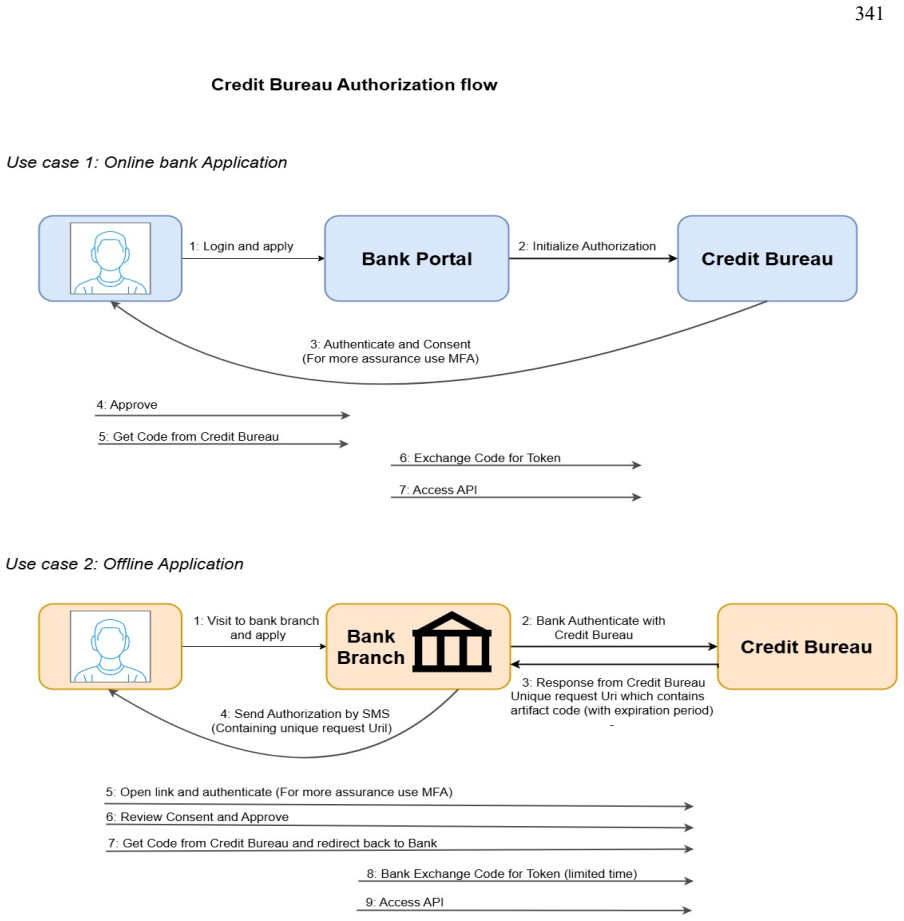
The paper's claim is that a credit inquiry should be treated as an authorization event, not an automated backend lookup. In the proposed design, the bank or branch sends an OAuth authorization request to the credit bureau; the bureau returns either a consent prompt (online) or a unique SMS-delivered request URI with an expiring artifact code (offline); the customer authenticates, reviews the scope, and makes an explicit approve-or-deny decision. Approvals yield an authorization code that the bank exchanges for an access token to retrieve credit data, while denials terminate the request, log the attempt, and notify the user. The operative consequence is that possession of an SSN, which is what a fraudster typically holds, no longer suffices to pull a credit report: the legitimate user's real-time decision becomes the prerequisite.
Load-bearing premise
The whole prevention argument rests on the assumption that the approval message reaches the genuine account holder and cannot be intercepted, redirected, or turned into a false approval by phishing or SIM swapping.
Editorial extensions
If this is right
- Every credit inquiry, whether initiated online or at a branch, is blocked until the account holder approves it in real time, so no inquiry can run silently in the background.
- A stolen SSN alone becomes insufficient to authorize a credit check; the attacker must also pass the user's approval gate.
- Denied attempts are logged and the user is notified, shifting fraud detection from post-hoc discovery to immediate visibility.
- The workflow produces a consent record that supports FCRA permissible-purpose and GDPR explicit-consent requirements.
- The proof of concept shows the approve-token-report cycle completing in roughly a second in a local single-user setup, indicating the flow can keep pace with live loan applications.
Reading between the lines
- If this consent gate becomes standard, the black-market value of stolen SSNs should fall, and attackers would likely pivot to phishing the approval step itself; hardening the approval prompt against lookalike phishing and social engineering is the next necessary layer.
- Because the offline flow depends on an SMS link, phone-operator attacks such as SIM swapping become the critical residual threat; binding approval to a hardware-backed push or an in-app biometric would close that lane.
- The same OAuth-consent pattern transfers directly to other regulated data releases, including bank account aggregation, tax transcript access, or medical record sharing, where consent is already legally required but not mechanically enforced.
- A head-to-head deployment trial comparing a consent-gated inquiry flow against the current flow on fraud losses, approval rates, and application abandonment would quantify how much security survives real-world usability pressure.
Editorial analysis
A structured set of objections, weighed in public.
Referee Report
Summary. This paper proposes a real-time user approval system for credit inquiries, built on OAuth 2.0 with PKCE, HTTPS/TLS 1.3, and a consent UI, with the stated goal of preventing unauthorized credit checks and reducing SSN-based identity theft. It describes a two-case workflow (online and offline), gives a ten-step algorithm, and reports a Flask-based proof of concept that simulates the authorization-code flow. The paper also discusses adoption challenges, regulatory compliance (FCRA, GDPR, PCI-DSS), and future enhancements such as blockchain and biometrics.
Significance. If the central claim were established, the work would offer a useful design pattern for consumer-controlled credit inquiries and could plausibly reduce unauthorized access. The manuscript has some strengths: it clearly describes an architecture, explicitly uses standard OAuth 2.0/PKCE rather than inventing a new protocol, and discusses regulatory alignment. However, the paper does not provide a security analysis, does not test against any adversarial scenario, and supports its quantitative claims only with unverifiable statistics. The proof of concept demonstrates a consent screen but does not establish that the system prevents the attacks that motivate the paper.
major comments (4)
- [Abstract; §3, Use Case 2, Algorithm step 3] The central claim that the framework can 'avert unauthorized credit checks' is not supported under the paper's own threat model. In Use Case 2 (Offline Application), step 4 sends the authorization link via SMS, and step 5a authenticates the user with 'MFA recommended for added security,' while the Algorithm in step 3 makes MFA optional ('Auth(U_id) → MFA(U_id) (if enabled)'). An attacker who already possesses the victim's SSN and other PII, and who has performed a SIM swap on the victim's phone number, would receive the SMS link, authenticate with the stolen knowledge-based data, and approve the consent. The OAuth 2.0/PKCE machinery protects the token exchange but does not establish that the approver is the legitimate user. The paper needs a threat model that specifies the attacker's capabilities, and a control that independently authenticates the user (e.g., mandatory hardware-bound MFA or biometrics), before the 'prevents unauthorized credit checks' claim is defensible.
- [§3.3, 'Challenges in Adoption'] The paper concedes that phishing and social engineering are primary challenges and responds with user education, branding, and awareness campaigns rather than a technical control. This is inconsistent with the abstract's claim that the system 'minimizes the risks of interference by third parties.' Without a technical mechanism to prevent a user from being tricked into approving a fraudulent request—or to prevent an attacker from authenticating as the user—the proposal does not deliver the advertised security guarantee for the very attack class the introduction identifies as central.
- [§3, 'Real-World Applicability and Relevance of the PoC'] The usability and effectiveness statistics are unsupported. The statement that 'usability testing with mock users indicated that 90% authorized in under 10 seconds' is presented without methodology, sample size, task design, or statistical analysis. Similarly, the Background section cites Patel and Kim (2024) for a '40%' decrease in unauthorized credit inquiries without providing a verifiable source or study design, and Section 1 cites Yang et al. (2024) for a '30%' fraud-loss reduction. These numbers are load-bearing for the motivation and the claimed benefit, yet they are not backed by reproducible evidence or even stable references (the reference list contains duplicates, e.g., [22] and [23] are the same entry).
- [§3, 'Proof of Concept'] The proof of concept demonstrates only that an OAuth-style consent screen can be rendered in a Flask app and that an authorization code can be exchanged for a token. It does not include any adversarial tests (e.g., SIM swap, phishing, stolen-credential replay, token interception), nor does it verify that the consent step actually blocks an unauthorized inquiry in a realistic scenario. The paper's claim that 'the outputs affirm its ability to block unauthorized requests from proceeding' is therefore an overstatement of what the PoC shows.
minor comments (5)
- [Throughout] There are numerous typographical and formatting errors, including inconsistent variable naming (SMs_auth vs. SMS_auth), inconsistent use of 'realtime' vs. 'real-time', and broken sentence fragments (e.g., 'These findings, notwithstanding, gaps in technology and policy standardization' in the Background section).
- [Figures] Figure numbering is inconsistent: Figure 1 in the architecture section is 'System Architecture,' but later the thesis mentions 'Figure 1 shows the mobile screen with a request for consent,' and 'Figure 2 shows the system output after a rejected query,' while Figure 2 in the text is the 'Credit Bureau Authorization Workflow.' The figure captions and in-text references need to be aligned.
- [References] Several references appear to be duplicated or incorrectly numbered. For example, [22] and [23] are the same Yang, Lee, and Patel (2024) entry, and [42] and [50] are the authors' own prior works cited in contexts (MFA and adaptive authentication) where their relevance is not self-evident. The paper should be carefully copy-edited and the reference list checked against the in-text citations.
- [Algorithm step 3] The notation 'SMS_auth = Encrypt(U_id, E)' is underspecified: it does not state the encryption scheme, what is encrypted, or how the recipient decrypts it, and it is not used in the rest of the algorithm. This should be clarified or removed.
- [Table 1] The comparison table's entries are assertions without citation or evaluation (e.g., 'Excellent; automated and adaptable to large-scale systems' under scalability). For a security paper, such claims need support or should be phrased as design goals rather than measured properties.
Circularity Check
No significant circularity: the proposed approval flow is a standard OAuth 2.0/PKCE design demonstrated with a standalone PoC, and the paper's two self-citations are peripheral, not load-bearing.
full rationale
The paper is a system-design proposal rather than a fitted empirical derivation, so the main circularity modes do not apply. Its central workflow (credit bureau sends a consent URI, user authenticates and approves, bank exchanges an authorization code for an access token) is specified as an OAuth 2.0 Authorization Code flow with PKCE and is demonstrated by a self-contained Flask simulation; no parameter is fitted to the claimed outcome, and no 'prediction' is obtained from the data it is supposed to explain. The two references authored by the current authors ([42] and [50]) appear only in the future-enhancements passages on biometric MFA and adaptive authentication; they do not justify the core claim that real-time approval prevents unauthorized credit checks. The main weakness is that the approval channel and the primary authentication step are not independently hardened (MFA is optional and the offline flow relies on an SMS-delivered URI), so the security conclusion is vulnerable to SIM-swap and phishing for the very SSN-holder attacker model the paper motivates. That is a correctness and threat-model gap, not circularity: the text does not define 'authorized' as 'whoever approves' in a way that makes the conclusion true by construction. The paper's claims therefore stand or fall on their design merits, independent of any self-citational chain.
Assumptions & free parameters
assumptions (4)
- domain assumption OAuth 2.0 with PKCE and TLS 1.3 provide sufficient security for credit inquiry authorization.
- domain assumption The user's mobile device and notification channel cannot be compromised by attackers.
- domain assumption Explicit real-time user consent is an effective and necessary control against unauthorized credit inquiries.
- domain assumption FCRA and GDPR require the specific form of real-time consent described.
Cite this review
Pith. "Pith review of Securing Credit Inquiries: The Role of Real-Time User Approval in Preventing SSN Identity Theft." pith.science (2026). https://pith.science/paper/FWFYWUR5
@misc{pith2026250518861,
  author       = {Pith},
  title        = {Pith review of: Securing Credit Inquiries: The Role of Real-Time User Approval in Preventing SSN Identity Theft},
  year         = {2026},
  howpublished = {\url{https://pith.science/paper/FWFYWUR5}},
  note         = {Machine review of arXiv:2505.18861}
}
read the original abstract
Unauthorized credit inquiries are also a central entry point for identity theft, with Social Security Numbers (SSNs) being widely utilized in fraudulent cases. Traditional credit inquiry systems do not usually possess strict user authentication, making them vulnerable to unauthorized access. This paper proposes a real-time user authorization system to enhance security by enforcing explicit user approval before processing any credit inquiry. The system employs real-time verification and approval techniques. This ensures that the authorized user only approves or rejects a credit check request. It minimizes the risks of interference by third parties. Apart from enhancing security, this system complies with regulations like the General Data Protection Regulation (GDPR) and the Fair Credit Reporting Act (FCRA) while maintaining a seamless user experience. This article discusses the technical issues, scaling-up issues, and ways of implementing real-time user authorization in financial systems. Through this framework, financial institutions can drastically minimize the risk of identity theft, avert unauthorized credit checks, and increase customer trust in the credit verification system.
Figures


Figures from the paper (1 more)

Forward citations
Cited by 1 Pith paper
-
Docker under Siege: Securing Containers in the Modern Era
A narrative review of Docker security best practices that adds no original data, experiments, or new techniques.
Reference graph
Works this paper leans on
-
[22]
Log all authorization events for security & compliance 𝑳𝒐𝒈 ( 𝐸𝑣𝑒𝑛𝑡𝑎𝑢𝑡ℎ 𝑇𝑖𝑚𝑒𝑠𝑡𝑎𝑚𝑝,𝐷𝑒𝑐𝑖𝑠𝑖𝑜𝑛,𝐼𝑃 ) ○ Ensure regulatory compliance (FCRA, GDPR, PCI- DSS)
-
[23]
Proof of Concept: Implementation and Demonstration Overview To validate the feasibility of real-time user approval in credit-based transactions, we implemented a Proof of Concept (PoC) simulating the OAuth 2.0 Authorization 343 Code Flow with PKCE. This PoC demonstrates how a user securely authorizes a bank to perform a credit inquiry via a credit bureau,...
-
[1]
Introduction The Growing Threat of SSN-Based Identity Theft Data breaches of personal and sensitive data, such as social security numbers (SSNs), have increased exponentially over the past several years. Purloined SSNs and other personal information are utilized to perpetrate fraud against individuals and institutions, which costs billions of dollars to i...
-
[2]
Background and Related Work The rise in SSN-based identity theft has highlighted the security of credit inquiries as an issue of pressing concern within the financial industry. With identity fraud losses exceeding $5 billion a year in the United States, according to a 2024 Federal Trade Commission report [15], the insecurity of conventional credit inquiry...
work page 2024
-
[3]
User Login & Application Submission: The customer enters the Bank Portal and applies for a credit related service
-
[4]
Authorization Initialization: The Bank Portal sends an authorization request to the Credit Bureau to initiate the process
-
[5]
Multi-factor authentication (MFA) can be used for added security
User Authentication & Consent: The user is prompted to authenticate and provide explicit consent for the credit inquiry. Multi-factor authentication (MFA) can be used for added security. Use Case 2: Offline Application (via Bank Branch)
-
[6]
Customer Application at Branch: The customer visits a bank branch and submits a credit inquiry request in person
Show all 81 references
-
[7]
Bank Authentication with Credit Bureau: The Bank Branch initiates an authorization request with the Credit Bureau on behalf of the customer
-
[8]
Credit Bureau Response with Unique Request URI: The Credit Bureau responds with a unique request URI, which includes an artifact code with an expiration period
-
[9]
Authorization Link Sent via SMS: The customer receives an SMS containing the unique request URI, allowing them to authenticate remotely. 342
-
[10]
The customer opens the authorization link on their device and authenticates (MFA recommended for added security)
User Authentication & Consent Verification: a. The customer opens the authorization link on their device and authenticates (MFA recommended for added security). b. The user reviews and approves the consent request
-
[11]
Upon approval, the Credit Bureau issues an authorization code
Code Retrieval & Redirection: a. Upon approval, the Credit Bureau issues an authorization code. b. The user is redirected back to the Bank Portal
-
[12]
Bank Exchanges Code for Token: The Bank exchanges the authorization code for an access token (within the limited expiration time)
-
[13]
Key Benefits of the Workflow: ● Enhanced Security: Incorporates OAuth-based authorization, consent validation, and optional MFA for fraud prevention
Secure API Access to Credit Bureau: The Bank uses the token to securely communicate with the Credit Bureau API to retrieve necessary credit information. Key Benefits of the Workflow: ● Enhanced Security: Incorporates OAuth-based authorization, consent validation, and optional ...
-
[14]
○ Offline: via Bank Branch
User submits credit inquiry request: ○ Online: via Bank Portal. ○ Offline: via Bank Branch
-
[15]
Bank System initializes OAuth Authorization request: 𝐵𝑠𝑦𝑠 →𝐶𝑏𝑢𝑟𝑒𝑎𝑢 :OAuth Request(𝑈𝑟𝑒𝑞 ,𝑈𝑖𝑑 )
-
[16]
Bank System initializes OAuth Authorization request: ● Online: User authenticates via the bank portal: Auth(𝑈𝑖𝑑 )→MFA(𝑈𝑖𝑑 ) (if enabled) ● Offline: The Bank sends an SMS authorization link: 𝑆𝑀𝑆𝑎𝑢𝑡ℎ =Encrypt(𝑈𝑖𝑑 ,E) Real-Time User Consent & Approval
-
[17]
User reviews request & provides consent: 𝐶𝑎𝑝𝑝𝑟𝑜𝑣𝑒 (𝑈𝑖 ) = {𝐴𝑝𝑝𝑟𝑜𝑣𝑒𝑑 (𝑖𝑓 (𝑈𝑠𝑒𝑟 𝑎𝑐𝑐𝑒𝑝𝑡)),𝐷𝑒𝑛𝑖𝑒𝑑 (𝑖𝑓 (𝑈𝑠𝑒𝑟 𝑅𝑒𝑗𝑒𝑐𝑡𝑠)) }
-
[18]
○ Notify the user via SMS/email
If 𝐶𝑎𝑝𝑝𝑟𝑜𝑣𝑒 (𝑈𝑖 ) = Denied, then: Terminate Request ○ Log unauthorized attempt. ○ Notify the user via SMS/email. Authorization Code & Token Exchange
-
[19]
If 𝐶𝑎𝑝𝑝𝑟𝑜𝑣𝑒 (𝑈𝑖 ) = Approved, then: ● Retrieve Authorization Code from Credit Bureau: 𝐴𝑢𝑡ℎ𝐶𝑜𝑑𝑒←𝐶𝑏𝑢𝑟𝑒𝑎 ● Exchange AuthCode for an Access Token: 𝑇𝑜𝑘𝑒𝑛 = 𝐸𝑥𝑐ℎ𝑎𝑛𝑔𝑒 (𝐴𝑢𝑡ℎ𝐶𝑜𝑑𝑒) ● Ensure secure token validation: 𝑉𝑎𝑙𝑖𝑑𝑎𝑡𝑒 ( 𝑇𝑜𝑘𝑒𝑛 ) = { 𝑉𝑎𝑙𝑖𝑑 , 𝑃𝑟𝑜𝑐𝑒𝑒𝑑 𝑡𝑜 𝐴𝑃𝐼 | 𝐼𝑛𝑣𝑎𝑙𝑖𝑑, 𝑅𝑒𝑣𝑜𝑘𝑒 𝑅𝑒𝑞𝑢𝑒𝑠𝑡 ...
-
[20]
Bank System uses Token to retrieve Credit Data: 𝐵𝑠𝑦𝑠 →𝐶𝑏𝑢𝑟𝑒𝑎𝑢 : 𝐴𝑐𝑐𝑒𝑠𝑠 𝐴𝑃𝐼 𝑤𝑖𝑡ℎ 𝑇𝑜𝑘𝑒
-
[21]
● Denied Inquiry: The user is alerted, and the request is blocked
User notified of transaction outcome: ● Approved Inquiry: Confirmation was sent via the Notification System. ● Denied Inquiry: The user is alerted, and the request is blocked. Logging & Compliance Audit
-
[24]
Authorize
Authorization Request Initiation A simulated bank client begins the flow by clicking an “Authorize” button. This triggers generation of a state value, code_verifier, and code_challenge (PKCE) for secure flow tracking. Figure 3: Mobile UI - Authorization UI
-
[25]
Forgot Password?
User Login (Credit Bureau Simulation) The user is redirected to a mobile-styled login screen, where they are prompted to enter their credentials. A “Forgot Password?” link generates a temporary username/password pair for demonstration. Figure 4: Mobile UI - Login Screen with F...
-
[26]
The user can approve or deny the request
Consent Form Presentation Upon successful login, the user is shown a consent screen informing them of the scope of the bank’s request (e.g., email and credit score access). The user can approve or deny the request. Figure 6: Mobile UI - Consent Screen with Scope Review
-
[27]
This step occurs seamlessly in the simulation backend
Authorization Code Issuance If consent is approved, the user is redirected to the bank's redirect URI with an authorization_code and state. This step occurs seamlessly in the simulation backend
-
[28]
PKCE ensures the request's integrity by comparing the hash of the code_verifier with the stored code_challenge
Access Token Exchange The bank exchanges the code along with the code_verifier to receive an access token. PKCE ensures the request's integrity by comparing the hash of the code_verifier with the stored code_challenge
-
[29]
Credit Report Retrieval Upon successful token issuance, the bank uses the access token to retrieve a simulated credit report. Figure 7: Credit Report (Console Log) 3.2 System Requirements and Tools The following table summarizes the minimum system specifications and tools requ...
2024
-
[30]
Future Enhancements and Recommendations • Potential for blockchain-based identity verification Blockchain technology offers a breakthrough solution to the issue of identity verification by enabling a decentralized, tamper-resistant system that could radically enhance credit in...
-
[31]
Gupta, M., & Sharman, R. (2012). Determinants of Data Breaches: A Categorization-Based Empirical Investigation. Journal of Applied Security Research, 7(3), 375–395. https://doi.org/10.1080/19361610.2012.686098
2012
-
[32]
Blockchain Identity Management: A Complete Guide
Robert MacDonald. Blockchain Identity Management: A Complete Guide
-
[33]
Abhilasha Bhargav-Spantzel, Anna Squicciarini, and Elisa Bertino. 2006. Privacy preserving multi-factor authentication with biometrics. In Proceedings of the second ACM workshop on Digital identity management (DIM '06). Association for Computing Machinery, New York, NY , USA, ...
2006
-
[34]
Privacy preserving multi-factor authentication with biometrics
Goto A, Bhargav-Spantzel A, Squicciarini AC, et al. Privacy preserving multi-factor authentication with biometrics. Journal of Computer Security. 2007;15(5):529-560. doi:10.3233/JCS-2007-15503
2007 doi
-
[35]
Ainsworth, R. T. (2012). Refund fraud? Real- time solution! Tax Notes, Forthcoming. Boston Univ. School of Law, Law and Economics Research Paper No. 12-01. Retrieved from https://papers.ssrn.com/sol3/papers.cfm?abstra ct_id=1978898
2012
-
[36]
R., & Greeson, J
Gyourko, J. R., & Greeson, J. K. P. (2023). Annual Credit Checks for Adolescent Youth in Foster Care: Factors Associated with Identity Fraud Victimization. Child Maltreatment, 28(2), 372-383. https://doi.org/10.1177/10775595221101504
2023 doi
-
[37]
O., Ojugo, A
Aghware, F. O., Ojugo, A. A., Adigwe, W., Odiakaose, C. C., Ojei, E. O., Ashioba, N. C., Okpor, M. D., & Geteloma, V . O. (2024). Enhancing the Random Forest Model via Synthetic Minority Oversampling Technique for Credit-Card Fraud Detection. Journal of Computing Theories and ...
2024 doi
-
[38]
M., Zafar, A., Nabila, & Khan, I
Zeeshan Ali Haider, Khan, F. M., Zafar, A., Nabila, & Khan, I. U. (2024). Optimizing Machine Learning Classifiers for Credit Card Fraud Detection on Highly Imbalanced Datasets Using PCA and SMOTE Techniques. VAWKUM Transactions on Computer Sciences, 12(2), 28–49. https://doi.o...
2024 doi
-
[39]
T., & Howe, L
Adesina, M. T., & Howe, L. (2024). Credit card fraud detection. International Journal of Science and Research Archive, 12(2), 2072– 2080. https://doi.org/10.30574/ijsra.2024.12.2.1430
2024 doi
-
[40]
Content analysis of American consumers’ credit card fraud complaints filed with the Consumer Financial Protection Bureau
Estelami, H. and Liu, K. (2024), "Content analysis of American consumers’ credit card fraud complaints filed with the Consumer Financial Protection Bureau", Journal of Financial Crime, V ol. 31 No. 3, pp. 618-628. https://doi.org/10.1108/JFC-03-2023-0070
2024 doi
-
[41]
Sahiba Chopra, Current Regulatory Challenges in Consumer Credit Scoring Using Alternative Data-Driven Methodologies, 23 V anderbilt Journal of Entertainment and Technology Law 625 (2021) Available at: https://scholarship.law.vanderbilt.edu/jetlaw/vo l23/iss3/4
2021
-
[42]
Jadhav, A., Wankhande, P., Balure, P., Pawar, A., & Halkarnikar, P. P. (2023). Loan approval prediction using machine learning. International Research Journal of Modernization in Engineering, Technology and Science, 5(5), 4956. https://www.doi.org/10.56726/IRJMETS39658
2023 doi
-
[43]
Sekar, R., & Columbus, C. (2023). Enhancing credit card application approval through data scaling in machine learning algorithms. Proceedings of the International Conference on Sustainable Communication Networks and Application (ICSCNA 2023). IEEE. ISBN: 979- 8-3503-1398-7
2023
-
[47]
Gupta, S., & Singh, R. (2024). Machine learning for real-time fraud detection in credit systems. International Journal of Artificial Intelligence and Security, 10(4), 134-149
2024
-
[48]
Chen, L., & Alvarez, P. (2025). Biometric authentication in real-time credit inquiry systems. Cybersecurity Advances, 7(1), 78-92
2025
-
[49]
Carter, L., & Singh, P. (2023). User trust and transparency in financial security systems. International Journal of Digital Finance, 9(2), 88-102
2023
-
[50]
Financial Stability Oversight Council. (2025). Annual Report on Financial Security Trends. U.S. Department of Treasury, Washington, DC
2025
-
[52]
Federal Trade Commission. (2024). Consumer Sentinel Network Data Book 2024. Retrieved from https://www.ftc.gov/reports/consumer- sentinel-network-data-book-2024
2024
-
[53]
Yang, J., Lee, K., & Patel, S. (2024). Regulatory frameworks for real-time fraud prevention. Journal of Financial Regulation, 11(3), 165-180
2024
-
[54]
Patel, R., & Kim, H. (2024). Real-time user approval: A new frontier in credit inquiry security. Journal of Cybersecurity and Privacy, 14(3), 201-218
2024
-
[55]
Fintech Security Alliance. (2024). API Security Trends in Financial Services 2024. Fintech Security Reports, 6(2), 45-60
2024
-
[56]
Carter, L., & Singh, P. (2023). User trust and transparency in financial security systems. International Journal of Digital Finance, 9(2), 88-102. 349
2023
-
[57]
Experian. (2025). Credit Report API Integration Guide. Retrieved from https://www.experian.com/developer/api-docs
2025
-
[58]
Twilio. (2024). Global Authentication Trends Report 2024. Retrieved from https://www.twilio.com/reports/auth-2024
2024
-
[60]
Identity Fraud Institute. (2025). Synthetic Identity Fraud in Financial Systems. Fraud Prevention Journal, 13(1), 22-37
2025
-
[61]
Bitcoin: A peer-to-peer electronic cash system,
S. Nakamoto, “Bitcoin: A peer-to-peer electronic cash system,” Bitcoin White Paper,
-
[63]
A next-generation smart contract and decentralized application platform,
V . Buterin, “A next-generation smart contract and decentralized application platform,” Ethereum White Paper, 2014. [Online]. Available: https://ethereum.org/en/whitepaper/
2014
-
[64]
Swan, Blockchain: Blueprint for a new economy
M. Swan, Blockchain: Blueprint for a new economy. O’Reilly Media, 2015
2015
-
[65]
Tapscott and A
D. Tapscott and A. Tapscott, Blockchain revolution: How the technology behind Bitcoin is changing money, business, and the world. Penguin Random House, 2016
2016
-
[67]
The knowledge complexity of interactive proof systems,
S. Goldwasser, S. Micali, and C. Rackoff, “The knowledge complexity of interactive proof systems,” SIAM Journal on Computing, vol. 18, no. 1, pp. 186–208, 1989. doi: 10.1137/0218012
1989 doi
-
[68]
The Bitcoin Lightning Network: Scalable off-chain instant payments,
J. Poon and T. Dryja, “The Bitcoin Lightning Network: Scalable off-chain instant payments,” Lightning Network White Paper, 2016. [Online]. Available: https://lightning.network/lightning-network- paper.pdf
2016
-
[69]
Hawk: The blockchain model of cryptography and privacy-preserving smart contracts,
A. Kosba, A. Miller, E. Shi, Z. Wen, and C. Papamanthou, “Hawk: The blockchain model of cryptography and privacy-preserving smart contracts,” in Proc. 2016 IEEE Symposium on Security and Privacy (SP), San Jose, CA, USA, 2016, pp. 839–858. doi: 10.1109/SP.2016.55
2016 doi
-
[70]
An introduction to biometric recognition,
A. K. Jain, A. Ross, and S. Prabhakar, “An introduction to biometric recognition,” IEEE Transactions on Circuits and Systems for Video Technology, vol. 14, no. 1, pp. 4–20, Jan. 2004. doi: 10.1109/TCSVT.2003.818349
2004
-
[71]
Bolle, J
R. Bolle, J. Connell, S. Pankanti, N. Ratha, and A. Senior, Guide to biometrics. Springer, 2004
2004
-
[72]
Maltoni, D
D. Maltoni, D. Maio, A. K. Jain, and S. Prabhakar, Handbook of fingerprint recognition, 2nd ed. Springer, 2009
2009
-
[73]
Thiyagarajan, G., Bist, V ., & Nayak, P. (2024). AI-Driven Configuration Drift Detection in Cloud Environments. Gogulakrishnan Thiyagarajan, Vinay Bist, Prabhudarshi Nayak.(2024). AI-Driven Configuration Drift Detection in Cloud Environments. International Journal of Communica...
2024
-
[74]
Stallings, Cryptography and network security: Principles and practice, 7th ed
W. Stallings, Cryptography and network security: Principles and practice, 7th ed. Pearson, 2017
2017
-
[75]
Lopez, M., Zhang, Y ., & Gupta, A. (2025). Blockchain and real-time consent for identity protection. IEEE Transactions on Information Forensics and Security, 20(1), 45-59
2025
-
[76]
DeepFace: Closing the gap to human- level performance in face verification,
Y . Taigman, M. Yang, M. Ranzato, and L. Wolf, “DeepFace: Closing the gap to human- level performance in face verification,” in Proc. 2014 IEEE Conference on Computer Vision and Pattern Recognition (CVPR), Columbus, OH, USA, 2014, pp. 1701–1708. doi: 10.1109/CVPR.2014.220
2014 doi
-
[77]
Wayman, A
J. Wayman, A. Jain, D. Maltoni, and D. Maio, Biometric systems: Technology, design and performance evaluation. Springer, 2005
2005
-
[78]
Enhancing security and privacy in biometrics- based authentication systems,
N. K. Ratha, J. H. Connell, and R. M. Bolle, “Enhancing security and privacy in biometrics- based authentication systems,” IBM Systems Journal, vol. 40, no. 3, pp. 614–634, 2001. doi: 10.1147/sj.403.0614
2001 doi
-
[79]
Campisi, Security and privacy in biometrics
P. Campisi, Security and privacy in biometrics. Springer, 2013
2013
-
[80]
Marcel, M
S. Marcel, M. S. Nixon, and S. Z. Li, Handbook of biometric anti-spoofing. Springer, 2014
2014
-
[81]
Thiyagarajan, G., Bist, V ., & Nayak, P. (2025). The Hidden Dangers of Outdated Software: A Cyber Security Perspective. arXiv preprint arXiv:2505.13922
2025 arXiv
-
[82]
On the effectiveness of local binary patterns in face anti-spoofing,
I. Chingovska, A. Anjos, and S. Marcel, “On the effectiveness of local binary patterns in face anti-spoofing,” in Proc. 2012 BIOSIG - International Conference of Biometrics Special Interest Group, Darmstadt, Germany, 2012, pp. 1–7
2012
-
[83]
Decentralizing privacy: Using blockchain to protect personal data,
G. Zyskind, O. Nathan, and A. Pentland, “Decentralizing privacy: Using blockchain to protect personal data,” in Proc. 2015 IEEE Security and Privacy Workshops (SPW), San Jose, CA, USA, 2015, pp. 180–184. doi: 10.1109/SPW.2015.27
2015 doi
-
[84]
Smith, L., & Jones, K. (2023). The evolution of fraud detection in digital transactions. Financial Security Review, 15(4), 33-47
2023
-
[85]
Kumar, P., Singh, R., & Gupta, S. (2022). Machine learning applications in real-time fraud detection. International Journal of Cybersecurity, 8(2), 112-128
2022
-
[86]
Lee, J., & Patel, M. (2024). Microservices security: Challenges and solutions in real-time systems. IEEE Transactions on Software Engineering, 50(1), 89-104
2024
-
[87]
Brown, A., & Taylor, R. (2021). Real-time fraud prevention: Balancing security and efficiency. Journal of Financial Technology, 12(3), 45-59
2021
-
[2008]
Available: https://bitcoin.org/bitcoin.pdf
[Online]. Available: https://bitcoin.org/bitcoin.pdf
Reviewed August 7, 2026 · model on record in the stance chip above.
Discussion (0). Continue with ORCID to comment.