REVIEW 4 major objections 5 minor 1 cited by
Degradation-Aware and Machine Learning-Driven Uncertainty Quantification in Crystal Plasticity Finite Element: Texture-Driven Plasticity in 316L Stainless Steel
T0 review · 4 major / 5 minor · reviewed 2026-08-07 · deepseek-v4-flash
Pith's one-line read A 200-run surrogate reveals Cube and Goss texture dominate 316L weld stress variability.
desk verdict The 200-run PCE workflow for texture-driven UQ is a solid engineering demonstration, but the Cube/Goss sensitivity ranking is not supported because the compositional texture fractions are treated as independent inputs in the PCE and Sobol analysis. read the letter →
The pith
A machine-rendered reading of the paper's core claim, the machinery that carries it, and where it could break.
The reading
What carries the argument
The central object is the polynomial-chaos expansion (PCE) surrogate: an expansion of the CPFE output in orthogonal polynomial basis functions of the eight random texture fractions, with coefficients obtained by least-squares regression on 200 training runs. The inputs themselves are grounded in experiment: 104 EBSD sub-maps of the electron-beam weld define min–max volume-fraction bounds for Cube, Goss, Brass, S1, S2, S3, Copper, and Taylor, and a texture-analysis routine converts sampled weights into grain Euler angles for RVE construction. Once fitted, the PCE gives closed-form estimates of the mean and variance of stress and of first-order Sobol indices, which is what allows the paper to attribute stress variability to individual texture components without additional Monte Carlo simulation.
What would settle it
Quantitatively validate the surrogate on all 40 held-out CPFE simulations, reporting pointwise relative error in engineering stress and coverage of the reported uncertainty bands, and repeat the validation at the corners of the EBSD texture bounds where Cube and Goss are extreme; if errors there are large, or if the Sobol ranking changes when the PCE training set or polynomial degree is varied, the central claim fails.
Extended reading notes
Core claim
The paper's central claim is that a sparse polynomial-chaos expansion, fitted by least-squares regression to 200 crystal-plasticity finite-element simulations whose eight inputs are texture-component volume fractions bounded by experimental EBSD data, reproduces the CPFE stress–strain response closely enough to replace direct Monte Carlo sampling. From the surrogate's coefficients the authors compute mean stress, uncertainty bands, and Sobol sensitivity indices, and they find that at 0.2%, 1.0%, and 3.0% strain the Cube and Goss texture components are the only inputs with material influence. The conclusion is concrete: two 316L weld samples that differ only in Brass, Copper, S1, S2, S3, or Taylor content should show nearly identical stress–strain curves, while small differences in Cube or Goss content should shift the flow stress noticeably. The paper reports a yield-stress band of 378.6–409.2 MPa, widening to 472.9–527.5 MPa at 3% strain, as the texture-induced uncertainty envelope.
Load-bearing premise
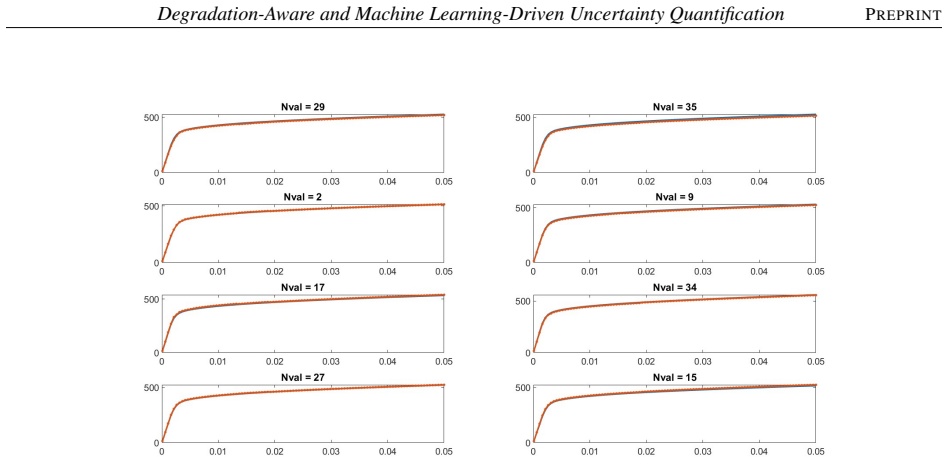
The load-bearing premise is that a polynomial-chaos surrogate trained on 200 CPFE runs accurately represents the CPFE stress–strain response across the full eight-dimensional space of texture volume fractions; the paper's evidence is a visual match on eight of forty held-out samples, with no quantitative error metric or convergence study.
Editorial extensions
If this is right
- Uncertainty quantification for CPFE-based degradation studies drops from thousands of Monte Carlo runs to 200 simulations plus a polynomial-chaos fit, cutting computational cost by several orders of magnitude.
- The reported stress uncertainty widens with plastic strain, from a yield-stress band of 378.6–409.2 MPa to a 3%-strain band of 472.9–527.5 MPa, directly bounding degradation-relevant flow scatter.
- Texture control in 316L welding can be prioritized: Cube and Goss fractions are the variables that change flow stress, while Brass, Copper, S1, S2, S3, and Taylor variations leave the response nearly unchanged.
- The calibrated 615-grain RVE with realistic EBSD texture bounds can be reused as the base simulator for propagating texture uncertainty into other degradation-relevant outputs such as strain localization or fatigue indicators.
Reading between the lines
- Inference: if Cube and Goss really dominate, weld-process control and quality screening can focus on those two volume fractions; measuring the other six adds little for flow-stress prediction.
- Inference: the Sobol ranking is tied to the EBSD-derived joint distribution of texture fractions; a different weld schedule with a different texture envelope could reorder the inputs, so 'negligible' should be read as negligible within this data envelope.
- Inference: since the constitutive law already includes Armstrong–Frederick back-stress for kinematic hardening, the same 200-run PCE pipeline is immediately extendable to cyclic loading, where the Cube/Goss dominance may or may not persist.
- Inference: a cheap testable extension is to retrain the PCE on outputs such as per-grain strain-localization metrics or stress hotspots instead of mean flow stress; if Cube/Goss remain the dominant inputs there, the texture-based degradation ranking is stronger than the surrogate's current scalar validation suggests.
Editorial analysis
A structured set of objections, weighed in public.
Referee Report
Summary. The paper combines EBSD-derived texture statistics from electron-beam-welded 316L stainless steel with crystal plasticity finite element (CPFE) simulations and a polynomial chaos expansion (PCE) surrogate to perform uncertainty quantification and sensitivity analysis of the stress-strain response. The authors calibrate a CPFE model against experimental data, select an RVE with 615 grains via a convergence study, and train a PCE surrogate on 200 CPFE simulations with eight texture volume fractions as inputs. The central scientific claim is that the surrogate accurately reproduces the CPFE stress-strain response and that the Cube and Goss texture components dominate stress variability, while Brass, S1, S2, S3, Copper, and Taylor have negligible influence. If established, this would be a useful acceleration of texture-driven uncertainty quantification for weld degradation assessment.
Significance. The workflow is practically motivated and the integration of high-throughput EBSD texture bounds with CPFE and PCE is a reasonable direction. The claimed computational speedup over Monte Carlo CPFE is plausible, and the idea of using experimentally grounded texture bounds as uncertainty inputs is valuable for degradation-oriented modeling. I credit the authors for presenting the constitutive formulation, the calibration procedure, and the RVE selection study in detail. However, the central sensitivity and surrogate-accuracy claims are not currently supported by quantitative evidence: no Sobol indices, no error metrics on the held-out set, no convergence study, and no explicit treatment of the compositional nature of the texture inputs. The paper also does not ship data or code, and several reported numbers and table entries are internally inconsistent. The framework is defensible, but the current manuscript does not yet substantiate its headline scientific conclusions.
major comments (4)
- [§4.6, Eqs. (19)–(23), Table 3] The eight texture volume fractions are compositional, but the PCE construction in Eqs. (19)–(23) assumes independent input variables. The marginal bounds in Table 3 have maxima whose sum is approximately 293%, so independently sampling each component within its interval would generate physically impossible vectors; if the vectors are normalized or otherwise made dependent, the product-basis PCE and the textbook Sobol decomposition used for sensitivity analysis are not valid. The manuscript states that 'MTex' was used 'to create a joint probability distribution' but does not report that distribution, the correlations among the eight components, or the normalization procedure applied to the 200 samples. Without this information, the derived ranking that Cube and Goss dominate is not well-defined and may be an artifact of the sampling distribution or of implicit dependence among inputs.
- [§4.6, Figure 19] The surrogate validation is only visual: eight of the forty held-out samples are shown, and no quantitative error metric such as R², RMSE, normalized mean error, or maximum error is reported. There is also no convergence study in which the PCE degree, basis truncation, or training-set size is varied, and no statement about whether the validation samples cover the corners or edges of the eight-dimensional texture domain. The claim that the surrogate 'reliably approximates' the CPFE response across the full input space is therefore not established. I request quantitative validation metrics over all forty held-out samples, a check of extrapolation behavior near the texture-boundary corners, and a convergence study of the PCE approximation.
- [§4.7, Figures 20–21, Table 4] The central sensitivity conclusion is presented without reporting any numerical sensitivity indices. Figure 20 and Figure 21 purportedly show 'sensitivity' of the stress to the eight texture components, but no Sobol indices, variance contributions, or even axis definitions are given. Table 4 reports 'Min.' and 'Max.' stress bounds without stating whether these are PCE-based mean±standard deviation, empirical quantiles, or extrema of the surrogate output. To make the main claim testable, the authors must report the Sobol indices (total and first-order, or the specific index plotted) for each texture component at the three strain points, together with the corresponding uncertainty bounds and their definitions.
- [§2.3, §4.6] The PCE hyperparameters are not reported: the polynomial degree, the number of basis terms P, the sample design used to generate the 200 input vectors, and the train/test split are not given. The system in Eq. (21) is solved by ordinary least squares in Eq. (23), yet the conclusion describes the surrogate as 'sparse polynomial chaos'; no sparsity-promoting method is described in §2.3. This matters because with eight inputs and an unknown degree, P can be large relative to the 160 training samples, and the risk of overfitting cannot be assessed. Please report the basis construction, the sparsity technique (if any), and the resulting number of retained terms.
minor comments (5)
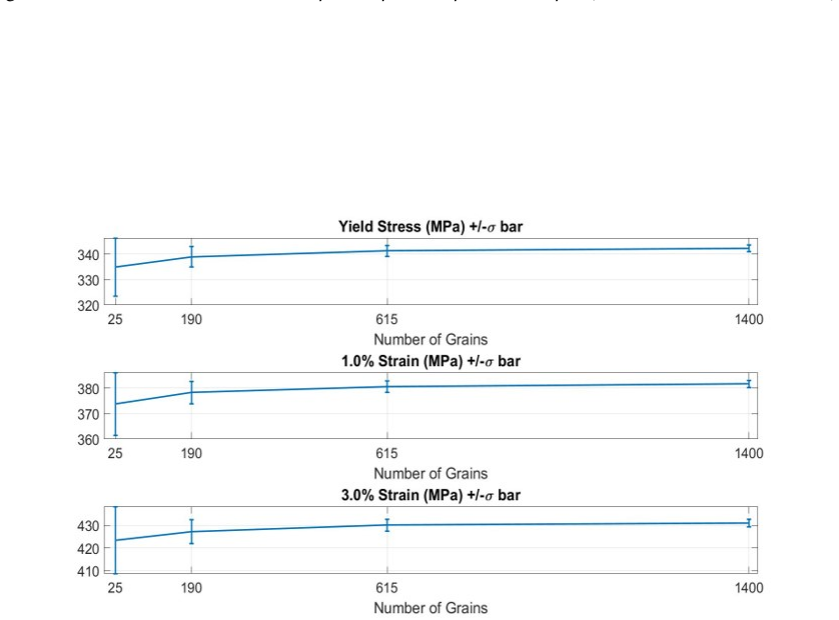
- [Table 2 and Figure 4 caption] The third row of Table 2 lists an element size of 3.2 µm for the 32³ mesh of the 80 µm RVE, but 80/32 = 2.5 µm; Figure 4's caption also says the 80 µm RVE 'contains 25 grains', whereas the text of §4.1 states it contains approximately 190 grains. These inconsistencies should be corrected.
- [§4.2] The calibrated values of the five constitutive parameters are never reported; only the optimization trajectory and the final stress-strain comparison are shown. Since the CPFE model is the basis for all subsequent surrogate training, the parameter values (and their uncertainties, if any) should be given in a table for reproducibility.
- [§4.1, Figures 3–4] The mesh-convergence criterion is described qualitatively as 'approximately 40 elements per grain', but no quantitative convergence measure (e.g., relative change in a selected stress statistic) is reported. Defining the convergence threshold would strengthen the RVE-selection argument.
- [§5, Conclusions] The conclusion says the surrogate is 'sparse polynomial chaos', but §2.3 only describes ordinary least-squares regression. Either describe the sparsity mechanism or remove the word 'sparse'.
- [Data and code availability] The data and code are only 'available from the corresponding author on reasonable request'. Given the central role of the 200 CPFE simulations and the PCE fit, a public repository with the surrogate coefficients and validation data would substantially improve transparency and verification.
Circularity Check
No circularity found: the surrogate-based sensitivity ranking is a post-hoc statistic of a fitted response surface with out-of-sample validation, not an input reused as a prediction.
full rationale
The claimed derivation chain is standard surrogate-based UQ and does not reduce to its own inputs by construction. The CPFE model is calibrated to an experimental tensile curve (Sec. 4.2, Fig. 7); the same CPFE model is then run on 200 RVEs whose texture weights are sampled from EBSD-derived bounds via MTEX (Sec. 4.6); a PCE surrogate is fitted to those runs by least-squares regression (Eqs. 19-23); and the mean, uncertainty bounds, and Cube/Goss sensitivity ranking in Sec. 4.7 are post-hoc statistics of the fitted surrogate. Nothing in these steps defines the input texture fractions in terms of the output stress, nor fits a parameter to a subset and then reports that same subset as a prediction. The held-out validation (Sec. 4.6, Fig. 19) is genuine out-of-sample evidence, though reported only visually with eight curves and no quantitative error metric. The paper's self-citations (e.g., Demir et al. 2023 for CPFE constitutive details and tangent) are methodological dependencies, not a uniqueness theorem or an unverified premise that forces the Cube/Goss conclusion. The manuscript itself flags a calibration limitation ('the experiment against which the current calibration is carried out is not cyclic, the isotropic hardening ... and kinematic hardening ... cannot be separated', Sec. 4.2), and the compositional/independence issue surrounding the MTEX joint distribution and standard Sobol indices is a real validity risk; however, these are correctness, validation, and reporting gaps, not reductions of the claimed result to its inputs by definition. Hence no circular step meeting the quoted-equation standard is present.
Assumptions & free parameters
free parameters (4)
- Five CPFE constitutive parameters (CRSS, hardening and softening constants, etc.)
- Polynomial chaos expansion order (degree)
- RVE size and grain count =
120 µm, ~615 grains
- Number of training simulations and train/test split =
200 simulations, 80/20 split
assumptions (5)
- domain assumption CPFE constitutive laws (power-law slip rate, Taylor hardening, Kocks-Mecking-Estrin, Armstrong-Frederick) govern 316L plasticity at the grain scale.
- domain assumption The 120 µm RVE with 615 grains is statistically representative of weld microstructure for degradation-relevant stress-strain response.
- domain assumption The EBSD-derived texture bounds (Table 3) capture the full service-relevant range of texture variability.
- standard math The chosen orthogonal polynomial basis is matched to the joint distribution of the texture weight inputs.
- domain assumption The five calibrated CPFE parameters are identifiable from a single monotonic tensile curve.
Cite this review
Pith. "Pith review of Degradation-Aware and Machine Learning-Driven Uncertainty Quantification in Crystal Plasticity Finite Element: Texture-Driven Plasticity in 316L Stainless Steel." pith.science (2026). https://pith.science/paper/JG6EBFAI
@misc{pith2026250518891,
  author       = {Pith},
  title        = {Pith review of: Degradation-Aware and Machine Learning-Driven Uncertainty Quantification in Crystal Plasticity Finite Element: Texture-Driven Plasticity in 316L Stainless Steel},
  year         = {2026},
  howpublished = {\url{https://pith.science/paper/JG6EBFAI}},
  note         = {Machine review of arXiv:2505.18891}
}
read the original abstract
The mechanical properties and long-term structural reliability of crystalline materials are strongly influenced by microstructural features such as grain size, morphology, and crystallographic texture. These characteristics not only determine the initial mechanical behavior but also govern the progression of degradation mechanisms, such as strain localization, fatigue damage, and microcrack initiation under service conditions. Variability in these microstructural attributes, introduced during manufacturing or evolving through in-service degradation, leads to uncertainty in material performance. Therefore, understanding and quantifying microstructure-sensitive plastic deformation is critical for assessing degradation risk in high-value mechanical systems. This study presents a first-of-its-kind machine learning-driven framework that couples high-fidelity crystal plasticity finite element (CPFE) simulations with data-driven surrogate modeling to accelerate degradation-aware uncertainty quantification in welded structural alloys. Specifically, the impact of crystallographic texture variability in 316L stainless steel weldments, characterized via high-throughput electron backscatter diffraction (EBSD), is examined through CPFE simulations on calibrated representative volume elements (RVEs). A polynomial chaos expansion-based surrogate model is then trained to efficiently emulate the CPFE response using only 200 simulations, reducing computational cost by several orders of magnitude compared to conventional Monte Carlo analysis. The surrogate enables rapid quantification of uncertainty in stress-strain behavior and identifies texture components such as Cube and Goss as key drivers of degradation-relevant plastic response.
Figures


Figures from the paper (18 more)






Forward citations
Cited by 1 Pith paper
-
Distribution-Free Uncertainty-Aware Virtual Sensing via Conformalized Neural Operators
CMCO attaches conformalized Monte Carlo dropout intervals to DeepONet field predictions, achieving high average coverage but severe undercoverage in some test samples.
Reference graph
Works this paper leans on
-
[1]
write newline
" write newline "" before.all 'output.state := FUNCTION fin.entry add.period write newline FUNCTION new.block output.state before.all = 'skip after.block 'output.state := if FUNCTION new.sentence skip FUNCTION not #0 #1 if FUNCTION and 'skip pop #0 if FUNCTION or pop #1 'skip if FUNCTION new.block.checka empty 'skip 'new.block if FUNCTION new.block.checkb...
-
[2]
write newline
" write newline "" before.all 'output.state := FUNCTION n.dashify 't := "" t empty not t #1 #1 substring "-" = t #1 #2 substring "--" = not "--" * t #2 global.max substring 't := t #1 #1 substring "-" = "-" * t #2 global.max substring 't := while if t #1 #1 substring * t #2 global.max substring 't := if while FUNCTION word.in bbl.in ":" * " " * FUNCTION f...
-
[3]
, " * write output.state after.block = add.period write newline
ENTRY address archive author booktitle chapter edition editor eprint howpublished institution journal key month note number organization pages publisher school series title type url volume year label INTEGERS output.state before.all mid.sentence after.sentence after.block FUNCTION init.state.consts #0 'before.all := #1 'mid.sentence := #2 'after.sentence ...
-
[4]
write newline
" write newline "" before.all 'output.state := FUNCTION n.dashify 't := "" t empty not t #1 #1 substring "-" = t #1 #2 substring "--" = not "--" * t #2 global.max substring 't := t #1 #1 substring "-" = "-" * t #2 global.max substring 't := while if t #1 #1 substring * t #2 global.max substring 't := if while FUNCTION word.in bbl.in capitalize " " * FUNCT...
-
[5]
Exceptional cryogenic tensile properties of k4169 superalloy by micro-grain casting process
Yue Wang, Jinshan He, Pinpin Hu, Chengbo Xiao, and Xitao Wang. Exceptional cryogenic tensile properties of k4169 superalloy by micro-grain casting process. Materials & Design, 236: 0 112450, 2023
2023
-
[6]
Effects of mg17al12 phase on microstructure evolution and ductility in the az91 magnesium alloy during the continuous rheo-squeeze casting-extrusion process
Dijia Zhao, Shulin L \"u , Wenbo Guo, Shilong Li, Jianyu Li, Guanghui Guo, Wei Guo, and Shusen Wu. Effects of mg17al12 phase on microstructure evolution and ductility in the az91 magnesium alloy during the continuous rheo-squeeze casting-extrusion process. Journal of Materials Science & Technology, 191: 0 63--79, 2024
2024
-
[7]
Grain size distribution and interfacial heat transfer coefficient during solidification of magnesium alloys using high pressure die casting process
P Sharifi, J Jamali, K Sadayappan, and JT Wood. Grain size distribution and interfacial heat transfer coefficient during solidification of magnesium alloys using high pressure die casting process. Journal of Materials Science & Technology, 34 0 (2): 0 324--334, 2018
2018
-
[8]
Sensor degradation in nuclear reactor pressure vessels: the overlooked factor in remaining useful life prediction
Raisa Bentay Hossain et al. Sensor degradation in nuclear reactor pressure vessels: the overlooked factor in remaining useful life prediction. npj Materials Degradation, 8 0 (1): 0 71, 2024
2024
Show all 101 references
-
[9]
Weight loss and burst testing investigations of sintered silicon carbide under oxidizing environments for next generation accident tolerant fuels for smr applications
Bader Almutairi et al. Weight loss and burst testing investigations of sintered silicon carbide under oxidizing environments for next generation accident tolerant fuels for smr applications. Materials Today Communications, 30: 0 102958, 2022
2022
-
[10]
Microstructure and properties of novel al-ce-sc, al-ce-y, al-ce-zr and al-ce-sc-y alloy conductors processed by die casting, hot extrusion and cold drawing
Weiyi Wang, Qinglin Pan, Geng Lin, Xiaoping Wang, Yuqiao Sun, Xiangdong Wang, Ji Ye, Yuanwei Sun, Yi Yu, Fuqing Jiang, et al. Microstructure and properties of novel al-ce-sc, al-ce-y, al-ce-zr and al-ce-sc-y alloy conductors processed by die casting, hot extrusion and cold dra...
2020
-
[11]
Exceptional mechanical properties of az31 alloy wire by combination of cold drawing and ept
Zhaohui Shan, Jing Bai, Jianfeng Fan, Hongfei Wu, Hua Zhang, Qiang Zhang, Yucheng Wu, Weiguo Li, Hongbiao Dong, and Bingshe Xu. Exceptional mechanical properties of az31 alloy wire by combination of cold drawing and ept. Journal of Materials Science & Technology, 51: 0 111--118, 2020
2020
-
[12]
Grain evolution analysis and experimental validation in the extrusion of 6xxx alloys by use of a lagrangian fe code
Lorenzo Donati, Antonio Segatori, Mohamad El Mehtedi, and Luca Tomesani. Grain evolution analysis and experimental validation in the extrusion of 6xxx alloys by use of a lagrangian fe code. International Journal of Plasticity, 46: 0 70--81, 2013
2013
-
[13]
Crystal plasticity analysis of texture development in magnesium alloy during extrusion
Tsuyoshi Mayama, Masafumi Noda, Ryoichi Chiba, and Mitsutoshi Kuroda. Crystal plasticity analysis of texture development in magnesium alloy during extrusion. International Journal of Plasticity, 27 0 (12): 0 1916--1935, 2011
1916
-
[14]
Predicting residual stress in a 316l electron beam weld joint incorporating plastic properties derived from a crystal plasticity finite element model
Mehdi Mokhtarishirazabad, Martin McMillan, VD Vijayanand, Chris Simpson, Dylan Agius, Christopher Truman, David Knowles, and Mahmoud Mostafavi. Predicting residual stress in a 316l electron beam weld joint incorporating plastic properties derived from a crystal plasticity fini...
2023
-
[15]
Microstructure-based multiscale and heterogeneous elasto-plastic properties of 2205 duplex stainless steel welded joints: Experimental and modeling
Zhilong Dong, Xue-fang Xie, Wenchun Jiang, Yu Wan, Xiangnan Zhai, and Xu Zhao. Microstructure-based multiscale and heterogeneous elasto-plastic properties of 2205 duplex stainless steel welded joints: Experimental and modeling. International Journal of Plasticity, 159: 0 103474, 2022
2022
-
[16]
Tailored deformation behavior of 304l stainless steel through control of the crystallographic texture with laser-powder bed fusion
C Sofras, J C apek, A Arabi-Hashemi, C Leinenbach, M Frost, K An, RE Log \'e , M Strobl, and E Polatidis. Tailored deformation behavior of 304l stainless steel through control of the crystallographic texture with laser-powder bed fusion. Materials & Design, 219: 0 110789, 2022
2022
-
[17]
Crystallographic texture evolution in bulk deformation processing of fcc metals
Surya R Kalidindi, Curt A Bronkhorst, and Lallit Anand. Crystallographic texture evolution in bulk deformation processing of fcc metals. Journal of the Mechanics and Physics of Solids, 40 0 (3): 0 537--569, 1992
1992
-
[18]
Machine learning-based multi-objective optimization for efficient identification of crystal plasticity model parameters
Khem Veasna, Zhangxi Feng, Qi Zhang, and Marko Knezevic. Machine learning-based multi-objective optimization for efficient identification of crystal plasticity model parameters. Computer Methods in Applied Mechanics and Engineering, 403: 0 115740, 2023
2023
-
[19]
Improving mechanical properties of selective laser melted co29cr9w3cu alloy by eliminating mesh-like random high-angle grain boundary
Yanjin Lu, Wei Zhao, Chunguagn Yang, Yujing Liu, Hongliang Xiang, Ke Yang, and Jinxin Lin. Improving mechanical properties of selective laser melted co29cr9w3cu alloy by eliminating mesh-like random high-angle grain boundary. Materials Science and Engineering: A, 793: 0 139895, 2020
2020
-
[20]
Transition between low and high angle grain boundaries
Myrjam Winning and Anthony D Rollett. Transition between low and high angle grain boundaries. Acta materialia, 53 0 (10): 0 2901--2907, 2005
2005
-
[21]
The response of dislocations, low angle grain boundaries and high angle grain boundaries at high strain rates
Qian Liu, Leiming Fang, Zhengwei Xiong, Jia Yang, Ye Tan, Yi Liu, Youjun Zhang, Qing Tan, Chenchun Hao, Linhong Cao, et al. The response of dislocations, low angle grain boundaries and high angle grain boundaries at high strain rates. Materials Science and Engineering: A, 822:...
2021
-
[22]
Localized brittle intergranular cracking and recrystallization-induced blunting in fatigue crack growth of ductile tantalum
Rongzheng Huang, Ye Zhou, Qidong Yang, Xujing Yang, Kai Wei, Zhaoliang Qu, Haiqiong Xie, Xiang Chen, and Daining Fang. Localized brittle intergranular cracking and recrystallization-induced blunting in fatigue crack growth of ductile tantalum. International Journal of Plastici...
2025
-
[23]
Mechanics and mechanisms of fatigue damage and crack growth in advanced materials
RO Ritchie, CJ Gilbert, and JM McNaney. Mechanics and mechanisms of fatigue damage and crack growth in advanced materials. International Journal of Solids and Structures, 37 0 (1-2): 0 311--329, 2000
2000
-
[24]
Variational gradient plasticity at finite strains
Christian Miehe, Steffen Mauthe, and FE Hildebrand. Variational gradient plasticity at finite strains. part iii: Local--global updates and regularization techniques in multiplicative plasticity for single crystals. Computer Methods in Applied Mechanics and Engineering, 268: 0 ...
2014
-
[25]
Crystal plasticity simulations with representative volume element of as-build laser powder bed fusion materials
Dmitry S Bulgarevich, Sukeharu Nomoto, Makoto Watanabe, and Masahiko Demura. Crystal plasticity simulations with representative volume element of as-build laser powder bed fusion materials. Scientific Reports, 13 0 (1): 0 20372, 2023
2023
-
[26]
A virtual laboratory based on full-field crystal plasticity simulation to characterize the multiscale mechanical properties of ahss
Hongyue Ma, Yangqi Li, Haiming Zhang, Qian Li, Fei Chen, and Zhenshan Cui. A virtual laboratory based on full-field crystal plasticity simulation to characterize the multiscale mechanical properties of ahss. Scientific reports, 12 0 (1): 0 5054, 2022
2022
-
[27]
The inverse band-structure problem of finding an atomic configuration with given electronic properties
Alberto Franceschetti and Alex Zunger. The inverse band-structure problem of finding an atomic configuration with given electronic properties. Nature, 402 0 (6757): 0 60--63, 1999
1999
-
[28]
Machine learning for molecular and materials science
Keith T Butler, Daniel W Davies, Hugh Cartwright, Olexandr Isayev, and Aron Walsh. Machine learning for molecular and materials science. Nature, 559 0 (7715): 0 547--555, 2018
2018
-
[29]
Materials discovery and design using machine learning
Yue Liu, Tianlu Zhao, Wangwei Ju, and Siqi Shi. Materials discovery and design using machine learning. Journal of Materiomics, 3 0 (3): 0 159--177, 2017
2017
-
[30]
Grain-orientation induced stress formation in aa2024 monocrystal and bicrystal using crystal plasticity finite element method
Qi Zhao, Magd Abdel Wahab, Yong Ling, and Zhiyi Liu. Grain-orientation induced stress formation in aa2024 monocrystal and bicrystal using crystal plasticity finite element method. Materials & Design, 206: 0 109794, 2021
2021
-
[31]
Machine learning-enabled self-consistent parametrically-upscaled crystal plasticity model for ni-based superalloys
George Weber, Maxwell Pinz, and Somnath Ghosh. Machine learning-enabled self-consistent parametrically-upscaled crystal plasticity model for ni-based superalloys. Computer Methods in Applied Mechanics and Engineering, 402: 0 115384, 2022
2022
-
[32]
Micro-mechanisms of anisotropic deformation in the presence of notch in commercially pure titanium: An in-situ study with cpfem simulations
Vivek Kumar Sahu, Pritam Chakraborty, Manasij Yadava, and Nilesh P Gurao. Micro-mechanisms of anisotropic deformation in the presence of notch in commercially pure titanium: An in-situ study with cpfem simulations. International Journal of Plasticity, 177: 0 103985, 2024
2024
-
[33]
Modeling cyclic deformation of inconel 718 superalloy by means of crystal plasticity and computational homogenization
A Cruzado, J LLorca, and J Segurado. Modeling cyclic deformation of inconel 718 superalloy by means of crystal plasticity and computational homogenization. International Journal of Solids and Structures, 122: 0 148--161, 2017
2017
-
[34]
Investigating grain-resolved evolution of lattice strains during plasticity and creep using 3dxrd and crystal plasticity modelling
Farhan Ashraf, Ranggi S Ramadhan, Abdullah Al Mamun, James AD Ball, Eralp Demir, Thomas Connolley, David M Collins, Mahmoud Mostafavi, and David Knowles. Investigating grain-resolved evolution of lattice strains during plasticity and creep using 3dxrd and crystal plasticity mo...
2024
-
[35]
Improved generalization with deep neural operators for engineering systems: Path towards digital twin
Kazuma Kobayashi et al. Improved generalization with deep neural operators for engineering systems: Path towards digital twin. Engineering Applications of Artificial Intelligence, 131: 0 107844, 2024 a
2024
-
[36]
Deep neural operator-driven real-time inference to enable digital twin solutions for nuclear energy systems
Kazuma Kobayashi et al. Deep neural operator-driven real-time inference to enable digital twin solutions for nuclear energy systems. Nature Scientific reports, 14 0 (1): 0 2101, 2024 b
2024
-
[37]
A machine learning model to predict yield surfaces from crystal plasticity simulations
Anderson Nascimento, Sharan Roongta, Martin Diehl, and Irene J Beyerlein. A machine learning model to predict yield surfaces from crystal plasticity simulations. International Journal of Plasticity, 161: 0 103507, 2023
2023
-
[38]
Data-driven inverse design of monbtivwzr refractory multicomponent alloys: Microstructure and mechanical properties
Lavanya Raman, Arindam Debnath, Erik Furton, Shuang Lin, Adam Krajewski, Subrata Ghosh, Na Liu, Marcia Ahn, Bed Poudel, Shunli Shang, et al. Data-driven inverse design of monbtivwzr refractory multicomponent alloys: Microstructure and mechanical properties. Materials Science a...
2024
-
[39]
Explainable, interpretable, and trustworthy AI for an intelligent digital twin: A case study on remaining useful life
Kazuma Kobayashi et al. Explainable, interpretable, and trustworthy AI for an intelligent digital twin: A case study on remaining useful life. Engineering Applications of Artificial Intelligence, 129: 0 107620, 2024 c
2024
-
[40]
Transfer learning with spinally shared layers
H Kabir et al. Transfer learning with spinally shared layers. Applied Soft Computing, page 111908, 2024
2024
-
[41]
Digital twin-centered hybrid data-driven multi-stage deep learning framework for enhanced nuclear reactor power prediction
James Daniell et al. Digital twin-centered hybrid data-driven multi-stage deep learning framework for enhanced nuclear reactor power prediction. Energy and AI, 19: 0 100450, 2025
2025
-
[42]
Physics-regularized neural networks for predictive modeling of silicon carbide swelling with limited experimental data
Kazuma Kobayashi et al. Physics-regularized neural networks for predictive modeling of silicon carbide swelling with limited experimental data. Scientific reports, 14 0 (1): 0 30666, 2024 d
2024
-
[43]
A generic high-throughput microstructure classification and quantification method for regular sem images of complex steel microstructures combining ebsd labeling and deep learning
Chunguang Shen, Chenchong Wang, Minghao Huang, Ning Xu, Sybrand van der Zwaag, and Wei Xu. A generic high-throughput microstructure classification and quantification method for regular sem images of complex steel microstructures combining ebsd labeling and deep learning. Journ...
2021
-
[44]
Unveiling the quantitative relationship between microstructural features and quasi-static tensile properties in dual-phase titanium alloys based on data-driven neural networks
Gan Li, Qunbo Fan, Guoju Li, Lin Yang, Haichao Gong, Meiqin Li, Shun Xu, and Xingwang Cheng. Unveiling the quantitative relationship between microstructural features and quasi-static tensile properties in dual-phase titanium alloys based on data-driven neural networks. Materia...
2024
-
[45]
Gaussian process regression as a surrogate model for the computation of dispersion relations
Alexander C Ogren, Berthy T Feng, Katherine L Bouman, and Chiara Daraio. Gaussian process regression as a surrogate model for the computation of dispersion relations. Computer Methods in Applied Mechanics and Engineering, 420: 0 116661, 2024
2024
-
[46]
Gaussian process regressions on hot deformation behaviors of fgh98 nickel-based powder superalloy
Jie Xiong, Jian-Chao He, Xue-Song Leng, and Tong-Yi Zhang. Gaussian process regressions on hot deformation behaviors of fgh98 nickel-based powder superalloy. Journal of Materials Science & Technology, 146: 0 177--185, 2023
2023
-
[47]
Practical applications of gaussian process with uncertainty quantification and sensitivity analysis for digital twin for accident-tolerant fuel
Kazuma Kobayashi, Dinesh Kumar, Matthew Bonney, and Syed Alam. Practical applications of gaussian process with uncertainty quantification and sensitivity analysis for digital twin for accident-tolerant fuel. In Handbook of Smart Energy Systems, pages 1--12. Springer, 2022
2022
-
[48]
Global sensitivity analysis using polynomial chaos expansions
Bruno Sudret. Global sensitivity analysis using polynomial chaos expansions. Reliability engineering & system safety, 93 0 (7): 0 964--979, 2008
2008
-
[49]
Surrogate modeling of high-dimensional problems via data-driven polynomial chaos expansions and sparse partial least square
Yicheng Zhou, Zhenzhou Lu, Jinghan Hu, and Yingshi Hu. Surrogate modeling of high-dimensional problems via data-driven polynomial chaos expansions and sparse partial least square. Computer Methods in Applied Mechanics and Engineering, 364: 0 112906, 2020
2020
-
[50]
Data-driven multi-scale modeling and robust optimization of composite structure with uncertainty quantification
Kazuma Kobayashi, Shoaib Usman, Carlos Castano, Ayodeji Alajo, Dinesh Kumar, Susmita Naskar, and Syed Alam. Data-driven multi-scale modeling and robust optimization of composite structure with uncertainty quantification. In Handbook of Smart Energy Systems, pages 1333--1343. S...
2023
-
[51]
Recent advances in machine learning-assisted fatigue life prediction of additive manufactured metallic materials: A review
H Wang, SL Gao, BT Wang, YT Ma, ZJ Guo, K Zhang, Y Yang, XZ Yue, J Hou, HJ Huang, et al. Recent advances in machine learning-assisted fatigue life prediction of additive manufactured metallic materials: A review. Journal of Materials Science & Technology, 2024
2024
-
[52]
Bayesian analysis of parametric uncertainties and model form probabilities for two different crystal plasticity models of lamellar grains in + titanium alloys
Aditya Venkatraman, David L McDowell, and Surya R Kalidindi. Bayesian analysis of parametric uncertainties and model form probabilities for two different crystal plasticity models of lamellar grains in + titanium alloys. International Journal of Plasticity, 154: 0 103289, 2022
2022
-
[53]
A predictive machine learning approach for microstructure optimization and materials design
Ruoqian Liu, Abhishek Kumar, Zhengzhang Chen, Ankit Agrawal, Veera Sundararaghavan, and Alok Choudhary. A predictive machine learning approach for microstructure optimization and materials design. Scientific reports, 5 0 (1): 0 11551, 2015 a
2015
-
[54]
Extracting dislocation microstructures by deep learning
Yuqi Zhang and Alfonso HW Ngan. Extracting dislocation microstructures by deep learning. International Journal of Plasticity, 115: 0 18--28, 2019
2019
-
[55]
Structural health monitoring: a machine learning perspective
Charles R Farrar and Keith Worden. Structural health monitoring: a machine learning perspective. John Wiley & Sons, 2012
2012
-
[56]
Machine learning strategy for accelerated design of polymer dielectrics
Arun Mannodi-Kanakkithodi, Ghanshyam Pilania, Tran Doan Huan, Turab Lookman, and Rampi Ramprasad. Machine learning strategy for accelerated design of polymer dielectrics. Scientific reports, 6 0 (1): 0 20952, 2016
2016
-
[57]
A review of the application of machine learning and data mining approaches in continuum materials mechanics
Frederic E Bock, Roland C Aydin, Christian J Cyron, Norbert Huber, Surya R Kalidindi, and Benjamin Klusemann. A review of the application of machine learning and data mining approaches in continuum materials mechanics. Frontiers in Materials, 6: 0 110, 2019
2019
-
[58]
Data-driven reduced-order models for rank-ordering the high cycle fatigue performance of polycrystalline microstructures
Noah H Paulson, Matthew W Priddy, David L McDowell, and Surya R Kalidindi. Data-driven reduced-order models for rank-ordering the high cycle fatigue performance of polycrystalline microstructures. Materials & Design, 154: 0 170--183, 2018
2018
-
[59]
Combining a neural network with a genetic algorithm for process parameter optimization
Deborah F Cook, Cliff T Ragsdale, and RL Major. Combining a neural network with a genetic algorithm for process parameter optimization. Engineering applications of artificial intelligence, 13 0 (4): 0 391--396, 2000
2000
-
[60]
Understanding of additively manufactured material cyclic behavior at the grain scale by neutron diffraction and crystal plasticity modeling
Hugo Roirand, Nicolas Saintier, Anis Hor, and Benoit Malard. Understanding of additively manufactured material cyclic behavior at the grain scale by neutron diffraction and crystal plasticity modeling. Materials Science and Engineering: A, 918: 0 147380, 2024
2024
-
[61]
Convolutional neural network-based method for real-time orientation indexing of measured electron backscatter diffraction patterns
Yu-Feng Shen, Reeju Pokharel, Thomas J Nizolek, Anil Kumar, and Turab Lookman. Convolutional neural network-based method for real-time orientation indexing of measured electron backscatter diffraction patterns. Acta Materialia, 170: 0 118--131, 2019
2019
-
[62]
Real-time coherent diffraction inversion using deep generative networks
Mathew J Cherukara, Youssef SG Nashed, and Ross J Harder. Real-time coherent diffraction inversion using deep generative networks. Scientific reports, 8 0 (1): 0 16520, 2018
2018
-
[63]
Applied machine learning to predict stress hotspots i: Face centered cubic materials
Ankita Mangal and Elizabeth A Holm. Applied machine learning to predict stress hotspots i: Face centered cubic materials. International Journal of Plasticity, 111: 0 122--134, 2018
2018
-
[64]
Smart finite elements: A novel machine learning application
German Capuano and Julian J Rimoli. Smart finite elements: A novel machine learning application. Computer Methods in Applied Mechanics and Engineering, 345: 0 363--381, 2019
2019
-
[65]
Stress--strain curve predictions by crystal plasticity simulations and machine learning
Dmitry S Bulgarevich and Makoto Watanabe. Stress--strain curve predictions by crystal plasticity simulations and machine learning. Scientific Reports, 14 0 (1): 0 29492, 2024
2024
-
[66]
Application of artificial neural networks in micromechanics for polycrystalline metals
Usman Ali, Waqas Muhammad, Abhijit Brahme, Oxana Skiba, and Kaan Inal. Application of artificial neural networks in micromechanics for polycrystalline metals. International Journal of Plasticity, 120: 0 205--219, 2019
2019
-
[67]
An uncertainty quantification framework for multiscale parametrically homogenized constitutive models (phcms) of polycrystalline ti alloys
Deniz Ozturk, Shravan Kotha, and Somnath Ghosh. An uncertainty quantification framework for multiscale parametrically homogenized constitutive models (phcms) of polycrystalline ti alloys. Journal of the Mechanics and Physics of Solids, 148: 0 104294, 2021
2021
-
[68]
Grain size and shape dependent crystal plasticity finite element model and its application to electron beam welded ss316l
Eralp Demir, Edward W Horton, Mehdi Mokhtarishirazabad, Mahmoud Mostafavi, and David Knowles. Grain size and shape dependent crystal plasticity finite element model and its application to electron beam welded ss316l. Journal of the Mechanics and Physics of Solids, page 105331, 2023
2023
-
[69]
Kinetics of flow and strain-hardening
H Mecking and UF Kocks. Kinetics of flow and strain-hardening. Acta metallurgica, 29 0 (11): 0 1865--1875, 1981
1981
-
[70]
A unified phenomenological description of work hardening and creep based on one-parameter models
Yu Estrin and H Mecking. A unified phenomenological description of work hardening and creep based on one-parameter models. Acta metallurgica, 32 0 (1): 0 57--70, 1984
1984
-
[71]
A mathematical representation of the multiaxial Bauschinger effect, volume 731
Peter J Armstrong, CO Frederick, et al. A mathematical representation of the multiaxial Bauschinger effect, volume 731. Berkeley Nuclear Laboratories Berkeley, CA, 1966
1966
-
[72]
Three dimensional predictions of grain scale plasticity and grain boundaries using crystal plasticity finite element models
Marko Knezevic, Borys Drach, Milan Ardeljan, and Irene J Beyerlein. Three dimensional predictions of grain scale plasticity and grain boundaries using crystal plasticity finite element models. Computer Methods in Applied Mechanics and Engineering, 277: 0 239--259, 2014
2014
-
[73]
Crystal plasticity finite element modeling of extension twinning in we43 mg alloys: calibration and validation
Mohammadreza Yaghoobi, Zhe Chen, Veera Sundararaghavan, Samantha Daly, and John E Allison. Crystal plasticity finite element modeling of extension twinning in we43 mg alloys: calibration and validation. Integrating Materials and Manufacturing Innovation, 10: 0 488--507, 2021
2021
-
[74]
Multiscale stress and strain statistics in the deformation of polycrystalline alloys
Jingwei Chen, Zifan Wang, and Alexander M Korsunsky. Multiscale stress and strain statistics in the deformation of polycrystalline alloys. International Journal of Plasticity, 152: 0 103260, 2022
2022
-
[75]
Investigating mesh sensitivity and polycrystalline rves in crystal plasticity finite element simulations
Hojun Lim, Corbett C Battaile, Joseph E Bishop, and James W Foulk III. Investigating mesh sensitivity and polycrystalline rves in crystal plasticity finite element simulations. International Journal of Plasticity, 121: 0 101--115, 2019
2019
-
[76]
Managing computational complexity using surrogate models: a critical review
Reza Alizadeh, Janet K Allen, and Farrokh Mistree. Managing computational complexity using surrogate models: a critical review. Research in Engineering Design, 31 0 (3): 0 275--298, 2020
2020
-
[77]
Engineering design via surrogate modelling: a practical guide
Alexander Forrester, Andras Sobester, and Andy Keane. Engineering design via surrogate modelling: a practical guide. John Wiley & Sons, 2008
2008
-
[78]
Building surrogate models based on detailed and approximate simulations
Zhiguang Qian, Carolyn Conner Seepersad, V Roshan Joseph, Janet K Allen, and CF Jeff Wu. Building surrogate models based on detailed and approximate simulations. 2006
2006
-
[79]
The homogeneous chaos
Norbert Wiener. The homogeneous chaos. American Journal of Mathematics, 60 0 (4): 0 897--936, 1938
1938
-
[80]
The wiener--askey polynomial chaos for stochastic differential equations
Dongbin Xiu and George Em Karniadakis. The wiener--askey polynomial chaos for stochastic differential equations. SIAM Journal on Scientific Computing, 24 0 (2): 0 619--644, 2002
2002
-
[81]
Quantitative risk assessment of a high power density small modular reactor ( SMR ) core using uncertainty and sensitivity analyses
Dinesh Kumar, Syed Alam, Tuhfatur Ridwan, and Cameron S Goodwin. Quantitative risk assessment of a high power density small modular reactor ( SMR ) core using uncertainty and sensitivity analyses. Energy, 227: 0 120400, 2021
2021
-
[82]
Multi-criteria decision making under uncertainties in composite materials selection and design
Dinesh Kumar, Mariapia Marchi, Syed Bahauddin Alam, Carlos Kavka, Yao Koutsawa, Gaston Rauchs, and Salim Belouettar. Multi-criteria decision making under uncertainties in composite materials selection and design. Composite Structures, 279: 0 114680, 2022
2022
-
[83]
Uncertainty quantification and sensitivity analysis for digital twin enabling technology
Kazuma Kobayashi et al. Uncertainty quantification and sensitivity analysis for digital twin enabling technology. Springer Nature, Handbook of Smart Energy Systems: 0 2265--–2277, 2023 b
2023
-
[84]
Sparse polynomial chaos expansions and adaptive stochastic finite elements using a regression approach
G \'e raud Blatman and Bruno Sudret. Sparse polynomial chaos expansions and adaptive stochastic finite elements using a regression approach. Comptes Rendus M \'e canique , 336 0 (6): 0 518--523, 2008
2008
-
[85]
An efficient non-intrusive reduced basis model for high dimensional stochastic problems in CFD
Dinesh Kumar, Mehrdad Raisee, and Chris Lacor. An efficient non-intrusive reduced basis model for high dimensional stochastic problems in CFD . Computers & Fluids, 138: 0 67--82, 2016
2016
-
[86]
Efficient uncertainty quantification and management in the early stage design of composite applications
Dinesh Kumar, Yao Koutsawa, Gaston Rauchs, Mariapia Marchi, Carlos Kavka, and Salim Belouettar. Efficient uncertainty quantification and management in the early stage design of composite applications. Composite Structures, page 112538, 2020
2020
-
[87]
Recent advances in uncertainty quantification methods for engineering problems
Dinesh Kumar et al. Recent advances in uncertainty quantification methods for engineering problems. Academic Press, AI Assurance: 0 453--472, 2023
2023
-
[88]
Uncertainty quantification and polynomial chaos techniques in computational fluid dynamics
Habib N Najm. Uncertainty quantification and polynomial chaos techniques in computational fluid dynamics. Annual review of fluid mechanics, 41 0 (1): 0 35--52, 2009
2009
-
[89]
AI -driven uncertainty quantification & multi-physics approach to evaluate cladding materials in a microreactor
Alexander Foutch, Kazuma Kobayashi, Ayodeji Alajo, Dinesh Kumar, and Syed Bahauddin Alam. AI -driven uncertainty quantification & multi-physics approach to evaluate cladding materials in a microreactor. Progress in Nuclear Energy, 186: 0 105793, 2025
2025
-
[90]
AI -driven non-intrusive uncertainty quantification of advanced nuclear fuels for digital twin-enabling technology
Kazuma Kobayashi, Dinesh Kumar, and Syed Bahauddin Alam. AI -driven non-intrusive uncertainty quantification of advanced nuclear fuels for digital twin-enabling technology. Progress in Nuclear Energy, 172: 0 105177, 2024 e
2024
-
[91]
Error estimation and adaptive mesh refinement in boundary element method, an overview
Eisuke Kita and Norio Kamiya. Error estimation and adaptive mesh refinement in boundary element method, an overview. Engineering Analysis with Boundary Elements, 25 0 (7): 0 479--495, 2001
2001
-
[92]
Adaptive mesh refinement method for optimal control using nonsmoothness detection and mesh size reduction
Fengjin Liu, William W Hager, and Anil V Rao. Adaptive mesh refinement method for optimal control using nonsmoothness detection and mesh size reduction. Journal of the Franklin Institute, 352 0 (10): 0 4081--4106, 2015 b
2015
-
[93]
Isogeometric analysis: Cad, finite elements, nurbs, exact geometry and mesh refinement
Thomas JR Hughes, John A Cottrell, and Yuri Bazilevs. Isogeometric analysis: Cad, finite elements, nurbs, exact geometry and mesh refinement. Computer methods in applied mechanics and engineering, 194 0 (39-41): 0 4135--4195, 2005
2005
-
[94]
The inclusion and role of micro mechanical residual stress on deformation of stainless steel type 316l at grain level
Edward William Horton, Eralp Demir, Dylan Agius, Anna Kareer, David M Collins, Mahmoud Mostafavi, and David Knowles. The inclusion and role of micro mechanical residual stress on deformation of stainless steel type 316l at grain level. Materials Science and Engineering: A, 876...
2023
-
[95]
Stress fields and geometrically necessary dislocation density distributions near the head of a blocked slip band
T Benjamin Britton and Angus J Wilkinson. Stress fields and geometrically necessary dislocation density distributions near the head of a blocked slip band. Acta Materialia, 60 0 (16): 0 5773--5782, 2012
2012
-
[96]
On the measurement of dislocations and dislocation substructures using ebsd and hrsd techniques
Ondrej Muransky, Levente Balogh, M Tran, CJ Hamelin, J-S Park, and Mark R Daymond. On the measurement of dislocations and dislocation substructures using ebsd and hrsd techniques. Acta Materialia, 175: 0 297--313, 2019
2019
-
[97]
Experimental measurement of dislocation density in metallic materials: A quantitative comparison between measurements techniques (xrd, r-ecci, hr-ebsd, tem)
Julien Gallet, Michel Perez, Rapha \"e lle Guillou, Clement Ernould, Christophe Le Bourlot, Cyril Langlois, Benoit Beausir, Emmanuel Bouzy, Thibaut Chaise, and Sophie Cazottes. Experimental measurement of dislocation density in metallic materials: A quantitative comparison bet...
2023
-
[98]
Methods and guidelines for effective model calibration
Mary C Hill. Methods and guidelines for effective model calibration. In Building partnerships, pages 1--10. 2000
2000
-
[99]
The future of distributed models: model calibration and uncertainty prediction
Keith Beven and Andrew Binley. The future of distributed models: model calibration and uncertainty prediction. Hydrological processes, 6 0 (3): 0 279--298, 1992
1992
-
[100]
Crystal plasticity modeling of deformation and creep in polycrystalline ti-6242
Dhyanjyoti Deka, Deepu S Joseph, Somnath Ghosh, and Michael J Mills. Crystal plasticity modeling of deformation and creep in polycrystalline ti-6242. Metallurgical and materials transactions A, 37: 0 1371--1388, 2006
2006
-
[101]
Calibration and surrogate model-based sensitivity analysis of crystal plasticity finite element models
Hugh Dorward, David M Knowles, Eralp Demir, Mahmoud Mostafavi, and Matthew J Peel. Calibration and surrogate model-based sensitivity analysis of crystal plasticity finite element models. arXiv preprint arXiv:2312.12024, 2023
2023 arXiv
Reviewed August 7, 2026 · model on record in the stance chip above.
Discussion (0). Sign in to comment.