REVIEW 3 major objections 5 minor 17 references
Learning to Explain: Prototype-Based Surrogate Models for LLM Classification
T0 review · 3 major / 5 minor · reviewed 2026-08-07 · deepseek-v4-flash
Pith's one-line read Prototype-based surrogate models give faithful, human-readable explanations of LLM classifications.
desk verdict ProtoSurE is a plausible new surrogate idea, but the Comp/Suff equations contradict the table numbers and the central faithfulness claim is unverifiable without code. read the letter →
The pith
A machine-rendered reading of the paper's core claim, the machinery that carries it, and where it could break.
The reading
What carries the argument
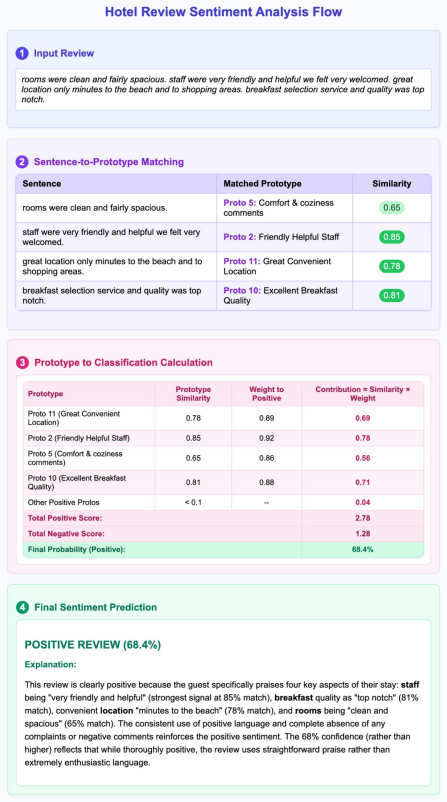
The key machinery is the prototype-based surrogate: input sentences are embedded, token-level attribution scores from the LLM guide a self-attention module, sentences are pooled into embeddings weighted by attention, and each sentence is compared by cosine similarity to a set of trainable prototype embeddings. A linear classifier maps the similarity vector to the label. Explanation is produced by showing which prototypes each sentence activates and how those activations combine additively into the final logits. The training loss combines cross-entropy with the LLM's predictions, a prototype-utilization term, and a diversity term.
What would settle it
Recompute Comprehensiveness and Sufficiency for ProtoSurE and the baselines directly from the equations in Appendix B.2 (without any '1 −' sign) on the same data, and check whether ProtoSurE still ranks first. A cleaner test is to take a random sentence removed from a review and measure the actual drop in the LLM's output probability: if removing ProtoSurE's top-ranked sentences does not cause a larger drop than removing random sentences, the faithfulness claim fails.
Extended reading notes
Core claim
The central claim is that sentence-level prototype-based surrogate models can serve as faithful and human-understandable explainers for black-box LLM text classifiers. The surrogate is trained to replicate the LLM's label distribution, and its internal prototype-matching scores plus a simple linear decision rule provide the explanation. The paper reports that ProtoSurE achieves the best average rank (1.55) across six faithfulness metrics compared with four standard post-hoc methods, and that it reaches roughly 80–85% accuracy with only 128 training examples, suggesting the approach is practical when labeled data is scarce.
Load-bearing premise
The faithfulness evaluation assumes the perturbation-based metrics are computed in the direction the text claims, but the equations in Appendix B.2 for Comprehensiveness and Sufficiency contain a leading '1 −' term that would invert the direction of the reported superiority if the implementation follows those equations.
Editorial extensions
If this is right
- If ProtoSurE's faithfulness holds, practitioners can deploy a single interpretable model to audit LLM decisions in high-stakes domains such as health, law, and finance without needing white-box access.
- Sentence-level explanations would make model behavior reviewable by non-experts, since each explanation reduces to a few prototype sentences and their weighted contributions.
- The reported data efficiency suggests that generating a faithful surrogate for a new LLM or dataset may require only a few hundred labeled examples, lowering the cost of interpretability audits.
- The prototype-based architecture could be extended to other modalities or to span-level explanations, where evidence is not aligned with sentence boundaries.
Reading between the lines
- The faithful-surrogate approach shifts the interpretability problem from explaining a black box to training a white box, and its success depends on how well distillation preserves the decision boundary; a surrogate that matches labels but not the model's internal priorities could yield misleading explanations even with high accuracy.
- The reported gains in comprehensiveness and sufficiency are consistent with the idea that sentence-level granularity matches the natural unit of human reasoning for text, which would extend to other sequence-classification tasks such as claim verification or toxic-content detection.
- A testable extension is to measure whether human users can actually use ProtoSurE's explanations to predict the LLM's behavior on new inputs, which would directly validate the 'human-understandable' claim beyond the faithfulness metrics.
- The method's reliance on token-level attribution scores from the LLM creates a circular dependency: if the base attributions are unfaithful, the surrogate inherits their bias, so ProtoSurE's faithfulness is bounded by the quality of the underlying attribution method.
Editorial analysis
A structured set of objections, weighed in public.
Referee Report
Summary. The paper proposes ProtoSurE, a prototype-based surrogate model that explains classifications of black-box LLMs in text classification. The surrogate is trained to reproduce target-LLM labels, uses sentence-level prototypes as interpretable concepts, and incorporates token-level attribution scores (Chefer relevancy maps) into sentence embeddings. The authors evaluate faithfulness with accuracy plus six perturbation-based metrics (Comprehensiveness, Sufficiency, DFF, DFS, Deletion/Insertion rank correlation) across four datasets and four LLMs, and report an average ranking of 1.55 over all faithfulness metrics, claiming consistent superiority over SHAP, IG, Occlusion, and DeepLIFT. They also report data-efficiency experiments, ablations, and qualitative case studies.
Significance. If the quantitative claims are correct, ProtoSurE would be a useful contribution: sentence-level prototype explanations are more human-comprehensible than token-level attributions, and the idea of training an interpretable surrogate with LLM-derived token attributions is sensible. The experimental scope is broad (four LLMs, four datasets, multiple faithfulness metrics), and the ablations for encoder choice, token attribution, and prototype updating are a strength. However, the central empirical claim is currently unverifiable because the definitions of Comprehensiveness and Sufficiency in Appendix B.2 conflict with the reported numbers and with the text, and because Chefer's relevancy maps—a SOTA attribution method—are used as an ingredient but are not included as a baseline. The human-understandability half of the central claim is supported only by illustrative case studies, not by measurement.
major comments (3)
- [Section 4.1, Baselines; Section 3.2] ProtoSurE uses the token attribution scores of Chefer et al. (2021) as a central input: these scores are normalized and added to the self-attention logits in Eq. (3), and they determine the attention-weighted sentence embeddings in Eq. (6). Yet Chefer's relevancy map—itself a state-of-the-art attribution method—is not included as a baseline. The fair comparison in Table 7 is therefore incomplete: ProtoSurE's superiority may come substantially from the quality of Chefer's token attributions rather than from the prototype-based architecture. The authors should add Chefer (aggregated to sentence level in the same way as the other baselines) and, ideally, one or two additional recent attribution methods, or explicitly reframe the contribution as a wrapper that builds sentence-level explanations from token-level attributions.
- [Abstract; Section 4.6; Appendix F] The paper claims ProtoSurE provides 'human-understandable explanations,' but this part of the central claim is never measured. The only evidence is qualitative: the case study in Section 4.6 and Figures 5-6 in Appendix F. No user study, no rating of explanation clarity, no simulatability experiment, and no quantitative comprehensibility metric is reported. Since understandability is one of the two pillars of the claimed contribution, the authors should either add a human-subject evaluation or substantially soften the claim to say the design aims at human understandability, supported by qualitative examples.
- [Table 1; Table 7] Several of the headline differences are very small—for example, Insertion Rank Correlation is 0.336 for ProtoSurE versus 0.334 for IG, and DFF is 0.685 versus 0.706—and the paper reports no variance, confidence intervals, or significance tests. Without multiple random seeds or a paired test across instances, the claim of 'consistently outperforming' is not statistically supported for these metrics. The authors should report mean and standard deviation over several runs and indicate which differences are significant.
minor comments (5)
- [Appendix D, paragraph on Sufficiency] The sentence 'it also yields the lowest Sufficiency score ... demonstrating that the remaining tokens after removing important ones are less sufficient for prediction' misstates the metric: lower Sufficiency means that keeping only the important sentences is sufficient to preserve the prediction, not that the remaining tokens are less sufficient. Please correct this wording throughout.
- [Section 4.2, DFF discussion] The text says lower DFF 'suggest[s] higher stability,' but under the standard definition a lower DFF means the model's decision flips after removing fewer important sentences, i.e., the identified sentences are more decision-critical. This is not 'stability' in any usual sense; please rephrase to avoid confusion.
- [Eq. (3), Section 3.2] The addition of the normalized attribution vector r_hat_i to the attention logits QK^T / sqrt(d) is not clearly justified. Since r_hat_i is a per-token vector, adding it can dominate the scaled dot-product attention; please clarify the scaling or provide an ablation showing that the attribution-guided attention behaves as intended.
- [References] A few references are incomplete or malformed: the entry 'Spectra 2021' is a website with no author and is not a standard scholarly citation, and several author lists in the references (e.g., Li et al. 2023, Ni et al. 2021) appear garbled. Please verify all references against their original sources.
- [Table 7] Table 7 is very dense and hard to read in print. Consider splitting it into per-dataset or per-LLM tables, or moving full results to a supplementary file while keeping a condensed version in the main text. Also, the caption says 'Avg' but it is not defined in the caption; please add a brief definition.
Circularity Check
No circular derivation: the surrogate's faithfulness is evaluated externally on the target LLM, and the only self-citation is a non-load-bearing related-work pointer; Appendix B.2's flipped Comp/Suff equations are a correctness inconsistency, not circularity.
full rationale
The central claimed result (ProtoSurE faithfully explains LLM classifications) is not equivalent to its inputs by construction. The surrogate is trained to imitate target-LLM labels and uses Chefer et al.'s token relevancy scores as soft guidance for sentence embeddings, but the headline faithfulness metrics (Comp, Suff, DFF, DFS, Del, Ins) are computed by perturbing the target LLM's own confidence scores, not by reading back the surrogate's training loss. Thus the main evaluation is external and falsifiable. The only overlapping-author citation is ProtoLens (Wei and Zhu, 2024), used in Related Work to contrast interpretable-by-design prototype classifiers with the present post-hoc surrogate goal; it carries no load-bearing premise, theorem, or ansatz. A separate, non-circular concern is that Appendix B.2 prints Comp = 1 - mean_drop (Eq. 11) and Suff = 1 - mean_drop (Eq. 12), while the text and Table 7 arrows interpret higher Comp / lower Suff as better; the reported magnitudes match the unflipped ERASER definitions, so the equations are likely misprinted. This is a reproducibility/correctness risk that inverts the empirical claim if implemented literally, but it does not make the derivation circular. Therefore the circularity score is low (2), reflecting only the non-load-bearing self-citation.
Assumptions & free parameters
free parameters (3)
- prototype count P =
selected from {10,20,40,100}
- loss weights lambda1, lambda2 =
0.1
- learning rate =
selected from {1e-2,2e-3}
assumptions (4)
- domain assumption Sentence splitting by punctuation yields semantically coherent units for the target LLM's reasoning.
- domain assumption Cosine similarity between sentence embedding and prototype embedding reflects semantic relevance to the LLM's decision.
- domain assumption Chefer's relevance map token attributions correctly identify tokens that drive the target LLM.
- domain assumption The perturbation-based faithfulness metrics (Comp, Suff, DFF, etc.) provide valid measures of explanation faithfulness.
Cite this review
Pith. "Pith review of Learning to Explain: Prototype-Based Surrogate Models for LLM Classification." pith.science (2026). https://pith.science/paper/N7LQPXAE
@misc{pith2026250518970,
  author       = {Pith},
  title        = {Pith review of: Learning to Explain: Prototype-Based Surrogate Models for LLM Classification},
  year         = {2026},
  howpublished = {\url{https://pith.science/paper/N7LQPXAE}},
  note         = {Machine review of arXiv:2505.18970}
}
read the original abstract
Large language models (LLMs) have demonstrated impressive performance on natural language tasks, but their decision-making processes remain largely opaque. Existing explanation methods either suffer from limited faithfulness to the model's reasoning or produce explanations that humans find difficult to understand. To address these challenges, we propose \textbf{ProtoSurE}, a novel prototype-based surrogate framework that provides faithful and human-understandable explanations for LLMs. ProtoSurE trains an interpretable-by-design surrogate model that aligns with the target LLM while utilizing sentence-level prototypes as human-understandable concepts. Extensive experiments show that ProtoSurE consistently outperforms SOTA explanation methods across diverse LLMs and datasets. Importantly, ProtoSurE demonstrates strong data efficiency, requiring relatively few training examples to achieve good performance, making it practical for real-world applications.
Figures


Figures from the paper (3 more)


Reference graph
Works this paper leans on
-
[4]
Advancing Interpretability in Text Classification through Prototype Learning
URL https://arxiv.org/abs/2410.17546. Jacob Devlin, Ming-Wei Chang, Kenton Lee, and Kristina Toutanova. Bert: Pre-training of deep bidirectional transformers for language understanding,
-
[6]
Distill-and-compare: Auditing black-box models using transparent model distillation
Sarah Tan, Rich Caruana, Giles Hooker, and Yin Lou. Distill-and-compare: Auditing black-box models using transparent model distillation. In Proceedings of the 2018 AAAI/ACM Conference on AI, Ethics, and Society, 2018b. Cynthia Rudin. Stop explaining black box machine learning models for high stakes decisions and use interpretable models instead. Nature Ma...
work page 2018
-
[7]
Kaitao Song, Xu Tan, Tao Qin, Jianfeng Lu, and Tie-Yan Liu
URL https://arxiv.org/abs/2012.09838. Kaitao Song, Xu Tan, Tao Qin, Jianfeng Lu, and Tie-Yan Liu. Mpnet: Masked and permuted pre-training for language understanding. Advances in neural information processing systems, 33:16857–16867,
arXiv 2012
-
[9]
Decoupled weight decay regularization
I Loshchilov. Decoupled weight decay regularization. arXiv preprint arXiv:1711.05101,
-
[10]
doi:10.18653/v1/2020.acl-main.408. Sofia Serrano and Noah A. Smith. Is attention interpretable? In Proceedings of the 57th Annual Meeting of the Association for Computational Linguistics , pages 2931–2951. Association for Computational Linguistics,
-
[11]
12 George Chrysostomou and Nikolaos Aletras
doi:10.18653/v1/P19-1282. 12 George Chrysostomou and Nikolaos Aletras. Improving the faithfulness of attention-based explanations with task- specific information for text classification. In Proceedings of the 59th Annual Meeting of the Association for Computational Linguistics and the 11th International Joint Conference on Natural Language Processing , pa...
-
[12]
David Alvarez-Melis and Tommi S
doi:10.18653/v1/2021.acl-long.40. David Alvarez-Melis and Tommi S. Jaakkola. Towards robust interpretability with self-explaining neural networks. In S. Bengio, H. Wallach, H. Larochelle, K. Grauman, N. Cesa-Bianchi, and R. Garnett, editors, Advances in Neural Information Processing Systems 31 (NeurIPS 2018), pages 7775–7784. Curran Associates, Inc.,
-
[13]
Nils Reimers and Iryna Gurevych
doi:10.1145/3447548.3467229. Nils Reimers and Iryna Gurevych. Sentence-bert: Sentence embeddings using siamese BERT-networks. In Proceedings of the 2019 Conference on Empirical Methods in Natural Language Processing and the 9th International Joint Conference on Natural Language Processing (EMNLP-IJCNLP), pages 3982–3992. Association for Computational Linguistics,
arXiv 2019
Show all 17 references
-
[14]
URL https://aclanthology.org/D19-1410
doi:10.18653/v1/D19-1410. URL https://aclanthology.org/D19-1410. Shitao Li, Chi Zhang, Jiazhao Ma, Jiawen Ma, Yidong Lv, Yidong Lu, Yuhao Wu, Zihan Wei, Tao Liu, Shuaiqiang Zhao, Ji Zhang, Dawei Zhu, Bin Zhao, and Yelong Liu. Towards generative text embeddings. arXiv preprint ...
-
[16]
Sentence-t5: Scalable sentence encoders from pre-trained text-to-text models
Jianmo Ni, Gustavo Hernández Niu, Daniel Cer, Yun Yang, Noah Constant, Jax Pillias, Benjamin Schlesinger, and Sean Larson. Sentence-t5: Scalable sentence encoders from pre-trained text-to-text models. In Findings of the Association for Computational Linguistics: ACL-IJCNLP 202...
2021
-
[17]
Person,” “Animal,
13 A Datasets The IMDB dataset contains 25,000 balanced training and test samples and follows a binary sentiment classification format. The Hotel dataset includes 20,000 reviews evaluating 1,000 hotels. Reviews with fewer than 10 characters or containing less than two sentence...
2017
-
[2019]
why should i trust you?
URL https://arxiv.org/abs/1810.04805. Marco Tulio Ribeiro, Sameer Singh, and Carlos Guestrin. "why should i trust you?": Explaining the predictions of any classifier. In Proceedings of the 22nd ACM SIGKDD international conference on knowledge discovery and data mining, pages 1...
-
[2020]
Bge m3-embedding: Multi- lingual, multi-functionality, multi-granularity text embeddings through self-knowledge distillation
Jianlv Chen, Shitao Xiao, Peitian Zhang, Kun Luo, Defu Lian, and Zheng Liu. Bge m3-embedding: Multi- lingual, multi-functionality, multi-granularity text embeddings through self-knowledge distillation. arXiv preprint arXiv:2402.03216,
-
[2021]
11 Andreas Madsen et al
URL https://spectra.mathpix.com/ article/2021.09.00007/demystify-post-hoc-explainability . 11 Andreas Madsen et al. Are self-explanations from large language models faithful? arXiv preprint arXiv:2401.07927,
2021 arXiv
-
[2022]
Measuring faithfulness in chain-of-thought reasoning
Tamera Lanham et al. Measuring faithfulness in chain-of-thought reasoning. arXiv preprint arXiv:2307.13702,
-
[2023]
Text embeddings by weakly-supervised contrastive pre-training
Liang Wang, Nan Liu, Xiaoqing Guo, Po-Sen Huang, Xia Liu, Michael Johnson, and Siqi Tang. Text embeddings by weakly-supervised contrastive pre-training. In Findings of the Association for Computational Linguistics: ACL 2023, pages 9157–9171. Association for Computational Linguistics,
2023
-
[2024]
Chain-of-thought prompting elicits reasoning in large language models
Jason Wei et al. Chain-of-thought prompting elicits reasoning in large language models. arXiv preprint arXiv:2201.11903,
Reviewed August 7, 2026 · model on record in the stance chip above.
Discussion (0). Sign in to comment.