REVIEW 5 major objections 6 minor 48 references
NTIRE 2025 Challenge on Video Quality Enhancement for Video Conferencing: Datasets, Methods and Results
T0 review · 5 major / 6 minor · reviewed 2026-08-07 · deepseek-v4-flash
Pith's one-line read The paper reports that in a video-conferencing enhancement challenge, lookup-table-based correction won the top two subjective-preference spots, attributed to its efficiency and temporal stability.
desk verdict A genuinely useful dataset and a credible ranking, wrapped in a challenge report whose causal conclusion about LUT temporal stability outruns the evidence. read the letter →
The pith
A machine-rendered reading of the paper's core claim, the machinery that carries it, and where it could break.
The reading
What carries the argument
The load-bearing object is a differentiable Siamese video quality assessment model, trained on 315,636 side-by-side human comparisons; given two videos it outputs the probability that the first would win in a P.910 preference study, and it also emits eleven auxiliary scores for factors such as color liveliness, noise, and face capture quality. The top-performing submissions share a second piece of machinery: a content-adaptive 3D lookup table, in which a small network predicts blending weights from a downsampled frame and merges several base color tables into one image-specific table before tone mapping each pixel. A lightweight restoration network then removes noise and compression artifacts. The argument for why this combination wins is that the LUT changes colors efficiently and smoothly in time, whereas dense pixel-to-pixel prediction is more expressive but less stable across video frames.
What would settle it
Measure adjacent-frame color differences (a flicker proxy) on the 3,000-video test outputs of every submission; if the highest-ranked LUT methods are not the most temporally stable, the paper's explanation for their win fails.
Extended reading notes
Core claim
On the paper's own terms, the discovery is that in a controlled comparison of ten NPU-constrained video enhancement models, the top two spots in crowdsourced subjective preference go to methods whose color and brightness correction is a lookup table rather than a learned dense pixel-to-pixel mapping. The paper argues that the reason is that a LUT-based correction changes color in a limited, smooth way that stays temporally stable across frames, while dense mapping methods risk introducing flicker and inconsistency. The paper also contributes the evaluation machinery that made the ranking possible: a differentiable Siamese video quality assessment model that predicts the probability one video is preferred over another, trained on hundreds of thousands of pairwise judgments, plus a synthetic studio-relighting dataset used as a supervised target.
Load-bearing premise
The ranking rests on the assumption that the 'studio-grade' look people want is the look of the AutoAdjust baseline that the 300 selected real videos strongly favored, together with the synthetic studio-lighting targets; if the desired look differs, the VQA model, the ranking, and the conclusions inherit that bias.
Editorial extensions
If this is right
- If LUT-based correction is the preferred recipe, video-conferencing enhancement can run within the challenge's NPU compute cap of 20 billion MACs per 720p frame while still improving perceived quality.
- The content-adaptive 3D LUT, with blend weights predicted from a downsampled frame, becomes a reusable design pattern for real-time color and brightness correction without per-pixel dense prediction.
- The differentiable VQA model can serve as both a training loss and a ranking instrument, letting future model development iterate without running fresh subjective studies at every step.
- The organizers treat the 300-video AutoAdjust-preferred subset and the synthetic studio targets as suggestive rather than optimal, so a model that produces a different but subjectively better correction can legitimately outrank the provided ground truth.
Reading between the lines
- A testable extension the paper does not run: add a temporal-consistency loss to a dense pixel-to-pixel method and see whether its P.910 score approaches the LUT methods; if it does, temporal stability rather than LUT lookup per se is the causal factor.
- The evaluation loop may be self-reinforcing: the VQA model was trained on videos labeled by preference for the AutoAdjust look, and the top models are optimized against that VQA, so the challenge may reward fidelity to one aesthetic rather than 'studio-grade' quality in general.
- The synthetic paired relighting set offers a direct way to quantify that aesthetic bias: train the same enhancement backbone on synthetic studio targets versus AutoAdjust-style targets and compare P.910 preference across diverse environments; the size of the preference gap measures how much the target choice matters.
- The LUT advantage could partly come from a low-dimensional parameter space that resists overfitting to the small 300-video ground-truth subset; the paper does not separate this from the temporal-stability explanation.
Editorial analysis
A structured set of objections, weighed in public.
Referee Report
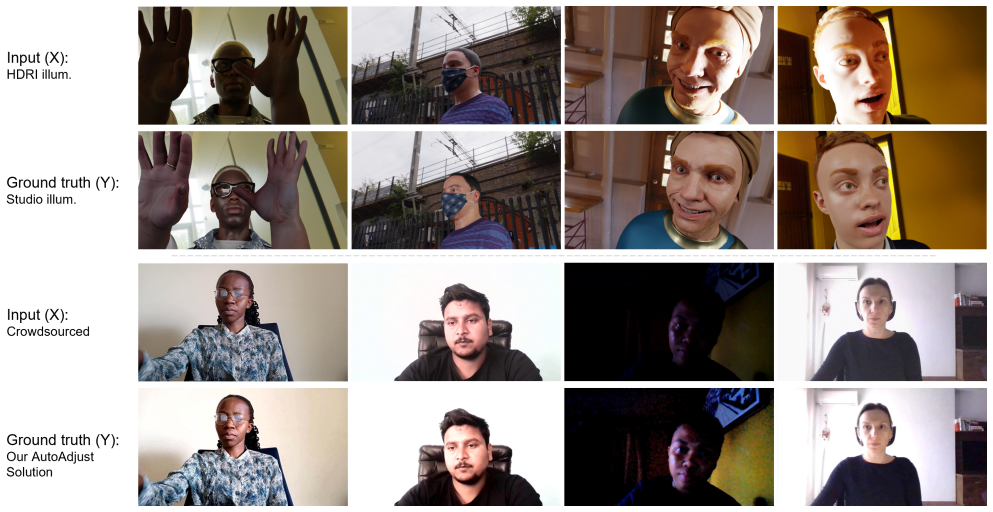
Summary. This NTIRE 2025 challenge report describes the first challenge on video quality enhancement for video conferencing. The organizers provide a problem statement (lighting, color, noise, sharpness), a large unpaired real-world video dataset (13,000 videos, with 300 selected as ground truth because P.910 raters preferred the AutoAdjust baseline), a paired synthetic portrait-relighting dataset (2,000 rendered videos), and a differentiable VQA model trained on 315,636 human comparisons. Ten valid submissions were received and ranked through crowdsourced P.910 evaluation totaling 270,000 pairwise comparisons, with Bradley-Terry scores and confidence intervals reported. The paper's headline finding is that LUT-based submissions TMobileRestore and DeepView scored highest, attributed to the efficiency and temporal stability of LUT-based correction relative to dense pixel-to-pixel mapping. The report also documents each team's architecture, training data, and compute usage.
Significance. If the ranking is reliable, the paper contributes a reusable benchmark and dataset for video-conferencing enhancement, and the release of the VQA model and challenge data is valuable to the community. The evaluation protocol is a notable strength: a large crowdsourced P.910 study with Bradley-Terry scoring, explicit confidence intervals, and clear comparison against input and baseline videos. The paired synthetic rendering pipeline is also a useful resource. However, the causal interpretation of the ranking (Section 4) is not supported by the reported evidence, the compute-constraint reporting contains an internal contradiction, and the objective-score equations are garbled. These issues are local and fixable, but they affect the manuscript's central claims and reproducibility.
major comments (5)
- [Section 4] The causal claim that LUT-based solutions scored highest because of efficient, temporally stable correction versus dense pixel-to-pixel mapping is not supported by the reported evidence. TMobileRestore is a two-stage CLUT-plus-U-Net ensemble (Section 4.1), and DeepView uses HVI-CIDNet color enhancement rather than a LUT (Section 4.3); the top two also differ from lower-ranked methods in MACs per frame, ensembling, and training schedules (Table 1). Please either remove the attribution or provide a controlled comparison, such as the same backbone with and without a LUT at matched compute.
- [Sections 2.3 and Table 1] The compute constraint is stated as at most 20 x 10^9 MACs per frame, with non-qualifying submissions not considered for the P.910 evaluation, yet Table 1 lists DeepView and Auv at 106.4 x 10^9 and Wizard at 114.2 x 10^9 MACs, and Figure 4 includes these methods in the ranked evaluation. Specify whether the constraint was enforced, and if it was relaxed, state the actual criterion; otherwise the 'NPU-friendly' framing and the fairness of the ranking are unclear.
- [Section 3, Figure 4] The statement that TMobileRestore and DeepView 'scored the highest' requires a statistical separation test. The figure reports Bradley-Terry scores with 95% confidence intervals, but no pairwise significance tests or raw vote counts are provided, and the displayed intervals appear to overlap across neighboring methods. Report pairwise tests (e.g., bootstrap or Bradley-Terry difference tests) and, if the top methods are not significantly separated, soften the headline accordingly.
- [Section 2.6, Equations (2)-(4)] Equations (2) and (3) are garbled and cannot be used to reproduce S_obj: Equation (2) mixes set notation with the VQA output tuple, and Equation (3) contains an anomalous denominator. Since S_obj is described as the continuous objective for teams and as the tie-breaker in ranking, provide correct, compilable definitions and clarify the units or ranges of the product in Equation (4).
- [Section 2.4.1] The ground-truth selection is anchored to AutoAdjust: the 300 real videos were chosen because P.910 raters strongly preferred AutoAdjust, and the MOS values of 3.58 and 4.06 are reported without confidence intervals. This is transparent, but it limits the external claim of 'studio-grade' quality. Please add confidence intervals for the MOS values and discuss, or ideally measure, how the ranking would change under a different anchor (e.g., expert manual edits instead of AutoAdjust).
minor comments (6)
- [Sections 1 and 3] The total of 350,000 P.910 pairwise comparisons in Section 1 and the 270,000 comparisons in Section 3 come from different studies, but the text does not make this distinction explicit; add a clarifying sentence.
- [Appendix A] The affiliation 'Nankai Uninversity' should be spelled 'Nankai University'.
- [Section 3] The statement 'We received 5 complete submissions for both the mid-point and final evaluations' is inconsistent with the '10 valid submissions' in the abstract; clarify whether only 5 of the 10 were evaluated at both stages.
- [Section 4.1.3] The hyperparameter listing 'Adam optimizer with beta1 = 0.9 and beta1 = 0.99' should read beta2 = 0.99.
- [Section 2.5, Equation (1)] The left-hand side of Equation (1) is ambiguous: clarify whether the model outputs a scalar preference plus two auxiliary vectors, or a single tuple with all three components.
- [Figure 4] The legend labels run together (e.g., 'baseline auvmeeting TMobileRestorevelta xteaminputs'); improve spacing and marker visibility so the methods are individually readable.
Circularity Check
Minor self-definitional ground-truth selection; final P.910 ranking is independent and not circular.
-
self definitional
[Section 2.4.1, 'Unpaired Real Data' (ground-truth selection and MOS statement)]
"Of the 13,000 videos, we selected 300 high quality videos where P.910 raters voted strongly in favor of the AutoAdjust result... We assumed these to be the ground truth. P.910 done on these videos shows a Mean Opinion Score (MOS) [26] of 3.58 in favor of the target."
The 'ground truth' subset is defined by the very preference that is then reported as validation: videos were chosen because P.910 raters strongly preferred the AutoAdjust output, and the MOS of 3.58 'in favor of the target' is therefore a restatement of the inclusion criterion, not an independent confirmation of the target. This makes the ground-truth label partly self-definitional. The circularity is limited: the final challenge ranking is produced by fresh P.910 comparisons on the 3,000-video test set, not by matching this 300-video target, so the central ranking does not reduce to this construction.
full rationale
The central ranking of the challenge is not circular: the 10 submissions are ordered by fresh P.910 pairwise comparisons on the 3,000-video test set (270,000 comparisons), and the paper explicitly states that the objective VQA score was not used for ranking (Section 2.6: 'we did not rank the teams based on these objective metrics'). The VQA model is a training/progress signal, not the evaluation. The only genuinely self-referential step is the construction of the 300-video real 'ground truth': those videos were selected because P.910 raters strongly preferred the AutoAdjust output, and the reported MOS=3.58 on that subset is a restatement of the inclusion criterion rather than independent validation. The paper partially mitigates this by calling the labels 'suggestive improvements, and not as global optima'. Self-citations, including [13] for the synthetic rendering pipeline, are not load-bearing for the final ranking. The Section 4 causal attribution of the win to LUT temporal stability is under-supported (DeepView is listed with LUT=No in Table 1, and the top entries are ensembles), but that is an evidential/correctness weakness, not circularity.
Assumptions & free parameters
free parameters (1)
- VQA model neural network weights =
not specified (trained on 22,553 videos and 315,636 human comparisons)
assumptions (4)
- standard math Bradley-Terry model for paired comparison yields valid quality scores
- domain assumption P.910 crowdsourced ratings reflect true user preference for video conferencing quality
- ad hoc to paper The 300 real videos strongly preferred by raters for AutoAdjust represent valid ground truth for studio-grade quality
- domain assumption Synthetic studio lighting rendered in Blender approximates real studio setups and desired targets
Cite this review
Pith. "Pith review of NTIRE 2025 Challenge on Video Quality Enhancement for Video Conferencing: Datasets, Methods and Results." pith.science (2026). https://pith.science/paper/I32IRK5W
@misc{pith2026250518988,
  author       = {Pith},
  title        = {Pith review of: NTIRE 2025 Challenge on Video Quality Enhancement for Video Conferencing: Datasets, Methods and Results},
  year         = {2026},
  howpublished = {\url{https://pith.science/paper/I32IRK5W}},
  note         = {Machine review of arXiv:2505.18988}
}
read the original abstract
This paper presents a comprehensive review of the 1st Challenge on Video Quality Enhancement for Video Conferencing held at the NTIRE workshop at CVPR 2025, and highlights the problem statement, datasets, proposed solutions, and results. The aim of this challenge was to design a Video Quality Enhancement (VQE) model to enhance video quality in video conferencing scenarios by (a) improving lighting, (b) enhancing colors, (c) reducing noise, and (d) enhancing sharpness - giving a professional studio-like effect. Participants were given a differentiable Video Quality Assessment (VQA) model, training, and test videos. A total of 91 participants registered for the challenge. We received 10 valid submissions that were evaluated in a crowdsourced framework.
Figures


Figures from the paper (5 more)


Reference graph
Works this paper leans on
-
[1]
Rank analysis of incomplete block designs: I
Ralph Allan Bradley and Milton E Terry. Rank analysis of incomplete block designs: I. the method of paired compar- isons.Biometrika, 39(3/4):324–345, 1952. 1
1952
-
[2]
Learning photographic global tonal adjustment with a database of input / output image pairs
Vladimir Bychkovsky, Sylvain Paris, Eric Chan, and Fr ´edo Durand. Learning photographic global tonal adjustment with a database of input / output image pairs. InThe Twenty- Fourth IEEE Conference on Computer Vision and Pattern Recognition, 2011. 7
work page 2011
-
[3]
Basicvsr++: Improving video super- resolution with enhanced propagation and alignment
Kelvin CK Chan, Shangchen Zhou, Xiangyu Xu, and Chen Change Loy. Basicvsr++: Improving video super- resolution with enhanced propagation and alignment. InPro- ceedings of the IEEE/CVF conference on computer vision and pattern recognition, pages 5972–5981, 2022. 7
work page 2022
-
[4]
Deep photo enhancer: Unpaired learning for image enhancement from photographs with gans
Yu-Sheng Chen, Yu-Ching Wang, Man-Hsin Kao, and Yung- Yu Chuang. Deep photo enhancer: Unpaired learning for image enhancement from photographs with gans. InCVPR, pages 6306–6314, 2018. 7
work page 2018
-
[5]
NTIRE 2025 challenge on image super-resolution (×4): Methods and results
Zheng Chen, Kai Liu, Jue Gong, Jingkai Wang, Lei Sun, Zongwei Wu, Radu Timofte, Yulun Zhang, et al. NTIRE 2025 challenge on image super-resolution (×4): Methods and results. InProceedings of the IEEE/CVF Conference on Computer Vision and Pattern Recognition (CVPR) Work- shops, 2025. 2
2025
-
[6]
NTIRE 2025 challenge on real-world face restoration: Methods and results
Zheng Chen, Jingkai Wang, Kai Liu, Jue Gong, Lei Sun, Zongwei Wu, Radu Timofte, Yulun Zhang, et al. NTIRE 2025 challenge on real-world face restoration: Methods and results. InProceedings of the IEEE/CVF Conference on Computer Vision and Pattern Recognition (CVPR) Work- shops, 2025. 2
2025
-
[7]
NTIRE 2025 challenge on raw image restoration and super-resolution
Marcos Conde, Radu Timofte, et al. NTIRE 2025 challenge on raw image restoration and super-resolution. InProceed- ings of the IEEE/CVF Conference on Computer Vision and Pattern Recognition (CVPR) Workshops, 2025. 2
2025
-
[8]
Raw image reconstruc- tion from RGB on smartphones
Marcos Conde, Radu Timofte, et al. Raw image reconstruc- tion from RGB on smartphones. NTIRE 2025 challenge re- port. InProceedings of the IEEE/CVF Conference on Com- puter Vision and Pattern Recognition (CVPR) Workshops,
2025
Show all 48 references
-
[9]
Aesthetic- driven image enhancement by adversarial learning
Yubin Deng, Chen Change Loy, and Xiaoou Tang. Aesthetic- driven image enhancement by adversarial learning. InACM MM, pages 870–878, 2018. 7
2018
-
[10]
NTIRE 2025 challenge on night photography rendering
Egor Ershov, Sergey Korchagin, Alexei Khalin, Artyom Pan- shin, Arseniy Terekhin, Ekaterina Zaychenkova, Georgiy Lobarev, Vsevolod Plokhotnyuk, Denis Abramov, Elisey Zhdanov, Sofia Dorogova, Yasin Mamedov, Nikola Banic, Georgii Perevozchikov, Radu Timofte, et al. NTIRE 2025 ch...
2025
-
[11]
NTIRE 2025 challenge on cross-domain few-shot object detection: Methods and results
Yuqian Fu, Xingyu Qiu, Bin Ren Yanwei Fu, Radu Timofte, Nicu Sebe, Ming-Hsuan Yang, Luc Van Gool, et al. NTIRE 2025 challenge on cross-domain few-shot object detection: Methods and results. InProceedings of the IEEE/CVF Con- ference on Computer Vision and Pattern Recognition (...
2025
-
[12]
NTIRE 2025 challenge on text to image generation model quality assess- ment
Shuhao Han, Haotian Fan, Fangyuan Kong, Wenjie Liao, Chunle Guo, Chongyi Li, Radu Timofte, et al. NTIRE 2025 challenge on text to image generation model quality assess- ment. InProceedings of the IEEE/CVF Conference on Com- puter Vision and Pattern Recognition (CVPR) Workshops,
2025
-
[13]
Look ma, no markers: holistic performance capture without the hassle.ACM Transactions on Graphics (TOG), 43(6):1–12, 2024
Charlie Hewitt, Fatemeh Saleh, Sadegh Aliakbarian, Lohit Petikam, Shideh Rezaeifar, Louis Florentin, Zafiirah Hose- nie, Thomas J Cashman, Julien Valentin, Darren Cosker, et al. Look ma, no markers: holistic performance capture without the hassle.ACM Transactions on Graphics (...
2024
-
[14]
Dslr-quality photos on mobile devices with deep convolutional networks
Andrey Ignatov, Nikolay Kobyshev, Radu Timofte, Kenneth Vanhoey, and Luc Van Gool. Dslr-quality photos on mobile devices with deep convolutional networks. InICCV, pages 3277–3285, 2017. 7
2017
-
[15]
Siamese neural networks for one-shot image recognition
Gregory Koch, Richard Zemel, Ruslan Salakhutdinov, et al. Siamese neural networks for one-shot image recognition. In ICML deep learning workshop, pages 1–30. Lille, 2015. 4
2015
-
[16]
NTIRE 2025 challenge on efficient burst hdr and restoration: Datasets, methods, and results
Sangmin Lee, Eunpil Park, Angel Canelo, Hyunhee Park, Youngjo Kim, Hyungju Chun, Xin Jin, Chongyi Li, Chun-Le Guo, Radu Timofte, et al. NTIRE 2025 challenge on efficient burst hdr and restoration: Datasets, methods, and results. In Proceedings of the IEEE/CVF Conference on Com...
2025
-
[17]
NTIRE 2025 challenge on day and night raindrop removal for dual-focused images: Methods and results
Xin Li, Yeying Jin, Xin Jin, Zongwei Wu, Bingchen Li, Yufei Wang, Wenhan Yang, Yu Li, Zhibo Chen, Bihan Wen, Robby Tan, Radu Timofte, et al. NTIRE 2025 challenge on day and night raindrop removal for dual-focused images: Methods and results. InProceedings of the IEEE/CVF Confe...
2025
-
[18]
NTIRE 2025 challenge on short-form ugc video quality assessment and enhancement: Kwaisr dataset and study
Xin Li, Xijun Wang, Bingchen Li, Kun Yuan, Yizhen Shao, Suhang Yao, Ming Sun, Chao Zhou, Radu Timofte, and Zhibo Chen. NTIRE 2025 challenge on short-form ugc video quality assessment and enhancement: Kwaisr dataset and study. InProceedings of the IEEE/CVF Conference on Com- pu...
2025
-
[19]
NTIRE 2025 challenge on short-form ugc video quality assessment and enhancement: Methods and results
Xin Li, Kun Yuan, Bingchen Li, Fengbin Guan, Yizhen Shao, Zihao Yu, Xijun Wang, Yiting Lu, Wei Luo, Suhang Yao, Ming Sun, Chao Zhou, Zhibo Chen, Radu Timofte, et al. NTIRE 2025 challenge on short-form ugc video quality assessment and enhancement: Methods and results. InPro- ce...
2025
-
[20]
NTIRE 2025 the 2nd restore any image model (RAIM) in the wild challenge
Jie Liang, Radu Timofte, Qiaosi Yi, Zhengqiang Zhang, Shuaizheng Liu, Lingchen Sun, Rongyuan Wu, Xindong Zhang, Hui Zeng, Lei Zhang, et al. NTIRE 2025 the 2nd restore any image model (RAIM) in the wild challenge. In Proceedings of the IEEE/CVF Conference on Computer Vi- sion a...
2025
-
[21]
Un- supervised flow-aligned sequence-to-sequence learning for video restoration
Jing Lin, Xiaowan Hu, Yuanhao Cai, Haoqian Wang, You- liang Yan, Xueyi Zou, Yulun Zhang, and Luc Van Gool. Un- supervised flow-aligned sequence-to-sequence learning for video restoration. InInternational Conference on Machine Learning, pages 13394–13404. PMLR, 2022. 7
2022
-
[22]
Video super-resolution based on deep learning: a compre- hensive survey.Artificial Intelligence Review, 55(8):5981– 6035, 2022
Hongying Liu, Zhubo Ruan, Peng Zhao, Chao Dong, Fan- hua Shang, Yuanyuan Liu, Linlin Yang, and Radu Timofte. Video super-resolution based on deep learning: a compre- hensive survey.Artificial Intelligence Review, 55(8):5981– 6035, 2022. 6
2022
-
[23]
NTIRE 2025 XGC quality assessment chal- lenge: Methods and results
Xiaohong Liu, Xiongkuo Min, Qiang Hu, Xiaoyun Zhang, Jie Guo, et al. NTIRE 2025 XGC quality assessment chal- lenge: Methods and results. InProceedings of the IEEE/CVF Conference on Computer Vision and Pattern Recognition (CVPR) Workshops, 2025. 2
2025
-
[24]
NTIRE 2025 challenge on low light image enhancement: Methods and results
Xiaoning Liu, Zongwei Wu, Florin-Alexandru Vasluianu, Hailong Yan, Bin Ren, Yulun Zhang, Shuhang Gu, Le Zhang, Ce Zhu, Radu Timofte, et al. NTIRE 2025 challenge on low light image enhancement: Methods and results. In Proceedings of the IEEE/CVF Conference on Computer Vi- sion ...
2025
-
[25]
Es- timating generalized gaussian blur kernels for out-of-focus image deblurring.IEEE Transactions on circuits and sys- tems for video technology, 31(3):829–843, 2020
Yu-Qi Liu, Xin Du, Hui-Liang Shen, and Shu-Jie Chen. Es- timating generalized gaussian blur kernels for out-of-focus image deblurring.IEEE Transactions on circuits and sys- tems for video technology, 31(3):829–843, 2020. 4
2020
-
[26]
A crowdsourcing approach to video quality assessment
Babak Naderi and Ross Cutler. A crowdsourcing approach to video quality assessment. InICASSP 2024-2024 IEEE International Conference on Acoustics, Speech and Signal Processing (ICASSP), pages 2810–2814. IEEE, 2024. 1, 3
2024
-
[27]
Optical flow estima- tion using a spatial pyramid network
Anurag Ranjan and Michael J Black. Optical flow estima- tion using a spatial pyramid network. InProceedings of the IEEE conference on computer vision and pattern recogni- tion, pages 4161–4170, 2017. 7
2017
-
[28]
The tenth NTIRE 2025 efficient super- resolution challenge report
Bin Ren, Hang Guo, Lei Sun, Zongwei Wu, Radu Timo- fte, Yawei Li, et al. The tenth NTIRE 2025 efficient super- resolution challenge report. InProceedings of the IEEE/CVF Conference on Computer Vision and Pattern Recognition (CVPR) Workshops, 2025. 2
2025
-
[29]
NTIRE 2025 challenge on UGC video enhancement: Meth- ods and results
Nickolay Safonov, Alexey Bryntsev, Andrey Moskalenko, Dmitry Kulikov, Dmitriy Vatolin, Radu Timofte, et al. NTIRE 2025 challenge on UGC video enhancement: Meth- ods and results. InProceedings of the IEEE/CVF Conference on Computer Vision and Pattern Recognition (CVPR) Work- sh...
2025
-
[30]
NTIRE 2025 challenge on event-based image deblurring: Methods and results
Lei Sun, Andrea Alfarano, Peiqi Duan, Shaolin Su, Kaiwei Wang, Boxin Shi, Radu Timofte, Danda Pani Paudel, Luc Van Gool, et al. NTIRE 2025 challenge on event-based image deblurring: Methods and results. InProceedings of the IEEE/CVF Conference on Computer Vision and Pattern Re...
2025
-
[31]
The tenth ntire 2025 image denoising challenge report
Lei Sun, Hang Guo, Bin Ren, Luc Van Gool, Radu Timo- fte, Yawei Li, et al. The tenth ntire 2025 image denoising challenge report. InProceedings of the IEEE/CVF Confer- ence on Computer Vision and Pattern Recognition (CVPR) Workshops, 2025. 2
2025
-
[32]
NTIRE 2025 image shadow removal challenge report
Florin-Alexandru Vasluianu, Tim Seizinger, Zhuyun Zhou, Cailian Chen, Zongwei Wu, Radu Timofte, et al. NTIRE 2025 image shadow removal challenge report. InProceed- ings of the IEEE/CVF Conference on Computer Vision and Pattern Recognition (CVPR) Workshops, 2025. 2
2025
-
[33]
NTIRE 2025 ambi- ent lighting normalization challenge
Florin-Alexandru Vasluianu, Tim Seizinger, Zhuyun Zhou, Zongwei Wu, Radu Timofte, et al. NTIRE 2025 ambi- ent lighting normalization challenge. InProceedings of the IEEE/CVF Conference on Computer Vision and Pattern Recognition (CVPR) Workshops, 2025. 2
2025
-
[34]
Q-cidnet: Perceptual quality aware color and intensity decoupling network for video quality enhancement
Ajeet Kumar Verma, Shweta Tripathi, Vinit Jakhetiya, Badri N Subudhi, and Sunil Jaiswal. Q-cidnet: Perceptual quality aware color and intensity decoupling network for video quality enhancement. InProceedings of the IEEE/CVF Conference on Computer Vision and Pattern Recognition...
2025
-
[35]
Ex- ploring clip for assessing the look and feel of images
Jianyi Wang, Kelvin CK Chan, and Chen Change Loy. Ex- ploring clip for assessing the look and feel of images. InPro- ceedings of the AAAI conference on artificial intelligence, pages 2555–2563, 2023. 7
2023
-
[36]
Real-esrgan: Training real-world blind super-resolution with pure synthetic data
Xintao Wang, Liangbin Xie, Chao Dong, and Ying Shan. Real-esrgan: Training real-world blind super-resolution with pure synthetic data. InProceedings of the IEEE/CVF inter- national conference on computer vision, pages 1905–1914,
1905
-
[37]
NTIRE 2025 challenge on light field image super-resolution: Methods and results
Yingqian Wang, Zhengyu Liang, Fengyuan Zhang, Lvli Tian, Longguang Wang, Juncheng Li, Jungang Yang, Radu Timofte, Yulan Guo, et al. NTIRE 2025 challenge on light field image super-resolution: Methods and results. InPro- ceedings of the IEEE/CVF Conference on Computer Vision an...
2025
-
[38]
Exploring video quality assessment on user gener- ated contents from aesthetic and technical perspectives
Haoning Wu, Erli Zhang, Liang Liao, Chaofeng Chen, Jing- wen Hou, Annan Wang, Wenxiu Sun, Qiong Yan, and Weisi Lin. Exploring video quality assessment on user gener- ated contents from aesthetic and technical perspectives. In Proceedings of the IEEE/CVF International Conferenc...
2023
-
[39]
Hvi: A new color space for low-light image enhancement.arXiv preprint arXiv:2502.20272, 2025
Qingsen Yan, Yixu Feng, Cheng Zhang, Guansong Pang, Kangbiao Shi, Peng Wu, Wei Dong, Jinqiu Sun, and Yan- ning Zhang. Hvi: A new color space for low-light image enhancement.arXiv preprint arXiv:2502.20272, 2025. 6, 7, 8
2025 arXiv
-
[40]
NTIRE 2025 challenge on single image reflection removal in the wild: Datasets, methods and results
Kangning Yang, Jie Cai, Ling Ouyang, Florin-Alexandru Vasluianu, Radu Timofte, Jiaming Ding, Huiming Sun, Lan Fu, Jinlong Li, Chiu Man Ho, Zibo Meng, et al. NTIRE 2025 challenge on single image reflection removal in the wild: Datasets, methods and results. InProceedings of the...
2025
-
[41]
AIM 2022 challenge on super-resolution of compressed image and video: Dataset, methods and results
Ren Yang, Radu Timofte, et al. AIM 2022 challenge on super-resolution of compressed image and video: Dataset, methods and results. InEuropean Conference on Computer Vision Workshops, 2022. 6
2022
-
[42]
Taming lookup tables for efficient image retouching
Sidi Yang, Binxiao Huang, Mingdeng Cao, Yatai Ji, Hanzhong Guo, Ngai Wong, and Yujiu Yang. Taming lookup tables for efficient image retouching. InEuropean Confer- ence on Computer Vision, pages 144–159. Springer, 2024. 7
2024
-
[43]
NTIRE 2025 challenge on hr depth from images of specular and transparent surfaces
Pierluigi Zama Ramirez, Fabio Tosi, Luigi Di Stefano, Radu Timofte, Alex Costanzino, Matteo Poggi, Samuele Salti, Ste- fano Mattoccia, et al. NTIRE 2025 challenge on hr depth from images of specular and transparent surfaces. InPro- ceedings of the IEEE/CVF Conference on Comput...
2025
-
[44]
Hui Zeng, Jianrui Cai, Lida Li, Zisheng Cao, and Lei Zhang. Learning image-adaptive 3d lookup tables for high perfor- mance photo enhancement in real-time.IEEE Transactions on Pattern Analysis and Machine Intelligence, 44(4):2058– 2073, 2020. 6
2020
-
[45]
Region-aware portrait retouching with sparse interactive guidance.IEEE Transactions on Multimedia, 26:127–140,
Huimin Zeng, Jie Huang, Jiacheng Li, and Zhiwei Xiong. Region-aware portrait retouching with sparse interactive guidance.IEEE Transactions on Multimedia, 26:127–140,
-
[46]
Clut-net: Learning adaptively compressed representations of 3dluts for lightweight image enhancement
Fengyi Zhang, Hui Zeng, Tianjun Zhang, and Lin Zhang. Clut-net: Learning adaptively compressed representations of 3dluts for lightweight image enhancement. InProceedings of the 30th ACM International Conference on Multimedia, pages 6493–6501, 2022. 6
2022
-
[47]
Multiple cycle-in-cycle generative adversar- ial networks for unsupervised image super-resolution.TIP, 29:1101–1112, 2020
Yongbing Zhang, Siyuan Liu, Chao Dong, Xinfeng Zhang, and Yuan Yuan. Multiple cycle-in-cycle generative adversar- ial networks for unsupervised image super-resolution.TIP, 29:1101–1112, 2020. 7
2020
-
[48]
Deep single-image portrait relighting
Hao Zhou, Sunil Hadap, Kalyan Sunkavalli, and David W Jacobs. Deep single-image portrait relighting. InProceed- ings of the IEEE/CVF international conference on computer vision, pages 7194–7202, 2019. 1
2019
Reviewed August 7, 2026 · model on record in the stance chip above.
Discussion (0). Sign in to comment.