REVIEW 3 major objections 5 minor 43 references
Disentangled Human Body Representation Based on Unsupervised Semantic-Aware Learning
T0 review · 3 major / 5 minor · reviewed 2026-08-07 · deepseek-v4-flash
Pith's one-line read An unsupervised model learns controllable shape and pose codes for 3D human bodies, reconstructing meshes at 3.62 mm average error.
desk verdict Solid reconstruction numbers and a clever template-residual autoencoder, but the semantic disentanglement claim rests on an unverified ARAP assumption. read the letter →
The pith
A machine-rendered reading of the paper's core claim, the machinery that carries it, and where it could break.
The reading
What carries the argument
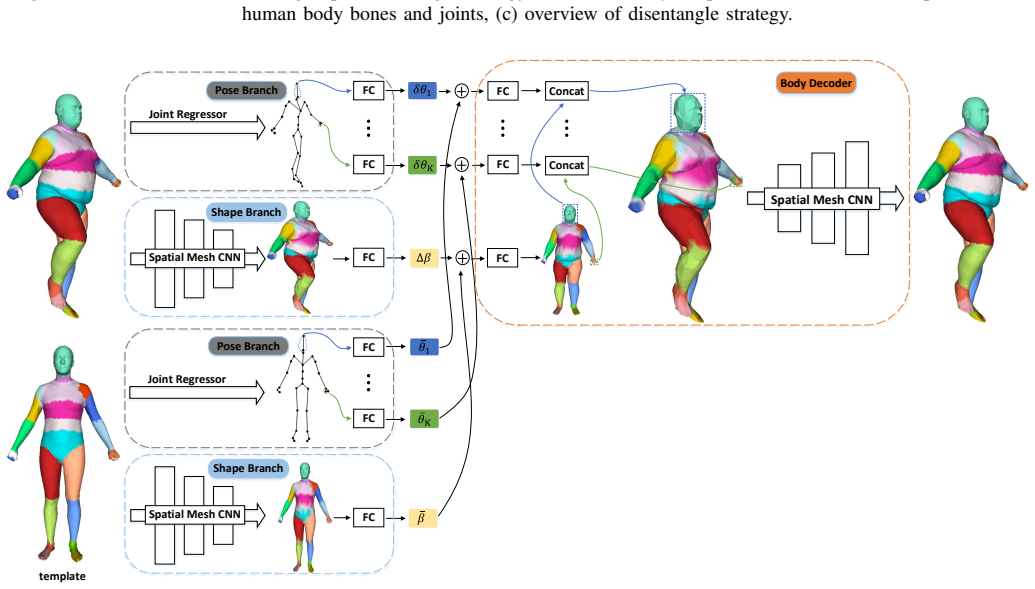
The load-bearing mechanism is the whole-aware skeleton-grouped disentanglement with as-rigid-as-possible (ARAP) cycle losses. The encoder splits into a shape branch producing $\beta = \bar{\beta} + \Delta\beta$ and a pose branch producing per-bone-group codes $\theta_k = \bar{\theta}_k + \Delta\theta_k$, where the bar terms are base codes computed from a template and the delta terms are residuals. The cross-consistency loss (Eq. 6) takes a mesh $x_1$, builds an intermediate mesh $\tilde{x}_2 = D(\beta_1,\theta_2)$, ARAP-deforms $x_2$ toward $\tilde{x}_2$, re-encodes it, and reconstructs $x_1$; the self-consistency loss (Eq. 8) runs the analogous cycle for pose. These cycles force the shape code to represent only shape and the pose codes to represent only bone orientations.
What would settle it
Train the model, fix one mesh's pose code, linearly interpolate its shape code, decode, then re-encode each intermediate mesh; if the reconstructed bone-group pose codes vary substantially along the interpolation, shape information has leaked into the pose branch and the disentanglement claim fails even if reconstruction error stays low.
Extended reading notes
Core claim
The central claim is that fine-grained semantic disentanglement of shape and pose can be learned in an unsupervised way by aligning latent codes with anatomical bone groups: one identity code $\beta$ captures whole-body shape variation and 24 bone-group pose codes $\theta_k$ capture orientation. The model's two-branch encoder predicts residual codes on top of template-derived base codes, and a part-aware decoder fuses pose and shape features to reconstruct the mesh. Two unsupervised losses enforce the disentanglement: a cross-consistency loss that swaps shape codes between a mesh and an as-rigid-as-possible deformed version with the same pose, and a self-consistency loss that ensures pose codes carry no shape information. The paper reports sub-4 mm average reconstruction error and demonstrates pose transfer and bilinear interpolation as evidence that the latent codes are semantically meaningful.
Load-bearing premise
The whole disentanglement rests on ARAP deformation swapping pose or shape between meshes without leaking the other factor; if ARAP warps leak shape information into pose codes or vice versa, the consistency losses can be minimized without true disentanglement and the controllability claim collapses.
Editorial extensions
If this is right
- A user can edit a body part by changing the corresponding bone-group pose code while leaving identity and other regions unchanged.
- The training recipe applies to any registered mesh dataset with fixed topology, removing the need for paired shape-pose supervision.
- The roughly one-million-parameter model reconstructs bodies at sub-4 mm error, making it feasible for on-device or interactive use.
- Linear interpolation in shape and pose codes produces plausible intermediate bodies, indicating the learned latent spaces are geometrically meaningful.
Reading between the lines
- If ARAP swapping is truly leak-free, the same skeleton-grouped strategy could extend to hands, animals, or other articulated objects with a kinematic skeleton, though the paper only demonstrates humans.
- The paper's quantitative evaluation is reconstruction error; a stronger controllability test would measure whether pose codes stay invariant under shape interpolation and whether pose transfer preserves body measurements.
- Because fixed mesh connectivity is required, a natural extension is to learn a canonical-template registration so the representation generalizes across datasets without retraining.
- The baselines differ in architecture and parameter count; equal-capacity comparisons would isolate the contribution of the disentanglement losses.
Signed reviews
Editorial analysis
A structured set of objections, weighed in public.
Referee Report
Summary. The paper proposes DHBR, an unsupervised autoencoder for 3D human meshes that learns a whole-body shape latent code and 24 per-bone-group pose latent codes. The architecture uses a skeleton-grouped whole-aware encoder, a part-aware decoder, and a template-based residual learning scheme. Training combines a reconstruction loss with ARAP-based cross- and self-consistency losses intended to enforce shape/pose disentanglement. On SPRING and DFAUST, the authors report average Euclidean distances of 3.62 mm and 3.89 mm, respectively, outperforming the listed baselines, and they provide ablations of the loss terms and residual scheme. Pose transfer and bilinear interpolation are demonstrated qualitatively.
Significance. If the disentanglement claim holds, the paper offers a compact, semantically controllable human body representation, which is a useful step beyond whole-body-only disentanglement models. The reconstruction evidence is a genuine strength: Table I reports numbers on two public datasets, the parameter count is small (1.04M and 1.23M), and Table II shows that each loss component and the residual scheme affect reconstruction accuracy. The central weakness is that the semantic controllability claim, which is the paper's main novelty, is not quantitatively tested: the disentanglement losses rely on an unverified ARAP separation assumption, and the applications section is entirely qualitative. No code or evaluation protocol is provided, but that alone is not disqualifying. The paper is best viewed as a promising method whose reconstruction claim is supported and whose disentanglement claim requires substantially more evidence.
major comments (3)
- [Section III-D2, Eqs. (5)-(8)] The disentanglement claim rests on ARAP acting as an unsupervised oracle that exchanges shape or pose without leakage. The manuscript asserts that 'ARAP can work successfully due to the reason that the pose of x~2 could converge to the pose of x2 with training' but provides no measurement of this convergence or of ARAP leakage. With only 0.8% anchor vertices and one iteration step, the deformed meshes x~'2 and x~'3 can plausibly contain residual pose or shape information, in which case Eqs. (6) and (8) can be minimized by encoding ARAP artifacts into the wrong latent code rather than by learning factorized semantics. I request a concrete invariance check: compare Es(x~'2) with Es(x1) and Ep(x~'2) with Ep(x2) before and after training, or measure the distance from x~'2 to a ground-truth mesh with the shape of x1 and the pose of x2 (and the analogous test for x~'3). Without such a test, the consistency losses do not certify disentanglement.
- [Section IV-D, Figs. 5-6] The pose transfer and bilinear interpolation results are only qualitative. The claim of controllable fine-grained semantics requires quantitative evaluation: for pose transfer, report a pose error metric (e.g., joint-angle error) and a shape-preservation metric (e.g., identity or body-shape distance); for interpolation, report consistency of pose across rows and shape across columns. More importantly, the paper claims per-bone-group semantic control but never tests editing or interpolating a single bone group's pose code and measuring the localized geometric effect. Without any of these measurements, the central 'fine-grained semantics' claim is not established by the experiments.
- [Section IV-C, Table II] The ablation study evaluates only reconstruction error. The text states that 'the use of Lc and Ls is required to enable latent space decoupling,' but Table II contains no disentanglement or controllability metric. The observed reconstruction degradation when removing Lc or Ls is consistent with a regularization effect and does not by itself demonstrate that the latent space is factorized. I recommend augmenting the ablation with a semantic metric, such as pose-transfer accuracy or code-invariance distances, so the effect of each loss on disentanglement is measured directly.
minor comments (5)
- [Throughout] The manuscript contains numerous typos and grammatical errors (e.g., 'precison', 'paramerers', 'fator', 'decouping', 'utlized', 'trainging', 'is resconstructed', 'crossponding') and would benefit from careful proofreading.
- [Figures 1-6] Several figure blocks and captions appear to be duplicated in the manuscript text, which makes the paper difficult to read; the final version should ensure each figure appears exactly once with its correct caption.
- [Section IV-C2, Table II] The abbreviation 'OLS' is used for the residual learning scheme but is never defined; the text should name the scheme and explain the acronym or remove it.
- [Section III-D2, Eqs. (6) and (8)] The transformation T is mentioned as 'noise corruption, random scaling' but its exact implementation is never specified; since T is used inside the consistency losses, the paper should state precisely what corruption or scaling is applied and with what probability.
- [Section IV-B, Table I] The comparison fairness statement that the latent space dimension is set 'to the same with our model' is ambiguous: the paper should report the exact shape and pose latent dimensions used for each baseline and the training epochs/hyperparameters, because parameter count alone does not ensure comparable capacity.
Circularity Check
ARAP swap-oracle justification presupposes the pose-transfer property it is used to learn; reconstruction benchmarks remain externally grounded.
-
self definitional
[Section III-D2, paragraph after Eq. (5)]
"ARAP can work successfully due to the reason that the pose of x~2 could converge to the pose of x2 with training."
x~2 is defined earlier in the same section as D(β1, θ2), i.e., a mesh decoded from the shape code of x1 and the pose code of x2. The paper justifies ARAP as a reliable shape/pose swap oracle by asserting that the pose of this model-generated mesh converges to x2's pose during training. But the pose of D(β1, θ2) matching x2 is precisely the pose-transfer/disentanglement property that the cross- and self-consistency losses (Eqs. 6 and 8) are designed to instill. Thus the correctness of the disentanglement training signal is justified by the very conclusion it is supposed to produce. No quantitative measurement of this convergence or of ARAP leakage is provided, so the controllability claim is not independently established.
full rationale
The reconstruction performance in Table I is evaluated on held-out test meshes of SPRING and DFAUST and is therefore grounded in external data; this part of the claim is not circular. The disentanglement/controllability claim, however, depends on Eqs. (5)-(8), and the paper's only stated justification for ARAP's ability to separate shape and pose is that the intermediate mesh x~2 = D(β1, θ2) will converge to the pose of x2 during training, which is exactly the pose-transfer property the losses are intended to enforce. This is a bootstrapping justification rather than an independent verification. The pose-transfer and interpolation demonstrations are qualitative and do not break the circularity. There is no load-bearing self-citation or imported uniqueness theorem, and no fitted parameter is renamed as a prediction. Overall, the reconstruction claim is independent, but the central unsupervised disentanglement claim is partially circular due to the unverified ARAP oracle assumption.
Assumptions & free parameters
free parameters (6)
- per-bone pose code dimensionality =
8
- global shape code dimensionality =
10
- edge regularization weight lambda_e =
not reported
- cross-consistency weight lambda_c =
not reported
- self-consistency weight lambda_s =
not reported
- ARAP anchor fraction and iterations =
0.8% or 8% (text unclear), 1 iteration
assumptions (3)
- domain assumption Human body deformation factorizes cleanly into whole-body identity shape and per-bone orientation pose factors.
- domain assumption The SMPL-based template, joint regressor, and part labels provide a valid prior for every input mesh after one-time alignment.
- ad hoc to paper ARAP-deformed meshes preserve the desired factor, shape or pose, well enough for the consistency losses.
Cite this review
Pith. "Pith review of Disentangled Human Body Representation Based on Unsupervised Semantic-Aware Learning." pith.science (2026). https://pith.science/paper/23QLL4UQ
@misc{pith2026250519049,
  author       = {Pith},
  title        = {Pith review of: Disentangled Human Body Representation Based on Unsupervised Semantic-Aware Learning},
  year         = {2026},
  howpublished = {\url{https://pith.science/paper/23QLL4UQ}},
  note         = {Machine review of arXiv:2505.19049}
}
read the original abstract
In recent years, more and more attention has been paid to the learning of 3D human representation. However, the complexity of lots of hand-defined human body constraints and the absence of supervision data limit that the existing works controllably and accurately represent the human body in views of semantics and representation ability. In this paper, we propose a human body representation with controllable fine-grained semantics and high precison of reconstruction in an unsupervised learning framework. In particularly, we design a whole-aware skeleton-grouped disentangle strategy to learn a correspondence between geometric semantical measurement of body and latent codes, which facilitates the control of shape and posture of human body by modifying latent coding paramerers. With the help of skeleton-grouped whole-aware encoder and unsupervised disentanglement losses, our representation model is learned by an unsupervised manner. Besides, a based-template residual learning scheme is injected into the encoder to ease of learning human body latent parameter in complicated body shape and pose spaces. Because of the geometrically meaningful latent codes, it can be used in a wide range of applications, from human body pose transfer to bilinear latent code interpolation. Further more, a part-aware decoder is utlized to promote the learning of controllable fine-grained semantics. The experimental results on public 3D human datasets show that the method has the ability of precise reconstruction.
Figures


Figures from the paper (4 more)


Reference graph
Works this paper leans on
-
[1]
Keep it smpl: Automatic estimation of 3d human pose and shape from a single image,
F. Bogo, A. Kanazawa, C. Lassner, P. Gehler, J. Romero, and M. J. Black, “Keep it smpl: Automatic estimation of 3d human pose and shape from a single image,” inComputer Vision–ECCV 2016: 14th European Conference, Amsterdam, The Netherlands, October 11-14, 2016, Proceedings, Part V 14. Springer, 2016, pp. 561–578
work page 2016
-
[2]
End-to- end recovery of human shape and pose,
A. Kanazawa, M. J. Black, D. W. Jacobs, and J. Malik, “End-to- end recovery of human shape and pose,” inProceedings of the IEEE conference on computer vision and pattern recognition, 2018, pp. 7122– 7131
work page 2018
-
[3]
Recovering 3d human mesh from monocular images: A survey,
Y . Tian, H. Zhang, Y . Liu, and L. Wang, “Recovering 3d human mesh from monocular images: A survey,”IEEE transactions on pattern analysis and machine intelligence, 2023
work page 2023
-
[4]
Pymaf: 3d human pose and shape regression with pyramidal mesh alignment feedback loop,
H. Zhang, Y . Tian, X. Zhou, W. Ouyang, Y . Liu, L. Wang, and Z. Sun, “Pymaf: 3d human pose and shape regression with pyramidal mesh alignment feedback loop,” inProceedings of the IEEE/CVF International Conference on Computer Vision, 2021, pp. 11 446–11 456
work page 2021
-
[5]
G. Bouritsas, S. Bokhnyak, S. Ploumpis, M. Bronstein, and S. Zafeiriou, “Neural 3d morphable models: Spiral convolutional networks for 3d shape representation learning and generation,” inProceedings of the IEEE/CVF international conference on computer vision, 2019, pp. 7213– 7222
work page 2019
-
[6]
Variational autoencoders for deforming 3d mesh models,
Q. Tan, L. Gao, Y .-K. Lai, and S. Xia, “Variational autoencoders for deforming 3d mesh models,” inProceedings of the IEEE conference on computer vision and pattern recognition, 2018, pp. 5841–5850
work page 2018
-
[7]
Mesh-based autoen- coders for localized deformation component analysis,
Q. Tan, L. Gao, Y .-K. Lai, J. Yang, and S. Xia, “Mesh-based autoen- coders for localized deformation component analysis,” inProceedings of the AAAI conference on artificial intelligence, vol. 32, no. 1, 2018
work page 2018
-
[8]
Semantic parametric reshaping of human body models,
Y . Yang, Y . Yu, Y . Zhou, S. Du, J. Davis, and R. Yang, “Semantic parametric reshaping of human body models,” in2014 2nd International Conference on 3D Vision, vol. 2. IEEE, 2014, pp. 41–48
work page 2014
Show all 43 references
-
[9]
3d human body reshaping with anthropo- metric modeling,
Y . Zeng, J. Fu, and H. Chao, “3d human body reshaping with anthropo- metric modeling,” inInternational Conference on Internet Multimedia Computing and Service. Springer, 2017, pp. 96–107
2017
-
[10]
Parametric reshaping of human bodies in images,
S. Zhou, H. Fu, L. Liu, D. Cohen-Or, and X. Han, “Parametric reshaping of human bodies in images,”ACM transactions on graphics (TOG), vol. 29, no. 4, pp. 1–10, 2010
2010
-
[11]
Scape: shape completion and animation of people,
D. Anguelov, P. Srinivasan, D. Koller, S. Thrun, J. Rodgers, and J. Davis, “Scape: shape completion and animation of people,” inACM SIGGRAPH 2005 Papers, 2005, pp. 408–416
2005
-
[12]
Disentangled human body em- bedding based on deep hierarchical neural network,
B. Jiang, J. Zhang, J. Cai, and J. Zheng, “Disentangled human body em- bedding based on deep hierarchical neural network,”IEEE transactions on visualization and computer graphics, vol. 26, no. 8, pp. 2560–2575, 2020
2020
-
[13]
Smpl: A skinned multi-person linear model,
M. Loper, N. Mahmood, J. Romero, G. Pons-Moll, and M. J. Black, “Smpl: A skinned multi-person linear model,”ACM transactions on graphics (TOG), vol. 34, no. 6, pp. 1–16, 2015
2015
-
[14]
Building statistical shape spaces for 3d human modeling,
L. Pishchulin, S. Wuhrer, T. Helten, C. Theobalt, and B. Schiele, “Building statistical shape spaces for 3d human modeling,”Pattern Recognition, vol. 67, pp. 276–286, 2017
2017
-
[15]
An automatic modeling of human bodies from sizing parameters,
H. Seo and N. Magnenat-Thalmann, “An automatic modeling of human bodies from sizing parameters,” inProceedings of the 2003 symposium on Interactive 3D graphics, 2003, pp. 19–26
2003
-
[16]
The space of human body shapes: reconstruction and parameterization from range scans,
B. Allen, B. Curless, and Z. Popovi ´c, “The space of human body shapes: reconstruction and parameterization from range scans,”ACM transactions on graphics (TOG), vol. 22, no. 3, pp. 587–594, 2003
2003
-
[17]
Total capture: A 3d deformation model for tracking faces, hands, and bodies,
H. Joo, T. Simon, and Y . Sheikh, “Total capture: A 3d deformation model for tracking faces, hands, and bodies,” inProceedings of the IEEE conference on computer vision and pattern recognition, 2018, pp. 8320–8329
2018
-
[18]
Learning feature aggregation for deep 3d morphable models,
Z. Chen and T.-K. Kim, “Learning feature aggregation for deep 3d morphable models,” inProceedings of the IEEE/CVF conference on computer vision and pattern recognition, 2021, pp. 13 164–13 173
2021
-
[19]
Learning local neighboring structure for robust 3d shape representation,
Z. Gao, J. Yan, G. Zhai, J. Zhang, Y . Yang, and X. Yang, “Learning local neighboring structure for robust 3d shape representation,” inProceedings of the AAAI conference on artificial intelligence, vol. 35, no. 2, 2021, pp. 1397–1405
2021
-
[20]
Spiralnet++: A fast and highly efficient mesh convolution operator,
S. Gong, L. Chen, M. Bronstein, and S. Zafeiriou, “Spiralnet++: A fast and highly efficient mesh convolution operator,” in2019 IEEE/CVF In- ternational Conference on Computer Vision Workshop (ICCVW). IEEE Computer Society, 2019, pp. 4141–4148
2019
-
[21]
Generating 3d faces using convolutional mesh autoencoders,
A. Ranjan, T. Bolkart, S. Sanyal, and M. J. Black, “Generating 3d faces using convolutional mesh autoencoders,” inProceedings of the European conference on computer vision (ECCV), 2018, pp. 704–720
2018
-
[22]
Geometric disentanglement for generative latent shape models,
T. Aumentado-Armstrong, S. Tsogkas, A. Jepson, and S. Dickinson, “Geometric disentanglement for generative latent shape models,” in Proceedings of the IEEE/CVF international conference on computer vision, 2019, pp. 8181–8190
2019
-
[23]
Intrinsic- extrinsic preserved gans for unsupervised 3d pose transfer,
H. Chen, H. Tang, H. Shi, W. Peng, N. Sebe, and G. Zhao, “Intrinsic- extrinsic preserved gans for unsupervised 3d pose transfer,” inProceed- ings of the IEEE/CVF International Conference on Computer Vision, 2021, pp. 8630–8639
2021
-
[24]
Unsupervised shape and pose disentanglement for 3d meshes,
K. Zhou, B. L. Bhatnagar, and G. Pons-Moll, “Unsupervised shape and pose disentanglement for 3d meshes,” inComputer Vision–ECCV 2020: 16th European Conference, Glasgow, UK, August 23–28, 2020, Proceedings, Part XXII 16. Springer, 2020, pp. 341–357
2020
-
[25]
Embodied hands: Mod- eling and capturing hands and bodies together,
J. Romero, D. Tzionas, and M. J. Black, “Embodied hands: Mod- eling and capturing hands and bodies together,”arXiv preprint arXiv:2201.02610, 2022
2022 arXiv
-
[26]
Expressive body capture: 3d hands, face, and body from a single image,
G. Pavlakos, V . Choutas, N. Ghorbani, T. Bolkart, A. A. Osman, D. Tzionas, and M. J. Black, “Expressive body capture: 3d hands, face, and body from a single image,” inProceedings of the IEEE/CVF conference on computer vision and pattern recognition, 2019, pp. 10 975–10 985
2019
-
[27]
3d menagerie: Modeling the 3d shape and pose of animals,
S. Zuffi, A. Kanazawa, D. W. Jacobs, and M. J. Black, “3d menagerie: Modeling the 3d shape and pose of animals,” inProceedings of the IEEE conference on computer vision and pattern recognition, 2017, pp. 6365–6373
2017
-
[28]
Auto-encoding variational bayes,
P. K. Diederik, M. Welling,et al., “Auto-encoding variational bayes,” inProceedings of the International Conference on Learning Represen- tations (ICLR), vol. 1, 2014
2014
-
[29]
Learning class-specific descriptors for deformable shapes using localized spectral convolutional networks,
D. Boscaini, J. Masci, S. Melzi, M. M. Bronstein, U. Castellani, and P. Vandergheynst, “Learning class-specific descriptors for deformable shapes using localized spectral convolutional networks,” inComputer graphics forum, vol. 34, no. 5. Wiley Online Library, 2015, pp. 13–23
2015
-
[30]
Spectral networks and locally connected networks on graphs,
J. Bruna, W. Zaremba, A. Szlam, and Y . LeCun, “Spectral networks and locally connected networks on graphs,”arXiv preprint arXiv:1312.6203, 2013
2013 arXiv
-
[31]
Inductive representation learning on large graphs,
W. Hamilton, Z. Ying, and J. Leskovec, “Inductive representation learning on large graphs,”Advances in neural information processing systems, vol. 30, 2017
2017
-
[32]
Deep convolutional networks on graph-structured data,
M. Henaff, J. Bruna, and Y . LeCun, “Deep convolutional networks on graph-structured data,”arXiv preprint arXiv:1506.05163, 2015
2015 arXiv
-
[33]
Dynamic filters in graph con- volutional networks,
N. Verma, E. Boyer, and J. Verbeek, “Dynamic filters in graph con- volutional networks,”arXiv preprint arXiv:1706.05206, vol. 2, no. 6, 2017
2017 arXiv
-
[34]
Sparse data driven mesh deformation,
L. Gao, Y .-K. Lai, J. Yang, L.-X. Zhang, S. Xia, and L. Kobbelt, “Sparse data driven mesh deformation,”IEEE transactions on visualization and computer graphics, vol. 27, no. 3, pp. 2085–2100, 2019
2019
-
[35]
Explicit disentanglement of appearance and perspective in generative models,
N. Skafte and S. Hauberg, “Explicit disentanglement of appearance and perspective in generative models,”Advances in Neural Information Processing Systems, vol. 32, 2019
2019
-
[36]
Deforming autoencoders: Unsupervised disentangling of shape and appearance,
Z. Shu, M. Sahasrabudhe, R. A. Guler, D. Samaras, N. Paragios, and I. Kokkinos, “Deforming autoencoders: Unsupervised disentangling of shape and appearance,” inProceedings of the European conference on computer vision (ECCV), 2018, pp. 650–665
2018
-
[37]
Lifting autoencoders: Unsupervised learning of a fully- disentangled 3d morphable model using deep non-rigid structure from motion,
M. Sahasrabudhe, Z. Shu, E. Bartrum, R. Alp Guler, D. Samaras, and I. Kokkinos, “Lifting autoencoders: Unsupervised learning of a fully- disentangled 3d morphable model using deep non-rigid structure from motion,” inProceedings of the IEEE/CVF International Conference on Compu...
2019
-
[38]
Unsupervised geometry-aware representation for 3d human pose estimation,
H. Rhodin, M. Salzmann, and P. Fua, “Unsupervised geometry-aware representation for 3d human pose estimation,” inProceedings of the European conference on computer vision (ECCV), 2018, pp. 750–767
2018
-
[39]
Learning semantic-aware disentangled representation for flexible 3d human body editing,
X. Sun, Q. Feng, X. Li, J. Zhang, Y .-K. Lai, J. Yang, and K. Li, “Learning semantic-aware disentangled representation for flexible 3d human body editing,” inProceedings of the IEEE/CVF Conference on Computer Vision and Pattern Recognition, 2023, pp. 16 985–16 994
2023
-
[40]
3d- coded: 3d correspondences by deep deformation,
T. Groueix, M. Fisher, V . G. Kim, B. C. Russell, and M. Aubry, “3d- coded: 3d correspondences by deep deformation,” inProceedings of the european conference on computer vision (ECCV), 2018, pp. 230–246
2018
-
[41]
Neural pose transfer by spatially adaptive instance normalization,
J. Wang, C. Wen, Y . Fu, H. Lin, T. Zou, X. Xue, and Y . Zhang, “Neural pose transfer by spatially adaptive instance normalization,” inProceedings of the IEEE/CVF conference on computer vision and pattern recognition, 2020, pp. 5831–5839
2020
-
[42]
Adam: A method for stochastic optimization,
D. P. Kingma and J. Ba, “Adam: A method for stochastic optimization,” arXiv preprint arXiv:1412.6980, 2014
2014 arXiv
-
[43]
Dynamic faust: Registering human bodies in motion,
F. Bogo, J. Romero, G. Pons-Moll, and M. J. Black, “Dynamic faust: Registering human bodies in motion,” inProceedings of the IEEE conference on computer vision and pattern recognition, 2017, pp. 6233– 6242
2017
Reviewed August 7, 2026 · model on record in the stance chip above.
Discussion (0). Continue with ORCID to comment.