REVIEW 4 major objections 5 minor 28 references
Controlling Language Confusion in Multilingual LLMs
T0 review · 4 major / 5 minor · reviewed 2026-08-07 · deepseek-v4-flash
Pith's one-line read Adding an explicit penalty against undesired languages during fine-tuning suppresses language confusion in multilingual LLMs without degrading general QA performance.
desk verdict Useful, honest empirical note on ORPO for Korean language consistency, but the paper's own SFT baseline undercuts the claim that the penalty is the active ingredient. read the letter →
The pith
A machine-rendered reading of the paper's core claim, the machinery that carries it, and where it could break.
The reading
What carries the argument
The central mechanism is the ORPO objective (odds-ratio preference optimization), which augments standard supervised fine-tuning with a penalty term that widens the odds ratio between chosen and rejected responses without needing a reference model. The paper operationalizes this as triplet data: a Korean prompt, a fully Korean chosen response, and a rejected response that is fully English or Korean with randomly injected machine-translated English or Chinese tokens. The penalty inside ORPO is what creates the measurable loss gap between coherent and code-mixed outputs, and that gap is the paper's evidence that the model has internalized a preference for monolingual generation.
What would settle it
Test ORPO-trained models on naturally occurring code-mixed input or on code-mixed prompts drawn from real user logs, and score the outputs both with WPR/LPR and with human raters; if consistency drops or raters still flag confusion, the synthetic-rejection training did not generalize to genuine confusion patterns.
Extended reading notes
Core claim
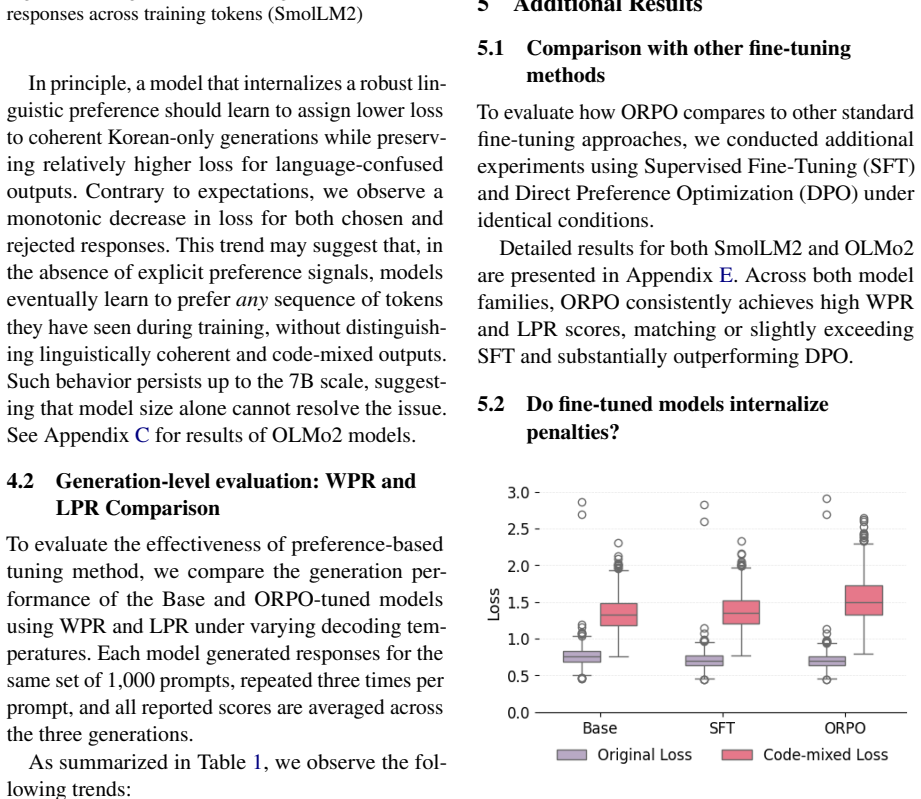
The paper's central claim is that language confusion is not intrinsic to multilingual models but a consequence of an objective that never penalizes undesired languages, and that adding such a penalty through preference optimization fixes it. Evidence comes from two directions: loss trajectories during pretraining show no gap between monolingual and code-mixed text, and generation-level metrics (WPR and LPR) show ORPO-tuned models reach near-perfect language consistency at temperatures 0.7, 1.0, and 1.2, where the base models' consistency collapses at high temperature. ORPO's delta loss on code-mixed responses is the largest among SFT, DPO, and ORPO, indicating the penalty is internalized, and HAE-RAE accuracy does not degrade, so the gain is not paid for in general QA ability.
Load-bearing premise
The load-bearing premise is that the constructed rejected responses—fully English outputs and synthetically code-mixed outputs with randomly inserted translated tokens—capture the language confusion users actually encounter, so defeating them means defeating genuine confusion rather than memorizing an artificial training pattern.
Editorial extensions
If this is right
- ORPO fine-tuning on language-consistency triplets raises WPR and LPR to near-perfect levels for both SmolLM2-1.7B and OLMo2-7B at temperatures 0.7, 1.0, and 1.2, while the base models degrade markedly as temperature rises.
- The pretraining loss analysis indicates that models do not learn to disfavor code-mixed text at any scale up to 7B, so language confusion is better addressed through explicit preference signals than through model size alone.
- Because HAE-RAE accuracy is preserved, the language-consistency gain from ORPO comes without a measurable trade-off in general Korean QA performance.
- ORPO matches or exceeds SFT and clearly outperforms DPO on language fidelity across temperatures, making it a practical fine-tuning recipe for low-resource language consistency.
Reading between the lines
- Because the penalty mechanism is language-agnostic, the same triplet recipe could be applied to other language pairs, and even to non-linguistic style attributes such as verbosity or off-topic generation, by choosing the right rejected outputs.
- The synthetic rejection data (random token injection) may be easier to learn than real, naturally occurring code-mixing; constructing triplets from observed confusion patterns would test whether the method transfers beyond its training signal.
- If the loss-gap diagnostic is right, adding an ORPO-style penalty during pretraining rather than only at fine-tuning could prevent confusion from forming in the first place, an extension the paper only gestures at.
Editorial analysis
A structured set of objections, weighed in public.
Referee Report
Summary. The paper addresses language confusion in multilingual LLMs, proposing that standard supervised fine-tuning lacks an explicit penalty against undesired languages and that ORPO-style preference optimization can supply this penalty. The authors construct Korean triplet datasets (OIG, HC3, KoAlpaca) in which chosen responses are pure Korean and rejected responses are either fully English or synthetically code-mixed, fine-tune SmolLM2-1.7B and OLMo2-7B with ORPO, and evaluate language consistency with WPR/LPR at temperatures 0.7, 1.0, and 1.2. They report near-perfect WPR/LPR scores for ORPO, loss trajectories suggesting that pretraining does not separate monolingual from code-mixed text, and HAE-RAE QA results that they describe as showing no significant degradation.
Significance. The problem is practically important, particularly for low-resource languages, and the paper provides a concrete, reproducible recipe for constructing preference data and fine-tuning models for language consistency. The loss-based diagnostics are a useful descriptive addition, and the paper is honest about several limitations. However, the central causal claim—that the explicit penalty in ORPO, rather than exposure to Korean-only text, is what suppresses language confusion—is not supported by the paper's own baselines: the SFT baseline in Appendix E matches or exceeds ORPO on the generation metrics. The evaluation also appears to be in-distribution and the metric is not independent of the training objective. The contribution is therefore currently a promising practical recipe rather than an established demonstration that preference penalties are necessary or uniquely effective.
major comments (4)
- [§5.1, Appendix E, Tables 4–5] The central claim that ORPO's explicit penalty, rather than mere exposure to Korean-only text, suppresses language confusion is not supported by the paper's own baselines. In Table 4, SmolLM2 SFT at T=1.2 achieves WPR>0.9 ratio of 100.0% and LPR>0.9 ratio of 99.7%, essentially identical to ORPO's 100.0% and 99.9%. In Table 5, OLMo2 SFT at T=1.2 actually reports slightly higher average WPR (0.9970 vs 0.9962) and average LPR (0.9915 vs 0.9881) than ORPO. Thus the generation-level evaluation cannot distinguish the proposed penalty mechanism from standard SFT on Korean responses. The authors should either provide an evaluation setting in which SFT fails and ORPO succeeds (e.g., naturally code-mixed prompts or held-out domains), report effect sizes with confidence intervals for the differences, or explicitly soften the causal conclusion to 'exposure to monolingual Korean data is sufficient under these conditions.'
- [§4.2, §3.1, Appendix A/D] The evaluation appears in-distribution and the metric is not independent of the training objective. The paper does not specify the source of the 1,000 evaluation prompts or whether they are disjoint from the roughly 10k triplet training sets derived from OIG, HC3, and KoAlpaca. If the prompts come from the same corpora, the near-perfect WPR/LPR scores may reflect learning a surface rule—emit Korean tokens and avoid English/Chinese tokens—that exactly matches the constructed training labels (full-English or randomly injected rejected responses). This concern is compounded by the fact that chosen responses were filtered to WPR/LPR = 1.0 during data construction and the WPR/LPR > 0.9 threshold was chosen by manual inspection (Appendix D). The authors should report prompt provenance and disjointness, add a held-out evaluation on naturally occurring Korean-English code-mixed inputs, and report sensitivity of the conclusions to the 0.9 threshold.
- [§5.2, Appendix A] The loss-based evidence for 'internalized penalties' is not independent of training. Section 3.1 lists HC3 as one of the three training datasets, but Section 5.2 reports delta-loss on 'the HC3 evaluation set' without stating that this subset is disjoint from the HC3-derived training triplets. If the evaluation set is drawn from the same HC3 corpus used in training, the larger ORPO delta-loss could reflect memorization of the training signal rather than a general internal preference. Additionally, Appendix A's HC3 description ('synthetically generated code-mixed rejected response') contradicts Section 3.1, which says HC3 rejected responses are written entirely in English; this discrepancy must be resolved because it changes what the HC3 diagnostic measures. Please specify the evaluation subset size, its overlap with training data, and define 'delta loss' precisely with per-sample variance.
- [§5.3, Figure 5] The claim that ORPO 'does not introduce measurable harm' to QA is not supported by the reported analysis. Figure 5 shows average accuracies without error bars, sample sizes, or significance tests, and the text uses 'no significant performance degradation' without a statistical test. Given the modest model sizes and the small differences likely involved, the authors should report per-subcategory scores with confidence intervals and, ideally, a paired comparison (e.g., bootstrap or McNemar) between Base, SFT, and ORPO on HAE-RAE. The same missing-variance issue affects Table 1 and Tables 4–5, where all WPR/LPR scores are reported to four decimal places without any measure of dispersion across the three repeated generations.
minor comments (5)
- [Eq. (1)] The notation 'T = SN i=1 Ti' should use a union symbol; as printed, 'S' appears to be a variable rather than the intended set union.
- [Table 1 caption] The phrase 'All metrics are higher is better' should read 'higher is better' or 'for all metrics, higher is better.'
- [§5.2] The term 'delta loss' is used without a definition; please state explicitly that it is mean loss on rejected responses minus mean loss on chosen responses, and report its standard deviation or confidence interval.
- [Appendix E, Tables 3–5] The ORPO-vs-DPO comparison is confounded by differences in optimizer (AdamW vs RMSprop), global batch size, and number of training steps; the authors should either match these settings or report a hyperparameter sensitivity analysis before claiming that ORPO 'substantially outperforms' DPO.
- [§4.1, Figure 2] The pretraining-loss diagnostic would be stronger with a control condition: a monotonic decrease in loss on any fixed held-out string is expected as pretraining improves, so parallel trajectories do not by themselves demonstrate the absence of an implicit penalty; reporting the loss gap with confidence intervals and comparing against matched non-Korean text would help.
Circularity Check
No circularity: reported WPR/LPR gains are empirical outcomes with external controls; the metric/filter overlap is a design concern, not a by-construction equivalence.
full rationale
The central derivation—ORPO-tuned models achieve near-perfect WPR/LPR—is an empirical outcome, not an identity. Training triplets are filtered so chosen responses have WPR=LPR=1.0 (Appendix A), but nothing forces the fine-tuned model to generate Korean-only text; the DPO baseline on identical triplets degrades (Appendix E), showing that the filter alone does not produce the result. The 0.9 threshold (Appendix D) is a disclosed measurement choice, not a fitted parameter used to generate the reported numbers. The loss diagnostic in Section 5.2 is run on 'the evaluation subset HC3' and Appendix A describes HC3 as 'designed to evaluate ... unseen data during training,' so it is a held-out check rather than a re-measurement of the training objective. The HAE-RAE QA benchmark and SFT/DPO comparisons provide external control. The largest validity concern—SFT nearly matches ORPO (Appendix E), so the unique contribution of the penalty term is not isolated—is an experimental-design issue, not circularity, and the paper reports the SFT numbers transparently. No load-bearing self-citation or uniqueness argument appears.
Assumptions & free parameters
free parameters (4)
- WPR/LPR threshold =
0.9
- Chosen/rejected length ratio filter =
0.4 to 2.0
- ORPO weighting coefficient beta =
0.1
- Synthetic code-mixing injection rate =
unspecified
assumptions (5)
- domain assumption Language confusion is undesirable and should be suppressed in multilingual LLM outputs.
- domain assumption WPR and LPR with the is_Korean and is_valid predicates correctly quantify target-language consistency.
- domain assumption Parallel loss decrease during pretraining on monolingual and code-mixed text indicates absence of internal penalization.
- domain assumption Synthetic rejected responses (fully English or randomly code-mixed) are representative of real language-confusion failures.
- standard math ORPO's odds-ratio objective can be applied to style control without reference model and without degrading generation quality.
Cite this review
Pith. "Pith review of Controlling Language Confusion in Multilingual LLMs." pith.science (2026). https://pith.science/paper/7C5LXJ5F
@misc{pith2026250519116,
  author       = {Pith},
  title        = {Pith review of: Controlling Language Confusion in Multilingual LLMs},
  year         = {2026},
  howpublished = {\url{https://pith.science/paper/7C5LXJ5F}},
  note         = {Machine review of arXiv:2505.19116}
}
read the original abstract
Large language models often suffer from language confusion, a phenomenon in which responses are partially or entirely generated in unintended languages. This critically degrades the user experience, especially in low-resource settings. We hypothesize that this issue stems from limitations in conventional fine-tuning objectives, such as supervised learning, which optimize the likelihood of correct tokens without explicitly penalizing undesired outputs such as cross-lingual mixing. Analysis of loss trajectories during pretraining further reveals that models fail to distinguish between monolingual and language-mixed texts, highlighting the absence of inherent pressure to avoid such confusion. In this work, we apply ORPO, which adds penalties for unwanted output styles to standard SFT, effectively suppressing language-confused generations. ORPO maintains strong language consistency, even under high decoding temperatures, while preserving general QA performance. Our findings suggest that incorporating appropriate penalty terms can effectively mitigate language confusion in multilingual models, particularly in low-resource scenarios.
Figures


Figures from the paper (4 more)


Reference graph
Works this paper leans on
-
[1]
Loubna Ben Allal, Anton Lozhkov, Elie Bakouch, Gabriel Mart \' n Bl \'a zquez, Guilherme Penedo, Lewis Tunstall, Andr \'e s Marafioti, Hynek Kydl \' c ek, Agust \' n Piqueres Lajar \' n, Vaibhav Srivastav, and 1 others. 2025. Smollm2: When smol goes big--data-centric training of a small language model. arXiv preprint arXiv:2502.02737
arXiv 2025
-
[2]
Duarte M Alves, Jos \'e Pombal, Nuno M Guerreiro, Pedro H Martins, Jo \ a o Alves, Amin Farajian, Ben Peters, Ricardo Rei, Patrick Fernandes, Sweta Agrawal, and 1 others. 2024. Tower: An open multilingual large language model for translation-related tasks. arXiv preprint arXiv:2402.17733
arXiv 2024
-
[3]
Naveen Arivazhagan, Ankur Bapna, Orhan Firat, Roee Aharoni, Melvin Johnson, and Wolfgang Macherey. 2019. Massively multilingual neural machine translation in the wild: Findings and challenges. arXiv preprint arXiv:1907.05019
arXiv 2019
-
[4]
Beomi. 2023. https://github.com/beomi/KoAlpaca Koalpaca: Korean instruction-tuning dataset
work page 2023
-
[5]
Yiyi Chen, Qiongxiu Li, Russa Biswas, and Johannes Bjerva. 2024. Large language models are easily confused: A quantitative metric, security implications and typological analysis. arXiv preprint arXiv:2410.13237
work page Pith review arXiv 2024
-
[6]
Team Cohere, Arash Ahmadian, Marwan Ahmed, Jay Alammar, Yazeed Alnumay, Sophia Althammer, Arkady Arkhangorodsky, Viraat Aryabumi, Dennis Aumiller, Rapha \"e l Avalos, and 1 others. 2025. Command a: An enterprise-ready large language model. arXiv preprint arXiv:2504.00698
arXiv 2025
-
[7]
Jessica Zosa Forde, Ruochen Zhang, Lintang Sutawika, Alham Fikri Aji, Samuel Cahyawijaya, Genta Indra Winata, Minghao Wu, Carsten Eickhoff, Stella Biderman, and Ellie Pavlick. 2024. https://doi.org/10.18653/v1/2024.emnlp-main.1085 Re-evaluating evaluation for multilingual summarization . In Proceedings of the 2024 Conference on Empirical Methods in Natura...
-
[8]
Biyang Guo, Xin Zhang, Ziyuan Wang, Minqi Jiang, Jinran Nie, Yuxuan Ding, Jianwei Yue, and Yupeng Wu. 2023. How close is chatgpt to human experts? comparison corpus, evaluation, and detection. arXiv preprint arXiv:2301.07597
arXiv 2023
Show all 28 references
-
[9]
Heegyu. 2023. Oig-small-chip2-ko. https://huggingface.co/datasets/heegyu/OIG-small-chip2-ko
2023
-
[10]
Jiwoo Hong, Noah Lee, and James Thorne. 2024. Orpo: Monolithic preference optimization without reference model. arXiv preprint arXiv:2403.07691
2024 arXiv
-
[11]
Aaron Hurst, Adam Lerer, Adam P Goucher, Adam Perelman, Aditya Ramesh, Aidan Clark, AJ Ostrow, Akila Welihinda, Alan Hayes, Alec Radford, and 1 others. 2024. Gpt-4o system card. arXiv preprint arXiv:2410.21276
2024 arXiv
-
[12]
LAION. 2022. Open instruction generalist (oig) dataset. https://laion.ai/blog/oig-dataset/
2022
-
[13]
Kelly Marchisio, Wei-Yin Ko, Alexandre B \'e rard, Th \'e o Dehaze, and Sebastian Ruder. 2024. Understanding and mitigating language confusion in llms. arXiv preprint arXiv:2406.20052
2024 arXiv
-
[14]
Yohan Na. 2023. Hc3-ko: Korean human chatgpt comparison corpus. https://huggingface.co/datasets/nayohan/HC3-ko. Accessed: 2025-05-17
2023
-
[15]
Team OLMo, Pete Walsh, Luca Soldaini, Dirk Groeneveld, Kyle Lo, Shane Arora, Akshita Bhagia, Yuling Gu, Shengyi Huang, Matt Jordan, and 1 others. 2024. 2 olmo 2 furious. arXiv preprint arXiv:2501.00656
2024 arXiv
-
[16]
Rafael Rafailov, Archit Sharma, Eric Mitchell, Christopher D Manning, Stefano Ermon, and Chelsea Finn. 2023. Direct preference optimization: Your language model is secretly a reward model. Advances in Neural Information Processing Systems, 36:53728--53741
2023
-
[17]
Guijin Son, Jiwoo Hong, Hyunwoo Ko, and James Thorne. 2025. Linguistic generalizability of test-time scaling in mathematical reasoning. arXiv preprint arXiv:2502.17407
2025 arXiv
-
[18]
Guijin Son, Hyunwoo Ko, Hoyoung Lee, Yewon Kim, and Seunghyeok Hong. 2024 a . Llm-as-a-judge & reward model: What they can and cannot do. arXiv preprint arXiv:2409.11239
2024 arXiv
-
[19]
Guijin Son, Hanwool Lee, Suwan Kim, Huiseo Kim, Jaecheol Lee, Je Won Yeom, Jihyu Jung, Jung Woo Kim, and Songseong Kim. 2023. Hae-rae bench: Evaluation of korean knowledge in language models. arXiv preprint arXiv:2309.02706
2023 arXiv
-
[20]
Guijin Son, Dongkeun Yoon, Juyoung Suk, Javier Aula-Blasco, Mano Aslan, Vu Trong Kim, Shayekh Bin Islam, Jaume Prats-Cristi \`a , Luc \' a Tormo-Ba \ n uelos, and Seungone Kim. 2024 b . Mm-eval: A multilingual meta-evaluation benchmark for llm-as-a-judge and reward models. arX...
2024 arXiv
-
[21]
u/VictorRM . 2025. https://www.reddit.com/r/OpenAI/comments/1iflvc8/o3_thinks_in_chinese_for_no_reason_randomly/ O3 thinks in chinese for no reason randomly . Reddit, r/OpenAI. Accessed 2025-05-19
2025
-
[22]
Bin Wang, Zhengyuan Liu, Xin Huang, Fangkai Jiao, Yang Ding, AiTi Aw, and Nancy F Chen. 2023. Seaeval for multilingual foundation models: From cross-lingual alignment to cultural reasoning. arXiv preprint arXiv:2309.04766
2023 arXiv
-
[23]
Zhijun Wang, Jiahuan Li, Hao Zhou, Rongxiang Weng, Jingang Wang, Xin Huang, Xue Han, Junlan Feng, Chao Deng, and Shujian Huang. 2025. Investigating and scaling up code-switching for multilingual language model pre-training. arXiv preprint arXiv:2504.01801
2025 arXiv
-
[24]
An Yang, Anfeng Li, Baosong Yang, Beichen Zhang, Binyuan Hui, Bo Zheng, Bowen Yu, Chang Gao, Chengen Huang, Chenxu Lv, and 1 others. 2025. Qwen3 technical report. arXiv preprint arXiv:2505.09388
2025 arXiv
-
[25]
Haneul Yoo, Cheonbok Park, Sangdoo Yun, Alice Oh, and Hwaran Lee. 2024. Code-switching curriculum learning for multilingual transfer in llms. arXiv preprint arXiv:2411.02460
2024 arXiv
-
[26]
Lianmin Zheng, Wei-Lin Chiang, Ying Sheng, Siyuan Zhuang, Zhanghao Wu, Yonghao Zhuang, Zi Lin, Zhuohan Li, Dacheng Li, Eric Xing, and 1 others. 2023. Judging llm-as-a-judge with mt-bench and chatbot arena. Advances in Neural Information Processing Systems, 36:46595--46623
2023
-
[27]
online" 'onlinestring :=
ENTRY address archivePrefix author booktitle chapter edition editor eid eprint eprinttype howpublished institution journal key month note number organization pages publisher school series title type volume year doi pubmed url lastchecked label extra.label sort.label short.list...
-
[28]
write newline
" write newline "" before.all 'output.state := FUNCTION n.dashify 't := "" t empty not t #1 #1 substring "-" = t #1 #2 substring "--" = not "--" * t #2 global.max substring 't := t #1 #1 substring "-" = "-" * t #2 global.max substring 't := while if t #1 #1 substring * t #2 gl...
Reviewed August 7, 2026 · model on record in the stance chip above.
Discussion (0). Sign in to comment.