REVIEW 3 major objections 4 minor 2 cited by
QMIO: A tightly integrated hybrid HPCQC system
T0 review · 3 major / 4 minor · reviewed 2026-08-07 · deepseek-v4-flash
Pith's one-line read The paper argues that the right way to attach a quantum processor to an HPC cluster is a gateway message-bus path, and reports a running 32-qubit deployment that uses it.
desk verdict An honest and useful deployment report whose architecture story is solid, but whose central performance claims are unmeasured and need either data or softening before it can be relied upon. read the letter →
The pith
A machine-rendered reading of the paper's core claim, the machinery that carries it, and where it could break.
The reading
What carries the argument
The load-bearing component is the second-generation integration middleware: a gateway HPC node that is SLURM-allocated like any other node but talks to the Quantum Control Node through a ZeroMQ message bus. On the HPC side, the QmioRuntimeService ('qmio-run') receives user-framework calls, converts them to supported intermediate representations such as QIR or OpenQASM 2.0/3.0, sends them over the bus, and passes results back to the application. Below this layer, the Quantum Assembly Toolchain (QAT) lowers logical circuits to calibrated control pulses using hardware models, instruction builders, and engines, with serializable models that support ahead-of-time and parametric compilation.
What would settle it
Run a representative hybrid workload, say 1,000 iterations of a small variational circuit, through both integration paths—per-circuit scheduler submission and the ZeroMQ gateway path—and measure end-to-end time, circuit throughput, and QPU idle time; if the gateway path is not substantially faster, the central advantage of the redesign is unsupported.
Extended reading notes
Core claim
QMIO's core discovery is architectural: the tightest possible integration—making the Quantum Control Node a schedulable compute node of the cluster—proved impractical for real hybrid workloads because the scheduler charges 1–3 seconds for every circuit submission. The working design instead places a normal HPC gateway node in front of the Quantum Control Node; the gateway is allocated by the scheduler, but circuit submissions travel over a ZeroMQ broker through the qmio-run runtime, which returns results the same way. The paper reports that this message-bus path has much lower task-submission latency than the scheduler-only path, while keeping a single scheduler for classical, emulation, and quantum resources. The authors present QMIO as a general blueprint for on-premises HPCQC, including future multi-QPU and distributed-quantum extensions.
Load-bearing premise
The load-bearing premise is that routing every circuit through a dedicated gateway node over a ZeroMQ message bus adds no significant overhead compared with direct Quantum Control Node access; the paper asserts this qualitatively in Section 3.2 and reports no measurements.
Editorial extensions
If this is right
- Hybrid algorithms such as variational eigensolvers, QAOA, and quantum machine learning can issue many circuit calls through the message-bus path without paying the 1–3 second per-circuit scheduler overhead, making long training loops practical.
- Interactive use becomes viable: an interactive session requests a short gateway routing job only when a QPU call is made, then exchanges results over a socket connection without significant added runtime, according to the paper.
- A single scheduler continues to govern classical nodes, emulation nodes, and the quantum processor, so user code never runs on the Quantum Control Node and the quantum stack stays isolated.
- Because the middleware accepts QIR and OpenQASM 2.0/3.0 and supports ahead-of-time compilation of parametric circuits, a circuit family can be compiled once and executed thousands of times while the QPU is held.
- The design extends to multiple QPUs: each future Quantum Control Node can sit behind its own gateway node, so the scheduler sees a pool of quantum resources, and inter-QPU communication can be added—the paper's stated future direction.
Reading between the lines
- Editorial: the same gateway-plus-message-bus pattern should apply to any accelerator whose kernels run in under a second, such as FPGAs or analog co-processors, making QMIO an instance of a general 'scheduler-visible accelerator gateway' design.
- Editorial: because the paper's headline performance advantage is stated without numbers, the highest-value follow-up would be a public benchmark of per-circuit latency, throughput, and QPU utilization for the two middleware designs.
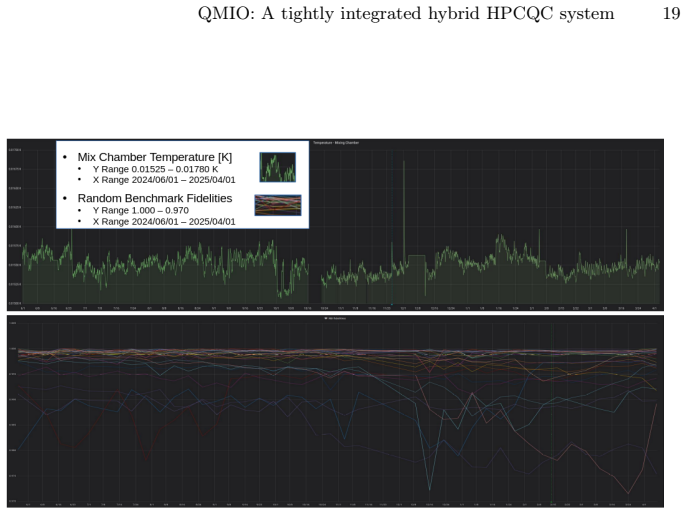
- Editorial: the reported correlations between system fidelity and nearby building activity, if quantified, could let operators schedule calibration and long runs around environmental disturbances—a reliability lever the paper only flags for future investigation.
- Editorial: exposing each QPU as a schedulable resource behind a gateway node makes a heterogeneous multi-vendor quantum pool a natural next step; the middleware would negotiate device-specific intermediate representations while the scheduler only tracks availability.
Editorial analysis
A structured set of objections, weighed in public.
Referee Report
Summary. The paper describes QMIO, a production on-premises hybrid HPCQC system at CESGA that integrates a 32-qubit superconducting QPU from Oxford Quantum Circuits, an HPC cluster with x86 and A64FX partitions, and a 34-qubit quantum emulator. The authors detail the data-center facility, quantum hardware stack, quantum emulator, shared storage, connectivity, and a layered software stack consisting of user-facing frameworks (Qiskit, PyTket, etc.), an integration middleware, and the QAT quantum toolchain. The central design contribution is the evolution of the middleware: an initial design treated the Quantum Control Node as a SLURM compute node, submitting each circuit as a SLURM job with a reported 1-to-3-second overhead; a second design routes circuit execution through a gateway node using a ZeroMQ message bus, which the authors claim offers much lower task-submission latency and no significant additional runtime. The paper also reports operational experience, including calibration routines, monitoring, and lessons learned.
Significance. If the performance claims are supported, QMIO is a valuable reference architecture for on-premises HPCQC integration, and the paper provides a rare, detailed description of a production system operating since 2023. Strengths include the concrete treatment of facility engineering, the clear contrast between two middleware integration designs, the use of open-source components (QAT, Qulacs), and the discussion of operational considerations such as calibration scheduling and monitoring. The paper does not include measured performance data or reproducible code, so its current value is as an experience report rather than a benchmarking study; the central quantitative assertion about the message-bus advantage is therefore not yet established.
major comments (3)
- [Section 3.2, message-bus integration] The load-bearing claim that the ZeroMQ message bus has 'much lower latency for task submission' than per-circuit SLURM submission is not supported by any measured data. The only quantitative statement is the legacy path's '1 to 3 seconds' overhead, with no methodology, sample size, or conditions, and Section 6 itself identifies a benchmarking framework as future work. Please add measured latency, throughput, and end-to-end runtime comparisons for both middleware designs, including scheduler allocation and queueing times, or substantially weaken the claim to a qualitative design observation.
- [Section 3.2, Interactive usage and Figure 6] The interactive workflow still begins with a SLURM allocation on the frontal node, so the message-bus advantage applies only to per-circuit dispatch after that allocation, not to the full interactive path. The sentence 'The use of the socket-socket communication over the frontal node route does not add any significant increase in runtime' is an empirical assertion about serialization, TCP, and hop-through-frontal-node overhead, but no measurement or analysis is provided. Please report the overhead of the interactive path separately from the direct path, or restrict the claim to the direct/batch case.
- [Sections 2.6 and 3.2] The paper states that the control server is reachable only over Ethernet from a single HPC node, while the HPC and emulator partitions use InfiniBand. Given the paper's emphasis on tight integration and low-latency PQC workloads, the potential bottleneck of a single-node Ethernet path should be quantified or at least analyzed in terms of its impact on job latency; without this, the 'tightly integrated' characterization is incomplete and the assertion that the topology is sufficient is unsupported.
minor comments (4)
- [Section 3.2] The term 'QmioRuntineService' appears to be a typo for 'QmioRuntimeService'; please correct it throughout.
- [Sections 2.3 and 2.4] Please correct the typographical errors: 'Oxford instruments Proetox LX' should be 'Oxford Instruments Proteox LX', and 'This the open source quantum emulation software' is missing a verb.
- [Sections 3.2 and 3.3] Please fix the typographical and spelling issues: 'extremelly demanding' should be 'extremely demanding', 'Pannylane' should be 'PennyLane', and the footnote reference in 'repetition period6' is malformed.
- [Figure 6 caption] The caption contains a typographical artifact ('workflowdiagrama') and does not fully describe both usage paths; please revise for clarity.
Circularity Check
No circularity: the paper is an operational architecture report with no fitted parameters, predictive claims derived from inputs, or load-bearing self-references.
full rationale
QMIO is a descriptive systems paper. It presents hardware and software components and recounts the evolution of the integration middleware from a direct SLURM-managed Quantum Control Node to a ZeroMQ message-bus gateway architecture. There is no derivation chain in the sense of a mathematical or statistical result, no fitted parameter renamed as a prediction, and no equation whose output is equivalent to its input by construction. The central claim that the message-bus design yields 'much lower latency for task submission' than the SLURM-based path is an empirical assertion, but it is not derived from the quantities it aims to explain: the paper does not define latency in terms of the redesign, nor does it fit the redesign to latency data and then 'predict' the same latency. The absence of benchmark data is a completeness and verifiability concern, not a circularity concern. Self-references to OQC hardware, the QAT toolchain, and prior CESGA/OQC works appear, but these are external components or general background references, not load-bearing justifications for the central architectural claim. The cited prior work on distributed quantum computing and OpenCL QPU integration is used for context and future directions, not to force the paper's conclusions. Accordingly, the circularity score is 0.
Assumptions & free parameters
assumptions (3)
- domain assumption A standard HPC data center can host a cryogenic QPU with limited modifications such as leveling, nitrogen supply, and noise separation.
- domain assumption PQC algorithms need continuous exclusive QPU access because drift between separated circuit batches degrades convergence.
- domain assumption The gateway-node and ZeroMQ route does not add significant overhead compared with direct QCN access.
Cite this review
Pith. "Pith review of QMIO: A tightly integrated hybrid HPCQC system." pith.science (2026). https://pith.science/paper/4AELICKB
@misc{pith2026250519267,
  author       = {Pith},
  title        = {Pith review of: QMIO: A tightly integrated hybrid HPCQC system},
  year         = {2026},
  howpublished = {\url{https://pith.science/paper/4AELICKB}},
  note         = {Machine review of arXiv:2505.19267}
}
read the original abstract
High-Performance Computing (HPC) systems are the most powerful tools that we currently have to solve complex scientific simulations. Quantum computing (QC) has the potential to enhance HPC systems by accelerating the execution of specific kernels that can be offloaded to a Quantum Processing Unit (QPU), granting them new capabilities, improving the speed of computation, or reducing energy consumption. In this paper, we present QMIO: a state-of-the-art hybrid HPCQC system, which tightly integrates HPC and QC. We describe its hardware and software components, the integration middleware, and the lessons learned during the design, implementation, and operation of the system.
Figures


Figures from the paper (5 more)


Forward citations
Cited by 2 Pith papers
-
Examining QRMI as a Unified Interface for Quantum-HPC Integration
QRMI's acquire-execute-release interface can be adapted to PBS, LSF, Grid Engine, Kubernetes, and partly Flux, with three reusable integration patterns.
-
Navigating the Socio-Technical Complexity Challenge in Quantum Software Ecosystems
A socio-technical framework identifies 'gravity wells' (e.g., Kubernetes, Slurm) and four desiderata to guide quantum software environment choices.
Reference graph
Works this paper leans on
-
[1]
Acharya, N., Armstrong, R., Balaji, Y., Crawford, K.G., Gates, J.C., Gow, P.C., Kennedy, O.W., Pothuraju, R.D., Shahbazi, K., Shelly, C.D.: Integration of through-sapphire substrate machin- ing with superconducting quantum processors. Advanced Materials p. 2411780. https://doi.org/https://doi.org/10.1002/adma.202411780, https://advanced.onlinelibrary.wile...
-
[2]
Cacheiro et al
Alexeev, Y., Amsler, M., Barroca, M.A., Bassini, S., Battelle, T., Camps, D., Casanova, D., Choi, Y.J., Chong, F.T., Chung, C., Codella, C., Córcoles, A.D., Cruise, J., Meglio, A.D., Duran, I., Eckl, T., Economou, S., Eidenbenz, S., Elmegreen, B., Fare, C., Faro, I., Fernández, C.S., Ferreira, R.N.B., Fuji, K., Fuller, B., Gagliardi, L., Galli, G., Glick,...
2024
-
[3]
Reports on Progress in Physics87(11), 116001 (Oct 2024)
Au-Yeung, R., Camino, B., Rathore, O., Kendon, V.: Quantum algorithms for scientific computing. Reports on Progress in Physics87(11), 116001 (Oct 2024). https://doi.org/10.1088/1361-6633/ad85f0, http://dx.doi.org/10.1088/1361- 6633/ad85f0
-
[4]
npj Quantum Information2(1), 16033 (2016)
Ball, H., Oliver, W.D., Biercuk, M.J.: The role of master clock stability in quantum information processing. npj Quantum Information2(1), 16033 (2016). https://doi.org/10.1038/npjqi.2016.33, https://doi.org/10.1038/npjqi.2016.33
-
[5]
from single qpu to high performance quantum computing (2024), https://arxiv.org/abs/2404.01265
Barral, D., Cardama, F.J., Díaz, G., Faílde, D., Llovo, I.F., Juane, M.M., Vázquez- Pérez, J., Villasuso, J., Piñeiro, C., Costas, N., Pichel, J.C., Pena, T.F., Gómez, A.: Review of distributed quantum computing. from single qpu to high performance quantum computing (2024), https://arxiv.org/abs/2404.01265
arXiv 2024
-
[6]
Bartsch, D.V., Colin, D.I.G., de Verdière Dr-Ing Jean-Philippe, Nominé, D.D., Ottaviani, D., Chayma, D.D., Bouazza, F., Magugliani, D., Cyril, B.D., Al- louche, D.M., Johansson, D.O., Andrea, T.D., Scarabosio, G., Vitali, D.F., Kris- tel, S.P.D., Michielsen, Allouche, D.C., Johansson, D.M., Terzo, D.O., Scara- bosio, D.A., Vitali, G., Shagieva, D.F., Mich...
work page 2021
-
[7]
Future Generation Computer Systems 161, 11–25 (2024)
Beck, T., Baroni, A., Bennink, R., Buchs, G., Pérez, E.A.C., Eisen- bach, M., da Silva, R.F., Meena, M.G., Gottiparthi, K., Groszkowski, P., Humble, T.S., Landfield, R., Maheshwari, K., Oral, S., Sandoval, M.A., Shehata, A., Suh, I.S., Zimmer, C.: Integrating quantum computing re- sources into scientific hpc ecosystems. Future Generation Computer Systems ...
-
[8]
Castanon, B.: 2024 quantum open source survey (2024), https://unitaryfoundation.github.io/survey-2024/
work page 2024
Show all 36 references
-
[9]
CESGA: Qmio, the new galician quantum computer (2023), https://quantum.cesga.es/2023/10/02/qmio-the-new-galician-quantum- computer/
2023
-
[10]
CESGA: La apertura del qmio a la comunidad científica atraerá talento e inver- siones a galicia y promoverá su liderazgo en el ámbito de la computación cuán- tica (2024), https://www.xunta.gal/es/notas-de-prensa/-/nova/001723/apertura- del-qmio-comunidad-cientifica-atraera-tal...
2024
-
[11]
CESGA: Qmio open call (2024), https://qcalls.cesga.es/
2024
-
[12]
Quan- tum Science and Technology5, 044005 (8 2020)
Cruz, P.M.Q., Catarina, G., Gautier, R., Fernández-Rossier, J.: Optimizing quan- tum phase estimation for the simulation of hamiltonian eigenstates. Quan- tum Science and Technology5, 044005 (8 2020). https://doi.org/10.1088/2058- 9565/abaa2c, https://iopscience.iop.org/articl...
2020 doi
-
[14]
Elsharkawy, A., To, X.T.M., Seitz, P., Chen, Y., Stade, Y., Geiger, M., Huang, Q., Guo, X., Ansari, M.A., Mendl, C.B., Kranzlmüller, D., Schulz, M.: Integration of quantum accelerators with high performance computing – a review of quantum programming tools (2023), https://arxi...
2023
-
[15]
EuroHPC-JU: One step closer to european quantum computing: The eurohpc ju signs hosting agreements for six quantum computers (2023), https://eurohpc- ju.europa.eu/one-step-closer-european-quantum-computing-eurohpc-ju-signs- hosting-agreements-six-quantum-computers-2023-06-27
2023
-
[16]
EuroHPC-JU: New eurohpc quantum computer to be hosted in the netherlands (2024), https://eurohpc-ju.europa.eu/new-eurohpc-quantum-computer-be-hosted- netherlands-2024-10-22
2024
-
[17]
In: 2014 First International Workshop on HPC User Support Tools
Geimer, M., Hoste, K., McLay, R.: Modern scientific software management using easybuild and lmod. In: 2014 First International Workshop on HPC User Support Tools. pp. 41–51 (2014). https://doi.org/10.1109/HUST.2014.8
2014 doi
-
[18]
Giusto, E., Nuñez-Corrales, S., Cao, P., Cilardo, A., Iyer, R.K., Jiang, W., Rech, P., Vella, F., Montrucchio, B., Dasgupta, S., Humble, T.S.: Dependable classical- quantum computer systems engineering (2024), https://arxiv.org/abs/2408.10484
2024
-
[19]
IEEE Micro41(5), 15–23 (2021)
Humble, T.S., McCaskey, A., Lyakh, D.I., Gowrishankar, M., Frisch, A., Monz, T.: Quantum computers for high-performance computing. IEEE Micro41(5), 15–23 (2021). https://doi.org/10.1109/MM.2021.3099140
2021
-
[20]
Kanno, K., Kohda, M., Imai, R., Koh, S., Mitarai, K., Mizukami, W., Naka- gawa, Y.O.: Quantum-selected configuration interaction: classical diagonalization of hamiltonians in subspaces selected by quantum computers (2 2023)
2023
-
[21]
Nature Communications15(1), 3950 (2024)
Kono, S., Pan, J., Chegnizadeh, M., Wang, X., Youssefi, A., Scigliuzzo, M., Kippen- berg, T.J.: Mechanically induced correlated errors on superconducting qubits with relaxation times exceeding 0.4 ms. Nature Communications15(1), 3950 (2024)
2024
-
[22]
Applied Physics Reviews6(2), 021318 (06 2019)
Krantz, P., Kjaergaard, M., Yan, F., Orlando, T.P., Gustavsson, S., Oliver, W.D.: A quantum engineer’s guide to superconducting qubits. Applied Physics Reviews6(2), 021318 (06 2019). https://doi.org/10.1063/1.5089550, https://doi.org/10.1063/1.5089550
2019 doi
-
[23]
EPJ Quantum Tech- nology6(1), 2 (2019)
Krinner, S., Storz, S., Kurpiers, P., Magnard, P., Heinsoo, J., Keller, R., Lütolf, J., Eichler, C., Wallraff, A.: Engineering cryogenic setups for 100-qubit scale superconducting circuit systems. EPJ Quantum Tech- nology6(1), 2 (2019). https://doi.org/10.1140/epjqt/s40507-019...
2019 doi
-
[24]
https://doi.org/10.48550/arXiv.2412.04705, http://arxiv.org/abs/2412.04705
Lambert, N., Giguère, E., Menczel, P., Li, B., Hopf, P., Suárez, G., Gali, M., Lishman, J., Gadhvi, R., Agarwal, R., Galicia, A., Shammah, N., Nation, P., Johansson, J.R., Ahmed, S., Cross, S., Pitchford, A., Nori, F.: Qutip 5: The quantum toolbox in python (12 2024). https://...
-
[25]
Nature 2025 638:8050 638, 383–388 (2 2025)
Main, D., Drmota, P., Nadlinger, D.P., Ainley, E.M., Agrawal, A., Nichol, B.C., Srinivas, R., Araneda, G., Lucas, D.M.: Distributed quan- tum computing across an optical network link. Nature 2025 638:8050 638, 383–388 (2 2025). https://doi.org/10.1038/s41586-024-08404-x, https...
2025 doi
-
[26]
Data Center Handbook: Plan, Design, Build, and Operations of a Smart Data Center pp
McFarlane, R.E.: Ashrae standards and practices for data centers. Data Center Handbook: Plan, Design, Build, and Operations of a Smart Data Center pp. 175– 191 (2021) 24 J. Cacheiro et al
2021
-
[27]
Perini, S., Ciarletta, F.: Untangling the hpc innovation dilemma through quantum computing. Tech. rep., Technical Report (available at: http://www.meetiqm.com/technology/iqm-atos-state-of-quantum-research- 2021/) (2021)
2021
-
[28]
Applied Physics Letters110(22), 222602 (05 2017)
Rahamim, J., Behrle, T., Peterer, M.J., Patterson, A., Spring, P.A., Tsun- oda, T., Manenti, R., Tancredi, G., Leek, P.J.: Double-sided coaxial circuit qed with out-of-plane wiring. Applied Physics Letters110(22), 222602 (05 2017). https://doi.org/10.1063/1.4984299, https://do...
2017 doi
-
[29]
Robledo-Moreno, J., Motta, M., Haas, H., Javadi-Abhari, A., Jurcevic, P., Kirby, W., Martiel, S., Sharma, K., Sharma, S., Shirakawa, T., Sitdikov, I., Sun, R.Y., Sung, K.J., Takita, M., Tran, M.C., Yunoki, S., Mezzacapo, A.: Chemistry beyond exact solutions on a quantum-centri...
2024
-
[30]
In: 2023 IEEE International Conference on Quantum Software (QSW)
Saurabh, N., Jha, S., Luckow, A.: A Conceptual Architecture for a Quantum-HPC Middleware . In: 2023 IEEE International Conference on Quantum Software (QSW). pp. 116–127. IEEE Computer Society, Los Alamitos, CA, USA (Jul 2023). https://doi.org/10.1109/QSW59989.2023.00023, https...
2023
-
[31]
Scientific Reports12, 11927 (7 2022)
Schetakis, N., Aghamalyan, D., Griffin, P., Boguslavsky, M.: Review of some exist- ing qml frameworks and novel hybrid classical–quantum neural networks realising binary classification for the noisy datasets. Scientific Reports12, 11927 (7 2022). https://doi.org/10.1038/s41598...
2022 doi
-
[33]
2024 IEEE International Con- ference on Quantum Computing and Engineering (QCE)02, 577–578 (2024), https://api.semanticscholar.org/CorpusID:275439793
Shehata, A., Naughton, T.J., Suh, I.S.: Integrating quantum computing with high- performance computing: A streamlined approach. 2024 IEEE International Con- ference on Quantum Computing and Engineering (QCE)02, 577–578 (2024), https://api.semanticscholar.org/CorpusID:275439793
2024
-
[34]
Sci- ence Advances8(16), eabl6698 (2022)
Spring, P.A., Cao, S., Tsunoda, T., Campanaro, G., Fasciati, S., Wills, J., Bakr, M., Chidambaram, V., Shteynas, B., Carpenter, L., Gow, P., Gates, J., Vlastakis, B., Leek, P.J.: High coherence and low cross- talk in a tileable 3d integrated superconducting circuit architectur...
2022 doi
-
[35]
Quantum5, 559 (Oct 2021)
Suzuki, Y., Kawase, Y., Masumura, Y., Hiraga, Y., Nakadai, M., Chen, J., Nakan- ishi, K.M., Mitarai, K., Imai, R., Tamiya, S., Yamamoto, T., Yan, T., Kawakubo, T., Nakagawa, Y.O., Ibe, Y., Zhang, Y., Yamashita, H., Yoshimura, H., Hayashi, A., Fujii, K.: Qulacs: a fast and vers...
2021 doi
-
[36]
In: 2023 IEEE International Conference on Quantum Computing and Engineering (QCE)
Tabuchi, A., Imamura, S., Yamazaki, M., Honda, T., Kasagi, A., Nakao, H., Fukumoto, N., Nakashima, K.: mpiqulacs: A scalable distributed quantum com- puter simulator for arm-based clusters. In: 2023 IEEE International Conference on Quantum Computing and Engineering (QCE). vol....
2023
-
[37]
Microprocessors and Microsystems66, 90– 101 (2019)
van Dijk, J., Charbon, E., Sebastiano, F.: The electronic interface for quantum processors. Microprocessors and Microsystems66, 90– 101 (2019). https://doi.org/https://doi.org/10.1016/j.micpro.2019.02.004, https://www.sciencedirect.com/science/article/pii/S0141933118303417 QMI...
2019 doi
-
[38]
The Journal of Supercom- puting80, 11682–11703 (5 2024)
Vázquez-Pérez, J., Piñeiro, C., Pichel, J.C., Pena, T.F., Gómez, A.: Qpu in- tegration in opencl for heterogeneous programming. The Journal of Supercom- puting80, 11682–11703 (5 2024). https://doi.org/10.1007/s11227-023-05879-9, https://link.springer.com/10.1007/s11227-023-05879-9
2024 doi
Reviewed August 7, 2026 · model on record in the stance chip above.
Discussion (0). Sign in to comment.