REVIEW 5 major objections 5 minor 13 references
Concept Reachability in Diffusion Models: Beyond Dataset Constraints
T0 review · 5 major / 5 minor · reviewed 2026-08-07 · deepseek-v4-flash
Pith's one-line read The paper establishes a phase transition in concept reachability: below roughly 1% training frequency, concepts become unreachable, while activation steering recovers concepts that prompting cannot.
desk verdict Useful framework and a plausible steering-vs-prompting story, but the headline 1% phase transition is confounded with absolute sample counts and needs to be redone. read the letter →
The pith
A machine-rendered reading of the paper's core claim, the machinery that carries it, and where it could break.
The reading
What carries the argument
The carrying mechanism is the steering vector, a vector optimised on frozen model weights to minimise the denoising loss $\mathbb{E}\lVert \epsilon_t - \epsilon_\theta(x_t, t, y_s, v)\rVert^2$ over an auxiliary image set containing the target concept, then added either to the prompt's text embedding (prompt-space steering, $v_p$) or to the U-net bottleneck output (h-space steering, $v_h$). Reachability is scored by three trained classifiers that read off back shape, front shape, and the back-front colour pair from each generated image, with incomplete images counted as incorrect. The load-bearing phenomenon is the phase transition at $p_X(f) \approx 0.01$: a concept-agnostic, low threshold above which more data adds little and below which reachability drops abruptly. The contrast between the two steering spaces — $v_p$ stable and prompt-matching, $v_h$ fragile with accuracy falling as more concepts are modified and correlating with the optimised vector's final norm — locates the effect at a specific stage of the transformation.
What would settle it
Measure generation accuracy on a production-scale text-to-image model across concepts whose training frequency spans 0.001% to 5%: if reachability declines smoothly with frequency rather than stepping sharply near $p_X(f) \approx 0.01$, or if steering does not beat prompting on positionally out-of-distribution combinations, the paper's two central claims fail.
Extended reading notes
Core claim
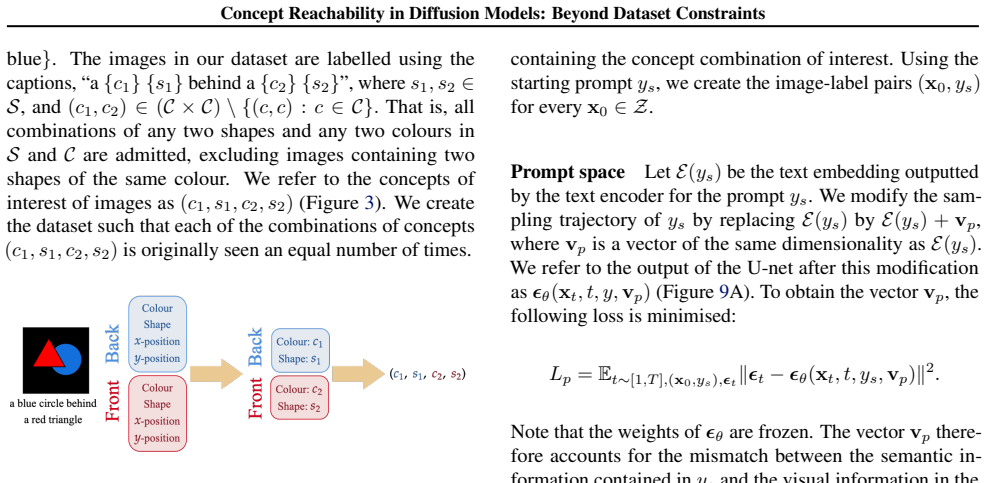
The paper's central claim is that concept reachability — defined as the fraction of generated images that contain the target concept combination $(c_1, s_1, c_2, s_2)$ — is governed by the structure of the training data in a sharp, quantifiable way, and that activation steering is systematically more resilient than prompting. In the synthetic coloured-shapes setting, reachability stays high as a concept's frequency is reduced and then collapses once the concept appears in fewer than about 1% of training images, $p_X(f) \approx 0.01$, a phase transition observed whichever of the four concept positions is thinned. When the target combination is positionally out-of-distribution — each individual concept appears in training but not in the requested position, for instance red shapes only ever appear in front but are requested in back — prompting falls to near zero while prompt-space steering reaches the combination with over 50% accuracy in one of the studied cases. When captions no longer name a concept, reachability drops for both prompting and steering, showing that captions organise the latent space and that a never-captioned concept is effectively unreachable. When two concepts are perfectly tied in the training data, steering, particularly on the prompt space, partially disentangles them, and adding independent examples of one tied concept lifts reachability of both.
Load-bearing premise
The synthetic coloured-shapes dataset and the small 3.7M-parameter model faithfully represent production-scale text-to-image models, so the $p_X(f) \approx 0.01$ threshold and the steering advantage transfer to real systems.
Editorial extensions
If this is right
- Concepts present in at least roughly 1% of training images are reliably learnable, so data collection can stop once a concept crosses the threshold instead of chasing large counts.
- Steering in the prompt space reaches concepts that prompting cannot, so model providers could ship user-facing steering controls in place of costly retraining and dataset curation.
- A concept that never appears in captions is unreachable by every method tested, making caption completeness a hard lower bound on what a model can generate on demand.
- Positionally out-of-distribution combinations are mostly lost to prompting but partially recovered by steering, so reachability depends on how a concept is requested, not only on whether it was learned.
- The intervention layer itself determines what is reachable: text-embedding steering is stable across targets, while bottleneck steering degrades as more concepts are modified.
Reading between the lines
- If the phase transition is generic, comparable sharp thresholds should appear when steering language models toward learned concepts, and the critical frequency may shift with model scale and task complexity rather than staying at 1%.
- The correlation between h-space reachability and the optimised vector's final norm suggests a cheap, image-free probe: estimate reachability from vector norms to audit which concepts a model can access.
- Repeating the scarcity sweep across model sizes within one architecture would separate two explanations — a property of the learning task versus a property of model capacity — that the paper's single small model cannot distinguish.
- A corollary for evaluation practice is that prompt-to-image alignment scores understate model capability, and steering-based evaluation would give a fairer measure of what a text-to-image model has actually learned.
Editorial analysis
A structured set of objections, weighed in public.
Referee Report
Summary. This paper studies concept reachability in text-to-image diffusion models under three dataset limitations: concept scarcity, caption underspecification, and co-occurrence bias. The authors introduce a synthetic dataset of colored shapes (54 concept combinations, 54,000 images) with known generative factors, train small 3.7M-parameter diffusion models, and compare prompt-only generation against steering in prompt-embedding space and U-Net bottleneck h-space. They report (i) a sharp, phase-transition-like drop in reachability when concept presence falls below roughly 1% of the training data, (ii) that the layer/space where steering is applied changes reachability, and (iii) that steering maintains reachability when prompting fails. They supplement the synthetic study with qualitative Stable Diffusion examples and a small CelebA experiment.
Significance. If the results hold, the paper provides a useful empirical map of when concepts can be accessed by prompting versus activation steering, and it argues for user-facing control mechanisms as an alternative to dataset curation. The synthetic design is a strength: the generative factors are known, the dataset modifications are controlled, and the code is released. The authors also honestly acknowledge limitations in Section 6. However, the central quantitative claims are not yet supported at the precision required: the scarcity experiments conflate relative frequency with absolute counts, the p=0 steering results lack a described source for the steering-image set, and the phase-transition threshold is drawn without uncertainty quantification. The real-data sections are qualitative or use a max-ensemble reporting choice that makes quantitative comparison difficult.
major comments (5)
- [§4.1, Appendix B, §5.2] The scarcity manipulation changes pX(f) while preserving the total dataset size (54,000 images), so the relative frequency and the absolute number of images containing the target are varied together. At the claimed threshold p ≈ 0.01, the target combination (red, triangle, green, square) has roughly 540 images of the concept and only about 30 images of the exact combination (since the subset [c1=red]X contains 18 combinations). The design therefore cannot separate a frequency effect from an absolute sample-count effect, and the statement that the model needs 'few data points, relative to the train set size' is unsupported. The authors should run control experiments in which the total dataset size is varied (e.g., scaling all combinations) while holding pX(f) fixed, or report absolute counts and show that the same threshold is obtained across different total sizes.
- [§4.2 and §5.2] The steering method in Section 4.2 requires a collection Z of images containing the target concept combination to optimize the vector vp or vh. In Section 5.2, results are reported at pX(f)=0, where the target combination is absent from the training set, but the manuscript does not specify where Z comes from in this condition. This makes the p=0 steering results irreproducible and weakens the claim that steering can reach concepts 'even when no training images contain the reduced concept.' The authors must state the source of Z (e.g., external images, images with the concept in another position, or model-generated images) and confirm that the same Z is used consistently across conditions.
- [§5.2, Figures 5 and 14, Appendix G.3] The phase-transition claim is based on mean-over-four-seeds curves with no error bars, no per-seed plots, and a threshold marked 'by eye' with a dashed red line. Given the frequency/abundance confound raised above, the strong wording 'distinct phase transition' and 'concept-agnostic, low threshold' in the contributions is not yet justified. The authors should provide per-seed results or confidence intervals, and ideally use an automated or pre-specified procedure to estimate the threshold and its uncertainty, for both the synthetic and CelebA experiments.
- [Appendix G.3, Figure 21] The CelebA scarcity result reports the steering curve as max(prompt space, h-space). Taking the maximum of two methods per point is a form of cherry-picking and prevents a meaningful comparison of steering against prompting, which is the stated purpose of the experiment. The authors should plot both methods separately with error bars, or justify a principled way of selecting one method ahead of time.
- [§5.5 and Appendix F] The Stable Diffusion experiments are presented as evidence that 'concepts often remain reliably reachable through steering' in real settings, but the evaluation is qualitative: 50 images per concept are generated and a few sample panels are shown, with no quantitative accuracy or counts reported. The text acknowledges that steering sometimes fails (e.g., Figure 18), yet the summary claim is stronger than the evidence. The authors should either report the fraction of successful/improved images for the 50-image evaluation or explicitly label this part as anecdotal and move the quantitative claim to the synthetic and CelebA results.
minor comments (5)
- [§4.3] The text says 'Reachability, as defined in Section 5', but Definition 3.1 is in Section 3.4; please correct the cross-reference.
- [§5.1] The paragraph on starting-prompt selection is ambiguous: it says the starting prompt that maximizes h-space performance is chosen, then says 'unless stated otherwise' the starting prompts describe the target concepts. Please clarify which starting prompt is used for each experiment and whether the h-space choice was made on held-out targets or on the same targets reported later.
- [Figures 5 and 13] The p-axis ranges differ between the main figure (0 to 0.08) and Appendix E.3 (0 to 0.175), making visual comparison of the threshold behavior across figures harder. Please use consistent axis ranges or clearly annotate the difference.
- [Contributions bullet list] The contribution states a 'concept-agnostic, low threshold', but only four concept values (red, green, square, triangle) are varied in the scarcity experiments. Please soften this to 'observed for the tested concepts' or provide evidence across a wider set of concepts.
- [Appendix G.3] The CelebA figure caption says the dotted red line marks threshold 0.01, but no error bars or standard deviations are shown for the four seeds; please add them or state why they are omitted.
Circularity Check
No significant circularity: the claims are empirical and not forced by the paper's definitions, fits, or citations.
full rationale
The paper's central claims are experimental observations rather than derivations, and I found no step in which a result reduces by construction to its inputs. (i) Concept reachability is defined in Definition 3.1 as the measured accuracy of generated images, and the phase-transition claim in Section 5.2 is an empirical reading of Figure 5, not an algebraic consequence of the definition or of the steering losses in Section 4.2. (ii) The steering vectors are fitted to images containing the target concept combination, but the paper then evaluates whether adding the fitted vector during sampling actually produces the target concepts; the fit does not by construction determine the reported accuracy. The acknowledged reliance on an auxiliary image set Z is a practical limitation of the method (discussed in Section 6), not a circular derivation. (iii) The reference list contains no self-citations by Aparicio Rodriguez, Miscouridou, or Borovykh, and no load-bearing uniqueness theorem or ansatz is imported from the authors' prior work. (iv) The skeptic's concern that the 1% threshold is confounded with absolute sample counts is a validity or generalizability criticism of the experimental design, not a circularity: varying p while preserving total dataset size changes absolute counts, but this does not make the observed accuracy curve a tautology or a renamed input. Similarly, the real-data sections are qualitative or use small subsets, which is a strength-of-evidence concern rather than circularity. Overall, the derivation chain is self-contained: the definitions and losses are used as measurement machinery, and the conclusions are not equivalent to the inputs by definition.
Assumptions & free parameters
free parameters (2)
- Steering vector vp (prompt space) =
R^{1x10x512} (varies with caption length)
- Steering vector vh (h-space) =
R^{128x8x8}
assumptions (3)
- domain assumption Images are generated by a set of concept variables (F_i) via an injective function g, so each concept combination uniquely determines an image.
- domain assumption Captions are produced by an injective function h, so the concepts of interest are fully specified by the caption.
- ad hoc to paper The three selected dataset obstacles (scarcity, underspecification, bias) are the dominant causes of prompting failure in real models.
Cite this review
Pith. "Pith review of Concept Reachability in Diffusion Models: Beyond Dataset Constraints." pith.science (2026). https://pith.science/paper/QYSAILSZ
@misc{pith2026250519313,
  author       = {Pith},
  title        = {Pith review of: Concept Reachability in Diffusion Models: Beyond Dataset Constraints},
  year         = {2026},
  howpublished = {\url{https://pith.science/paper/QYSAILSZ}},
  note         = {Machine review of arXiv:2505.19313}
}
read the original abstract
Despite significant advances in quality and complexity of the generations in text-to-image models, prompting does not always lead to the desired outputs. Controlling model behaviour by directly steering intermediate model activations has emerged as a viable alternative allowing to reach concepts in latent space that may otherwise remain inaccessible by prompt. In this work, we introduce a set of experiments to deepen our understanding of concept reachability. We design a training data setup with three key obstacles: scarcity of concepts, underspecification of concepts in the captions, and data biases with tied concepts. Our results show: (i) concept reachability in latent space exhibits a distinct phase transition, with only a small number of samples being sufficient to enable reachability, (ii) where in the latent space the intervention is performed critically impacts reachability, showing that certain concepts are reachable only at certain stages of transformation, and (iii) while prompting ability rapidly diminishes with a decrease in quality of the dataset, concepts often remain reliably reachable through steering. Model providers can leverage this to bypass costly retraining and dataset curation and instead innovate with user-facing control mechanisms.
Figures


Figures from the paper (19 more)


Reference graph
Works this paper leans on
- [1]
-
[2]
a{c 1}shape behind a{c 2} {s2}
Removes 1: replace the caption with “a{c 1}shape behind a{c 2} {s2}”
-
[3]
Removec 2: replace the caption with “a{c 1} {s2}behind a{s 2}” 15 Concept Reachability in Diffusion Models: Beyond Dataset Constraints
-
[4]
Removes 2: replace the caption with “a{c 1} {s2}behind a{c 2}shape”
- [5]
-
[6]
Removec 1,s 1 andc 2: replace the caption with “a{s 2}”
-
[7]
a red triangle behind a green square
Removec 1,s 1,c 2 ands 2: replace the caption with the empty string, “” E. Additional Experiments E.1. Additional Analysis on a Balanced Data Final norm of optimised concept vector is indicative of reachability when steering on the h-spaceThe differences in the accuracies achieved through steering on the h-space suggest that, from a given starting prompt ...
work page 2024
- [11]
Show all 13 references
-
[12]
Remove ˆh: replace the caption with “a{g}”
-
[13]
” We steer from the starting prompt describing only seen concepts. For example, when removing ˆh from the captions, to steer to (woman,wearing a hat) we use ys = “a woman
Removegand ˆh: replace the caption with the empty string, “” We steer from the starting prompt describing only seen concepts. For example, when removing ˆh from the captions, to steer to (woman,wearing a hat) we use ys = “a woman”. Additionally, we compare the accuracy of prom...
-
[2017]
cc/paper_files/paper/2017/file/ 3f5ee243547dee91fbd053c1c4a845aa-Paper
URL https://proceedings.neurips. cc/paper_files/paper/2017/file/ 3f5ee243547dee91fbd053c1c4a845aa-Paper. pdf. von Platen, P., Patil, S., Lozhkov, A., Cuenca, P., Lam- bert, N., Rasul, K., Davaadorj, M., Nair, D., Paul, S., Berman, W., Xu, Y ., Liu, S., and Wolf, T. Diffusers: ...
2017 arXiv
-
[2018]
a {c1} {s1} behind a {c2} {s2}
URL https://proceedings.neurips. cc/paper_files/paper/2018/file/ 12 Concept Reachability in Diffusion Models: Beyond Dataset Constraints 5317b6799188715d5e00a638a4278901-Paper. pdf. Zheng, X., Pang, T., Du, C., Jiang, J., and Lin, M. Intriguing properties of data attribution o...
2018 arXiv
-
[2022]
ISBN 9781713871088
Curran Associates Inc. ISBN 9781713871088. M´esz´aros, A., Ujv ´ary, S., Brendel, W., Reizinger, P., and Husz´ar, F. Rule extrapolation in language modeling: A study of compositional generalization on ood prompts. InAdvances in Neural Information Processing Systems, volume 37,...
2024 arXiv
Reviewed August 7, 2026 · model on record in the stance chip above.
Discussion (0). Continue with ORCID to comment.