REVIEW 4 major objections 7 minor 43 references
Future Link Prediction Without Memory or Aggregation
T0 review · 4 major / 7 minor · reviewed 2026-08-07 · deepseek-v4-flash
Pith's one-line read CRAFT predicts future links without memory or aggregation, using node identifiers and cross-attention to beat memory-based models on most benchmarks.
desk verdict CRAFT is a clean and provocative simplification of temporal graph models, but it never embeds the source node itself, so the 'unique identifiers' story is incomplete and the k-window assumption is untested. read the letter →
The pith
A machine-rendered reading of the paper's core claim, the machinery that carries it, and where it could break.
The reading
What carries the argument
The load-bearing component is the cross-attention layer between a candidate destination and the source's k recent neighbors: each destination vector is the query, and the source's neighbor embeddings with learnable positional encodings are the keys and values. This makes the score of an edge explicitly depend on how well the destination matches the source's interaction history, rather than on independently computed node states. The learnable node embeddings provide the unique identifiers that let the model tell nodes apart when raw node or edge features are missing or sparse. The elapsed-time and repeat-time projections supply the temporal context that attention alone does not encode.
What would settle it
Take a temporal graph with strong periodic re-engagement, where a node interacts with a particular contact only after a long gap and with more than k other events in between, and train CRAFT with the largest tested k. If a full-history memory model or a variant that reads the entire neighbor history predicts those re-engagements while CRAFT does not, the recent-window premise fails.
Extended reading notes
Core claim
The central claim is that future link prediction does not need memory modules or aggregation modules, provided each node has a unique learnable identifier and the model evaluates candidate destinations against the source's recent behavior. CRAFT realizes this with trainable node embeddings used as identifiers and a stacked cross-attention module in which each candidate destination attends to the k most recent neighbors of the source before the query time. The destination's elapsed time since its last activity is appended before an MLP scores the edge, and on seen-edge-heavy datasets a repeat-time encoding is added. With this minimal design, CRAFT reports top MRR on the majority of the 17 datasets and consistently outperforms memory-based baselines on unseen-dominant datasets, where models that cannot identify nodes or match targets are claimed to fail.
Load-bearing premise
The model assumes that everything needed to predict a future edge is contained in the source's k most recent interactions before the prediction time, together with the destination's last-activity time; any signal older than that window is invisible to the model.
Editorial extensions
If this is right
- Memory and aggregation modules can be removed from future-link-prediction architectures without sacrificing accuracy; the two requirements that remain are node identifiers and target-aware matching.
- On datasets dominated by never-before-seen edges, where prior models degrade, CRAFT's design is claimed to give large relative gains, suggesting that identifier-based expressiveness and target-conditioned scoring are key to generalizing to unseen edges.
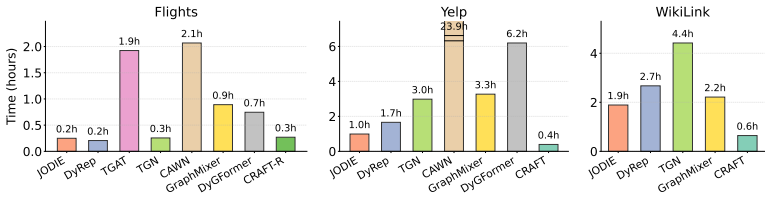
- Because CRAFT only retrieves the source's k recent neighbors and scores all candidate destinations jointly via one cross-attention pass, inference cost scales more cheaply than methods that retrieve and aggregate neighbors for both endpoints.
- Seen-edge-heavy datasets can absorb a repeat-time encoding, and the same architecture then remains competitive even where co-occurrence-based baselines currently lead.
Reading between the lines
- A direct test of the k-window premise would be to construct a dataset with long-range periodic re-engagements, links that recur after more than k intervening events, and compare CRAFT against a memory-augmented model; if CRAFT fails there, the recent-neighbor window is the limiting factor.
- The architecture resembles a session-based recommender whose 'session' is the source's recent neighborhood; adapting CRAFT's cross-attention scoring to cold-start nodes or to session-based recommendation may inherit its efficiency without needing temporal-graph machinery.
- The paper's comparisons with DyGFormer variants suggest that how the destination conditions the representation matters more than the encoder family; one could test whether any lightweight target-aware pooling rule, not just attention, recovers most of the gain.
Editorial analysis
A structured set of objections, weighed in public.
Referee Report
Summary. Future link prediction on temporal graphs requires ranking candidate destinations for a source at a future time. The paper proposes CRAFT, an architecture that replaces memory and aggregation modules with learnable node embeddings (as unique identifiers) and cross-attention between the candidate destination set and the source's k most recent neighbors. A variant CRAFT-R adds repeat-time encoding for datasets with a high seen-edge ratio. The paper reports MRR results on 17 datasets, compares against seven baselines, provides ablations on the two proposed components, gives a time-complexity analysis, and claims consistent superior performance with high efficiency. The code is publicly available.
Significance. The paper's central claim is provocative: if true, it shows that the memory/aggregation paradigm is not necessary for strong future link prediction, and that a simple cross-attention model over a fixed-size neighbor window suffices. The strengths are the breadth of the evaluation (17 datasets including large-scale TGB/TGB-Seq), the public code, the efficiency analysis, and the controlled ablations showing that learnable embeddings and cross-attention improve over featureless baselines. However, the significance is tempered by three protocol issues: the source node never receives its own learnable embedding, the baseline numbers on TGB-Seq/TGB are transferred from prior papers rather than re-run under the same protocol, and the model switches between CRAFT and CRAFT-R based on the seen-edge ratio. These issues do not necessarily invalidate the method, but they affect the strength of the 'consistently superior' claim and the paper's conceptual narrative.
major comments (4)
- [Section 4.1, Eqs. (4)-(7)] The source node s is never embedded: the query H(0)=D contains only candidate destination embeddings, and the keys/values S contain only the k recent neighbor embeddings. The claimed 'unique node identifiers' therefore apply to destinations and neighbors but not to the source. Two sources with identical recent-neighbor sequences (same nodes, same order) receive identical cross-attention context, so the model cannot distinguish them. This is a load-bearing point for the paper's motivation that learnable embeddings provide the unique-identifier capability that memory/aggregation lack. Please add an ablation that includes e(s) in the key/value sequence (or uses it as an additional query) and report whether MRR changes; if it does, the claim that memory and aggregation can be discarded needs qualification.
- [Section 5.1, Experimental Setup; Appendix B.4] The results for all baselines on TGB-Seq and TGB datasets are taken directly from [40,41] rather than re-run under identical conditions. Meanwhile, the paper states that collision checks are applied to small datasets and that this 'may lead to different results compared to prior works.' Since the collision-check protocol is known to improve most methods, transferring baseline numbers from papers that did not use this protocol makes the comparison potentially biased in CRAFT's favor. Please re-run the baselines under the same collision-check and negative-sampling protocol, or at least quantify the impact of collision checks on the transferred baseline numbers.
- [Tables 2 and 3; Section 5.1] The evaluation uses two different models: CRAFT without repeat-time encoding on unseen-dominant datasets (Table 2) and CRAFT-R with repeat-time encoding on seen-dominant datasets (Table 3). The abstract and introduction claim that 'CRAFT consistently achieves superior performance,' but this is a claim about a model family with per-dataset variant selection. Moreover, on three seen-dominant datasets (wikipedia, uci, Flights) CRAFT-R is worse than DyGFormer by 0.44-1.50 MRR points. Please present results for a single unified configuration, or explicitly frame the contribution as CRAFT/CRAFT-R with the selection rule disclosed as part of the method, and soften the 'consistently' language accordingly.
- [Section 4.1; Table 6] The k-neighbor window (k in {30,60,90,120} after tuning) is the only channel through which the source's history enters the model, and the paper never tests whether this window is sufficient. There is no sensitivity analysis over k beyond the tuning grid, no comparison with full-history sequences, and no variant with a memory module to check what information is lost. This is the load-bearing assumption of the architecture: if longer windows or full histories materially improve MRR, the claim that memory and aggregation can be discarded would need to be qualified. Please add at least a k-sensitivity curve and a full-history or sliding-window comparison.
minor comments (7)
- [Section 4.1, Eq. (7) text] The phrase 'edge presentation' should be 'edge representation'.
- [Table 4] The dataset is named 'tgbl-flight' in Table 4 but 'tgbl-flights' in Tables 2 and 3; please unify the naming.
- [Section 4.2.1] The text refers to 'the example shown in Figure 1' as a graph with nodes a and f, but Figure 1 is the architecture diagram; the figure numbering appears to be off.
- [Section 5.2] For Yelp, TGAT-LE uses one layer while the reported TGAT baseline uses two layers; the comparison of TGAT vs TGAT-LE on Yelp is not fully controlled.
- [Appendix B.4] It is unclear whether the collision check is applied at test time or only during training and validation; please clarify, since it affects the validity of the reported test MRR.
- [Section 4.1] The description 'we first extract the k recent neighbors of s before t' should clarify that this is a fixed-size window, and the paper should state the default window size used when reporting results.
- [Section 3] The repeated phrase 'the termstargetanddestinationinterchangeably' is missing spaces; a formatting typo.
Circularity Check
No circular derivation: CRAFT's predictions are scored by an external BPR/MRR pipeline; the only self-citation (TGB-Seq) is a public benchmark, not a load-bearing reduction.
full rationale
I walked the derivation chain from the architecture (Eqs. 1-7) to the empirical claims. The model is defined by learnable node embeddings, positional encoding of the source's k recent neighbors, cross-attention with destination embeddings, elapsed-time and repeat-time features, and an MLP scoring head trained with BPR. None of these equations is defined in terms of the MRR it is later evaluated against, and no predicted quantity is a fitted parameter renamed as a result. The k-window and transductive-embedding choices are architectural assumptions, acknowledged in C.2 and C.5, but they are not reductions: the paper does not derive 'memory and aggregation are unnecessary' from the architecture itself; it supports that claim with external MRR comparisons on 17 datasets. The one self-referential element is that TGB-Seq [40] is the authors' own benchmark and is used both for motivation and for baseline numbers, while other TGB baseline numbers come from [41]. This is a public, reproducible benchmark rather than an unverified uniqueness theorem, so it does not make the central claim circular. The ablation studies (TGAT-LE, DyGFormer-LE, w/o PosEnc/w/o Elapsed/w/o Repeat) are empirical and could in principle falsify the design. No equation equals another by construction; I therefore find no significant circularity, only a minor convenience self-citation, which the scoring rubric places at 2.
Assumptions & free parameters
free parameters (4)
- learnable node embeddings =
d=64 or 128 per dataset
- neighbor window size k =
30, 60, 90, or 120 per dataset (Table 6)
- repeat-time encoding flag =
enabled for seen-dominant, disabled for unseen-dominant
- embedding dimension F =
64 (small) or 128 (large)
assumptions (4)
- domain assumption The k most recent neighbors of the source contain sufficient context for future link prediction.
- domain assumption Cross-attention between destination and source's neighbors captures compatibility better than neighborhood co-occurrence or independent node encoding.
- domain assumption Prior-reported baseline numbers are comparable to CRAFT's runs.
- standard math Standard transformer building blocks (softmax attention, FFN, GELU) behave as expected.
Cite this review
Pith. "Pith review of Future Link Prediction Without Memory or Aggregation." pith.science (2026). https://pith.science/paper/MGGUIKLM
@misc{pith2026250519408,
  author       = {Pith},
  title        = {Pith review of: Future Link Prediction Without Memory or Aggregation},
  year         = {2026},
  howpublished = {\url{https://pith.science/paper/MGGUIKLM}},
  note         = {Machine review of arXiv:2505.19408}
}
read the original abstract
Future link prediction on temporal graphs is a fundamental task with wide applicability in real-world dynamic systems. These scenarios often involve both recurring (seen) and novel (unseen) interactions, requiring models to generalize effectively across both types of edges. However, existing methods typically rely on complex memory and aggregation modules, yet struggle to handle unseen edges. In this paper, we revisit the architecture of existing temporal graph models and identify two essential but overlooked modeling requirements for future link prediction: representing nodes with unique identifiers and performing target-aware matching between source and destination nodes. To this end, we propose Cross-Attention based Future Link Predictor on Temporal Graphs (CRAFT), a simple yet effective architecture that discards memory and aggregation modules and instead builds on two components: learnable node embeddings and cross-attention between the destination and the source's recent interactions. This design provides strong expressive power and enables target-aware modeling of the compatibility between candidate destinations and the source's interaction patterns. Extensive experiments on diverse datasets demonstrate that CRAFT consistently achieves superior performance with high efficiency, making it well-suited for large-scale real-world applications.
Figures


Figures from the paper (8 more)


Reference graph
Works this paper leans on
-
[1]
Ralph Abboud, Ismail Ilkan Ceylan, Martin Grohe, and Thomas Lukasiewicz. The sur- prising power of graph neural networks with random node initialization.arXiv preprint arXiv:2010.01179, 2020
arXiv 2010
-
[2]
Temporal graph neural networks for social recommendation
Ting Bai, Youjie Zhang, Bin Wu, and Jian-Yun Nie. Temporal graph neural networks for social recommendation. In2020 IEEE International Conference on Big Data (Big Data), pages 898–903. IEEE, 2020
work page 2020
-
[3]
Maya Bechler-Speicher, Moshe Eliasof, Carola-Bibiane Schonlieb, Ran Gilad-Bachrach, and Amir Globerson. Towards invariance to node identifiers in graph neural networks.arXiv preprint arXiv:2502.13660, 2025
arXiv 2025
-
[4]
Hot: Higher-order dynamic graph representation learning with efficient transformers
Maciej Besta, Afonso Claudino Catarino, Lukas Gianinazzi, Nils Blach, Piotr Nyczyk, Hubert Niewiadomski, and Torsten Hoefler. Hot: Higher-order dynamic graph representation learning with efficient transformers. InLearning on Graphs Conference, pages 15–1. PMLR, 2024
work page 2024
-
[5]
Kyunghyun Cho, Bart Van Merriënboer, Caglar Gulcehre, Dzmitry Bahdanau, Fethi Bougares, Holger Schwenk, and Yoshua Bengio. Learning phrase representations using rnn encoder- decoder for statistical machine translation.arXiv preprint arXiv:1406.1078, 2014
arXiv 2014
-
[6]
Weilin Cong, Si Zhang, Jian Kang, Baichuan Yuan, Hao Wu, Xin Zhou, Hanghang Tong, and Mehrdad Mahdavi. Do we really need complicated model architectures for temporal networks? InThe Eleventh International Conference on Learning Representations, ICLR 2023, Kigali, Rwanda, May 1-5, 2023, 2023. URL https://openreview.net/forum?id=ayPPc0SyLv1
work page 2023
-
[7]
Nur Nasuha Daud, Siti Hafizah Ab Hamid, Muntadher Saadoon, Firdaus Sahran, and Nor Badrul Anuar. Applications of link prediction in social networks: A review.Journal of Network and Computer Applications, 166:102716, 2020
work page 2020
-
[8]
Temporal link prediction: A survey.New Generation Computing, 38(1):213–258, 2020
Aswathy Divakaran and Anuraj Mohan. Temporal link prediction: A survey.New Generation Computing, 38(1):213–258, 2020
work page 2020
Show all 43 references
-
[9]
Machine learning on dynamic graphs: a survey on applications.2023 IEEE Ninth Multimedia Big Data (BigMM), pages 32–39, 2023
Sanaz Hasanzadeh Fard. Machine learning on dynamic graphs: a survey on applications.2023 IEEE Ninth Multimedia Big Data (BigMM), pages 32–39, 2023
2023
-
[10]
A systemic analysis of link prediction in social network.Artificial Intelligence Review, 52:1961–1995, 2019
Sogol Haghani and Mohammad Reza Keyvanpour. A systemic analysis of link prediction in social network.Artificial Intelligence Review, 52:1961–1995, 2019
1961
-
[11]
Alan G. Hawkes. Spectra of some self-exciting and mutually exciting point processes. Biometrika, 58:83–90, 1971
1971
-
[12]
Tempo- ral graph benchmark for machine learning on temporal graphs.Advances in Neural Information Processing Systems, 36, 2024
Shenyang Huang, Farimah Poursafaei, Jacob Danovitch, Matthias Fey, Weihua Hu, Emanuele Rossi, Jure Leskovec, Michael Bronstein, Guillaume Rabusseau, and Reihaneh Rabbany. Tempo- ral graph benchmark for machine learning on temporal graphs.Advances in Neural Information Processi...
2024
-
[13]
Self-attentive sequential recommendation
Wang-Cheng Kang and Julian McAuley. Self-attentive sequential recommendation. In2018 IEEE international conference on data mining (ICDM), pages 197–206. IEEE, 2018
2018
-
[14]
Representation learning for dynamic graphs: A survey.Journal of Machine Learning Research, 21(70):1–73, 2020
Seyed Mehran Kazemi, Rishab Goel, Kshitij Jain, Ivan Kobyzev, Akshay Sethi, Peter Forsyth, and Pascal Poupart. Representation learning for dynamic graphs: A survey.Journal of Machine Learning Research, 21(70):1–73, 2020
2020
-
[15]
Learning temporal attention in dynamic graphs with bilinear interactions.Plos one, 16(3):e0247936, 2021
Boris Knyazev, Carolyn Augusta, and Graham W Taylor. Learning temporal attention in dynamic graphs with bilinear interactions.Plos one, 16(3):e0247936, 2021. 10
2021
-
[16]
Predicting dynamic embedding trajectory in temporal interaction networks
Srijan Kumar, Xikun Zhang, and Jure Leskovec. Predicting dynamic embedding trajectory in temporal interaction networks. InProceedings of the 25th ACM SIGKDD International Conference on Knowledge Discovery & Data Mining, KDD 2019, Anchorage, AK, USA, August 4-8, 2019, pages 126...
2019
-
[17]
Revisiting recommendation loss functions through contrastive learning (technical report).arXiv preprint arXiv:2312.08520, 2023
Dong Li, Ruoming Jin, and Bin Ren. Revisiting recommendation loss functions through contrastive learning (technical report).arXiv preprint arXiv:2312.08520, 2023
2023 arXiv
-
[18]
What graph neural networks cannot learn: depth vs width.arXiv preprint arXiv:1907.03199, 2019
Andreas Loukas. What graph neural networks cannot learn: depth vs width.arXiv preprint arXiv:1907.03199, 2019
1907 arXiv
-
[19]
Neighborhood-aware scalable temporal network representation learning
Yuhong Luo and Pan Li. Neighborhood-aware scalable temporal network representation learning. InLearning on Graphs Conference, pages 1–1. PMLR, 2022
2022
-
[20]
The neural hawkes process: A neurally self-modulating multivariate point process.Advances in neural information processing systems, 30, 2017
Hongyuan Mei and Jason M Eisner. The neural hawkes process: A neurally self-modulating multivariate point process.Advances in neural information processing systems, 30, 2017
2017
-
[21]
de Rijke
Zhiqiang Pan, Fei Cai, Wanyu Chen, Honghui Chen, and M. de Rijke. Star graph neural networks for session-based recommendation.Proceedings of the 29th ACM International Conference on Information & Knowledge Management, 2020. URL https://api.semanticscholar.org/ CorpusID:221339954
2020
-
[22]
Pietro Panzarasa, Tore Opsahl, and Kathleen M Carley. Patterns and dynamics of users’ behavior and interaction: Network analysis of an online community.Journal of the American Society for Information Science and Technology, 60(5):911–932, 2009
2009
-
[23]
Towards better evaluation for dynamic link prediction.Advances in Neural Information Processing Systems, 35:32928–32941, 2022
Farimah Poursafaei, Shenyang Huang, Kellin Pelrine, and Reihaneh Rabbany. Towards better evaluation for dynamic link prediction.Advances in Neural Information Processing Systems, 35:32928–32941, 2022
2022
-
[24]
Temporal graph learning for financial world: Algorithms, scalability, explainability & fairness
Nitendra Rajput and Karamjit Singh. Temporal graph learning for financial world: Algorithms, scalability, explainability & fairness. InProceedings of the 28th ACM SIGKDD Conference on Knowledge Discovery and Data Mining, pages 4818–4819, 2022
2022
-
[25]
Bpr: Bayesian personalized ranking from implicit feedback.arXiv preprint arXiv:1205.2618, 2012
Steffen Rendle, Christoph Freudenthaler, Zeno Gantner, and Lars Schmidt-Thieme. Bpr: Bayesian personalized ranking from implicit feedback.arXiv preprint arXiv:1205.2618, 2012
2012 arXiv
-
[26]
Temporal graph networks for deep learning on dynamic graphs
Emanuele Rossi, Ben Chamberlain, Fabrizio Frasca, Davide Eynard, Federico Monti, and Michael Bronstein. Temporal graph networks for deep learning on dynamic graphs. InICML 2020 Workshop on Graph Representation Learning, 2020
2020
-
[27]
Methods and metrics for cold-start recommendations
Andrew I Schein, Alexandrin Popescul, Lyle H Ungar, and David M Pennock. Methods and metrics for cold-start recommendations. InProceedings of the 25th annual international ACM SIGIR conference on Research and development in information retrieval, pages 253–260, 2002
2002
-
[28]
Foundations and modeling of dynamic networks using dynamic graph neural networks: A survey.iEEE Access, 9:79143–79168, 2021
Joakim Skarding, Bogdan Gabrys, and Katarzyna Musial. Foundations and modeling of dynamic networks using dynamic graph neural networks: A survey.iEEE Access, 9:79143–79168, 2021
2021
-
[29]
Co-author rela- tionship prediction in heterogeneous bibliographic networks
Yizhou Sun, Rick Barber, Manish Gupta, Charu C Aggarwal, and Jiawei Han. Co-author rela- tionship prediction in heterogeneous bibliographic networks. In2011 international conference on advances in social networks analysis and mining, pages 121–128. IEEE, 2011
2011
-
[30]
Mlp-mixer: An all-mlp architecture for vision.Advances in neural information processing systems, 34: 24261–24272, 2021
Ilya O Tolstikhin, Neil Houlsby, Alexander Kolesnikov, Lucas Beyer, Xiaohua Zhai, Thomas Unterthiner, Jessica Yung, Andreas Steiner, Daniel Keysers, Jakob Uszkoreit, et al. Mlp-mixer: An all-mlp architecture for vision.Advances in neural information processing systems, 34: 242...
2021
-
[31]
Dyrep: Learn- ing representations over dynamic graphs
Rakshit Trivedi, Mehrdad Farajtabar, Prasenjeet Biswal, and Hongyuan Zha. Dyrep: Learn- ing representations over dynamic graphs. In7th International Conference on Learning Representations, ICLR 2019, New Orleans, LA, USA, May 6-9, 2019, 2019. URL https: //openreview.net/forum?...
2019
-
[32]
Attention is all you need.Advances in Neural Information Processing Systems, 2017
A Vaswani. Attention is all you need.Advances in Neural Information Processing Systems, 2017
2017
-
[33]
Tcl: Transformer-based dynamic graph modelling via contrastive learning.arXiv preprint arXiv:2105.07944, 2021
Lu Wang, Xiaofu Chang, Shuang Li, Yunfei Chu, Hui Li, Wei Zhang, Xiaofeng He, Le Song, Jingren Zhou, and Hongxia Yang. Tcl: Transformer-based dynamic graph modelling via contrastive learning.arXiv preprint arXiv:2105.07944, 2021
2021 arXiv
-
[34]
Inductive representation learning in temporal networks via causal anonymous walks
Yanbang Wang, Yen-Yu Chang, Yunyu Liu, Jure Leskovec, and Pan Li. Inductive representation learning in temporal networks via causal anonymous walks. In9th International Conference on Learning Representations, ICLR 2021, Virtual Event, Austria, May 3-7, 2021, 2021. URL https://...
2021
-
[35]
Trend: Temporal event and node dynamics for graph representation learning
Zhihao Wen and Yuan Fang. Trend: Temporal event and node dynamics for graph representation learning. InProceedings of the ACM Web Conference 2022, pages 1159–1169, 2022
2022
-
[36]
Recurrent recommender networks
Chao-Yuan Wu, Amr Ahmed, Alex Beutel, Alexander J Smola, and How Jing. Recurrent recommender networks. InProceedings of the tenth ACM international conference on web search and data mining, pages 495–503, 2017
2017
-
[37]
On the feasibility of simple transformer for dynamic graph modeling
Yuxia Wu, Yuan Fang, and Lizi Liao. On the feasibility of simple transformer for dynamic graph modeling. InProceedings of the ACM on Web Conference 2024, pages 870–880, 2024
2024
-
[38]
Inductive representation learning on temporal graphs
Da Xu, Chuanwei Ruan, Evren Körpeoglu, Sushant Kumar, and Kannan Achan. Inductive representation learning on temporal graphs. In8th International Conference on Learning Representations, ICLR 2020, Addis Ababa, Ethiopia, April 26-30, 2020, 2020. URL https: //openreview.net/foru...
2020
-
[39]
Towards ideal temporal graph neural networks: Evaluations and conclusions after 10,000 gpu hours.arXiv preprint arXiv:2412.20256, 2024
Yuxin Yang, Hongkuan Zhou, Rajgopal Kannan, and Viktor Prasanna. Towards ideal temporal graph neural networks: Evaluations and conclusions after 10,000 gpu hours.arXiv preprint arXiv:2412.20256, 2024
2024 arXiv
-
[40]
Tgb-seq benchmark: Challenging temporal gnns with complex sequential dynamics
Lu Yi, Jie Peng, Yanping Zheng, Fengran Mo, Zhewei Wei, Yuhang Ye, Yue Zixuan, and Zengfeng Huang. Tgb-seq benchmark: Challenging temporal gnns with complex sequential dynamics. InThe Thirteenth International Conference on Learning Representations
-
[41]
An empirical evaluation of temporal graph benchmark.arXiv preprint arXiv:2307.12510, 2023
Le Yu. An empirical evaluation of temporal graph benchmark.arXiv preprint arXiv:2307.12510, 2023
2023 arXiv
-
[42]
Towards better dynamic graph learning: New ar- chitecture and unified library
Le Yu, Leilei Sun, Bowen Du, and Weifeng Lv. Towards better dynamic graph learning: New ar- chitecture and unified library. InAdvances in Neural Information Processing Systems 36: Annual Conference on Neural Information Processing Systems 2023, NeurIPS 2023, New Orleans, LA, U...
2023
-
[43]
A survey of dynamic graph neural networks.arXiv preprint arXiv:2404.18211, 2024
Yanping Zheng, Lu Yi, and Zhewei Wei. A survey of dynamic graph neural networks.arXiv preprint arXiv:2404.18211, 2024. 12 Table 4: Datasets statistics: seven TGB-Seq datasets, four TGB datasets, and six commonly used datasets. This table is partially adopted from TGB-Seq [40]....
2024 arXiv
Reviewed August 7, 2026 · model on record in the stance chip above.
Discussion (0). Sign in to comment.