REVIEW 3 major objections 7 minor 44 references
Leveraging Cascaded Binary Classification and Multimodal Fusion for Dementia Detection through Spontaneous Speech
T0 review · 3 major / 7 minor · reviewed 2026-08-07 · deepseek-v4-flash
Pith's one-line read This paper claims that splitting three-class dementia diagnosis into two binary classifiers plus pause-encoded transcripts raises test F1 to 58.6% (vs 55% baseline) and that multimodal feature ensembling improves MMSE regression RMSE to…
desk verdict Solid PROCESS challenge system paper with official test numbers, but the manual-to-ASR transcript shift is a real unvalidated confound for the mechanistic interpretation. read the letter →
The pith
A machine-rendered reading of the paper's core claim, the machinery that carries it, and where it could break.
The reading
What carries the argument
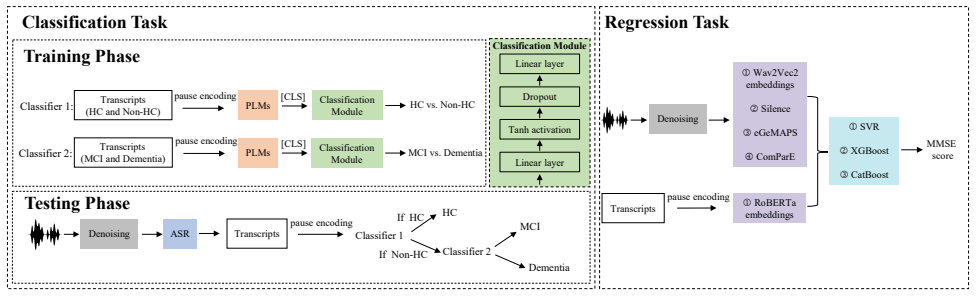
The load-bearing mechanism is the cascaded binary classification framework: instead of one three-class head, the system trains two binary classifiers in sequence, with the first separating healthy controls from all patients and the second separating mild cognitive impairment from dementia, a structure that rebalances the lopsided class distribution and lets each binary decision operate on a more separable signal. The other central mechanism is pause encoding: forced alignment marks silences, pauses are binned into short (<0.5 s), medium (0.5-2 s), and long (>2 s) and rendered as commas, periods, and ellipses in the transcript, so the language model sees disfluency structure as text. For regression, the machinery is the multimodal feature ensemble: five feature sets (Wav2Vec2 embeddings, a 10-dimensional silence feature set, eGeMAPS, ComParE, and RoBERTa embeddings) feed three simple regressors, and model outputs with RMSE below 3 are averaged to produce the final MMSE prediction.
What would settle it
Re-run the submitted systems on a manually transcribed version of the test set: if the F1 and RMSE gains over the baseline shrink or vanish, the reported improvements are driven by how the speech recognizer transcribes each diagnostic group rather than by the dementia signals the models were trained on.
Extended reading notes
Core claim
The central discovery claimed is that the proposed cascaded binary classification framework, which replaces a single three-class classifier with two independently trained binary classifiers (healthy versus non-healthy, then mild cognitive impairment versus dementia), together with pause encoding that represents short, medium, and long silences as comma, period, and ellipsis in the transcript, outperforms both direct three-class classification and the challenge baseline. On the test set, the ensemble of three pre-trained language models voting across the three elicitation tasks and ten random seeds reaches a macro F1 of 58.6%, exceeding the baseline of 55% by 3.6 percentage points. For the regression task, the paper claims that combining five feature sets—Wav2Vec2 embeddings, silence statistics, eGeMAPS, ComParE, and RoBERTa embeddings—with support vector regression, XGBoost, and CatBoost and averaging the selected models' outputs yields an RMSE of 2.87 on the test set, an improvement of 0.11 over the baseline of 2.98. The paper further reports that the cascaded structure is consistently better than direct three-class classification across four validation splits, and that multimodal feature fusion beats fine-tuning RoBERTa and Wav2Vec2 directly for regression on the small dataset.
Load-bearing premise
The system is trained on hand-written transcripts but tested on speech-to-text output, and the paper never checks whether its models respond the same way to transcription errors as they do to clean text.
Editorial extensions
If this is right
- If the reported test results hold, a challenge participant can beat the baseline without exotic architecture: reorganizing the decision structure and encoding pauses is enough, on top of ordinary fine-tuned PLMs.
- The cascade gives the mild cognitive impairment class, typically the hardest due to few samples and overlaps, its own dedicated binary classifier, which is the stated reason it outperforms direct three-class classification.
- For regression, the results imply that on small clinical cohorts, simple regressors over diverse frozen features are more reliable than end-to-end fine-tuning of large pre-trained models.
- Ensembling across models, elicitation tasks, and random seeds (90 models for classification) is presented as the way to keep performance stable when a single data split overfits.
- Since the regression selection threshold is applied on validation, the approach offers a recipe for small-data clinical prediction: fit many simple models on diverse feature views and average the well-calibrated ones.
Reading between the lines
- If the cascade's advantage comes from rebalancing, the same two-stage structure could transfer to other imbalanced three-class clinical speech tasks, such as depression severity staging, though the paper does not test this.
- A direct check the paper leaves open is measuring how ASR transcription errors interact with pause encoding: since pauses are added from forced alignment of the ASR transcript, any errors could artificially lengthen or shorten silences, and the paper does not quantify this.
- The ensemble's reliance on three elicitation tasks suggests a testable extension: removing one task at a time would isolate how much of the gain comes from task diversity versus seed diversity.
- Because the regression models are selected on the validation split by an RMSE threshold, the approach implies that validation-based model selection can be a practical safeguard against overfitting in small-N clinical prediction.
Editorial analysis
A structured set of objections, weighed in public.
Referee Report
Summary. The manuscript describes the authors' submission to the PROCESS 2025 challenge for dementia detection from spontaneous speech. For the three-class classification problem (Healthy Control, MCI, Dementia), it proposes a cascaded binary classification scheme: a first PLM-based binary classifier separates HC from Non-HC, and a second separates MCI from Dementia, with pause symbols inserted into transcripts to capture disfluencies. For MMSE score regression, it extracts five feature sets (Wav2Vec2 embeddings, silence statistics, eGeMAPS, ComParE, RoBERTa embeddings) and trains SVR, XGBoost, and CatBoost models, averaging predictions after filtering models by validation RMSE. The paper reports official test results: a Macro F1 of 58.6% versus the 55.0% baseline, and an RMSE of 2.87 versus the 2.98 baseline.
Significance. If the reported test scores are accurate—and they appear to be official challenge results—the paper demonstrates a competitive system. The use of an external held-out test set and the multi-split, multi-seed ensemble are strengths. The main contributions are architectural: replacing a three-way classifier with two binary classifiers and combining multimodal features for regression. However, the interpretive value of the result is currently limited by the unexamined train/test transcript-type mismatch, by the absence of uncertainty estimates, and by the lack of per-class performance. The paper would be a useful system description for a challenge-oriented venue; as a journal paper, these gaps need to be addressed.
major comments (3)
- [§4.1.2, Figure 1 caption, §5.2.1] The training and test input conditions are inconsistent. The PLM classifiers and the pause-encoding module are trained on manual transcripts (Figure 1 caption; §4.1.3), while the test-set evaluation uses Whisper ASR transcripts. Section 5.2.1 reports only that fine-tuning reduced WER from 29.7% to 23.2%; it does not report classification or regression metrics under ASR input. The absence of a task-level validation under the test-time condition is load-bearing because ASR errors are unlikely to be class-independent: the authors' own ref. [11] shows that ASR errors carry diagnostic clues, and pause patterns derived from forced alignment of erroneous ASR text can be systematically different across diagnostic groups. The reported F1 and RMSE gains on the official test set could therefore reflect transcription artifacts rather than the intended linguistic or disfluency signals. I request an experiment in which the validation set is processed through the same ASR-plus-forced-alignment pipeline and both classification and regression are evaluated on those ASR-based transcripts, with a comparison of pause statistics between manual and ASR transcripts.
- [§5.2.2, §5.2.3, Tables 1 and 2] The central claim is based on point estimates without uncertainty quantification. The test-set F1 and RMSE differences over the baseline (3.6 percentage points and 0.11) are computed from a single official evaluation, and the paper highlights the best of three submitted variants (58.6% F1, RMSE 2.87). With 157 subjects for classification and 69 for regression, these differences may be within chance variation. The validation results are averages over four splits, but no variance across the 10 random seeds is reported, so statements such as "consistently outperforms" are not backed by distributions. Please provide confidence intervals (e.g., bootstrap on subjects for test-set metrics, or per-seed and per-split standard deviations for validation metrics) and report per-class precision, recall, and F1 for HC, MCI, and Dementia, since the small Dementia class (n=16) can dominate a Macro-F1 change.
- [§4.2.2, §5.2.2] The cascaded binary design is motivated by class imbalance and the goal of early MCI diagnosis, but no evidence is given that the second stage works as intended. Classifier 2 is trained on only 75 subjects (59 MCI, 16 Dementia); with such a small and imbalanced training set, it may simply predict the majority class. Also, the cascaded decision structure creates error propagation: any HC sample misclassified by Classifier 1 is forced into Classifier 2, potentially degrading HC recall. The paper reports only Macro F1, which can conceal these failure modes. Please report the confusion matrix and per-class metrics on the validation set for both the cascaded and direct three-class systems, and state the test-set per-class performance if available from the challenge organizers.
minor comments (7)
- [§5.2.3] "An 0.11 improvement" should be "a 0.11 improvement."
- [Tables 1 and 2] The placement of the check marks and the mapping of rows to the three submitted models is confusing; please clarify which row corresponds to which selection criterion (best split, majority voting over splits, retraining).
- [§4.1.3] Please specify explicitly whether the same pause-encoding procedure is applied to ASR transcripts at test time; if so, note the effect of ASR insertion and deletion errors on pause boundaries.
- [§5.1] The statement that "participants were allowed to submit up to three models" should be explicitly tied to the three submitted variants in the Results section, with a caution about selection bias when highlighting the best test score.
- [§4.3.1] Please specify which Wav2Vec2 model is used (base or large) and confirm that the "24th transformer layer" exists in that configuration.
- [§5.2.2, observation 3] Comparing the validation performance of Split 3 with the test score is not, by itself, evidence of overfitting because the two scores come from different data distributions; please rephrase or support the claim with additional analyses.
- [§4.1.1] The decision to omit speaker diarization after noting misclassifications is reasonable, but the "minimal impact" claim is not quantified; please report the actual validation numbers that motivated the decision.
Circularity Check
No significant circularity: the central claims are empirical test-set comparisons against organizer baselines, with no derivation reducing to fitted inputs or self-citations.
full rationale
The paper's central claims are the officially evaluated test-set results: an F1 of 58.6% versus the 55.0% baseline in classification (Section 5.2.2) and an RMSE of 2.87 versus 2.98 in regression (Section 5.2.3). These are external, held-out comparisons against challenge baselines, not quantities constructed from the same fitted labels or from the paper's own definitions. The cascaded binary classification and multimodal fusion systems are trained on the provided training/validation data and then evaluated on the organizers' test set; the selection criteria (best validation split, majority voting across splits, retraining on the full dataset) are standard model-selection procedures and do not leak test labels. The pause-encoding thresholds follow the authors' prior work [29], and several other citations are the authors' own papers ([8], [11], [31]), but none of these citations supplies the central empirical claim; the test-set comparison is self-contained. The manual-transcript training / ASR-transcript testing mismatch noted by the reader is a real validation concern about mechanism attribution, but it is not a circular derivation: the system's output is not definitionally equal to its input, and the reported gains are not forced by construction. No equation in the paper reduces to its own input, and no fitted parameter is renamed as a prediction. Therefore the circularity score is low; the paper's limitations are about generalization and task-level ASR validation, not circularity.
Assumptions & free parameters
free parameters (4)
- Regression ensemble RMSE threshold =
3.0
- Pause duration thresholds =
0.5s and 2s
- PLM fine-tuning hyperparameters =
20 epochs, batch size 8, learning rate 2e-5
- Train/validation split ratio =
3:1
assumptions (4)
- domain assumption The [CLS] token from the 24th layer of a PLM carries enough task-relevant information for dementia classification and MMSE regression.
- domain assumption Punctuation-encoded pauses preserve disfluency cues that aid dementia detection.
- domain assumption ASR transcripts are sufficiently accurate for classification even though the models are trained on manual transcripts.
- domain assumption The challenge-provided diagnostic labels and MMSE scores are reliable ground truth.
Cite this review
Pith. "Pith review of Leveraging Cascaded Binary Classification and Multimodal Fusion for Dementia Detection through Spontaneous Speech." pith.science (2026). https://pith.science/paper/Q5ZIDXKK
@misc{pith2026250519446,
  author       = {Pith},
  title        = {Pith review of: Leveraging Cascaded Binary Classification and Multimodal Fusion for Dementia Detection through Spontaneous Speech},
  year         = {2026},
  howpublished = {\url{https://pith.science/paper/Q5ZIDXKK}},
  note         = {Machine review of arXiv:2505.19446}
}
read the original abstract
This paper presents our submission to the PROCESS Challenge 2025, focusing on spontaneous speech analysis for early dementia detection. For the three-class classification task (Healthy Control, Mild Cognitive Impairment, and Dementia), we propose a cascaded binary classification framework that fine-tunes pre-trained language models and incorporates pause encoding to better capture disfluencies. This design streamlines multi-class classification and addresses class imbalance by restructuring the decision process. For the Mini-Mental State Examination score regression task, we develop an enhanced multimodal fusion system that combines diverse acoustic and linguistic features. Separate regression models are trained on individual feature sets, with ensemble learning applied through score averaging. Experimental results on the test set outperform the baselines provided by the organizers in both tasks, demonstrating the robustness and effectiveness of our approach.
Figures
Reference graph
Works this paper leans on
-
[29]
M. Rohanian, J. Hough, and M. Purver, “Alzheimer’s dementia recognition using acoustic, lexical, disfluency and speech pause features robust to noisy inputs,”arXiv preprint arXiv:2106.15684, 2021
work page Pith review arXiv 2021
-
[17]
Clever hans ef- fect found in automatic detection of alzheimer’s disease through speech,
Y .-L. Liu, R. Feng, J.-H. Yuan, and Z.-H. Ling, “Clever hans ef- fect found in automatic detection of alzheimer’s disease through speech,” in Proc. Interspeech, 2024, pp. 2435–2439
work page 2024
-
[11]
The alzheimer’s disease neuroimag- ing initiative (adni): Mri methods,
C. R. Jack Jr, M. A. Bernstein, N. C. Fox, P. Thomp- son, G. Alexander, D. Harvey, B. Borowski, P. J. Britson, J. L. Whitwell, and C. Ward, “The alzheimer’s disease neuroimag- ing initiative (adni): Mri methods,” Journal of Magnetic Reso- nance Imaging: An Official Journal of the International Society for Magnetic Resonance in Medicine, vol. 27, no. 4, pp...
work page 2008
-
[1]
Introduction Dementia is a neurodegenerative disease that worsens over time and causes irreversible damage to the brain, manifested by a persistent deterioration of an individual’s cognitive and functional abilities, including memory, attention, and executive function [1]. Mild Cognitive Impairment (MCI), an early de- mentia symptom, is typically regarded...
-
[2]
Related Work Current research primarily utilizes two types of features ex- tracted from spontaneous speech for dementia detection: acous- tic features from raw audio signals and linguistic features from transcripts [10, 14, 16]. Both features offer unique insights into cognitive decline associated with Dementia. Based on the re- cent studies [17–20], acou...
work page Pith review arXiv 2025
-
[3]
Dataset The provided dataset contains a total of 157 subjects, later di- vided into training and validation sets. Each subject has a diag- nostic label (82 HC, 59 MCI, 16 Dementia) for the classification task. For the regression task, MMSE scores are available for a subset of 69 subjects. To evaluate language communication and cognitive function, subjects...
-
[4]
Methods This section outlines our methods for classification and regres- sion tasks, covering data preprocessing, architectural details for both tasks (Figure 1), and the ensemble strategies applied. 4.1. Preprocessing for classification and regression 4.1.1. Denoising Through manual inspection of the dataset, we identified some audio recordings with loud...
-
[5]
Experiments 5.1. Experimental setup For the classification task, we partitioned the 157 subjects into training and validation sets in a 3:1 ratio based on diagnos- tic labels. To enhance robustness, we conducted four different data splits and evaluated performance using the Macro F1 score. Similarly, for the regression task, 69 subjects were divided into ...
Show all 44 references
-
[6]
2) On the test set, our method achieved an F1 score of 58.6%, exceed- ing the baseline (55%) by 3.6%, further confirming its effec- tiveness
The proposed cascaded binary classification approach consistently outperforms direct three-class classification on the validation set, effectively simplifying multiclass classification and mitigating data imbalance across diagnostic classes. 2) On the test set, our method achi...
-
[7]
Fine-tuned models often pre- dict MMSE scores near the mean of the training data, likely due to the dataset’s limited size (69 subjects)
The proposed multimodal feature fusion method con- sistently outperforms fine-tuned pre-trained models in terms of RMSE on the validation set. Fine-tuned models often pre- dict MMSE scores near the mean of the training data, likely due to the dataset’s limited size (69 subject...
-
[8]
Conclusions In this paper, we present the results and analyses of our sub- mission to this year’s PROCESS challenge. For the classifica- tion task, we introduce a cascaded binary classification strat- egy to tackle the underexplored three-class problem, with par- ticular empha...
-
[9]
23AYY012), and by the Supercomputing Center of the University of Science and Tech- nology of China
Acknowledgements This work was partially supported by the National Social Sci- ence Foundation of China (Grant No. 23AYY012), and by the Supercomputing Center of the University of Science and Tech- nology of China
-
[10]
Dementia in the elderly: the silent epidemic,
J. C. Beck, D. F. Benson, A. B. Scheibel, J. E. Spar, and L. Z. Rubenstein, “Dementia in the elderly: the silent epidemic,” An- nals of Internal Medicine, vol. 97, no. 2, pp. 231–241, 1982
1982
-
[12]
Re- producible evaluation of classification methods in alzheimer’s dis- ease: Framework and application to mri and pet data,
J. Samper-Gonz ´alez, N. Burgos, S. Bottani, S. Fontanella, P. Lu, A. Marcoux, A. Routier, J. Guillon, M. Bacci, and J. Wen, “Re- producible evaluation of classification methods in alzheimer’s dis- ease: Framework and application to mri and pet data,” NeuroIm- age, vol. 183, p...
2018
-
[13]
Semi-supervised cognitive state classification from speech with multi-view pseudo- labeling,
Y . Li, Z. Zhang, J. Han, P. Bell, and C. Lai, “Semi-supervised cognitive state classification from speech with multi-view pseudo- labeling,” ICASSP, 2025
2025
-
[14]
Speech and language alter- ations in dementia syndromes,
J. L. Cummings and D. F. Benson, “Speech and language alter- ations in dementia syndromes,” inBrain organization of language and cognitive processes. Springer, 1989, pp. 107–120
1989
-
[15]
Yeung, A
A. Yeung, A. Iaboni, E. Rochon, M. Lavoie, C. Santiago, M. Yancheva, J. Novikova, M. Xu, J. Robin, and L. D. Kaufman, “Correlating natural language processing and automated speech analysis with clinician assessment to quantify speech-language changes in mild cognitive impairme...
2021
-
[16]
De- tection of cognitive impairment and alzheimer’s disease using a speech- and language-based protocol,
T. Talkar, S. Charles, C. Krantsevich, and K. Kawabata, “De- tection of cognitive impairment and alzheimer’s disease using a speech- and language-based protocol,” inProc. Interspeech, 2024, pp. 3025–3029
2024
-
[18]
Alzheimer’s dementia detection through spontaneous dialogue with proactive robotic listeners,
Y . Li, C. Lai, D. Lala, K. Inoue, and T. Kawahara, “Alzheimer’s dementia detection through spontaneous dialogue with proactive robotic listeners,” in 2022 17th ACM/IEEE International Confer- ence on Human-Robot Interaction (HRI). IEEE, 2022, pp. 875– 879
2022
-
[19]
Using the outputs of different automatic speech recognition paradigms for acoustic-and BERT-based Alzheimer’s dementia detection through spontaneous speech
Y . Pan, B. Mirheidari, J. M. Harris, J. C. Thompson, M. Jones, and J. S. Snowden, “Using the outputs of different automatic speech recognition paradigms for acoustic-and BERT-based Alzheimer’s dementia detection through spontaneous speech.” in Proc. Inter- speech, 2021, pp. 3810–3814
2021
-
[20]
Can automated speech recognition errors pro- vide valuable clues for alzheimer’s disease detection?
Y .-L. Liu, R. Feng, Y .-X. Lu, J.-X. Chen, Y . Ai, J.-H. Yuan, and Z.-H. Ling, “Can automated speech recognition errors pro- vide valuable clues for alzheimer’s disease detection?” in Proc. ICASSP, 2025, pp. 1–5
2025
-
[21]
Early dementia detection using multiple spontaneous speech prompts: The process challenge,
F. Tao, B. Mirheidari, M. Pahar, S. Young, Y . Xiao, H. Elghaz- aly, F. Peters, C. Illingworth, D. Braun, and R. O’Malley, “Early dementia detection using multiple spontaneous speech prompts: The process challenge,” arXiv preprint arXiv:2412.15230, 2024
2024 arXiv
-
[22]
Alzheimer’s dementia recognition through spontaneous speech: The ADReSS challenge,
S. Luz, F. Haider, S. de la Fuente Garcia, D. Fromm, and B. MacWhinney, “Alzheimer’s dementia recognition through spontaneous speech: The ADReSS challenge,” in Proc. Inter- speech, 2020, pp. 2172–2176
2020
-
[23]
Detecting cognitive decline using speech only: The ADReSSo challenge,
S. Luz, F. Haider, S. de la Fuente, D. Fromm, and B. MacWhin- ney, “Detecting cognitive decline using speech only: The ADReSSo challenge,” arXiv preprint arXiv:2104.09356, 2021
2021 arXiv
-
[24]
Multilingual Alzheimer’s dementia recogni- tion through spontaneous speech: a signal processing grand chal- lenge,
S. Luz, F. Haider, D. Fromm, I. Lazarou, I. Kompatsiaris, and B. MacWhinney, “Multilingual Alzheimer’s dementia recogni- tion through spontaneous speech: a signal processing grand chal- lenge,” in Proc. ICASSP, 2023, pp. 1–2
2023
-
[25]
Infusing acoustic pause con- text into text-based dementia assessment,
F. Braun, S. P. Bayerl, F. H ¨onig, H. Lehfeld, T. Hillemacher, T. Bocklet, and K. Riedhammer, “Infusing acoustic pause con- text into text-based dementia assessment,” in Proc. Interspeech, 2024, pp. 1980–1984
2024
-
[26]
The USTC system for ADReSS-M challenge,
K. Mei, X. Ding, Y . Liu, Z. Guo, F. Xu, X. Li, T. Naren, J. Yuan, and Z. Ling, “The USTC system for ADReSS-M challenge,” in Proc. ICASSP, 2023, pp. 1–2
2023
-
[27]
Automated screening for Alzheimer’s dementia through spontaneous speech
M. S. S. Syed, Z. S. Syed, M. Lech, and E. Pirogova, “Automated screening for Alzheimer’s dementia through spontaneous speech.” in Proc. Interspeech, 2020, pp. 2222–2226
2020
-
[28]
Tackling the adresso challenge 2021: The muet-rmit system for alzheimer’s dementia recognition from spontaneous speech
Z. S. Syed, M. S. S. Syed, M. Lech, and E. Pirogova, “Tackling the adresso challenge 2021: The muet-rmit system for alzheimer’s dementia recognition from spontaneous speech.” in Interspeech, 2021, pp. 3815–3819
2021
-
[30]
Tackling the adress challenge: A mul- timodal approach to the automated recognition of alzheimer’s de- mentia
M. Martinc and S. Pollak, “Tackling the adress challenge: A mul- timodal approach to the automated recognition of alzheimer’s de- mentia.” in Interspeech, 2020, pp. 2157–2161
2020
-
[31]
Alzheimer’s dis- ease detection from spontaneous speech through combining lin- guistic complexity and (dis) fluency features with pretrained lan- guage models,
Y . Qiao, X. Yin, D. Wiechmann, and E. Kerz, “Alzheimer’s dis- ease detection from spontaneous speech through combining lin- guistic complexity and (dis) fluency features with pretrained lan- guage models,” arXiv preprint arXiv:2106.08689, 2021
2021 arXiv
-
[32]
Enriching complex networks with word embeddings for detecting mild cognitive impairment from speech transcripts,
L. B. d. Santos, E. A. Corr ˆea Jr, O. N. Oliveira Jr, D. R. Amancio, L. L. Mansur, and S. M. Alu ´ısio, “Enriching complex networks with word embeddings for detecting mild cognitive impairment from speech transcripts,” arXiv preprint arXiv:1704.08088, 2017
2017 arXiv
-
[33]
A comparative study of acoustic and linguistic fea- tures classification for Alzheimer’s disease detection,
J. Li, J. Yu, Z. Ye, S. Wong, M. Mak, B. Mak, X. Liu, and H. Meng, “A comparative study of acoustic and linguistic fea- tures classification for Alzheimer’s disease detection,” in Proc. ICASSP, 2021, pp. 6423–6427
2021
-
[34]
BERT: Pre- training of deep bidirectional transformers for language under- standing,
J. Devlin, M.-W. Chang, K. Lee, and K. Toutanova, “BERT: Pre- training of deep bidirectional transformers for language under- standing,” arXiv preprint arXiv:1810.04805, 2018
2018 arXiv
-
[35]
RoBERTa: A robustly optimized BERT pretraining approach,
Y . Liu, M. Ott, N. Goyal, J. Du, M. Joshi, and D. Chen, “RoBERTa: A robustly optimized BERT pretraining approach,” arXiv preprint arXiv:1907.11692, 2019
1907 arXiv
-
[36]
Ernie 2.0: A continual pre-training framework for language un- derstanding,
Y . Sun, S. Wang, Y . Li, S. Feng, H. Tian, H. Wu, and H. Wang, “Ernie 2.0: A continual pre-training framework for language un- derstanding,” in Proc. AAAI, 2020, pp. 8968–8975
2020
-
[37]
Exploring linguistic feature and model combination for speech recognition based automatic ad detection,
Y . Wang, T. Wang, Z. Ye, L. Meng, S. Hu, X. Wu, X. Liu, and H. Meng, “Exploring linguistic feature and model combination for speech recognition based automatic ad detection,” inProc. In- terspeech, 2022, pp. 3328–3332
2022
-
[38]
Disflu- encies and fine-tuning pre-trained language models for detection of Alzheimer’s disease
J. Yuan, Y . Bian, X. Cai, J. Huang, Z. Ye, and K. Church, “Disflu- encies and fine-tuning pre-trained language models for detection of Alzheimer’s disease.” in Proc. Interspeech, 2020, pp. 2162– 2166
2020
-
[39]
Mp-senet: A speech enhance- ment model with parallel denoising of magnitude and phase spec- tra,
Y .-X. Lu, Y . Ai, and Z.-H. Ling, “Mp-senet: A speech enhance- ment model with parallel denoising of magnitude and phase spec- tra,” in Proc. Interspeech, 2023, pp. 3834–3838
2023
-
[40]
Leveraging prompt learning and pause encoding for alzheimer’s disease de- tection,
Y .-L. Liu, R. Feng, J.-H. Yuan, and Z.-H. Ling, “Leveraging prompt learning and pause encoding for alzheimer’s disease de- tection,” in Proc. ISCSLP, 2024, pp. 486–490
2024
-
[41]
Powerset multi-class cross entropy loss for neural speaker diarization,
A. Plaquet and H. Bredin, “Powerset multi-class cross entropy loss for neural speaker diarization,” in Proc. Interspeech, 2023, pp. 3222–3226
2023
-
[42]
Speaker identification on the scotus corpus,
J. Yuan and M. Liberman, “Speaker identification on the scotus corpus,” Journal of the Acoustical Society of America , vol. 123, no. 5, p. 3878, 2008
2008
-
[43]
Attention is all you need,
A. Vaswani, “Attention is all you need,” Advances in Neural In- formation Processing Systems, 2017
2017
-
[44]
wav2vec 2.0: A framework for self-supervised learning of speech representa- tions,
A. Baevski, Y . Zhou, A. Mohamed, and M. Auli, “wav2vec 2.0: A framework for self-supervised learning of speech representa- tions,” in Proc. NeurIPS, 2020, pp. 12 449–12 460
2020
Reviewed August 7, 2026 · model on record in the stance chip above.
Discussion (0). Continue with ORCID to comment.