REVIEW 4 major objections 5 minor 15 references
Balancing Computation Load and Representation Expressivity in Parallel Hybrid Neural Networks
T0 review · 4 major / 5 minor · reviewed 2026-08-07 · deepseek-v4-flash
Pith's one-line read This paper claims that FlowHN, a parallel hybrid of attention and state-space branches with FLOP-aware circulating token splits and a concatenation-plus-projection fusion, achieves up to 4x tokens-per-second and 2x model FLOPs utilization…
desk verdict A real load-balancing idea for parallel hybrids, but the experiments don't yet support the headline speedups; needs code, seeds, and a FLOPs-matched accuracy comparison. read the letter →
The pith
A machine-rendered reading of the paper's core claim, the machinery that carries it, and where it could break.
The reading
What carries the argument
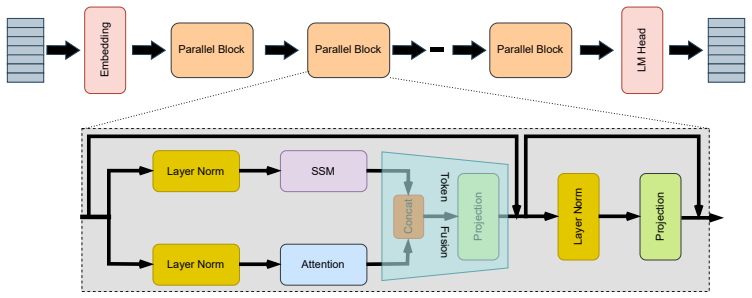
The load-bearing object is the token-splitting strategy, specifically the FLOP-Aware Circulating Split (FAC_Split). It measures the FLOPs per token of the attention branch and the SSM branch, then in each parallel block sends a number of tokens proportional to the inverse FLOP cost to each branch: the branch with the higher per-token cost processes a smaller contiguous block, and the cheaper branch processes the rest. Across blocks the starting position of the smaller block circulates, so over the network depth each branch observes every token at least once. The second mechanism is the token fusion module, which concatenates the normalized branch outputs and passes them through a linear projection before LayerNorm rather than averaging the branches or inserting learnable meta-tokens. These two parts together are what the paper credits for balancing compute while preserving representation expressivity.
What would settle it
Train FlowHN on a recall task where key tokens are assigned to different branches in the same block, such as a copying or long-context retrieval benchmark, and compare FAC_Split to No_Split; if the accuracy gap exceeds the roughly one-point differences reported on the six commonsense tasks, the split sacrifices global context that the fusion does not restore.
Extended reading notes
Core claim
The central claim is that the efficiency bottleneck of parallel hybrid architectures, one branch idling while the other computes plus the difficulty of combining divergent branch outputs, can be solved by splitting tokens by FLOP cost and by a concatenation-plus-projection fusion. FlowHN distributes each block's input tokens inversely to per-branch FLOPs, so the heavier branch gets fewer tokens and the lighter branch gets more; the circulating variant rotates which tokens go where across consecutive blocks, so each branch eventually sees the full sequence. The fused representation is formed by concatenating the branch outputs and projecting them to the model dimension, which the paper argues preserves complementary short-range attention and long-range SSM information better than averaging. The experiments aim to show that this design yields up to 4x Token per Second and up to 2x Model FLOPs Utilization relative to prior hybrids while keeping accuracy competitive; at 350M, for instance, the no-split variant reaches 41.31% average accuracy over six commonsense benchmarks, while the strongest parallel baseline reaches 39.78%.
Load-bearing premise
The claim depends on the assumption that processing tokens in disjoint subsets per block, even with circulation over later blocks, leaves enough global context for the fused representation to remain accurate.
Editorial extensions
If this is right
- At every tested scale, at least one FlowHN variant posts the highest average accuracy over six commonsense tasks: 38.85% at 135M, 41.31% at 350M, and 42.95% at 1B.
- Splitting raises throughput substantially: FAC_Split reaches about 34,430 tokens per second at 135M and 7,926 at 1B, versus 26,443 and 4,325 for the no-split variant at the same scales.
- FAC_Split achieves the highest MFU at scale, 47.63% at 1B, compared with 33.16% for the leading parallel hybrid baseline, suggesting the split keeps both branches busy.
- The accuracy cost of splitting shrinks as models grow: at 1B, FAC_Split's 41.97% is 0.98 points below no-split, while at 135M the gap is 1.44 points.
- Because the design needs no learnable meta-tokens, FlowHN avoids the extra sequence-length and memory overhead that the parallel baseline incurs.
Reading between the lines
- The circulating split can be read as a temporal ensemble: over depth, each branch sees the same token in different local contexts, so the fused representation may benefit from diversity without extra parameters; a controlled study that varies the number of blocks before circulation completes could test whether this diversity is load-bearing.
- The FLOP ratio is computed once from static op counts; on heterogeneous hardware or with input-dependent costs, a per-batch measured ratio could further tighten the split, and the paper's own limitation statement points toward dynamic routing by token helpfulness as the natural next step.
- The accuracy drop of the split modes is not uniform across tasks, so evaluating on recall-intensive or locally ambiguous benchmarks would show whether the fusion can fully compensate for the context lost in a single block.
Editorial analysis
A structured set of objections, weighed in public.
Referee Report
Summary. The paper introduces FlowHN, a parallel hybrid architecture that combines an attention branch and an SSM branch in each block, with a token-splitting mechanism to balance computational load. Three split strategies (AE_Split, FA_Split, FAC_Split) are proposed and compared to a no-split configuration across 135M, 350M, and 1B parameter models trained on SlimPajama-6B. The experiments report TPS, MFU, and average accuracy against LLaMA, Mamba-1/2, Jamba, a sequential hybrid (SHM), and Hymba. The paper claims up to 4x higher TPS and 2x better MFU while maintaining accuracy, with the FAC_Split strategy as the headline contribution.
Significance. If the efficiency and accuracy claims were fully validated, FlowHN would be a useful addition to the active line of work on hybrid attention/SSM architectures, particularly for improving hardware utilization in parallel hybrids. The conceptual idea of a FLOP-aware circulating token split that balances branch workloads while preserving cross-block token coverage is interesting and could inspire further work. However, the paper ships no code, no repeated trials, and no compute-matched accuracy comparison, so the quantitative claims currently rest on a thin and partially contradictory evidence base. The architecture itself and the token-fusion idea are worth pursuing, but the present manuscript does not yet establish the claimed advantages.
major comments (4)
- [Section 3.4 and Algorithm 1] Algorithm 1 does not implement the circulating token assignment described in Section 3.4 and illustrated in Figure 2. For L=6 and block_size=4, the first block sends tokens 1-4 to the SSM and 5-6 to attention; in the second block, end_index >= L, so the algorithm enters the else branch, resets block_index to 0, and processes no data; the third block repeats the first split. This is a different pattern from the rotation described in the text (tokens 1-2 and 5-6 to SSM in block 2, tokens 3-6 to SSM in block 3). The core mechanism of FAC_Split is therefore under-specified and not reproducible from the pseudocode.
- [Table 1 and abstract claims] The central claim that FlowHN achieves higher accuracy while being faster is not supported by the data for the efficient split variants. FAC_Split is consistently less accurate than No_Split (37.41 vs 38.85 at 135M, 40.56 vs 41.31 at 350M, 41.97 vs 42.95 at 1B), and it is also below Hymba at 135M (37.41 vs 37.99) and 1B (41.97 vs 42.41). No_Split, which has the best accuracy, shows essentially no TPS advantage over SHM (1.03x, 1.00x, and 0.88x at the three scales). The paper never compares the split variants against a compute-matched no-split model, so the claimed efficiency gain is not distinguished from simply spending less compute per token. The abstract's statement of "significantly improved accuracy as compared to other competing works" is contradicted by Table 1 for the headline FAC_Split strategy.
- [Section 4.3 and Equation (1)] The TPS and MFU measurements are single-run values with no error bars, no multiple seeds, and no reported variance, making it impossible to assess whether the differences among models are meaningful. The MFU calculation relies on per-model FLOPs/Token, but these are not tabulated; only LLaMA-350M (27.46T FLOPs/Iter) and FlowHN-350M (19.24T FLOPs/Iter) appear in the prose. The claimed "up to 4x TPS" is not supported by the table: the largest ratio to any baseline is 34430/9393 = 3.67x at 135M against Hymba, and the 2x MFU claim is also based on a single favorable comparison (47.63 vs 14.89 at 350M) while versus SHM the FAC_Split MFU gains are only 1.01x, 1.09x, and 1.01x. Reporting maximal ratios against the weakest baseline without a complete ratio table is misleading.
- [Sections 3.2 and 5] The paper acknowledges "slight information loss" for split strategies, but the magnitude is not quantified against the compute savings. The accuracy drop of roughly 1.0-1.5 points between No_Split and FAC_Split at 135M and 350M is comparable to or larger than the differences among the baseline models, so this is not a slight loss in the context of the reported accuracy scale. The conclusion that "FlowHN consistently outperforms existing hybrid parallel architectures" is contradicted by the FAC_Split results at 135M and 1B, where Hymba scores higher. A thorough accuracy-FLOPs tradeoff analysis is needed before the efficiency claims can be accepted.
minor comments (5)
- [Figures 3 and 4] The labels PHM_A through PHM_D are used in the figures but are not defined in the text or captions; they should be explicitly mapped to No_Split, AE_Split, FA_Split, and FAC_Split.
- [Table 1] The "Tokens" column header is ambiguous; the values (1B, 2B) appear to denote the training token budget, but the header could be confused with a model attribute. It should be renamed to "Training Tokens" or "Budget".
- [Section 4.2] The sentence "each configuration was trained using exactly 1,024 tokens" should read "a sequence length of 1,024 tokens" for clarity.
- [Algorithm 1] Line 8 computes block_size as L/(F_s/F_a + 1), which may not be an integer; the algorithm should specify whether floor/ceil is applied and how the final partial block is handled.
- [Equation (1)] The two expressions for MFU are dimensionally equivalent only if FLOPs/Iter, FLOPs/Token, and Iter/Sec are defined consistently for the forward and backward passes; this should be stated explicitly.
Circularity Check
No circular reasoning found: FlowHN's efficiency and accuracy claims rest on direct measurements and a FLOP-based heuristic, not on fitted parameters or self-citation chains.
full rationale
I walked the claimed derivation chain. The architecture's token-splitting strategies (No_Split, AE_Split, FA_Split, FAC_Split) are defined as routing procedures; FAC_Split's block size is set from measured per-branch FLOPs (Algorithm 1: block_size ← L/(F_s/F_a + 1)), not fitted to the reported accuracies. The headline claims (up to 4× TPS, up to 2× MFU) are presented as measured outcomes from Table 1 and Figures 3-4, not as derivations from the architecture. The only equation used in the discussion is the standard MFU identity (Eq. 1), and the statement that MFU improves with scale follows analytically from that definition rather than constituting a prediction that is equivalent to its input. No prior work by the same authors is cited as load-bearing; baselines are externally implemented and trained from scratch under identical conditions, and the paper admits its own limitations (e.g., accuracy drops for split variants, limited task coverage) rather than masking them. Therefore no step reduces, by construction or by self-citation, to its own inputs.
Assumptions & free parameters
free parameters (1)
- FLOP ratio F_s/F_a =
not disclosed
assumptions (3)
- domain assumption Disjoint token subsets preserve sufficient contextual information for each branch
- domain assumption FLOP counts accurately predict wall-clock execution time on the target GPU
- domain assumption Concatenation plus linear projection adequately fuses divergent branch outputs
Cite this review
Pith. "Pith review of Balancing Computation Load and Representation Expressivity in Parallel Hybrid Neural Networks." pith.science (2026). https://pith.science/paper/WW4MPEUJ
@misc{pith2026250519472,
  author       = {Pith},
  title        = {Pith review of: Balancing Computation Load and Representation Expressivity in Parallel Hybrid Neural Networks},
  year         = {2026},
  howpublished = {\url{https://pith.science/paper/WW4MPEUJ}},
  note         = {Machine review of arXiv:2505.19472}
}
read the original abstract
Attention and State-Space Models (SSMs) when combined in a hybrid network in sequence or in parallel provide complementary strengths. In a hybrid sequential pipeline they alternate between applying a transformer to the input and then feeding its output into a SSM. This results in idle periods in the individual components increasing end-to-end latency and lowering throughput caps. In the parallel hybrid architecture, the transformer operates independently in parallel with the SSM, and these pairs are cascaded, with output from one pair forming the input to the next. Two issues are (i) creating an expressive knowledge representation with the inherently divergent outputs from these separate branches, and (ii) load balancing the computation between these parallel branches, while maintaining representation fidelity. In this work we present FlowHN, a novel parallel hybrid network architecture that accommodates various strategies for load balancing, achieved through appropriate distribution of input tokens between the two branches. Two innovative differentiating factors in FlowHN include a FLOP aware dynamic token split between the attention and SSM branches yielding efficient balance in compute load, and secondly, a method to fuse the highly divergent outputs from individual branches for enhancing representation expressivity. Together they enable much better token processing speeds, avoid bottlenecks, and at the same time yield significantly improved accuracy as compared to other competing works. We conduct comprehensive experiments on autoregressive language modeling for models with 135M, 350M, and 1B parameters. FlowHN outperforms sequential hybrid models and its parallel counterpart, achieving up to 4* higher Tokens per Second (TPS) and 2* better Model FLOPs Utilization (MFU).
Figures


Figures from the paper (1 more)

Reference graph
Works this paper leans on
-
[1]
Marah Abdin, Jyoti Aneja, Hany Awadalla, Ahmed Awadallah, Ammar Ahmad Awan, Nguyen Bach, Amit Bahree, Arash Bakhtiari, Jianmin Bao, Harkirat Behl, et al. Phi-3 technical report: A highly capable language model locally on your phone.arXiv preprint arXiv:2404.14219,
-
[4]
Daniel Y Fu, Tri Dao, Khaled K Saab, Armin W Thomas, Atri Rudra, and Christopher Ré. Hungry hungry hippos: Towards language modeling with state space models.arXiv preprint arXiv:2212.14052,
-
[6]
Efficiently modeling long sequences with structured state spaces
Albert Gu, Karan Goel, and Christopher Ré. Efficiently modeling long sequences with structured state spaces. arXiv preprint arXiv:2111.00396,
-
[9]
Amirkeivan Mohtashami and Martin Jaggi. Landmark attention: Random-access infinite context length for transformers.arXiv preprint arXiv:2305.16300,
-
[10]
Can mamba learn how to learn? a comparative study on in-context learning tasks
Jongho Park, Jaeseung Park, Zheyang Xiong, Nayoung Lee, Jaewoong Cho, Samet Oymak, Kangwook Lee, and Dimitris Papailiopoulos. Can mamba learn how to learn? a comparative study on in-context learning tasks. arXiv preprint arXiv:2402.04248,
-
[11]
Rwkv: Reinventing rnns for the transformer era.arXiv preprint arXiv:2305.13048,
Bo Peng, Eric Alcaide, Quentin Anthony, Alon Albalak, Samuel Arcadinho, Stella Biderman, Huanqi Cao, Xin Cheng, Michael Chung, Matteo Grella, et al. Rwkv: Reinventing rnns for the transformer era.arXiv preprint arXiv:2305.13048,
-
[12]
Liliang Ren, Yang Liu, Yadong Lu, Yelong Shen, Chen Liang, and Weizhu Chen. Samba: Simple hybrid state space models for efficient unlimited context language modeling.arXiv preprint arXiv:2406.07522,
-
[13]
URL https://huggingface.co/datasets/cerebras/SlimPajama-627B. Jamba Team, Barak Lenz, Alan Arazi, Amir Bergman, Avshalom Manevich, Barak Peleg, Ben Aviram, Chen Almagor, Clara Fridman, Dan Padnos, et al. Jamba-1.5: Hybrid transformer-mamba models at scale.arXiv preprint arXiv:2408.12570,
Show all 15 references
-
[14]
Gated linear attention transformers with hardware-efficient training.arXiv preprint arXiv:2312.06635,
Songlin Yang, Bailin Wang, Yikang Shen, Rameswar Panda, and Yoon Kim. Gated linear attention transformers with hardware-efficient training.arXiv preprint arXiv:2312.06635,
-
[15]
Zeta: Leveraging z-order curves for efficient top-k attention.arXiv preprint arXiv:2501.14577,
Qiuhao Zeng, Jerry Huang, Peng Lu, Gezheng Xu, Boxing Chen, Charles Ling, and Boyu Wang. Zeta: Leveraging z-order curves for efficient top-k attention.arXiv preprint arXiv:2501.14577,
-
[2020]
Jamba: A hybrid transformer-mamba language model
Opher Lieber, Barak Lenz, Hofit Bata, Gal Cohen, Jhonathan Osin, Itay Dalmedigos, Erez Safahi, Shaked Meirom, Yonatan Belinkov, Shai Shalev-Shwartz, et al. Jamba: A hybrid transformer-mamba language model. arXiv preprint arXiv:2403.19887,
-
[2021]
Bridging the divide: Reconsidering softmax and linear attention.Advances in Neural Information Processing Systems, 37:79221–79245, 2024a
Dongchen Han, Yifan Pu, Zhuofan Xia, Yizeng Han, Xuran Pan, Xiu Li, Jiwen Lu, Shiji Song, and Gao Huang. Bridging the divide: Reconsidering softmax and linear attention.Advances in Neural Information Processing Systems, 37:79221–79245, 2024a. Dongchen Han, Ziyi Wang, Zhuofan X...
-
[2022]
Mamba: Linear-time sequence modeling with selective state spaces.arXiv preprint arXiv:2312.00752,
Albert Gu and Tri Dao. Mamba: Linear-time sequence modeling with selective state spaces.arXiv preprint arXiv:2312.00752,
-
[2023]
Transformers are ssms: Generalized models and efficient algorithms through structured state space duality.arXiv preprint arXiv:2405.21060,
Tri Dao and Albert Gu. Transformers are ssms: Generalized models and efficient algorithms through structured state space duality.arXiv preprint arXiv:2405.21060,
-
[2024]
Hymba: A hybrid-head architecture for small language models.arXiv preprint arXiv:2411.13676,
9 Xin Dong, Yonggan Fu, Shizhe Diao, Wonmin Byeon, Zijia Chen, Ameya Sunil Mahabaleshwarkar, Shih-Yang Liu, Matthijs Van Keirsbilck, Min-Hung Chen, Yoshi Suhara, et al. Hymba: A hybrid-head architecture for small language models.arXiv preprint arXiv:2411.13676,
Reviewed August 7, 2026 · model on record in the stance chip above.
Discussion (0). Sign in to comment.