REVIEW 4 major objections 6 minor 35 references
LogiCoL: Logically-Informed Contrastive Learning for Set-based Dense Retrieval
T0 review · 4 major / 6 minor · reviewed 2026-08-07 · deepseek-v4-flash
Pith's one-line read LogiCoL trains dense retrievers with soft subset and exclusion constraints, so that queries like "A and B" and "A but not B" produce well-separated result sets; on the QUEST benchmark it lifts Recall@1000 by 2–3 points and cuts…
desk verdict The LogiCoL recipe (grouped batching plus constraint losses) does beat SupCon across four backbones, but the paper's own ablation shows the constraint losses add almost nothing—the batching is doing the work. read the letter →
The pith
A machine-rendered reading of the paper's core claim, the machinery that carries it, and where it could break.
The reading
What carries the argument
The mechanism that carries the argument is a joint constrained learning objective built on supervised contrastive learning. The base loss is a multi-positive variant of InfoNCE that allows each query to have several ground-truth documents in-batch. On top of it, two regularization terms encode logical relations: the exclusion loss uses the symmetric KL divergence between two queries' softmax-normalized similarity distributions over the batch documents, pushed apart by a margin; the subset loss uses the product t-norm to penalize cases where a document scores high for the logically narrower query but low for the broader one. These constraints are only computed over documents in the training mini-batch, and the batching strategy deliberately places queries sharing atomic sub-queries but differing in connectives into the same batch, so the model sees the logical distinction directly during training.
What would settle it
Evaluate the subset and exclusion losses on each model's top-100 retrieved documents from the full corpus (not just in-batch documents): if LogiCoL leaves corpus-level overlap between mutually exclusive query result sets and corpus-level subset violations essentially unchanged while reducing in-batch losses, the central claim of transfer fails.
Extended reading notes
Core claim
The paper's central discovery is that explicitly constraining the similarity distributions of logically related queries during contrastive training makes dense retrievers represent logical structure in the embedding space. Concretely, for a pair of queries that should retrieve disjoint sets (e.g., A∩B vs A\B), LogiCoL maximizes the symmetric KL divergence between their softmax-normalized document-similarity distributions; for a pair where one result set should be a subset of the other (e.g., A∩B vs A), it penalizes any document receiving high similarity from the subset query while scoring low on the superset query, using the product t-norm. Models trained this way show much lower correlation between mutually exclusive queries' similarity scores — Pearson r drops from 0.88 to 0.13 in one example — and their retrieved results are far less likely to include logically excluded documents. The authors interpret this as evidence that logical connectives, not just lexical or semantic overlap, can be learned as first-class geometric structure by the retriever.
Load-bearing premise
The subset and exclusion losses are computed only over the documents in each training batch, so the argument assumes that shaping the model's similarity distributions on a small in-batch sample generalizes to its ranking over the full corpus of roughly 300,000 documents.
Editorial extensions
If this is right
- Any dual- or bi-encoder dense retriever can be fine-tuned with LogiCoL without changing its architecture or inference-time behavior; the reported gains are consistent across four backbones (GTR-base, GTE-base, Contriever, E5-base-v2).
- The largest retrieval gains appear on intersection and negation queries, precisely the templates where standard contrastive learning treats all logical operators as union; models trained with LogiCoL separate these templates instead of collapsing them.
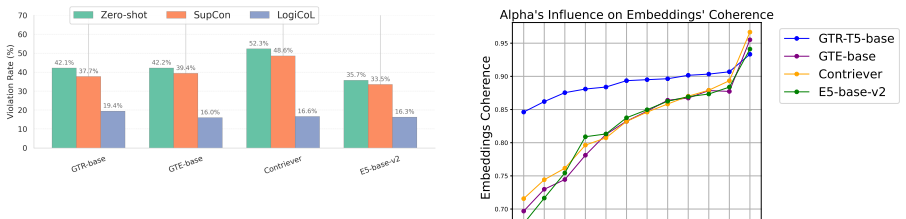
- LogiCoL reduces the rate at which negation queries rank logically excluded documents above ground-truth documents by over 20% relative to SupCon, indicating that logical consistency can be trained into the representation rather than patched at decode time.
- The mixed batching strategy — combining random samples with groups of related queries — is necessary: pure grouped batching can hurt semantic generalization, while pure random batching loses the logical signal; the best operating point is around α=0.5–0.7 in the paper's experiments.
- The augmentation of QUEST with template-based variants (QUEST+VARIANTS) yields a larger training and evaluation set, and LogiCoL's gains are even larger on it (about 5% Recall@1000), suggesting the method benefits from denser logical coverage in training data.
Reading between the lines
- Because the constraints are enforced on in-batch distributions, the gains may transfer to the full corpus only insofar as the batch is a representative microcosm of the ranking problem; a natural extension would evaluate the same losses on hard negatives mined from the full 300k corpus to test whether corpus-level constraint satisfaction improves further.
- The subset and exclusion losses are generic set-relation regularizers; they could in principle be applied to other logical templates (e.g., complement or symmetric difference) or to structured retrieval tasks beyond entity seeking, such as multi-hop QA where intermediate sets must be chained.
- The paper's evidence that mutual-exclusion queries become geometrically decorrelated suggests a cheap probe for logical consistency: measure the correlation of top-k similarity distributions for logically disjoint query pairs; LogiCoL predicts this correlation should approach zero or go negative after training.
- One could test whether the method's benefit is specifically the logical constraints or partly the grouped batching's effect on hard negatives; the ablation suggests both matter, but a controlled comparison holding batch composition fixed while removing only the constraint losses would isolate the contribution of each.
Editorial analysis
A structured set of objections, weighed in public.
Referee Report
Summary. This paper introduces LogiCoL, a training objective for dense retrievers that augments supervised contrastive learning with two logic-based regularizers: an exclusion loss that maximizes symmetric KL divergence between similarity distributions of mutually exclusive queries, and a subset loss that penalizes violations of the implication that relevance to a subquery entails relevance to its superquery. The method also uses a mixed batching strategy that groups queries sharing atomic subqueries. The authors evaluate on QUEST and on an augmented dataset QUEST+VARIANTS, reporting consistent improvements over SupCon across four encoder backbones on the original QUEST test set, and larger gains on the augmented test set, plus analyses of logical consistency violation rates and embedding coherence. The paper includes an ablation study and a hyperparameter analysis of the batch-mixture ratio.
Significance. If the central claim holds, LogiCoL is a practically useful contribution: it provides a training-time mechanism to make dense retrievers respect set-based logical relations, with consistent gains on an independent benchmark (QUEST) across four different backbone encoders. The paper also contributes a reproducible training recipe, with code and data publicly linked, and a thoughtful analysis of why logical queries are hard for dense retrievers. The most valuable part is the demonstration that a small, targeted change to contrastive training can improve recall and logical consistency. However, the paper's central attribution of the improvement to the constraint terms is not fully supported by the reported ablation, and the augmented evaluation set is constructed from the same set operations the method is trained to satisfy, so the larger numbers on QUEST+VARIANTS should be treated with caution.
major comments (4)
- [§4.5, Table 4] The paper's central claim is that the joint constrained learning objective (the subset and exclusion losses) improves retrieval performance, but Table 4 shows that removing these constraints yields only small differences: for Contriever, R@1000 drops from 71.46 to 71.39 and R@100 from 39.38 to 39.21; for E5-base-v2, R@1000 drops from 73.52 to 73.26 and R@100 from 42.13 to 41.73. These deltas are much smaller than the SupCon-to-LogiCoL gaps of 2.16 and 3.20 R@1000 for Contriever and E5 respectively, and the paper reports no variance or significance testing. The sentence in §4.5 that LOGICOL 'further improves upon LOGICOL – Constraints' is therefore not established by the evidence presented. Please provide multiple seeds with standard deviations, paired bootstrap tests, or another significance measure, and discuss whether the constraints' contribution is practically meaningful beyond the batching and data augmentation effects.
- [§3.3.2, Eq. (2)] The subset loss uses log sim(q₁,d) and log sim(q₂,d), but the similarity scores are cosine similarities, which can take negative values, making the logarithm undefined. The paper does not state a positivity transform, a clipping operation, or an alternative formulation. Since the subset loss is one of the two central constraint terms, this omission makes the objective as written not well-defined. Please specify the exact transformation used (e.g., sim ∈ (0,1], or a shifted/clipped version) and confirm that the implemented loss matches the equation.
- [§3.1 and §4.1, QUEST+VARIANTS] The augmented test set QUEST+VARIANTS is constructed by taking atomic ground-truth sets and applying set operations (intersection, union, difference) to derive ground-truth sets for the new queries, as described in Appendix A.1. This is exactly the relation LogiCoL is trained to enforce, so the larger reported gains on QUEST+VARIANTS (e.g., roughly 5% R@1000 gains versus 2–3% on QUEST) are partly a closed loop. The original QUEST test set is independent and shows consistent though smaller improvements, so the paper's main claim should be presented primarily on QUEST, and the augmented-set results should be framed as a stress test with a clear statement of their constructed nature. Ideally, add a human-verified subset of the augmented test or report only on original QUEST for the headline claim.
- [§3.2–§3.3 and §4.5] The exclusion and subset losses operate on similarity distributions over the documents in the current training mini-batch, which contain only one sampled positive per query (plus whatever positives co-occur), rather than over the actual retrieval distribution from the 300k-document corpus. The paper's evidence that this in-batch separation transfers to corpus-level ranking is limited to two query visualizations (Figures 2–3) and the aggregated violation rate in Figure 4, which is computed on the augmented test set. The skepticism that batch-level KL separation might not transfer to corpus-level candidate distributions is not addressed. Please provide corpus-level evidence that the constraints improve ranking behavior, for example by reporting logical consistency metrics on the original QUEST test set, or by analyzing constraint satisfaction over the full corpus rather than only in-batch documents.
minor comments (6)
- [Throughout] The augmented dataset is consistently spelled 'QUEST+VARAIANTS' in the text and tables; this appears to be a typo for 'QUEST+VARIANTS'.
- [§4.3] The implementation details state 'γe = 0.2 and γe = 0.2'; the second hyperparameter should likely be γs, the subset-loss margin.
- [§4.2 and Limitations] The main text says 'average effective batch size of 16' while the Limitations section says 'effective batch size of 32'. Please reconcile this inconsistency.
- [§5.2] The sentence 'As shown in Figure 4, the performance experiences a slight drop...' appears to refer to Figure 6, which plots Recall@100 versus α; Figure 4 plots violation rates. Please correct the cross-reference.
- [§2 and Figures 2–3] The two query pairs used to illustrate similarity-distribution correlation are anecdotal; please state how these examples were selected and whether the pattern holds more broadly across templates.
- [Table 2] No variance, confidence intervals, or significance tests are reported for any of the main results. Even if a full significance analysis is added for the ablation, the main table would benefit from at least error bars on the key metrics.
Circularity Check
No significant circularity: LogiCoL's training objective and evaluation are distinct, and the original QUEST test set provides independent grounding.
full rationale
The claimed derivation—that adding subset/exclusion regularizers to supervised contrastive learning improves retrieval on logical set queries—is not equivalent to its inputs. The constraints in Eqs. (1)–(2) are computed over in-batch similarity distributions and are used only during training; the reported metrics (Recall@k and the violation rate of Eq. 4) are computed from held-out rankings over the full corpus. The original QUEST test set (1,727 queries, Table 1) is an externally constructed benchmark, and the main gains (e.g., E5-base-v2 R@1000 rising from 70.32 to 73.52 on QUEST) are measured there, independent of the authors' augmentation pipeline. The QUEST+VARIANTS set is admittedly synthesized by applying set operations to atomic ground-truth sets (Appendix A.1), so its label algebra matches the training objective; however, this alignment is a data-generation choice, not a fitted parameter or definitional reduction, and it does not force the ranking predictions. Self-citations to QUEST (Malaviya et al., 2023) and to joint-constrained-learning background (Roth and Yih 2004, 2007) are contextual and not load-bearing; no uniqueness claim is imported from the authors. The appended Limitations section acknowledges moderate model scale (110M parameters) and batch size 32, but those are scope limitations, not circularity. The small ablation gap in Table 4 is an empirical/statistical concern rather than a circularity concern. Therefore no circular step is exhibited under the required standard.
Assumptions & free parameters
free parameters (6)
- lambda_E =
0.1
- lambda_S =
0.1
- gamma_e =
0.2
- gamma_s =
0.2
- alpha =
not stated in main text
- effective batch size =
16 (main text) vs 32 (limitations)
assumptions (4)
- domain assumption The ground truth document set for an augmented complex query is exactly the result of applying the corresponding set operation to the atomic ground truth document sets.
- ad hoc to paper Logical consistency between query result sets can be enforced by constraints on similarity distributions over the small in-batch document pool.
- ad hoc to paper The cosine similarity scores used in the log-based subset loss are positive, or the authors apply an unstated transformation to make them positive.
- ad hoc to paper A subset relation between queries can be expressed as a per-document score inequality of the form sim(q1,d) <= sim(q2,d) plus margin.
Cite this review
Pith. "Pith review of LogiCoL: Logically-Informed Contrastive Learning for Set-based Dense Retrieval." pith.science (2026). https://pith.science/paper/3NAICPAS
@misc{pith2026250519588,
  author       = {Pith},
  title        = {Pith review of: LogiCoL: Logically-Informed Contrastive Learning for Set-based Dense Retrieval},
  year         = {2026},
  howpublished = {\url{https://pith.science/paper/3NAICPAS}},
  note         = {Machine review of arXiv:2505.19588}
}
read the original abstract
While significant progress has been made with dual- and bi-encoder dense retrievers, they often struggle on queries with logical connectives, a use case that is often overlooked yet important in downstream applications. Current dense retrievers struggle with such queries, such that the retrieved results do not respect the logical constraints implied in the queries. To address this challenge, we introduce LogiCoL, a logically-informed contrastive learning objective for dense retrievers. LogiCoL builds upon in-batch supervised contrastive learning, and learns dense retrievers to respect the subset and mutually-exclusive set relation between query results via two sets of soft constraints expressed via t-norm in the learning objective. We evaluate the effectiveness of LogiCoL on the task of entity retrieval, where the model is expected to retrieve a set of entities in Wikipedia that satisfy the implicit logical constraints in the query. We show that models trained with LogiCoL yield improvement both in terms of retrieval performance and logical consistency in the results. We provide detailed analysis and insights to uncover why queries with logical connectives are challenging for dense retrievers and why LogiCoL is most effective.
Figures


Figures from the paper (2 more)

Reference graph
Works this paper leans on
-
[1]
URL: " 'urlintro :=
ENTRY address author booktitle chapter edition editor howpublished institution journal key month note number organization pages publisher school series title type volume year eprint doi pubmed url lastchecked label extra.label sort.label short.list INTEGERS output.state before.all mid.sentence after.sentence after.block STRINGS urlintro eprinturl eprintpr...
-
[2]
write newline
" write newline "" before.all 'output.state := FUNCTION n.dashify 't := "" t empty not t #1 #1 substring "-" = t #1 #2 substring "--" = not "--" * t #2 global.max substring 't := t #1 #1 substring "-" = "-" * t #2 global.max substring 't := while if t #1 #1 substring * t #2 global.max substring 't := if while FUNCTION word.in bbl.in capitalize " " * FUNCT...
-
[3]
Danqi Chen, Adam Fisch, Jason Weston, and Antoine Bordes. 2017. https://doi.org/10.18653/v1/P17-1171 Reading W ikipedia to answer open-domain questions . In Proceedings of the 55th Annual Meeting of the Association for Computational Linguistics (Volume 1: Long Papers), pages 1870--1879, Vancouver, Canada. Association for Computational Linguistics
-
[4]
Jacob Devlin, Ming-Wei Chang, Kenton Lee, and Kristina Toutanova. 2019. Bert: Pre-training of deep bidirectional transformers for language understanding. In Proceedings of the 2019 conference of the North American chapter of the association for computational linguistics: human language technologies, volume 1 (long and short papers), pages 4171--4186
2019
-
[5]
Huawen Feng, Junlong Liu, Junhao Zheng, Haibin Chen, Xichen Shang, and Qianli Ma. 2023. Joint constrained learning with boundary-adjusting for emotion-cause pair extraction. In Proceedings of the 61st Annual Meeting of the Association for Computational Linguistics (Volume 1: Long Papers), pages 1118--1131
work page 2023
-
[6]
Tianyu Gao, Xingcheng Yao, and Danqi Chen. 2021. Simcse: Simple contrastive learning of sentence embeddings. arXiv preprint arXiv:2104.08821
arXiv 2021
-
[7]
Sebastian Hofst \"a tter, Sheng-Chieh Lin, Jheng-Hong Yang, Jimmy Lin, and Allan Hanbury. 2021. Efficiently teaching an effective dense retriever with balanced topic aware sampling. In Proceedings of the 44th International ACM SIGIR Conference on Research and Development in Information Retrieval, pages 113--122
work page 2021
-
[8]
Gautier Izacard, Mathilde Caron, Lucas Hosseini, Sebastian Riedel, Piotr Bojanowski, Armand Joulin, and Edouard Grave. 2021. Unsupervised dense information retrieval with contrastive learning. arXiv preprint arXiv:2112.09118
arXiv 2021
Show all 35 references
-
[9]
Vladimir Karpukhin, Barlas Oguz, Sewon Min, Patrick SH Lewis, Ledell Wu, Sergey Edunov, Danqi Chen, and Wen-tau Yih. 2020. Dense passage retrieval for open-domain question answering. In EMNLP (1), pages 6769--6781
2020
-
[10]
Prannay Khosla, Piotr Teterwak, Chen Wang, Aaron Sarna, Yonglong Tian, Phillip Isola, Aaron Maschinot, Ce Liu, and Dilip Krishnan. 2020. Supervised contrastive learning. Advances in neural information processing systems, 33:18661--18673
2020
-
[11]
Antonios Minas Krasakis, Andrew Yates, and Evangelos Kanoulas. 2025. Constructing set-compositional and negated representations for first-stage ranking. arXiv preprint arXiv:2501.07679
2025 arXiv
-
[12]
Dai, Jakob Uszkoreit, Quoc Le, and Slav Petrov
Tom Kwiatkowski, Jennimaria Palomaki, Olivia Redfield, Michael Collins, Ankur Parikh, Chris Alberti, Danielle Epstein, Illia Polosukhin, Jacob Devlin, Kenton Lee, Kristina Toutanova, Llion Jones, Matthew Kelcey, Ming-Wei Chang, Andrew M. Dai, Jakob Uszkoreit, Quoc Le, and Slav...
2019 doi
-
[13]
Tao Li, Vivek Gupta, Maitrey Mehta, and Vivek Srikumar. 2019. A logic-driven framework for consistency of neural models. arXiv preprint arXiv:1909.00126
2019 arXiv
-
[14]
Tao Li and Vivek Srikumar. 2019. Augmenting neural networks with first-order logic. arXiv preprint arXiv:1906.06298
2019 arXiv
-
[15]
Zehan Li, Xin Zhang, Yanzhao Zhang, Dingkun Long, Pengjun Xie, and Meishan Zhang. 2023. Towards general text embeddings with multi-stage contrastive learning. arXiv preprint arXiv:2308.03281
2023 arXiv
-
[16]
Jiawei Ma, Po-Yao Huang, Saining Xie, Shang-Wen Li, Luke Zettlemoyer, Shih-Fu Chang, Wen-Tau Yih, and Hu Xu. 2024. Mode: Clip data experts via clustering. In Proceedings of the IEEE/CVF Conference on Computer Vision and Pattern Recognition, pages 26354--26363
2024
-
[17]
Quan Mai, Susan Gauch, and Douglas Adams. 2024. Setbert: Enhancing retrieval performance for boolean logic and set operation queries. In Proceedings of the 2024 8th International Conference on Natural Language Processing and Information Retrieval, pages 162--167
2024
-
[18]
Chaitanya Malaviya, Peter Shaw, Ming-Wei Chang, Kenton Lee, and Kristina Toutanova. 2023. Quest: A retrieval dataset of entity-seeking queries with implicit set operations. arXiv preprint arXiv:2305.11694
2023 arXiv
-
[19]
John X Morris and Alexander M Rush. 2024. Contextual document embeddings. arXiv preprint arXiv:2410.02525
2024 arXiv
-
[20]
Tri Nguyen, Mir Rosenberg, Xia Song, Jianfeng Gao, Saurabh Tiwary, Rangan Majumder, and Li Deng. 2016. Ms marco: A human-generated machine reading comprehension dataset
2016
-
[21]
Jianmo Ni, Chen Qu, Jing Lu, Zhuyun Dai, Gustavo Hern \'a ndez \'A brego, Ji Ma, Vincent Y Zhao, Yi Luan, Keith B Hall, Ming-Wei Chang, et al. 2021. Large dual encoders are generalizable retrievers. arXiv preprint arXiv:2112.07899
2021 arXiv
-
[22]
Aaron van den Oord, Yazhe Li, and Oriol Vinyals. 2018. Representation learning with contrastive predictive coding. arXiv preprint arXiv:1807.03748
2018 arXiv
-
[23]
Fabio Petroni, Aleksandra Piktus, Angela Fan, Patrick Lewis, Majid Yazdani, Nicola De Cao, James Thorne, Yacine Jernite, Vladimir Karpukhin, Jean Maillard, Vassilis Plachouras, Tim Rockt \"a schel, and Sebastian Riedel. 2021. https://doi.org/10.18653/v1/2021.naacl-main.200 KIL...
2021 doi
-
[24]
Stephen Robertson, Hugo Zaragoza, et al. 2009. The probabilistic relevance framework: Bm25 and beyond. Foundations and Trends in Information Retrieval , 3(4):333--389
2009
-
[25]
Joshua Robinson, Ching-Yao Chuang, Suvrit Sra, and Stefanie Jegelka. 2020. Contrastive learning with hard negative samples. arXiv preprint arXiv:2010.04592
2020 arXiv
-
[26]
Dan Roth and Wen-tau Yih. 2004. A linear programming formulation for global inference in natural language tasks. In Proceedings of the eighth conference on computational natural language learning (CoNLL-2004) at HLT-NAACL 2004, pages 1--8
2004
-
[27]
Dan Roth and Wen-tau Yih. 2007. Global inference for entity and relation identification via a linear programming formulation. Introduction to statistical relational learning, pages 553--580
2007
-
[28]
Vin Sachidananda, Ziyi Yang, and Chenguang Zhu. 2023. Global selection of contrastive batches via optimization on sample permutations. In International Conference on Machine Learning, pages 29542--29562. PMLR
2023
-
[29]
Aivin V Solatorio. 2024. Gistembed: Guided in-sample selection of training negatives for text embedding fine-tuning. arXiv preprint arXiv:2402.16829
2024 arXiv
-
[30]
Haoyu Wang, Muhao Chen, Hongming Zhang, and Dan Roth. 2020. Joint constrained learning for event-event relation extraction. arXiv preprint arXiv:2010.06727
2020 arXiv
-
[31]
Liang Wang, Nan Yang, Xiaolong Huang, Binxing Jiao, Linjun Yang, Daxin Jiang, Rangan Majumder, and Furu Wei. 2022. Text embeddings by weakly-supervised contrastive pre-training. arXiv preprint arXiv:2212.03533
2022 arXiv
-
[32]
Orion Weller, Dawn Lawrie, and Benjamin Van Durme. 2024. Nevir: Negation in neural information retrieval. In Proceedings of the 18th Conference of the European Chapter of the Association for Computational Linguistics (Volume 1: Long Papers), pages 2274--2287
2024
-
[33]
Lee Xiong, Chenyan Xiong, Ye Li, Kwok-Fung Tang, Jialin Liu, Paul Bennett, Junaid Ahmed, and Arnold Overwijk. 2020. Approximate nearest neighbor negative contrastive learning for dense text retrieval. arXiv preprint arXiv:2007.00808
2020 arXiv
-
[34]
Yu Zhang, Yanzhen Shen, SeongKu Kang, Xiusi Chen, Bowen Jin, and Jiawei Han. 2025. Chain-of-factors paper-reviewer matching. In Proceedings of the ACM on Web Conference 2025, pages 1901--1910
2025
-
[35]
Zongmeng Zhang, Jinhua Zhu, Wengang Zhou, Xiang Qi, Peng Zhang, and Houqiang Li. 2024. Boolquestions: Does dense retrieval understand boolean logic in language? arXiv preprint arXiv:2411.12235
2024 arXiv
Reviewed August 7, 2026 · model on record in the stance chip above.
Discussion (0). Sign in to comment.