REVIEW 4 major objections 4 minor 98 references
LangDAug: Langevin Data Augmentation for Multi-Source Domain Generalization in Medical Image Segmentation
T0 review · 4 major / 4 minor · reviewed 2026-08-07 · deepseek-v4-flash
Pith's one-line read The paper proposes LangDAug, which trains energy-based models for each source-domain pair and uses intermediate Langevin-dynamics samples as labeled augmentation data, claiming state-of-the-art domain generalization on retinal fundus and…
desk verdict A useful empirical augmentation recipe with code and consistent gains on two medical segmentation benchmarks, but the theory analyzes a one-step true-score model that the implemented latent-space 40-step Langevin pipeline does not approximate. read the letter →
The pith
A machine-rendered reading of the paper's core claim, the machinery that carries it, and where it could break.
The reading
What carries the argument
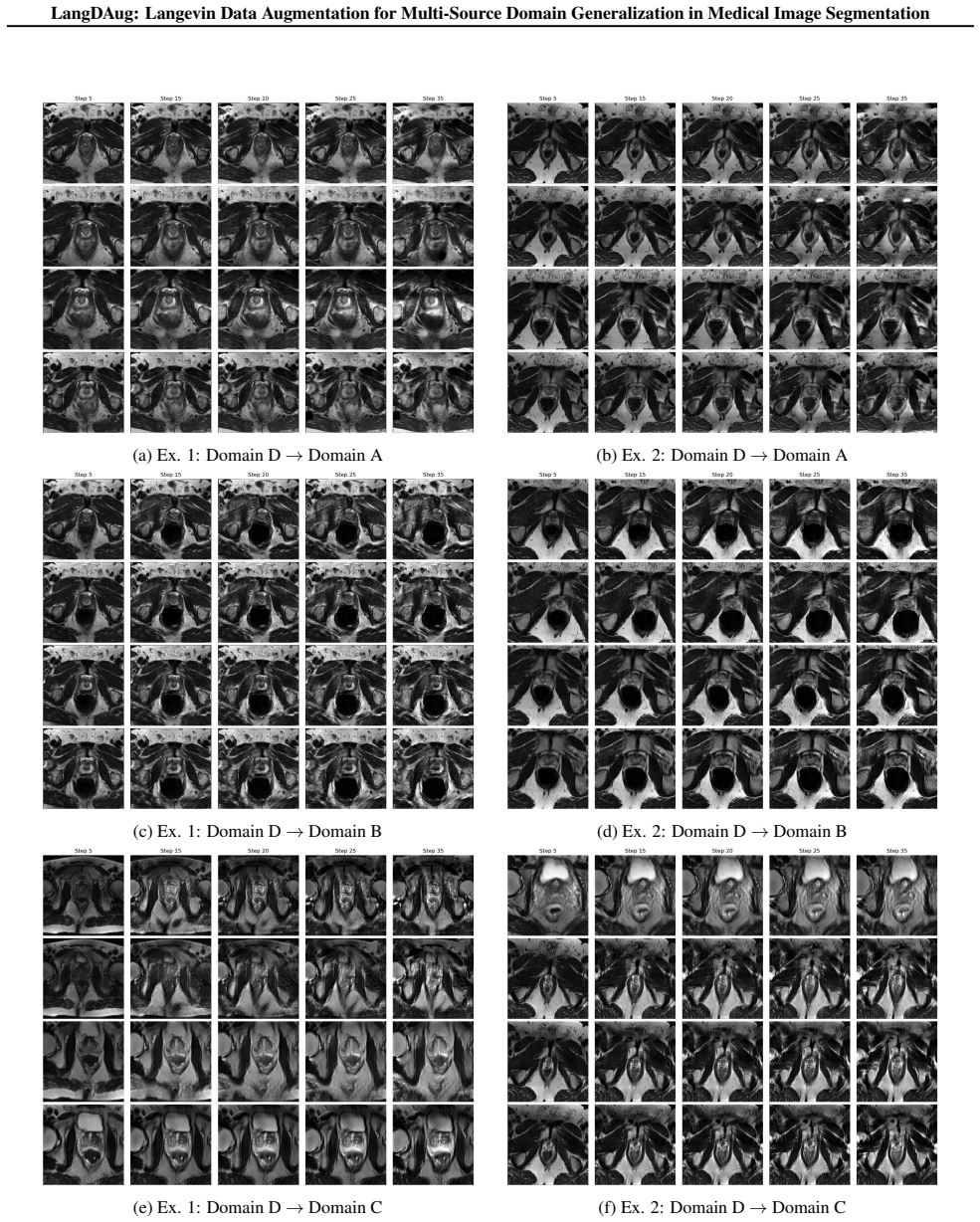
The load-bearing object is a pair of energy-based models trained with contrastive divergence for each ordered pair of source domains, together with the stored intermediate iterates of Langevin dynamics. The energy model $E_{\theta_{ij}}$ assigns low energy to domain $j$, and the Langevin update $x_{t+1} = x_t - \frac{\beta^2}{2}\nabla E_{\theta_{ij}}(x_t) + \beta\epsilon$, initialized at a sample from domain $i$, is run for $K$ steps; samples at selected steps form the augmentation set $D^k_{ij} = \{x^k_j, y_j\}$. In the analysis, a single Langevin step from the true data density gives the expansion $L_{\mathrm{aug}} = L_{\mathrm{std}} + R_1 + R_2 + R_3$, where $R_2$ is a Hessian-smoothing term and $R_1$/$R_3$ involve the score $\nabla\log p(x)$ and the Laplacian of the predictor. For GLMs the regularizer simplifies to $\frac{\beta^2}{2n}\sum_i \big(A''(\theta^T x_i)\theta^T\theta - A'(\theta^T x_i)\theta^T s(x_i)\big)$, and the class $W_\gamma$ of functions satisfying the constraint $\theta^T \mathbb{E}_x[A''\theta - A's] \le \gamma$ has empirical Rademacher complexity at most $C\sqrt{\mathrm{rank}(\Sigma_x)/k}$.
What would settle it
Train the segmentation model on Langevin samples produced by a randomly initialized, untrained EBM (same $K=40$, $\beta=1$, same VQ-VAE decoder) and compare Dice/IoU with the trained-EBM samples; if the gain over ERM persists, the reported improvements do not depend on the learned domain-bridging energy landscape.
Extended reading notes
Core claim
The central claim is that taking intermediate Langevin-dynamics iterates between source domains and training on them with their original labels makes a segmentation model generalize better to an unseen target domain than training on the source domains alone or with other augmentation schemes. For each ordered pair $(i,j)$ of source domains, the paper trains an energy-based model with a contrastive-divergence objective whose gradient pulls samples from domain $i$ toward the Boltzmann density of domain $j$; the iterates $x_{t+1} = x_t - \frac{\beta^2}{2}\nabla E_{\theta_{ij}}(x_t) + \beta\epsilon$ are stored at selected steps and added to the ERM objective. The theoretical section shows that one Langevin step from the true density $p(x)$ turns the augmented empirical risk into the standard empirical risk plus three derivative-based regularization terms (Theorem 4.1), specializes this to GLMs (Corollary 4.2), and bounds the Rademacher complexity of the regularized function class by $C\sqrt{\mathrm{rank}(\Sigma_x)/k}$, which yields a generalization-gap bound through a standard Rademacher argument (Corollary 4.4). The empirical section reports average IoU/DSC of 78.84/87.61 on fundus and ASD/DSC of 0.81 mm/89.16 on prostate MRI, the best averages among the compared methods.
Load-bearing premise
The theoretical analysis assumes a single Langevin step from the true data density $p(x)$, while the implementation uses 40 steps of a learned energy model in a VQ-VAE latent space, and the paper does not show that the one-step true-score guarantee carries over to that pipeline.
Editorial extensions
If this is right
- For GLMs trained with LangDAug, the generalization gap scales with $\sqrt{\mathrm{rank}(\Sigma_x)/k}$ instead of the ambient input dimension, so data lying on a low-dimensional manifold should need fewer samples to generalize.
- Combining LangDAug with domain-randomization methods (FedDG, RAM, TriD) improves their average performance on both benchmarks, with the largest reported gains when it is added to TriD.
- Because Langevin samples keep original labels, the augmentation preserves anatomical content in these medical images, which is why the training objective can reuse $y_j$.
- The method requires one pair of EBMs per ordered source-domain pair and stores $nK/f$ extra samples per chain, so its cost grows with the number of source domains and the chain length.
Reading between the lines
- Editorial inference: the paper proves its bound for one Langevin step from the true density $p(x)$, but the deployed pipeline runs 40 steps from a learned EBM in VQ-VAE latent space; if the same regularization story holds there, the step size $\beta$ and the score norm of the latent EBM should predict the degree of Hessian smoothing, which could be tested by varying them independently.
- Editorial inference: the L-channel replacement used for fundus images suggests content preservation is doing essential work; a natural stress test is to measure how much of the gain survives when the augmentation is allowed to move anatomical position.
- Editorial inference: the $O(n^2)$ EBM training cost points to a conditional or shared energy model that encodes the source-domain identity as an input, which would make the augmentation recipe applicable to many-source regimes without the pair explosion.
- Editorial inference: the method could be transferred to other dense prediction tasks where domain shift is spectral, such as histopathology or CT-MR; checking whether the rank of $\Sigma_x$ predicts improvement across such tasks would connect the bound to practice.
Editorial analysis
A structured set of objections, weighed in public.
Referee Report
Summary. This paper proposes LangDAug, a data-augmentation method for multi-source domain generalization in 2D medical image segmentation. For each ordered pair of source domains, the authors train an energy-based model (EBM) with contrastive divergence, run Langevin dynamics initialized from one domain, and store intermediate iterates as 'bridge' samples that are added to the ERM training set. Experiments on retinal fundus and prostate MRI segmentation under a leave-one-domain-out protocol report that LangDAug outperforms several state-of-the-art DG baselines (Tables 1-2) and improves the average performance of domain-randomization methods FedDG, RAM, and TriD when applied on top of them (Tables 3-4). The paper also presents a theoretical analysis claiming that the augmentation induces an explicit regularizer for general losses (Theorem 4.1), that for generalized linear models this regularizer takes a simple form (Corollary 4.2), and that the Rademacher complexity of the resulting function class is bounded by C*sqrt(rank(Sigma_x)/k), which the authors interpret as dependence on the intrinsic dimension of the data (Theorem 4.3). The code is publicly available.
Significance. If the theoretical claims were established for the implemented procedure, this would be a valuable contribution: it would give a principled capacity-control explanation for a practical augmentation scheme and connect domain generalization to data intrinsic dimensionality. The empirical part is a strength in itself: the method is evaluated on two medical segmentation benchmarks with a public codebase, multiple baselines, leave-one-domain-out evaluation, ablations over the key hyperparameters (K, beta, EBM size, number of stored samples), and a computational-cost analysis. The combination experiments with FedDG/RAM/TriD show consistent average improvements and are a useful practical finding. However, the theoretical analysis currently applies to a one-step true-score perturbation in pixel space, while the implemented method uses K=40 steps of a learned latent-space EBM; the claimed bound in Theorem 4.3 is therefore not connected to the evaluated algorithm. The paper's central theoretical claim is defensible as an idealized model but needs either a transfer argument or a reformulation of the theory.
major comments (4)
- [Sections 3.2-3.3, Appendix B vs. Section 4, Eq. (9)] The theory in Section 4 is developed for the augmentation x_i_tilde(beta) = x_i - (beta^2/2) grad log p(x_i) + beta*epsilon, i.e., one Langevin step using the true score of the data density in the input space. The implemented LangDAug, as described in Sections 3.2-3.3 and Appendix B/Algorithm 1, trains an EBM E_theta on the latent codes of a VQ-VAE, performs K=40 iterations of z_{t+1} = z_t - (beta^2/2) grad_z E_theta(z_t) + beta*epsilon, and decodes the final latent code to an image. The learned energy gradient is not the true score grad log p(x), the space is not the image space, and the number of steps is not one. The paper provides no argument (approximation, coupling, or otherwise) that the multi-step learned-EBM latent-space process is close to the one-step true-score process analyzed in Theorems 4.1-4.3. Consequently, the bound Rad(W_gamma, D) <= C*sqrt(rank(Sigma_x)/k) in Eq. (9), which is derived for function classes constrained by the true score s(x), does not follow for the augmentation that produced the results in Tables 1-4. This gap affects the central theoretical claim in the abstract and conclusion; it should be addressed either by providing a quantitative transfer argument or by recasting the theoretical statements as claims about an idealized version and clearly separating them from the empirical method.
- [Theorem 4.1 and Appendix A, Eq. (14)] Theorem 4.1 (Eq. 7) is stated as an exact equality, but the proof in Appendix A (Eq. 14) expands psi_i(beta) via a second-order Taylor polynomial and discards the remainder beta^2*phi(beta). Since phi(beta) does not vanish for the nonzero beta used in the experiments (beta=1 in Appendix B), Eq. (7) is not an equality; it is an approximation with an O(beta^3) (or higher) error term. In addition, the definitions of R_1, R_2, R_3 in the theorem omit the 1/2 factor that appears in the proof's expansion (Eq. 25); Corollary 4.2 uses the 1/2 factor. The theorem and proof should be made consistent, and the approximate nature of the expansion should be stated explicitly, since the subsequent corollaries inherit this approximation.
- [Corollary 4.2] Corollary 4.2 states R_GLM = (beta^2/(2n)) sum_i [A''(theta^T x_i) theta^T theta - A'(theta^T x_i) theta^T s(x_i)]. Applying Theorem 4.1 to the GLM loss ell(theta,(x,y)) = A(theta^T x) - y theta^T x yields an additional term +(beta^2/2) y_i theta^T s(x_i) coming from R_1, because R_1 contains (h'(f_theta(x_i)) - y_i) = (A'(theta^T x_i) - y_i). This y-dependent term vanishes only in expectation over y|x under the GLM identity E[y|x] = A'(theta^T x); the augmented empirical risk in Eq. (6) is an average over the empirical y_i, not an expectation over y. Since W_gamma in Theorem 4.3 is defined from the reduced R_GLM, the function class whose Rademacher complexity is bounded does not exactly correspond to the regularizer induced by the augmentation. The derivation should either include the y term or justify its omission.
- [Theorem 4.3, proof in Appendix A (Eqs. 45-49)] In the proof of Theorem 4.3 (Appendix A, Eqs. 45-49), the last step replaces sqrt(Tr(Sigma_x)/k) by sqrt(rank(Sigma_x)/k). From E||sum_i xi_i x_i||^2 = k Tr(Sigma_x), the bound obtained is C*sqrt(Tr(Sigma_x)/k), and Tr(Sigma_x) <= lambda_max(Sigma_x) rank(Sigma_x). The constant C defined in Eq. 10 contains gamma, rho, and sigma (the smallest singular value of Sigma_x), but not lambda_max. Therefore the displayed inequality Rad(W_gamma, D) <= C*sqrt(rank(Sigma_x)/k) does not follow from the proof as written unless lambda_max is absorbed into C or the data are normalized. This is a technical but load-bearing issue in the main capacity bound; the constant should be corrected.
minor comments (4)
- [Table 1] In Table 1, the Hutchinson row has identical entries for Domains A and B, and the RandConv row has an identical first metric pair for Domains C and D; these look like copy-paste errors and should be verified and corrected.
- [General text] There are several typos: 'alalysis' in Section 4, 'aleviate' in Section 3.1, 'detailes' in Section 6 Limitations, and 'Lipchitz' in Corollary 4.4 should be 'Lipschitz' (or the intended notation made precise).
- [Appendix B, VQ-VAE description] The text 'VQ-V AE 2' and 'VQ-V AE' appear with spacing artifacts; these should read 'VQ-VAE-2' and 'VQ-VAE' for clarity.
- [Algorithm 1] The output line 'Augmentation datasets {D^k_ij}_{i=1,j=1,k=1}^{n,n,K}' is confusingly indexed; it should clarify that the union is over i != j and that D^k_ij is defined for k=1,...,K, since the 'intermediate domain' claim in Section 3.3 also relies on this notation.
Circularity Check
No circularity: Theorem 4.1 is a Taylor expansion of the augmentation definition, the Rademacher bound is standard and not fitted, and the empirical results are compared against external baselines on public benchmarks.
full rationale
The derivation chain is self-contained. Theorem 4.1 expands the augmented empirical risk defined in Eq. 6 under the one-step perturbation x̃_i(β) = x_i − (β²/2)∇log p(x_i) + βε; the regularization terms R1–R3 follow by differentiation and expectation over ε, with no fitted quantities imported. Corollary 4.2 substitutes the GLM loss form into that expansion, and Theorem 4.3 bounds the Rademacher complexity of the class Wγ using standard ρ-retentiveness and spectral assumptions; the bound C√(rank(Σ_x)/k) depends only on stated assumptions and is not calibrated to the results in Tables 1–4. The empirical evaluation uses leave-one-out protocols on public fundus and prostate MRI datasets against external baselines (DomainBed methods, RandConv, MixStyle, FedDG, RAM, TriD), so the headline performance claims are not circular. The self-citations (Tiwary et al., 2023, 2024, 2025) appear in related-work or implementation contexts and are not load-bearing. One genuine weakness is that the implemented pipeline runs K=40 Langevin steps from a learned latent-space EBM, while the theory analyzes a single step from the true data density; this is an unsupported transfer assumption that may threaten the interpretation, but it is a correctness or relevance gap rather than circularity, because the bound is not obtained by assuming the empirical outcome and no parameter is fitted to the unseen test domains. Under the quoted-evidence standard, no circular step is established.
Assumptions & free parameters
free parameters (4)
- Langevin step size beta =
1
- Number of Langevin steps K =
40
- Number of stored samples per chain =
13 for fundus, 5 for prostate
- Segmentation network hyperparameters =
lr=1e-4, bs=8 for fundus; lr=1e-6, bs=32/64 for prostate
assumptions (4)
- domain assumption The data distribution is rho-retentive, as assumed in Theorem 4.3.
- ad hoc to paper The method has access to the true score function grad log p(x) for the theoretical analysis.
- domain assumption Langevin samples preserve the label-relevant content, so original labels can be retained.
- domain assumption The rank of the covariance matrix Sigma_x represents the intrinsic dimensionality of the data manifold.
invented entities (1)
-
Intermediate domains D^k_ij formed by Langevin samples
Cite this review
Pith. "Pith review of LangDAug: Langevin Data Augmentation for Multi-Source Domain Generalization in Medical Image Segmentation." pith.science (2026). https://pith.science/paper/RTTTQCPN
@misc{pith2026250519659,
  author       = {Pith},
  title        = {Pith review of: LangDAug: Langevin Data Augmentation for Multi-Source Domain Generalization in Medical Image Segmentation},
  year         = {2026},
  howpublished = {\url{https://pith.science/paper/RTTTQCPN}},
  note         = {Machine review of arXiv:2505.19659}
}
abstract
Medical image segmentation models often struggle to generalize across different domains due to various reasons. Domain Generalization (DG) methods overcome this either through representation learning or data augmentation (DAug). While representation learning methods seek domain-invariant features, they often rely on ad-hoc techniques and lack formal guarantees. DAug methods, which enrich model representations through synthetic samples, have shown comparable or superior performance to representation learning approaches. We propose LangDAug, a novel $\textbf{Lang}$evin $\textbf{D}$ata $\textbf{Aug}$mentation for multi-source domain generalization in 2D medical image segmentation. LangDAug leverages Energy-Based Models (EBMs) trained via contrastive divergence to traverse between source domains, generating intermediate samples through Langevin dynamics. Theoretical analysis shows that LangDAug induces a regularization effect, and for GLMs, it upper-bounds the Rademacher complexity by the intrinsic dimensionality of the data manifold. Through extensive experiments on Fundus segmentation and 2D MRI prostate segmentation benchmarks, we show that LangDAug outperforms state-of-the-art domain generalization methods and effectively complements existing domain-randomization approaches. The codebase for our method is available at https://github.com/backpropagator/LangDAug.
Figures


Figures from the paper (18 more)




Reference graph
Works this paper leans on
-
[1]
Retinal fundus images for glaucoma analysis: the riga dataset
Almazroa, A., Alodhayb, S., Osman, E., Ramadan, E., Hummadi, M., Dlaim, M., Alkatee, M., Raahemifar, K., and Lakshminarayanan, V. Retinal fundus images for glaucoma analysis: the riga dataset. In Medical Imaging 2018: Imaging Informatics for Healthcare, Research, and Applications, volume 10579, pp.\ 55--62. SPIE, 2018
2018
-
[2]
Arjovsky, M., Bottou, L., Gulrajani, I., and Lopez-Paz, D. Invariant risk minimization. arXiv preprint arXiv:1907.02893, 2019
arXiv 1907
-
[3]
Dropout: Explicit forms and capacity control
Arora, R., Bartlett, P., Mianjy, P., and Srebro, N. Dropout: Explicit forms and capacity control. In International Conference on Machine Learning, pp.\ 351--361. PMLR, 2021
2021
-
[4]
P., Cohen-Adad, J., and Hamarneh, G
Asgari Taghanaki, S., Abhishek, K., Cohen, J. P., Cohen-Adad, J., and Hamarneh, G. Deep semantic segmentation of natural and medical images: a review. Artificial Intelligence Review, 54: 0 137--178, 2021
2021
-
[5]
Metareg: Towards domain generalization using meta-regularization
Balaji, Y., Sankaranarayanan, S., and Chellappa, R. Metareg: Towards domain generalization using meta-regularization. Advances in neural information processing systems, 31, 2018
2018
-
[6]
Bartlett, P. L. and Mendelson, S. Rademacher and gaussian complexities: Risk bounds and structural results. Journal of Machine Learning Research, 3 0 (Nov): 0 463--482, 2002
2002
-
[7]
A., Dogan, U., Lee, G., and Scott, C
Blanchard, G., Deshmukh, A. A., Dogan, U., Lee, G., and Scott, C. Domain generalization by marginal transfer learning. Journal of machine learning research, 22 0 (2): 0 1--55, 2021
2021
-
[8]
Cayton, L. et al. Algorithms for manifold learning. eScholarship, University of California, 2008
2008
Show all 98 references
-
[9]
Treasure in distribution: a domain randomization based multi-source domain generalization for 2d medical image segmentation
Chen, Z., Pan, Y., Ye, Y., Cui, H., and Xia, Y. Treasure in distribution: a domain randomization based multi-source domain generalization for 2d medical image segmentation. In International Conference on Medical Image Computing and Computer-Assisted Intervention, pp.\ 89--99. ...
2023
-
[10]
Domain generalization via model-agnostic learning of semantic features
Dou, Q., Coelho de Castro, D., Kamnitsas, K., and Glocker, B. Domain generalization via model-agnostic learning of semantic features. Advances in neural information processing systems, 32, 2019
2019
-
[11]
and Mordatch, I
Du, Y. and Mordatch, I. Implicit generation and modeling with energy based models. Advances in Neural Information Processing Systems, 32, 2019
2019
-
[12]
Compositional visual generation with energy based models
Du, Y., Li, S., and Mordatch, I. Compositional visual generation with energy based models. Advances in Neural Information Processing Systems, 33: 0 6637--6647, 2020 a
2020
-
[13]
G., and Shao, L
Du, Y., Xu, J., Xiong, H., Qiu, Q., Zhen, X., Snoek, C. G., and Shao, L. Learning to learn with variational information bottleneck for domain generalization. In Computer Vision--ECCV 2020: 16th European Conference, Glasgow, UK, August 23--28, 2020, Proceedings, Part X 16, pp.\...
2020
-
[14]
O ., Abdulkadir, A., Marrakchi, Y., B \
Falk, T., Mai, D., Bensch, R., C i c ek, \"O ., Abdulkadir, A., Marrakchi, Y., B \"o hm, A., Deubner, J., J \"a ckel, Z., Seiwald, K., et al. U-net: deep learning for cell counting, detection, and morphometry. Nature methods, 16 0 (1): 0 67--70, 2019
2019
-
[15]
H., Moshayedi, A., Roy, G., Dedieu, J., Petit, S., and Hadj, S
Fick, R. H., Moshayedi, A., Roy, G., Dedieu, J., Petit, S., and Hadj, S. B. Domain-specific cycle-gan augmentation improves domain generalizability for mitosis detection. In International Conference on Medical Image Computing and Computer-Assisted Intervention, pp.\ 40--47. Sp...
2021
-
[16]
Model-agnostic meta-learning for fast adaptation of deep networks
Finn, C., Abbeel, P., and Levine, S. Model-agnostic meta-learning for fast adaptation of deep networks. In International conference on machine learning, pp.\ 1126--1135. PMLR, 2017
2017
-
[17]
Domain-adversarial training of neural networks
Ganin, Y., Ustinova, E., Ajakan, H., Germain, P., Larochelle, H., Laviolette, F., March, M., and Lempitsky, V. Domain-adversarial training of neural networks. Journal of machine learning research, 17 0 (59): 0 1--35, 2016
2016
-
[18]
R., Upchurch, P., Kusner, M
Gardner, J. R., Upchurch, P., Kusner, M. J., Li, Y., Weinberger, K. Q., Bala, K., and Hopcroft, J. E. Deep manifold traversal: Changing labels with convolutional features. arXiv preprint arXiv:1511.06421, 2015
2015 arXiv
-
[19]
T., Ligett, K., and Wu, S
Garg, V., Kalai, A. T., Ligett, K., and Wu, S. Learn to expect the unexpected: Probably approximately correct domain generalization. In International Conference on Artificial Intelligence and Statistics, pp.\ 3574--3582. PMLR, 2021
2021
-
[20]
Gorban, A. N. and Tyukin, I. Y. Blessing of dimensionality: mathematical foundations of the statistical physics of data. Philosophical Transactions of the Royal Society A: Mathematical, Physical and Engineering Sciences, 376 0 (2118): 0 20170237, 2018
2018
-
[21]
Domain composition and attention for unseen-domain generalizable medical image segmentation
Gu, R., Zhang, J., Huang, R., Lei, W., Wang, G., and Zhang, S. Domain composition and attention for unseen-domain generalizable medical image segmentation. In Medical Image Computing and Computer Assisted Intervention--MICCAI 2021: 24th International Conference, Strasbourg, Fr...
2021
-
[22]
and Liu, M
Guan, H. and Liu, M. Domain adaptation for medical image analysis: a survey. IEEE Transactions on Biomedical Engineering, 69 0 (3): 0 1173--1185, 2021
2021
-
[23]
and Lopez-Paz, D
Gulrajani, I. and Lopez-Paz, D. In search of lost domain generalization. In International Conference on Learning Representations, 2021. URL https://openreview.net/forum?id=lQdXeXDoWtI
2021
-
[24]
and Raginsky, M
Hajek, B. and Raginsky, M. Ece 543: Statistical learning theory. Class notes for ECE, 2021
2021
-
[25]
E., Stork, D
Hart, P. E., Stork, D. G., and Duda, R. O. Pattern classification. Wiley Hoboken, 2000
2000
-
[26]
Deep residual learning for image recognition
He, K., Zhang, X., Ren, S., and Sun, J. Deep residual learning for image recognition. In Proceedings of the IEEE conference on computer vision and pattern recognition, pp.\ 770--778, 2016
2016
-
[27]
Understanding hessian alignment for domain generalization
Hemati, S., Zhang, G., Estiri, A., and Chen, X. Understanding hessian alignment for domain generalization. In Proceedings of the IEEE/CVF International Conference on Computer Vision, pp.\ 19004--19014, 2023
2023
-
[28]
Hinton, G. E. Training products of experts by minimizing contrastive divergence. Neural computation, 14 0 (8): 0 1771--1800, 2002
2002
-
[29]
and Kovashka, A
Honarvar Nazari, N. and Kovashka, A. Domain generalization using shape representation. In European Conference on Computer Vision, pp.\ 666--670. Springer, 2020
2020
-
[30]
Domain generalization via multidomain discriminant analysis
Hu, S., Zhang, K., Chen, Z., and Chan, L. Domain generalization via multidomain discriminant analysis. In Uncertainty in artificial intelligence, pp.\ 292--302. PMLR, 2020
2020
-
[31]
Domain and content adaptive convolution based multi-source domain generalization for medical image segmentation
Hu, S., Liao, Z., Zhang, J., and Xia, Y. Domain and content adaptive convolution based multi-source domain generalization for medical image segmentation. IEEE Transactions on Medical Imaging, 42 0 (1): 0 233--244, 2022
2022
-
[32]
P., and Huang, D
Huang, Z., Wang, H., Xing, E. P., and Huang, D. Self-challenging improves cross-domain generalization. In Computer vision--ECCV 2020: 16th European conference, Glasgow, UK, August 23--28, 2020, proceedings, part II 16, pp.\ 124--140. Springer, 2020
2020
-
[33]
M., Louizos, C., and Welling, M
Ilse, M., Tomczak, J. M., Louizos, C., and Welling, M. Diva: Domain invariant variational autoencoders. In Medical Imaging with Deep Learning, pp.\ 322--348. PMLR, 2020
2020
-
[34]
F., Kohl, S
Isensee, F., Jaeger, P. F., Kohl, S. A. A., Petersen, J., and Maier-Hein, K. nnu-net: a self-configuring method for deep learning-based biomedical image segmentation. Nature Methods, 18: 0 203 -- 211, 2020. URL https://api.semanticscholar.org/CorpusID:227947847
2020
-
[35]
D., Chen, Q., Wei, L., and Su, R
Jin, Q., Meng, Z., Pham, T. D., Chen, Q., Wei, L., and Su, R. Dunet: A deformable network for retinal vessel segmentation. Knowledge-Based Systems, 178: 0 149--162, 2019
2019
-
[36]
Unsupervised domain adaptation in brain lesion segmentation with adversarial networks
Kamnitsas, K., Baumgartner, C., Ledig, C., Newcombe, V., Simpson, J., Kane, A., Menon, D., Nori, A., Criminisi, A., Rueckert, D., et al. Unsupervised domain adaptation in brain lesion segmentation with adversarial networks. In Information Processing in Medical Imaging: 25th In...
2017
-
[37]
Domain generalization on medical imaging classification using episodic training with task augmentation
Li, C., Lin, X., Mao, Y., Lin, W., Qi, Q., Ding, X., Huang, Y., Liang, D., and Yu, Y. Domain generalization on medical imaging classification using episodic training with task augmentation. Computers in biology and medicine, 141: 0 105144, 2022 a
2022
-
[38]
Learning to generalize: Meta-learning for domain generalization
Li, D., Yang, Y., Song, Y.-Z., and Hospedales, T. Learning to generalize: Meta-learning for domain generalization. In Proceedings of the AAAI conference on artificial intelligence, volume 32, 2018 a
2018
-
[39]
J., Wang, S., and Kot, A
Li, H., Pan, S. J., Wang, S., and Kot, A. C. Domain generalization with adversarial feature learning. In Proceedings of the IEEE conference on computer vision and pattern recognition, pp.\ 5400--5409, 2018 b
2018
-
[40]
Progressive domain expansion network for single domain generalization
Li, L., Gao, K., Cao, J., Huang, Z., Weng, Y., Mi, X., Yu, Z., Li, X., and Xia, B. Progressive domain expansion network for single domain generalization. In Proceedings of the IEEE/CVF Conference on Computer Vision and Pattern Recognition, pp.\ 224--233, 2021 a
2021
-
[41]
Li, P., Li, D., Li, W., Gong, S., Fu, Y., and Hospedales, T. M. A simple feature augmentation for domain generalization. In Proceedings of the IEEE/CVF International Conference on Computer Vision, pp.\ 8886--8895, 2021 b
2021
-
[42]
Uncertainty modeling for out-of-distribution generalization
Li, X., Dai, Y., Ge, Y., Liu, J., Shan, Y., and Duan, L.-Y. Uncertainty modeling for out-of-distribution generalization. arXiv preprint arXiv:2202.03958, 2022 b
2022 arXiv
-
[43]
Domain generalization via conditional invariant representations
Li, Y., Gong, M., Tian, X., Liu, T., and Tao, D. Domain generalization via conditional invariant representations. In Proceedings of the AAAI conference on artificial intelligence, volume 32, 2018 c
2018
-
[44]
H., Liu, Y.-C., Yeh, Y.-Y., and Wang, Y.-C
Liu, A. H., Liu, Y.-C., Yeh, Y.-Y., and Wang, Y.-C. F. A unified feature disentangler for multi-domain image translation and manipulation. Advances in neural information processing systems, 31, 2018
2018
-
[45]
Shape-aware meta-learning for generalizing prostate mri segmentation to unseen domains
Liu, Q., Dou, Q., and Heng, P.-A. Shape-aware meta-learning for generalizing prostate mri segmentation to unseen domains. In Medical Image Computing and Computer Assisted Intervention--MICCAI 2020: 23rd International Conference, Lima, Peru, October 4--8, 2020, Proceedings, Par...
2020
-
[46]
Feddg: Federated domain generalization on medical image segmentation via episodic learning in continuous frequency space
Liu, Q., Chen, C., Qin, J., Dou, Q., and Heng, P.-A. Feddg: Federated domain generalization on medical image segmentation via episodic learning in continuous frequency space. In Proceedings of the IEEE/CVF conference on computer vision and pattern recognition, pp.\ 1013--1023, 2021 a
2021
-
[47]
Liu, X., Thermos, S., O’Neil, A., and Tsaftaris, S. A. Semi-supervised meta-learning with disentanglement for domain-generalised medical image segmentation. In Medical Image Computing and Computer Assisted Intervention--MICCAI 2021: 24th International Conference, Strasbourg, F...
2021
-
[48]
Geometric and textural augmentation for domain gap reduction
Liu, X.-C., Yang, Y.-L., and Hall, P. Geometric and textural augmentation for domain gap reduction. In Proceedings of the IEEE/CVF Conference on Computer Vision and Pattern Recognition, pp.\ 14340--14350, 2022
2022
-
[49]
Domain generalization using causal matching
Mahajan, D., Tople, S., and Sharma, A. Domain generalization using causal matching. In International conference on machine learning, pp.\ 7313--7324. PMLR, 2021
2021
-
[50]
V-net: Fully convolutional neural networks for volumetric medical image segmentation
Milletari, F., Navab, N., and Ahmadi, S.-A. V-net: Fully convolutional neural networks for volumetric medical image segmentation. In 2016 fourth international conference on 3D vision (3DV), pp.\ 565--571. Ieee, 2016
2016
-
[51]
A., and Doretto, G
Motiian, S., Piccirilli, M., Adjeroh, D. A., and Doretto, G. Unified deep supervised domain adaptation and generalization. In Proceedings of the IEEE international conference on computer vision, pp.\ 5715--5725, 2017
2017
-
[52]
Domain generalization via invariant feature representation
Muandet, K., Balduzzi, D., and Sch \"o lkopf, B. Domain generalization via invariant feature representation. In International conference on machine learning, pp.\ 10--18. PMLR, 2013
2013
-
[53]
Murphy, K. P. Probabilistic Machine Learning: An introduction. MIT Press, 2022. URL probml.ai
2022
-
[54]
Olabarriaga, S. D. and Smeulders, A. W. Interaction in the segmentation of medical images: A survey. Medical image analysis, 5 0 (2): 0 127--142, 2001
2001
-
[55]
I., Fu, H., Breda, J
Orlando, J. I., Fu, H., Breda, J. B., Van Keer, K., Bathula, D. R., Diaz-Pinto, A., Fang, R., Heng, P.-A., Kim, J., Lee, J., et al. Refuge challenge: A unified framework for evaluating automated methods for glaucoma assessment from fundus photographs. Medical image analysis, 5...
2020
-
[56]
Two at once: Enhancing learning and generalization capacities via ibn-net
Pan, X., Luo, P., Shi, J., and Tang, X. Two at once: Enhancing learning and generalization capacities via ibn-net. In Proceedings of the european conference on computer vision (ECCV), pp.\ 464--479, 2018
2018
-
[57]
Global and local texture randomization for synthetic-to-real semantic segmentation
Peng, D., Lei, Y., Liu, L., Zhang, P., and Liu, J. Global and local texture randomization for synthetic-to-real semantic segmentation. IEEE Transactions on Image Processing, 30: 0 6594--6608, 2021
2021
-
[58]
Domain2vec: Domain embedding for unsupervised domain adaptation
Peng, X., Li, Y., and Saenko, K. Domain2vec: Domain embedding for unsupervised domain adaptation. In Computer Vision--ECCV 2020: 16th European Conference, Glasgow, UK, August 23--28, 2020, Proceedings, Part VI 16, pp.\ 756--774. Springer, 2020
2020
-
[59]
Structured domain randomization: Bridging the reality gap by context-aware synthetic data
Prakash, A., Boochoon, S., Brophy, M., Acuna, D., Cameracci, E., State, G., Shapira, O., and Birchfield, S. Structured domain randomization: Bridging the reality gap by context-aware synthetic data. In 2019 International Conference on Robotics and Automation (ICRA), pp.\ 7249-...
2019
-
[60]
Learning to learn single domain generalization
Qiao, F., Zhao, L., and Peng, X. Learning to learn single domain generalization. In Proceedings of the IEEE/CVF conference on computer vision and pattern recognition, pp.\ 12556--12565, 2020
2020
-
[61]
M., Fookes, C., Baktashmotlagh, M., and Sridharan, S
Rahman, M. M., Fookes, C., Baktashmotlagh, M., and Sridharan, S. Multi-component image translation for deep domain generalization. In 2019 IEEE Winter Conference on Applications of Computer Vision (WACV), pp.\ 579--588. IEEE, 2019
2019
-
[62]
Fishr: Invariant gradient variances for out-of-distribution generalization
Rame, A., Dancette, C., and Cord, M. Fishr: Invariant gradient variances for out-of-distribution generalization. In International Conference on Machine Learning, pp.\ 18347--18377. PMLR, 2022
2022
-
[63]
J., and Hassani, H
Robey, A., Pappas, G. J., and Hassani, H. Model-based domain generalization. Advances in Neural Information Processing Systems, 34: 0 20210--20229, 2021
2021
-
[64]
and Ben-David, S
Shalev-Shwartz, S. and Ben-David, S. Understanding Machine Learning: From Theory to Algorithms. Cambridge University Press, 2014
2014
-
[65]
Deep learning in medical image analysis
Shen, D., Wu, G., and Suk, H.-I. Deep learning in medical image analysis. Annual review of biomedical engineering, 19 0 (1): 0 221--248, 2017
2017
-
[66]
Gradient matching for domain generalization
Shi, Y., Seely, J., Torr, P., N, S., Hannun, A., Usunier, N., and Synnaeve, G. Gradient matching for domain generalization. In International Conference on Learning Representations, 2022. URL https://openreview.net/forum?id=vDwBW49HmO
2022
-
[67]
D., Jain, M., and Tabish, A
Sivaswamy, J., Krishnadas, S., Joshi, G. D., Jain, M., and Tabish, A. U. S. Drishti-gs: Retinal image dataset for optic nerve head (onh) segmentation. In 2014 IEEE 11th international symposium on biomedical imaging (ISBI), pp.\ 53--56. IEEE, 2014
2014
-
[68]
Frustratingly simple domain generalization via image stylization
Somavarapu, N., Ma, C.-Y., and Kira, Z. Frustratingly simple domain generalization via image stylization. arXiv preprint arXiv:2006.11207, 2020
2006 arXiv
-
[69]
and Ermon, S
Song, Y. and Ermon, S. Generative modeling by estimating gradients of the data distribution. Advances in neural information processing systems, 32, 2019
2019
-
[70]
and Saenko, K
Sun, B. and Saenko, K. Deep coral: Correlation alignment for deep domain adaptation. In Computer vision--ECCV 2016 workshops: Amsterdam, the Netherlands, October 8-10 and 15-16, 2016, proceedings, part III 14, pp.\ 443--450. Springer, 2016
2016
-
[71]
Fourier features let networks learn high frequency functions in low dimensional domains
Tancik, M., Srinivasan, P., Mildenhall, B., Fridovich-Keil, S., Raghavan, N., Singhal, U., Ramamoorthi, R., Barron, J., and Ng, R. Fourier features let networks learn high frequency functions in low dimensional domains. Advances in neural information processing systems, 33: 0 ...
2020
-
[72]
Cycle consistent twin energy-based models for image-to-image translation
Tiwary, P., Bhattacharyya, K., and AP, P. Cycle consistent twin energy-based models for image-to-image translation. Medical Image Analysis (MedIA), 91, 2023. doi:https://doi.org/10.1016/j.media.2023.103031. URL https://www.sciencedirect.com/science/article/pii/S1361841523002918
2023
-
[73]
Bayesian pseudo-coresets via contrastive divergence
Tiwary, P., Shubham, K., Kashyap, V., and AP, P. Bayesian pseudo-coresets via contrastive divergence. In Conference on Uncertainity in Artificial Intelligence (UAI), 2024. URL https://arxiv.org/abs/2303.11278
2024 arXiv
-
[74]
Adapt then unlearn: Exploring parameter space semantics for unlearning in generative adversarial networks
Tiwary, P., Guha, A., Panda, S., and AP, P. Adapt then unlearn: Exploring parameter space semantics for unlearning in generative adversarial networks. Transactions on Machine Learning Research, 2025. URL https://openreview.net/forum?id=jAHEBivObO&t=1739258832039
2025
-
[75]
Deep feature interpolation for image content changes
Upchurch, P., Gardner, J., Pleiss, G., Pless, R., Snavely, N., Bala, K., and Weinberger, K. Deep feature interpolation for image content changes. In Proceedings of the IEEE conference on computer vision and pattern recognition, pp.\ 7064--7073, 2017
2017
-
[76]
Vapnik, V. N. An overview of statistical learning theory. IEEE transactions on neural networks, 10 0 (5): 0 988--999, 1999
1999
-
[77]
Wang, J., Lan, C., Liu, C., Ouyang, Y., Qin, T., Lu, W., Chen, Y., Zeng, W., and Philip, S. Y. Generalizing to unseen domains: A survey on domain generalization. IEEE transactions on knowledge and data engineering, 35 0 (8): 0 8052--8072, 2022
2022
-
[78]
Dofe: Domain-oriented feature embedding for generalizable fundus image segmentation on unseen datasets
Wang, S., Yu, L., Li, K., Yang, X., Fu, C.-W., and Heng, P.-A. Dofe: Domain-oriented feature embedding for generalizable fundus image segmentation on unseen datasets. IEEE Transactions on Medical Imaging, 39 0 (12): 0 4237--4248, 2020
2020
-
[79]
Xiao, Z., Zhen, X., Liao, S., and Snoek, C. G. M. Energy-based test sample adaptation for domain generalization. In The Eleventh International Conference on Learning Representations, 2023. URL https://openreview.net/forum?id=3dnrKbeVatv
2023
-
[80]
Robust and generalizable visual representation learning via random convolutions
Xu, Z., Liu, D., Yang, J., Raffel, C., and Niethammer, M. Robust and generalizable visual representation learning via random convolutions. In International Conference on Learning Representations, 2021. URL https://openreview.net/forum?id=BVSM0x3EDK6
2021
-
[81]
Tea: Test-time energy adaptation
Yuan, Y., Xu, B., Hou, L., Sun, F., Shen, H., and Cheng, X. Tea: Test-time energy adaptation. In Proceedings of the IEEE/CVF Conference on Computer Vision and Pattern Recognition, pp.\ 23901--23911, 2024
2024
-
[82]
mixup: Beyond empirical risk minimization
Zhang, H. mixup: Beyond empirical risk minimization. arXiv preprint arXiv:1710.09412, 2017
2017 arXiv
-
[83]
How does mixup help with robustness and generalization? arXiv preprint arXiv:2010.04819, 2020 a
Zhang, L., Deng, Z., Kawaguchi, K., Ghorbani, A., and Zou, J. How does mixup help with robustness and generalization? arXiv preprint arXiv:2010.04819, 2020 a
2010 arXiv
-
[84]
J., Roth, H., Myronenko, A., Xu, D., et al
Zhang, L., Wang, X., Yang, D., Sanford, T., Harmon, S., Turkbey, B., Wood, B. J., Roth, H., Myronenko, A., Xu, D., et al. Generalizing deep learning for medical image segmentation to unseen domains via deep stacked transformation. IEEE transactions on medical imaging, 39 0 (7)...
2020
-
[85]
Deep stable learning for out-of-distribution generalization
Zhang, X., Cui, P., Xu, R., Zhou, L., He, Y., and Shen, Z. Deep stable learning for out-of-distribution generalization. In Proceedings of the IEEE/CVF Conference on Computer Vision and Pattern Recognition, pp.\ 5372--5382, 2021
2021
-
[86]
Exact feature distribution matching for arbitrary style transfer and domain generalization
Zhang, Y., Li, M., Li, R., Jia, K., and Zhang, L. Exact feature distribution matching for arbitrary style transfer and domain generalization. In Proceedings of the IEEE/CVF conference on computer vision and pattern recognition, pp.\ 8035--8045, 2022
2022
-
[87]
S., Liu, J., Wong, W
Zhang, Z., Yin, F. S., Liu, J., Wong, W. K., Tan, N. M., Lee, B. H., Cheng, J., and Wong, T. Y. Origa-light: An online retinal fundus image database for glaucoma analysis and research. In 2010 Annual international conference of the IEEE engineering in medicine and biology, pp....
2010
-
[88]
and Chen, C
Zhao, Y. and Chen, C. Unpaired image-to-image translation via latent energy transport. In Proceedings of the IEEE/CVF conference on computer vision and pattern recognition, pp.\ 16418--16427, 2021
2021
-
[89]
Deep domain-adversarial image generation for domain generalisation
Zhou, K., Yang, Y., Hospedales, T., and Xiang, T. Deep domain-adversarial image generation for domain generalisation. In Proceedings of the AAAI conference on artificial intelligence, volume 34, pp.\ 13025--13032, 2020 a
2020
-
[90]
Learning to generate novel domains for domain generalization
Zhou, K., Yang, Y., Hospedales, T., and Xiang, T. Learning to generate novel domains for domain generalization. In Computer Vision--ECCV 2020: 16th European Conference, Glasgow, UK, August 23--28, 2020, Proceedings, Part XVI 16, pp.\ 561--578. Springer, 2020 b
2020
-
[91]
Deep domain-adversarial image generation for domain generalisation
Zhou, K., Yang, Y., Hospedales, T., and Xiang, T. Deep domain-adversarial image generation for domain generalisation. In Proceedings of the AAAI conference on artificial intelligence, volume 34, pp.\ 13025--13032, 2020 c
2020
-
[92]
Domain generalization with mixstyle
Zhou, K., Yang, Y., Qiao, Y., and Xiang, T. Domain generalization with mixstyle. In ICLR, 2021
2021
-
[93]
Zhou, K., Liu, Z., Qiao, Y., Xiang, T., and Loy, C. C. Domain generalization: A survey. IEEE Transactions on Pattern Analysis and Machine Intelligence, 45 0 (4): 0 4396--4415, 2022 a
2022
-
[94]
C., and Liu, Z
Zhou, K., Loy, C. C., and Liu, Z. Semi-supervised domain generalization with stochastic stylematch. International Journal of Computer Vision, 131 0 (9): 0 2377--2387, 2023
2023
-
[95]
Zhou, Z., Siddiquee, M. M. R., Tajbakhsh, N., and Liang, J. Unet++: Redesigning skip connections to exploit multiscale features in image segmentation. IEEE transactions on medical imaging, 39 0 (6): 0 1856--1867, 2019
2019
-
[96]
Generalizable medical image segmentation via random amplitude mixup and domain specific image restoration
Zhou, Z., Qi, L., and Shi, Y. Generalizable medical image segmentation via random amplitude mixup and domain specific image restoration. In ECCV, 2022 b
2022
-
[97]
A., Volpi, R., Sameki, M., Zhang, J., Sclaroff, S., Murino, V., and Saenko, K
Zunino, A., Bargal, S. A., Volpi, R., Sameki, M., Zhang, J., Sclaroff, S., Murino, V., and Saenko, K. Explainable deep classification models for domain generalization. In Proceedings of the IEEE/CVF Conference on Computer Vision and Pattern Recognition, pp.\ 3233--3242, 2021
2021
-
[98]
write newline
" write newline "" before.all 'output.state := FUNCTION n.dashify 't := "" t empty not t #1 #1 substring "-" = t #1 #2 substring "--" = not "--" * t #2 global.max substring 't := t #1 #1 substring "-" = "-" * t #2 global.max substring 't := while if t #1 #1 substring * t #2 gl...
Reviewed August 7, 2026 · model on record in the stance chip above.
Discussion (0). Continue with ORCID to comment.