REVIEW 4 major objections 6 minor 54 references
Burst Image Super-Resolution via Multi-Cross Attention Encoding and Multi-Scan State-Space Decoding
T0 review · 4 major / 6 minor · reviewed 2026-08-07 · deepseek-v4-flash
Pith's one-line read A burst super-resolution architecture that pairs overlapping cross-window and cross-frame attention with a multi-scan state-space decoder claims state-of-the-art results on the NTIRE2022 benchmarks.
desk verdict A plausible burst-SR architecture with a genuine synthetic SOTA claim, but the real-world SOTA claims in the abstract and Section 4.3 are contradicted by Table 1. read the letter →
The pith
A machine-rendered reading of the paper's core claim, the machinery that carries it, and where it could break.
The reading
What carries the argument
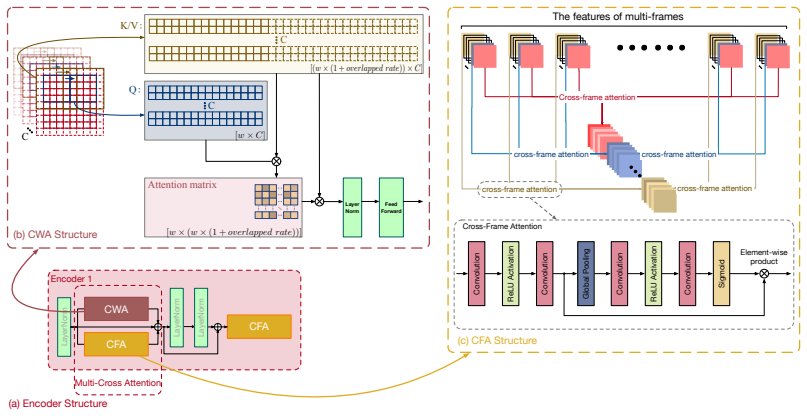
The paper's central objects are Multi-Cross Attention (MCA) and the Multi-Scan State-Space Module (MS-SSM). MCA combines overlapping Cross-Window Attention, in which the key/value windows are larger than the query window so attention reaches beyond the fixed window, with Cross-Frame Attention, a lightweight channel-compressed convolutional gating block that pools global frame information. MS-SSM is a four-direction scan of the flattened feature sequence inside a Residual Mamba Block, so long-range dependencies are modeled with linear complexity while a local convolution restores neighborhood regularity after the 1D scan. Together they carry the argument: CWA and CFA widen the receptive field during feature extraction, and MS-SSM plus CFA compensates for the limited receptive field of the DCN alignment in the fusion stage.
What would settle it
Retraining every compared method under identical settings (patch size 64, same epochs, same aligned-L1 loss, same data) and recomputing the real-world PSNR column would settle the claim; as printed, Table 1 already shows BurstM at 48.65 and AFCNet at 48.63, both above the paper's 48.60, so the asserted 'second in PSNR' ranking does not follow from the table.
Extended reading notes
Core claim
The central claim is that the standard burst-SR pipeline of feature extraction, flow-guided deformable alignment, fusion, and reconstruction can be improved by replacing the Swin Transformer stages with two purpose-built modules. In the encoder, Multi-Cross Attention (MCA) runs overlapping Cross-Window Attention and Cross-Frame Attention in parallel: the query uses a $P\times P$ window while keys and values use overlapping $P'\times P'$ windows, so each query token can attend to a wider neighborhood and to information from other frames. In the decoder, a Multi-Scan State-Space Module (MS-SSM) scans the fused features in four directions inside a Residual Mamba Block, and a Cross-Frame Attention block then re-weights the frame-wise information. The paper reports that this architecture achieves 43.20 PSNR, 0.972 SSIM, and 0.028 LPIPS on the synthetic NTIRE2022 dataset, ahead of all compared methods, and 48.60 PSNR, 0.986 SSIM, 0.021 LPIPS on the real-world dataset, where it says it is first in SSIM and LPIPS and second in PSNR. The ablation attributes 0.78 dB of the synthetic gain to MCA and a further 0.11 dB to the RMB fusion module.
Load-bearing premise
The reported state-of-the-art ranking assumes that all numbers in the comparison table are directly comparable, even though the baselines were trained with different patch sizes (80 versus 64) and some were retrained while others were taken from their original papers.
Editorial extensions
If this is right
- On the synthetic NTIRE2022 burst benchmark, the method claims 43.20 dB PSNR, a 0.34 dB gain over the previous best SeBIR, together with the best SSIM and LPIPS among the compared methods.
- On the real-world benchmark, it reports the best SSIM and LPIPS scores, reaching 48.60 dB PSNR while training at a smaller patch size than several baselines.
- On the ISO 12233 chart experiments, it reports 66 LP/mm horizontal, 59 LP/mm vertical, and 65 LP/mm diagonal resolution, exceeding the BSRT and Burstormer reconstructions.
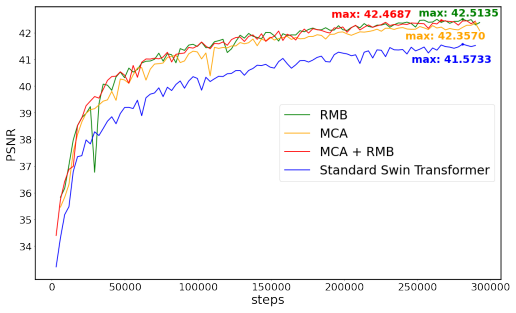
- The ablation study reports that replacing the Swin extraction with MCA adds 0.78 dB PSNR on synthetic bursts, and adding the MS-SSM-based RMB adds a further 0.11 dB.
- The design implies that retaining DCN-based alignment is not a liability when a multi-scan state-space fusion module is available to correct the residual misalignment.
Reading between the lines
- The attention recipe may transfer to other multi-frame low-level vision tasks: any alignment-plus-fusion pipeline that suffers from fixed-window attention could use overlapping cross-window attention and cross-frame gating to pull sub-pixel information from neighboring frames.
- Since the multi-scan SSM explicitly scans the dithering range of each pixel, it could be tested as a generic post-alignment error corrector, potentially reducing dependence on accurate optical flow estimates in video restoration.
- The real-world PSNR column of Table 1 lists BurstM (48.65) and AFCNet (48.63) above the paper's 48.60, so the 'second in PSNR' statement is an editorial reading of the table rather than a direct numerical consequence.
- The ISO 12233 result uses a short-wave infrared camera with 14-frame bursts and controlled 2-pixel dithering; those LP/mm numbers indicate fine-detail recovery in that specific setup and should not be treated as a direct RGB burst-SR measurement.
Editorial analysis
A structured set of objections, weighed in public.
Referee Report
Summary. The manuscript proposes a burst super-resolution network that combines a Multi-Cross Attention (MCA) encoder, built from overlapping cross-window attention and cross-frame attention, with a decoder based on a Multi-Scan State-Space Module (MS-SSM) and cross-frame attention, while retaining DCN-based alignment. The method is evaluated on the NTIRE2022 synthetic and real-world burst-SR benchmarks and on an ISO 12233 resolution chart. The central claims are that the method achieves state-of-the-art results on the synthetic dataset across PSNR, SSIM, and LPIPS, and that on the real-world dataset it achieves the highest SSIM and LPIPS with second-best PSNR.
Significance. If the reported synthetic result is reproducible, the proposed architecture is a credible integration of window attention, cross-frame attention, and state-space models for burst super-resolution, offering competitive performance at a moderate parameter count (12.60M). The synthetic comparison in Table 1 supports the claim of improved PSNR/SSIM/LPIPS over the listed baselines, including SeBIR. The real-world claims, however, are not supported by the table as presented, because the comparison mixes published patch-80 numbers with retrained patch-64 numbers and the text asserts rankings that the table does not show. The ISO 12233 experiment is a useful practical extension, but its protocol is not described in enough detail to verify. Overall, the work is of moderate significance for the burst-SR community, provided the comparison claims are corrected and the retraining protocol is documented.
major comments (4)
- [Table 1 caption, §4.3] The real-world ranking claims are not supported by Table 1. The text states that on the real-world dataset the method 'achieves the highest scores for SSIM and LPIPS, while ranking second in PSNR,' and the abstract repeats this. Sorting the real-world columns shows that Ours (PSNR 48.60, SSIM 0.986, LPIPS 0.021) is below BurstM at patch 64 (48.65 PSNR) and below several patch-80 entries (BurstM 49.12, SBFBurst 48.87, Burstormer 48.82, AFCNet 48.63). For SSIM, Ours 0.986 is below BurstM (0.987) and SBFBurst (0.987), and for LPIPS Ours 0.021 is tied with BSRT (0.021) and SeBIR (0.021), not strictly best. The claims are therefore only defensible if restricted to the 64-patch retrained models, but the text does not state that restriction. This is a load-bearing issue because the abstract, §4.3, and the conclusion all repeat the real-world state-of-the-art claim. The authors should either revise the claims to match the table or provide a consistent comparison protocol that justifies the stated ranking.
- [Table 1 caption / §4.2] The retraining protocol for the entries labeled '(64)' is not adequately specified. The caption says these values are obtained by retraining on the real-world dataset with the same 64-patch size as the proposed method, 'based on the open-sourced code from the paper,' but the manuscript does not report the retraining epochs, learning-rate schedule, loss function (aligned or not), data splits, or any other details needed to reproduce those numbers. Because the real-world comparison mixes published patch-80 numbers with retrained patch-64 numbers in a single table, the ranking of methods across these columns is not interpretable without knowing whether the retraining was faithful and comparable. The authors should either report full retraining details or present patch-80 and patch-64 results in separate, clearly labeled comparisons.
- [§4.5] The ablation study reports quantitative gains of 0.78 dB (MCA versus baseline) and 0.11 dB (full model versus MCA only) but does not provide a table with final PSNR, SSIM, or LPIPS values for the baseline, MCA-only, RMB-only, and full model. Only training curves are shown, and the sole numeric value, '≈43.07' for the RMB-only model, appears in the caption of Fig. 13. Without a numeric ablation table, the claimed contributions of the individual modules cannot be verified. Please add a table with final metrics and parameter counts for each ablated configuration.
- [§4.4] The ISO 12233 resolution-chart experiment does not describe a controlled comparison protocol. It states that low-resolution images were upsampled using 'several state-of-the-art BurstSR methods' but does not say whether those methods were retrained or fine-tuned on the same short-wave infrared data as the proposed method. The conclusion later asserts that 'the results, obtained using the same training data,' but this is not described in §4.4. Without a clear statement of how the competing models were adapted to the SWIR domain, the reported LP/mm differences cannot be attributed to the proposed architecture rather than to training conditions.
minor comments (6)
- [Header] The manuscript header reads 'Preprint submitted to Nuclear Physics B,' which is not an appropriate journal for a computer-vision paper; this appears to be a template error and should be corrected.
- [§3, §3.1] Equation numbering is inconsistent: Eq. (1) is used twice, first for Fd = E(F0) in §3 and again for the four equations inside the encoder description in §3.1. The equations in §3.1 should be renumbered sequentially.
- [Eq. (10)] The loss in Eq. (10) is written as L = ||ISR − IHR|| without specifying the norm; given the text mentions L1 loss, the equation should state the L1 norm explicitly and clarify whether the aligned L1 loss is used for real-world training.
- [§4.2] The patch-size description is confusing: 'For synthetic training, we used a patch size of 384 × 384 for high-resolution images. However, due to memory constraints, the patch size for low-resolution images was reduced to 64 × 64 during training on real-world data.' Please clarify which patch size applies to synthetic versus real-world training and the relationship between the HR and LR patch sizes.
- [§4.5] The ablation text says the orange line uses 'the proposed MCA modules in the decoder,' but MCA is described as an encoder module; this is likely a typo and should be corrected. Also, the baseline 'original BSRT' should be described precisely so the reader knows which configuration is used as the blue line.
- [§4.4] The conversion factor of 9.26 used to convert LW/PH to LP/mm is stated without derivation. Please provide the formula and the sensor parameters used, so the reported resolution values can be checked.
Circularity Check
No circular derivation: the method is an architecture proposal evaluated against external benchmarks, and the claimed rankings do not reduce by construction to the paper's own equations or citations.
full rationale
The paper's derivation chain is an architecture proposal plus empirical evaluation. The central claims (synthetic 43.20 PSNR, real-world LPIPS 0.021, etc.) are obtained by training the proposed MCA/MS-SSM network on NTIRE2022 data and comparing it with published baselines; there is no fitted parameter inserted into an equation that is then renamed a prediction, and no result is defined in terms of the target metric it claims to achieve. The equations in the paper (Eqs. 1-10) are forward-model definitions and the L1 loss; none of them encodes PSNR, SSIM, or LPIPS. Citations to MambaIR, VMamba, SwinIR, and similar works are used as component-design inspiration, not as load-bearing proof of this paper's SOTA claim. There is no self-citation chain and no imported uniqueness theorem. The skeptical observation that Table 1 does not support the statements 'highest scores for SSIM and LPIPS' and 'ranking second in PSNR' on the real-world dataset (e.g., BurstM and SBFBurst report higher PSNR/SSIM at the 80-patch setting) is a factual and benchmarking-consistency concern about mixed patch sizes, not a circularity: the claim, even if overstated, does not reduce by construction to a fitted input or to a self-cited result. Under the hard rules, that correctness risk does not raise the circularity score. The paper is self-contained against external benchmarks, so the honest finding is no significant circularity.
Assumptions & free parameters
free parameters (8)
- Overlap rate r in cross-window attention =
not reported
- Query window size P =
not reported
- Channel reduction factor beta in CFA =
not reported
- Channel expansion factor lambda in RMB =
not reported
- Number of MS-SSM scan directions =
4
- Learnable residual scales gamma and s' =
learned during training
- Feature embedding dimensions C and C' =
not reported
- Training patch sizes =
384x384 HR synthetic, 64x64 LR real
assumptions (5)
- standard math Softmax attention with relative position bias (Eq. 3) is a suitable operation for fusing window and frame features.
- domain assumption Pre-trained SpyNet optical flow and DCN offsets produce alignments accurate enough for the decoder to correct residuals.
- domain assumption Training on synthetic NTIRE bursts and fine-tuning on real-world bursts transfers to real captures.
- domain assumption PWC-Net alignment of real-world ground truth does not bias the reported metrics.
- ad hoc to paper Four fixed scan directions are sufficient to cover the sub-pixel displacement range in bursts.
Cite this review
Pith. "Pith review of Burst Image Super-Resolution via Multi-Cross Attention Encoding and Multi-Scan State-Space Decoding." pith.science (2026). https://pith.science/paper/C56XASFT
@misc{pith2026250519668,
  author       = {Pith},
  title        = {Pith review of: Burst Image Super-Resolution via Multi-Cross Attention Encoding and Multi-Scan State-Space Decoding},
  year         = {2026},
  howpublished = {\url{https://pith.science/paper/C56XASFT}},
  note         = {Machine review of arXiv:2505.19668}
}
read the original abstract
Multi-image super-resolution (MISR) can achieve higher image quality than single-image super-resolution (SISR) by aggregating sub-pixel information from multiple spatially shifted frames. Among MISR tasks, burst super-resolution (BurstSR) has gained significant attention due to its wide range of applications. Recent methods have increasingly adopted Transformers over convolutional neural networks (CNNs) in super-resolution tasks, due to their superior ability to capture both local and global context. However, most existing approaches still rely on fixed and narrow attention windows that restrict the perception of features beyond the local field. This limitation hampers alignment and feature aggregation, both of which are crucial for high-quality super-resolution. To address these limitations, we propose a novel feature extractor that incorporates two newly designed attention mechanisms: overlapping cross-window attention and cross-frame attention, enabling more precise and efficient extraction of sub-pixel information across multiple frames. Furthermore, we introduce a Multi-scan State-Space Module with the cross-frame attention mechanism to enhance feature aggregation. Extensive experiments on both synthetic and real-world benchmarks demonstrate the superiority of our approach. Additional evaluations on ISO 12233 resolution test charts further confirm its enhanced super-resolution performance.
Figures


Figures from the paper (10 more)



Reference graph
Works this paper leans on
-
[1]
J. Li, Z. Pei, W. Li, G. Gao, L. Wang, Y. Wang, T. Zeng, A system- atic survey of deep learning-based single-image super-resolution, ACM Computing Surveys 56 (10) (2024) 1–40
work page 2024
-
[2]
A. Dudhane, S. W. Zamir, S. Khan, F. S. Khan, M.-H. Yang, Burstormer: Burst Image Restoration and Enhancement Transformer (2023). 21
work page 2023
-
[3]
W. Ye, B. Lin, J. Lao, Y. Liu, Z. Lin, Mra-idn: a lightweight super- resolution framework of remote sensing images based on multi-scale residual attention fusion mechanism, IEEE Journal of Selected Topics in Applied Earth Observations and Remote Sensing (2024)
work page 2024
-
[4]
A. Kappeler, S. Yoo, Q. Dai, A. K. Katsaggelos, Video Super-Resolution With Convolutional Neural Networks, IEEE Transactions on Computa- tional Imaging 2 (2) (2016) 109–122. doi:10.1109/TCI.2016.2532323
-
[5]
Z. Luo, L. Yu, X. Mo, Y. Li, L. Jia, H. Fan, J. Sun, S. Liu, EBSR: Feature Enhanced Burst Super-Resolution with Deformable Alignment, in: 2021 IEEE/CVF Conference on Computer Vision and Pattern Recognition Workshops (CVPR W), IEEE, 2021, pp. 471–478. doi: 10.1109/CVPRW53098.2021.00058
arXiv 2021
-
[6]
Z. Luo, Y. Li, S. Cheng, L. Yu, Q. Wu, Z. Wen, H. Fan, J. Sun, S. Liu, BSRT: Improving Burst Super-Resolution with Swin Transformer and Flow-Guided Deformable Alignment (2022)
work page 2022
- [7]
-
[8]
B. Wronski, I. Garcia-Dorado, M. Ernst, D. Kelly, M. Krainin, C.-K. Liang, M. Levoy, P. Milanfar, Handheld multi-frame super-resolution, ACM Transactions on Graphics 38 (4) (2019) 1–18. doi:10.1145/ 3306346.3323024
arXiv 2019
Show all 54 references
-
[9]
Kawulok, P
M. Kawulok, P. Benecki, S. Piechaczek, K. Hrynczenko, D. Kostrzewa, J. Nalepa, Deep Learning for Multiple-Image Super-Resolution, IEEE Geoscience and Remote Sensing Letters 17 (6) (2020) 1062–1066
2020
- [10]
-
[11]
Rifat Arefin, V
M. Rifat Arefin, V. Michalski, P.-L. St-Charles, A. Kalaitzis, S. Kim, S. E. Kahou, Y. Bengio, Multi-Image Super-Resolution for Remote Sens- ing using Deep Recurrent Networks, in: 2020 IEEE/CVF Conference on 22 Computer Vision and Pattern Recognition Workshops (CVPR W), IEEE, ...
2020
- [12]
-
[13]
A. B. Molini, D. Valsesia, G. Fracastoro, E. Magli, DeepSUM: Deep neu- ral network for Super-resolution of Unregistered Multitemporal images, IEEE Transactions on Geoscience and Remote Sensing 58 (5) (2020) 3644–3656, arXiv:1907.06490 [eess]. doi:10.1109/TGRS.2019.2959248
2020 arXiv
-
[14]
Dudhane, S
A. Dudhane, S. W. Zamir, S. Khan, F. S. Khan, M.-H. Yang, Burst im- age restoration and enhancement, IEEE transactions on pattern analysis and machine intelligence (2024)
2024
-
[15]
E. Kang, B. Lee, S. Im, K. H. Jin, Burstm: Deep burst multi-scale sr using fourier space with optical flow, in: European Conference on Computer Vision, Springer, 2024, pp. 459–477
2024
- [16]
- [17]
- [18]
- [19]
- [20]
- [21]
-
[22]
X. Wang, L. Xie, C. Dong, Y. Shan, Real-ESRGAN: Training Real- World Blind Super-Resolution with Pure Synthetic Data, in: 2021 IEEE/CVF International Conference on Computer Vision Workshops (ICCVW), IEEE, 2021, pp. 1905–1914. doi:10.1109/ICCVW54120. 2021.00217
2021
-
[23]
N. Bose, N. Ahuja, Superresolution and noise filtering using moving least squares, IEEE Transactions on Image Processing 15 (8) (2006) 2239–2248. doi:10.1109/TIP.2006.877406
2006
-
[24]
Fermuller, Robust Wavelet-Based Super-Resolution Recon- struction: Theory and Algorithm, IEEE Transactions on Pattern Anal- ysis and Machine Intelligence 31 (4) (2009) 649–660
Hui Ji, C. Fermuller, Robust Wavelet-Based Super-Resolution Recon- struction: Theory and Algorithm, IEEE Transactions on Pattern Anal- ysis and Machine Intelligence 31 (4) (2009) 649–660. doi:10.1109/ TPAMI.2008.103
2009
-
[25]
S. P. Belekos, N. P. Galatsanos, A. K. Katsaggelos, Maximum a Pos- teriori Video Super-Resolution Using a New Multichannel Image Prior, IEEE Transactions on Image Processing 19 (6) (2010) 1451–1464. doi: 10.1109/TIP.2010.2042115
2010
-
[26]
G. Bhat, M. Danelljan, L. Van Gool, R. Timofte, Deep Burst Super- Resolution, in: 2021 IEEE/CVF Conference on Computer Vision and Pattern Recognition (CVPR), IEEE, 2021, pp. 9205–9214
2021
-
[27]
G. Bhat, M. Danelljan, F. Yu, L. Van Gool, R. Timofte, Deep Reparametrization of Multi-Frame Super-Resolution and Denoising, in: 2021 IEEE/CVF International Conference on Computer Vision (ICCV), IEEE, 2021, pp. 2440–2450
2021
-
[28]
J. Dai, H. Qi, Y. Xiong, Y. Li, G. Zhang, H. Hu, Y. Wei, Deformable convolutional networks, in: Proceedings of the IEEE international con- ference on computer vision, 2017, pp. 764–773
2017
-
[29]
Z. Liu, Y. Lin, Y. Cao, H. Hu, Y. Wei, Z. Zhang, S. Lin, B. Guo, Swin Transformer: Hierarchical Vision Transformer using Shifted Win- dows, in: 2021 IEEE/CVF International Conference on Computer Vi- sion (ICCV), IEEE, 2021, pp. 9992–10002. 24
2021
-
[30]
Dosovitskiy, L
A. Dosovitskiy, L. Beyer, A. Kolesnikov, D. Weissenborn, X. Zhai, T. Unterthiner, M. Dehghani, M. Minderer, G. Heigold, S. Gelly, J. Uszkoreit, N. Houlsby, An Image is Worth 16x16 Words: Transform- ers for Image Recognition at Scale (2021)
2021
-
[31]
Parmar, P
N. Parmar, P. Ramachandran, A. Vaswani, I. Bello, A. Levskaya, J. Shlens, Stand-Alone Self-Attention in Vision Models, Advances in neural information processing systems 32 (2019)
2019
-
[32]
Carion, F
N. Carion, F. Massa, G. Synnaeve, N. Usunier, A. Kirillov, S. Zagoruyko, End-to-end object detection with transformers, in: European conference on computer vision, Springer, 2020, pp. 213–229
2020
-
[33]
Touvron, M
H. Touvron, M. Cord, M. Douze, F. Massa, A. Sablayrolles, H. J´ egou, Training data-efficient image transformers & distillation through atten- tion, in: International conference on machine learning, PMLR, 2021, pp. 10347–10357
2021
-
[34]
X. Chu, Z. Tian, Y. Wang, B. Zhang, H. Ren, X. Wei, H. Xia, C. Shen, Twins: Revisiting the Design of Spatial Attention in Vision Transform- ers, Advances in neural information processing systems 34 (2021) 9355– 9366
2021
- [36]
- [37]
-
[38]
R. Liu, H. Deng, Y. Huang, X. Shi, L. Lu, W. Sun, X. Wang, J. Dai, H. Li, FuseFormer: Fusing Fine-Grained Information in Transformers 25 for Video Inpainting, in: 2021 IEEE/CVF International Conference on Computer Vision (ICCV), IEEE, 2021, pp. 14020–14029. doi:10.1109/ ICCV48...
2021
-
[39]
Zhang, J
K. Zhang, J. Peng, J. Fu, D. Liu, Exploiting Optical Flow Guid- ance for Transformer-Based Video Inpainting, IEEE Transactions on Pattern Analysis and Machine Intelligence 46 (7) (2024) 4977–4992, arXiv:2301.10048 [cs]. doi:10.1109/TPAMI.2024.3361010
2024 arXiv
-
[40]
Liang, J
J. Liang, J. Cao, G. Sun, K. Zhang, L. Van Gool, R. Timofte, SwinIR: Image Restoration Using Swin Transformer, in: 2021 IEEE/CVF Inter- national Conference on Computer Vision Workshops (ICCVW), IEEE, 2021, pp. 1833–1844
2021
-
[41]
H. Chen, Y. Wang, T. Guo, C. Xu, Y. Deng, Z. Liu, S. Ma, C. Xu, C. Xu, W. Gao, Pre-Trained Image Processing Transformer, in: 2021 IEEE/CVF Conference on Computer Vision and Pattern Recognition (CVPR), IEEE, 2021, pp. 12294–12305. doi:10.1109/CVPR46437. 2021.01212
2021
-
[42]
A. Gu, I. Johnson, K. Goel, K. Saab, T. Dao, A. Rudra, C. R´ e, Combin- ing Recurrent, Convolutional, and Continuous-time Models with Linear State-Space Layers, Advances in neural information processing systems 34 (2021) 572–585
2021
- [43]
- [44]
-
[45]
Ranjan, M
A. Ranjan, M. J. Black, Optical Flow Estimation Using a Spatial Pyramid Network, in: 2017 IEEE Conference on Computer Vision and Pattern Recognition (CVPR), IEEE, 2017, pp. 2720–2729. doi: 10.1109/CVPR.2017.291. 26
2017 doi
-
[46]
Huang, H
C. Huang, H. Nien, Multi chaotic systems based pixel shuffle for image encryption, Optics Communications 282 (11) (2009) 2123–2127. doi: 10.1016/j.optcom.2009.02.044
2009 doi
-
[47]
K. Li, Y. Wang, J. Zhang, P. Gao, G. Song, Y. Liu, H. Li, Y. Qiao, UniFormer: Unifying Convolution and Self-Attention for Visual Recog- nition, IEEE Transactions on Pattern Analysis and Machine Intelligence 45 (10) (2023) 12581–12600. doi:10.1109/TPAMI.2023.3282631. URL https:...
2023
-
[48]
T. Xiao, M. Singh, E. Mintun, T. Darrell, P. Doll´ ar, R. Girshick, Early convolutions help transformers see better, Advances in neural informa- tion processing systems 34 (2021) 30392–30400
2021
- [49]
- [50]
-
[51]
G. Bhat, M. Danelljan, R. Timofte, Y. Cao, Y. Cao, M. Chen, X. Chen, S. Cheng, A. Dudhane, H. Fan, et al., Ntire 2022 burst super-resolution challenge, in: Proceedings of the IEEE/CVF conference on computer vision and pattern recognition, 2022, pp. 1041–1061
2022
-
[52]
Loshchilov, F
I. Loshchilov, F. Hutter, SGDR: STOCHASTIC GRADIENT DE- SCENT WITH W ARM RESTARTS, arXiv preprint arXiv:1608.03983 (2017)
2017 arXiv
-
[53]
D. Sun, X. Yang, M.-Y. Liu, J. Kautz, PWC-Net: CNNs for Optical Flow Using Pyramid, Warping, and Cost Volume, in: 2018 IEEE/CVF Conference on Computer Vision and Pattern Recognition, IEEE, 2018, pp. 8934–8943. doi:10.1109/CVPR.2018.00931
2018
-
[54]
Mehta, A
N. Mehta, A. Dudhane, S. Murala, S. W. Zamir, S. Khan, F. S. Khan, Adaptive Feature Consolidation Network for Burst Super-Resolution, in: 2022 IEEE/CVF Conference on Computer Vision and Pattern Recognition Workshops (CVPR W), IEEE, 2022, pp. 1278–1285. doi: 10.1109/CVPRW56347....
2022
-
[55]
H. Liu, M. Shao, Y. Wan, Y. Liu, K. Shang, Sebir: Semantic-guided burst image restoration, Neural Networks 181 (2025) 106834. 28 BIPNet BSRT Burstormer OursBurstM SBFBurst Ground Truth Lr Figure 5: Visual comparison results on Synthetic Datasets [26]. The odd rows the Ground t...
2025
Reviewed August 7, 2026 · model on record in the stance chip above.
Discussion (0). Sign in to comment.