REVIEW 4 major objections 4 minor 54 references
Comparing Moral Values in Western English-speaking societies and LLMs with Word Associations
T0 review · 4 major / 4 minor · reviewed 2026-08-07 · deepseek-v4-flash
Pith's one-line read By comparing word-association graphs built from human participants and from Llama, this paper claims that humans and LLMs align more closely on positive moral values than on negative ones, where human responses are more emotional and…
desk verdict A well-built dataset and a plausible method, but the central human-vs-LLM moral contrast is currently confounded by an internal alpha contradiction and by cue-selection bias. read the letter →
The pith
A machine-rendered reading of the paper's core claim, the machinery that carries it, and where it could break.
The reading
What carries the argument
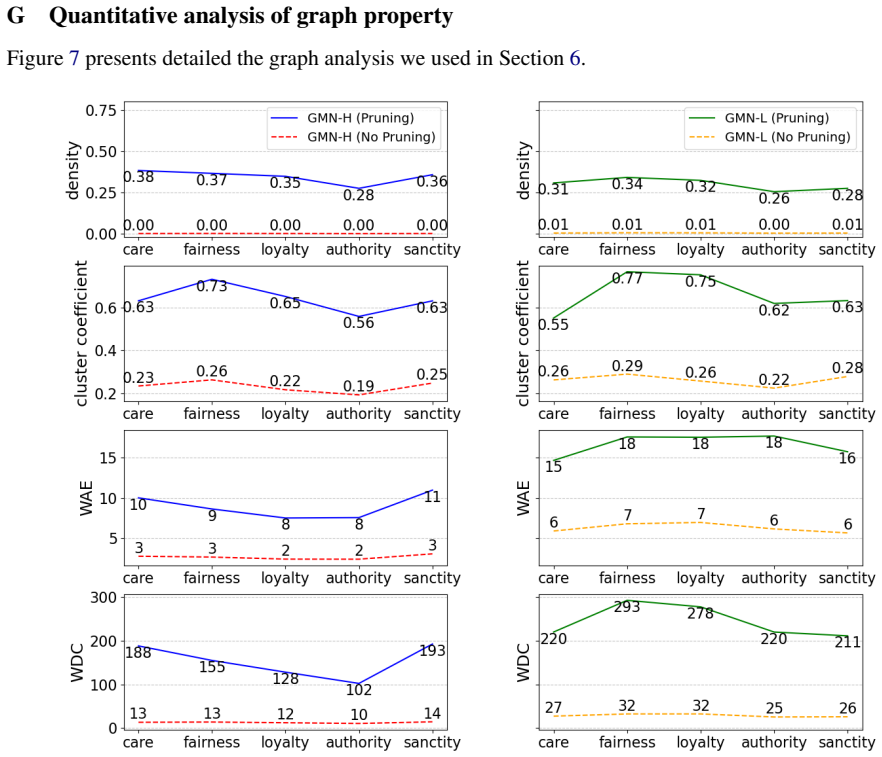
The central object is a pair of word-association graphs, WA-H built from about 90,000 human participants' responses in the Small World of Words dataset, and WA-L built by prompting Llama with the same cue words and the exact human instructions, repeated 100 times per cue with temperature tuned to match human variability and robustness. Moral values enter through 626 seed words from the Moral Foundations Dictionary, each carrying a five-dimensional score on the MFT dimensions Care, Fairness, Loyalty, Authority, and Sanctity. The propagation step is a random walk over the global graph with closed form $F^* = (I - \alpha S)^{-1} F_0$, where $S = D^{-1/2} W D^{-1/2}$ is the normalized adjacency matrix, $F_0$ is the seed matrix, and $\alpha$ controls how far moral information travels; it assigns every word a five-dimensional moral vector. Applying this method to WA-H and WA-L yields the Global Moral Networks GMN-H and GMN-L, whose correlation with the crowdsourced Extended Moral Foundations Dictionary is the key quantitative evidence, and whose graph topology (diameter, density, connectivity) explains why the LLM graph needs a larger $\alpha$ to propagate moral information.
What would settle it
Run the same association elicitation on Llama-3.1-8B without the role-playing instruction, or on a non-instruction-tuned base model, and compare the emotionality and concreteness of responses to negative moral cues. If the pattern of sterile, abstract, fairness-dominated associations disappears or the positive-negative asymmetry flips, the reported moral map is an artifact of the prompt and instruction tuning rather than a stable property of the model's associations.
Extended reading notes
Core claim
Read through the lens of the mental lexicon, Llama-3.1-8B-Instruct and English-speaking human participants share a largely similar moral map for positive concepts—both rank religious and virtue words like church, kind, and holy at the top—but diverge sharply on negative concepts. Humans associate negative moral cues with sensory, physical, and emotionally charged words such as vomit, gross, and pain, whereas Llama associates them with abstract social categories such as prejudice, discrimination, and betrayal, and tends to make the same abstract words top responses to each other. The paper's central claim is that this asymmetry is systematic: humans show greater emotional diversity and concreteness in morally negative associations, while LLMs are less varied and more abstract, and this divergence matters because an LLM lacking experiential, affective grounding for negative concepts could misjudge the severity of harm. Methodologically, the paper claims that propagating moral values through a global association graph yields moral scores that correlate with human moral judgments better than the local moral association graph baseline, demonstrating that multi-hop associations over longer distances carry recoverable moral content.
Load-bearing premise
That the word associations Llama produces when given the human experiment instructions reveal its internal moral organization, rather than being shaped by instruction-following, RLHF, or text memorized from training data.
Editorial extensions
If this is right
- Word associations can be used to probe LLM morality indirectly, sidestepping the instability and training-data leakage that plague direct moral questionnaires.
- The five-dimensional moral scores assigned to all 12,000 concepts can serve as word-level building blocks for future sentence- or document-level moral inference.
- Because the LLM graph has fewer edges, lower density, and larger diameter than the human graph, moral information propagates less efficiently through LLM associations, a measurable structural signature of the divergence.
- The strong overlap on positive moral concepts suggests LLM representations do reflect aspects of human moral conceptualization, supporting the plausibility of aligning deployed models with human values.
- The systematic divergence on negative concepts implies that an LLM without experiential and affective grounding could misjudge the severity of harm or respond inappropriately in morally critical situations, even when direct answers are superficially correct.
Reading between the lines
- An extension the authors leave implicit: the positive-negative asymmetry could partly reflect RLHF and the training objective, which reward sanitized, socially desirable continuations and suppress visceral, negatively charged language; comparing instruction-tuned and base models on the same association task would test this.
- Going beyond the paper, the same protocol could be run with prompt-free distributional measures such as embedding nearest neighbors or next-token probabilities without role-playing instructions, to determine whether the abstract-versus-concrete pattern is intrinsic to Llama's representations or an artifact of the elicitation prompt.
- Grounded in the paper's framework but not its experiments, the word-level moral scores from GMN-L could be piped into downstream moral-judgment tasks; if the low-emotion representation of negative concepts transfers, models should under-predict harm severity in vignettes involving visceral disgust or physical pain.
Editorial analysis
A structured set of objections, weighed in public.
Referee Report
Summary. This paper proposes a framework for comparing moral values in Western English-speaking human word associations (SWOW English) and associations generated by Llama-3.1-8B-Instruct. The authors elicit 100 associations per cue from Llama using the SWOW instruction, tune the sampling temperature to match human diversity and split-half reliability, and construct two word-association graphs (WA-H and WA-L). They then seed moral values from the Moral Foundations Dictionary and propagate them through each graph with a random-walk algorithm, producing Global Moral Networks (GMN-H and GMN-L). They report that this global propagation outperforms the local MAG baseline in correlation with the extended Moral Foundations Dictionary (eMFD), and they compare the two networks' top positive and negative moral concepts. Their headline finding is that LLMs and humans align more closely on positive moral concepts, while they diverge on negative concepts, with humans showing more emotional and concrete associations and Llama producing more abstract ones. The paper includes public code and data.
Significance. The paper's dataset-construction practices are a clear strength: 100 generations per cue, temperature tuning on 400 held-out cues, split-half reliability checks, and held-out alpha selection on 277 eMFD words are all described and make the resource valuable. The global propagation method is a plausible step beyond the local MAG baseline, and if the central comparison were sound, the finding that positive moral concepts align better than negative concepts would be a useful empirical contribution to LLM moral-alignment research. However, the headline comparison currently rests on an internally contradictory choice of the propagation parameter alpha and on downstream selection of cues from the very scores being compared, so the central asymmetry is not yet interpretable. The paper is honest about its cultural scope and acknowledges the possibility that different LLMs behave differently.
major comments (4)
- [§5.1.1 and Appendix D] The assignment of α is internally contradictory: §5.1.1 reports GMN-H optimal at α=0.75 and GMN-L at α=0.9, while Appendix D states GMN-L peaks at α=0.75 and GMN-H at α=0.9. Because α controls how far the MFD seed values diffuse through the graph, the identity of the top negative concepts in Table 2 and the cue sets used in §6.2 both depend on this choice. The headline asymmetry (humans more concrete/emotional, LLMs more abstract; positive alignment but negative divergence) is exactly the kind of pattern an α mismatch could produce. The authors should resolve the contradiction and re-run the human-LLM comparison with a common α for both graphs, or report the full sensitivity surface across α for both graphs, and show that the top lists and Table 4 are stable.
- [§6.2 and Table 4] The emotionality and concreteness analyses are performed on the top 50 negative cues selected from the same propagated scores that are being compared. If the two graphs rank different cues into the top 50, then the observation that GMN-H responses are more concrete and more emotionally diverse may simply reflect the properties of the cue words, not a difference in how humans and Llama respond to the same cues. The paper should restrict the comparison to a shared set of cues (intersection, or a fixed score threshold applied to both graphs), report the size of the overlap, and show that the emotion/concreteness differences survive on that common set.
- [§4 and Appendix A] The interpretation that WA-L reflects Llama's 'mental lexicon' is not established. The prompt explicitly asks the model to 'help scientists understand how meaning is organized in our mental dictionary' and to give the first words that come to mind; an instruction-tuned model is trained to comply with such role-playing requests, and its responses may be a simulation of human word-association behavior learned from text rather than a trace of its internal conceptual organization. To support the central claim, the authors should include a control condition (e.g., a non-instruction-tuned base model, a paraphrased instruction that does not invoke a mental dictionary, or a prompt that asks for the most textually associated words) and demonstrate that the §6 divergence pattern remains. This is a correctness-risk concern rather than a claim about intentional mimicry.
- [§5.2, §5.1.1, and Appendix E] The comparison with eMFD is not fully independent of the dictionary family: seeds are from MFD, alpha is tuned on a held-out slice of eMFD, and evaluation uses the remaining eMFD words. In addition, the MAD normalization described in Appendix E rescales each graph separately, which cannot undo α-driven differences in relative ranking (or fix the contradiction in the first major comment). The paper should report the correlation results after excluding all MFD seed words from evaluation, with the procedure clearly specified (the current text around 'subtract the seed values' is ambiguous about whether this is done for all nodes or only seed nodes), and should acknowledge the remaining dependence on MFT-derived resources. If the central contribution is the human-LLM comparison, the eMFD evaluation is secondary, but the normalization and seed-exclusion details need to be precise.
minor comments (4)
- [Abstract, §3.1, and Appendix C] The number of cue words is given as 12,000, 12k, and 12,216 in different places; the exact count should be stated once and used consistently throughout.
- [Table 4] The 'All' column contains a bare '41' and the significance markers are not fully explained; the table should be restructured so the reader can see the dimension-wise sample sizes and the exact test performed.
- [Appendix F] The tables list 'Top Response' and 'Top Unique Response' side by side, but several rows are misaligned; please use a single table with clear column headers and verify that the top-4 lists correspond to the same cue across the two graphs.
- [Appendix A] The sentence 'The exact same system prompt has been used to collecting human responses' is inaccurate: human participants were not given a system prompt; the wording should say that the same instruction text was adapted from the human data-collection procedure.
Circularity Check
The positive human-LLM alignment is partly by construction because both GMNs receive identical MFD seed values and seeds are not removed from the Section 6 ranking; the negative-concept emotionality/concreteness comparison is additionally confounded by a direct contradiction in the α assignments between the main text and Appendix D.
-
self definitional
[Section 5.1 (moral value initialization) + Section 6.1 and Table 2]
"We then initialize F0 with moral values by assigning each ci ∈ MFD its five associated moral values ∈[−1,1,0] for vice, virtue and no association, respectively. ... We calculate each concept’s overall morality by summing its moral scores across the five dimensions for both positive (virtues) and negative (vices), then rank the concepts accordingly."
The seed matrix F0 is identical for GMN-H and GMN-L because both use the same MFD. Propagation via (I−αS)^−1 with a nonnegative kernel preserves the sign of each seed dimension, so MFD virtue seeds start at +1 in both graphs and dominate the positive pole. Section 6.1 ranks concepts using these propagated scores without subtracting or excluding the MFD seeds (unlike the evaluation setup in §5.1.1). The headline claim that 'LLMs and humans align more closely for positive moral values' is therefore at least partly an artifact of shared initialization: the two GMNs are being compared on the very words that were set equal by construction. The positive-overlap rows of Table 2 are not independent evidence of human-LLM alignment.
-
fitted input called prediction
[Section 5.1.1 vs. Appendix D, and Section 6.2 (Table 4)]
"We find that GMN-H requires a smaller α=0.75 for optimal performance, while GMN-L performs best at α=0.9 (detailed in the Appendix D). ... Appendix D: The GMN-L correlation reaches its peak at alpha = 0.75, while the GMN-H correlation peaks at alpha = 0.9. We used these respective optimal values in Section 5 to propagate the moral values."
α is fitted to a slice of eMFD, and the resulting scores are then used to select the top 50 negative cues analyzed in §6.2. The main text and Appendix D assign the optimal α values to opposite graphs. Because α controls how far the shared MFD seeds diffuse, a larger α propagates abstract fairness-cluster concepts (prejudice, discrimination) to the top, while a smaller α leaves local sensory concepts (vomit, disgusting) on top. The reported asymmetry—human top negatives concrete/emotional, LLM top negatives abstract/sterile—is therefore a direct consequence of whichever α assignment was actually used, rather than an independent property of the two association graphs.
full rationale
The paper's core methodological derivation—propagating MFD seed values through WA-H and WA-L and correlating the results with the eMFD—is not circular in itself: it uses standard label propagation, the tuning and evaluation slices of eMFD are disjoint, and the authors' self-citations to their own word-association work are background support rather than load-bearing. The evaluation against eMFD is meaningful despite sharing the MFT dictionary family, because the graph structure must still generate the eMFD scores from sparse seeds. However, the headline qualitative comparison is compromised in two concrete, quotable ways. First, the positive-alignment result is partially by construction: both GMNs are initialized from the same MFD seeds, and the Section 6 ranking does not remove those seeds, so the overlapping top positive concepts (church, religion, God, kind, etc.) reflect the shared seed matrix rather than emergent alignment. Second, the human-vs-LLM negative-concept comparison is confounded by a direct contradiction between §5.1.1 and Appendix D over which graph uses α=0.75 versus α=0.9; since α determines which concepts become top-ranked negatives, and since §6.2 then selects the top 50 negative cues from those very scores, the emotion/concreteness findings are not an independent test of human versus LLM associations. These issues make the central comparative claim substantially circular or artifact-driven, while the underlying graph-propagation and correlation results retain independent content, yielding a score of 6.
Assumptions & free parameters
free parameters (3)
- temperature =
2.1
- alpha_H =
0.75
- alpha_L =
0.9
assumptions (6)
- domain assumption Moral Foundation Theory's five dimensions adequately capture human moral variation.
- domain assumption Word association graphs reflect mental-lexicon organization and support moral inference.
- domain assumption Prompting Llama with the human word-association instructions gives a valid proxy for the model's internal lexical organization.
- domain assumption MFD and eMFD provide valid ground-truth moral scores for English words.
- standard math The closed-form random-walk propagation F*=(I-alpha S)^-1 F0 is valid and converges.
- domain assumption Human and LLM graphs with different densities, diameters, and tuned alpha values can be compared directly.
Cite this review
Pith. "Pith review of Comparing Moral Values in Western English-speaking societies and LLMs with Word Associations." pith.science (2026). https://pith.science/paper/AJSVSXKE
@misc{pith2026250519674,
  author       = {Pith},
  title        = {Pith review of: Comparing Moral Values in Western English-speaking societies and LLMs with Word Associations},
  year         = {2026},
  howpublished = {\url{https://pith.science/paper/AJSVSXKE}},
  note         = {Machine review of arXiv:2505.19674}
}
read the original abstract
As the impact of large language models increases, understanding the moral values they reflect becomes ever more important. Assessing the nature of moral values as understood by these models via direct prompting is challenging due to potential leakage of human norms into model training data, and their sensitivity to prompt formulation. Instead, we propose to use word associations, which have been shown to reflect moral reasoning in humans, as low-level underlying representations to obtain a more robust picture of LLMs' moral reasoning. We study moral differences in associations from western English-speaking communities and LLMs trained predominantly on English data. First, we create a large dataset of LLM-generated word associations, resembling an existing data set of human word associations. Next, we propose a novel method to propagate moral values based on seed words derived from Moral Foundation Theory through the human and LLM-generated association graphs. Finally, we compare the resulting moral conceptualizations, highlighting detailed but systematic differences between moral values emerging from English speakers and LLM associations.
Figures


Figures from the paper (3 more)


Reference graph
Works this paper leans on
-
[1]
Marwa Abdulhai, Gregory Serapio-Garcia, Clément Crepy, Daria Valter, John Canny, and Natasha Jaques. 2023. https://arxiv.org/abs/2310.15337 Moral foundations of large language models . arXiv preprint arXiv:2310.15337
arXiv 2023
-
[2]
Katherine Abramski, Clara Lavorati, Giulio Rossetti, and Massimo Stella. 2024. https://doi.org/10.3233/FAIA240177 Llm-generated word association norms . In HHAI 2024: Hybrid Human AI Systems for the Social Good, pages 3--12. IOS Press
-
[3]
Guilherme F. C. F. Almeida, José Luiz Nunes, Neele Engelmann, Alex Wiegmann, and Marcelo de Araújo. 2024. https://doi.org/10.1016/j.artint.2024.104145 Exploring the psychology of llms’ moral and legal reasoning . Artificial Intelligence, 333:104145
arXiv 2024
-
[4]
Sotiris Anagnostidis and Jannis Bulian. 2024. https://doi.org/10.48550/arXiv.2408.11865 How susceptible are llms to influence in prompts? arXiv preprint arXiv:2408.11865. Computer Science > Computation and Language (cs.CL)
-
[5]
M. Atari, J. Haidt, J. Graham, S. Koleva, S. T. Stevens, and M. Dehghani. 2023. https://doi.org/10.1037/pspp0000470 Morality beyond the weird: How the nomological network of morality varies across cultures . Journal of Personality and Social Psychology, 125(5):1157--1188
-
[6]
John Baldwin. 2017. https://oxfordre.com/communication/view/10.1093/acrefore/9780190228613.001.0001/acrefore-9780190228613-e-164 Culture, prejudice, racism, and discrimination . Oxford Research Encyclopedia of Communication. Date of access 5 Oct. 2024
arXiv 2017
-
[7]
Marc Brysbaert, Amy Beth Warriner, and Victor Kuperman. 2014. Concreteness ratings for 40 thousand generally known english word lemmas. Behavior Research Methods, 46(3):904--911
work page 2014
-
[8]
Damon Centola. 2010. https://doi.org/10.1126/science.1185231 The spread of behavior in an online social network experiment . Science, 329:1194--1197
Show all 54 references
-
[9]
Richard A. Charter. 1996. https://doi.org/10.2466/pms.1996.82.2.401 Note on the underrepresentation of the split-half reliability formula for unequal standard deviations . Perceptual and Motor Skills, 82(2):401--402
1996 doi
-
[10]
Herbert H Clark. 1970. Word associations and linguistic theory. New horizons in linguistics, 1:271--286
1970
-
[11]
Sunhao Dai, Chen Xu, Shicheng Xu, Liang Pang, Zhenhua Dong, and Jun Xu. 2024. https://doi.org/10.1145/3637528.3671458 Bias and unfairness in information retrieval systems: New challenges in the llm era . In Proceedings of the 30th ACM SIGKDD Conference on Knowledge Discovery a...
2024
-
[12]
Simon De Deyne, \'A lvaro Cabana, Bing Li, Qing Cai, and Meredith McKague. 2020. A cross-linguistic study into the contribution of affective connotation in the lexico-semantic representation of concrete and abstract concepts. In CogSci
2020
-
[13]
Kenett, David Anaki, and Miriam Faust
Simon De Deyne, Yoed N. Kenett, David Anaki, and Miriam Faust. 2016. Large-scale network representations of semantics in the mental lexicon. In Michael Ramscar, Matt Jones, Melody Dye, and Ernest Klein, editors, Big Data in Cognitive Science, 1st edition, page 7. Psychology Press
2016
-
[14]
Simon De Deyne, Danielle J Navarro, Guillem Collell, and Andrew Perfors. 2021. Visual and affective multimodal models of word meaning in language and mind. Cognitive Science, 45(1):e12922
2021
-
[15]
small world of words
Simon De Deyne, Danielle J. Navarro, Amy Perfors, Marc Brysbaert, and Gert Storms. 2019. The “small world of words” english word association norms for over 12,000 cue words. Behavior Research Methods, 51(3):987--1006
2019
-
[16]
Danica Dillion, Niket Tandon, Yuling Gu, and Kurt Gray. 2023. https://doi.org/10.1016/j.tics.2023.04.008 Can ai language models replace human participants? Trends in Cognitive Sciences, 27(7):597--600
2023 doi
-
[17]
Yupei Du, Yuanbin Wu, and Man Lan. 2019. Exploring human gender stereotypes with word association test. In Proceedings of the 2019 Conference on Empirical Methods in Natural Language Processing and the 9th International Joint Conference on Natural Language Processing (EMNLP-IJ...
2019
-
[18]
Abhimanyu Dubey, Abhinav Jauhri, Abhinav Pandey, Abhishek Kadian, Ahmad Al-Dahle, Aiesha Letman, Akhil Mathur, Alan Schelten, Amy Yang, Angela Fan, et al. 2024. The llama 3 herd of models. arXiv preprint arXiv:2407.21783
2024 arXiv
-
[19]
Hartry H. Field. 1981. https://doi.org/doi:10.4159/harvard.9780674594722.c7 5. Mental Representation , pages 78--114. Harvard University Press, Cambridge, MA and London, England
1981 doi
-
[20]
Jillian Fish and Moin Syed. 2020. https://www.researchgate.net/profile/Jillian-Fish/publication/339240954_Racism_Discrimination_and_Prejudice/links/5e45a7c5299bf1cdb9284646/Racism-Discrimination-and-Prejudice.pdf Racism, discrimination, and prejudice . In The Encyclopedia of C...
2020
-
[21]
Jeremy Frimer, Jonathan Haidt, Jesse Graham, Morteza Dehghani, and Reihane Boghrati. 2017. Moral foundations dictionaries for linguistic analyses, 2.0. Unpublished Manuscript
2017
-
[22]
Wojcik, and Peter H
Jesse Graham, Jonathan Haidt, Sena Koleva, Matt Motyl, Ravi Iyer, Sean P. Wojcik, and Peter H. Ditto. 2013. Moral foundations theory: The pragmatic validity of moral pluralism. In Patricia Devine and Ashby Plant, editors, Advances in Experimental Social Psychology, volume 47, ...
2013
-
[23]
Jesse Graham, Jonathan Haidt, and Brian A. Nosek. 2009. https://doi.org/10.1037/a0015141 Liberals and conservatives rely on different sets of moral foundations . Journal of Personality and Social Psychology, 96(5):1029--1046
2009 doi
-
[24]
Rui Guo, Greg Farnan, Niall McLaughlin, and Barry Devereux. 2024. https://doi.org/10.18653/v1/2024.bionlp-1.58 QUB -cirdan at discharge me! : Zero shot discharge letter generation by open-source LLM . In Proceedings of the 23rd Workshop on Biomedical Natural Language Processin...
2024 doi
-
[25]
Loek Halman and Ruud De Moor. 1994. Religion, churches and moral values. In The individualizing society, pages 37--65. Brill
1994
-
[26]
Joseph Henrich, Steven J Heine, and Ara Norenzayan. 2010. The weirdest people in the world? Behavioral and brain sciences, 33(2-3):61--83
2010
-
[27]
Hopp, Jacob T
Frederic R. Hopp, Jacob T. Fisher, Devin Cornell, Richard Huskey, and René Weber. 2021. The extended moral foundations dictionary (emfd): Development and applications of a crowd-sourced approach to extracting moral intuitions from text. Behavior Research Methods, 53(1):232--246
2021
- [28]
-
[29]
Anil Jain, Karthik Nandakumar, and Arun Ross. 2005. https://doi.org/10.1016/j.patcog.2005.01.012 Score normalization in multimodal biometric systems . Pattern Recognition, 38(12):2270--2285
2005 doi
- [30]
-
[31]
Cheongwoong Kang and Jaesik Choi. 2023. https://doi.org/10.18653/v1/2023.findings-emnlp.518 Impact of co-occurrence on factual knowledge of large language models . In Findings of the Association for Computational Linguistics: EMNLP 2023, pages 7721--7735, Singapore. Associatio...
2023 doi
-
[32]
S. Kappal. 2019. Data normalization using median median absolute deviation mmad based z-score for robust predictions vs. min--max normalization. London Journal of Research in Science: Natural and Formal, 19(4):39--44
2019
-
[33]
Zdravka Kostova and Blagovesta Radoynovska. 2008. https://zdravka-kostova.com/free/Kostova, Bulgarian Journal of Science and Education Policy (BJSEP), 2(2):209--231
2008
-
[34]
Chunhua Liu, Trevor Cohn, Simon De Deyne, and Lea Frermann. 2022. https://doi.org/10.18653/v1/2022.aacl-main.9 WAX : A new dataset for word association e X planations . In Proceedings of the 2nd Conference of the Asia-Pacific Chapter of the Association for Computational Lingui...
2022 doi
-
[35]
Chunhua Liu, Trevor Cohn, and Lea Frermann. 2021. https://doi.org/10.18653/v1/2021.conll-1.38 Commonsense knowledge in word associations and C oncept N et . In Proceedings of the 25th Conference on Computational Natural Language Learning, pages 481--495, Online. Association fo...
2021 doi
-
[36]
Will Lowe. 1997. Meaning and the mental lexicon. In Proceedings of the 15th International Joint Conference on Artificial Intelligence (IJCAI), pages 1092--1097
1997
-
[37]
Tomas Mikolov, Ilya Sutskever, Kai Chen, Greg S Corrado, and Jeff Dean. 2013. https://proceedings.neurips.cc/paper_files/paper/2013/file/9aa42b31882ec039965f3c4923ce901b-Paper.pdf Distributed representations of words and phrases and their compositionality . In Advances in Neur...
2013
-
[38]
Daye Nam, Andrew Macvean, Vincent Hellendoorn, Bogdan Vasilescu, and Brad Myers. 2024. https://doi.org/10.1145/3597503.3639187 Using an llm to help with code understanding . In ICSE '24: Proceedings of the IEEE/ACM 46th International Conference on Software Engineering, New Yor...
2024
-
[39]
Aida Ramezani and Yang Xu. 2023. https://doi.org/10.18653/v1/2023.acl-long.26 Knowledge of cultural moral norms in large language models . In Proceedings of the 61st Annual Meeting of the Association for Computational Linguistics (Volume 1: Long Papers), pages 428--446, Toront...
2023 doi
-
[40]
Aida Ramezani and Yang Xu. 2024. Moral association graph: A cognitive model for moral inference. In Proceedings of the Annual Meeting of the Cognitive Science Society, volume 46
2024
-
[41]
Shibani Santurkar, Esin Durmus, Faisal Ladhak, Cinoo Lee, Percy Liang, and Tatsunori Hashimoto. 2023. Whose opinions do language models reflect? In Proceedings of the 40th International Conference on Machine Learning, ICML'23. JMLR.org
2023
-
[42]
Nino Scherrer, Claudia Shi, Amir Feder, and David Blei. 2023. Evaluating the moral beliefs encoded in llms. In Advances in Neural Information Processing Systems, volume 36, pages 51778--51809
2023
-
[43]
happiness
Ji-eun Shin, Eunkook M. Suh, Kimin Eom, and Heejung S. Kim. 2018. https://doi.org/10.1007/s10902-016-9836-8 What does “happiness” prompt in your mind? culture, word choice, and experienced happiness . Journal of Happiness Studies, 19:649--662
2018 doi
-
[44]
rice” and “good rice
Jung-Soo Son, Vinh Bao Do, Kwang-Ok Kim, Mi Sook Cho, Thongchai Suwonsichon, and Dominique Valentin. 2014. https://doi.org/10.1016/j.foodqual.2013.07.001 Understanding the effect of culture on food representations using word associations: The case of “rice” and “good rice” . F...
2014 doi
-
[45]
Io Taxidou and Peter M. Fischer. 2014. https://doi.org/10.1145/2567948.2580050 Online analysis of information diffusion in twitter . In Proceedings of the 23rd International Conference on World Wide Web (WWW '14 Companion), pages 1313--1318, New York, NY, USA. Association for ...
2014
-
[46]
Lindia Tjuatja, Valerie Chen, Tongshuang Wu, Ameet Talwalkar, and Graham Neubig. 2024. https://doi.org/10.1162/tacl\_a\_00685 Do llms exhibit human-like response biases? a case study in survey design . Transactions of the Association for Computational Linguistics, 12:1011--1026
2024 doi
-
[47]
Ahmed Topkev. 2024. https://doi.org/10.1007/978-3-031-49519-9_6 Framing Religion , pages 185--284. Springer Nature Switzerland, Cham
2024 doi
-
[48]
Bram Van Rensbergen, Gert Storms, and Simon De Deyne. 2015. https://doi.org/10.3758/s13423-015-0832-5 Examining assortativity in the mental lexicon: Evidence from word associations . Psychonomic Bulletin & Review, 22:1717--1724
2015 doi
-
[49]
David A. Walker. 2006. https://doi.org/10.56801/10.56801/v5.i.261 A comparison of the spearman-brown and flanagan-rulon formulas for split half reliability under various variance parameter conditions . Archives, 5(2)
2006 doi
-
[50]
Amy Beth Warriner, Victor Kuperman, and Marc Brysbaert. 2013. Norms of valence, arousal, and dominance for 13,915 english lemmas. Behavior Research Methods, 45(4):1191--1207
2013
-
[51]
Lianmin Zheng, Wei-Lin Chiang, Ying Sheng, Siyuan Zhuang, Zhanghao Wu, Yonghao Zhuang, Zi Lin, Zhuohan Li, Dacheng Li, Eric Xing, Hao Zhang, Joseph E Gonzalez, and Ion Stoica. 2023. https://proceedings.neurips.cc/paper_files/paper/2023/file/91f18a1287b398d378ef22505bf41832-Pap...
2023
-
[52]
Dengyong Zhou, Olivier Bousquet, Thomas Lal, Jason Weston, and Bernhard Sch \"o lkopf. 2003. Learning with local and global consistency. In Advances in Neural Information Processing Systems 16 (NeurIPS 2003). MIT Press
2003
-
[53]
online" 'onlinestring :=
ENTRY address archivePrefix author booktitle chapter edition editor eid eprint eprinttype howpublished institution journal key month note number organization pages publisher school series title type volume year doi pubmed url lastchecked label extra.label sort.label short.list...
-
[54]
write newline
" write newline "" before.all 'output.state := FUNCTION n.dashify 't := "" t empty not t #1 #1 substring "-" = t #1 #2 substring "--" = not "--" * t #2 global.max substring 't := t #1 #1 substring "-" = "-" * t #2 global.max substring 't := while if t #1 #1 substring * t #2 gl...
Reviewed August 7, 2026 · model on record in the stance chip above.
Discussion (0). Sign in to comment.