REVIEW 2 major objections 5 minor 26 references
Efficient globalization of heavy-ball type methods for unconstrained optimization based on curve searches
T0 review · 2 major / 5 minor · reviewed 2026-08-07 · deepseek-v4-flash
Pith's one-line read Curve-search backtracking globalizes heavy-ball methods without discarding their momentum steps.
desk verdict Solid general curve-search framework with a genuinely new nonmonotone convergence result; the advertised optimal heavy-ball complexity rests on an assumption the paper never proves for the heavy-ball direction. read the letter →
The pith
A machine-rendered reading of the paper's core claim, the machinery that carries it, and where it could break.
The reading
What carries the argument
The machine is the two-direction quadratic search curve $\gamma(t;x,d,s)=x+td+t^2(s-d)$, read as a degree-2 Bézier curve with control points $x$, $x+\tfrac12 d$, and $x+s$. Its defining properties are that it starts at $x$, has initial velocity $d$, and ends at the tentative point $x+s$ at $t=1$, so the heavy-ball direction $s_k=-\alpha\nabla f(x_k)+\beta(x_k-x_{k-1})$ is never preemptively altered: it is the first point evaluated, and backtracking along the curve smoothly blends the update back to the gradient direction $d_k$ when decrease fails. The argument is carried by the gradient-relatedness of the initial velocities, boundedness of the second directions, and a new smoothness estimate for the composed function $\phi_k(t)=f(\gamma_k(t))$, which yields a uniform lower bound on acceptable stepsizes.
What would settle it
Run the parabolic curve-search algorithm on an $L$-smooth nonconvex problem with a large fixed momentum coefficient and record, at each accepted iterate, whether $\|s_k\| \le c\|\nabla f(x_k)\|$ for a fixed $c$; if the inequality is violated infinitely often while the algorithm still finds approximate stationarity, then the stated complexity proof's hypothesis is not satisfied by the heavy-ball choice, and a separate argument would be needed.
Extended reading notes
Core claim
The central claim is that a heavy-ball type method can be globalized without ever discarding the momentum step when it is acceptable. The algorithm builds the quadratic curve $\gamma_k(t)=x_k+t d_k+t^2(s_k-d_k)$ with $d_k$ gradient-related and $s_k$ the heavy-ball direction; since $\gamma_k(1)=x_k+s_k$, the first point checked is exactly the pure heavy-ball update. If $f(x_k+s_k)$ satisfies the sufficient decrease condition, that step is accepted unchanged; otherwise a backtracking loop moves a smaller $t$ along the same curve, which reverts the motion toward the gradient-related initial direction. The authors prove that every accumulation point of the generated sequence is stationary, that a nonmonotone Armijo-type version still has a stationary accumulation point, and that under the bounded-direction assumption the parabolic case needs at most $O(\epsilon^{-2})$ function evaluations to reach $\|\nabla f(x_k)\|<\epsilon$.
Load-bearing premise
The load-bearing premise is Assumption 4: at every iteration both the search-direction size $\|d_k\|$ and the second-direction size $\|s_k\|$ must stay within a constant multiple of $\|\nabla f(x_k)\|$; for the heavy-ball direction this means the momentum term must not outgrow the gradient, which is not proved for general nonconvex problems.
Editorial extensions
If this is right
- Any iterative method whose tentative direction sequence is bounded and whose curve initial velocities are gradient-related inherits global convergence from this curve-search rule.
- The nonmonotone Armijo-type curve search—new in this paper—keeps a stationarity guarantee while allowing the objective to rise over short windows.
- For parabolic curves satisfying the bounded-direction condition, reaching $\|\nabla f(x_k)\|<\epsilon$ costs at most $O(\epsilon^{-2})$ function evaluations, the optimal order for nonconvex smooth problems, and the same bound covers gradient evaluations when the gradient is computed only at current points.
- In strongly convex problems with optimal heavy-ball parameters, the curve-search variants reproduce the pure heavy-ball trajectory rather than replacing it with a perturbed direction, so the fast linear rate is not sacrificed.
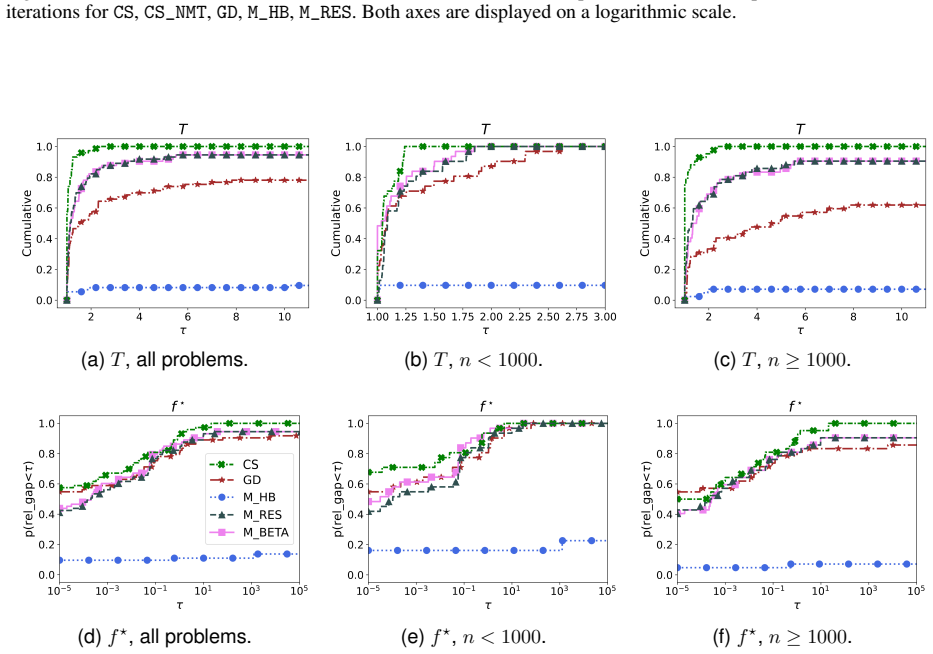
- Numerical comparisons on nonconvex problems indicate the curve-search version is competitive with or better than restart-based and adaptive-momentum safeguards.
Reading between the lines
- The authors do not draw this conclusion, but the optimal complexity bound rests on Assumption 4, which requires the momentum part $\beta(x_k-x_{k-1})$ to shrink at least as fast as the gradient; the paper does not prove this for general nonconvex heavy-ball runs, so the $O(\epsilon^{-2})$ guarantee should be read as conditional for the heavy-ball variant.
- A testable extension not pursued in the paper is to make the curve's initial-velocity parameter, such as $g_f$, adaptive so that Assumption 4 can be enforced or cheaply verified at every iteration, potentially turning the conditional complexity result into an unconditional one.
- By the same logic, the nonmonotone acceptance window may also apply to stochastic or inexact gradient settings, where the pure heavy-ball step is even more likely to fail a strict decrease test yet the curve can absorb the failure without abandoning momentum entirely.
Signed reviews
Editorial analysis
A structured set of objections, weighed in public.
Referee Report
Summary. This paper proposes a curve-search globalization framework for unconstrained optimization, aimed primarily at Polyak's heavy-ball method. At each iteration, a tentative point x_k + s_k is tested through an Armijo-type search along a quadratic Bézier curve whose initial velocity is a gradient-related direction d_k; if the tentative step is not acceptable, the algorithm backtracks along the curve instead of discarding the momentum step outright. The authors prove convergence of the general framework under gradient-relatedness of d_k and boundedness of the auxiliary directions (Proposition 2), give a weaker convergence result for a nonmonotone Armijo rule (Proposition 4) and a stronger variant under an additional curve-displacement condition (Proposition 5), and then specialize to quadratic curves. Under Assumption 4, which bounds both d_k and s_k by a constant multiple of the gradient norm, they derive an O(ε^{-2}) worst-case complexity bound for reaching approximate stationarity (Propositions 6–8). Section 4 applies the framework to the heavy-ball direction s_k = -α∇f(x_k) + β(x_k - x_{k-1}), and Section 5 reports experiments on a strongly convex example and on CUTEst problems.
Significance. If the results hold as stated, the paper offers a genuinely useful way to globalize heavy-ball-type methods: pure momentum steps can be accepted when they decrease the objective, while the curve search provides a fallback to a gradient-related path. The general convergence proof (Proposition 2) is clean and is a parameter-free derivation from explicit assumptions, and the proposed nonmonotone curve-search convergence result appears to be new. The public code and the reproducible experimental setup are welcome strengths. The main caveat is that the advertised optimal complexity bound is not actually established for the heavy-ball method, because Assumption 4 is not verified for the momentum direction; the bound applies to the abstract parabolic-search framework only. In addition, the abstract's wording overstates the nonmonotone convergence result, which in Proposition 4 guarantees only the existence of a stationary accumulation point, not stationarity of every accumulation point.
major comments (2)
- [§3.1 (Assumption 4) and §4 (heavy-ball direction)] The O(ε^{-2}) complexity result of Proposition 8 is conditional on Assumption 4, but for the heavy-ball direction s_k = -α∇f(x_k) + β(x_k - x_{k-1}) introduced in Section 4, the required bound ‖s_k‖ ≤ c‖∇f(x_k)‖ is never established. This condition entails, in particular, that the past displacement ‖x_k - x_{k-1}‖ must shrink at least proportionally to the current gradient norm; compactness of the level set gives only a uniform bound on displacements, and neither the Armijo condition nor the curve-search backtracking rule forces such proportionality. For example, with f(x,y) = x^2/2, α = β = 1, x_0 = (ε, M), x_{-1} = (ε, 0), the unit heavy-ball step is Armijo-accepted, but ‖s_0‖/‖∇f(x_0)‖ ≈ M/ε is unbounded as M/ε grows. Consequently, the constant Δ_low in Proposition 7 and the constant interval of acceptable stepsizes in Proposition 8 may collapse, and the advertised optimal complexity bound for the heavy-ball variant is unsupported. The theorem should be stated only for the abstract parabolic-search framework satisfying Assumption 4, or Assumption 4 must be proved for a modified heavy-ball direction and the consequences for acceptance of pure momentum steps clarified.
- [Abstract and §2.2.1 (Proposition 4)] The abstract and the introduction claim “global convergence guarantees, even with a nonmonotone decrease condition.” Proposition 4, however, proves only that the sequence of iterates has at least one stationary accumulation point; the stronger conclusion that every accumulation point is stationary requires the additional curve-displacement forcing-function condition in Proposition 5. Since “global convergence” in the optimization literature normally means convergence of every accumulation point to stationarity, the advertised claim overstates Proposition 4. Please rephrase the nonmonotone claim as weak global convergence (existence of a stationary accumulation point), or present Proposition 5 as the main nonmonotone convergence theorem.
minor comments (5)
- [§1, Introduction] The word “nomonotone” appears in the sentence “the convergence result for a nomonotone curve search approach”; it should be “nonmonotone.”
- [§2.2.1, proof of Proposition 4] The phrase “all limit points of {x_{l(k)-1}}_K are stationary” is confusing because K was introduced as a specific subsequence in a contradiction argument; the argument actually applies to an arbitrary accumulation point of {x_{l(k)-1}}, so the wording should be adjusted accordingly.
- [§5, Computational experiments] The experimental parameter g_f (the scaling of the initial curve velocity) is not connected to any theoretical quantity. Please state explicitly that g_f is a fixed algorithmic parameter used in the experiments and that no proof depends on its value.
- [§5, stopping criterion] The stopping criterion uses the infinity norm ‖∇f(x_k)‖_∞ while the theoretical results use the Euclidean norm; this is standard in practice but should be stated so readers do not expect the same constants.
- [§3, Remark 4] The claim that the complexity bound is “optimal” would benefit from a reference to the known lower bound for first-order methods on nonconvex problems, or a sentence clarifying in which sense optimality is meant.
Circularity Check
No circularity: the convergence and complexity theorems are conditional derivations from stated assumptions; the unverified heavy-ball Assumption 4 is a correctness gap, not circularity.
full rationale
The paper's derivation chain is as follows: the Armijo-type curve search (Algorithm 1) is shown to terminate under Assumption 1; global convergence (Propositions 2 and 4) follows from the gradient-relatedness of the initial velocities and boundedness of the auxiliary directions; the complexity result (Proposition 8) follows from the L-smoothness of the objective and Assumption 4, which gives a uniform stepsize interval. These are all conditional theorems proved from explicitly stated hypotheses. No parameter is fitted to data and then renamed as a prediction, no result is imported from the authors' own prior work in a load-bearing way, and no quantity is defined in terms of the quantity it is supposed to establish. The numerical parameters (gf = 0.125, α = 1, β = 0.9, etc.) are tuned in unreported preliminary experiments, but they enter only the experiments, not the convergence or complexity proofs, so this is not a fitted-input-called-prediction issue. The only in-scope weakness is that for the heavy-ball direction sk = −α∇f(xk) + β(xk − xk−1), the paper never verifies Assumption 4 (∥sk∥ ≤ c∥∇f(xk)∥) or Assumption 3 (boundedness of the momentum terms), so the O(ε−2) complexity bound is not actually established for the advertised heavy-ball variant; that is a correctness/completeness gap, not a circular reduction, because Proposition 8 does not assume its conclusion and the proof does not rely on the heavy-ball update. The one self-citation ([15]) is used only as a pointer to related work and is not load-bearing. Therefore the paper is self-contained against its stated assumptions and no circular step can be exhibited.
Assumptions & free parameters
free parameters (4)
- alpha (heavy-ball step size) =
1
- beta (momentum weight) =
0.9
- g_f (initial velocity scale) =
0.125
- sigma, delta, Delta0 (search parameters) =
sigma=1e-7, delta=0.5, Delta0=1
assumptions (6)
- domain assumption f is continuously differentiable and L-smooth (gradient Lipschitz) for complexity results
- domain assumption Level set L0 = {x | f(x) <= f(x0)} is compact (Assumption 2)
- domain assumption The sequence of search directions d_k is gradient-related to {x_k}
- domain assumption The sequence of second directions xi_k is bounded (Assumption 3)
- ad hoc to paper The second direction satisfies ||s_k|| <= c||grad f(x_k)|| (Assumption 4)
- standard math Mean Value Theorem and standard descent lemma for smooth functions
Cite this review
Pith. "Pith review of Efficient globalization of heavy-ball type methods for unconstrained optimization based on curve searches." pith.science (2026). https://pith.science/paper/EBHJHECL
@misc{pith2026250519705,
  author       = {Pith},
  title        = {Pith review of: Efficient globalization of heavy-ball type methods for unconstrained optimization based on curve searches},
  year         = {2026},
  howpublished = {\url{https://pith.science/paper/EBHJHECL}},
  note         = {Machine review of arXiv:2505.19705}
}
read the original abstract
In this work, we deal with unconstrained nonlinear optimization problems. Specifically, we are interested in methods carrying out updates possibly along directions not of descent, like Polyak's heavy-ball algorithm. Instead of enforcing convergence properties through line searches and modifications of search direction when suitable safeguards are not satisfied, we propose a strategy based on searches along curve paths: a curve search starting from the first tentative update allows to smoothly revert towards a gradient-related direction if a sufficient decrease condition is not met. The resulting algorithm provably possesses global convergence guarantees, even with a nonmonotone decrease condition. While the presented framework is rather general, particularly of interest is the case of parabolic searches; in this case, under reasonable assumptions, the resulting algorithm can be shown to possess optimal worst case complexity bounds for reaching approximate stationarity in nonconvex settings. Practically, we show that the proposed globalization strategy allows to consistently accept (optimal) pure heavy-ball steps in the strongly convex case, while standard globalization approaches would at times negate them before even evaluating the objective function. Preliminary computational experiments also suggest that the proposed framework might be more convenient than classical safeguard based approaches.
Figures


Reference graph
Works this paper leans on
-
[1]
A. Ben-Tal, A. Melman, and J. Zowe. Curved search methods for unconstrained optimization. Optimization, 21(5):669–695, 1990
work page 1990
-
[2]
D. P. Bertsekas. Nonlinear programming. Athena Scientific, Belmont, MA, 2 edition, 1999
work page 1999
-
[3]
C. A. Botsaris. Differential gradient methods. Journal of Mathematical Analysis and Applications, 63(1):177–198, 1978
work page 1978
- [4]
-
[5]
E. D. Dolan and J. J. Moré. Benchmarking optimization software with performance profiles. Mathematical Programming, 91:201–213, 2002
2002
-
[6]
C. Fan, S. Vaswani, C. Thrampoulidis, and M. Schmidt. MSL: An adaptive momentum-based stochastic line-search framework. In OPT 2023: Optimization for Machine Learning, 2023
work page 2023
-
[7]
G. Farin and D. Hansford. The essentials of CAGD. AK Peters/CRC Press, 2000
work page 2000
-
[8]
E. Ghadimi, H. R. Feyzmahdavian, and M. Johansson. Global convergence of the Heavy-Ball method for convex optimization. In 2015 European control conference (ECC), pages 310–315. IEEE, 2015
work page 2015
Show all 26 references
-
[9]
Goldfarb
D. Goldfarb. Curvilinear path steplength algorithms for minimization which use directions of negative curvature. Mathematical programming, 18(1):31–40, 1980. 16 FEDERICA DONNINI , MATTEO LAPUCCI AND PIERLUIGI MANSUETO
1980
-
[10]
N. I. Gould, S. Lucidi, M. Roma, and P. L. Toint. Exploiting negative curvature directions in linesearch methods for unconstrained optimization. Optimization methods and software, 14(1-2):75–98, 2000
2000
-
[11]
N. I. Gould, D. Orban, and P. L. Toint. CUTEst: a constrained and unconstrained testing environment with safe threads for mathematical optimization. Computational Optimization and Applications, 60:545–557, 2015
2015
-
[12]
Grippo, F
L. Grippo, F. Lampariello, and S. Lucidi. A nonmonotone line search technique for newton’s method. SIAM journal on Numerical Analysis, 23(4):707–716, 1986
1986
-
[13]
Grippo and M
L. Grippo and M. Sciandrone. Introduction to methods for nonlinear optimization, volume 152. Springer Nature, 2023
2023
-
[14]
Kassing and S
S. Kassing and S. Weissmann. Polyak’s Heavy Ball method achieves accelerated local rate of convergence under Polyak-Lojasiewicz inequality. arXiv preprint arXiv:2410.16849, 2024
2024
-
[15]
Lapucci, G
M. Lapucci, G. Liuzzi, S. Lucidi, and M. Sciandrone. A globally convergent gradient method with momentum, 2024
2024
-
[16]
Lee, P.-W
C.-P. Lee, P.-W. Wang, W. Chen, and C.-J. Lin. Limited-memory Common-directions Method for Distributed Optimization and its Application on Empirical Risk Minimization, pages 732–740. SIAM, 2017
2017
-
[17]
Lessard, B
L. Lessard, B. Recht, and A. Packard. Analysis and design of optimization algorithms via integral quadratic constraints. SIAM Journal on Optimization, 26(1):57–95, 2016
2016
-
[18]
Z. Liu, Y . Ni, H. Liu, and W. Sun. A new subspace minimization conjugate gradient method for unconstrained minimization. Journal of Optimization Theory and Applications, 200(2):820–851, Feb 2024
2024
-
[19]
B. T. Polyak. Some methods of speeding up the convergence of iteration methods.Ussr computational mathematics and mathematical physics, 4(5):1–17, 1964
1964
-
[20]
B. T. Polyak. Introduction to optimization. New York, Optimization Software„ 1987
1987
-
[21]
M. J. D. Powell. Restart procedures for the conjugate gradient method. Mathematical Programming, 12(1):241– 254, Dec 1977
1977
-
[22]
Saab Jr, S
S. Saab Jr, S. Phoha, M. Zhu, and A. Ray. An adaptive Polyak Heavy-Ball method. Machine Learning, 111(9):3245–3277, 2022
2022
-
[23]
Shi and J
Z.-J. Shi and J. Shen. A new descent algorithm with curve search rule. Applied mathematics and computation, 161(3):753–768, 2005
2005
-
[24]
Tang, K.-C
T. Tang, K.-C. Toh, N. Xiao, and Y . Ye. A Riemannian dimension-reduced second-order method with application in sensor network localization. SIAM Journal on Scientific Computing, 46(3):A2025–A2046, 2024
2024
-
[25]
Z. Xu, Y . Tang, Z.-J. Shi, et al. Global convergence of curve search methods for unconstrained optimization. Applied Mathematics, 7(07):721, 2016
2016
-
[26]
Zhang, D
C. Zhang, D. Ge, C. He, B. Jiang, Y . Jiang, and Y . Ye. DRSOM: A dimension reduced second-order method, 2023. 17
2023
Reviewed August 7, 2026 · model on record in the stance chip above.
Discussion (0). Continue with ORCID to comment.