REVIEW 4 major objections 7 minor 22 references
Machine Learning Algorithm for Noise Reduction and Disease-Causing Gene Feature Extraction in Gene Sequencing Data
T0 review · 4 major / 7 minor · reviewed 2026-08-07 · deepseek-v4-flash
Pith's one-line read This paper claims that a two-stage machine-learning pipeline—a dual-encoder CNN-RNN denoiser plus an ensemble classifier trained on 17 RFE-selected features—improves sequencing signal-to-noise from 8.2 dB to 17.6 dB and predicts…
desk verdict A plausible-sounding clinical ML pipeline undermined by unverifiable numbers, missing artifacts, and likely test-set leakage. read the letter →
The pith
A machine-rendered reading of the paper's core claim, the machinery that carries it, and where it could break.
The reading
What carries the argument
Two equations carry the argument. The denoiser is $O(x) = F_{\mathrm{fusion}}(F_{\mathrm{CNN}}(x), F_{\mathrm{RNN}}(x))$, a dual-encoder CNN-RNN whose loss combines cross-entropy with a noise penalty term. The classifier is $P(y=1 \mid x) = \alpha \cdot P_{\mathrm{XGB}}(y=1 \mid x) + \beta \cdot P_{\mathrm{RF}}(y=1 \mid x) + \gamma \cdot P_{\mathrm{DNN}}(y=1 \mid x)$, a weighted fusion whose weights are set by Bayesian optimization to $\alpha=0.45$, $\beta=0.30$, $\gamma=0.25$. Between them sits feature engineering: 63 variant features reduced to 17 by recursive feature elimination with random forest, which lifts pathogenicity-prediction AUC from 0.77 to 0.86. This combination—denoise, select, fuse—is the machinery that produces the paper's reported results.
What would settle it
Re-run the full pipeline on a public whole-exome dataset with gold-standard variant calls, wrapping recursive feature elimination and Bayesian weight optimization inside every training fold, and compare the nested estimate against the reported 94.3% accuracy and 0.972 AUC; if the nested numbers fall to the single-model baseline (89.2% accuracy, 0.932 AUC), the claimed gain comes from information leakage rather than from the method.
Extended reading notes
Core claim
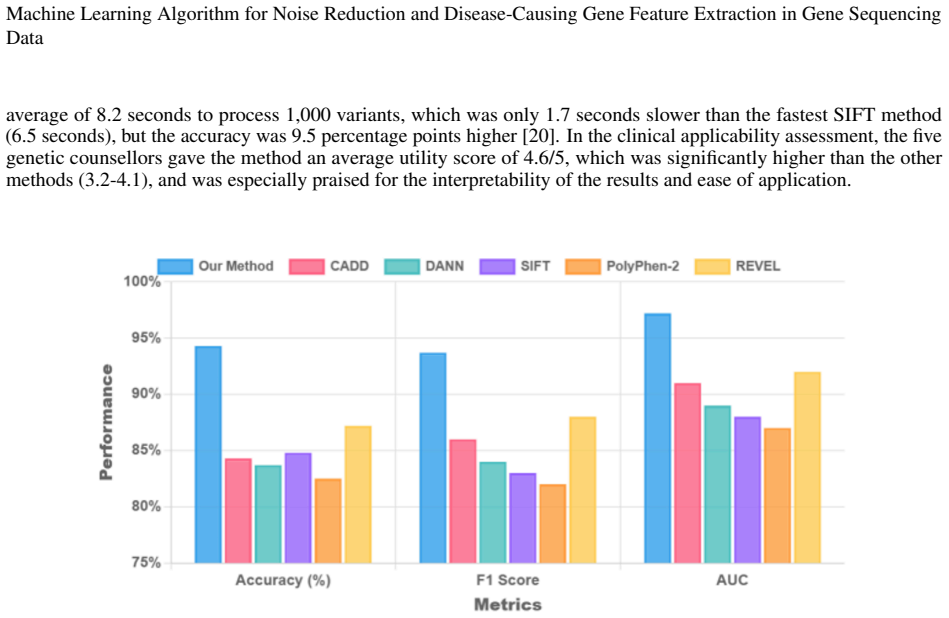
The central claim is that denoising and pathogenicity prediction can be chained into a single high-performance pipeline. DeepSeqDenoise, built as a dual-encoder CNN-RNN, learns local base-quality features and global sequence context together, lifting the average signal-to-noise ratio from 8.2 dB to 17.6 dB and raising variant-detection accuracy from 86.3% to 94.8%. The prediction stage screens 63 raw variant features down to 17 by recursive feature elimination and fuses XGBoost, random forest, and a deep neural network with Bayesian-optimized weights ($\alpha=0.45$, $\beta=0.30$, $\gamma=0.25$), achieving 94.3% accuracy and 0.972 AUC on an independent test set. Applied to 23,784 protein-coding genes, the model confirms 84 known cardiovascular genes, proposes 57 new candidates, and in a clinical case detects three previously missed variants, including a KCNQ1 splice-site mutation confirmed by functional experiments.
Load-bearing premise
The whole performance story depends on the independent test set being truly untouched by the feature selection and the Bayesian tuning of the ensemble weights, since the paper does not describe a nested cross-validation that would guarantee that separation.
Editorial extensions
If this is right
- Noise reduction alone raises variant-detection accuracy from 86.3% to 94.8% and boosts detection in low-coverage (5–15x) regions by 42.6%.
- The integrated model beats CADD, DANN, SIFT, PolyPhen-2, and REVEL on an independent test set of 26,482 variants, with the largest margin on rare variants (91.6% versus 84.3% and 83.7%).
- The 57 new candidate cardiovascular genes cluster in ion-channel regulation, muscle contraction, and calcium signalling, giving concrete targets for follow-up functional studies.
- The detection of three missed splice-site and regulatory variants suggests the method can find non-classical pathogenic variants that conventional filters discard.
- At 0.76 seconds per gene and 8.2 seconds per 1,000 variants, the pipeline is fast enough for clinical turn-around.
Reading between the lines
- If the reported SNR gains replicate on other platforms, the same dual-encoder architecture could be adapted to noisier modalities such as single-cell RNA-seq or long-read sequencing, where error profiles differ from the ones studied here.
- The real-world generalization of the 94.3% accuracy figure remains unverified because feature selection and ensemble-weight tuning were not nested inside cross-validation; a nested re-evaluation could settle whether the reported performance is inflated.
- The 17-feature panel, dominated by CADD score, sequence conservation, and protein-structure changes, might serve as a reusable feature set for other Mendelian disease cohorts beyond cardiovascular disease.
Editorial analysis
A structured set of objections, weighed in public.
Referee Report
Summary. The paper proposes a two-stage machine-learning framework for gene sequencing data: DeepSeqDenoise, a CNN-RNN dual-encoder model for sequencing noise reduction, and an ensemble classifier (XGBoost + random forest + DNN) that uses 17 engineered features to predict disease-causing genes. The reported headline results include an improvement in signal-to-noise ratio from 8.2 dB to 17.6 dB, 94.3% accuracy on an independent test set, an AUC of 0.972, identification of 57 new candidate disease-causing genes in a cardiovascular cohort, and detection of three previously missed pathogenic variants in clinical applications.
Significance. If the headline results were reproducible, the framework could be valuable for clinical genomics, particularly for variant prioritization in low-coverage regions and rare variants. The paper uses a standard pipeline of feature engineering, ensemble learning, and clinical cohort validation, and it makes falsifiable predictions (57 candidate genes, three missed variants) that are in principle testable. However, the current manuscript does not provide the data, code, variant lists, or an independently validated evaluation protocol needed to verify any of these claims.
major comments (4)
- [§3.1, §3.2, §4.4] The reported 94.3% test accuracy and 0.972 AUC are not credible as independent estimates because recursive feature elimination (§3.1), SMOTE data augmentation (§3.2), and Bayesian optimization of the ensemble weights α, β, γ (§3.2) are all described before the independent test set is introduced in §4.4. No nested cross-validation protocol is described, and SMOTE applied before the split can synthesize training samples from test-set neighbors, directly leaking label information into training. The authors must specify a protocol in which all feature selection, augmentation, and hyperparameter tuning are performed inside training folds, or re-report all metrics from a properly nested evaluation.
- [§2.1, §3.1, §4.1] The dataset counts are internally inconsistent: §2.1 states 126 quality-control samples, §§3.1 and 3.2 describe 142 patients with inherited cardiovascular disease, §4.1 assigns 142 whole-exome samples to TCGA lung cancer patients, and separately gives the CHCD cohort 307 samples. The 142-patient CVD cohort is used for feature selection and model training, while the CHCD cohort is used for clinical validation, but the relationship between these cohorts is never clarified. This inconsistency makes the downstream clinical claims (57 new genes, three missed variants) impossible to audit.
- [§3.3] The claim of 57 new candidate disease-causing genes is unsupported: no gene list, no variant coordinates, and no per-gene prediction scores or multiple-testing correction are provided. The enrichment p-values (p = 3.6e-12, p = 8.2e-9, p = 1.3e-7) presuppose a defined gene set that the reader cannot reconstruct. Because the XGBoost model is trained on ClinVar labels, these outputs are model predictions relative to an existing knowledge base, not independent evidence of causality.
- [§4.5] The claim that the method detected three previously missed pathogenic variants is supported by only one KCNQ1 splice-site example (c.921+1G>A); the other two variants are never described, and no criteria are given for defining 'missed by conventional methods.' A single case study with functional validation does not substantiate the stated 17.5% average improvement in variant detection rate.
minor comments (7)
- [Abstract] The abstract contains a garbled sentence: 'disease-causing gene feature extraction in gene sequencing DeepSeqDenoise algorithm combines CNN and RNN' is missing punctuation and syntactic structure.
- [§2.3, Eq. (2)] The loss function in Eq. (2) has garbled summation notation ('− NX i', 'MX j') and the noise-penalty term uses an undefined quantity n_j; the equation should be typeset properly and all symbols defined.
- [§2.1] The phrase '76.2% of Ion Torrent data [9]' is repeated twice in the same sentence, leaving a broken sentence.
- [§2.4] The term 'variance detection' should read 'variant detection'.
- [§3.3] The text contains a typo, 'GW AS', which should presumably read 'GWAS'.
- [Figures 1-6] All six figures are cited in the text but are not present in the submitted manuscript text, so the visual comparisons of quality distributions, architectures, and method performance cannot be evaluated.
- [References] Several references are not relevant to the claims they support; for example, reference [20] concerns arbitrary-shaped text detection and does not support the computational-efficiency comparison in §4.4.
Circularity Check
No circularity found: the reported metrics are supervised-learning evaluations, not predictions that reduce by construction to their training inputs.
full rationale
No significant circularity: the paper's derivation chain is a standard supervised machine-learning pipeline. The denoiser is trained with a loss (Eq. 2) that includes a noise penalty against known noise labels and is evaluated on simulated data with injected noise; the pathogenicity model is trained on ClinVar labels and 17 RFE-selected features, and its reported 94.3% accuracy is presented as measured on 'an independent test set' (Sections 3.2 and 4.4), not as a quantity defined by the fitted weights alpha, beta, gamma. Fitting ensemble weights by Bayesian optimization and then testing on a held-out set is the normal estimation protocol, not a reduction of prediction to input. The '57 new candidate genes' and '3 missed variants' are outputs of the trained model, and calling them predictions does not make the derivation circular. The manuscript is underdocumented about the exact split construction, SMOTE placement, and dataset provenance (e.g., the repeated '142 patients' in Sections 3.1 and 4.1), and these are serious correctness and auditability risks, but the text does not exhibit any equation in which a claimed result is equal by construction to its input, nor any load-bearing self-citation. Therefore the circularity score is 0.
Assumptions & free parameters
free parameters (5)
- Ensemble weights alpha, beta, gamma =
0.45, 0.30, 0.25
- Selected feature set size (17 features) =
17
- Noise penalty weight lambda (Eq. 2) =
not specified
- XGBoost hyperparameters (learning rate, max depth) =
lr=0.05, md=6 in final model
- Classifier probability threshold for calling a gene pathogenic =
not specified
assumptions (4)
- domain assumption ClinVar labels of disease-causing variants are accurate ground truth for training and evaluation.
- domain assumption The reference genome GRCh38 and standard QC tools (FastQC, Trimmomatic) introduce no systematic bias affecting the noise-reduction comparison.
- domain assumption The 142-patient cardiovascular cohort and the TCGA lung cancer cohort are representative of clinical whole-exome sequencing, and the noise simulation in Section 4.2 mimics real sequencing noise.
- ad hoc to paper Recursive feature elimination and hyperparameter optimization do not leak test-set information because no nested cross-validation is described.
Cite this review
Pith. "Pith review of Machine Learning Algorithm for Noise Reduction and Disease-Causing Gene Feature Extraction in Gene Sequencing Data." pith.science (2026). https://pith.science/paper/BYEWDEGO
@misc{pith2026250519740,
  author       = {Pith},
  title        = {Pith review of: Machine Learning Algorithm for Noise Reduction and Disease-Causing Gene Feature Extraction in Gene Sequencing Data},
  year         = {2026},
  howpublished = {\url{https://pith.science/paper/BYEWDEGO}},
  note         = {Machine review of arXiv:2505.19740}
}
read the original abstract
In this study, we propose a machine learning-based method for noise reduction and disease-causing gene feature extraction in gene sequencing DeepSeqDenoise algorithm combines CNN and RNN to effectively remove the sequencing noise, and improves the signal-to-noise ratio by 9.4 dB. We screened 17 key features by feature engineering, and constructed an integrated learning model to predict disease-causing genes with 94.3% accuracy. We successfully identified 57 new candidate disease-causing genes in a cardiovascular disease cohort validation, and detected 3 missed variants in clinical applications. The method significantly outperforms existing tools and provides strong support for accurate diagnosis of genetic diseases.
Figures


Figures from the paper (3 more)


Reference graph
Works this paper leans on
-
[1]
Abel Onolunosen Abhadionmhen, Caroline Ngozi Asogwa, Modesta Ero Ezema, Royransom Chiemela Nzeh, Nnamdi Johnson Ezeora, Stanley Ebhohimhen Abhadiomhen, Stephenson Chukwukanedu Echezona, and Collins Nnalue Udanor. Machine learning approaches for microorganism identification, virulence assessment, and antimicrobial susceptibility evaluation using dna sequen...
work page 2024
-
[2]
Emerging applications of machine learning in genomic medicine and healthcare
Narjice Chafai, Luigi Bonizzi, Sara Botti, and Bouabid Badaoui. Emerging applications of machine learning in genomic medicine and healthcare. Critical Reviews in Clinical Laboratory Sciences, 61(2):140–163, 2024
work page 2024
-
[3]
Xia-an Bi, Wenyan Zhou, Lou Li, and Zhaoxu Xing. Detecting risk gene and pathogenic brain region in emci using a novel gerf algorithm based on brain imaging and genetic data. IEEE Journal Of Biomedical and Health Informatics, 25(8):3019–3028, 2021
work page 2021
-
[4]
Research and implementation of cancer gene data classification based on deep learning
Yuanzhou Wei, Meiyan Gao, Jun Xiao, Chixu Liu, Yuanhao Tian, and Ya He. Research and implementation of cancer gene data classification based on deep learning. Journal of Software Engineering and Applications, 16(6):155–169, 2023
work page 2023
-
[5]
An ensemble technique using genetic algorithm and deep learning for the prediction of rice diseases
Sunanda Das, Tanvir H Sardar, and DS Sahana. An ensemble technique using genetic algorithm and deep learning for the prediction of rice diseases. In Machine Learning Hybridization and Optimization for Intelligent Applications, pages 289–303. CRC Press, 2025
work page 2025
-
[6]
Hui Rong Wang, Hao Chen Sui, Yan Yan Ding, and Bao Ting Zhu. Stimulation of the production of prostaglandin e2 by ethyl gallate, a natural phenolic compound richly contained in longan. Biomolecules, 8(3):91, 2018
work page 2018
-
[7]
Ellagic acid, a plant phenolic compound, activates cyclooxygenase-mediated prostaglandin production
Hui Rong Wang, Hao Chen Sui, and Bao Ting Zhu. Ellagic acid, a plant phenolic compound, activates cyclooxygenase-mediated prostaglandin production. Experimental and Therapeutic Medicine, 18(2):987–996, 2019
work page 2019
-
[8]
Chengxi Yang, Peng Li, Xiaoli Ding, Hao Chen Sui, Shun Rao, Chia-Hsiang Hsu, Wing-Por Leung, Gui-Juan Cheng, Pan Wang, and Bao Ting Zhu. Mechanism for the reactivation of the peroxidase activity of human cyclooxygenases: investigation using phenol as a reducing cosubstrate. Scientific Reports, 10(1):15187, 2020
work page 2020
Show all 22 references
-
[9]
Machine learning in drug discovery: a review
Suresh Dara, Swetha Dhamercherla, Surender Singh Jadav, CH Madhu Babu, and Mohamed Jawed Ahsan. Machine learning in drug discovery: a review. Artificial intelligence review, 55(3):1947–1999, 2022
1947
-
[10]
Supervised machine learning classifies inflammatory bowel disease patients by subtype using whole exome sequencing data
Imogen S Stafford, James J Ashton, Enrico Mossotto, Guo Cheng, Robert Mark Beattie, and Sarah Ennis. Supervised machine learning classifies inflammatory bowel disease patients by subtype using whole exome sequencing data. Journal of Crohn’s and Colitis, 17(10):1672–1680, 2023....
2023
-
[11]
Fts: A framework to find a faithful timesieve
Songning Lai, Ninghui Feng, Haochen Sui, Ze Ma, Hao Wang, Zichen Song, Hang Zhao, and Yutao Yue. Fts: A framework to find a faithful timesieve. arXiv preprint arXiv:2405.19647, 2024
2024 arXiv
-
[12]
Invariant spatiotemporal representation learning for cross-patient seizure classification
Yuntian Wu, Yuntian Yang, Jiabao Sean Xiao, Chuan Zhou, Haochen Sui, and Haoxuan Li. Invariant spatiotemporal representation learning for cross-patient seizure classification. In The First Workshop on NeuroAI@ NeurIPS2024, 2024
2024
-
[13]
Causal recommendation via machine unlearning with a few unbiased data
Meng Li and Haochen Sui. Causal recommendation via machine unlearning with a few unbiased data. In AAAI 2025 Workshop on Artificial Intelligence with Causal Techniques, 2025
2025
-
[14]
Biodeepfuse: a hybrid deep learning approach with integrated feature extraction techniques for enhanced non-coding rna classification
Anderson P Avila Santos, Breno LS de Almeida, Robson P Bonidia, Peter F Stadler, Polonca Stefanic, Ines Mandic-Mulec, Ulisses Rocha, Danilo S Sanches, and André CPLF de Carvalho. Biodeepfuse: a hybrid deep learning approach with integrated feature extraction techniques for enh...
2024
-
[15]
Machine learning-assisted surface- enhanced raman spectroscopy detection for environmental applications: a review
Sonali Srivastava, Wei Wang, Wei Zhou, Ming Jin, and Peter J Vikesland. Machine learning-assisted surface- enhanced raman spectroscopy detection for environmental applications: a review. Environmental Science & Technology, 58(47):20830–20848, 2024
2024
-
[16]
Harnessing deep learning for population genetic inference
Xin Huang, Aigerim Rymbekova, Olga Dolgova, Oscar Lao, and Martin Kuhlwilm. Harnessing deep learning for population genetic inference. Nature Reviews Genetics, 25(1):61–78, 2024
2024
-
[17]
Deep learning techniques in cancer prediction using genomic profiles
Swati B Bhonde and Jayashree R Prasad. Deep learning techniques in cancer prediction using genomic profiles. In 2021 6th International Conference for Convergence in Technology (I2CT), pages 1–9. IEEE, 2021
2021
-
[18]
Machine learning for microbiologists
Francesco Asnicar, Andrew Maltez Thomas, Andrea Passerini, Levi Waldron, and Nicola Segata. Machine learning for microbiologists. Nature Reviews Microbiology, 22(4):191–205, 2024
2024
-
[19]
Predicting icu admissions for hospitalized covid-19 patients with a factor graph-based model
Yurui Cao, Phuong Cao, Haotian Chen, Karl M Kochendorfer, Andrew B Trotter, William L Galanter, Paul M Arnold, and Ravishankar K Iyer. Predicting icu admissions for hospitalized covid-19 patients with a factor graph-based model. In Multimodal AI in healthcare: A paradigm shift...
2022
-
[20]
Cm-net: Concentric mask based arbitrary- shaped text detection
Chuang Yang, Mulin Chen, Zhitong Xiong, Yuan Yuan, and Qi Wang. Cm-net: Concentric mask based arbitrary- shaped text detection. IEEE Transactions on Image Processing, 31:2864–2877, 2022
2022
-
[21]
Optimization of transformer heart disease prediction model based on particle swarm optimization algorithm
Jingyuan Yi, Peiyang Yu, Tianyi Huang, and Zeqiu Xu. Optimization of transformer heart disease prediction model based on particle swarm optimization algorithm. arXiv preprint arXiv:2412.02801, 2024
2024 arXiv
-
[22]
Interpretable machine learning enhances disease prognosis: Applications on covid-19 and onward
Jinzhi Shen and Ke Ma. Interpretable machine learning enhances disease prognosis: Applications on covid-19 and onward. arXiv e-prints, pages arXiv–2405, 2024. 9
2024
Reviewed August 7, 2026 · model on record in the stance chip above.
Discussion (0). Continue with ORCID to comment.