REVIEW 5 major objections 6 minor 64 references
Divide and Conquer: Grounding LLMs as Efficient Decision-Making Agents via Offline Hierarchical Reinforcement Learning
T0 review · 5 major / 6 minor · reviewed 2026-08-07 · deepseek-v4-flash
Pith's one-line read An offline hierarchical RL framework makes LLM agents plan sub-tasks and act on them, beating non-hierarchical baselines on long-horizon benchmarks.
desk verdict A genuinely neat parameter-efficient hierarchy, undermined by an unvalidated LLM-based reward judge and missing statistics. read the letter →
The pith
A machine-rendered reading of the paper's core claim, the machinery that carries it, and where it could break.
The reading
What carries the argument
The central object is the two-level hierarchical policy with temporal abstraction: every c environment steps the high-level policy proposes one sub-task goal gt, and the low-level policy executes c primitive actions against that goal, collecting sub-task-completion intrinsic reward. The training machinery is a three-stage pipeline of SFT (behavior cloning with length regularization), ORL (offline actor-critic; IQL-style asymmetric expectile value learning, and advantage-weighted actor updates), and O2O (online fine-tuning of the high level only while the low level is refreshed with offline demonstrations). What carries the argument is that shared parameters with a hierarchy prompt make the hierarchy cheap, and the intrinsic reward makes the low level task-agnostic enough to transfer.
What would settle it
If a head-to-head rerun of the exact Llama-3-8B tables (ScienceWorld seen/unseen, ALFWorld seen/unseen, and the three online adaptation curves) were run with the sub-task-completion judge replaced by an objective state-checker (or with a judge shown to be systematically noisy), and the margins over ETO collapsed, the paper's central mechanism would be identified as reward noise rather than hierarchy.
Extended reading notes
Core claim
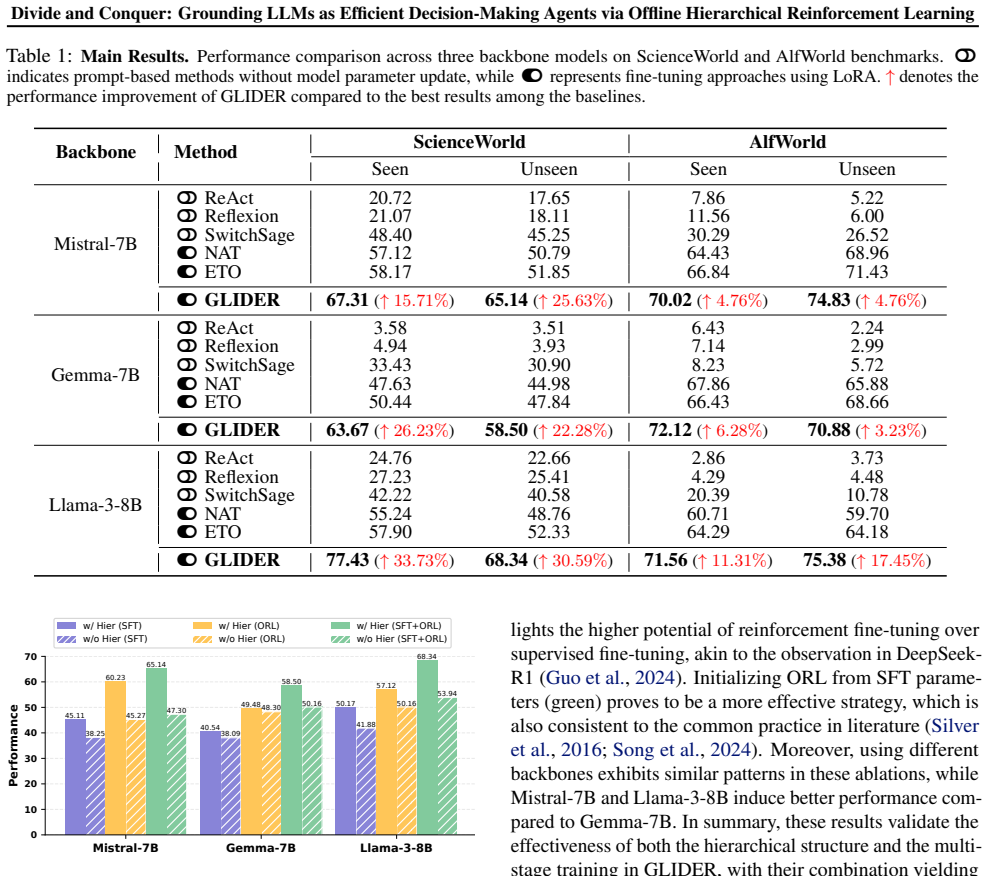
The core claim is that a parameter-efficient hierarchy—where high-level planner and low-level executor share one LoRA-tuned LLM backbone differentiated only by a prompt—is a reliable way to lift LLM agent performance on long-horizon decision tasks. The high-level policy receives the task description and observation and emits a sub-task goal every c steps; the low-level policy then emits primitive actions for those c steps and receives a binary intrinsic reward indicating sub-task completion derived from the observation. Both policies are trained offline from a mixture of expert and medium-quality trajectories, first by behavior cloning and then by token-level advantage-weighted policy optimization with sentence-level critics. The paper reports that with Llama-3-8B, GLIDER reaches 77.43 on seen and 68.34 on unseen ScienceWorld tasks, versus 57.90 and 52.33 for ETO; it also reports consistent gains on ALFWorld and in ablations across backbones and model scales.
Load-bearing premise
Sub-task completion can be read off the observation reliably, and this reading needs no manual design, because the low-level policy is trained entirely on binary intrinsic rewards built from that judgement; the appendix shows the judgement is actually made by a hand-written LLM prompt.
Editorial extensions
If this is right
- If the method works as claimed, hierarchical sub-task decomposition plus offline RL could be the default recipe for grounding LLM policies in sparse-reward, long-horizon environments.
- Unseen tasks should inherit the low-level sub-task library, so generalization to new tasks becomes mostly a planning problem, not an action-generation problem.
- Offline-to-online adaptation should need far fewer environment interactions than monolithic fine-tuning, since only the high-level policy must be re-adapted to a new reward.
- Even smaller models (Llama-3B) are claimed to outperform larger non-hierarchical models, which would make hierarchical decomposition a partial substitute for model scale.
- The ablation results imply that SFT alone is not enough, and that offline RL alone is better than SFT alone, so the main source of capability is the reinforcement fine-tuning stage.
Reading between the lines
- A testable extension suggested by the paper's own logic: if the low-level skills are truly task-agnostic, then a planner trained on one benchmark should bootstrap a low-level library trained on another, which the paper does not directly demonstrate.
- The hierarchical structure may also function as an implicit reward-shaping mechanism: the binary sub-task completion signal gives the low-level policy dense feedback where environment rewards are sparse, which the non-hierarchical baselines lack.
- The claim that sub-task completion is 'easily accessible from observation' would be stronger if it were verified across language-domains with adversarial distractors, where a verification LLM prompt could confidently misjudge completion.
- The framework's authors have implicitly connected it to the idea of language-generality for sub-tasks (e.g., reusing 'monitor until done' patterns), which suggests a next step: measuring how much of the gain survives translation to environments whose observations do not naturally decompose into named sub-tasks.
Editorial analysis
A structured set of objections, weighed in public.
Referee Report
Summary. The paper proposes GLIDER, a hierarchical LLM agent framework that pairs a high-level subtask planner with a low-level action executor sharing a single LoRA-tuned backbone, and trains it via behavior cloning, offline RL (IQL-style actor-critic), and optional offline-to-online fine-tuning. Experiments on ScienceWorld and ALFWorld report consistent gains over prompt-based and fine-tuned baselines across Mistral-7B, Gemma-7B, and Llama-3-8B, together with ablations that separate the effects of the hierarchy, the training stages, model scale, and the expert-to-medium data mixture ratio.
Significance. If the central claims hold, GLIDER offers a parameter-efficient recipe for injecting temporal abstraction into LLM-based agents, and the central ablation comparing hierarchical and non-hierarchical versions on the same pipeline and backbones is a well-designed test of the hierarchy hypothesis. The cross-backbone and cross-scale consistency are genuine strengths, and the release of code would support reproducibility. However, the paper's headline claims are currently undercut by an unvalidated LLM completion judge that supplies the low-level reward, by an internal inconsistency about freezing the low-level policy in offline-to-online adaptation, and by the absence of any statistical error analysis. These issues are load-bearing because they directly affect the attribution of the reported performance gains to the proposed hierarchy.
major comments (5)
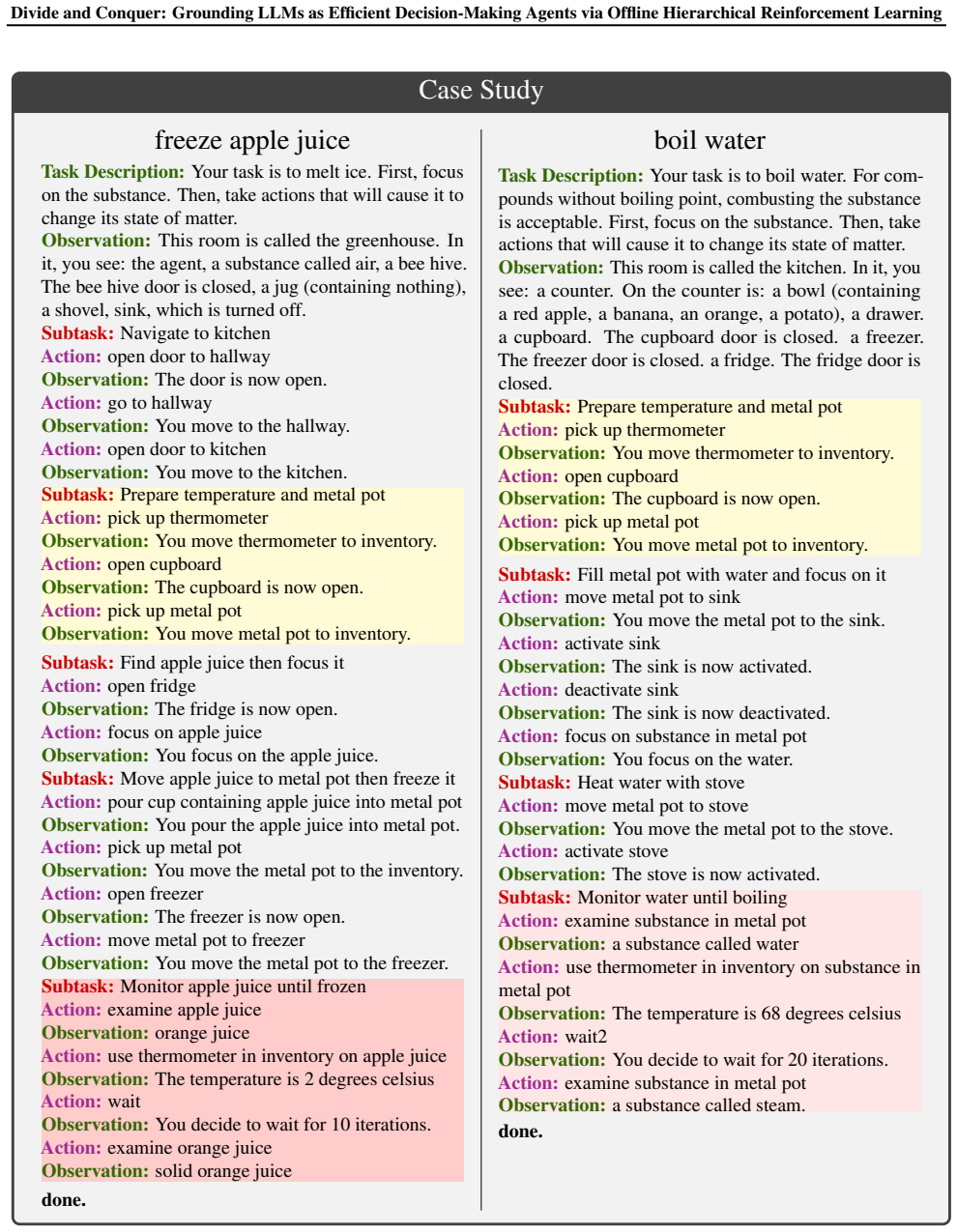
- [Section 3.2, Eq. (2), Appendix D] The paper states that subtask completion 'can be easily accessible from the environment observation, without requiring any manual design or domain knowledge,' and Eq. (2) defines the low-level reward r-hat as this binary completion signal. Appendix D, however, shows that completion is determined by a hand-written 'Check Subtask Complete' LLM prompt that receives the subtask, initial observation, action sequence, and final observation. No accuracy statistics, failure-mode analysis, or ablation against ground-truth completion labels is provided. Since the low-level policy is trained entirely on r-hat through Eqs. (4)-(7), a noisy or gameable judge directly threatens the central hierarchy claim; at minimum, the revision should report judge agreement with ground-truth labels on a held-out sample and include an ablation that replaces the prompt judge with oracle completion labels.
- [Section 3.5 and Algorithm 1, line 12] The offline-to-online description says the task-agnostic low-level policy is frozen and only the high-level policy is fine-tuned, but Algorithm 1 says 'Fix low-level policy' and the Appendix A text then admits that parameter sharing prevents strict freezing, so low-level performance is instead maintained by continually training on offline demonstration data. This internal inconsistency undermines the attribution of the O2O results in Section 4.4 to frozen, transferable skills. Please specify the exact parameter update scheme (for example, which LoRA modules or prompts are updated) and report an ablation with truly frozen low-level parameters, or reinterpret the O2O claims accordingly.
- [Table 1, Figures 3-5] No evaluation seeds, error bars, confidence intervals, or significance tests are reported anywhere, despite the small evaluation sets shown in Table 3 (for example, 211 unseen ScienceWorld episodes). The headline comparison of Llama-3-8B GLIDER at 68.34 versus ETO at 52.33 could in principle be within run-to-run noise. Please run at least three to five seeds per condition and report mean and standard deviation, or provide pairwise significance tests; this is essential for the paper's repeated claim of 'consistent performance gains.'
- [Section 4.5 and Figure 5] The expert-to-medium 1:2 mixture ratio used for all main experiments appears to have been selected because it gives the best point estimate in Figure 5. If this ratio was chosen after inspecting test performance, the reported gains carry an optimism bias, and the claim that 1:2 is best needs a defined selection protocol or a held-out validation split. Moreover, without error bars, the differences among 68.34 (1:2), 60.31 (1:1), and 60.29 (1:5) may be noise; the revision should report variance and justify the selection procedure.
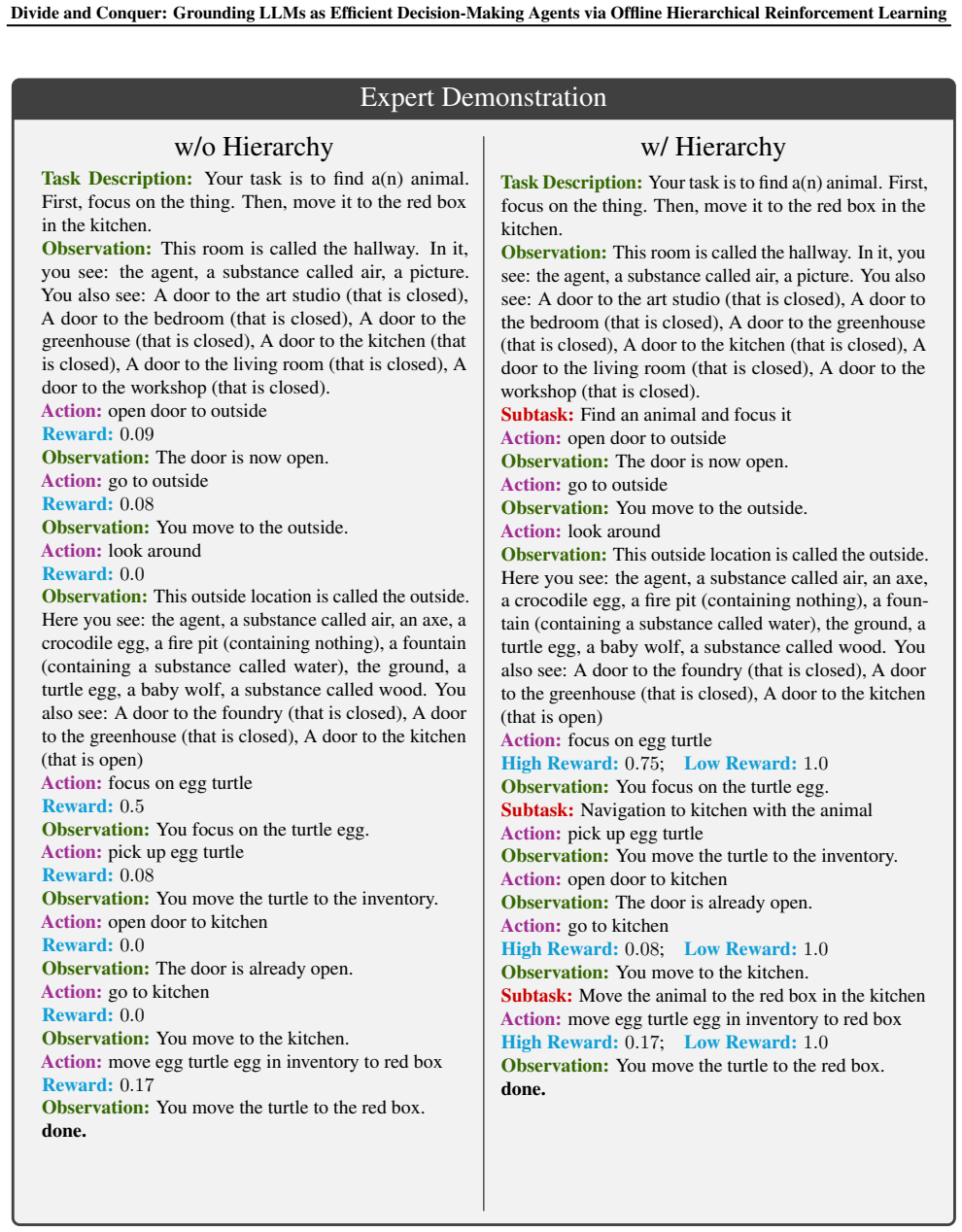
- [Section 3.2 and Appendix B] The claim that the framework eliminates 'the necessity for any manual or task-specific design' is not supported by the implementation: the subtask labels in expert demonstrations are produced by GPT-4 decomposition (Appendix B), the completion judge is a custom LLM prompt, and the hierarchy interval c is a hyperparameter. Please either soften these autonomy claims or provide evidence that these design choices are not task-specific.
minor comments (6)
- [Section 4.1 and Table 1] The baseline is called 'SwiftSage' in the related work but appears as 'SwitchSage' in Table 1 and elsewhere; please standardize the name.
- [Table 1] The \toggle-off and \toggle-on markup artifacts appear in the rendered table; these should be removed.
- [Appendix C, Table 5] The hyperparameter table lists 'batch size' twice with different values (64 and a per-device batch size of 2) and also gives gradient accumulation steps; please clarify the effective global batch size.
- [Appendix B, O2O task setups] The text describes the setting as 'Online-to-Offline' when it should be 'Offline-to-Online' to match Section 3.5.
- [References] The Konda and Tsitsiklis (1999) entry lists page range 75993-76005, which appears incorrect; please verify and correct the citation details.
- [Appendix D] The low-level prompt asks the model to 'determine if the subtask is completed (true/false),' while the completion reward is generated separately by the 'Check Subtask Complete' prompt; please clarify how these two completion signals relate and whether the judge is the sole source of r-hat.
Circularity Check
No circular derivation: benchmark scores are externally measured; the LLM-judged low-level reward is an unvalidated training-signal issue, not a collapse of prediction into input.
full rationale
GLIDER's reported results are not circular. The main comparison (Table 1) is evaluated with ScienceWorld and ALFWorld environment rewards on held-out seen/unseen tasks; these scores are external to the training objective and cannot be derived from the model's own outputs by construction. The hierarchical decomposition is trained from GPT-4-annotated demonstration subtasks (Appendix B), and the low-level policy is trained with the intrinsic reward r-hat of Eq. (2). Appendix D shows that r-hat is implemented by a hand-written 'Check Subtask Complete' LLM prompt rather than by direct observation read-off, and no accuracy statistics or ablations against ground-truth completion labels are provided. This is a genuine internal self-referential loop—an LLM judge scores an LLM executor—and it undermines the Sec. 3.2 claim that completion is 'easily accessible from the environment observation... without requiring any manual design.' However, this does not make the benchmark predictions equivalent to the training inputs: the final scores are environment rewards, and the paper does not fit any parameter to the test-set scores. There are no load-bearing self-citations or imported uniqueness theorems. The central derivation (hierarchy + SFT + offline RL) is independent of the evaluation, so the circularity score is low.
Assumptions & free parameters
free parameters (4)
- Hierarchy interval c
- Expert-to-medium data mixture ratio =
1:2
- IQL expectile tau (Eq. 5)
- Length regularization lambda (Eq. 3)
assumptions (4)
- standard math The tasks are Markovian text MDPs, so the policy-gradient and Bellman updates apply unchanged.
- domain assumption GPT-4-generated sub-task decompositions are a valid and sufficient label space for the high-level policy.
- domain assumption Sub-task completion (the low-level intrinsic reward) is accessible from the observation without manual design.
- domain assumption Prompt-differentiated sharing of one actor lets high- and low-level roles be learned without interference.
Cite this review
Pith. "Pith review of Divide and Conquer: Grounding LLMs as Efficient Decision-Making Agents via Offline Hierarchical Reinforcement Learning." pith.science (2026). https://pith.science/paper/Z6XHRTTX
@misc{pith2026250519761,
  author       = {Pith},
  title        = {Pith review of: Divide and Conquer: Grounding LLMs as Efficient Decision-Making Agents via Offline Hierarchical Reinforcement Learning},
  year         = {2026},
  howpublished = {\url{https://pith.science/paper/Z6XHRTTX}},
  note         = {Machine review of arXiv:2505.19761}
}
read the original abstract
While showing sophisticated reasoning abilities, large language models (LLMs) still struggle with long-horizon decision-making tasks due to deficient exploration and long-term credit assignment, especially in sparse-reward scenarios. Inspired by the divide-and-conquer principle, we propose an innovative framework **GLIDER** (**G**rounding **L**anguage Models as Eff**I**cient **D**ecision-Making Agents via Offline Hi**E**rarchical **R**einforcement Learning) that introduces a parameter-efficient and generally applicable hierarchy to LLM policies. We develop a scheme where the low-level controller is supervised with abstract, step-by-step plans that are learned and instructed by the high-level policy. This design decomposes complicated problems into a series of coherent chain-of-thought reasoning sub-tasks, providing flexible temporal abstraction to significantly enhance exploration and learning for long-horizon tasks. Furthermore, GLIDER facilitates fast online adaptation to non-stationary environments owing to the strong transferability of its task-agnostic low-level skills. Experiments on ScienceWorld and ALFWorld benchmarks show that GLIDER achieves consistent performance gains, along with enhanced generalization capabilities.
Figures


Figures from the paper (6 more)




Reference graph
Works this paper leans on
-
[1]
Do as I can, not as I say: Grounding language in robotic affordances
Ahn, M., Brohan, A., Brown, N., Chebotar, Y., Cortes, O., David, B., Finn, C., Fu, C., Gopalakrishnan, K., Hausman, K., et al. Do as I can, not as I say: Grounding language in robotic affordances. In Proceedings of Conference on Robot Learning, 2022
work page 2022
-
[2]
The option-critic architecture
Bacon, P.-L., Harb, J., and Precup, D. The option-critic architecture. In Proceedings of AAAI Conference on Artificial Intelligence, volume 31, 2017
work page 2017
-
[3]
_0 : A vision-language-action flow model for general robot control
Black, K., Brown, N., Driess, D., Esmail, A., Equi, M., Finn, C., Fusai, N., Groom, L., Hausman, K., Ichter, B., et al. _0 : A vision-language-action flow model for general robot control. arXiv preprint arXiv:2410.24164, 2024
- [4]
-
[5]
Exploration by random network distillation
Burda, Y., Edwards, H., Storkey, A., and Klimov, O. Exploration by random network distillation. In Proceedings of International Conference on Learning Representations, 2019
work page 2019
-
[6]
FireAct : Toward language agent fine-tuning
Chen, B., Shu, C., Shareghi, E., Collier, N., Narasimhan, K., and Yao, S. FireAct : Toward language agent fine-tuning. arXiv preprint arXiv:2310.05915, 2023
arXiv 2023
-
[7]
AgentVerse : Facilitating multi-agent collaboration and exploring emergent behaviors
Chen, W., Su, Y., Zuo, J., Yang, C., Yuan, C., Chan, C.-M., Yu, H., Lu, Y., Hung, Y.-H., Qian, C., et al. AgentVerse : Facilitating multi-agent collaboration and exploring emergent behaviors. In Proceedings of International Conference on Learning Representations, 2024
work page 2024
-
[8]
Dietterich, T. G. Hierarchical reinforcement learning with the maxq value function decomposition. Journal of Artificial Intelligence Research, 13: 0 227--303, 2000
work page 2000
Show all 64 references
-
[9]
M., Hao, B., and Van Roy, B
Dwaracherla, V., Asghari, S. M., Hao, B., and Van Roy, B. Efficient exploration for llms. In Proceedings of International Conference on Machine Learning, pp.\ 12215–12227, 2024
2024
-
[10]
Off-policy deep reinforcement learning without exploration
Fujimoto, S., Meger, D., and Precup, D. Off-policy deep reinforcement learning without exploration. In Proceedings of International Conference on Machine Learning, pp.\ 2052--2062, 2019
2019
-
[11]
Gandhi, K., Sadigh, D., and Goodman, N. D. Strategic reasoning with language models. arXiv preprint arXiv:2305.19165, 2023
2023 arXiv
-
[12]
Deepseek-coder: When the large language model meets programming--the rise of code intelligence
Guo, D., Zhu, Q., Yang, D., Xie, Z., Dong, K., Zhang, W., Chen, G., Bi, X., Wu, Y., Li, Y., et al. Deepseek-coder: When the large language model meets programming--the rise of code intelligence. arXiv preprint arXiv:2401.14196, 2024
2024 arXiv
-
[13]
DeepSeek-R1 : Incentivizing reasoning capability in llms via reinforcement learning
Guo, D., Yang, D., Zhang, H., Song, J., Zhang, R., et al. DeepSeek-R1 : Incentivizing reasoning capability in llms via reinforcement learning. arXiv preprint arXiv:2501.12948, 2025
2025 arXiv
-
[14]
Soft actor-critic: Off-policy maximum entropy deep reinforcement learning with a stochastic actor
Haarnoja, T., Zhou, A., Abbeel, P., and Levine, S. Soft actor-critic: Off-policy maximum entropy deep reinforcement learning with a stochastic actor. In Proceedings of International Conference on Machine Learning, pp.\ 1861--1870, 2018
2018
-
[15]
J., Wallis, P., Allen-Zhu, Z., Li, Y., Wang, S., et al
Hu, E. J., Wallis, P., Allen-Zhu, Z., Li, Y., Wang, S., et al. LoRA : Low-rank adaptation of large language models. In Proceedings of International Conference on Learning Representations, 2022
2022
-
[16]
Q., Sablayrolles, A., Mensch, A., Bamford, C., Chaplot, D
Jiang, A. Q., Sablayrolles, A., Mensch, A., Bamford, C., Chaplot, D. S., Casas, D. d. l., Bressand, F., Lengyel, G., Lample, G., Saulnier, L., et al. Mistral 7b. arXiv preprint arXiv:2310.06825, 2023
2023 arXiv
-
[17]
and Tsitsiklis, J
Konda, V. and Tsitsiklis, J. Actor-critic algorithms. In Advances in Neural Information Processing Systems, volume 12, pp.\ 75993--76005, 1999
1999
-
[18]
Offline reinforcement learning with fisher divergence critic regularization
Kostrikov, I., Fergus, R., Tompson, J., and Nachum, O. Offline reinforcement learning with fisher divergence critic regularization. In International Conference on Machine Learning, pp.\ 5774--5783, 2021
2021
-
[19]
Offline reinforcement learning with implicit Q -learning
Kostrikov, I., Nair, A., and Levine, S. Offline reinforcement learning with implicit Q -learning. In Proceedings of International Conference on Learning Representations, 2022
2022
-
[20]
Conservative q-learning for offline reinforcement learning
Kumar, A., Zhou, A., Tucker, G., and Levine, S. Conservative q-learning for offline reinforcement learning. In Advances in Neural Information Processing Systems, volume 33, pp.\ 1179--1191, 2020
2020
-
[21]
Offline-to-online reinforcement learning via balanced replay and pessimistic Q -ensemble
Lee, S., Seo, Y., Lee, K., Abbeel, P., and Shin, J. Offline-to-online reinforcement learning via balanced replay and pessimistic Q -ensemble. In Proceedings of Conference on Robot Learning, pp.\ 1702--1712, 2022
2022
-
[22]
Offline reinforcement learning: Tutorial, review, and perspectives on open problems
Levine, S., Kumar, A., Tucker, G., and Fu, J. Offline reinforcement learning: Tutorial, review, and perspectives on open problems. arXiv preprint arXiv:2005.01643, 2020
2005 arXiv
-
[23]
Learning multi-level hierarchies with hindsight
Levy, A., Konidaris, G., Platt, R., and Saenko, K. Learning multi-level hierarchies with hindsight. In Proceedings of International Conference on Learning Representations, 2019
2019
-
[24]
Sub-policy adaptation for hierarchical reinforcement learning
Li, A., Florensa, C., Clavera, I., and Abbeel, P. Sub-policy adaptation for hierarchical reinforcement learning. In Proceedings of International Conference on Learning Representations, 2020
2020
-
[25]
Pre-trained language models for interactive decision-making
Li, S., Puig, X., Paxton, C., Du, Y., Wang, C., Fan, L., Chen, T., Huang, D.-A., Aky \"u rek, E., Anandkumar, A., et al. Pre-trained language models for interactive decision-making. In Advances in Neural Information Processing Systems, volume 35, pp.\ 31199--31212, 2022
2022
-
[26]
Optimus-1: Hybrid multimodal memory empowered agents excel in long-horizon tasks
Li, Z., Xie, Y., Shao, R., Chen, G., Jiang, D., and Nie, L. Optimus-1: Hybrid multimodal memory empowered agents excel in long-horizon tasks. In Advances in Neural Information Processing Systems, volume 37, 2024
2024
-
[27]
Y., Fu, Y., Yang, K., Brahman, F., Huang, S., Bhagavatula, C., Ammanabrolu, P., Choi, Y., and Ren, X
Lin, B. Y., Fu, Y., Yang, K., Brahman, F., Huang, S., Bhagavatula, C., Ammanabrolu, P., Choi, Y., and Ren, X. SwiftSage : a generative agent with fast and slow thinking for complex interactive tasks. In Advances in Neural Information Processing Systems, pp.\ 23813--23825, 2023
2023
-
[28]
WizardCoder : Empowering code large language models with evol-instruct
Luo, Z., Xu, C., Zhao, P., Sun, Q., Geng, X., Hu, W., Tao, C., Ma, J., Lin, Q., and Jiang, D. WizardCoder : Empowering code large language models with evol-instruct. In Proceedings of International Conference on Learning Representations, 2024
2024
-
[29]
Large language models play StarCraft II : Benchmarks and a chain of summarization approach
Ma, W., Mi, Q., Zeng, Y., Yan, X., Wu, Y., Lin, R., Zhang, H., and Wang, J. Large language models play StarCraft II : Benchmarks and a chain of summarization approach. In Advances in Neural Information Processing Systems, volume 37, 2024
2024
-
[30]
Random latent exploration for deep reinforcement learning
Mahankali, S., Hong, Z.-W., Sekhari, A., Rakhlin, A., and Agrawal, P. Random latent exploration for deep reinforcement learning. In Proceedings of International Conference on Machine Learning, pp.\ 34219–34252, 2024
2024
-
[31]
Introducing Meta Llama 3 : The most capable openly available LLM to date, 2024
Meta. Introducing Meta Llama 3 : The most capable openly available LLM to date, 2024. https://ai.meta.com/blog/meta-llama-3/
2024
-
[32]
S., Lee, H., and Levine, S
Nachum, O., Gu, S. S., Lee, H., and Levine, S. Data-efficient hierarchical reinforcement learning. In Advances in Neural Information Processing Systems, volume 31, pp.\ 3307–3317, 2018
2018
-
[33]
AWAC : Accelerating online reinforcement learning with offline datasets
Nair, A., Gupta, A., Dalal, M., and Levine, S. AWAC : Accelerating online reinforcement learning with offline datasets. arXiv preprint arXiv:2006.09359, 2020
2006 arXiv
-
[34]
Training language models to follow instructions with human feedback
Ouyang, L., Wu, J., Jiang, X., Almeida, D., Wainwright, C., Mishkin, P., Zhang, C., Agarwal, S., Slama, K., Ray, A., et al. Training language models to follow instructions with human feedback. In Advances in Neural Information Processing Systems, volume 35, pp.\ 27730--27744, 2022
2022
-
[35]
Agent planning with world knowledge model
Qiao, S., Fang, R., Zhang, N., Zhu, Y., Chen, X., Deng, S., Jiang, Y., Xie, P., Huang, F., and Chen, H. Agent planning with world knowledge model. In Advances in Neural Information Processing Systems, volume 37, 2024
2024
-
[36]
D., Ermon, S., and Finn, C
Rafailov, R., Sharma, A., Mitchell, E., Manning, C. D., Ermon, S., and Finn, C. Direct preference optimization: Your language model is secretly a reward model. In Advances in Neural Information Processing Systems, volume 36, pp.\ 53728–53741, 2023
2023
-
[37]
Vision-language models are zero-shot reward models for reinforcement learning
Rocamonde, J., Montesinos, V., Nava, E., Perez, E., and Lindner, D. Vision-language models are zero-shot reward models for reinforcement learning. In Proceedings of International Conference on Learning Representations, 2024
2024
-
[38]
LM-Nav : Robotic navigation with large pre-trained models of language, vision, and action
Shah, D., Osi \'n ski, B., Levine, S., et al. LM-Nav : Robotic navigation with large pre-trained models of language, vision, and action. In Proceedings of Conference on Robot Learning, pp.\ 492--504, 2023
2023
-
[39]
R., and Yao, S
Shinn, N., Cassano, F., Gopinath, A., Narasimhan, K. R., and Yao, S. Reflexion: language agents with verbal reinforcement learning. In Advances in Neural Information Processing Systems, volume 36, pp.\ 8634–8652, 2023
2023
-
[40]
ALFWorld : Aligning text and embodied environments for interactive learning
Shridhar, M., Yuan, X., Cote, M.-A., Bisk, Y., Trischler, A., and Hausknecht, M. ALFWorld : Aligning text and embodied environments for interactive learning. In Proceedings of International Conference on Learning Representations, 2021
2021
-
[41]
J., Guez, A., Sifre, L., et al
Silver, D., Huang, A., Maddison, C. J., Guez, A., Sifre, L., et al. Mastering the game of Go with deep neural networks and tree search. Nature, 529 0 (7587): 0 484--489, 2016
2016
-
[42]
Silver, D., Singh, S., Precup, D., and Sutton, R. S. Reward is enough. Artificial Intelligence, 299: 0 103535, 2021
2021
-
[43]
V., Kostrikov, I., Su, Y., Yang, S., and Levine, S
Snell, C. V., Kostrikov, I., Su, Y., Yang, S., and Levine, S. Offline RL for natural language generation with implicit language Q -learning. In Proceedings of International Conference on Learning Representations, 2023
2023
-
[44]
Song, Y., Yin, D., Yue, X., Huang, J., Li, S., and Lin, B. Y. Trial and error: Exploration-based trajectory optimization for llm agents. In Proceedings of Annual Meeting of the Association for Computational Linguistics, 2024
2024
-
[45]
S., Precup, D., and Singh, S
Sutton, R. S., Precup, D., and Singh, S. Between mdps and semi-mdps: A framework for temporal abstraction in reinforcement learning. Artificial intelligence, 112 0 (1-2): 0 181--211, 1999
1999
-
[46]
D., and Toshev, A
Szot, A., Schwarzer, M., Agrawal, H., Mazoure, B., Metcalf, R., Talbott, W., Mackraz, N., Hjelm, R. D., and Toshev, A. T. Large language models as generalizable policies for embodied tasks. In Proceedings of International Conference on Learning Representations, 2024
2024
-
[47]
True knowledge comes from practice: Aligning large language models with embodied environments via reinforcement learning
Tan, W., Zhang, W., Liu, S., Zheng, L., Wang, X., and An, B. True knowledge comes from practice: Aligning large language models with embodied environments via reinforcement learning. In Proceedings of International Conference on Learning Representations, 2024
2024
-
[48]
S., Love, J., et al
Team, G., Mesnard, T., Hardin, C., Dadashi, R., Bhupatiraju, S., Pathak, S., Sifre, L., Rivi \`e re, M., Kale, M. S., Love, J., et al. Gemma: Open models based on gemini research and technology. arXiv preprint arXiv:2403.08295, 2024
2024 arXiv
-
[49]
K.-W., and Lim, E.-P
Wang, L., Xu, W., Lan, Y., Hu, Z., Lan, Y., Lee, R. K.-W., and Lim, E.-P. Plan-and-solve prompting: Improving zero-shot chain-of-thought reasoning by large language models. In Proceedings of Annual Meeting of the Association for Computational Linguistics, pp.\ 9--14, 2023 a
2023
-
[50]
ScienceWorld : Is your agent smarter than a 5th grader? In Proceedings of Empirical Methods in Natural Language Processing, pp.\ 11279--11298, 2022
Wang, R., Jansen, P., C \^o t \'e , M.-A., and Ammanabrolu, P. ScienceWorld : Is your agent smarter than a 5th grader? In Proceedings of Empirical Methods in Natural Language Processing, pp.\ 11279--11298, 2022
2022
-
[51]
Learning from failure: Integrating negative examples when fine-tuning large language models as agents
Wang, R., Li, H., Han, X., Zhang, Y., and Baldwin, T. Learning from failure: Integrating negative examples when fine-tuning large language models as agents. arXiv preprint arXiv:2402.11651, 2024
2024 arXiv
-
[52]
Train once, get a family: State-adaptive balances for offline-to-online reinforcement learning
Wang, S., Yang, Q., Gao, J., Lin, M., Chen, H., Wu, L., Jia, N., Song, S., and Huang, G. Train once, get a family: State-adaptive balances for offline-to-online reinforcement learning. In Advances in Neural Information Processing Systems, volume 36, pp.\ 47081–47104, 2023 b
2023
-
[53]
V., Zhou, D., et al
Wei, J., Wang, X., Schuurmans, D., Bosma, M., Xia, F., Chi, E., Le, Q. V., Zhou, D., et al. Chain-of-thought prompting elicits reasoning in large language models. In Advances in Neural Information Processing Systems, volume 35, pp.\ 24824--24837, 2022
2022
-
[54]
and Jennings, N
Wooldridge, M. and Jennings, N. R. Intelligent agents: Theory and practice. The Knowledge Engineering Review, 10 0 (2): 0 115--152, 1995
1995
-
[55]
The rise and potential of large language model based agents: A survey
Xi, Z., Chen, W., Guo, X., He, W., Ding, Y., et al. The rise and potential of large language model based agents: A survey. arXiv preprint arXiv:2309.07864, 2023
2023 arXiv
-
[56]
Language agents with reinforcement learning for strategic play in the werewolf game
Xu, Z., Yu, C., Fang, F., Wang, Y., and Wu, Y. Language agents with reinforcement learning for strategic play in the werewolf game. In Proceedings of International Conference on Machine Learning, pp.\ 55434–55464, 2024
2024
-
[57]
L., Cao, Y., and Narasimhan, K
Yao, S., Yu, D., Zhao, J., Shafran, I., Griffiths, T. L., Cao, Y., and Narasimhan, K. R. Tree of thoughts: Deliberate problem solving with large language models. In Advances in Neural Information Processing Systems, volume 36, pp.\ 11809–11822, 2023 a
2023
-
[58]
ReAct : Synergizing reasoning and acting in language models
Yao, S., Zhao, J., Yu, D., Du, N., Shafran, I., Narasimhan, K., and Cao, Y. ReAct : Synergizing reasoning and acting in language models. In Proceedings of International Conference on Learning Representations, 2023 b
2023
-
[59]
and Zhang, X
Yu, Z. and Zhang, X. Actor-critic alignment for offline-to-online reinforcement learning. In Proceedings of the 40th International Conference on Machine Learning, pp.\ 40452--40474, 2023
2023
-
[60]
AgentTuning : Enabling generalized agent abilities for LLMs
Zeng, A., Liu, M., Lu, R., Wang, B., Liu, X., Dong, Y., and Tang, J. AgentTuning : Enabling generalized agent abilities for LLMs . arXiv preprint arXiv:2310.12823, 2023
2023 arXiv
-
[61]
Fine-tuning large vision-language models as decision-making agents via reinforcement learning
Zhai, Y., Bai, H., Lin, Z., Pan, J., Tong, S., Zhou, Y., Suhr, A., Xie, S., LeCun, Y., Ma, Y., et al. Fine-tuning large vision-language models as decision-making agents via reinforcement learning. In Advances in Neural Information Processing Systems, volume 37, 2024
2024
-
[62]
V., and Chi, E
Zhou, D., Sch \"a rli, N., Hou, L., Wei, J., Scales, N., Wang, X., Schuurmans, D., Cui, C., Bousquet, O., Le, Q. V., and Chi, E. H. Least-to-most prompting enables complex reasoning in large language models. In Proceedings of International Conference on Learning Representations, 2023
2023
-
[63]
ArCHer : Training language model agents via hierarchical multi-turn rl
Zhou, Y., Zanette, A., Pan, J., Levine, S., and Kumar, A. ArCHer : Training language model agents via hierarchical multi-turn rl. In Proceedings of International Conference on Machine Learning, pp.\ 62178–62209, 2024
2024
-
[64]
write newline
" write newline "" before.all 'output.state := FUNCTION n.dashify 't := "" t empty not t #1 #1 substring "-" = t #1 #2 substring "--" = not "--" * t #2 global.max substring 't := t #1 #1 substring "-" = "-" * t #2 global.max substring 't := while if t #1 #1 substring * t #2 gl...
Reviewed August 7, 2026 · model on record in the stance chip above.
Discussion (0). Sign in to comment.