REVIEW 1 major objections 5 minor 48 references
Depth-Guided Bundle Sampling for Efficient Generalizable Neural Radiance Field Reconstruction
T0 review · 1 major / 5 minor · reviewed 2026-08-07 · deepseek-v4-flash
Pith's one-line read This paper claims that grouping adjacent rays into bundles and sampling each bundle as a cone of depth-guided spheres makes generalizable neural radiance fields up to twice as fast to render, sometimes with better image quality.
desk verdict A promising acceleration trick for generalizable NeRFs that is undermined as written by a max/min typo in the sample-count formula; the core idea is worth refereeing after that fix. read the letter →
The pith
A machine-rendered reading of the paper's core claim, the machinery that carries it, and where it could break.
The reading
What carries the argument
Bundle sampling partitions the target image into non-overlapping $K\times K$ pixel bundles; each bundle is a cone from the camera through the corresponding image disk, and the cone is sampled by a sequence of inscribed spheres with centers and radii given by Eq. (3). Feature extraction uses mipmap levels from the source-view feature volumes selected by the sphere's projected footprint radius (Eq. (5)), producing a joint bundle representation, while pixel-aligned colors for each individual ray inside the bundle are concatenated as a ray-specific representation that restores high-frequency detail. Depth-guided adaptive sampling sets the number of spheres per cone to $N_C = \max(\lceil 2R/\delta_s \rceil, N_{\max})$ (Eq. (6)), with $R$ the predicted depth range and $\delta_s$ the minimum inter-sample spacing, so smooth regions can receive as few as one sample. This machinery converts the plenoptic-sampling observation into a concrete rendering-speedup mechanism.
What would settle it
Render a scene dominated by thin structures and high-frequency texture (fences, hair, grass, specular highlights) using the method at $2\times 2$ versus $4\times 4$ bundle sizes and compare against per-ray sampling: if the larger bundle collapses PSNR and LPIPS on these regions far more than on smooth scenes, or if the depth-guided sampler visibly under-samples at depth discontinuities, the piecewise-smooth assumption is the weak point.
Extended reading notes
Core claim
The central claim is that you do not need to sample every ray in a generalizable radiance field: rays that land in the same $K\times K$ patch of the target image can be treated as one bundle, represented by a cone whose inscribed spheres carry pre-filtered mipmap features from the source views, with one shared volume-rendering pass. The number of spheres per cone is set adaptively from the predicted depth range, so smooth, confident regions receive very few samples while boundaries and depth discontinuities receive more. The paper shows that this bundle representation, combined with a per-ray color residual, actually improves rendering quality over the ENeRF base while slashing the sample count, and that the same recipe transfers to a 3D-GS base model with smaller but positive gains.
Load-bearing premise
The load-bearing premise is that all $K\times K$ rays within a bundle see essentially the same scene content, so one shared cone of spheres with depth-guided sampling can represent them without losing details; if a bundle straddles a thin structure, a sharp edge, or strong parallax, the shared representation blurs detail and the depth-confidence-based sampler may put too few samples in the wrong place.
Editorial extensions
If this is right
- At bundle size $2\times 2$, the method raises PSNR on DTU by 1.27 dB over the ENeRF base while increasing FPS by 47%, so shared bundle sampling can improve quality while cutting cost.
- At bundle size $4\times 4$, the same model runs at over 2x the FPS of the base (43.6 vs 19.5) with comparable PSNR, offering a tunable speed/quality trade-off.
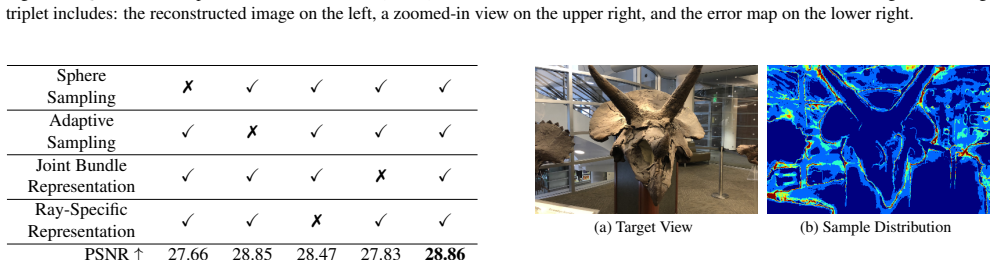
- The depth-guided adaptive sampler concentrates samples at object boundaries and depth discontinuities and reduces them in smooth areas, which is how the average sample count per ray drops below 0.1 without visible degradation.
- The method transfers to a generalizable 3D-GS pipeline, giving a small quality improvement and faster inference, indicating the bundle idea is not specific to volume-density decoders.
- Cross-dataset results on Real Forward-facing and NeRF Synthetic keep quality on par with or above the base method, so the speed gains do not obviously come from overfitting to the DTU training set.
Reading between the lines
- The piecewise-smooth assumption predicts the largest speed-ups will appear on scenes with large low-texture regions; scenes packed with fine detail will need smaller bundles or a higher $N_{\max}$, and a per-bundle measure of texture energy could make that trade-off explicit.
- The same cone-of-spheres sampling could be applied at training time or to scene-specific radiance fields, where the depth range $R$ is known from geometry, potentially removing the need for a learned depth-confidence branch.
- A direct comparison against a per-ray baseline with the same total sample budget would isolate whether the quality gain comes from bundle regularization or from depth-guided allocation.
Editorial analysis
A structured set of objections, weighed in public.
Referee Report
Summary. The paper proposes a depth-guided bundle sampling strategy for generalizable neural radiance field rendering. Adjacent K×K rays in the target view are grouped into cones; each cone is sampled with inscribed spheres, encoded with mipmap features from source views and per-ray colors, and decoded by a small neural renderer. The number of samples per bundle is intended to be adapted to a predicted depth range R, with an upper cap N_max=6. The method is applied to ENeRF and to MVSGaussian, and is evaluated on DTU, Real Forward-facing, and NeRF Synthetic. The reported claims are up to 1.27 dB PSNR improvement over ENeRF and up to a 2.24× FPS increase on DTU, with average samples per ray of 0.422 for 2×2 bundles and 0.104 for 4×4 bundles.
Significance. The efficiency-oriented idea of sampling bundles of rays jointly with depth-guided adaptive counts is timely and, if implemented as described, would be a useful contribution to generalizable view synthesis. The paper has concrete strengths: it provides ablations isolating the sphere-based bundle sampling, the adaptive depth-guided count, the joint bundle representation, and the ray-specific representation; it evaluates across multiple datasets; the gains are compared against standard benchmarks; and the code is promised publicly. However, the central efficiency claim is currently not reproducible from the equations, because Eq. (6) uses max where the text requires a minimum cap. This is a load-bearing internal inconsistency, not a matter of disagreement with external consensus, and it must be resolved before the results can be accepted.
major comments (1)
- [Section 4.2, Eq. (6)] The printed formula N_C = max(ceil(2·R/δ_s), N_max), with N_max = 6 in Section 5.1, forces every bundle to contain at least six samples, because the max operator returns N_max whenever the depth term is smaller. This directly contradicts the sentence that calls N_max a 'maximum limit' and makes the reported average samples per ray in Table 1 impossible: the lower bounds are 6/4 = 1.5 for 2×2 bundles and 6/16 = 0.375 for 4×4 bundles, while Table 1 reports 0.422 and 0.104. If the implementation actually uses min(ceil(2·R/δ_s), N_max), as the surrounding text and the sample-count measurements imply, then Eq. (6), the implementation description, and the reported efficiency numbers must be reconciled before the central speed claim can be reproduced from the manuscript.
minor comments (5)
- [Abstract and Table 1] The claim of 'state-of-the-art rendering quality' is not supported by Table 1 on DTU, where ConvGLR reports a PSNR of 31.65 compared with 28.86 for ENeRF+Ours (2×2); the wording should be qualified, for example as state-of-the-art among methods at interactive rates.
- [Abstract and Table 1] The abstract reports a PSNR improvement of up to 1.27 dB over ENeRF, but the values in Table 1 give 28.86−27.61 = 1.25 dB; the discrepancy should be corrected or explained.
- [Table 3] In the fourth ablation column, the LPIPS value is printed as 0.933, which is implausible relative to all other LPIPS values in the table (roughly 0.07–0.11); this appears to be a typo, likely 0.093, and should be corrected.
- [Section 4.1.1] The statement that grouping rays into K×K bundles 'reduces the total number of samples by approximately 1/K^2' is only true at a fixed number of samples per bundle; since the later adaptive scheme changes the per-bundle count, the sentence should be clarified to avoid an implied guarantee that is not what the method delivers.
- [Section 4.1.1, Eq. (4)] The typesetting of the expression for r_src appears malformed in the manuscript, with unclear placement of the square root and parentheses; please check and re-set the equation so the projection radius calculation is unambiguous.
Circularity Check
No circularity: the efficiency and quality claims are validated against external benchmarks and do not reduce to fitted parameters or self-citations.
full rationale
The central claims (bundle sampling reduces samples; depth-guided adaptive sampling improves speed; ENeRF+Ours outperforms ENeRF on DTU) are evaluated on external datasets (DTU, Real Forward-facing, NeRF Synthetic) against published baselines using standard PSNR/SSIM/LPIPS and FPS metrics. The adaptive sample count N_C in Eq. (6) is a function of the predicted depth range R and hand-set constants (delta_s, N_max); it is not fitted to the target PSNR or FPS, and the reported sample averages are produced by the depth estimator's confidence rather than by construction from the metric. The cone/mipmap sampling is borrowed from external prior work [15] and integrated into a new bundle formulation, so no load-bearing claim is justified only by a self-citation (the authors do not cite themselves). The only notable manuscript issue is that Eq. (6) reads max(...) while the surrounding text describes N_max as a maximum cap; taken literally this would force at least N_max samples per bundle and is inconsistent with the reported 0.422/0.104 average samples per ray. That is a reproducibility/consistency concern, not a circularity: it does not make any predicted quantity equivalent to an input by construction. Score 0.
Assumptions & free parameters
free parameters (2)
- delta_s (minimum inter-sample spacing) =
1/64 of scene depth range
- N_max (maximum samples per bundle) =
6
assumptions (3)
- domain assumption Plenoptic sampling bound (Eq. 2) transfers to NeRF bundle sampling.
- domain assumption Natural scenes are piecewise smooth, with high-frequency content localized at boundaries.
- domain assumption The predicted depth range R from the feature volume is reliable enough for adaptive sampling.
Cite this review
Pith. "Pith review of Depth-Guided Bundle Sampling for Efficient Generalizable Neural Radiance Field Reconstruction." pith.science (2026). https://pith.science/paper/ESVZQRUS
@misc{pith2026250519793,
  author       = {Pith},
  title        = {Pith review of: Depth-Guided Bundle Sampling for Efficient Generalizable Neural Radiance Field Reconstruction},
  year         = {2026},
  howpublished = {\url{https://pith.science/paper/ESVZQRUS}},
  note         = {Machine review of arXiv:2505.19793}
}
read the original abstract
Recent advancements in generalizable novel view synthesis have achieved impressive quality through interpolation between nearby views. However, rendering high-resolution images remains computationally intensive due to the need for dense sampling of all rays. Recognizing that natural scenes are typically piecewise smooth and sampling all rays is often redundant, we propose a novel depth-guided bundle sampling strategy to accelerate rendering. By grouping adjacent rays into a bundle and sampling them collectively, a shared representation is generated for decoding all rays within the bundle. To further optimize efficiency, our adaptive sampling strategy dynamically allocates samples based on depth confidence, concentrating more samples in complex regions while reducing them in smoother areas. When applied to ENeRF, our method achieves up to a 1.27 dB PSNR improvement and a 47% increase in FPS on the DTU dataset. Extensive experiments on synthetic and real-world datasets demonstrate state-of-the-art rendering quality and up to 2x faster rendering compared to existing generalizable methods. Code is available at https://github.com/KLMAV-CUC/GDB-NeRF.
Figures


Figures from the paper (2 more)

Reference graph
Works this paper leans on
-
[1]
Henrik Aanæs, Rasmus Ramsbøl Jensen, George V ogiatzis, Engin Tola, and Anders Bjorholm Dahl. Large-scale data for multiple-view stereopsis.International Journal of Computer Vision, 120:153–168, 2016. 1, 6, 7
work page 2016
-
[2]
Mip-nerf: A multiscale representation for anti-aliasing neu- ral radiance fields
Jonathan T Barron, Ben Mildenhall, Matthew Tancik, Peter Hedman, Ricardo Martin-Brualla, and Pratul P Srinivasan. Mip-nerf: A multiscale representation for anti-aliasing neu- ral radiance fields. InProceedings of the IEEE/CVF inter- national conference on computer vision, pages 5855–5864,
-
[3]
Mip-nerf 360: Unbounded anti-aliased neural radiance fields
Jonathan T Barron, Ben Mildenhall, Dor Verbin, Pratul P Srinivasan, and Peter Hedman. Mip-nerf 360: Unbounded anti-aliased neural radiance fields. InProceedings of the IEEE/CVF conference on computer vision and pattern recognition, pages 5470–5479, 2022. 5
2022
-
[4]
Real-time neural light field on mobile devices
Junli Cao, Huan Wang, Pavlo Chemerys, Vladislav Shakhrai, Ju Hu, Yun Fu, Denys Makoviichuk, Sergey Tulyakov, and Jian Ren. Real-time neural light field on mobile devices. InProceedings of the IEEE/CVF Conference on Computer Vision and Pattern Recognition, pages 8328–8337, 2023. 2
work page 2023
-
[5]
Jin-Xiang Chai, Xin Tong, Shing-Chow Chan, and Heung- Yeung Shum. Plenoptic sampling. InProceedings of the 27th annual conference on Computer graphics and interac- tive techniques, pages 307–318, 2000. 2, 3
work page 2000
-
[6]
Efficient geometry-aware 3d generative adversarial networks
Eric R Chan, Connor Z Lin, Matthew A Chan, Koki Nagano, Boxiao Pan, Shalini De Mello, Orazio Gallo, Leonidas J Guibas, Jonathan Tremblay, Sameh Khamis, et al. Efficient geometry-aware 3d generative adversarial networks. InPro- ceedings of the IEEE/CVF conference on computer vision and pattern recognition, pages 16123–16133, 2022. 3
2022
-
[7]
pixelsplat: 3d gaussian splats from image pairs for scalable generalizable 3d reconstruction
David Charatan, Sizhe Lester Li, Andrea Tagliasacchi, and Vincent Sitzmann. pixelsplat: 3d gaussian splats from image pairs for scalable generalizable 3d reconstruction. InPro- ceedings of the IEEE/CVF Conference on Computer Vision and Pattern Recognition, pages 19457–19467, 2024. 2
2024
-
[8]
Mvsnerf: Fast general- izable radiance field reconstruction from multi-view stereo
Anpei Chen, Zexiang Xu, Fuqiang Zhao, Xiaoshuai Zhang, Fanbo Xiang, Jingyi Yu, and Hao Su. Mvsnerf: Fast general- izable radiance field reconstruction from multi-view stereo. InProceedings of the IEEE/CVF international conference on computer vision, pages 14124–14133, 2021. 1, 2, 6, 7
work page 2021
Show all 48 references
-
[9]
Tensorf: Tensorial radiance fields
Anpei Chen, Zexiang Xu, Andreas Geiger, Jingyi Yu, and Hao Su. Tensorf: Tensorial radiance fields. InEuropean con- ference on computer vision, pages 333–350. Springer, 2022. 2
2022
-
[10]
Explicit correspondence matching for generalizable neural radiance fields.arXiv preprint arXiv:2304.12294, 2023
Yuedong Chen, Haofei Xu, Qianyi Wu, Chuanxia Zheng, Tat-Jen Cham, and Jianfei Cai. Explicit correspondence matching for generalizable neural radiance fields.arXiv preprint arXiv:2304.12294, 2023. 1, 2, 6, 7, 8
2023 arXiv
-
[11]
Mobilenerf: Exploiting the polygon ras- terization pipeline for efficient neural field rendering on mo- bile architectures
Zhiqin Chen, Thomas Funkhouser, Peter Hedman, and An- drea Tagliasacchi. Mobilenerf: Exploiting the polygon ras- terization pipeline for efficient neural field rendering on mo- bile architectures. InProceedings of the IEEE/CVF Con- ference on Computer Vision and Pattern Recogn...
2023
-
[12]
Stereo radiance fields (srf): Learning view syn- thesis for sparse views of novel scenes
Julian Chibane, Aayush Bansal, Verica Lazova, and Gerard Pons-Moll. Stereo radiance fields (srf): Learning view syn- thesis for sparse views of novel scenes. InProceedings of the IEEE/CVF Conference on Computer Vision and Pattern Recognition, pages 7911–7920, 2021. 1, 2
2021
-
[13]
Plenoxels: Radiance fields without neural networks
Sara Fridovich-Keil, Alex Yu, Matthew Tancik, Qinhong Chen, Benjamin Recht, and Angjoo Kanazawa. Plenoxels: Radiance fields without neural networks. InProceedings of the IEEE/CVF conference on computer vision and pattern recognition, pages 5501–5510, 2022. 1, 2
2022
-
[14]
Efficientnerf efficient neural radiance fields
Tao Hu, Shu Liu, Yilun Chen, Tiancheng Shen, and Jiaya Jia. Efficientnerf efficient neural radiance fields. InProceed- ings of the IEEE/CVF Conference on Computer Vision and Pattern Recognition, pages 12902–12911, 2022. 1, 2
2022
-
[15]
Tri-miprf: Tri-mip represen- tation for efficient anti-aliasing neural radiance fields
Wenbo Hu, Yuling Wang, Lin Ma, Bangbang Yang, Lin Gao, Xiao Liu, and Yuewen Ma. Tri-miprf: Tri-mip represen- tation for efficient anti-aliasing neural radiance fields. In Proceedings of the IEEE/CVF International Conference on Computer Vision, pages 19774–19783, 2023. 4, 5
2023
-
[16]
Geonerf: Generalizing nerf with geometry priors
Mohammad Mahdi Johari, Yann Lepoittevin, and Franc ¸ois Fleuret. Geonerf: Generalizing nerf with geometry priors. InProceedings of the IEEE/CVF Conference on Computer Vision and Pattern Recognition, pages 18365–18375, 2022. 1, 2
2022
-
[17]
Relu fields: The little non-linearity that could
Animesh Karnewar, Tobias Ritschel, Oliver Wang, and Niloy Mitra. Relu fields: The little non-linearity that could. InACM SIGGRAPH 2022 conference proceedings, pages 1–9, 2022. 2
2022
-
[18]
3d gaussian splatting for real-time radiance field rendering.ACM Trans
Bernhard Kerbl, Georgios Kopanas, Thomas Leimk ¨uhler, and George Drettakis. 3d gaussian splatting for real-time radiance field rendering.ACM Trans. Graph., 42(4):139–1,
-
[19]
Adam: A method for stochastic opti- mization.arXiv preprint arXiv:1412.6980, 2014
Diederik P Kingma. Adam: A method for stochastic opti- mization.arXiv preprint arXiv:1412.6980, 2014. 6
2014 arXiv
-
[20]
Adanerf: Adaptive sam- pling for real-time rendering of neural radiance fields
Andreas Kurz, Thomas Neff, Zhaoyang Lv, Michael Zollh¨ofer, and Markus Steinberger. Adanerf: Adaptive sam- pling for real-time rendering of neural radiance fields. In European Conference on Computer Vision, pages 254–270. Springer, 2022. 2
2022
-
[21]
Mine: Towards continuous depth mpi with nerf for novel view synthesis
Jiaxin Li, Zijian Feng, Qi She, Henghui Ding, Changhu Wang, and Gim Hee Lee. Mine: Towards continuous depth mpi with nerf for novel view synthesis. InProceedings of the IEEE/CVF International Conference on Computer Vi- sion, pages 12578–12588, 2021. 1, 2
2021
-
[22]
Efficient neural radiance fields for interactive free-viewpoint video
Haotong Lin, Sida Peng, Zhen Xu, Yunzhi Yan, Qing Shuai, Hujun Bao, and Xiaowei Zhou. Efficient neural radiance fields for interactive free-viewpoint video. InSIGGRAPH Asia 2022 Conference Papers, pages 1–9, 2022. 1, 2, 3, 4, 5, 6, 7, 8
2022
-
[23]
Neural sparse voxel fields.Advances in Neural Information Processing Systems, 33:15651–15663,
Lingjie Liu, Jiatao Gu, Kyaw Zaw Lin, Tat-Seng Chua, and Christian Theobalt. Neural sparse voxel fields.Advances in Neural Information Processing Systems, 33:15651–15663,
-
[24]
Mvsgaussian: Fast generalizable gaussian splatting recon- struction from multi-view stereo
Tianqi Liu, Guangcong Wang, Shoukang Hu, Liao Shen, Xinyi Ye, Yuhang Zang, Zhiguo Cao, Wei Li, and Ziwei Liu. Mvsgaussian: Fast generalizable gaussian splatting recon- struction from multi-view stereo. InEuropean Conference on Computer Vision, pages 37–53. Springer, 2024. 1, 2...
2024
-
[25]
Geometry-aware reconstruc- tion and fusion-refined rendering for generalizable neural ra- diance fields
Tianqi Liu, Xinyi Ye, Min Shi, Zihao Huang, Zhiyu Pan, Zhan Peng, and Zhiguo Cao. Geometry-aware reconstruc- tion and fusion-refined rendering for generalizable neural ra- diance fields. InProceedings of the IEEE/CVF Conference on Computer Vision and Pattern Recognition, pages...
2024
-
[26]
Neural rays for occlusion-aware image-based render- ing
Yuan Liu, Sida Peng, Lingjie Liu, Qianqian Wang, Peng Wang, Christian Theobalt, Xiaowei Zhou, and Wenping Wang. Neural rays for occlusion-aware image-based render- ing. InProceedings of the IEEE/CVF Conference on Com- puter Vision and Pattern Recognition, pages 7824–7833,
-
[27]
Local light field fusion: Practical view syn- thesis with prescriptive sampling guidelines.ACM Transac- tions on Graphics (ToG), 38(4):1–14, 2019
Ben Mildenhall, Pratul P Srinivasan, Rodrigo Ortiz-Cayon, Nima Khademi Kalantari, Ravi Ramamoorthi, Ren Ng, and Abhishek Kar. Local light field fusion: Practical view syn- thesis with prescriptive sampling guidelines.ACM Transac- tions on Graphics (ToG), 38(4):1–14, 2019. 6, 7
2019
-
[28]
Srinivasan, Matthew Tancik, Jonathan T
Ben Mildenhall, Pratul P. Srinivasan, Matthew Tancik, Jonathan T. Barron, Ravi Ramamoorthi, and Ren Ng. Nerf: Representing scenes as neural radiance fields for view syn- thesis. InECCV, 2020. 1, 6, 7
2020
-
[29]
Instant neural graphics primitives with a mul- tiresolution hash encoding.ACM transactions on graphics (TOG), 41(4):1–15, 2022
Thomas M ¨uller, Alex Evans, Christoph Schied, and Alexan- der Keller. Instant neural graphics primitives with a mul- tiresolution hash encoding.ACM transactions on graphics (TOG), 41(4):1–15, 2022. 1, 2
2022
-
[30]
Donerf: Towards real- time rendering of compact neural radiance fields using depth oracle networks
Thomas Neff, Pascal Stadlbauer, Mathias Parger, Andreas Kurz, Joerg H Mueller, Chakravarty R Alla Chaitanya, Anton Kaplanyan, and Markus Steinberger. Donerf: Towards real- time rendering of compact neural radiance fields using depth oracle networks. InComputer Graphics Forum, ...
-
[31]
Cascaded and generalizable neural ra- diance fields for fast view synthesis.IEEE Transactions on Pattern Analysis and Machine Intelligence, 2023
Phong Nguyen-Ha, Lam Huynh, Esa Rahtu, Jiri Matas, Janne Heikkil, et al. Cascaded and generalizable neural ra- diance fields for fast view synthesis.IEEE Transactions on Pattern Analysis and Machine Intelligence, 2023. 1, 2, 6, 7
2023
-
[32]
Sampling for view synthesis: From local light field fusion to neural radiance fields and beyond.arXiv preprint arXiv:2408.04586, 2024
Ravi Ramamoorthi. Sampling for view synthesis: From local light field fusion to neural radiance fields and beyond.arXiv preprint arXiv:2408.04586, 2024. 3
2024 arXiv
-
[33]
Direct voxel grid optimization: Super-fast convergence for radiance fields reconstruction
Cheng Sun, Min Sun, and Hwann-Tzong Chen. Direct voxel grid optimization: Super-fast convergence for radiance fields reconstruction. InProceedings of the IEEE/CVF conference on computer vision and pattern recognition, pages 5459– 5469, 2022. 2
2022
-
[34]
Recent advances in im- plicit representation-based 3d shape generation.Visual Intel- ligence, 2(1):9, 2024
Jia-Mu Sun, Tong Wu, and Lin Gao. Recent advances in im- plicit representation-based 3d shape generation.Visual Intel- ligence, 2(1):9, 2024. 1
2024
-
[35]
Splatter image: Ultra-fast single-view 3d recon- struction
Stanislaw Szymanowicz, Chrisitian Rupprecht, and Andrea Vedaldi. Splatter image: Ultra-fast single-view 3d recon- struction. InProceedings of the IEEE/CVF Conference on Computer Vision and Pattern Recognition, pages 10208– 10217, 2024. 2
2024
-
[36]
Global latent neu- ral rendering
Thomas Tanay and Matteo Maggioni. Global latent neu- ral rendering. InProceedings of the IEEE/CVF Conference on Computer Vision and Pattern Recognition, pages 19723– 19733, 2024. 1, 2, 6, 7
2024
-
[37]
Grf: Learning a general radi- ance field for 3d representation and rendering
Alex Trevithick and Bo Yang. Grf: Learning a general radi- ance field for 3d representation and rendering. InProceed- ings of the IEEE/CVF International Conference on Com- puter Vision, pages 15182–15192, 2021. 1, 2
2021
-
[38]
Learning neural duplex ra- diance fields for real-time view synthesis
Ziyu Wan, Christian Richardt, Alja ˇz Bo ˇziˇc, Chao Li, Vijay Rengarajan, Seonghyeon Nam, Xiaoyu Xiang, Tuotuo Li, Bo Zhu, Rakesh Ranjan, et al. Learning neural duplex ra- diance fields for real-time view synthesis. InProceedings of the IEEE/CVF Conference on Computer Vision ...
2023
-
[39]
Is attention all that nerf needs?Proceedings of the International Conference on Learning Representations (ICLR), 2023
Peihao Wang, Xuxi Chen, Tianlong Chen, Subhashini Venu- gopalan, Zhangyang Wang, et al. Is attention all that nerf needs?Proceedings of the International Conference on Learning Representations (ICLR), 2023. 1, 2, 6, 7
2023
-
[40]
Ibr- net: Learning multi-view image-based rendering
Qianqian Wang, Zhicheng Wang, Kyle Genova, Pratul P Srinivasan, Howard Zhou, Jonathan T Barron, Ricardo Martin-Brualla, Noah Snavely, and Thomas Funkhouser. Ibr- net: Learning multi-view image-based rendering. InPro- ceedings of the IEEE/CVF conference on computer vision and p...
2021
-
[41]
Image quality assessment: from error visibility to structural similarity.IEEE transactions on image processing, 13(4):600–612, 2004
Zhou Wang, Alan C Bovik, Hamid R Sheikh, and Eero P Si- moncelli. Image quality assessment: from error visibility to structural similarity.IEEE transactions on image processing, 13(4):600–612, 2004. 6
2004
-
[42]
Adaptive shells for efficient neu- ral radiance field rendering.ACM Transactions on Graphics (TOG), 42(6):1–15, 2023
Zian Wang, Tianchang Shen, Merlin Nimier-David, Nicholas Sharp, Jun Gao, Alexander Keller, Sanja Fidler, Thomas M¨uller, and Zan Gojcic. Adaptive shells for efficient neu- ral radiance field rendering.ACM Transactions on Graphics (TOG), 42(6):1–15, 2023. 1
2023
-
[43]
Murf: Multi-baseline radiance fields
Haofei Xu, Anpei Chen, Yuedong Chen, Christos Sakaridis, Yulun Zhang, Marc Pollefeys, Andreas Geiger, and Fisher Yu. Murf: Multi-baseline radiance fields. InProceedings of the IEEE/CVF Conference on Computer Vision and Pattern Recognition, pages 20041–20050, 2024. 1, 6, 7
2024
-
[44]
Plenoctrees for real-time rendering of neural radiance fields
Alex Yu, Ruilong Li, Matthew Tancik, Hao Li, Ren Ng, and Angjoo Kanazawa. Plenoctrees for real-time rendering of neural radiance fields. InProceedings of the IEEE/CVF International Conference on Computer Vision, pages 5752– 5761, 2021. 2
2021
-
[45]
pixelnerf: Neural radiance fields from one or few images
Alex Yu, Vickie Ye, Matthew Tancik, and Angjoo Kanazawa. pixelnerf: Neural radiance fields from one or few images. In Proceedings of the IEEE/CVF conference on computer vi- sion and pattern recognition, pages 4578–4587, 2021. 1, 2, 6, 7
2021
-
[46]
The unreasonable effectiveness of deep features as a perceptual metric
Richard Zhang, Phillip Isola, Alexei A Efros, Eli Shecht- man, and Oliver Wang. The unreasonable effectiveness of deep features as a perceptual metric. InProceedings of the IEEE conference on computer vision and pattern recogni- tion, pages 586–595, 2018. 6
2018
-
[47]
Gps- gaussian: Generalizable pixel-wise 3d gaussian splatting for real-time human novel view synthesis
Shunyuan Zheng, Boyao Zhou, Ruizhi Shao, Boning Liu, Shengping Zhang, Liqiang Nie, and Yebin Liu. Gps- gaussian: Generalizable pixel-wise 3d gaussian splatting for real-time human novel view synthesis. InProceedings of the IEEE/CVF Conference on Computer Vision and Pattern Rec...
2024
-
[59]
Wiley Online Library, 2021. 1, 2
2021
Reviewed August 7, 2026 · model on record in the stance chip above.
Discussion (0). Sign in to comment.