REVIEW 4 major objections 6 minor 98 references
Density-Functional Green Function Theory: Dynamical exchange-correlation field in lieu of self-energy
T0 review · 4 major / 6 minor · reviewed 2026-08-07 · deepseek-v4-flash
Pith's one-line read This paper argues that the one-particle Green function can be obtained from a local dynamical exchange-correlation field instead of the nonlocal self-energy, with simple approximations already matching benchmark spectra for strongly…
desk verdict A well-written consolidation of the author's own Vxc program; the formal rewriting is sound and the benchmarks are honestly presented, but the practical transferability claim rests on uncontrolled cluster extrapolations. read the letter →
The pith
A machine-rendered reading of the paper's core claim, the machinery that carries it, and where it could break.
The reading
What carries the argument
The central object is the dynamical exchange-correlation hole $\rho_{\rm xc}(r,r',r'';t)$, defined by writing the two-particle Green function as $G^{(2)}(r,r',r'';t)=[\rho(r'')+\rho_{\rm xc}(r,r',r'';t)]G(r,r';t)$. Its Coulomb potential is $V_{\rm xc}$; the sum rule and on-top constraint make $V_{\rm xc}$ act like a local density-dependent field, and only the spherical average of $\rho_{\rm xc}$ and its first radial moment enter $V_{\rm xc}$. The paper also uses a quasiparticle-effective-field decomposition $\Xi_q(r,t)\approx\Xi^S_q(r)+\Xi^D_q(r)e^{i\Omega t}$ to turn the equation of motion into a quasiparticle picture of a static energy shift plus a dynamic satellite-generating term.
What would settle it
Calculate the exact $V_{\rm xc}$ for the one-dimensional Hubbard chain at $U=4$ using a large reference calculation and compare with the dimer- and six-site-extrapolated forms: if the difference at small $k$ and finite $t$ does not shrink as the cluster grows, the extrapolation premise fails.
Extended reading notes
Core claim
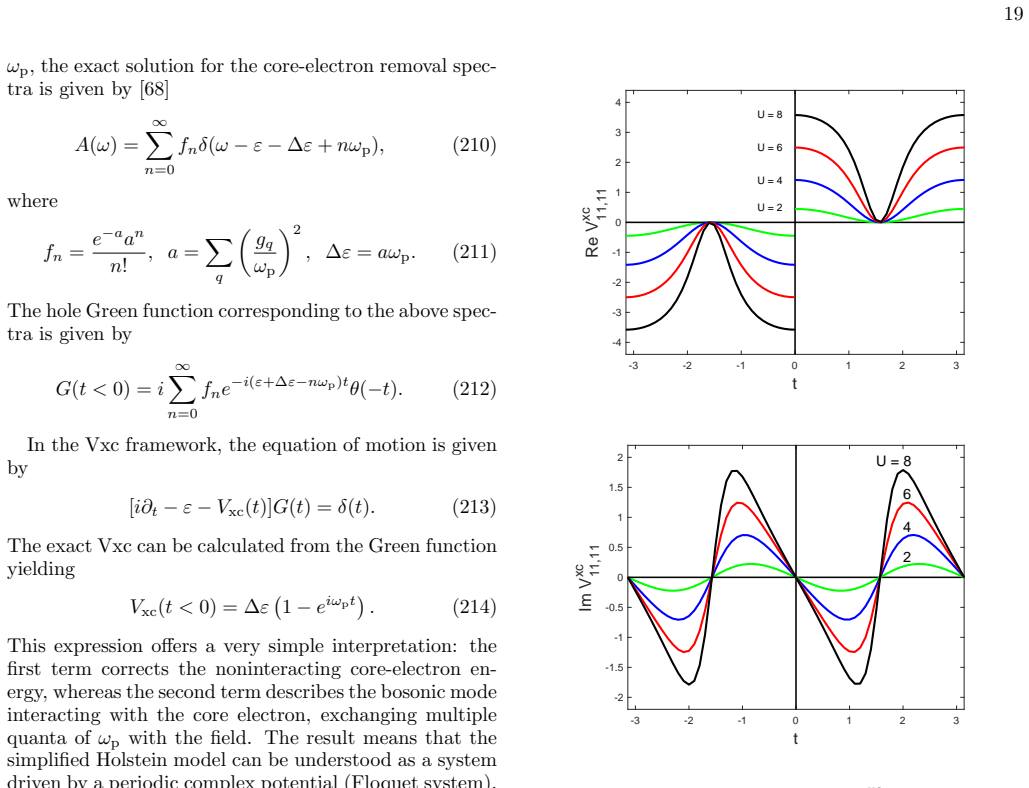
The central claim is that there exists an exact local-in-time equation of motion for the time-ordered Green function, $[i\partial_t - h(r) - V_{\rm xc}(r,r';t)]G(r,r';t)=\delta(r-r')\delta(t)$, where $V_{\rm xc}$ is generated by the dynamical exchange-correlation hole through $V_{\rm xc}(r,r';t)=\int dr''\, v(r-r'')\rho_{\rm xc}(r,r',r'';t)$. The hole satisfies $\int d^3r''\, \rho_{\rm xc}(r,r',r'';t)=-\delta_{\sigma\sigma''}\theta(-t)$ and $\rho_{\rm xc}(r,r',r;t)=-\rho(r)$, the same normalization and on-top conditions as the static exchange-correlation hole used in ground-state density-functional theory. The paper reports that approximate $V_{\rm xc}$ built from the Hubbard dimer and a six-site cluster produces the spinon-holon structure and the $\alpha U$ gap of the half-filled Hubbard chain; a four-site spin cluster extrapolated with a two-spinon energy reproduces the Heisenberg dynamic structure factor; an ansatz matched to a 50-site Anderson cluster reproduces the Hubbard side bands and Kondo resonance; and an electron-gas parametrization reproduces sodium photoemission with plasmon satellites.
Load-bearing premise
The practical results stand on the assumption that a small cluster's exchange-correlation field, with a few fitted parameters, accurately represents the infinite system's field.
Editorial extensions
If this is right
- Spectra for photoemission and inverse photoemission could be computed by propagating the Green function pointwise in time, because $V_{\rm xc}$ is local in time and no self-energy convolution is needed.
- Density-functional-style approximations such as a local-density approximation built from the homogeneous electron gas become available for one-particle excitation spectra, not just ground-state energies.
- For strongly correlated models, a $V_{\rm xc}$ parametrized from small clusters can capture correlation gaps, spinon continua, and Kondo features at much lower cost than exact diagonalization or impurity solvers.
- The static-plus-dynamic form of the effective quasiparticle field gives a systematic language for describing satellites: the dynamic term couples electrons to the main collective mode and transfers spectral weight to a replica peak.
- Because hole and electron see different $V_{\rm xc}$, the gap underestimation of ground-state density-functional theory is explained without invoking a derivative discontinuity.
Reading between the lines
- An extension the paper leaves implicit is that diagrammatic intuition could be redirected from self-energy expansions to constructing $\rho_{\rm xc}$ directly, for example from density-response data.
- The cluster-transfer success suggests a nearsightedness test: computing $V_{\rm xc}$ for systematically larger clusters and checking convergence would turn the practical claim into a quantitative statement about correlation length.
- The electron-gas local-density model could be probed on a second simple metal such as aluminum; the paper shows the sodium spectrum but does not test whether the same parametrization transfers.
- Since only the spherical average and first radial moment of the xc hole determine $V_{\rm xc}$, approximate holes with incorrect higher moments may still yield accurate spectra, which could be exploited in data-driven constructions of $V_{\rm xc}$.
Signed reviews
Editorial analysis
A structured set of objections, weighed in public.
Referee Report
Summary. This manuscript develops "density-functional Green function theory", in which the one-particle Green function obeys the local-in-time equation of motion [i∂t − h(r) − Vxc(r,r′;t)]G(r,r′;t)=δ(r−r′)δ(t) (Eq. 44), with Vxc defined as the instantaneous Coulomb potential of a dynamical exchange-correlation hole ρxc (Eq. 46). The hole is shown to satisfy the sum rule (Eq. 40) and the on-top constraint (Eq. 43), both derived from exact operator identities. The paper presents analytic and numerical Vxc for the hydrogen atom, the Holstein model, the Hubbard dimer, and the homogeneous electron gas within RPA/plasmon-pole approximations; derives quasiparticle equations, a total-energy formula, and thermal/nonequilibrium extensions; and applies cluster-extrapolated Vxc to the 1D Hubbard chain, the 1D antiferromagnetic Heisenberg chain, and the single-impurity Anderson model, comparing against Bethe ansatz, DMRG, NRG, and KCuF3/Na data. The formal part is internally consistent, but the load-bearing practical step is the assumption that a small-cluster Vxc can be extrapolated to infinite systems; this assumption is stated in Sec. XVIII but never validated by a systematic convergence study.
Significance. If established, the formalism would be conceptually attractive and computationally useful: local-in-time propagation avoids the convolution in the Dyson equation, and the xc-hole picture provides a natural link between Green function theory and DFT. The formal identities—Eqs. (40), (43), (44), and (46)—are correct and are derived cleanly. The Hubbard gap αU is a genuine parameter-free prediction and agrees remarkably well with the Bethe ansatz over a wide range of U (Fig. 23); the DMRG, NRG, KCuF3, and Na comparisons are real and nontrivial. However, the applications rest on uncontrolled cluster-to-lattice extrapolations and on several fitted parameters (e.g., γ, Z, η1 in Sec. XVII E; A, B, ωsp in Sec. XVIII B; λ, ω1, C in Sec. XVIII C). The central practical claim—that a short-range, cluster-derived Vxc can replace the self-energy without significant loss—is therefore not yet established. The exactness of the rewriting does not by itself validate any approximation scheme.
major comments (4)
- [XVIII A, Eqs. (361)-(370)] The central practical claim that a cluster-computed Vxc transfers to the infinite lattice is not supported by any convergence test. The dimer Vxc is truncated at nearest-neighbour level; the paper explicitly states it "clearly neglects components of Vxc beyond nearest neighbours" and attributes the small-k disagreement with DMRG to this neglect. The six-site calculation (Fig. 24) improves agreement, but no N=2,4,6 convergence sequence, no data on the distance decay of Vxc matrix elements, and no error estimate are provided. Since all applications in this section inherit this transferability assumption, the benchmark agreement, including the parameter-free gap αU, cannot be taken as evidence that the infinite-system Vxc is sufficiently short-ranged.
- [XVIII B, Eqs. (424)-(428)] The Heisenberg ansatz VD(k,t)=A(k)e^{-iωsp(k)t}+B(k) is not derived from the cluster calculation: ωsp(k) is fitted to the exact two-spinon boundary (Eq. 428) and B(k) is adjusted by hand to remove finite-size effects. This puts part of the target spectrum into the input, so the agreement with DMRG and KCuF3 is partly a consistency check of the ansatz rather than a predictive test of Vxc transferability. A protocol that determines A, B, and ωsp from cluster data alone, together with a sensitivity analysis, is needed before the comparison can be interpreted as support for the extrapolation premise.
- [XVIII C, Eq. (464)] The SIAM ansatz Vxc(t)=[λ(ω1+C)+(1−λ)Ce^{iω1t}]/[λ+(1−λ)e^{iω1t}] has its parameters determined from the same 50-site cluster whose physics it is then used to represent; benchmarking against NRG validates the functional form in the wide-band limit but does not test whether a Vxc computed on a small cluster converges to the infinite-system Vxc. No cluster-size study is reported for this model, and the wide-band-limit parameters are effectively fitted, so Fig. 31 does not isolate the transferability assumption.
- [XVII C-E, Eqs. (302)-(348)] The HEG-based LDA is not parameter-free: the unoccupied-momentum cutoff is set to about 1.5kF to reproduce the static correlation hole (Sec. XVII C), and γ(rs), Z(rs), and η1(rs) are extracted from GW calculations or treated as fitting parameters (Eqs. 339, 346, 347). The Na photoemission comparison therefore demonstrates that a GW-calibrated model can reproduce known spectra, but it does not establish a density-functional approximation for inhomogeneous systems; no inhomogeneous test of the LDA prescription in Eq. (100) is reported.
minor comments (6)
- [V B, Eq. (56)] The bosonic spectral representation of the dynamic part of Vxc is introduced as a conjecture; since it may be used in later constructions, it should be labelled as an assumption and its range of validity stated.
- [XVIII A, Eqs. (371)-(377)] The renormalized weights Ae0(q) and Ah0(q) are allowed to deviate from unity, but the paper does not state whether the resulting spectral functions still satisfy the relevant sum rules; a brief check would be helpful.
- [IV, Eqs. (30)-(31)] The notation g(r,r′,r′′;t) is introduced as a correlator, but its physical meaning and the regime in which it can be complex are not discussed until much later; a short comment near Eq. (30) would improve readability.
- [XVII C, Eqs. (302)-(303)] The validity condition for the q-independent plasmon-pole approximation (q≤qc with qc values given for rs=3,4,5) is stated without derivation or reference; a citation or one-line justification is needed.
- [XVIII B, Eq. (416)] The definition of Vxc(k,t) as a two-index object is stated without explaining how the four-index object of Eq. (49) reduces to it in the translationally invariant chain; an explicit reduction would prevent confusion.
- [Various] The manuscript is a synthesis of the author's previous publications (Refs. [35,44,45,58,66,84,86]); a short paragraph at the start of Sec. XIX summarizing what is new relative to those works would help readers place the contributions.
Circularity Check
The exact Vxc equation is a definitional rewrite of the interaction term, and the Heisenberg-chain spectrum fits the spinon boundary it then reproduces.
-
self definitional
[Secs. IV-V, Eqs. (30)-(32), (44), (46)]
"G^{(2)} can be rewritten as G^{(2)}(r,r',r'';t)=[\rho(r'')+\rho_{xc}(r,r',r'';t)]G(r,r';t) (Eq. 31); V_{xc}(r,r';t)=\int dr'' v(r-r'')\rho_{xc}(r,r',r'';t) (Eq. 46); "Using the expression for G^{(2)} in Eq. (31), the equation of motion ... becomes [i\partial_t-h(r)-V_{xc}(r,r';t)]G(r,r';t)=\delta(r-r')\delta(t)" (Eq. 44)."
V_{xc} is not an independent physical quantity: \rho_{xc} is defined by Eq. (31) so that, after substitution into the exact equation of motion, Eq. (44) holds identically. The sum rule (40) and on-top constraint (43) then follow from the same definition and elementary operator identities. Thus the central statement that an exact local V_{xc} exists and obeys a local equation of motion is a rewriting of the definition of V_{xc} in terms of G^{(2)}, not a derived prediction. The exactness is true by construction; all predictive content is delegated to subsequent approximations for \rho_{xc}.
-
fitted input called prediction
[Sec. XVIII B, Eqs. (424), (428), Fig. 27]
""The spinon excitation energy is estimated by fitting the cluster \omega_{sp} to the two-spinon spectrum boundary, \omega_{sp}\to(-J)\pi(\sin k/2-\frac{1}{2}|\sin k|)" (Eq. 428); this is inserted into the ansatz V_D(k,t)=A(k)e^{-i\omega_{sp}(k)t}+B(k) (Eq. 424), and the resulting spectrum is compared with the KCuF_3 structure factor "in both the peak locations and the relative weights"."
The predicted peak positions are constructed from the exact two-spinon boundaries. The static part V_S(k) is chosen to reproduce the lower boundary \Omega_L(k), and \omega_{sp} in the dynamical part is fitted to \Omega_U(k)-\Omega_L(k). Hence the main peak near \Omega_L+B and the satellite near \Omega_U+B are inputs, not outputs. The agreement with DMRG and KCuF_3 in peak locations is therefore partly by construction; only the weights A/\omega_{sp} and the finite-size shift B carry independent cluster information.
full rationale
The central formal object is constructed rather than derived: substituting Eq. (31) into the equation of motion and defining V_{xc} by Eq. (46) makes Eq. (44) an identity, and the accompanying sum rule and on-top constraint are immediate consequences of the same definitions. This is a legitimate exact rewriting, but it is not an independent falsifiable prediction, so it counts as a self-definitional step rather than an external theorem. The Hubbard-dimer application is not circular: \alpha U is computed from the dimer and compared with the Bethe-ansatz gap without fitting to that gap. The Anderson application fits an ansatz to a 50-site cluster and benchmarks against NRG, which is an independent transferability test. The electron-gas/Na model takes \gamma, Z, and \eta from GW calculations and then compares with photoemission, again not fitted to the target spectrum. The one clear case of reduction is the Heisenberg chain: the spinon excitation frequency is fitted to the two-spinon spectral boundary, so the peak positions compared with DMRG and KCuF_3 are partly inputs. Overall, the strong exactness claim is definitional and one benchmark is partly a fit, but several results retain independent anchors, giving partial rather than complete circularity.
Assumptions & free parameters
free parameters (6)
- HEG unoccupied-momentum cutoff (k' upper limit) =
1.5 kF for rs = 4
- gamma(rs), momentum-broadening factor =
from one-shot GW, Fig. 16
- Z(rs), quasiparticle renormalization factor =
average of q=0 and q=kF GW values, Fig. 16
- eta1(rs), lifetime broadening parameter =
from one-shot GW, Fig. 17
- A(k), B(k), omega_sp(k) for the Heisenberg chain =
linear interpolation from a 12-site cluster; omega_sp fitted to the two-spinon boundary
- lambda, omega1, C for the SIAM ansatz =
determined from a 50-site cluster calculation
assumptions (7)
- domain assumption The correlator g is well-defined by the division G^(2) = G g rho (Eq. 30), requiring G(r,r';t)rho(r'') != 0 on the domain of interest.
- ad hoc to paper Vxc has a bosonic spectral representation (Eq. 56) with a static and a dynamic part.
- ad hoc to paper Cluster-to-lattice extrapolation: Vxc from a dimer, 4-site, or 6-site cluster represents the infinite chain.
- ad hoc to paper RPA plus a q-independent plasmon-pole approximation, with the fitted 1.5kF cutoff, gives a reliable HEG correlation hole.
- domain assumption For a renormalized G, exchange plus density-response contributions preserve the xc-hole sum rule without vertex corrections.
- ad hoc to paper The effective field decomposes as a static term plus a single dynamic mode, Xi = XiS + XiD e^{iOmega t} (Eq. 172).
- domain assumption The Hubbard dimer ground-state solution transfers to the infinite chain, including the gap alpha U.
invented entities (4)
-
Dynamical exchange-correlation hole rho_xc(r,r',r'';t)
independent evidence
-
Temporal density rho(r,t) and temporal current density j(r,r';t)
-
Kinetic potential VK(r,t)
-
Quasiparticle wave function psi_k(r,t) and effective field Xi_q(r,t)
independent evidence
Cite this review
Pith. "Pith review of Density-Functional Green Function Theory: Dynamical exchange-correlation field in lieu of self-energy." pith.science (2026). https://pith.science/paper/HOGYUB55
@misc{pith2026250519852,
  author       = {Pith},
  title        = {Pith review of: Density-Functional Green Function Theory: Dynamical exchange-correlation field in lieu of self-energy},
  year         = {2026},
  howpublished = {\url{https://pith.science/paper/HOGYUB55}},
  note         = {Machine review of arXiv:2505.19852}
}
read the original abstract
The one-particle Green function of a many-electron system is traditionally formulated within the self-energy picture. A different formalism was recently proposed, in which the self-energy is replaced by a dynamical exchange-correlation field, which acts on the Green function locally in both space and time. It was found that there exists a fundamental quantity, referred to as the dynamical exchange-correlation hole, which can be interpreted as effective density fluctuations induced in a many-electron system when a hole or an electron is introduced into the system, as in photoemission and inverse photoemission experiments. The dynamical exchange-correlation potential is simply the Coulomb potential of this exchange-correlation hole, which fulfils a sum rule and an exact constraint, identical to those satisfied by the static exchange-correlation hole in density-functional theory. The proposed formalism has been applied to a number of model systems such as the half-filled one-dimensional Hubbard model, the one-dimensional antiferromagnetic Heisenberg model, and the single-impurity Anderson model. The dynamical exchange-correlation hole and field of the homogeneous electron gas have also been studied with the view of constructing a density-functional approximation such as the local-density approximation. The availability of simple but accurate approximations for the exchange-correlation potential would circumvent costly computations of the traditional self-energy. The formalism may also provide new perspectives and insights into the many-body problem.
Figures


Figures from the paper (25 more)



Reference graph
Works this paper leans on
-
[1]
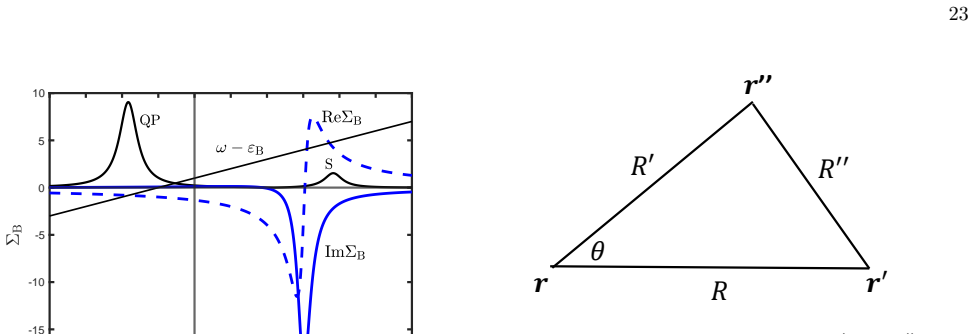
DefiningR= r′ −r=r ′ andR ′ =r ′′ −r=r ′′ as illustrated in Fig
Spherical average of the exchange hole For the homogeneous electron gas,rmay be chosen as the origin of coordinate and set to zero. DefiningR= r′ −r=r ′ andR ′ =r ′′ −r=r ′′ as illustrated in Fig. 7 the exchange hole in Eq. (266) becomes fort <0 ρx(R, R′, θ;t <0)×iG0(R, t <0) =− 1 Ω2 X k≤kF e−ik·Re−iεkt X k′≤kF eiq·R′ ,(275) whereq=k−k ′. The spherical av...
-
[2]
(287) overR ′ =r ′′ yields A1 = 4π Ω2 X k′>kF e−ik′·R X k≤kF sin (qR′) qR′ e−iεkt ×M(q, εk′ −ε k, t).(293) It can be seen from Fig
Spherical average of the correlation hole Spherical averagingA 1 in Eq. (287) overR ′ =r ′′ yields A1 = 4π Ω2 X k′>kF e−ik′·R X k≤kF sin (qR′) qR′ e−iεkt ×M(q, εk′ −ε k, t).(293) It can be seen from Fig. 12 that for a fixedk ′, the inte- gration overkis independent of the azimuthal angle so that A1 = 1 πΩ X k′>kF e−ik′·R Z kF 0 dkk2 × Z 1 −1 dy sin (qR′) ...
-
[3]
Exchange potential The exchange potential is the first moment of ρx inR ′, which from Eq. (277) is given by fort <0 Vx(R, t <0) = 1 iG0(R, t) 4π Ω2 X k,k′≤kF e−ik·Re−iεkt × Z dR′ sin(qR′) q .(307) Consider the integral overR ′ with positiveα→0: lim α→0 Z ∞ 0 dR′ sin(qR′)e−αR′ = 1 q .(308) One finds Vx(R, t <0) = 1 iG0(R, t) 4π Ω2 X k,k′≤kF e−ik·Re−iεkt 1 ...
-
[4]
(300) and (301)
Correlation potential Similarly, the correlation potential is given by the first moment inR ′ of the spherical average of the correlation hole in Eqs. (300) and (301). The integral to be evalu- ated is I(k, k′, t) = Z dR′R′Q(k, k′, R′, t) = Z dR′ Z 1 −1 dy sin (qR′) q M(q, εk′ −ε k, t) = Z 1 −1 dy 1 q2 M(q, εk′ −ε k, t),(316) whereq=|k−k ′|= p k2 +k ′2 −2...
-
[5]
(339), a possible local-density approximation [2–4] for simple metals is ΞS q (r) = [1−γ( ρ)Z(ρ)] 1 2 3π2ρ(r) 2/3 −ε q ,(349) where ρ= 1 Ω Z dr ρ(r) (350) is the average density
Local-density approximation From the ansatz in Eq. (339), a possible local-density approximation [2–4] for simple metals is ΞS q (r) = [1−γ( ρ)Z(ρ)] 1 2 3π2ρ(r) 2/3 −ε q ,(349) where ρ= 1 Ω Z dr ρ(r) (350) is the average density. BothγandZcan be calculated as functions of the electron gas density ρwithin theGW approximation [17] or using more accurate app...
-
[6]
This simplest cluster reveals features which are likely to be generic
A four-site spin chain Before considering the infinite lattice, it is instructive to consider a minimal cluster with an even number of sites for which theV xc is nonzero and can be calculated analytically. This simplest cluster reveals features which are likely to be generic. As an illustration, one of the diagonal elements is [84] V xc 11,11(t >0) =−J ( ...
-
[7]
The analytic spinon V xc in the bonding-like basis and its approximation are shown in Fig. 25. Ignoring the high-excitation factorf 3 reduces the fine-structure details inV xc. Consequently, V xc BB,BB simplifies to a constant whereasV xc BC,CB oscil- lates with a single frequency and a constant magnitude, and all other components are negligible
-
[8]
The effect ofV xc onGcan be decomposed into a static (S) and a dynamic (D) part: X q V xc(k−q, t)G(q, t) = V S(k) +V D(k, t) G(k, t)
Extrapolation to the infinite lattice For the infinite lattice it is natural to use a Bloch basis: G(k, t) = 1 N X ij Gij(t)e−ik(i−j) ,(415) V xc(k, t) = 1 N 2 X ij V xc ii,jj (t)e−ik(i−j) .(416) The equation of motion becomes i∂tG(k, t)− X q V xc(k−q, t)G(q, t) = 2sδ(t),(417) wheres=⟨ ˆSz i ⟩, which is independent of the lattice site due to translational...
Show all 98 references
-
[9]
This model can be solved analytically, providing valuable physical insights into some of the key features of the SIAM
Impurity model with a single-site bath (dimer) Before considering the full SIAM, it is instructive to study a dimer withUonly on one site and the other site treated as a bath. This model can be solved analytically, providing valuable physical insights into some of the key feat...
-
[10]
Impurity coupled to a finite cluster After studying the simplest impurity model, a dimer, we are in the position to consider a more realistic model in which the impurity is coupled to a bath with a finite FIG. 29. Illustration of the single-impurity Anderson model with a bath ...
-
[11]
J. Heyd, G. E. Scuseria, and M. Ernzerhof, Hybrid func- tionals based on a screened Coulomb potential, J. Chem. Phys.118, 8207 (2003)
2003
-
[12]
Ansatz for SIAM Vxc FIG. 31. The zero-temperature particle-hole symmetric SIAM spectra calculated withU= 3 andt h = 50 to approach the wide-band limit and compared with benchmark results obtained using the numerical renormalisation group (NRG) method [86]. Γ is related to the ...
-
[13]
Hohenberg and W
P. Hohenberg and W. Kohn, Inhomogeneous electron gas, Phys. Rev.136, B864 (1964)
1964
-
[14]
Kohn and L
W. Kohn and L. J. Sham, Self-consistent equations in- cluding exchange and correlation effects, Phys. Rev.140, A1133 (1965)
1965
-
[15]
R. O. Jones and O. Gunnarsson, The density functional formalism, its applications and prospects, Rev. Mod. Phys.61, 689 (1989)
1989
-
[16]
A. D. Becke, Fifty years of density functional theory in chemical physics, J. Chem. Phys.140, 18A301 (2014)
2014
-
[17]
R. O. Jones, Density functional theory: Its origins, rise to prominence, and future, Rev. Mod. Phys.87, 897 (2015)
2015
-
[18]
L. H. Thomas, The calculation of atomic fields, Mathe- matical Proceedings of the Cambridge Philosophical So- ciety23, 542–548 (1927)
1927
-
[19]
Fermi, Eine statistische Methode zur Bestimmung einiger Eigenschaften des Atoms und ihre Anwendung auf die Theorie des periodischen Systems der Elemente, Z
E. Fermi, Eine statistische Methode zur Bestimmung einiger Eigenschaften des Atoms und ihre Anwendung auf die Theorie des periodischen Systems der Elemente, Z. Physik48, 73 (1928)
1928
-
[20]
A. D. Becke, A new mixing of Hartree–Fock and lo- cal density-functional theories, J. Chem. Phys.98, 1372 (1993)
1993
-
[21]
J. P. Perdew and M. Ernzerhof, Rationale for mixing ex- act exchange with density functional approximations, J. Chem. Phys.105, 9982 (1996)
1996
-
[22]
J. P. Perdew, K. Burke, and M. Ernzerhof, Generalized gradient approximation made simple, Phys. Rev. Lett. 77, 3865 (1996)
1996
-
[23]
E. K. U. Gross, L. N. Oliveira, and W. Kohn, Density- functional theory for ensembles of fractionally occupied states. I. Basic formalism, Phys. Rev. A37, 2809 (1988)
1988
-
[24]
Burke, J
K. Burke, J. P. Perdew, and M. Ernzerhof, Why the gen- eralized gradient approximation works and how to go be- yond it, International Journal of Quantum Chemistry61, 287 (1997)
1997
-
[25]
Nagai, R
R. Nagai, R. Akashi, and O. Sugino, Completing density functional theory by machine learning hidden messages from molecules, npj Comput Mater6, 43 (2020). 45
2020
-
[26]
Fiedler, K
L. Fiedler, K. Shah, M. Bussmann, and A. Cangi, Deep dive into machine learning density functional theory for materials science and chemistry, Phys. Rev. Mater.6, 040301 (2022)
2022
-
[27]
L. J. Sham and W. Kohn, One-particle properties of an inhomogeneous interacting electron gas, Phys. Rev.145, 561 (1966)
1966
-
[28]
Pines and D
D. Pines and D. Bohm, A collective description of elec- tron interactions: II. Collective vs individual particle as- pects of the interactions, Phys. Rev.85, 338 (1952)
1952
-
[29]
(429) with ϵk = 2th cosk, v k = V√Nc (460) is reproduced in the limitN c → ∞
The SIAM defined in Eq. (429) with ϵk = 2th cosk, v k = V√Nc (460) is reproduced in the limitN c → ∞. Fig. 30 shows the numerically exact Vxc of the SIAM obtained with a bath consisting of a cluster of 50 sites [86]. ReV xc(t) exhibits the characteristic oscillating be- haviou...
-
[30]
Hedin, New method for calculating the one-particle Green’s function with application to the electron-gas problem, Phys
L. Hedin, New method for calculating the one-particle Green’s function with application to the electron-gas problem, Phys. Rev.139, A796 (1965)
1965
-
[31]
Hedin and S
L. Hedin and S. Lundqvist, Effects of electron-electron and electron-phonon interactions on the one-electron states of solids, inSolid State Physics, Vol. 23, edited by D. T. F. Seits and H. Ehrenreich (Academic Press, New York, 1969)
1969
-
[32]
Aryasetiawan and O
F. Aryasetiawan and O. Gunnarsson, TheGWmethod, Reports on Progress in Physics61, 237 (1998)
1998
-
[33]
Onida, L
G. Onida, L. Reining, and A. Rubio, Electronic exci- tations: Density-functional versus many-body Green’s- function approaches, Rev. Mod. Phys.74, 601 (2002)
2002
-
[34]
C. S. Wang and W. E. Pickett, Density-functional theory of excitation spectra of semiconductors: Application to Si, Phys. Rev. Lett.51, 597 (1983)
1983
-
[35]
R. W. Godby, M. Schl¨ uter, and L. J. Sham, Trends in self-energy operators and their corresponding exchange- correlation potentials, Phys. Rev. B36, 6497 (1987)
1987
-
[36]
L. N. Oliveira, E. K. U. Gross, and W. Kohn, Density- functional theory for ensembles of fractionally occupied states. II. Application to the He atom, Phys. Rev. A37, 2821 (1988)
1988
-
[37]
Gould, G
T. Gould, G. Stefanucci, and S. Pittalis, Ensemble den- sity functional theory: Insight from the fluctuation- dissipation theorem, Phys. Rev. Lett.125, 233001 (2020)
2020
-
[38]
T. R. Scott, J. Kozlowski, S. Crisostomo, A. Pribram- Jones, and K. Burke, Exact conditions for ensemble den- sity functional theory, Phys. Rev. B109, 195120 (2024)
2024
-
[39]
M. J. Stott and E. Zaremba, Linear-response theory within the density-functional formalism: Application to atomic polarizabilities, Phys. Rev. A21, 12 (1980)
1980
-
[40]
Zangwill and P
A. Zangwill and P. Soven, Density-functional approach to local-field effects in finite systems: Photoabsorption in the rare gases, Phys. Rev. A21, 1561 (1980)
1980
-
[41]
Runge and E
E. Runge and E. K. U. Gross, Density-functional the- ory for time-dependent systems, Phys. Rev. Lett.52, 997 (1984)
1984
-
[42]
C. A. Ullrich,Time-Dependent Density-Functional The- ory(Academic, Oxford University Press, 2011)
2011
-
[43]
Marques, C
inTime-Dependent Density Functional Theory, edited by M. Marques, C. Ullrich, F. Nogueira, A. Rubio, K. Burke, and E. K. U. Gross (Springer-Verlag (Lecture Notes in Physics), Berlin Heidelberg, 2006)
2006
-
[44]
N. T. Maitra, Perspective: Fundamental aspects of time- dependent density functional theory, The Journal of Chemical Physics144, 220901 (2016)
2016
-
[45]
Jacob and S
D. Jacob and S. Kurth, Many-body spectral functions from steady state density functional theory, Nano Letters 18, 2086 (2018)
2018
-
[46]
Kurth and G
S. Kurth and G. Stefanucci, Time-dependent i-DFT exchange-correlation potentials with memory: Applica- tions to the out-of-equilibrium Anderson model, Eur. Phys. J. B91, 118 (2018)
2018
-
[47]
Aryasetiawan, Time-dependent exchange-correlation potential in lieu of self-energy, Phys
F. Aryasetiawan, Time-dependent exchange-correlation potential in lieu of self-energy, Phys. Rev. B105, 075106 (2022)
2022
-
[48]
J. C. Slater, A simplification of the Hartree-Fock method, Phys. Rev.81, 385 (1951)
1951
-
[49]
J. C. Slater, Exchange in spin-polarized energy bands, Phys. Rev.165, 658 (1968)
1968
-
[50]
N. W. Ashcroft and N. D. Mermin,Solid State Physics (Saunders College Publishing, Forth Worth, 1976)
1976
-
[51]
Holm and U
B. Holm and U. von Barth, Fully self-consistentGWself- energy of the electron gas, Phys. Rev. B57, 2108 (1998)
1998
-
[52]
van Leeuwen, O
R. van Leeuwen, O. Gritsenko, and E. J. Baerends, Step structure in the atomic Kohn-Sham potential, Zeitschrift f¨ ur Physik D Atoms, Molecules and Clusters33, 229 (1995)
1995
-
[53]
A. L. Fetter and J. D. Walecka,Quantum Theory of Many-Particle Systems(Dover, Mineola, New York, 2003)
2003
-
[54]
J. W. Negele and H. Orland,Quantum Many-Particle Systems(Westview Press, Boulder, Colorado, 1998)
1998
-
[55]
Aryasetiawan,Elements of Green Function and Den- sity Functional Theory(World Scientific, Singapore, 2025)
F. Aryasetiawan,Elements of Green Function and Den- sity Functional Theory(World Scientific, Singapore, 2025)
2025
-
[56]
Aryasetiawan and T
F. Aryasetiawan and T. Sj¨ ostrand, Spectral functions of the half-filled one-dimensional Hubbard chain within the exchange-correlation potential formalism, Phys. Rev. B 106, 045123 (2022)
2022
-
[57]
Karlsson and F
K. Karlsson and F. Aryasetiawan, Time-dependent exchange-correlation hole and potential of the electron gas, Phys. Rev. B107, 115172 (2023)
2023
-
[58]
Gunnarsson and B
O. Gunnarsson and B. I. Lundqvist, Exchange and corre- lation in atoms, molecules, and solids by the spin-density- functional formalism, Phys. Rev. B13, 4274 (1976)
1976
-
[59]
Kohn, Density functional and density matrix method scaling linearly with the number of atoms, Phys
W. Kohn, Density functional and density matrix method scaling linearly with the number of atoms, Phys. Rev. Lett.76, 3168 (1996)
1996
-
[60]
Prodan and W
E. Prodan and W. Kohn, Nearsightedness of electronic matter, Proceedings of the National Academy of Sciences 102, 11635 (2005)
2005
-
[61]
Prodan, Nearsightedness of electronic matter in one dimension, Phys
E. Prodan, Nearsightedness of electronic matter in one dimension, Phys. Rev. B73, 085108 (2006)
2006
-
[62]
Gunnarsson, M
O. Gunnarsson, M. Jonson, and B. I. Lundqvist, Descrip- tions of exchange and correlation effects in inhomoge- neous electron systems, Phys. Rev. B20, 3136 (1979)
1979
-
[63]
J. A. Alonso and L. A. Girifalco, Nonlocal approximation to the exchange potential and kinetic energy of an inho- mogeneous electron gas, Phys. Rev. B17, 3735 (1978)
1978
-
[64]
L. J. Sham and M. Schl¨ uter, Density-functional theory of the energy gap, Phys. Rev. Lett.51, 1888 (1983)
1983
-
[65]
Langreth and J
D. Langreth and J. Perdew, The exchange-correlation en- ergy of a metallic surface, Solid State Communications 17, 1425 (1975)
1975
-
[66]
van Leeuwen and E
R. van Leeuwen and E. J. Baerends, Exchange- correlation potential with correct asymptotic behavior, Phys. Rev. A49, 2421 (1994)
1994
-
[67]
J. P. Perdew, R. G. Parr, M. Levy, and J. L. Balduz, Density-functional theory for fractional particle number: Derivative discontinuities of the energy, Phys. Rev. Lett. 49, 1691 (1982)
1982
-
[68]
Gatti, V
M. Gatti, V. Olevano, L. Reining, and I. V. Tokatly, 46 Transforming nonlocality into a frequency dependence: A shortcut to spectroscopy, Phys. Rev. Lett.99, 057401 (2007)
2007
-
[69]
S. Y. Savrasov and G. Kotliar, Spectral density function- als for electronic structure calculations, Phys. Rev. B69, 245101 (2004)
2004
-
[70]
Aryasetiawan, Continuity equation for the many- electron spectral function, Phys
F. Aryasetiawan, Continuity equation for the many- electron spectral function, Phys. Rev. B108, 115110 (2023)
2023
-
[71]
N. N. Lathiotakis, N. Helbig, and E. K. U. Gross, Open shells in reduced-density-matrix-functional theory, Phys. Rev. A72, 030501 (2005)
2005
-
[72]
N. N. Lathiotakis, N. Helbig, and E. K. U. Gross, Per- formance of one-body reduced density-matrix function- als for the homogeneous electron gas, Phys. Rev. B75, 195120 (2007)
2007
-
[73]
Sharma, J
S. Sharma, J. K. Dewhurst, N. N. Lathiotakis, and E. K. U. Gross, Reduced density matrix functional for many-electron systems, Phys. Rev. B78, 201103 (2008)
2008
-
[74]
Gibney, J.-N
D. Gibney, J.-N. Boyn, and D. A. Mazziotti, Den- sity functional theory transformed into a one-electron reduced-density-matrix functional theory for the capture of static correlation, The Journal of Physical Chemistry Letters13, 1382 (2022)
2022
-
[75]
T. L. Gilbert, Hohenberg-Kohn theorem for nonlocal ex- ternal potentials, Phys. Rev. B12, 2111 (1975)
1975
-
[76]
L. D. Landau, The theory of a Fermi liquid, Sov. Phys. JETP3, 920 (1957)
1957
-
[77]
L. D. Landau, Oscillations in a Fermi-liquid, Sov. Phys. JETP5, 101 (1957)
1957
-
[78]
Aryasetiawan and K
F. Aryasetiawan and K. Karlsson, Quasiparticle wave function and its equation of motion, Phys. Rev. B111, 075139 (2025)
2025
-
[79]
Dvorak, Particle conservation in the single-particle Green’s function, arXiv:2101.00704 [cond-mat.str.el] (2021)
M. Dvorak, Particle conservation in the single-particle Green’s function, arXiv:2101.00704 [cond-mat.str.el] (2021)
2021 arXiv
-
[80]
D. C. Langreth, Singularities in the X-ray spectra of met- als, Phys. Rev. B1, 471 (1970)
1970
-
[81]
Bergersen, F
B. Bergersen, F. W. Kus, and B. C., Single particle Green’s function in the electron–plasmon approximation, Can. J. Phys.51, 102 (1973)
1973
-
[82]
Hedin, Effects of recoil on shake-up spectra in metals, Physica Scripta21, 477 (1980)
L. Hedin, Effects of recoil on shake-up spectra in metals, Physica Scripta21, 477 (1980)
1980
-
[83]
Almbladh and L
C.-O. Almbladh and L. Hedin, Beyond the one-electron model. many-body effects in atoms, molecules, and solids, inHandbook of Synchrotron Radiation, Vol. 1b, edited by E. Koch (North-Holland, 1983) pp. 607–904
1983
-
[84]
Wang and J
Y. Wang and J. P. Perdew, Correlation hole of the spin- polarized electron gas, with exact small-wave-vector and high-density scaling, Phys. Rev. B44, 13298 (1991)
1991
-
[85]
Aryasetiawan, L
F. Aryasetiawan, L. Hedin, and K. Karlsson, Multiple plasmon satellites in Na and Al spectral functions from ab initio cumulant expansion, Phys. Rev. Lett.77, 2268 (1996)
1996
-
[86]
J. J. Kas, J. J. Rehr, and L. Reining, Cumulant expansion of the retarded one-electron Green function, Phys. Rev. B90, 085112 (2014)
2014
-
[87]
J. J. Kas, T. D. Blanton, and J. J. Rehr, Exchange- correlation contributions to thermodynamic properties of the homogeneous electron gas from a cumulant Green’s function approach, Phys. Rev. B100, 195144 (2019)
2019
-
[88]
Steiner, H
P. Steiner, H. H¨ ochst, and S. H¨ ufner, Photoemission in Solids II, inTopics in Applied Physics, Vol. 27, edited by L. Ley and M. Cardona (Springer-Verlag, Berlin, Heidel- berg, 1979) pp. 349–372
1979
-
[89]
Huotari, J
S. Huotari, J. A. Soininen, T. Pylkk¨ anen, K. H¨ am¨ al¨ ainen, A. Issolah, A. Titov, J. McMinis, J. Kim, K. Esler, D. M. Ceperley, M. Holzmann, and V. Olevano, Momentum dis- tribution and renormalization factor in sodium and the electron gas, Phys. Rev. Lett.105, 086403 (2010)
2010
-
[90]
Li and T
J. Li and T. Zhu, Interacting-bath dynamical embedding for capturing nonlocal electron correlation in solids, Phys. Rev. Lett.133, 216402 (2024)
2024
-
[91]
Benthien and E
H. Benthien and E. Jeckelmann, Spin and charge dy- namics of the one-dimensional extended Hubbard model, Phys. Rev. B75, 205128 (2007)
2007
-
[92]
Giamarchi,Quantum Physics in One Dimension(Ox- ford University Press, 2004)
T. Giamarchi,Quantum Physics in One Dimension(Ox- ford University Press, 2004)
2004
-
[93]
A. A. Ovchinnikov, Excitation spectrum in the one- dimensional Hubbard model, Sov. Phys., JETP30, 1160 (1970)
1970
-
[94]
Georges, G
A. Georges, G. Kotliar, W. Krauth, and M. J. Rozen- berg, Dynamical mean-field theory of strongly correlated fermion systems and the limit of infinite dimensions, Rev. Mod. Phys.68, 13 (1996)
1996
-
[95]
Go and G
A. Go and G. S. Jeon, Properties of the one-dimensional Hubbard model: Cellular dynamical mean-field descrip- tion, Journal of Physics: Condensed Matter21, 485602 (2009)
2009
-
[96]
Z. Zhao, C. Verdozzi, and F. Aryasetiawan, Dy- namical exchange-correlation potential formalism for spin- 1 2 Heisenberg and Hubbard chains: The antiferromagnetic/half-filled case, Phys. Rev. B108, 235132 (2023)
2023
-
[97]
B. Lake, D. A. Tennant, J.-S. Caux, T. Barthel, U. Schollw¨ ock, S. E. Nagler, and C. D. Frost, Multispinon continua at zero and finite temperature in a near-ideal Heisenberg chain, Phys. Rev. Lett.111, 137205 (2013)
2013
-
[98]
Zhao, Kondo spectral functions at low-temperatures: A dynamical-exchange-correlation-field perspective, Sci- Post Phys.18, 002 (2025)
Z. Zhao, Kondo spectral functions at low-temperatures: A dynamical-exchange-correlation-field perspective, Sci- Post Phys.18, 002 (2025)
2025
Reviewed August 7, 2026 · model on record in the stance chip above.
Discussion (0). Continue with ORCID to comment.