REVIEW 4 major objections 6 minor 47 references
PAMD: Plausibility-Aware Motion Diffusion Model for Long Dance Generation
T0 review · 4 major / 6 minor · reviewed 2026-08-07 · deepseek-v4-flash
Pith's one-line read PAMD, a plausibility-aware diffusion model, generates dances that are both musically aligned and physically realistic by constraining each pose with a learned neural distance field.
desk verdict A coherent integration of known components with consistent empirical gains, but the load-bearing plausibility field is underspecified, so the central claim is not yet verifiable. read the letter →
The pith
A machine-rendered reading of the paper's core claim, the machinery that carries it, and where it could break.
The reading
What carries the argument
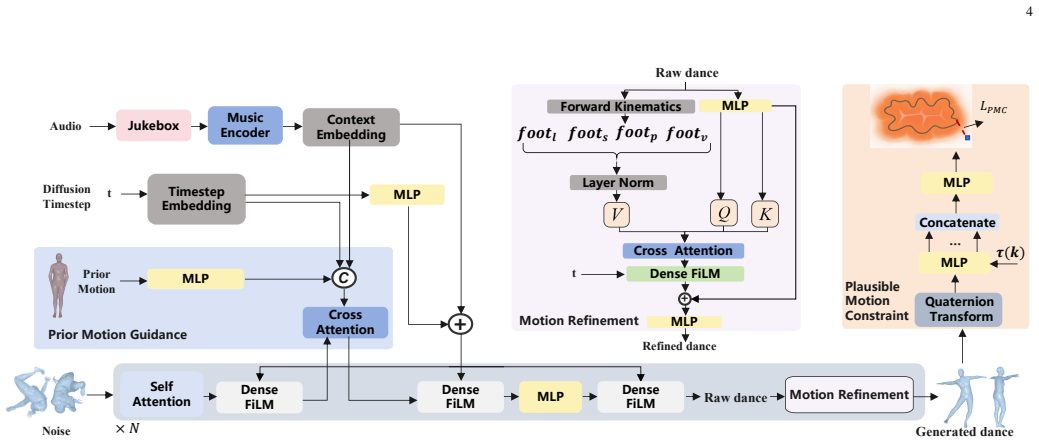
The load-bearing object is the Neural Distance Field (NDF), a function $f: SO(3)^K \to \mathbb{R}_+$ whose zero level set is the manifold of plausible poses, with outputs above zero giving an unsigned distance from that manifold. It is built with an encoder that aggregates joint rotations up the kinematic tree and a decoder that predicts the distance; during diffusion training, the average distance of generated frames is added as the auxiliary loss $L_{PMC}$. The other two modules are auxiliary: Prior Motion Guidance (PMG) concatenates a fixed standing pose with music features and the timestep as the conditioning input to cross-attention, and the Motion Refinement with Foot-Ground Contact (MRFC) block computes foot positions, velocities, and contact labels, derives a contact score, and refines the raw dance in position space before the model's output is used.
What would settle it
A concrete test: train the full PAMD pipeline but replace the NDF with a randomly initialized network (same architecture, no training); if PFC and FID metrics do not worsen relative to the trained NDF, then the reported plausibility gains are not caused by the distance field. More directly, feed the NDF a set of physically impossible poses (e.g., feet penetrating the floor, knees hyperextended) that are nonetheless close to real poses in the latent space; if it assigns them near-zero distance, the field is not detecting the implausibility it is claimed to model.
Extended reading notes
Core claim
On the paper's own terms, the discovery is that physical plausibility in diffusion-based dance generation can be enforced without a physics simulator: a network f trained to output zero on real, plausible poses and positive values elsewhere is used as a soft constraint. The training loss becomes $L = L_{recon} + \lambda_{joint} L_{joint} + \lambda_{vel} L_{vel} + \lambda_{foot} L_{foot} + \lambda_{PMC} L_{PMC}$, where $L_{PMC}$ is the average NDF output over the frames of the denoised dance, so the diffusion model is pushed toward the zero-level set of the plausibility field. Two further modules add a fixed standing pose as a conditioning prior (PMG) and a lightweight foot-contact refinement block (MRFC) that operates in joint-position space before converting back to rotations. The paper claims these components let PAMD generate long dances in parallel by overlapping sliding windows, without the error accumulation of autoregressive generation, and that the resulting motions have fewer skating, floating, and penetration artifacts.
Load-bearing premise
The load-bearing premise is that the NDF plausibility field, trained on real human poses, measures physical plausibility rather than mere proximity to the training distribution, so minimizing its output during diffusion training pulls generated motions toward physically valid poses.
Editorial extensions
If this is right
- On the AIST++ benchmark, PAMD improves beat alignment score and physical foot contact over EDGE, and the gap widens as generation length grows from 7.5 s to 10 s.
- Ablations show PMC, PMG, and MRFC are complementary: removing PMC raises PFC by roughly 29% (2.04 vs 1.44), while adding MRFC alone cuts PFC by about 6%.
- The refinement module achieves comparable or better quality than Lodge's coarse-to-fine foot refine block at roughly one-third the total parameters (207.44M vs 804.72M) and a smaller refine module (1.50M vs 4.51M).
- PAMD can generate long dances of arbitrary length in parallel by overlapping slices with a linear blend, avoiding the error accumulation of autoregressive inference.
Reading between the lines
- The NDF field is scored per frame, so it likely cannot capture temporal physical plausibility such as momentum or ground reaction forces; a natural extension is a spatiotemporal distance field that scores short pose windows.
- The paper does not describe the NDF's training set, split, or validation; a testable extension is to train the same PAMD pipeline with a distance field learned from a different motion corpus to see whether the plausibility gain transfers.
- The sliding-window merge uses a linear ramp for blending; it would be worth testing whether the overlap length and blending function affect the beat-alignment improvements reported for long sequences.
- If the NDF is essentially measuring proximity to the training distribution of poses, then its benefit may shrink on out-of-distribution music styles or unusual choreography; a stress test on novel genres would clarify whether the constraint generalizes or only memorizes.
Editorial analysis
A structured set of objections, weighed in public.
Referee Report
Summary. The paper proposes PAMD, a diffusion-based framework for music-to-dance generation on the AIST++ dataset. The method augments a standard motion diffusion model with three components: Plausible Motion Constraint (PMC), which uses a neural distance field to penalize implausible poses; Prior Motion Guidance (PMG), which appends a fixed standing pose as an auxiliary conditioning signal; and Motion Refinement with Foot-Ground Contact (MRFC), a lightweight cross-attention module for reducing foot-skating. Long sequences are generated by slicing the audio into overlapping 5-second segments, denoising them in parallel with latent-level replacement, and merging with weighted averaging. Experiments report improvements over EDGE on beat alignment, foot contact, FID, and user preference for 5s, 7.5s, and 10s dances, with ablations for each module.
Significance. If the central claim holds, PAMD is a useful contribution to long dance generation: it demonstrates a parallel generation scheme, a lightweight refinement module, and a new application of neural distance fields to music-conditioned motion synthesis. The paper provides an extensive evaluation with ablations, comparisons against EDGE and Lodge, and a user study. However, the physical-plausibility claim rests on the NDF's training and validity, which is not described, and the reported gains are not accompanied by variance or significance information. The novelty of applying NDFs to dance generation is real but the current manuscript does not substantiate it.
major comments (4)
- [§III-B, Eq. (7)] The Plausible Motion Constraint is the paper's core contribution, but the neural distance field f is never specified as a training objective, data split, or regularizer. The text gives the architecture (encoder/decoder MLPs with parent-joint aggregation and quaternion transform) and defines L_PMC = (1/N) Σ f_dec(f_enc(q(x̂_i))), but it does not state how f is trained, on which poses, with which loss, or whether it is frozen during end-to-end training. If f is trained jointly with the diffusion model without a distance regression objective, it can collapse to a near-constant small output and L_PMC becomes vacuous; if it is pretrained on the full AIST++ set, test-set improvements in Tables I–III could be inflated by memorization. Please provide the training protocol for the NDF, its validation (e.g., distance accuracy on held-out poses), and state whether it is frozen.
- [§I, §III-B, Table V] The central claim of 'physically realistic' motion is supported only by the learned NDF zero-level set of Eq. (4) and by the proxy metrics in Table V (Skating, floating, penetration), whose computation is not defined anywhere in the paper. A distance to a manifold learned from real motion data measures closeness to the training distribution, not physical validity; the paper provides no evidence (e.g., correlation with physics simulation or contact-force analysis) that the NDF distance corresponds to physical implausibility. Please define the Table V metrics precisely and show that minimizing the PMC loss reduces them in a controlled way, or provide external physical validation.
- [§III-E, Algorithm 1, Table II] The long-dance scheme is evaluated only for 7.5s and 10s outputs and against EDGE alone, which does not establish the claim of generating 'dances of arbitrary lengths'. More importantly, Algorithm 1 operates the overlap replacement on the noisy latent x_{t-1} at every reverse step (line 7), while the two slices are denoised from independent noise; this can create inconsistent latents at the boundary, and the final weighted averaging (lines 9–18) is not a substitute for enforcing motion coherence at the stitching points. Please quantify boundary continuity (e.g., velocity or acceleration discontinuity at slice boundaries) and evaluate longer sequences (e.g., 30s) with additional long-generation baselines.
- [§IV-A, Tables I–III] Evaluation metrics are reported as single numbers without standard deviations or significance tests. The implementation details state that the test process is repeated 100 times and averaged, but no variance is given; consequently, differences like BAS 0.31 vs. 0.30 in Table I or PFC 1.44 vs. 1.56 in Table III cannot be assessed for statistical significance. Please report error bars or run paired significance tests for the core comparisons against EDGE and for the ablations.
minor comments (6)
- [Figure 3] Figure 3 contains placeholder text ('?????') in the pipeline diagram, which should be replaced with the actual tensor/feature names.
- [§III-D, Eq. (9)] In Eq. (9), the variables h_max and v_max are used but never defined; please state how they are computed (presumably from dataset statistics).
- [§II-A] In Section II.A, the text claims the NDF 'constrains the motion to adhere to natural physical laws', but the motion representation is in rotation space and the NDF only models poses; this overstates what the module does.
- [Table I] In Table I, the TM2D method achieves Div_k = 9.10, closer to the ground truth 9.29 than PAMD's 5.94; the text should acknowledge this and discuss why lower diversity in the kinetic feature space is acceptable.
- [§IV-C] The user study in Section IV.C does not report how the 21 pairs were selected, whether the order was randomized, the expertise of the 11 participants, or inter-rater variability; please provide this information.
- [§IV-B] In Section IV.B, the phrase 'overcoming the poor quality and diversity of dances generated using Diffusion model in kinematic feature space' is incomplete; please clarify the intended comparison.
Circularity Check
PMC's plausibility is partly self-definitional: Eq. (4) defines “plausible” as the zero-level set of an NDF that, per Sec. III-B, models the “actual pose manifold” of real poses, and the abstract relabels that set as “physically valid”; the NDF's training (loss, data, frozen?) is undocumented, though independent metrics (PFC, artifact scores, user study) carry the empirical claims.
-
self definitional
[Abstract; Sec. III-B, Eqs. (4)-(7)]
"Abstract: “...leverages Neural Distance Fields (NDFs) to model the actual pose manifold and guide generated motions toward a physically valid pose manifold.” Sec. III-B: “The manifold of plausible poses is represented as the zero-level set: S={θ∈SO(3)^K | f(θ)=0}, where SO(3)^K denotes the pose space... and the value of f(θ) signifies the unsigned distance from the pose θ to the manifold of plausibility.”"
Eq. (4) defines plausibility as the zero-level set of f, and Sec. III-B says PMC “models the actual pose manifold, preserving distances between real poses,” so f is fit to real poses; a distance field's zero set is its training-pose set. The abstract then equates this statistical object with a “physically valid pose manifold.” Minimizing L_PMC (Eq. 7) pushes generated poses into the training-pose distribution by construction, so the claimed physical plausibility is, at this step, a relabeling of data-manifold matching: “plausible” means whatever poses f was trained on, and the outcome (physically valid poses) is contained in the input (real poses used to fit f). The NDF encodes no physical law; “adhere to natural physical laws” (Sec. II-A) is asserted, not derived.
-
other
[Sec. III-B, Eq. (7); Sec. IV-A Implementation Details]
"Sec. III-B: “The PMC module consists of an encoder f_enc and a decoder f_dec, following the practice of modeling pose manifolds with neural distance fields [11].” Eq. (7): “L_PMC = 1/N Σ_i f_dec(f_enc(q(x̂_i))).” Sec. IV-A lists only batch size, epochs, learning rate and weight decay; no NDF training objective, data split, or freeze status."
The NDF's training is never specified: no distance-supervision loss, no pose dataset, no train/test split, no statement of whether f is frozen when L_PMC is back-propagated. Eq. (7) is thus a sum of outputs of an unspecified network. If f is jointly trained without a distance objective it can collapse to a near-constant and L_PMC is vacuous; if f was fit to the same AIST++ poses used for evaluation, the FID/PFC gains in Tables I-III and V partly measure closeness to the memorized pose distribution rather than physical plausibility. This is a missing-support flag, not a deductive loop, but it is load-bearing: without the training specification, the “distance to the physically valid pose manifold” reading of Eq.
full rationale
Most of PAMD's empirical content is externally grounded: benchmarking on AIST++ against EDGE, Lodge, Bailando, TM2D, and BADM uses standard metrics (BAS, PFC, FID_k, FID_g, Div), and the physical measures in Table V (skating, floating, penetration) are computed from forward kinematics and contact labels, not from the learned NDF. MRFC and PMG are described with concrete objectives. So the method as a whole does not reduce to a single fit. The circular element is confined to PMC, which the abstract calls “the core of PAMD.” Eq. (4) defines “the manifold of plausible poses” as the zero-level set of a learned network f, and Sec. III-B says PMC “models the actual pose manifold, preserving distances between real poses.” Since f is fit to real human poses, its zero set lies where the training poses lie; the abstract's “physically valid pose manifold” and Sec. II-A's claim that the NDF “constrains the motion to adhere to natural physical laws” are relabelings of data-manifold membership. Minimizing L_PMC (Eq. 7) pulls generations toward the training pose manifold by construction. A missing-support problem compounds this: the paper never states how f_enc and f_dec are trained — no distance-supervision loss, no data split, no freeze status. If f is trained jointly without a distance objective, it can collapse and Eq. (7) becomes vacuous; if f was fit to the same AIST++ poses used for evaluation, the gains partly reflect distribution memorization. That is not itself a deductive loop, but it blocks independent grounding of the “physical plausibility” label. The only self-citation is ref. [45] (first author's PVRED) for the quaternion transform q(·) in Sec. III-B; it is standard mathematics and not load-bearing. Because PMC's plausibility notion is self-definitional and its training is undocumented, while headline results still rest on independent external metrics, the score is 4 rather than 6 or higher.
Assumptions & free parameters
free parameters (5)
- Loss weights lambda_joint, lambda_vel, lambda_foot, lambda_PMC =
not reported
- Guidance weight w =
2 (default) and 1 for comparison
- Foot-contact score scales k_h, k_v =
k_h = 5*h_max, k_v = 5*v_max
- Prior standing pose for PMG =
a standard standing pose from the dataset
- Diffusion timesteps T =
not reported
assumptions (5)
- standard math DDPM forward/reverse process and classifier-free guidance are valid generative machinery.
- domain assumption SMPL body model, 6D rotation representation, and forward kinematics faithfully describe human dance poses.
- ad hoc to paper The learned NDF zero-level set is an accurate model of the physically plausible pose manifold, and distance to it is a valid plausibility measure.
- ad hoc to paper A fixed standard standing pose is a beneficial universal condition for all dances in the target distribution.
- ad hoc to paper Overlapping slicing with weighted averaging produces long sequences that preserve coherence and avoid boundary artifacts.
invented entities (1)
-
Plausibility distance function f(theta) from the PMC Neural Distance Field
Cite this review
Pith. "Pith review of PAMD: Plausibility-Aware Motion Diffusion Model for Long Dance Generation." pith.science (2026). https://pith.science/paper/4GEMGLBS
@misc{pith2026250520056,
  author       = {Pith},
  title        = {Pith review of: PAMD: Plausibility-Aware Motion Diffusion Model for Long Dance Generation},
  year         = {2026},
  howpublished = {\url{https://pith.science/paper/4GEMGLBS}},
  note         = {Machine review of arXiv:2505.20056}
}
read the original abstract
Computational dance generation is crucial in many areas, such as art, human-computer interaction, virtual reality, and digital entertainment, particularly for generating coherent and expressive long dance sequences. Diffusion-based music-to-dance generation has made significant progress, yet existing methods still struggle to produce physically plausible motions. To address this, we propose Plausibility-Aware Motion Diffusion (PAMD), a framework for generating dances that are both musically aligned and physically realistic. The core of PAMD lies in the Plausible Motion Constraint (PMC), which leverages Neural Distance Fields (NDFs) to model the actual pose manifold and guide generated motions toward a physically valid pose manifold. To provide more effective guidance during generation, we incorporate Prior Motion Guidance (PMG), which uses standing poses as auxiliary conditions alongside music features. To further enhance realism for complex movements, we introduce the Motion Refinement with Foot-ground Contact (MRFC) module, which addresses foot-skating artifacts by bridging the gap between the optimization objective in linear joint position space and the data representation in nonlinear rotation space. Extensive experiments show that PAMD significantly improves musical alignment and enhances the physical plausibility of generated motions. This project page is available at: https://mucunzhuzhu.github.io/PAMD-page/.
Figures


Figures from the paper (4 more)


Reference graph
Works this paper leans on
-
[1]
Expression of emotions in dance: Relation between arm movement characteristics and emotion,
M. Sawada, K. Suda, and M. Ishii, “Expression of emotions in dance: Relation between arm movement characteristics and emotion,”Percep- tual and Motor Skills, vol. 97, no. 3, pp. 697–708, 2003
work page 2003
-
[2]
L. Georgios, “The transformation of traditional dance from its first to its second existence: The effectiveness of music-movement education and creative dance in the preservation of our cultural heritage.”Journal of Education and Training Studies, vol. 6, no. 1, pp. 104–112, 2018
work page 2018
-
[3]
Evolution and functions of human dance,
B. Fink, B. Bl ¨asing, A. Ravignani, and T. K. Shackelford, “Evolution and functions of human dance,”Evolution and Human Behavior, vol. 42, no. 4, pp. 351–360, 2021
work page 2021
-
[4]
Edge: Editable dance generation from music,
J. Tseng, R. Castellon, and K. Liu, “Edge: Editable dance generation from music,” inIEEE/CVF Conference on Computer Vision and Pattern Recognition, 2023, pp. 448–458
work page 2023
-
[5]
Dancing-to-music character animation,
T. Shiratori, A. Nakazawa, and K. Ikeuchi, “Dancing-to-music character animation,” inComputer Graphics Forum, vol. 25, no. 3, 2006, pp. 449– 458
work page 2006
-
[6]
A game-like appli- cation for dance learning using a natural human computer interface,
A. Kitsikidis, K. Dimitropoulos, D. U ˘gurca, C. Bayc ¸ay, E. Yilmaz, F. Tsalakanidou, S. Douka, and N. Grammalidis, “A game-like appli- cation for dance learning using a natural human computer interface,” inInternational Conference on Universal Access in Human-Computer Interaction, 2015, pp. 472–482
work page 2015
-
[7]
Ai choreographer: Music conditioned 3d dance generation with aist++,
R. Li, S. Yang, D. A. Ross, and A. Kanazawa, “Ai choreographer: Music conditioned 3d dance generation with aist++,” inIEEE/CVF International Conference on Computer Vision, 2021, pp. 13 401–13 412
work page 2021
-
[8]
J. Kim, H. Oh, S. Kim, H. Tong, and S. Lee, “A brand new dance partner: Music-conditioned pluralistic dancing controlled by multiple dance genres,” inIEEE/CVF Conference on Computer Vision and Pattern Recognition, 2022, pp. 3490–3500. 9 (a) Break (b) Pop EDGEOursGTEDGEOursGTEDGEOursGT (c) Waack Fig. 7.Visualization of Long Dance Generation:The dances with...
work page 2022
Show all 47 references
-
[9]
Bailando: 3d dance generation by actor-critic gpt with choreographic memory,
S. Li, W. Yu, T. Gu, C. Lin, Q. Wang, C. Qian, C. C. Loy, and Z. Liu, “Bailando: 3d dance generation by actor-critic gpt with choreographic memory,” inIEEE/CVF Conference on Computer Vision and Pattern Recognition, 2022, pp. 11 050–11 059
2022
-
[10]
Genre-conditioned long-term 3d dance generation driven by music,
Y . Huang, J. Zhang, S. Liu, Q. Bao, D. Zeng, Z. Chen, and W. Liu, “Genre-conditioned long-term 3d dance generation driven by music,” inIEEE International Conference on Acoustics, Speech and Signal Processing. IEEE, 2022, pp. 4858–4862
2022
-
[11]
Pose-ndf: Modeling human pose manifolds with neural distance fields,
G. Tiwari, D. Anti ´c, J. E. Lenssen, N. Sarafianos, T. Tung, and G. Pons- Moll, “Pose-ndf: Modeling human pose manifolds with neural distance fields,” inEuropean Conference on Computer Vision. Springer, 2022, pp. 572–589
2022
-
[12]
Humor: 3d human motion model for robust pose estimation,
D. Rempe, T. Birdal, A. Hertzmann, J. Yang, S. Sridhar, and L. J. Guibas, “Humor: 3d human motion model for robust pose estimation,” inIEEE/CVF International Conference on Computer Vision, 2021, pp. 11 488–11 499
2021
-
[13]
A unified framework for real time motion completion,
Y . Duan, Y . Lin, Z. Zou, Y . Yuan, Z. Qian, and B. Zhang, “A unified framework for real time motion completion,” inProceedings of the AAAI Conference on Artificial Intelligence, vol. 36, no. 4, 2022, pp. 4459– 4467
2022
-
[14]
Lodge: A coarse to fine diffusion network for long dance generation guided by the characteristic dance primitives,
R. Li, Y . Zhang, Y . Zhang, H. Zhang, J. Guo, Y . Zhang, Y . Liu, and X. Li, “Lodge: A coarse to fine diffusion network for long dance generation guided by the characteristic dance primitives,” inProceedings of the IEEE/CVF Conference on Computer Vision and Pattern Recognitio...
2024
-
[15]
Learn2dance: Learning statistical music-to-dance mappings for choreography synthesis,
F. Ofli, E. Erzin, Y . Yemez, and A. M. Tekalp, “Learn2dance: Learning statistical music-to-dance mappings for choreography synthesis,”IEEE Transactions on Multimedia, vol. 14, no. 3, pp. 747–759, 2011
2011
-
[16]
Example-based automatic music-driven conventional dance motion synthesis,
R. Fan, S. Xu, and W. Geng, “Example-based automatic music-driven conventional dance motion synthesis,”IEEE Transactions on Visualiza- tion and Computer Graphics, vol. 18, no. 3, pp. 501–515, 2011
2011
-
[17]
Kinetic imaginations: Exploring the possi- bilities of combining ai and dance
A. Berman and V . James, “Kinetic imaginations: Exploring the possi- bilities of combining ai and dance.” inIJCAI, 2015, p. 2431
2015
-
[18]
Music similarity-based approach to generating dance motion sequence,
M. Lee, K. Lee, and J. Park, “Music similarity-based approach to generating dance motion sequence,”Multimedia tools and applications, vol. 62, pp. 895–912, 2013
2013
-
[19]
Transflower: probabilistic autoregressive dance generation with multimodal attention,
G. Valle-P ´erez, G. E. Henter, J. Beskow, A. Holzapfel, P.-Y . Oudeyer, and S. Alexanderson, “Transflower: probabilistic autoregressive dance generation with multimodal attention,”ACM Transactions on Graphics (TOG), vol. 40, no. 6, pp. 1–14, 2021
2021
-
[20]
Deepdance: music-to-dance motion choreography with adversarial learning,
G. Sun, Y . Wong, Z. Cheng, M. S. Kankanhalli, W. Geng, and X. Li, “Deepdance: music-to-dance motion choreography with adversarial learning,”IEEE Transactions on Multimedia, vol. 23, pp. 497–509, 2020
2020
-
[21]
Tm2d: Bimodality driven 3d dance generation via music- text integration,
K. Gong, D. Lian, H. Chang, C. Guo, Z. Jiang, X. Zuo, M. B. Mi, and X. Wang, “Tm2d: Bimodality driven 3d dance generation via music- text integration,” inIEEE/CVF International Conference on Computer Vision, 2023, pp. 9942–9952
2023
-
[22]
Bidirectional autoregessive diffusion model for dance generation,
C. Zhang, Y . Tang, N. Zhang, R.-S. Lin, M. Han, J. Xiao, and S. Wang, “Bidirectional autoregessive diffusion model for dance generation,” in IEEE/CVF Conference on Computer Vision and Pattern Recognition, 2024, pp. 687–696
2024
-
[23]
Popdg: Popular 3d dance generation with popdanceset,
Z. Luo, M. Ren, X. Hu, Y . Huang, and L. Yao, “Popdg: Popular 3d dance generation with popdanceset,” inProceedings of the IEEE/CVF Conference on Computer Vision and Pattern Recognition, 2024, pp. 26 984–26 993
2024
-
[24]
Beat-it: Beat-synchronized multi-condition 3d dance generation,
Z. Huang, X. Xu, C. Xu, H. Zhang, C. Zheng, J. Qin, and S. He, “Beat-it: Beat-synchronized multi-condition 3d dance generation,”arXiv preprint arXiv:2407.07554, 2024
2024 arXiv
-
[25]
Dancecomposer: Dance-to- music generation using a progressive conditional music generator,
X. Liang, W. Li, L. Huang, and C. Gao, “Dancecomposer: Dance-to- music generation using a progressive conditional music generator,”IEEE Transactions on Multimedia, 2024
2024
-
[26]
Human motion generation: A survey,
W. Zhu, X. Ma, D. Ro, H. Ci, J. Zhang, J. Shi, F. Gao, Q. Tian, and Y . Wang, “Human motion generation: A survey,”IEEE Transactions on Pattern Analysis and Machine Intelligence, 2023
2023
-
[27]
Action2motion: Conditioned generation of 3d human motions,
C. Guo, X. Zuo, S. Wang, S. Zou, Q. Sun, A. Deng, M. Gong, and L. Cheng, “Action2motion: Conditioned generation of 3d human motions,” in28th ACM International Conference on Multimedia, 2020, pp. 2021–2029
2020
-
[28]
Action-conditioned 3d human motion synthesis with transformer vae,
M. Petrovich, M. J. Black, and G. Varol, “Action-conditioned 3d human motion synthesis with transformer vae,” inIEEE/CVF International Conference on Computer Vision, 2021, pp. 10 985–10 995
2021
-
[29]
Mo- tiondiffuse: Text-driven human motion generation with diffusion model,
M. Zhang, Z. Cai, L. Pan, F. Hong, X. Guo, L. Yang, and Z. Liu, “Mo- tiondiffuse: Text-driven human motion generation with diffusion model,” IEEE Transactions on Pattern Analysis and Machine Intelligence, 2024
2024
-
[30]
Temos: Generating diverse human motions from textual descriptions,
M. Petrovich, M. J. Black, and G. Varol, “Temos: Generating diverse human motions from textual descriptions,” inEuropean Conference on Computer Vision. Springer, 2022, pp. 480–497
2022
-
[31]
Gesturediffuclip: Gesture diffusion model with clip latents,
T. Ao, Z. Zhang, and L. Liu, “Gesturediffuclip: Gesture diffusion model with clip latents,”ACM Transactions on Graphics, vol. 42, no. 4, pp. 1–18, 2023
2023
-
[32]
Multi-semantics aggregation network based on the dynamic-attention mechanism for 3d human motion pre- diction,
J. Shi, J. Zhong, and W. Cao, “Multi-semantics aggregation network based on the dynamic-attention mechanism for 3d human motion pre- diction,”IEEE Transactions on Multimedia, vol. 26, pp. 5194–5206, 2023
2023
-
[33]
Character controllers using motion vaes,
H. Y . Ling, F. Zinno, G. Cheng, and M. Van De Panne, “Character controllers using motion vaes,”ACM Transactions on Graphics (TOG), vol. 39, no. 4, pp. 40–1, 2020
2020
-
[34]
A deep learning framework for character motion synthesis and editing,
D. Holden, J. Saito, and T. Komura, “A deep learning framework for character motion synthesis and editing,”ACM Transactions on Graphics, vol. 35, no. 4, pp. 1–11, 2016
2016
-
[35]
Physcap: Physically plausible monocular 3d motion capture in real time,
S. Shimada, V . Golyanik, W. Xu, and C. Theobalt, “Physcap: Physically plausible monocular 3d motion capture in real time,”ACM Transactions on Graphics (ToG), vol. 39, no. 6, pp. 1–16, 2020
2020
-
[36]
Neural monocular 3d human motion capture with physical awareness,
S. Shimada, V . Golyanik, W. Xu, P. P ´erez, and C. Theobalt, “Neural monocular 3d human motion capture with physical awareness,”ACM Transactions on Graphics (ToG), vol. 40, no. 4, pp. 1–15, 2021
2021
-
[37]
Simpoe: Simu- lated character control for 3d human pose estimation,
Y . Yuan, S.-E. Wei, T. Simon, K. Kitani, and J. Saragih, “Simpoe: Simu- lated character control for 3d human pose estimation,” inProceedings of the IEEE/CVF conference on computer vision and pattern recognition, 2021, pp. 7159–7169
2021
-
[38]
Physpt: Physics-aware pretrained transformer for estimating human dynamics from monocular videos,
Y . Zhang, J. O. Kephart, Z. Cui, and Q. Ji, “Physpt: Physics-aware pretrained transformer for estimating human dynamics from monocular videos,” inProceedings of the IEEE/CVF Conference on Computer Vision and Pattern Recognition, 2024, pp. 2305–2317
2024
-
[39]
Closely interactive human reconstruction with proxemics and physics-guided adaption,
B. Huang, C. Li, C. Xu, L. Pan, Y . Wang, and G. H. Lee, “Closely interactive human reconstruction with proxemics and physics-guided adaption,” inProceedings of the IEEE/CVF Conference on Computer Vision and Pattern Recognition, 2024, pp. 1011–1021
2024
-
[40]
Human motion diffusion model,
G. Tevet, S. Raab, B. Gordon, Y . Shafir, D. Cohen-or, and A. H. Bermano, “Human motion diffusion model,” inInternational Conference on Learning Representations, 2022
2022
-
[41]
Smpl: A skinned multi-person linear model,
M. Loper, N. Mahmood, J. Romero, G. Pons-Moll, and M. J. Black, “Smpl: A skinned multi-person linear model,”Acm Transactions on Graphics, vol. 34, no. Article 248, 2015
2015
-
[42]
On the continuity of rotation representations in neural networks,
Y . Zhou, C. Barnes, J. Lu, J. Yang, and H. Li, “On the continuity of rotation representations in neural networks,” inIEEE/CVF Conference on Computer Vision and Pattern Recognition, 2019, pp. 5745–5753
2019
-
[43]
Denoising diffusion probabilistic models,
J. Ho, A. Jain, and P. Abbeel, “Denoising diffusion probabilistic models,” Advances in Neural Information Processing Systems, vol. 33, pp. 6840– 6851, 2020
2020
-
[44]
Classifier-free diffusion guidance,
J. Ho and T. Salimans, “Classifier-free diffusion guidance,” inNeurIPS Workshop on Deep Generative Models and Downstream Applications, 2021
2021
-
[45]
Pvred: A position-velocity recurrent encoder-decoder for human motion prediction,
H. Wang, J. Dong, B. Cheng, and J. Feng, “Pvred: A position-velocity recurrent encoder-decoder for human motion prediction,”IEEE Trans- actions on Image Processing, vol. 30, pp. 6096–6106, 2021
2021
-
[46]
Proxycap: Real-time monocular full-body capture in world space via human-centric proxy-to-motion learning,
Y . Zhang, H. Zhang, L. Hu, J. Zhang, H. Yi, S. Zhang, and Y . Liu, “Proxycap: Real-time monocular full-body capture in world space via human-centric proxy-to-motion learning,” inIEEE/CVF Conference on Computer Vision and Pattern Recognition, 2024, pp. 1954–1964
2024
-
[47]
librosa: Audio and music signal analysis in python
B. McFee, C. Raffel, D. Liang, D. P. Ellis, M. McVicar, E. Battenberg, and O. Nieto, “librosa: Audio and music signal analysis in python.” in SciPy, 2015, pp. 18–24
2015
Reviewed August 7, 2026 · model on record in the stance chip above.
Discussion (0). Continue with ORCID to comment.