REVIEW 4 major objections 5 minor 80 references
SwarmThinkers: Learning Physically Consistent Atomic KMC Transitions at Scale
T0 review · 4 major / 5 minor · reviewed 2026-08-07 · deepseek-v4-flash
Pith's one-line read SwarmThinkers claims a learned KMC policy can run billion-atom simulations on a single GPU while preserving thermodynamic consistency.
desk verdict A plausible KMC acceleration scheme whose central promise—simultaneous speed and physical fidelity—is not yet demonstrated because the importance-sampling correction is never validated. read the letter →
The pith
A machine-rendered reading of the paper's core claim, the machinery that carries it, and where it could break.
The reading
What carries the argument
The load-bearing mechanism is the trajectory-level self-normalized importance sampling estimator, w(τ) = (Z'/Z)^T ∏_{t=1}^T 1/πθ(a_t), which corrects the bias introduced by the learned policy by reweighting each sampled transition by the inverse of its policy probability. The paper proves the estimator is unbiased as long as πθ(a) > 0 for all transitions, making the policy's full support the key requirement. The complementary component is the global softmax arbitration layer: all agent-direction logits are flattened into a single vector and passed through a softmax, creating direct competition among all locally proposed transitions and giving the system its structure-aware prioritization.
What would settle it
Run the SwarmThinkers estimator on the same Fe-Cu system at fixed composition and temperature with repeated seeds, measuring the effective sample size of the self-normalized trajectory weights at 10, 100, and 1000 steps; if the effective sample size collapses below a few percent of the total samples, the reported speedups do not translate into statistically reliable physical observables.
Extended reading notes
Core claim
The paper claims to establish that a reinforcement learning policy, which assigns higher selection probability to kinetically meaningful transitions, can be combined with classical KMC rates through a reweighting mechanism to produce unbiased estimates of physical observables. The hybrid proposal distribution q(a) proportional to πθ(a)Γa is corrected via self-normalized importance sampling, yielding an estimator that depends only on inverse policy weights 1/πθ(a), with unbiasedness guaranteed as long as the policy assigns positive probability to every transition. This reweighting is extended to trajectory-level estimates with cumulative weights w(τ) = (Z'/Z)^T ∏ 1/πθ(a_t). The authors further claim that the policy, trained under a centralized-training decentralized-execution paradigm on small lattices, generalizes to system sizes, concentrations, and temperatures it never saw during training, producing advancement curves that match OpenKMC and experimental data while running at supercomputer scale on a single GPU.
Load-bearing premise
The unbiasedness guarantee holds only if the trajectory-level importance weights have low enough variance over the long horizons used in the benchmarks that physically meaningful estimates can be obtained without an exponential number of samples.
Editorial extensions
If this is right
- Thermodynamically consistent KMC can be run at scales and costs previously requiring supercomputers, making full-scale radiation-damage and aging simulations accessible on commodity GPUs.
- The learned policy generalizes without retraining across system sizes, concentrations, and temperatures, meaning one training run could serve many materials-science regimes.
- Path-dependent observables such as the advancement factor of Cu precipitation can be estimated with trajectory-level importance weights while preserving unbiasedness.
- The effective transition ratio of 0.34 versus below 10^-4 for classical KMC suggests most compute is spent on kinetically meaningful rather than reversible fluctuations.
- The framework is claimed to be extensible to multi-component alloys and multi-node deployment, pointing toward trillion-atom long-timescale simulations.
Reading between the lines
- The paper does not report effective sample size or importance-weight variance for the trajectory-level estimator; if the variance grows exponentially with trajectory length in the benchmark regimes, the reported speedups may not translate into statistically reliable estimates of long-horizon observables.
- The correctness comparisons rely on advancement-factor curves and experimental data points, but without error bars or repetition statistics it is unclear whether the learned policy reproduces the distribution of trajectories or only its mean behavior.
- A natural testable extension would be to measure the effective sample size of the self-normalized estimator as a function of trajectory length and policy entropy, since the unbiasedness guarantee alone does not imply tractable variance.
- If the policy biases sampling toward structure-forming transitions, it may systematically underestimate the true variance of physical observables, which would matter for predicting embrittlement risk in reactor pressure vessel steels.
Editorial analysis
A structured set of objections, weighed in public.
Referee Report
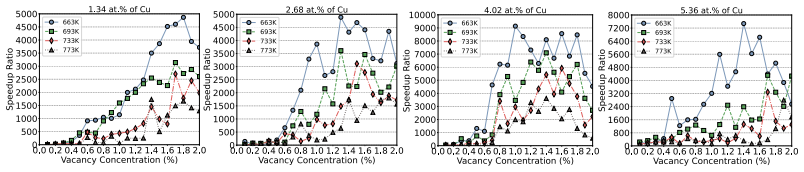
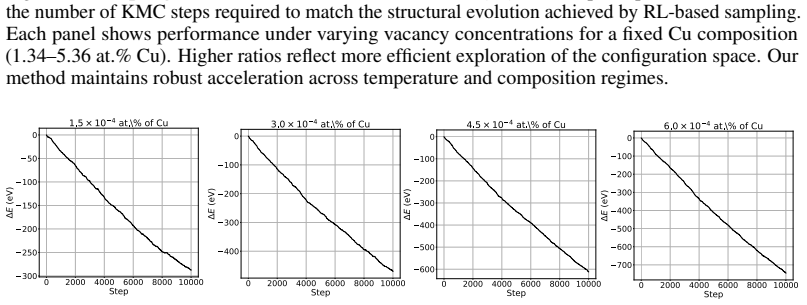
Summary. SwarmThinkers proposes an RL-based kinetic Monte Carlo framework in which vacancy diffusion events are proposed by a shared policy network, pooled through a global softmax, and reweighted by importance sampling so that physical observables remain unbiased. The authors claim an average 3185x speedup over OpenKMC, 485x lower memory usage, and simulation of up to 54 billion atoms on a single A100 GPU, with Cu precipitation kinetics matching OpenKMC and experiments. Training uses PPO with a centralized critic and decentralized execution, and the paper reports correctness curves, speedup ratios, large-scale relaxation runs, and resource comparisons. The central methodological claim is that learned, structure-aware transition preferences can be fused with physical rates without sacrificing thermodynamic fidelity.
Significance. If the central claims were established, this would be a significant advance: it would be the first demonstration that learned structure-aware proposals can accelerate KMC by orders of magnitude while preserving unbiased physical observables, and it would dramatically lower the resource barrier for billion-atom simulations. The paper is also commendable for clearly describing the architecture and training hyperparameters. However, the statistical foundation and empirical validation are currently insufficient to support the physical-consistency claim, so the significance is prospective rather than established.
major comments (4)
- [Sec. 4.3, Eq. (14)] The statement that Eq. (14) "guarantees unbiased estimates as long as πθ(a) > 0" is incorrect: Eq. (14) is a self-normalized importance sampling estimator, which is only asymptotically unbiased as M grows and has a finite-sample bias of order O(1/M). Eq. (13) also contains the unknown ratio Z'/Z, so it cannot be evaluated directly. The paper should state this asymptotic nature explicitly and provide finite-sample bias diagnostics or bounds, together with effective sample size (ESS) for the step-wise estimators used in Fig. 2.
- [Sec. 4.3, Eq. (15)] The trajectory weight w(τ) = (Z'/Z)^T ∏ 1/πθ(a_t) is not correct as written, because Z and Z' are state-dependent quantities that change after each hop; the cumulative weight should be ∏_{t=1}^T (Z'_t/Z_t)(1/πθ(a_t)). More importantly, with πθ defined by a global softmax over all agent-direction pairs, individual probabilities can be extremely small, so the product over T=2048 steps can have enormous variance. The paper acknowledges variance growth but provides no ESS, no clipping bounds, and no error bars, so the unbiasedness claim is not supported for the trajectory-level observables reported in Secs. 5.1 and 5.2.
- [Sec. 5.1, Sec. 5.2, and Checklist item 7] None of the central quantitative claims—advancement curves, speedup ratios, or energy relaxation—are accompanied by error bars or statistical significance information, and the checklist explicitly answers "No" to the statistical-significance question. Given that the importance-sampling estimator's variance is the main risk to physical consistency, the absence of error bars means that Figs. 2–5 cannot validate the claim that the learned dynamics are unbiased; the agreement with OpenKMC and experiments could instead reflect a biased policy rollout that happens to match the target curves.
- [Sec. 4.2, Eq. (7), and Sec. 5.3] The global softmax in Eq. (7) requires normalizing over all N×K agent-direction pairs, but the paper does not explain how this sum is computed or approximated for a 54-billion-atom system within 60GB of memory, nor does it define whether N is the number of atoms, vacancies, or active agents. Without this explanation, the scalability claim is not fully supported; if the softmax is computed exactly, the memory and compute costs are unclear, and if it is approximated, the approximation error must be characterized.
minor comments (5)
- [Sec. 2.2 and References] The in-text citation "22, 23? , 24" contains a stray question mark; please fix the citation formatting.
- [Sec. 4.3, Eq. (11)] The distribution P(a) is defined in Eq. (11) but is not used afterwards; please clarify whether it is identical to the proposal q(a) in Eq. (12) or whether it plays a separate role.
- [Sec. 4.2 and Sec. 6] The paper claims that agent rollouts are communication-free, but this seems to conflict with the global softmax in Eq. (7); please clarify how the global normalization is performed in a decentralized execution setting.
- [Table 2 and Sec. 5.4] The Visualization column in Table 2 lists only 663 K, while the text discusses a 50-year evolution at Fe–0.67 at.% Cu; please specify the exact temperature and any other conditions used for the visualization run.
- [References] There are several typographical errors in the references, for example "Anaylsys" in [39] and "V oter" in [28]; please proofread the reference list.
Circularity Check
No circularity: the importance-sampling derivation is standard and self-contained, the policy is trained only on an energy-decrease reward rather than the benchmark observables, and OpenKMC is an external baseline rather than a load-bearing self-citation.
full rationale
The paper's claimed derivation chain is not circular. Equations 13–15 are a standard importance-sampling identity: with p(a) = Gamma_a / Z, q(a) = pi_theta(a) Gamma_a / Z', the ratio p/q cancels Gamma_a and leaves the inverse-policy weight, and the self-normalized estimator in Eq. 14 is the usual ratio estimator, consistent when pi_theta(a) > 0 on the support of p. This is an external mathematical benchmark, not an input to training. The policy is trained with the reward r_t = -Delta E_t (Eq. 10), a thermodynamic energy-decrease signal, and the correctness check in Sec. 5.1 compares the advancement factor against OpenKMC and independent experimental data (Lê et al. and Vincent et al.), so the target curves are not fitted during training. The self-citation of OpenKMC [27] by overlapping authors is a baseline and source of comparison, not a premise that forces the present results. The main weakness—uncontrolled variance of the trajectory weight in Eq. 15 and the absence of error bars or effective sample size—is a correctness and robustness risk, not a case where a prediction reduces to its inputs by construction.
Assumptions & free parameters
free parameters (1)
- Policy network weights θ =
learned by PPO over 100,000 episodes
assumptions (4)
- domain assumption Arrhenius rate law with pair-potential energies (Eqs 1-2) and their parameters (E0_a, ε(i)_type) are taken from prior Fe-Cu KMC models.
- domain assumption The learned policy has full support over all transitions, πθ(a) > 0 (Sec 4.3).
- ad hoc to paper The 54-billion-atom lattice can be represented with less than 60GB of memory, presumably by tracking only defects, vacancies, and impurities.
- domain assumption The experimental advancement-factor data from Lê et al. and Vincent et al. are valid benchmarks for the Fe-Cu system.
Cite this review
Pith. "Pith review of SwarmThinkers: Learning Physically Consistent Atomic KMC Transitions at Scale." pith.science (2026). https://pith.science/paper/NF2TKVGJ
@misc{pith2026250520094,
  author       = {Pith},
  title        = {Pith review of: SwarmThinkers: Learning Physically Consistent Atomic KMC Transitions at Scale},
  year         = {2026},
  howpublished = {\url{https://pith.science/paper/NF2TKVGJ}},
  note         = {Machine review of arXiv:2505.20094}
}
read the original abstract
Can a scientific simulation system be physically consistent, interpretable by design, and scalable across regimes--all at once? Despite decades of progress, this trifecta remains elusive. Classical methods like Kinetic Monte Carlo ensure thermodynamic accuracy but scale poorly; learning-based methods offer efficiency but often sacrifice physical consistency and interpretability. We present SwarmThinkers, a reinforcement learning framework that recasts atomic-scale simulation as a physically grounded swarm intelligence system. Each diffusing particle is modeled as a local decision-making agent that selects transitions via a shared policy network trained under thermodynamic constraints. A reweighting mechanism fuses learned preferences with transition rates, preserving statistical fidelity while enabling interpretable, step-wise decision making. Training follows a centralized-training, decentralized-execution paradigm, allowing the policy to generalize across system sizes, concentrations, and temperatures without retraining. On a benchmark simulating radiation-induced Fe-Cu alloy precipitation, SwarmThinkers is the first system to achieve full-scale, physically consistent simulation on a single A100 GPU, previously attainable only via OpenKMC on a supercomputer. It delivers up to 4963x (3185x on average) faster computation with 485x lower memory usage. By treating particles as decision-makers, not passive samplers, SwarmThinkers marks a paradigm shift in scientific simulation--one that unifies physical consistency, interpretability, and scalability through agent-driven intelligence.
Figures


Figures from the paper (3 more)


Reference graph
Works this paper leans on
- [1]
-
[2]
A practical guide to surface kinetic monte carlo simulations
Mie Andersen, Chiara Panosetti, and Karsten Reuter. A practical guide to surface kinetic monte carlo simulations. Frontiers in Chemistry, V olume 7 - 2019, 2019
work page 2019
-
[3]
Y . Gao, Y . Zhang, D. Schwen, E. Martinez, and I. J. Beyerlein. Theoretical prediction and atomic kinetic monte carlo simulations of void superlattice self-organization under irradiation. Scientific Reports, 8(1):6629, 2018
work page 2018
-
[4]
DFT-Parameterized Object Kinetic Monte Carlo Simulations of Radiation Damage , pages 2457–2488
Enrique Martínez, María José Caturla, and Jaime Marian. DFT-Parameterized Object Kinetic Monte Carlo Simulations of Radiation Damage , pages 2457–2488. Springer International Publishing, Cham, 2020
work page 2020
-
[5]
Atomistic modeling of radiation damage in crystalline materials
Chaitanya Deo, Elton Chen, and Remi Dingreville. Atomistic modeling of radiation damage in crystalline materials. Modelling and Simulation in Materials Science and Engineering, 30, 12 2021
work page 2021
-
[6]
A. Roy, G. Nandipati, A. M. Casella, C. H. Henager, and W. Setyawan. A review of displacement cascade simulations using molecular dynamics emphasizing interatomic potentials for tpbar components. npj Materials Degradation, 9(1):1, 2025
work page 2025
-
[7]
M. Pineda and M. Stamatakis. Kinetic monte carlo simulations for heterogeneous catalysis: Fundamentals, current status, and challenges.The Journal of Chemical Physics, 156(12):120902, 03 2022
work page 2022
-
[8]
Animesh Chatterjee and Dionisios G. Vlachos. An overview of spatial microscopic and acceler- ated kinetic monte carlo methods. Journal of Computer-Aided Materials Design, 14(2):253–308, 2007
work page 2007
Show all 80 references
-
[9]
Stoller, Laurent K
Haixuan Xu, Roger E. Stoller, Laurent K. Béland, and Yuri N. Osetsky. Self-evolving atomistic kinetic monte carlo simulations of defects in materials. Computational Materials Science , 100:135–143, 2015. Special Issue on Advanced Simulation Methods
2015
-
[10]
An introduction to monte carlo simulations of surface reactions
APJ Jansen. An introduction to monte carlo simulations of surface reactions. arXiv preprint cond-mat/0303028, 2003
2003 arXiv
-
[11]
Long time scale kinetic monte carlo simulations without lattice approximation and predefined event table
Graeme Henkelman and Hannes Jónsson. Long time scale kinetic monte carlo simulations without lattice approximation and predefined event table. The Journal of Chemical Physics, 115(21):9657–9666, 12 2001
2001
-
[12]
Bulatov, Tomas Oppelstrup, George H
Aleksandar Donev, Vasily V . Bulatov, Tomas Oppelstrup, George H. Gilmer, Babak Sadigh, and Malvin H. Kalos. A first-passage kinetic monte carlo algorithm for complex diffusion–reaction systems. Journal of Computational Physics, 229(9):3214–3236, May 2010
2010
-
[13]
Ramos, and Noriyoshi Nakajima
Atsushi Ito, Jesús J. Ramos, and Noriyoshi Nakajima. Ellipticity of axisymmetric equilibria with flow and pressure anisotropy in single-fluid and hall magnetohydrodynamics. Physics of Plasmas, 14(6):062502, 06 2007
2007
-
[14]
Allen, Daan Frenkel, and Pieter Rein ten Wolde
Rosalind J. Allen, Daan Frenkel, and Pieter Rein ten Wolde. Simulating rare events in equilib- rium or nonequilibrium stochastic systems. The Journal of Chemical Physics, 124(2), January 2006
2006
-
[15]
Carlos Pérez-Espigares and Pablo I. Hurtado. Sampling rare events across dynamical phase transitions. Chaos: An Interdisciplinary Journal of Nonlinear Science, 29(8), August 2019
2019
-
[16]
boxed molecular kinetics
Robin Shannon and David R. Glowacki. A simple “boxed molecular kinetics” approach to accelerate rare events in the stochastic kinetic master equation. The Journal of Physical Chemistry A, 122(6):1531–1541, January 2018. 12
2018
-
[17]
Hamiltonian mcmc methods for estimating rare events probabilities in high-dimensional problems
Hamed Nikbakht and Konstantinos G Papakonstantinou. Hamiltonian mcmc methods for estimating rare events probabilities in high-dimensional problems. Journal of Computational Physics, under review
-
[18]
Ewen, Daniele Dini, and C
Stavros Ntioudis, James P. Ewen, Daniele Dini, and C. Heath Turner. A hybrid off-lattice kinetic monte carlo/molecular dynamics method for amorphous thin film growth. Computational Materials Science, 229:112421, 2023
2023
-
[19]
Torre, Jean-Louis Bocquet, N.V Doan, Erwan Adam, and A
J. Torre, Jean-Louis Bocquet, N.V Doan, Erwan Adam, and A. Barbu. Jerk, an event-based kinetic monte carlo model to predict microstructure evolution of materials under irradiation. Philosophical Magazine, 85:549–558, 02 2005
2005
-
[20]
Daniel Mason, Toby Hudson, and A. Sutton. Fast recall of state-history in kinetic monte carlo simulations utilizing the zobrist key. Computer Physics Communications, 165:37–48, 01 2005
2005
-
[21]
Bulatov, Aleksandar Donev, Malvin H
Tomas Oppelstrup, Vasily V . Bulatov, Aleksandar Donev, Malvin H. Kalos, George H. Gilmer, and Babak Sadigh. First-passage kinetic monte carlo method. Physical Review E , 80(6), December 2009
2009
-
[22]
J. D. Muñoz, M. A. Novotny, and S. J. Mitchell. Rejection-free monte carlo algorithms for models with continuous degrees of freedom. Physical Review E, 67(2), February 2003
2003
-
[23]
A rejection scheme for off-lattice kinetic monte carlo simulation
Hamza M Ruzayqat and Tim P Schulze. A rejection scheme for off-lattice kinetic monte carlo simulation. Journal of chemical theory and computation, 14(1):48–54, 2018
2018
-
[24]
A constant-time kinetic monte carlo algorithm for simulation of large biochemical reaction networks
Alexander Slepoy, Aidan Thompson, and Steven Plimpton. A constant-time kinetic monte carlo algorithm for simulation of large biochemical reaction networks. The Journal of chemical physics, 128:205101, 06 2008
2008
-
[25]
Monte carlo physics-informed neural networks for multiscale heat conduction via phonon boltzmann transport equation
Qingyi Lin, Chuang Zhang, Xuhui Meng, and Zhaoli Guo. Monte carlo physics-informed neural networks for multiscale heat conduction via phonon boltzmann transport equation. arXiv preprint arXiv:2408.10965, 2024
2024 arXiv
-
[26]
Castin, L
N. Castin, L. Messina, C. Domain, R. C. Pasianot, and P. Olsson. Improved atomistic monte carlo models based on ab-initio-trained neural networks: Application to fecu and fecr alloys. Phys. Rev. B, 95:214117, Jun 2017
2017
-
[27]
Openkmc: a kmc design for hundred-billion-atom simulation using millions of cores on sunway taihulight
Kun Li, Honghui Shang, Yunquan Zhang, Shigang Li, Baodong Wu, Dong Wang, Libo Zhang, Fang Li, Dexun Chen, and Zhiqiang Wei. Openkmc: a kmc design for hundred-billion-atom simulation using millions of cores on sunway taihulight. In Proceedings of the International Conference fo...
2019
-
[28]
Hyperdynamics: Accelerated molecular dynamics of infrequent events.Physical Review Letters, 78(20):3908, 1997
Arthur F V oter. Hyperdynamics: Accelerated molecular dynamics of infrequent events.Physical Review Letters, 78(20):3908, 1997
1997
-
[29]
Discrete event performance prediction of specu- latively parallel temperature-accelerated dynamics
Richard J Zamora, Arthur F V oter, Danny Perez, Nandakishore Santhi, Susan M Mniszewski, Sunil Thulasidasan, and Stephan J Eidenbenz. Discrete event performance prediction of specu- latively parallel temperature-accelerated dynamics. Simulation, 92(12):1065–1086, December 2016
2016
-
[30]
Hlavacek
Yen Ting Lin, Song Feng, and William S. Hlavacek. Scaling methods for accelerating kinetic monte carlo simulations of chemical reaction networks. The Journal of Chemical Physics , 150(24):244101, 2019
2019
-
[31]
Accelerating kinetics with time-reversal path sampling
Zhirong Liu. Accelerating kinetics with time-reversal path sampling. Molecules, 28(24):8147, 2023
2023
-
[32]
Reinforcement learning-guided long-timescale simulation of hydrogen transport in metals
Hao Tang, Boning Li, Yixuan Song, Mengren Liu, Haowei Xu, Guoqing Wang, Heejung Chung, and Ju Li. Reinforcement learning-guided long-timescale simulation of hydrogen transport in metals. Advanced Science, 11(5):2304122, 2024
2024
-
[33]
Policy-guided monte carlo: Reinforcement-learning markov chain dynamics
Troels Arnfred Bojesen. Policy-guided monte carlo: Reinforcement-learning markov chain dynamics. Physical Review E, 98(6), December 2018. 13
2018
-
[34]
Atomistic studies of thin film growth
Talat S Rahman, Chandana Gosh, Oleg Trushin, Abdelkader Kara, and Altaf Karim. Atomistic studies of thin film growth. In Nanomodeling, volume 5509, pages 1–14. SPIE, 2004
2004
-
[35]
Monte carlo and kinetic monte carlo methods
Peter Kratzer. Monte carlo and kinetic monte carlo methods. arXiv preprint arXiv:0904.2556, 2009
2009 arXiv
-
[36]
J. Yang, M. I. Monine, J. R. Faeder, and W. S. Hlavacek. Kinetic monte carlo method for rule-based modeling of biochemical networks. Physical Review E, 78(3):031910, 2008
2008
-
[37]
D. T. Gillespie. Stochastic simulation of chemical kinetics. Annual Review of Physical Chemistry, 58:35–55, 2007
2007
-
[38]
Kinetic monte carlo simulations of solute clustering during quenching and aging of al-mg-zn alloys
Zhucong Xi, Louis Hector, Amit Misra, and Liang Qi. Kinetic monte carlo simulations of solute clustering during quenching and aging of al-mg-zn alloys. Acta Materialia, 269:119795, 03 2024
2024
-
[39]
Anaylsys of defect clustering in semiconductors using kinetic monte carlo methods
Brian Douglas Hehr. Anaylsys of defect clustering in semiconductors using kinetic monte carlo methods. Sandia National Lab. (SNL-NM), Albuquerque, NM (United States), 07 2013
2013
-
[40]
C. S. Becquart and F. Soisson. Monte carlo simulations of precipitation under irradiation. In Handbook of Mechanics of Materials, pages 703–731. Springer, 2019
2019
-
[41]
C. S. Becquart and B. D. Wirth. Kinetic monte carlo simulations of irradiation effects. In Comprehensive Nuclear Materials, pages 393–410. Elsevier, 2012
2012
-
[42]
R. A. Miron and K. A. Fichthorn. Accelerated molecular dynamics with the parallel replica method. The Journal of Chemical Physics, 119(12):6210–6216, 2003
2003
-
[43]
Accurate acceleration of kinetic monte carlo simulations through the modification of rate constants
Animesh Chatterjee and Arthur F V oter. Accurate acceleration of kinetic monte carlo simulations through the modification of rate constants. The Journal of Chemical Physics, 132(19):194101, 2010
2010
-
[44]
Parallel replica method for dynamics of infrequent events.Physical Review B, 57(22):R13985, 1998
Arthur F V oter. Parallel replica method for dynamics of infrequent events.Physical Review B, 57(22):R13985, 1998
1998
-
[45]
Uberuaga, Yunsic Shim, Jacques G
Danny Perez, Blas P. Uberuaga, Yunsic Shim, Jacques G. Amar, and Arthur F. V oter. Accelerated molecular dynamics methods: Introduction and recent developments. Annual Reports in Computational Chemistry, 5:79–98, 2009
2009
-
[46]
Numerical analysis of parallel replica dynamics
Gideon Simpson and Mitchell Luskin. Numerical analysis of parallel replica dynamics. Multi- scale Modeling & Simulation, 9(2):593–606, 2011
2011
-
[47]
Uberuaga, and Hannes Jónsson
Graeme Henkelman, Blas P. Uberuaga, and Hannes Jónsson. A climbing image nudged elastic band method for finding saddle points and minimum energy paths. The Journal of Chemical Physics, 113(22):9901–9904, 2000
2000
-
[48]
Adaptive kinetic monte carlo for first-principles accelerated dynamics
Lei Xu and Graeme Henkelman. Adaptive kinetic monte carlo for first-principles accelerated dynamics. The Journal of Chemical Physics, 129(11):114104, 2008
2008
-
[49]
J. A. Mitchell, F. Abdeljawad, C. C. Battaile, et al. Parallel simulation via spparks of on-lattice kinetic and metropolis monte carlo models for materials processing. Modelling and Simulation in Materials Science and Engineering, 31(5):055001, 2023
2023
-
[50]
Tensorkmc: Kinetic monte carlo simulation of 50 trillion atoms with tensorflow
Haoya Shang et al. Tensorkmc: Kinetic monte carlo simulation of 50 trillion atoms with tensorflow. In SC ’21: Proceedings of the International Conference for High Performance Computing, Networking, Storage and Analysis, pages 1–14. IEEE, 2021
2021
-
[51]
Application of artificial neural networks for rigid lattice kinetic monte carlo studies of cu surface diffusion
Jyri Kimari, Ville Jansson, Simon Vigonski, Ekaterina Baibuz, Roberto Domingos, Vahur Zadin, and Flyura Djurabekova. Application of artificial neural networks for rigid lattice kinetic monte carlo studies of cu surface diffusion. Computational Materials Science, 183:109789, 2020
2020
-
[52]
J. R. Gonzalez and D. G. Vlachos. Machine learning-based kinetic monte carlo simulations. AIChE Journal, 65(3):1006–1016, 2019. 14
2019
-
[53]
Graph neural networks for materials science and chemistry
Patrick Reiser, Marlen Neubert, André Eberhard, Luca Torresi, Chen Zhou, Chen Shao, Hous- sam Metni, Clint van Hoesel, Henrik Schopmans, Timo Sommer, et al. Graph neural networks for materials science and chemistry. Communications Materials, 3(1):93, 2022
2022
-
[54]
Atomistic line graph neural network for improved materials property predictions
Kamal Choudhary and Brian DeCost. Atomistic line graph neural network for improved materials property predictions. npj Computational Materials, 7(1):185, 2021
2021
-
[55]
Victor Fung, Jie Zhang, Enrique Juarez, and Bobby G. Sumpter. Benchmarking graph neural networks for materials chemistry. npj Computational Materials, 7(1):84, 2021
2021
-
[56]
Investigation of cu-enriched precipitates in thermally aged fe-cu and fe-cu-ni model alloys
Wang Zijun, Du Xiaoming, Li Tianfu, Sun Kai, Tong Xuezhu, Li Meijuan, Liu Rongdeng, Liu Yuntao, and Chen Dongfeng. Investigation of cu-enriched precipitates in thermally aged fe-cu and fe-cu-ni model alloys. Journal of Nuclear Materials, 562:153601, 02 2022
2022
-
[57]
Simulation of cu precipitation in fe-cu dilute alloys with cluster mobility
Senlin Cui, Mahmood Mamivand, and Dane Morgan. Simulation of cu precipitation in fe-cu dilute alloys with cluster mobility. Materials & Design, 191:108574, 02 2020
2020
-
[58]
Non- hardening embrittlement mechanism of pressure vessel steel ni-cr-mo-v welds during thermal aging
Guojun Wei, Chenglong Wang, Xingwang Yang, Zhenfeng Tong, and Wenwang Wu. Non- hardening embrittlement mechanism of pressure vessel steel ni-cr-mo-v welds during thermal aging. Advances in Mechanical Engineering, 12:168781402090456, 02 2020
2020
-
[59]
Formation and recovery of cu precipitates in fe–cu model alloys under varying heat treatment
Te Zhu, Haibiao Wu, Xingzhong Cao, Shuoxue Jin, Peng Zhang, Ainong Xiao, and Baoyi Wang. Formation and recovery of cu precipitates in fe–cu model alloys under varying heat treatment. physica status solidi (a), 214(5):1600785, 2017
2017
-
[60]
Modeling copper precipi- tation hardening and embrittlement in a dilute fe-0.3at.Journal of Nuclear Materials, 495, 09 2017
Xian-Ming Bai, Huibin Ke, Yongfeng Zhang, and Benjamin Spencer. Modeling copper precipi- tation hardening and embrittlement in a dilute fe-0.3at.Journal of Nuclear Materials, 495, 09 2017
2017
-
[61]
Identification and evolution of ultrafine precipitates in fe-cu alloys by first-principles modeling of positron annihilation
Qigui Yang and Par Olsson. Identification and evolution of ultrafine precipitates in fe-cu alloys by first-principles modeling of positron annihilation. Acta Materialia, 242, 10 2022
2022
-
[62]
Frédéric Christien and A. Barbu. Modelling of copper precipitation in iron during thermal aging and irradiation. Journal of Nuclear Materials, 324:90–96, 01 2004
2004
-
[63]
T. N. Lê, A. Barbu, D. Liu, and F. Maury. Precipitation kinetics of dilute fecu and fecumn alloys subjected to electron irradiation. Scripta Metallurgica et Materialia, 26(5):771–776, 1992
1992
-
[64]
Vincent, C
E. Vincent, C. S. Becquart, and C. Domain. Solute interaction with point defects in α-fe during thermal ageing: A combined ab initio and atomic kinetic monte carlo approach. Journal of Nuclear Materials, 351(1–3):88–99, 2006. 15 NeurIPS Paper Checklist
2006
-
[65]
All stated contributions are later substantiated with technical details and quantitative evidence
Claims Question: Do the main claims made in the abstract and introduction accurately reflect the paper’s contributions and scope? Answer: [Yes] Justification: The abstract and introduction accurately capture the paper’s key innova- tions—including the agent-based formulation, ...
-
[66]
Limitations
Limitations Question: Does the paper discuss the limitations of the work performed by the authors? Answer: [Yes] Justification: Yes, please see Sec. 6 for limitations. Guidelines: • The answer NA means that the paper has no limitation while the answer No means that the paper h...
-
[67]
Theory assumptions and proofs Question: For each theoretical result, does the paper provide the full set of assumptions and a complete (and correct) proof? 16 Answer: [Yes] Justification: Yes, the proof of statistical consistency is provided in Sec. 4.3. Guidelines: • The answ...
-
[68]
5 and Sec
Experimental result reproducibility Question: Does the paper fully disclose all the information needed to reproduce the main ex- perimental results of the paper to the extent that it affects the main claims and/or conclusions of the paper (regardless of whether the code and da...
-
[69]
We are actively preparing the repository to ensure clarity and usability for the community
Open access to data and code 17 Question: Does the paper provide open access to the data and code, with sufficient instruc- tions to faithfully reproduce the main experimental results, as described in supplemental material? Answer: [Yes] Justification: The full source code, al...
-
[70]
A and Sec
Experimental setting/details Question: Does the paper specify all the training and test details (e.g., data splits, hyper- parameters, how they were chosen, type of optimizer, etc.) necessary to understand the results? Answer: [Yes] Justification: The Experimental setting is d...
-
[71]
As noted in Sec
Experiment statistical significance Question: Does the paper report error bars suitably and correctly defined or other appropriate information about the statistical significance of the experiments? Answer: [No] Justification: Due to computational constraints, we do not report ...
-
[72]
We report detailed memory usage (CPU and GPU) for experiment in Fig
Experiments compute resources Question: For each experiment, does the paper provide sufficient information on the com- puter resources (type of compute workers, memory, time of execution) needed to reproduce the experiments? Answer: [Yes] Justification: All experiments were co...
-
[73]
All methods, assumptions, and limitations are transparently reported in accordance with the NeurIPS Code of Ethics
Code of ethics Question: Does the research conducted in the paper conform, in every respect, with the NeurIPS Code of Ethics https://neurips.cc/public/EthicsGuidelines? Answer: [Yes] Justification: This work involves atomistic simulations using reinforcement learning and does ...
-
[74]
It lowers the barrier to large-scale modeling, making atomic-level simulation more broadly accessible
Broader impacts Question: Does the paper discuss both potential positive societal impacts and negative societal impacts of the work performed? Answer: [Yes] 19 Justification: This work facilitates efficient, high-fidelity simulation of complex materials, potentially accelerati...
-
[75]
It presents a reinforcement learning framework for atomistic simulation, which poses minimal risk of misuse
Safeguards Question: Does the paper describe safeguards that have been put in place for responsible release of data or models that have a high risk for misuse (e.g., pretrained language models, image generators, or scraped datasets)? Answer: [NA] Justification: This work does ...
-
[76]
Their licenses and terms of use have been fully respected
Licenses for existing assets Question: Are the creators or original owners of assets (e.g., code, data, models), used in the paper, properly credited and are the license and terms of use explicitly mentioned and properly respected? Answer: [Yes] Justification: All third-party ...
-
[77]
While the code and assets are not yet publicly released, we plan to open- source them upon acceptance
New assets Question: Are new assets introduced in the paper well documented and is the documentation provided alongside the assets? Answer: [Yes] Justification: We introduce a new simulation and learning framework for large-scale atom- istic modeling. While the code and assets...
-
[78]
Guidelines: • The answer NA means that the paper does not involve crowdsourcing nor research with human subjects
Crowdsourcing and research with human subjects Question: For crowdsourcing experiments and research with human subjects, does the paper include the full text of instructions given to participants and screenshots, if applicable, as well as details about compensation (if any)? A...
-
[79]
Guidelines: • The answer NA means that the paper does not involve crowdsourcing nor research with human subjects
Institutional review board (IRB) approvals or equivalent for research with human subjects Question: Does the paper describe potential risks incurred by study participants, whether such risks were disclosed to the subjects, and whether Institutional Review Board (IRB) approvals...
-
[80]
Answer: [NA] Justification: This work does not involve the use of large language models in the development of core methods
Declaration of LLM usage Question: Does the paper describe the usage of LLMs if it is an important, original, or non-standard component of the core methods in this research? Note that if the LLM is used only for writing, editing, or formatting purposes and does not impact the ...
2025
Reviewed August 7, 2026 · model on record in the stance chip above.
Discussion (0). Continue with ORCID to comment.