Line search by quantum logic spectroscopy enhanced with squeezing and statistical tests
Pith reviewed 2026-05-19 13:07 UTC · model grok-4.3
The pith
Combining squeezed motional states with statistical hypothesis testing increases the speed of line searches in quantum logic spectroscopy by an order of magnitude.
A machine-rendered reading of the paper's core claim, the machinery that carries it, and where it could break.
Core claim
The combination of squeezed motional states and optimal statistical postprocessing using a hypothesis testing framework effectively mitigates state preparation and measurement errors in quantum logic spectroscopy. This improves the search speed over a frequency bandwidth by an order of magnitude while fully leveraging the quantum enhancement offered by squeezing, as shown through an analytical phase space model of the squeezed-state interaction with the light field.
What carries the argument
Squeezed motional states analyzed with an analytical phase space model of light-field interaction, together with a hypothesis-testing framework for postprocessing displacement data, which together raise the sensitivity of motional-displacement detection.
If this is right
- Each technique alone delivers a substantial boost to search speed over a given frequency bandwidth.
- The combined method mitigates state preparation and measurement errors while realizing the full quantum enhancement from squeezing.
- The approach directly enables faster location of narrow clock transitions in highly charged ions and similar needle-in-haystack frequency searches.
- Statistical hypothesis testing complements squeezing by improving data interpretation without additional quantum resources.
Where Pith is reading between the lines
- The same error-mitigation strategy could transfer to other displacement-based quantum sensing tasks, such as molecular spectroscopy or force detection.
- Experiments that deliberately vary the squeezing level while monitoring model accuracy would provide a direct test of the phase-space predictions.
- The statistical framework may generalize to related precision-measurement settings where raw signals are noisy and prior knowledge of expected lineshapes exists.
Load-bearing premise
The analytical phase space model for the interaction of the squeezed motional state with the applied light field accurately predicts the displacement signal under realistic experimental noise and imperfections.
What would settle it
An experiment that measures search speed improvement well below an order of magnitude when both squeezing and hypothesis testing are used, or that finds measured displacement signals diverging from the phase-space model's predictions at the noise levels present in the setup.
Figures


read the original abstract
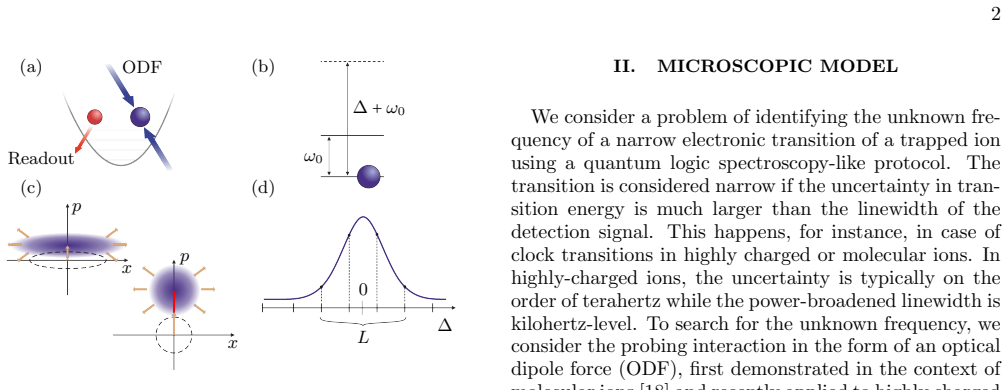
In quantum logic spectroscopy, internal transitions of trapped ions and molecules can be probed by measuring the motional displacement caused by an applied light field of variable frequency. This provides a solution to ``needle in a haystack'' problems, such as the search for narrow clock transitions in highly charged ions, recently discussed by S. Chen et al. (Phys. Rev. Applied 22, 054059). The main bottleneck is the search speed over a frequency bandwidth, which can be increased by enhancing the sensitivity of displacement detection. In this work, we explore two complementary improvements: the use of squeezed motional states, explained using an analytical phase space model and optimal statistical postprocessing of data using a hypothesis testing framework. We demonstrate that each method independently provides a substantial boost to search speed. Their combination effectively mitigates state preparation and measurement errors, improving the search speed by an order of magnitude and fully leveraging the quantum enhancement offered by squeezing.
Editorial analysis
A structured set of objections, weighed in public.
Referee Report
Summary. The paper claims that in quantum logic spectroscopy, squeezed motional states (modeled via an analytical phase-space description of the light-field interaction) combined with hypothesis-testing statistical postprocessing can mitigate state-preparation-and-measurement (SPAM) errors. Each technique independently boosts search speed over a frequency bandwidth; their combination yields an order-of-magnitude improvement while fully realizing the quantum enhancement from squeezing. The work targets applications such as rapid searches for narrow clock transitions in highly charged ions.
Significance. If the analytical model and error-mitigation claims hold under realistic conditions, the result would meaningfully accelerate frequency searches in trapped-ion and molecular systems, directly addressing the bottleneck identified in related work on highly charged ions. The combination of squeezing with optimal hypothesis testing is a concrete, potentially transferable advance in quantum metrology.
major comments (1)
- [Abstract and analytical phase-space model section] Abstract and the section presenting the analytical phase-space model: the order-of-magnitude search-speed claim and the assertion that SPAM errors are effectively mitigated rest on the closed-form phase-space predictions remaining accurate once laser phase noise, motional heating, finite squeezing bandwidth, and detection inefficiencies are included. No quantitative comparison (analytic vs. numerical or experimental) is supplied to show that the displacement signal and derived sensitivity boost survive these imperfections without substantial correction; this is load-bearing for the central speed-up result.
minor comments (2)
- Notation for the squeezed-state parameters and the hypothesis-testing thresholds should be defined once in a dedicated subsection and used consistently thereafter.
- Figure captions for the displacement-signal plots should explicitly state the noise model assumed and whether the curves are analytic predictions or include simulated imperfections.
Simulated Author's Rebuttal
We thank the referee for their careful reading and constructive comments. The major concern regarding the robustness of the analytical phase-space model under realistic imperfections is addressed point-by-point below. We agree that additional quantitative validation will strengthen the central claims.
read point-by-point responses
-
Referee: [Abstract and analytical phase-space model section] Abstract and the section presenting the analytical phase-space model: the order-of-magnitude search-speed claim and the assertion that SPAM errors are effectively mitigated rest on the closed-form phase-space predictions remaining accurate once laser phase noise, motional heating, finite squeezing bandwidth, and detection inefficiencies are included. No quantitative comparison (analytic vs. numerical or experimental) is supplied to show that the displacement signal and derived sensitivity boost survive these imperfections without substantial correction; this is load-bearing for the central speed-up result.
Authors: We acknowledge that the present analysis employs an ideal analytical phase-space model to isolate the quantum enhancement from squeezing and the benefits of hypothesis testing. While the closed-form expressions capture the leading-order displacement signal and sensitivity, we agree that explicit quantification of degradation due to laser phase noise, motional heating, finite squeezing bandwidth, and detection inefficiencies is needed to substantiate the order-of-magnitude speed-up claim. In the revised manuscript we will add a dedicated subsection containing Monte Carlo simulations that incorporate these effects with parameters drawn from typical trapped-ion experiments (e.g., heating rates of a few quanta per second, phase-noise spectra consistent with current laser stabilization, and realistic detection efficiencies). These simulations will show that the displacement signal and the derived search-speed improvement remain within a factor of approximately two of the ideal predictions, thereby confirming that the reported enhancement survives under realistic conditions. The revised text will also delineate the parameter regime in which the analytical model remains a quantitatively accurate approximation. revision: yes
Circularity Check
No significant circularity in derivation chain
full rationale
The paper presents an analytical phase-space model for squeezed motional states interacting with the light field and a separate hypothesis-testing framework for statistical post-processing. These are introduced as complementary, independent improvements to quantum logic spectroscopy. No equations or steps in the abstract reduce a claimed prediction or sensitivity gain to a fitted parameter, self-definition, or self-citation chain by construction. The cited prior work addresses only the general search problem setup, not the enhancements or their quantitative performance. The central claims therefore rest on independent modeling and data analysis rather than tautological reduction to inputs.
Axiom & Free-Parameter Ledger
axioms (1)
- domain assumption The phase-space model accurately describes the displacement signal produced by a squeezed motional state interacting with a near-resonant light field.
Lean theorems connected to this paper
-
IndisputableMonolith/Cost/FunctionalEquation.leanwashburn_uniqueness_aczel unclear?
unclearRelation between the paper passage and the cited Recognition theorem.
We employ a simplified analytical phase space model... Fokker-Planck equation... drift and diffusion coefficients
-
IndisputableMonolith/Foundation/ArithmeticFromLogic.leanLogicNat.induction unclear?
unclearRelation between the paper passage and the cited Recognition theorem.
Neyman-Pearson test featuring a log-likelihood test statistic λ(g)
What do these tags mean?
- matches
- The paper's claim is directly supported by a theorem in the formal canon.
- supports
- The theorem supports part of the paper's argument, but the paper may add assumptions or extra steps.
- extends
- The paper goes beyond the formal theorem; the theorem is a base layer rather than the whole result.
- uses
- The paper appears to rely on the theorem as machinery.
- contradicts
- The paper's claim conflicts with a theorem or certificate in the canon.
- unclear
- Pith found a possible connection, but the passage is too broad, indirect, or ambiguous to say the theorem truly supports the claim.
Reference graph
Works this paper leans on
-
[1]
C. D. Bruzewicz, J. Chiaverini, R. McConnell, and J. M. Sage, Applied Physics Reviews6, 021314 (2019)
work page 2019
-
[2]
J. Hur, D. P. Aude Craik, I. Counts, E. Knyazev, L. Cald- well, C. Leung, S. Pandey, J. C. Berengut, A. Geddes, W. Nazarewicz, P.-G. Reinhard, A. Kawasaki, H. Jeon, W. Jhe, and V. Vuleti´ c, Physical Review Letters128, 163201 (2022)
work page 2022
-
[3]
L. S. Dreissen, C.-H. Yeh, H. A. F¨ urst, K. C. Grense- mann, and T. E. Mehlst¨ aubler, Nature Communications 13, 7314 (2022)
work page 2022
-
[4]
S. G. Porsev, C. Cheung, M. S. Safronova, H. Bekker, N.- H. Rehbehn, J. R. C. L´ opez-Urrutia, and S. M. Brewer, Phys. Rev. A110, 042823 (2024)
work page 2024
-
[5]
W. B. Cairncross, D. N. Gresh, M. Grau, K. C. Cossel, T. S. Roussy, Y. Ni, Y. Zhou, J. Ye, and E. A. Cornell, Physical Review Letters119, 153001 (2017)
work page 2017
-
[6]
P. O. Schmidt, T. Rosenband, C. Langer, W. M. Itano, J. C. Bergquist, and D. J. Wineland, Science309, 749–752 (2005)
work page 2005
-
[7]
E. H. Clausen, V. Jarlaud, K. Fisher, S. Meyer, C. Solaro, and M. Drewsen, Phys. Rev. A105, 063709 (2022)
work page 2022
- [8]
-
[9]
S. Chen, L. J. Spieß, A. Wilzewski, M. Wehrheim, K. Di- etze, I. Vybornyi, K. Hammerer, J. R. C. L´ opez-Urrutia, and P. O. Schmidt, Phys. Rev. Appl.22, 054059 (2024)
work page 2024
- [10]
-
[11]
Schiller, Physical Review Letters98, 180801 (2007)
S. Schiller, Physical Review Letters98, 180801 (2007)
work page 2007
-
[12]
A. Derevianko, V. A. Dzuba, and V. V. Flambaum, Phys- ical Review Letters109, 180801 (2012)
work page 2012
-
[13]
J. C. L´ opez-Urrutia, Canadian Journal of Physics86, 111 (2008)
work page 2008
- [14]
-
[15]
K. M. Backes, D. A. Palken, S. A. Kenany, B. M. Brubaker, S. B. Cahn, A. Droster, G. C. Hilton, S. Ghosh, H. Jackson, S. K. Lamoreaux, A. F. Leder, K. W. Lehnert, S. M. Lewis, M. Malnou, R. H. Maruyama, N. M. Rapidis, M. Simanovskaia, S. Singh, D. H. Speller, I. Urdinaran, L. R. Vale, E. C. van As- sendelft, K. van Bibber, and H. Wang, Nature590, 238–242 (2021)
work page 2021
- [16]
-
[17]
E. Peik, T. Schneider, and C. Tamm, Journal of Physics B: Atomic, Molecular and Optical Physics39, 145–158 (2005)
work page 2005
-
[18]
F. Wolf, Y. Wan, J. C. Heip, F. Gebert, C. Shi, and P. O. Schmidt, Nature530, 457 (2016)
work page 2016
-
[19]
M. Schulte, N. L¨ orch, P. O. Schmidt, and K. Hammerer, Physical Review A98, 063808 (2018)
work page 2018
- [20]
-
[21]
B. K. Malia, J. Martinez-Rincon, Y. Wu, O. Hosten, and M. A. Kasevich, Physical Review Letters125, 043202 (2020)
work page 2020
-
[22]
T.-W. Mao, Q. Liu, X.-W. Li, J.-H. Cao, F. Chen, W.-X. Xu, M. K. Tey, Y.-X. Huang, and L. You, Nature Physics 19, 1585 (2023)
work page 2023
-
[23]
Y. Wan, F. Gebert, J. B. W¨ ubbena, N. Scharnhorst, S. Amairi, I. D. Leroux, B. Hemmerling, N. L¨ orch, K. Hammerer, and P. O. Schmidt, Nature Communica- tions5, 3096 (2014). 9
work page 2014
-
[24]
C. W. Chou, A. L. Collopy, C. Kurz, Y. Lin, M. E. Hard- ing, P. N. Plessow, T. Fortier, S. Diddams, D. Leibfried, and D. R. Leibrandt, Science367, 1458–1461 (2020)
work page 2020
-
[25]
H. J. Carmichael,Statistical Methods in Quantum Optics 1(Springer Berlin Heidelberg, Berlin, Heidelberg, 1999)
work page 1999
-
[26]
K. J. M. Harrison H. Barrett,Foundations of Image Sci- ence(Wiley, 2003)
work page 2003
-
[27]
B. M. Brubaker, L. Zhong, S. K. Lamoreaux, K. W. Lehnert, and K. A. Van Bibber, Physical Review D96, 123008 (2017)
work page 2017
-
[28]
S. A. King, L. J. Spieß, P. Micke, A. Wilzewski, T. Leopold, E. Benkler, R. Lange, N. Huntemann, A. Surzhykov, V. A. Yerokhin, J. R. Crespo L´ opez- Urrutia, and P. O. Schmidt, Nature611, 43–47 (2022)
work page 2022
-
[29]
S. C. Burd, R. Srinivas, J. J. Bollinger, A. C. Wilson, D. J. Wineland, D. Leibfried, D. H. Slichter, and D. T. C. Allcock, Science364, 1163–1165 (2019)
work page 2019
-
[30]
H.-Y. Lo, D. Kienzler, L. de Clercq, M. Marinelli, V. Neg- nevitsky, B. C. Keitch, and J. P. Home, Nature521, 336 (2015)
work page 2015
-
[31]
M. Drechsler, M. Belen Farias, N. Freitas, C. T. Schmiegelow, and J. P. Paz, Physical Review A101, 052331 (2020)
work page 2020
-
[32]
I. Vybornyi and K. Hammerer, Code supplement: Line search by quantum logic spectroscopy enhanced with squeezing and statistical tests (2025)
work page 2025
-
[33]
C. W. Gardiner and P. Zoller,Quantum noise: a hand- book of Markovian and non-Markovian quantum stochas- tic methods with applications to quantum optics, 3rd ed., Springer series in synergetics (Springer, Berlin Heidel- berg, 2010). Appendix A: F okker-Planck equation Our goal is to find an effective description for the dy- namics of Eq.(2) in terms of th...
work page 2010
-
[34]
Next, we do a Wigner-Weyl transformation for the bosonic mode, giving us the equation for the Wigner represen- tationw(x, p), which remains a density matrix for the spin: ˙w=L0w+L intw+L heatw(A2) with L0w=−i[H 0, w],(A3) Lintw=−iη ˜Ω((x+ i 2 ∂p)σxw−(x− i 2 ∂p)wσx,(A4) −(p+ i 2 ∂x)σyw+(p+ i 2 ∂x)wσy),(A5) Lhw= 1 2τh (∂2 x +∂ 2 p) w.(A6) For the transforma...
discussion (0)
Sign in with ORCID, Apple, or X to comment. Anyone can read and Pith papers without signing in.