REVIEW 2 major objections 5 minor 1 cited by
FMEnets: Flow, Material, and Energy networks for non-ideal plug flow reactor design
T0 review · 2 major / 5 minor · reviewed 2026-08-15 · deepseek-v4-flash
Pith's one-line read Three coupled physics networks predict reactor fields from inlet-outlet data and infer activation energy to within 2.5 percent.
desk verdict A useful sequential multi-network architecture for reactor design, undermined by a written FEM weak form that is inconsistent with the strong form, so the reported error numbers lack a trustworthy reference. read the letter →
The pith
A machine-rendered reading of the paper's core claim, the machinery that carries it, and where it could break.
The reading
What carries the argument
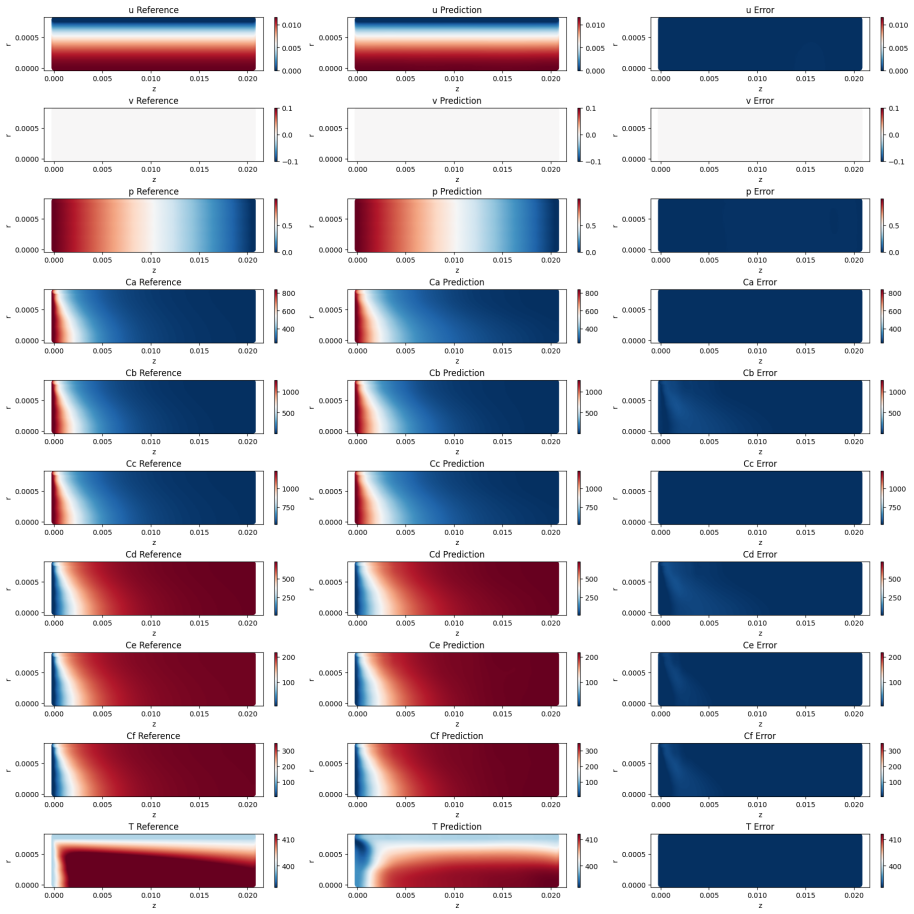
The load-bearing object is the FMEnets architecture itself: three neural networks chained in sequence, in which NN1 solves the axisymmetric steady Navier–Stokes equations for the velocity field, NN2 uses that velocity to enforce the material balance for each species concentration, and NN3 uses both to enforce the energy balance for temperature. Training runs in two stages, with NN1 trained alone for 30,000 iterations and then frozen while NN2 and NN3 train, so coupling variables propagate downstream only after the flow is learned. Each sub-network may be a multilayer perceptron (FME-PINNs) or a Chebyshev Kolmogorov–Arnold network (FME-KANs), and the equations are non-dimensionalized through Reynolds, mass-transfer Péclet, and thermal Péclet numbers. Supporting mechanisms include exact Dirichlet boundary conditions via approximate distance functions, weight normalization, and residual-based attention weights that balance per-point loss contributions; the ablation study singles out the FME structure and the attention weights as the components whose removal most damages accuracy.
What would settle it
Measure outlet concentrations and temperatures from a physical isothermal-bath plug flow reactor whose activation energy is independently known, run the inverse FMEnets on those data, and compare the inferred activation energy to the known value; if the deviation exceeds the reported roughly 2.5 percent, or if retesting against a substantially finer finite element mesh changes the reported errors, the claimed accuracy is an artifact of training and testing on the same simulated solver.
Extended reading notes
Core claim
The central claim, stated on the paper's own terms, is that coupling the Navier–Stokes, material balance, and energy balance equations through three interconnected sub-networks with independent optimizers is the decisive design choice: a single network trained on all residuals at once fails, while the sequential FME structure succeeds. In forward mode, trained on only inlet and outlet information, FME-PINNs reproduce velocity and pressure to within about 1 percent relative error, species concentrations to within 0.99–7.95 percent, and temperature to within 1.7 percent across a two-component, a three-component sequential, and a six-component parallel reaction system. In inverse mode, outlet data from quarter-, half-, and full-length reactors let the same architecture infer unknown activation energies with relative errors under 2.5 percent while simultaneously predicting concentration and temperature fields. The paper further claims that the FME-KAN variant matches FME-PINN accuracy while tolerating injected measurement noise better, holding state-variable errors below about 6 percent even at 10 percent noise. The ablation study is offered as proof of the architecture's necessity: removing the FME structure entirely raises concentration errors to hundreds of percent, and removing residual-based attention weighting also degrades accuracy substantially.
Load-bearing premise
The load-bearing premise is that the finite element simulations used as ground truth represent the real reactor: all reported errors are measured against FEniCS solutions of the same PDE system, and Section 3.4 states that simulated data stand in for experimental data in this proof-of-concept, so if the governing equations or discretization diverge from physical reality, every accuracy number in the paper would fail to reflect real reactor behavior.
Editorial extensions
If this is right
- Forward reactor design problems could be solved from inlet and outlet measurements alone, replacing repeated finite element solves with a trained surrogate for rapid iteration and optimization.
- Unknown kinetic parameters, particularly activation energy, could be estimated from sparse multi-residence-time outlet measurements, addressing reactions whose kinetics are not yet established, a common situation in pharmaceutical process development.
- Process data carrying up to 10 percent measurement noise would favor the KAN implementation, which holds state-variable errors below about 6 percent while the MLP variant degrades more sharply.
- Because each physical sub-problem is trained and frozen separately, adding new species or reactions means extending the material-balance sub-network while leaving the flow solver untouched.
Reading between the lines
- Editorial inference: every accuracy number is measured against finite element solutions of the same PDE model, so the reported errors certify how faithfully the network fits that model, not how faithfully the model describes a physical reactor; agreement with real experimental data is the untested next step.
- Editorial inference: the frozen-network sequencing implies each block could be swapped independently, say replacing the flow sub-network with an empirical pressure-drop correlation or a different surrogate, without retraining the full stack, a modularity the paper gestures at but does not demonstrate.
- Editorial inference: using quarter-, half-, and full-length reactor outlets as surrogate interior data is a general recipe that should transfer to other tubular equipment, such as fixed-bed or monolithic reactors, whenever a residence-time series can be sampled.
- Editorial inference: a direct test of the 2.5 percent inverse-error claim would push beyond the tested configurations, with fewer measurement locations, higher noise, or a six-component inverse problem, to see where the error begins to climb.
Signed reviews
Editorial analysis
A structured set of objections, weighed in public.
Referee Report
Summary. This manuscript proposes FMEnets, a modular physics-informed machine-learning framework for steady-state non-adiabatic plug-flow reactors. Three sequentially trained subnetworks enforce the Navier-Stokes, species material-balance, and energy-balance equations in an axisymmetric (r,z) domain; each subnetwork can be an MLP (FME-PINNs) or a Chebyshev KAN (FME-KANs). In forward mode the model is trained with PDE residuals, boundary conditions, and sparse inlet/outlet concentration data; in inverse mode it additionally uses sparse simulated multi-residence-time outlet measurements to infer the activation energy Ea. Results are reported for three reaction systems against FEniCS finite-element solutions, together with noise-robustness experiments and ablations. The central quantitative claim is that relative L2 errors for state variables are mostly a few percent and that inferred Ea errors remain below 2.5%.
Significance. If the results hold, the sequential decomposition into flow, material, and energy subnetworks is a practically useful surrogate for reactor CFD and a plausible template for kinetic-parameter inference from sparse measurements. The ablation study (Table 4) gives useful evidence that the multi-network decomposition, rather than the PINN or KAN representation alone, is responsible for accuracy, and the noise-robustness comparison in Figure 8 is a valuable datapoint for practitioners. A notable strength is that the paper explicitly acknowledges the proof-of-concept nature of using simulated data instead of experiment. However, every reported accuracy number depends on the FEniCS reference solutions reproducing the written governing equations, and the manuscript provides no code or data; the validation is therefore only as strong as the written numerical formulation.
major comments (2)
- [Section 3.5, Eqs. (16)-(18)] The weak form written in Eqs. (16)-(18) is not the weak form of the strong form in Eq. (4). In Eq. (4) the radial term (1/r)∂C/∂r appears only as part of the axisymmetric Laplacian multiplied by -1/Pe, whereas Eq. (16) adds a separate term ∫Ω (1/r)(∂C/∂r)φ dΩ with coefficient +1 alongside -(1/Pe)∫Ω ΔC φ dΩ. If ΔC denotes the Cartesian Laplacian ∂²C/∂r²+∂²C/∂z², the diffusive operator in the weak form becomes -(1/Pe)(∂²C/∂r²+∂²C/∂z²)+(1/r)∂C/∂r, which is not the operator in Eq. (4); if ΔC denotes the cylindrical Laplacian, the term (1/r)∂C/∂r is counted twice with inconsistent coefficients. The integration by parts in Eq. (17) leaves this term untouched, so the form is not a valid variational formulation under either the Cartesian measure dΩ=dr dz or the cylindrical measure r dr dz. Because every L2 error in Tables 1-3 and every Ea error is evaluated against FEniCS solutions obtained from Eq. (18), the central accuracy claim is unsupported unless the FEniCS implementation differs from the written form; the authors must either provide the corrected weak form or release the actual code so the reference solver can be verified.
- [Section 3.1.2, Chebyshev KAN recurrence] The Chebyshev recurrence is stated as T_n(ζ)=2ζT_{n-1}(ζ)+T_{n-2}(ζ), but the standard three-term recurrence is T_n(ζ)=2ζT_{n-1}(ζ)-T_{n-2}(ζ). With the plus sign, T_2(ζ)=2ζ²+1, which is not a Chebyshev polynomial. Since FME-KANs are a central contribution and the paper claims that cKANs are numerically stable, this written definition must be corrected or the implementation clarified for the KAN results to be reproducible.
minor comments (5)
- [Abstract and Section 1] The phrase 'using only inlet and outlet information' overstates the forward setup: the forward model also enforces PDE residuals and boundary conditions throughout the domain, with inlet/outlet data as an additional constraint; please rephrase to avoid implying a data-only input-output map.
- [Section 3.1.1, Eq. (8)] The residual eα(x_i,θ)=|αhat(x_i)-α(x_i,θ)| is a sensible definition for boundary and data losses, but for PDE residuals the target αhat is zero; this convention should be stated explicitly, since Eq. (8) currently reads as if every loss term has a nonzero target field.
- [Section 3.4] The claim that this is the 'first attempt to recover kinetic parameters in reactive flow systems using the physics-informed machine learning model' is too strong given the existing inverse-PINN literature on reacting flows cited in Section 1.1; please moderate the novelty claim.
- [Table 4 caption] The caption 'single-component ablation study of the three-component reaction system' is confusing; the table reports ablations on the three-component system, not a single-component system, and should be reworded.
- [Section 3.5, Eq. (16)] The symbol r is used both for the radial coordinate and for the reaction-rate term in Eq. (16), making the last integral ambiguous; use a distinct symbol such as R_i for the reaction contribution.
Circularity Check
No circularity in the FMEnets derivation: the inverse Ea is a parameter-recovery benchmark, the forward residuals are trained against standard PDEs plus boundary data, and the FEM comparison is an independent (though possibly flawed) numerical reference.
full rationale
No load-bearing step in the paper reduces to its own input. The forward problem trains separate networks on residuals of the non-dimensional Navier-Stokes, material-balance, and energy-balance equations (Eqs. 1-5) together with inlet/outlet boundary data, then compares against FEniCS solutions; this is a normal surrogate-validation setup, not a derivation of the answer from the answer. The inverse 'prediction' of Ea is presented as inference from sparse multi-residence-time data (Section 3.4: 'we use simulated data instead of experimental data to conduct a proof-of-concept'), so the <2.5% error is a standard parameter-recovery result on a synthetic benchmark, not a fitted input renamed as a prediction. Self-citations to prior group work (e.g., [51] for Chebyshev KANs, [56] for RBA, [77] for sequential training) supply implementation building blocks and are not load-bearing for the central FMEnets claim. One correctness risk, distinct from circularity: the written FEM weak form in Section 3.5, Eqs. (16)-(18), is inconsistent with the strong form Eq. (4): the (1/r)∂C/∂r term appears with the wrong coefficient/sign, and the claimed integration by parts leaves that term unchanged ('We now perform integration by parts to the third term of Equation 16 and obtain ... + ∫_Ω (1/r) ∂C_h/∂r φ dΩ'), so the FEniCS reference is only trustworthy if the implemented code corrects this; the manuscript does not provide the code or a corrected derivation. This weakens the support for the error tables but does not constitute circularity.
Assumptions & free parameters
free parameters (1)
- activation energy E_a =
ground truth 40230 J/mol; inferred with 1.198% and 2.112% relative error in inverse cases
assumptions (5)
- domain assumption The reactor is axisymmetric with fully developed steady laminar Newtonian flow; fluid properties are constant and species are dilute.
- domain assumption Arrhenius kinetics with known pre-exponential factors and unknown activation energy govern all reactions.
- domain assumption Finite element solutions with 120,000 quadratic elements and tight solver tolerances are accurate references.
- domain assumption Multi-residence-time outlet measurements at quarter, half, and full reactor lengths suffice to identify E_a.
- standard math Kolmogorov-Arnold representation theorem and universal approximation guarantee network expressiveness.
Cite this review
Pith. "Pith review of FMEnets: Flow, Material, and Energy networks for non-ideal plug flow reactor design." pith.science (2026). https://pith.science/paper/K2GQL3ZF
@misc{pith2026250520300,
  author       = {Pith},
  title        = {Pith review of: FMEnets: Flow, Material, and Energy networks for non-ideal plug flow reactor design},
  year         = {2026},
  howpublished = {\url{https://pith.science/paper/K2GQL3ZF}},
  note         = {Machine review of arXiv:2505.20300}
}
read the original abstract
We propose FMEnets, a physics-informed machine learning framework for the design and analysis of non-ideal plug flow reactors. FMEnets integrates the fundamental governing equations (Navier-Stokes for fluid flow, material balance for reactive species transport, and energy balance for temperature distribution) into a unified multi-scale network model. The framework is composed of three interconnected sub-networks with independent optimizers that enable both forward and inverse problem-solving. In the forward mode, FMEnets predicts velocity, pressure, species concentrations, and temperature profiles using only inlet and outlet information. In the inverse mode, FMEnets utilizes sparse multi-residence-time measurements to simultaneously infer unknown kinetic parameters and states. FMEnets can be implemented either as FME-PINNs, which employ conventional multilayer perceptrons, or as FME-KANs, based on Kolmogorov-Arnold Networks. Comprehensive ablation studies highlight the critical role of the FMEnets architecture in achieving accurate predictions. Specifically, FME-KANs are more robust to noise than FME-PINNs, although both representations are comparable in accuracy and speed in noise-free conditions. The proposed framework is applied to three different sets of reaction scenarios and is compared with finite element simulations. FMEnets effectively captures the complex interactions, achieving relative errors less than 2.5% for the unknown kinetic parameters. The new network framework not only provides a computationally efficient alternative for reactor design and optimization, but also opens new avenues for integrating empirical correlations, limited and noisy experimental data, and fundamental physical equations to guide reactor design.
Figures


Figures from the paper (5 more)



Forward citations
Cited by 1 Pith paper
-
ATHENA: Agentic Team for Hierarchical Evolutionary Numerical Algorithms
ATHENA introduces an agentic team framework that autonomously manages the end-to-end computational research lifecycle via a knowledge-driven HENA loop to achieve validation errors of 10^{-14} in scientific computing a...
Reference graph
Works this paper leans on
-
[1]
Systematic design of chemical reactors with multiple stages via multi-objective optimization approach
Mohd Nazri Mohd Fuad and Mohd Azlan Hussain. Systematic design of chemical reactors with multiple stages via multi-objective optimization approach. In Computer Aided Chemical Engineering, volume 37, pages 869–874. Elsevier, 2015
2015
-
[2]
Fundamentals of green chemistry: efficiency in reaction design
Roger A Sheldon. Fundamentals of green chemistry: efficiency in reaction design. Chemical Society Reviews, 41(4):1437–1451, 2012
work page 2012
-
[3]
Chemical reactor analysis and design
Gilbert F Froment. Chemical reactor analysis and design . 1979
work page 1979
-
[4]
Chemical engineering design: principles, practice and eco- nomics of plant and process design
Gavin Towler and Ray Sinnott. Chemical engineering design: principles, practice and eco- nomics of plant and process design . Butterworth-Heinemann, 2021
work page 2021
-
[5]
Thermal safety of chemical processes: risk assessment and process design
Francis Stoessel. Thermal safety of chemical processes: risk assessment and process design . John Wiley & Sons, 2021. 23
work page 2021
-
[6]
Essentials of chemical reaction engineering: essenti chemica reactio engi
H Scott Fogler. Essentials of chemical reaction engineering: essenti chemica reactio engi . Pearson education, 2010
work page 2010
-
[7]
Li-Tao Zhu, Xi-Zhong Chen, Bo Ouyang, Wei-Cheng Yan, He Lei, Zhe Chen, and Zheng-Hong Luo. Review of machine learning for hydrodynamics, transport, and reactions in multiphase flows and reactors. Industrial & Engineering Chemistry Research , 61(28):9901–9949, 2022
work page 2022
-
[8]
Advances of machine learning in molecular modeling and simulation
Mojtaba Haghighatlari and Johannes Hachmann. Advances of machine learning in molecular modeling and simulation. Current Opinion in Chemical Engineering , 23:51–57, 2019
work page 2019
Show all 81 references
-
[9]
The appli- cation of physics-informed machine learning in multiphysics modeling in chemical engineering
Zhiyong Wu, Huan Wang, Chang He, Bingjian Zhang, Tao Xu, and Qinglin Chen. The appli- cation of physics-informed machine learning in multiphysics modeling in chemical engineering. Industrial & Engineering Chemistry Research , 62(44):18178–18204, 2023
2023
-
[10]
Combining cfd and ai/ml modeling to improve the performance of polypropy- lene fluidized bed reactors
Nayef Ghasem. Combining cfd and ai/ml modeling to improve the performance of polypropy- lene fluidized bed reactors. Fluids, 9(12):298, 2024
2024
-
[11]
Analysis and predic- tion of hematocrit in microvascular networks
Guansheng Li, Ting Ye, Zehong Xia, Sitong Wang, and Ziwei Zhu. Analysis and predic- tion of hematocrit in microvascular networks. International Journal of Engineering Science , 191:103901, 2023
2023
-
[12]
Laplace neural operator for solving differential equations
Qianying Cao, Somdatta Goswami, and George Em Karniadakis. Laplace neural operator for solving differential equations. Nature Machine Intelligence , 6(6):631–640, 2024
2024
-
[13]
Learning the solution operator of para- metric partial differential equations with physics-informed deeponets
Sifan Wang, Hanwen Wang, and Paris Perdikaris. Learning the solution operator of para- metric partial differential equations with physics-informed deeponets. Science advances , 7(40):eabi8605, 2021
2021
-
[14]
Physics-informed machine learning
George Em Karniadakis, Ioannis G Kevrekidis, Lu Lu, Paris Perdikaris, Sifan Wang, and Liu Yang. Physics-informed machine learning. Nature Reviews Physics, 3(6):422–440, 2021
2021
-
[15]
Physics-informed neural networks: A deep learning framework for solving forward and inverse problems involving nonlinear partial differential equations
Maziar Raissi, Paris Perdikaris, and George E Karniadakis. Physics-informed neural networks: A deep learning framework for solving forward and inverse problems involving nonlinear partial differential equations. Journal of Computational physics , 378:686–707, 2019
2019
-
[16]
Deepxde: A deep learning library for solving differential equations
Lu Lu, Xuhui Meng, Zhiping Mao, and George Em Karniadakis. Deepxde: A deep learning library for solving differential equations. SIAM review, 63(1):208–228, 2021
2021
-
[17]
Scientific machine learning through physics–informed neural networks: Where we are and what’s next
Salvatore Cuomo, Vincenzo Schiano Di Cola, Fabio Giampaolo, Gianluigi Rozza, Maziar Raissi, and Francesco Piccialli. Scientific machine learning through physics–informed neural networks: Where we are and what’s next. Journal of Scientific Computing , 92(3):88, 2022
2022
-
[18]
From pinns to pikans: Recent advances in physics-informed machine learning
Juan Diego Toscano, Vivek Oommen, Alan John Varghese, Zongren Zou, Nazanin Ah- madi Daryakenari, Chenxi Wu, and George Em Karniadakis. From pinns to pikans: Recent advances in physics-informed machine learning. Machine Learning for Computational Science and Engineering, 1(1):1...
2025
-
[19]
Physics-informed machine learning: A survey on problems, methods and applications
Zhongkai Hao, Songming Liu, Yichi Zhang, Chengyang Ying, Yao Feng, Hang Su, and Jun Zhu. Physics-informed machine learning: A survey on problems, methods and applications. arXiv preprint arXiv:2211.08064 , 2022
2022 arXiv
-
[20]
Physics-informed neural networks for inverse problems in nano-optics and metamaterials
Yuyao Chen, Lu Lu, George Em Karniadakis, and Luca Dal Negro. Physics-informed neural networks for inverse problems in nano-optics and metamaterials. Optics express, 28(8):11618– 11633, 2020. 24
2020
-
[21]
Modeling finite-strain plasticity using physics-informed neural network and assessment of the network performance
Sijun Niu, Enrui Zhang, Yuri Bazilevs, and Vikas Srivastava. Modeling finite-strain plasticity using physics-informed neural network and assessment of the network performance. Journal of the Mechanics and Physics of Solids , 172:105177, 2023
2023
-
[22]
Hidden fluid mechanics: Learning velocity and pressure fields from flow visualizations
Maziar Raissi, Alireza Yazdani, and George Em Karniadakis. Hidden fluid mechanics: Learning velocity and pressure fields from flow visualizations. Science, 367(6481):1026–1030, 2020
2020
-
[23]
Physics-informed neural networks (pinns) for fluid mechanics: A review
Shengze Cai, Zhiping Mao, Zhicheng Wang, Minglang Yin, and George Em Karniadakis. Physics-informed neural networks (pinns) for fluid mechanics: A review. Acta Mechanica Sinica, 37(12):1727–1738, 2021
2021
-
[24]
Artificial to spiking neural networks conversion for scientific machine learning
Qian Zhang, Chenxi Wu, Adar Kahana, Youngeun Kim, Yuhang Li, George Em Karniadakis, and Priyadarshini Panda. Artificial to spiking neural networks conversion for scientific machine learning. arXiv preprint arXiv:2308.16372 , 2023
2023 arXiv
-
[25]
A review of physics- informed machine learning in fluid mechanics
Pushan Sharma, Wai Tong Chung, Bassem Akoush, and Matthias Ihme. A review of physics- informed machine learning in fluid mechanics. Energies, 16(5):2343, 2023
2023
-
[26]
Systems biology informed deep learning for inferring parameters and hidden dynamics
Alireza Yazdani, Lu Lu, Maziar Raissi, and George Em Karniadakis. Systems biology informed deep learning for inferring parameters and hidden dynamics. PLoS computational biology , 16(11):e1007575, 2020
2020
-
[27]
Systems biology: Iden- tifiability analysis and parameter identification via systems-biology-informed neural networks
Mitchell Daneker, Zhen Zhang, George Em Karniadakis, and Lu Lu. Systems biology: Iden- tifiability analysis and parameter identification via systems-biology-informed neural networks. In Computational Modeling of Signaling Networks , pages 87–105. Springer, 2023
2023
-
[28]
Investigating molecular transport in the human brain from mri with physics-informed neural networks
Bastian Zapf, Johannes Haubner, Miroslav Kuchta, Geir Ringstad, Per Kristian Eide, and Kent-Andre Mardal. Investigating molecular transport in the human brain from mri with physics-informed neural networks. Scientific Reports, 12(1):15475, 2022
2022
-
[29]
Physics-informed neural networks with hard constraints for inverse design
Lu Lu, Raphael Pestourie, Wenjie Yao, Zhicheng Wang, Francesc Verdugo, and Steven G Johnson. Physics-informed neural networks with hard constraints for inverse design. SIAM Journal on Scientific Computing , 43(6):B1105–B1132, 2021
2021
-
[30]
Digital twin of optical networks: a review of recent advances and future trends
Danshi Wang, Yuchen Song, Yao Zhang, Xiaotian Jiang, Jiawei Dong, Faisal Nadeem Khan, Takeo Sasai, Shanguo Huang, Alan Pak Tao Lau, Massimo Tornatore, et al. Digital twin of optical networks: a review of recent advances and future trends. Journal of Lightwave Technology, 2024
2024
-
[31]
Data-driven physics-informed neural networks: A digital twin perspective
Sunwoong Yang, Hojin Kim, Yoonpyo Hong, Kwanjung Yee, Romit Maulik, and Namwoo Kang. Data-driven physics-informed neural networks: A digital twin perspective. Computer Methods in Applied Mechanics and Engineering , 428:117075, 2024
2024
-
[32]
Self-adaptive physics-driven deep learning for seismic wave modeling in complex topography
Yi Ding, Su Chen, Xiaojun Li, Suyang Wang, Shaokai Luan, and Hao Sun. Self-adaptive physics-driven deep learning for seismic wave modeling in complex topography. Engineering Applications of Artificial Intelligence , 123:106425, 2023
2023
-
[33]
Optimal temperature trajectory for tubular reactor using physics informed neural networks
Rahul Patel, Sharad Bhartiya, and Ravindra Gudi. Optimal temperature trajectory for tubular reactor using physics informed neural networks. Journal of Process Control, 128:103003, 2023
2023
-
[34]
Data-driven discovery of reaction kinetic models in dynamic plug flow reactors using symbolic regression
Ben Cohen, Burcu Beykal, and George M Bollas. Data-driven discovery of reaction kinetic models in dynamic plug flow reactors using symbolic regression. In Computer Aided Chemical Engineering, volume 53, pages 2947–2952. Elsevier, 2024. 25
2024
-
[35]
Physics-informed deep learning for data-driven solutions of computational fluid dynamics
Solji Choi, Ikhwan Jung, Haeun Kim, Jonggeol Na, and Jong Min Lee. Physics-informed deep learning for data-driven solutions of computational fluid dynamics. Korean Journal of Chemical Engineering, 39(3):515–528, 2022
2022
-
[36]
Unit operation and process modeling with physics-informed machine learning
Haochen Li, David Spelman, and John Sansalone. Unit operation and process modeling with physics-informed machine learning. Journal of Environmental Engineering , 150(4):04024002, 2024
2024
-
[37]
Physics-informed neural networks for phase-field method in two-phase flow
Rundi Qiu, Renfang Huang, Yao Xiao, Jingzhu Wang, Zhen Zhang, Jieshun Yue, Zhong Zeng, and Yiwei Wang. Physics-informed neural networks for phase-field method in two-phase flow. Physics of Fluids , 34(5), 2022
2022
-
[38]
Physics-informed neural networks and time-series transformer for modeling of chemical reactors
Giacomo Lastrucci, Maximilian F Theisen, and Artur M Schweidtmann. Physics-informed neural networks and time-series transformer for modeling of chemical reactors. In Computer aided chemical engineering, volume 53, pages 571–576. Elsevier, 2024
2024
-
[39]
Physics-informed learning of chemical reactor systems using decoupling–coupling train- ing framework
Zhiyong Wu, Mingjian Li, Chang He, Bingjian Zhang, Jingzheng Ren, Haoshui Yu, and Qinglin Chen. Physics-informed learning of chemical reactor systems using decoupling–coupling train- ing framework. AIChE Journal, 70(7):e18436, 2024
2024
-
[40]
Physics informed neural network for forward and inverse multispecies contaminant transport with variable pa- rameters
Qingzhi Hou, Xiaolong Xu, Zewei Sun, Jianping Wang, and Vijay P Singh. Physics informed neural network for forward and inverse multispecies contaminant transport with variable pa- rameters. Journal of Hydrology, 655:132977, 2025
2025
-
[41]
A physics-informed neural net- work based simulation tool for reacting flow with multicomponent reactants
Zewei Sun, Honghan Du, Chunfu Miao, and Qingzhi Hou. A physics-informed neural net- work based simulation tool for reacting flow with multicomponent reactants. Advances in Engineering Software, 185:103525, 2023
2023
-
[42]
Physics-informed graph convolutional neural network for modeling fluid flow and heat con- vection
Jiang-Zhou Peng, Yue Hua, Yu-Bai Li, Zhi-Hua Chen, Wei-Tao Wu, and Nadine Aubry. Physics-informed graph convolutional neural network for modeling fluid flow and heat con- vection. Physics of Fluids , 35(8), 2023
2023
-
[43]
Simulation of multi-species flow and heat transfer using physics-informed neural networks
Ryno Laubscher. Simulation of multi-species flow and heat transfer using physics-informed neural networks. Physics of Fluids , 33(8), 2021
2021
-
[44]
Advancement of machine learning in materials science
P Rajendra, A Girisha, and T Gunavardhana Naidu. Advancement of machine learning in materials science. Materials Today: Proceedings, 62:5503–5507, 2022
2022
-
[45]
Machine learning for fluid mechanics
Steven L Brunton, Bernd R Noack, and Petros Koumoutsakos. Machine learning for fluid mechanics. Annual review of fluid mechanics , 52(1):477–508, 2020
2020
-
[46]
Machine learning in materials science
Jing Wei, Xuan Chu, Xiang-Yu Sun, Kun Xu, Hui-Xiong Deng, Jigen Chen, Zhongming Wei, and Ming Lei. Machine learning in materials science. InfoMat, 1(3):338–358, 2019
2019
-
[47]
Machine learning in medicine: a practical introduction
Jenni AM Sidey-Gibbons and Chris J Sidey-Gibbons. Machine learning in medicine: a practical introduction. BMC medical research methodology, 19:1–18, 2019
2019
-
[48]
Gpt vs human for scientific reviews: A dual source review on applications of chatgpt in science
Chenxi Wu, Alan John Varghese, Vivek Oommen, and George Em Karniadakis. Gpt vs human for scientific reviews: A dual source review on applications of chatgpt in science. Journal of Machine Learning for Modeling and Computing , 2023
2023
-
[49]
Forward physics-informed neural networks suitable for multiple operating conditions of catalytic co2 methanation isothermal fixed-bed
Son Ich Ngo and Young-Il Lim. Forward physics-informed neural networks suitable for multiple operating conditions of catalytic co2 methanation isothermal fixed-bed. IFAC-PapersOnLine, 55(7):429–434, 2022. 26
2022
-
[50]
¨Uber die reaktionsgeschwindigkeit bei der inversion von rohrzucker durch s¨ auren.Zeitschrift f¨ ur physikalische Chemie, 4(1):226–248, 1889
Svante Arrhenius. ¨Uber die reaktionsgeschwindigkeit bei der inversion von rohrzucker durch s¨ auren.Zeitschrift f¨ ur physikalische Chemie, 4(1):226–248, 1889
-
[51]
A comprehensive and fair comparison between mlp and kan representations for differential equations and operator networks
Khemraj Shukla, Juan Diego Toscano, Zhicheng Wang, Zongren Zou, and George Em Kar- niadakis. A comprehensive and fair comparison between mlp and kan representations for differential equations and operator networks. arXiv preprint arXiv:2406.02917 , 2024
2024 arXiv
-
[52]
Multilayer feedforward networks are universal approximators
Kurt Hornik, Maxwell Stinchcombe, and Halbert White. Multilayer feedforward networks are universal approximators. Neural Networks, 2(5):359–366, 1989
1989
-
[53]
Kan: Kolmogorov-arnold networks
Ziming Liu, Yixuan Wang, Sachin Vaidya, Fabian Ruehle, James Halverson, Marin Soljaˇ ci´ c, Thomas Y Hou, and Max Tegmark. Kan: Kolmogorov-arnold networks. arXiv preprint arXiv:2404.19756, 2024
2024 arXiv
-
[54]
Kkans: Kurkova- kolmogorov-arnold networks and their learning dynamics
Juan Diego Toscano, Li-Lian Wang, and George Em Karniadakis. Kkans: Kurkova- kolmogorov-arnold networks and their learning dynamics. arXiv preprint arXiv:2412.16738 , 2024
2024 arXiv
-
[55]
Weight normalization: A simple reparameterization to accelerate training of deep neural networks.Advances in neural information processing systems, 29, 2016
Tim Salimans and Durk P Kingma. Weight normalization: A simple reparameterization to accelerate training of deep neural networks.Advances in neural information processing systems, 29, 2016
2016
-
[56]
Residual-based attention in physics-informed neural networks.Computer Methods in Applied Mechanics and Engineering , 421:116805, 2024
Sokratis J Anagnostopoulos, Juan Diego Toscano, Nikolaos Stergiopulos, and George Em Karniadakis. Residual-based attention in physics-informed neural networks.Computer Methods in Applied Mechanics and Engineering , 421:116805, 2024
2024
-
[57]
A method for representing periodic functions and enforcing exactly periodic boundary conditions with deep neural networks
Suchuan Dong and Naxian Ni. A method for representing periodic functions and enforcing exactly periodic boundary conditions with deep neural networks. Journal of Computational Physics, 435:110242, 2021
2021
-
[58]
Understanding and mitigating gradient flow pathologies in physics-informed neural networks
Sifan Wang, Yujun Teng, and Paris Perdikaris. Understanding and mitigating gradient flow pathologies in physics-informed neural networks. SIAM Journal on Scientific Computing , 43(5):A3055–A3081, 2021
2021
-
[59]
A comparison study of deep galerkin method and deep ritz method for elliptic problems with different boundary conditions
Jingrun Chen, Rui Du, and Keke Wu. A comparison study of deep galerkin method and deep ritz method for elliptic problems with different boundary conditions. arXiv preprint arXiv:2005.04554, 2020
2005 arXiv
-
[60]
Exact imposition of boundary conditions with distance functions in physics-informed deep neural networks
N Sukumar and Ankit Srivastava. Exact imposition of boundary conditions with distance functions in physics-informed deep neural networks. Computer Methods in Applied Mechanics and Engineering, 389:114333, 2022
2022
-
[61]
Physics-informed neural networks for high-speed flows
Zhiping Mao, Ameya D Jagtap, and George Em Karniadakis. Physics-informed neural networks for high-speed flows. Computer Methods in Applied Mechanics and Engineering , 360:112789, 2020
2020
-
[62]
A comprehensive study of non-adaptive and residual-based adaptive sampling for physics-informed neural networks
Chenxi Wu, Min Zhu, Qinyang Tan, Yadhu Kartha, and Lu Lu. A comprehensive study of non-adaptive and residual-based adaptive sampling for physics-informed neural networks. Computer Methods in Applied Mechanics and Engineering , 403:115671, 2023
2023
-
[63]
Self-adaptive physics-informed neural networks
Levi D McClenny and Ulisses M Braga-Neto. Self-adaptive physics-informed neural networks. Journal of Computational Physics , 474:111722, 2023. 27
2023
-
[64]
Learning in PINNs: Phase transition, total diffusion, and generalization
Sokratis J Anagnostopoulos, Juan Diego Toscano, Nikolaos Stergiopulos, and George Em Karniadakis. Learning in PINNs: Phase transition, total diffusion, and generalization. arXiv preprint arXiv:2403.18494, 2024
2024 arXiv
-
[65]
Self-adaptive loss balanced physics-informed neural networks
Zixue Xiang, Wei Peng, Xu Liu, and Wen Yao. Self-adaptive loss balanced physics-informed neural networks. Neurocomputing, 496:11–34, 2022
2022
-
[66]
A dual-dimer method for training physics-constrained neural networks with minimax architecture
Dehao Liu and Yan Wang. A dual-dimer method for training physics-constrained neural networks with minimax architecture. Neural Networks, 136:112–125, 2021
2021
-
[67]
Investigating and mitigating failure modes in physics-informed neural networks (pinns)
Shamsulhaq Basir. Investigating and mitigating failure modes in physics-informed neural networks (pinns). arXiv preprint arXiv:2209.09988 , 2022
2022 arXiv
-
[68]
Respecting causality is all you need for training physics-informed neural networks
Sifan Wang, Shyam Sankaran, and Paris Perdikaris. Respecting causality is all you need for training physics-informed neural networks. arXiv preprint arXiv:2203.07404 , 2022
2022 arXiv
-
[69]
When and why PINNs fail to train: A neural tangent kernel perspective
Sifan Wang, Xinling Yu, and Paris Perdikaris. When and why PINNs fail to train: A neural tangent kernel perspective. Journal of Computational Physics , 449:110768, 2022
2022
-
[70]
Characterizing possible failure modes in physics-informed neural networks
Aditi Krishnapriyan, Amir Gholami, Shandian Zhe, Robert Kirby, and Michael W Mahoney. Characterizing possible failure modes in physics-informed neural networks. Advances in Neural Information Processing Systems, 34:26548–26560, 2021
2021
-
[71]
A Meshless Solver for Blood Flow Simula- tions in Elastic Vessels Using a Physics-Informed Neural Network
Han Zhang, Raymond H Chan, and Xue-Cheng Tai. A Meshless Solver for Blood Flow Simula- tions in Elastic Vessels Using a Physics-Informed Neural Network. SIAM Journal on Scientific Computing, 46(4):C479–C507, 2024
2024
-
[72]
An expert’s guide to training physics-informed neural networks
Sifan Wang, Shyam Sankaran, Hanwen Wang, and Paris Perdikaris. An expert’s guide to training physics-informed neural networks. arXiv preprint arXiv:2308.08468 , 2023
2023 arXiv
-
[73]
PirateNets: Physics-informed Deep Learning with Residual Adaptive Networks
Sifan Wang, Bowen Li, Yuhan Chen, and Paris Perdikaris. PirateNets: Physics-informed Deep Learning with Residual Adaptive Networks. arXiv preprint arXiv:2402.00326 , 2024
2024 arXiv
-
[74]
AI-Aristotle: A physics-informed framework for systems biology gray-box identification
Nazanin Ahmadi Daryakenari, Mario De Florio, Khemraj Shukla, and George Em Karniadakis. AI-Aristotle: A physics-informed framework for systems biology gray-box identification. PLOS Computational Biology, 20(3):e1011916, 2024
2024
-
[75]
Cminns: Compart- ment model informed neural networks—unlocking drug dynamics
Nazanin Ahmadi Daryakenari, Shupeng Wang, and George Karniadakis. Cminns: Compart- ment model informed neural networks—unlocking drug dynamics. Computers in Biology and Medicine, 184:109392, 2025
2025
-
[76]
Inferring in vivo murine cerebrospinal fluid flow using artificial intelligence velocimetry with moving boundaries and uncertainty quantification
Juan Diego Toscano, Chenxi Wu, Antonio Ladron-de Guevara, Ting Du, Maiken Nedergaard, Douglas H Kelley, George Em Karniadakis, and Kimberly Boster. Inferring in vivo murine cerebrospinal fluid flow using artificial intelligence velocimetry with moving boundaries and uncertaint...
2024
-
[77]
Inferring turbulent velocity and temperature fields and their statistics from Lagrangian velocity measurements using physics-informed Kolmogorov-Arnold Networks
Juan Diego Toscano, Theo K¨ aufer, Martin Maxey, Christian Cierpka, and George Em Karni- adakis. Inferring turbulent velocity and temperature fields and their statistics from Lagrangian velocity measurements using physics-informed Kolmogorov-Arnold Networks. arXiv preprint arX...
2024 arXiv
-
[78]
Challenges in training pinns: A loss landscape perspective
Pratik Rathore, Weimu Lei, Zachary Frangella, Lu Lu, and Madeleine Udell. Challenges in training pinns: A loss landscape perspective. arXiv preprint arXiv:2402.01868 , 2024. 28
2024 arXiv
-
[79]
M. S. Alnæs, J. Blechta, J. Hake, H. A. Johansen, and K. H. Karlsen. The fenics project version 1.5. Archives of Computational Methods in Engineering , 22(3):253–290, 2015
2015
-
[80]
Smith, Hong Zhang, et al
Barry F. Smith, Hong Zhang, et al. Petsc: Portable, extensible toolkit for scientific computa- tion. ACM Transactions on Mathematical Software , 32(3):669–702, 2006
2006
-
[81]
P. R. Amestoy, I. S. Duff, and J. Y. L’Excellent. Mumps: A general purpose distributed memory sparse direct solver. Parallel Computing, 30(2):235–274, 2004. 29 A Appendix A.1 Physical and Chemical Properties of the Fluid Parameter Value Units µ 0.000654416 N ·s/(m2) Cp 4200 J/...
2004
Reviewed August 15, 2026 · model on record in the stance chip above.
Discussion (0). Continue with ORCID to comment.