REVIEW 3 major objections 4 minor 60 references
Learning mechanical systems from real-world data using discrete forced Lagrangian dynamics
T0 review · 3 major / 4 minor · reviewed 2026-08-07 · deepseek-v4-flash
Pith's one-line read A discrete forced Lagrangian neural network learns damped mechanical systems from position measurements alone.
desk verdict A useful discrete variational extension with a real identifiability gap in the conservative/forced split, especially for the real-data task. read the letter →
The pith
A machine-rendered reading of the paper's core claim, the machinery that carries it, and where it could break.
The reading
What carries the argument
The central object is the forced discrete Euler-Lagrange equation (5), which says a discrete trajectory is physical when the variation of the discrete action plus the virtual work of the discrete force vanishes at every interior step. The paper uses a midpoint discretization, so the training residual (9) involves three consecutive positions through midpoint position and velocity. Minimizing the squared norm of this residual is the physics loss; a log-determinant barrier (12) enforces regularity of the Lagrangian, and the architecture choices — a positive-definite mass matrix $M_\theta$, a Rayleigh dissipation form for $F_\theta$, or dropout on the free-force network — keep the conservative and non-conservative components from collapsing into one another.
What would settle it
Train two DFLNN models from different random seeds on the same damped-oscillator position data, with the free-force architecture and no Rayleigh prior. If both achieve small residuals but return different Lagrangian/force splits — for example, one model moves part of the potential into the force term — the claimed separation of conservative from non-conservative dynamics is not uniquely determined by position data alone.
Extended reading notes
Core claim
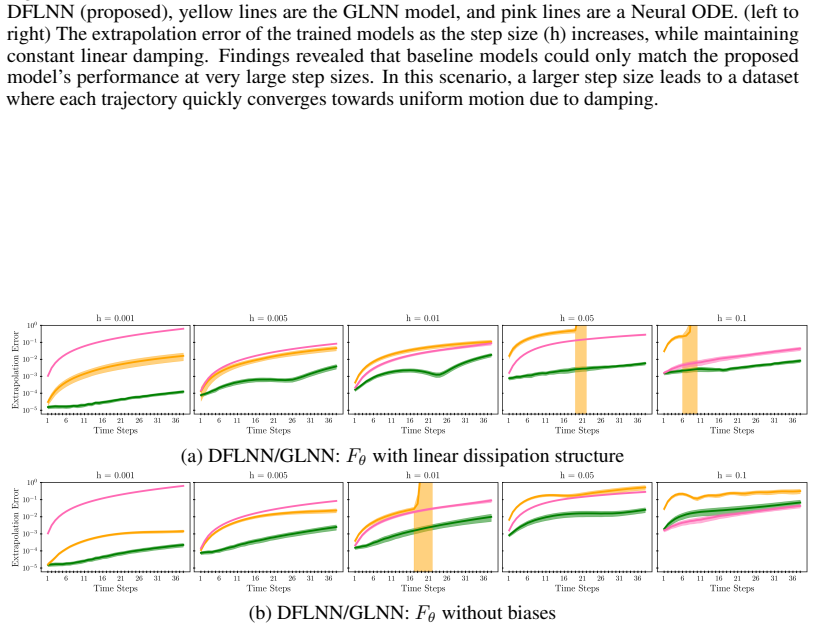
The central claim is that the inverse problem of identifying a mechanical system from position data can be posed as a regression on the discrete forced Euler-Lagrange equations. For each observed triple $(q_{n-1}, q_n, q_{n+1})$, the paper forms midpoint approximations of position and velocity, computes the residual of Eq. (9), and minimizes its squared norm over the dataset; $L_\theta$ and $F_\theta$ are separate feed-forward networks, so the learned model carries a distinct Lagrangian and a distinct external force. A log-determinant barrier keeps the Lagrangian regular, and when dissipation is expected the force is restricted to a Rayleigh form $F_\theta = -K_\theta \dot q$; when the force is unknown, dropout slows the free-force network so that it does not absorb conservative dynamics. Rollouts are generated by solving the residual equation for the next position, and setting $F_\theta = 0$ gives the corresponding conservative system. The experiments show accurate long-time rollouts on damped double-pendulum, charged-particle, pixel-pendulum, and human motion-capture data, and the recovered conservative/non-conservative split is demonstrated by extrapolating to the undamped regime.
Load-bearing premise
The load-bearing premise is that the observed position traces come from a single mechanical system of the standard kind — kinetic energy that is invertible in velocity and a force depending only on position and velocity — so that the residual can pick out one true energy/force pair; the paper does not prove this uniqueness.
Editorial extensions
If this is right
- Mechanical systems can be identified from data streams without velocity sensors, making motion capture, video, and low-resolution tracking usable training sources.
- A trained model can switch off the learned force term and simulate the underlying conservative dynamics, so a dissipative dataset can generate predictions for the equivalent undamped system.
- Because the force-free discretization is variational, rollouts preserve the symplectic structure of the Hamiltonian system and remain accurate over longer time spans than black-box models.
- The architecture applies in latent space: an autoencoder can compress pixel frames, and the dynamics can be learned and simulated in the low-dimensional latent coordinates.
- The method extends to real biomechanics data, suggesting that interpretable equations of motion can be extracted from human motion capture.
Reading between the lines
- Beyond the paper's explicit claims, the residual's gauge freedom means a gradient-like term can be moved from the Lagrangian into the force without changing the fit; the learned conservative/non-conservative split is therefore fixed by the chosen priors (Rayleigh form, dropout, regularity) rather than guaranteed by the data alone.
- A testable extension would train the same architecture on data with a known external input and check whether the learned force matches the input, turning the method into a position-only estimator of actuation or control.
- If the data contain non-mechanical modes or multiple interacting agents, the learned 'physics' will be a spurious fit, so the model should be applied only after verifying that a single forced mechanical system generated the observations.
Editorial analysis
A structured set of objections, weighed in public.
Referee Report
Summary. The paper introduces the Discrete Forced Lagrangian Neural Network (DFLNN), a method for learning mechanical systems from position data only. The model is trained by minimizing the residual of the discrete forced Euler-Lagrange equations (Eq. 9), with separate neural-network representations of the Lagrangian Lθ and the non-conservative force Fθ. The authors evaluate DFLNN on synthetic damped double-pendulum, dissipative charged-particle, and pixel-pendulum tasks, as well as on real CMU motion-capture data of a person swinging from a bar. They report favorable extrapolation performance against a continuous Generalized Lagrangian Neural Network (GLNN) and a Neural ODE baseline, and they claim that switching off the learned force term yields physically interpretable conservative extrapolations, thereby separating conservative from non-conservative dynamics.
Significance. If the central separation claim were firmly established, DFLNN would be a useful contribution: it avoids finite-difference velocity estimates, respects the discrete Lagrange-d'Alembert structure, and shows strong predictive rollouts on several synthetic tasks. The paper also demonstrates a sensible integration with autoencoder latent representations for pixel observations and reports modest computational cost. However, the core interpretability claim—that the learned pair (Lθ, Fθ) isolates conservative from non-conservative dynamics—is not justified by the training objective, because the loss is invariant under a gauge transformation that transfers gradients between L and F. The use of dropout or a Rayleigh ansatz is presented as an informal remedy rather than a structural guarantee. For these reasons, the significance of the contribution is currently conditional on the authors providing an identifiability analysis or a reframed, more modest claim.
major comments (3)
- [Section 3.1, Eq. (9); Section 1.2(c); Section 3.3] The loss in Eq. (9) is invariant under the transformation (Lθ, Fθ) -> (Lθ + S(q), Fθ − ∇S(q)) for any smooth scalar function S(q). Because all terms in the residual are evaluated at the same midpoints (qbar, vbar), the contributions ∇S cancel identically, so the learned decomposition of conservative versus non-conservative dynamics is not identifiable from the training loss alone. The paper provides no identifiability condition, and the Rayleigh form (Eq. 13) and dropout in Section 3.3 are informal priors rather than proven constraints. This directly affects the headline claim that the method "allows us to separate conservative from non-conservative dynamics," and it undermines the practice of turning off Fθ for conservative extrapolation: the resulting conservative system depends on which representative of the equivalence class was learned. Please provide either a structural identifiability proof, an explicit constraint that removes the gauge freedom, or an experiment with known L and F that verifies the recovered split.
- [Section 3.3] Dropout is the only mechanism offered to prevent Fθ from absorbing conservative dynamics when Fθ is a free network. Dropout is a stochastic regularizer and does not constrain the function space in a way that removes the gauge freedom described above, nor does it provide any convergence or uniqueness guarantee. The claim that it "encourages the Lagrangian term to fit the data when possible" is qualitative and requires empirical support, for example an ablation where the same task is trained with and without dropout, or a comparison of the learned L and F against ground truth on a system where the true split is known.
- [Section 4.4] The real-data experiment assumes that a person swinging from a bar is well described by a multi-pendulum model with a generalized potential U(q, qdot) and a force of the form −Kθ(q) qdot + F_free. This assumption is not verified, and the reported extrapolation error (11.75 ± 10.89 at k=35) plus visual rollouts do not establish that the learned conservative/non-conservative split is physically correct. Because no ground-truth L and F are available for human motion, the separation claim on real data remains anecdotal. Please report held-out quantitative metrics, compare against a purely black-box baseline with comparable capacity, or validate the same architecture on a synthetic system with known mechanical ground truth and similar trajectory statistics.
minor comments (4)
- [Section 4, Eq. (6)] The normalization factor NT(N+1) in Eq. (6) appears inconsistent with the sum over n=1,...,N−1; Eq. (15) uses NT(N−1) for the physics term. Please correct the denominator.
- [Table 2] The entry "Tabel 2" in Section 4.3 is a typo for "Table 2," and the NaN result for GLNN on Task 4 is not explained; please state whether it is a numerical instability or an implementation issue.
- [Appendix G] The phrase "Newtons second low" in the charged-particle section should be "Newton's second law." There is also a typo "resoures" in Appendix E.
- [Section 4.4] The latent dimension is written as "l=6" but the notation for the latent space is introduced as z∈R^l; please keep the notation uniform and clarify whether l is a scalar dimension.
Circularity Check
No circular derivation: the DFLNN residual is a discretization of the forced Euler-Lagrange equations, and conservative extrapolation is checked against ground truth in synthetic tasks; the (L,F) gauge ambiguity is an identifiability caveat, not a circular fit.
full rationale
The paper's derivation chain is not circular. The physics loss (Eq. 9) is obtained by discretizing the discrete Lagrange-d'Alembert principle (Eqs. 4-5), with L_theta and F_theta as free network parameters; there is no fitted parameter that is defined in terms of a target quantity and then renamed as a prediction. Training minimizes the squared residual of the discrete forced Euler-Lagrange equations, and prediction solves the same equations forward, which is a standard inverse-problem setup rather than a tautology. The claimed conservative extrapolation is genuinely external in the synthetic tasks: the model is trained on damped trajectories and then evaluated by turning off F_theta against ground-truth conservative rollouts (Section 4, Figures 3-4), so the conservative behavior is not an input to the fit. The self-citations ([29,30]) appear only in related-work context and are not load-bearing. A real limitation is that, for a general free force F_theta, the residual (Eq. 9) is invariant under (L,F) -> (L+S(q), F - grad S(q)), so the conservative/non-conservative split is not identifiable from data alone; however, this is a uniqueness/identifiability gap, not a circularity, and in Tasks 1-2 the Rayleigh form supplies additional structure that can break the gauge. The paper would be stronger with an explicit identifiability discussion, especially for Task 4, but the core derivation and its synthetic validation remain self-contained and non-circular.
Assumptions & free parameters
free parameters (3)
- loss weights and dropout rate =
Task-dependent: e.g. Task 1 omega_physics=0.5, omega_reg=0.5, dropout=0.5; Task 3 omega_physics=0.9, omega_reg=0.1…
- mass matrix regularization constant epsilon =
small positive, value not reported
- latent dimension l =
l=1 (Task 3), l=6 (Task 4)
assumptions (5)
- standard math The discrete Lagrange-d'Alembert principle and the forced discrete Euler-Lagrange equations (Eq. 5) correctly describe the observed dynamics.
- domain assumption The midpoint quadrature approximations in Eqs. (7)-(8) accurately represent the continuous Lagrangian and force integrals over each step.
- ad hoc to paper There exists a regular Lagrangian L and fiber-preserving force F such that the observed position sequences satisfy the discrete forced Euler-Lagrange equations.
- ad hoc to paper Latent coordinates from the autoencoder support a mechanical Lagrangian structure.
- ad hoc to paper Dropout prevents Ftheta from absorbing conservative dynamics.
Cite this review
Pith. "Pith review of Learning mechanical systems from real-world data using discrete forced Lagrangian dynamics." pith.science (2026). https://pith.science/paper/F67EFKOY
@misc{pith2026250520370,
  author       = {Pith},
  title        = {Pith review of: Learning mechanical systems from real-world data using discrete forced Lagrangian dynamics},
  year         = {2026},
  howpublished = {\url{https://pith.science/paper/F67EFKOY}},
  note         = {Machine review of arXiv:2505.20370}
}
read the original abstract
We introduce a data-driven method for learning the equations of motion of mechanical systems directly from position measurements, without requiring access to velocity data. This is particularly relevant in system identification tasks where only positional information is available, such as motion capture, pixel data or low-resolution tracking. Our approach takes advantage of the discrete Lagrange-d'Alembert principle and the forced discrete Euler-Lagrange equations to construct a physically grounded model of the system's dynamics. We decompose the dynamics into conservative and non-conservative components, which are learned separately using feed-forward neural networks. In the absence of external forces, our method reduces to a variational discretization of the action principle naturally preserving the symplectic structure of the underlying Hamiltonian system. We validate our approach on a variety of synthetic and real-world datasets, demonstrating its effectiveness compared to baseline methods. In particular, we apply our model to (1) measured human motion data and (2) latent embeddings obtained via an autoencoder trained on image sequences. We demonstrate that we can faithfully reconstruct and separate both the conservative and forced dynamics, yielding interpretable and physically consistent predictions.
Figures


Figures from the paper (6 more)



Reference graph
Works this paper leans on
-
[1]
Hamiltonian neural networks.Advances in neural information processing systems, 32, 2019
Samuel Greydanus, Misko Dzamba, and Jason Yosinski. Hamiltonian neural networks.Advances in neural information processing systems, 32, 2019
2019
-
[2]
Lagrangian neural networks.arXiv preprint arXiv:2003.04630, 2020
Miles Cranmer, Sam Greydanus, Stephan Hoyer, Peter Battaglia, David Spergel, and Shirley Ho. Lagrangian neural networks.arXiv preprint arXiv:2003.04630, 2020
arXiv 2003
-
[3]
Generalized lagrangian neural networks.arXiv preprint arXiv:2401.03728, 2024
Shanshan Xiao, Jiawei Zhang, and Yifa Tang. Generalized lagrangian neural networks.arXiv preprint arXiv:2401.03728, 2024
arXiv 2024
-
[4]
Yaofeng Desmond Zhong, Biswadip Dey, and Amit Chakraborty. Dissipative symoden: En- coding hamiltonian dynamics with dissipation and control into deep learning.arXiv preprint arXiv:2002.08860, 2020
arXiv 2002
-
[5]
Solving inverse problems using data-driven models.Acta Numerica, 28:1–174, 2019
Simon Arridge, Peter Maass, Ozan Öktem, and Carola-Bibiane Schönlieb. Solving inverse problems using data-driven models.Acta Numerica, 28:1–174, 2019
2019
-
[6]
Data-driven modeling: concept, techniques, challenges and a case study
Maki K Habib, Samuel A Ayankoso, and Fusaomi Nagata. Data-driven modeling: concept, techniques, challenges and a case study. In2021 IEEE international conference on mechatronics and automation (ICMA), pages 1000–1007. IEEE, 2021
work page 2021
-
[7]
Shen Yin, Steven X Ding, Xiaochen Xie, and Hao Luo. A review on basic data-driven approaches for industrial process monitoring.IEEE Transactions on Industrial electronics, 61(11):6418– 6428, 2014
work page 2014
-
[8]
Dealing with noise problem in machine learning data-sets: A systematic review.Procedia Computer Science, 161:466–474, 2019
Shivani Gupta and Atul Gupta. Dealing with noise problem in machine learning data-sets: A systematic review.Procedia Computer Science, 161:466–474, 2019
2019
Show all 60 references
-
[9]
Generalizing to unseen domains: A survey on domain general- ization.IEEE transactions on knowledge and data engineering, 35(8):8052–8072, 2022
Jindong Wang, Cuiling Lan, Chang Liu, Yidong Ouyang, Tao Qin, Wang Lu, Yiqiang Chen, Wenjun Zeng, and Philip S Yu. Generalizing to unseen domains: A survey on domain general- ization.IEEE transactions on knowledge and data engineering, 35(8):8052–8072, 2022
2022
-
[10]
Numerical differentiation of noisy, nonsmooth data.International Scholarly Research Notices, 2011(1):164564, 2011
Rick Chartrand. Numerical differentiation of noisy, nonsmooth data.International Scholarly Research Notices, 2011(1):164564, 2011
2011
-
[11]
Discrete mechanics and variational integrators.Acta numerica, 10:357–514, 2001. 10
2001
-
[12]
A survey of advances in vision-based human motion capture and analysis.Computer vision and image understanding, 104(2-3): 90–126, 2006
Thomas B Moeslund, Adrian Hilton, and V olker Krüger. A survey of advances in vision-based human motion capture and analysis.Computer vision and image understanding, 104(2-3): 90–126, 2006
2006
-
[13]
Skeleton-based abnormal gait detection.Sensors, 16(11):1792, 2016
Trong-Nguyen Nguyen, Huu-Hung Huynh, and Jean Meunier. Skeleton-based abnormal gait detection.Sensors, 16(11):1792, 2016
2016
-
[14]
Artificial intelligence for skeleton-based physical rehabilitation action evaluation: A systematic review.Computers in Biology and Medicine, 158:106835, 2023
Sara Sardari, Sara Sharifzadeh, Alireza Daneshkhah, Bahareh Nakisa, Seng W Loke, Vasile Palade, and Michael J Duncan. Artificial intelligence for skeleton-based physical rehabilitation action evaluation: A systematic review.Computers in Biology and Medicine, 158:106835, 2023
2023
-
[15]
An attention enhanced spatial– temporal graph convolutional lstm network for action recognition in karate.Applied Sciences, 11(18):8641, 2021
Jianping Guo, Hong Liu, Xi Li, Dahong Xu, and Yihan Zhang. An attention enhanced spatial– temporal graph convolutional lstm network for action recognition in karate.Applied Sciences, 11(18):8641, 2021
2021
-
[16]
Variational learning of euler–lagrange dynamics from data.Journal of Computational and Applied Mathematics, 421:114780, 2023
Sina Ober-Blöbaum and Christian Offen. Variational learning of euler–lagrange dynamics from data.Journal of Computational and Applied Mathematics, 421:114780, 2023
2023
-
[17]
Port-hamiltonian neural networks for learning explicit time-dependent dynamical systems
Shaan A Desai, Marios Mattheakis, David Sondak, Pavlos Protopapas, and Stephen J Roberts. Port-hamiltonian neural networks for learning explicit time-dependent dynamical systems. Physical Review E, 104(3):034312, 2021
2021
-
[18]
Dissipative hamiltonian neural networks: Learning dissipative and conservative dynamics separately.arXiv preprint arXiv:2201.10085, 2022
Andrew Sosanya and Sam Greydanus. Dissipative hamiltonian neural networks: Learning dissipative and conservative dynamics separately.arXiv preprint arXiv:2201.10085, 2022
2022 arXiv
-
[19]
Neural ordinary differential equations.Advances in neural information processing systems, 31, 2018
Ricky TQ Chen, Yulia Rubanova, Jesse Bettencourt, and David K Duvenaud. Neural ordinary differential equations.Advances in neural information processing systems, 31, 2018
2018
-
[20]
Physics-informed machine learning: A comprehensive review on applications in anomaly detection and condition monitoring.Expert Systems with Applications, page 124678, 2024
Yuandi Wu, Brett Sicard, and Stephen Andrew Gadsden. Physics-informed machine learning: A comprehensive review on applications in anomaly detection and condition monitoring.Expert Systems with Applications, page 124678, 2024
2024
-
[21]
Deep learning and process understanding for data-driven earth system science
Markus Reichstein, Gustau Camps-Valls, Bjorn Stevens, Martin Jung, Joachim Denzler, and Nuno Carvalhais. Deep learning and process understanding for data-driven earth system science. Nature, 566(7743):195–204, 2019
2019
-
[22]
Discovering physical concepts with neural networks.Physical review letters, 124(1):010508, 2020
Raban Iten, Tony Metger, Henrik Wilming, Lídia Del Rio, and Renato Renner. Discovering physical concepts with neural networks.Physical review letters, 124(1):010508, 2020
2020
-
[23]
Theory-guided data science: A new paradigm for scientific discovery from data.IEEE Transactions on knowledge and data engineering, 29(10):2318–2331, 2017
Anuj Karpatne, Gowtham Atluri, James H Faghmous, Michael Steinbach, Arindam Banerjee, Auroop Ganguly, Shashi Shekhar, Nagiza Samatova, and Vipin Kumar. Theory-guided data science: A new paradigm for scientific discovery from data.IEEE Transactions on knowledge and data enginee...
2017
-
[24]
Physics-informed machine learning for modeling multidimensional dynamics.Nonlinear Dynamics, 112(24): 21565–21585, 2024
Amirhassan Abbasi, Prashant N Kambali, Parham Shahidi, and C Nataraj. Physics-informed machine learning for modeling multidimensional dynamics.Nonlinear Dynamics, 112(24): 21565–21585, 2024
2024
-
[25]
Symplectic integration of learned hamiltonian systems.Chaos: An Interdisciplinary Journal of Nonlinear Science, 32(1), 2022
2022
-
[26]
Deep energy-based modeling of discrete-time physics.Advances in Neural Information Processing Systems, 33:13100–13111, 2020
Takashi Matsubara, Ai Ishikawa, and Takaharu Yaguchi. Deep energy-based modeling of discrete-time physics.Advances in Neural Information Processing Systems, 33:13100–13111, 2020
2020
-
[27]
Neural symplectic form: Learn- ing hamiltonian equations on general coordinate systems.Advances in Neural Information Processing Systems, 34:16659–16670, 2021
Yuhan Chen, Takashi Matsubara, and Takaharu Yaguchi. Neural symplectic form: Learn- ing hamiltonian equations on general coordinate systems.Advances in Neural Information Processing Systems, 34:16659–16670, 2021
2021
-
[28]
Physics-informed neural ode (pinode): embedding physics into models using collocation points.Scientific Reports, 13 (1):10166, 2023
Aleksei Sholokhov, Yuying Liu, Hassan Mansour, and Saleh Nabi. Physics-informed neural ode (pinode): embedding physics into models using collocation points.Scientific Reports, 13 (1):10166, 2023. 11
2023
-
[29]
Learning dynamical systems from noisy data with inverse-explicit integrators.Physica D: Nonlinear Phenomena, 472:134471, 2025
Elena Celledoni, Sølve Eidnes, and Håkon Noren Myhr. Learning dynamical systems from noisy data with inverse-explicit integrators.Physica D: Nonlinear Phenomena, 472:134471, 2025
2025
-
[30]
Symplectic neural networks based on dynamical systems.arXiv preprint arXiv:2408.09821, 2024
Benjamin K Tapley. Symplectic neural networks based on dynamical systems.arXiv preprint arXiv:2408.09821, 2024
2024 arXiv
-
[32]
Discovering governing equations from data by sparse identification of nonlinear dynamical systems.Proceedings of the national academy of sciences, 113(15):3932–3937, 2016
Steven L Brunton, Joshua L Proctor, and J Nathan Kutz. Discovering governing equations from data by sparse identification of nonlinear dynamical systems.Proceedings of the national academy of sciences, 113(15):3932–3937, 2016
2016
-
[33]
Data-driven discovery of coordinates and governing equations.Proceedings of the National Academy of Sciences, 116(45):22445–22451, 2019
Kathleen Champion, Bethany Lusch, J Nathan Kutz, and Steven L Brunton. Data-driven discovery of coordinates and governing equations.Proceedings of the National Academy of Sciences, 116(45):22445–22451, 2019
2019
-
[34]
Simplifying hamiltonian and lagrangian neural networks via explicit constraints.Advances in neural information processing systems, 33:13880–13889, 2020
Marc Finzi, Ke Alexander Wang, and Andrew G Wilson. Simplifying hamiltonian and lagrangian neural networks via explicit constraints.Advances in neural information processing systems, 33:13880–13889, 2020
2020
-
[35]
Learning hamiltonians of constrained mechanical systems.Journal of Computational and Applied Mathematics, 417: 114608, 2023
Elena Celledoni, Andrea Leone, Davide Murari, and Brynjulf Owren. Learning hamiltonians of constrained mechanical systems.Journal of Computational and Applied Mathematics, 417: 114608, 2023
2023
-
[36]
Hu and D
J.P Ortega J. Hu and D. Yin. A structure-preserving kernel method for learning hamiltonian systems.arXiv preprint arXiv:2403.10070, 2024
2024 arXiv
-
[37]
J.P Ortega and D. Yin. Expressiveness and structure preservation in learning Port-Hamiltonian systems.International Conference on Geometric Science of Information, pages 313–322, 2024
2024
-
[38]
J.P Ortega and D. Yin. Learnability of linear port-hamiltonian systems.Journal of Machine Learning Research, 25:1–56, 2024
2024
-
[39]
Learning strange attractors with reservoir systems.Nonlinearity, 36(9):4674, 2023
Lyudmila Grigoryeva, Allen Hart, and Juan-Pablo Ortega. Learning strange attractors with reservoir systems.Nonlinearity, 36(9):4674, 2023
2023
-
[40]
Deep discrete-time lagrangian mechanics
Takehiro Aoshima, Takashi Matsubara, and Takaharu Yaguchi. Deep discrete-time lagrangian mechanics
-
[41]
Machine learning and serving of discrete field theories.Scientific Reports, 10(1): 19329, 2020
Hong Qin. Machine learning and serving of discrete field theories.Scientific Reports, 10(1): 19329, 2020
2020
-
[42]
Deep lagrangian networks: Using physics as model prior for deep learning.arXiv preprint arXiv:1907.04490, 2019
Michael Lutter, Christian Ritter, and Jan Peters. Deep lagrangian networks: Using physics as model prior for deep learning.arXiv preprint arXiv:1907.04490, 2019
1907 arXiv
-
[43]
Learning of discrete models of variational pdes from data.Chaos: An Interdisciplinary Journal of Nonlinear Science, 34(1), 2024
Christian Offen and Sina Ober-Blöbaum. Learning of discrete models of variational pdes from data.Chaos: An Interdisciplinary Journal of Nonlinear Science, 34(1), 2024
2024
-
[44]
Machine learning of continuous and discrete variational odes with convergence guarantee and uncertainty quantification.arXiv preprint arXiv:2404.19626, 2024
Christian Offen. Machine learning of continuous and discrete variational odes with convergence guarantee and uncertainty quantification.arXiv preprint arXiv:2404.19626, 2024
2024 arXiv
-
[45]
Learnability of linear port-hamiltonian systems.Journal of Machine Learning Research, 25(68):1–56, 2024
Juan-Pablo Ortega and Daiying Yin. Learnability of linear port-hamiltonian systems.Journal of Machine Learning Research, 25(68):1–56, 2024
2024
-
[46]
Pseudo-hamiltonian neural networks for learning partial differential equations.Journal of Computational Physics, 500:112738, 2024
Sølve Eidnes and Kjetil Olsen Lye. Pseudo-hamiltonian neural networks for learning partial differential equations.Journal of Computational Physics, 500:112738, 2024
2024
-
[47]
Efficiently parameterized neural metriplectic systems.arXiv preprint arXiv:2405.16305, 2024
Anthony Gruber, Kookjin Lee, Haksoo Lim, Noseong Park, and Nathaniel Trask. Efficiently parameterized neural metriplectic systems.arXiv preprint arXiv:2405.16305, 2024
2024 arXiv
-
[48]
Variational order for forced lagrangian systems.Nonlinearity, 31(8):3814, 2018
D Martín De Diego and R Sato Martín de Almagro. Variational order for forced lagrangian systems.Nonlinearity, 31(8):3814, 2018. 12
2018
-
[49]
Variational integrators and the newmark algorithm for conservative and dissipative mechanical systems.International Journal for numerical methods in engineering, 49(10):1295–1325, 2000
2000
-
[50]
Discrete lagrangian neural networks with automatic symmetry discovery.IFAC-PapersOnLine, 56(2):3203–3210, 2023
Yana Lishkova, Paul Scherer, Steffen Ridderbusch, Mateja Jamnik, Pietro Liò, Sina Ober- Blöbaum, and Christian Offen. Discrete lagrangian neural networks with automatic symmetry discovery.IFAC-PapersOnLine, 56(2):3203–3210, 2023
2023
-
[51]
Dropout: a simple way to prevent neural networks from overfitting.The journal of machine learning research, 15(1):1929–1958, 2014
Nitish Srivastava, Geoffrey Hinton, Alex Krizhevsky, Ilya Sutskever, and Ruslan Salakhutdinov. Dropout: a simple way to prevent neural networks from overfitting.The journal of machine learning research, 15(1):1929–1958, 2014
1929
-
[52]
Rayleigh’s dissipation function at work.European Journal of Physics, 36(3):035014, 2015
2015
-
[53]
Gymnasium: A standard interface for reinforcement learning environments.arXiv preprint arXiv:2407.17032, 2024
Mark Towers, Ariel Kwiatkowski, Jordan Terry, John U Balis, Gianluca De Cola, Tristan Deleu, Manuel Goulao, Andreas Kallinteris, Markus Krimmel, Arjun KG, et al. Gymnasium: A standard interface for reinforcement learning environments.arXiv preprint arXiv:2407.17032, 2024
2024 arXiv
-
[54]
Openai gym.arXiv preprint arXiv:1606.01540, 2016
Greg Brockman, Vicki Cheung, Ludwig Pettersson, Jonas Schneider, John Schulman, Jie Tang, and Wojciech Zaremba. Openai gym.arXiv preprint arXiv:1606.01540, 2016
2016 arXiv
-
[55]
A combined corner and edge detector
Chris Harris, Mike Stephens, et al. A combined corner and edge detector. Citeseer, 1988
1988
-
[56]
Measures of the amount of ecologic association between species.Ecology, 26(3): 297–302, 1945
Lee R Dice. Measures of the amount of ecologic association between species.Ecology, 26(3): 297–302, 1945
1945
-
[57]
Cmu graphics lab motion capture database
Carnegie Mellon University. Cmu graphics lab motion capture database. Data obtained from https://mocap.cs.cmu.edu
-
[58]
Guide to the carnegie mellon university multimodal activity (cmu- mmac) database
Fernando De la Torre, Jessica Hodgins, Adam Bargteil, Xavier Martin, Justin Macey, Alex Collado, and Pep Beltran. Guide to the carnegie mellon university multimodal activity (cmu- mmac) database
-
[59]
Smoothing and differentiation of data by simplified least squares procedures
Abraham Savitzky. Smoothing and differentiation of data by simplified least squares procedures. Analytical chemistry, 36(8):1627–1639, 1964
1964
-
[60]
Symmetric multistep methods over long times.Numerische Mathematik, 97:699–723, 2004
Ernst Hairer and Christian Lubich. Symmetric multistep methods over long times.Numerische Mathematik, 97:699–723, 2004
2004
-
[61]
Symmetric multistep methods for charged-particle dynamics
Ernst Hairer and Christian Lubich. Symmetric multistep methods for charged-particle dynamics. The SMAI Journal of computational mathematics, 3:205–218, 2017. 13 A Higher order approximations In [16], the authors consider variational backward error analysis for learning Lagrang...
2017
Reviewed August 7, 2026 · model on record in the stance chip above.
Discussion (0). Sign in to comment.