REVIEW 3 major objections 4 minor 1 cited by
Ten Aligned Orbits: Planet Migration in the Era of JWST and Ariel
T0 review · 3 major / 4 minor · reviewed 2026-08-07 · deepseek-v4-flash
Pith's one-line read By fitting the Rossiter-McLaughlin effect in archival HARPS and HARPS-N spectra, this paper derives the first projected spin-orbit angles for nine gas giants and one brown dwarf, finding all ten orbits aligned with their host stars.
desk verdict Ten new R-M measurements, but 'aligned' is claimed too strongly for the four least-constrained systems. read the letter →
The pith
A machine-rendered reading of the paper's core claim, the machinery that carries it, and where it could break.
The reading
What carries the argument
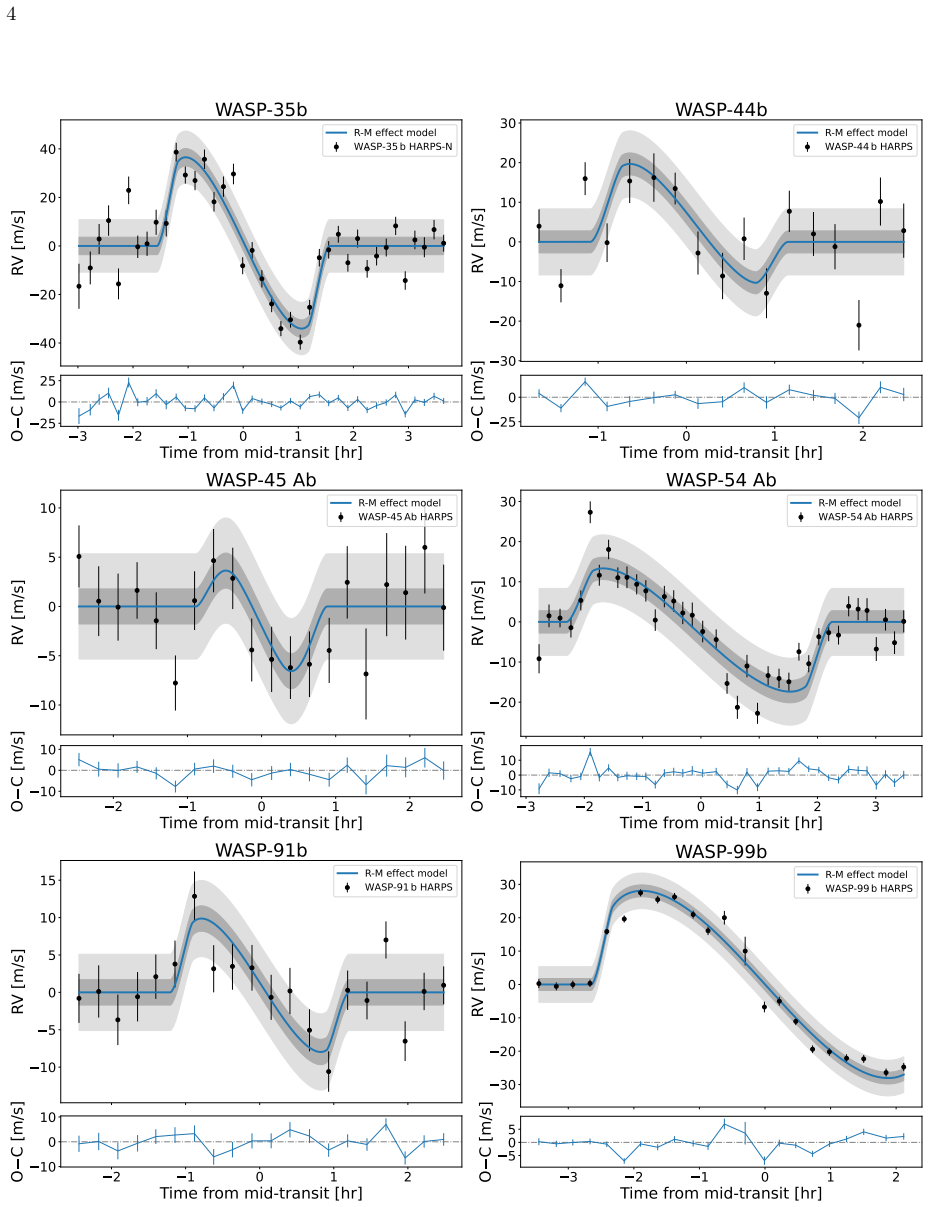
The analysis runs on the Rossiter-McLaughlin effect: as a planet transits, it obscures a moving chord of the rotating stellar disc, creating an anomalous radial-velocity signal whose amplitude and shape carry the projected spin-orbit angle $\lambda$. Each target's in-transit radial velocities are fitted with a composite model, a Keplerian orbit plus the R-M anomaly as formulated in the ARoME code and implemented in the ARoMEpy package, with ATLAS9 quadratic limb-darkening coefficients, Gaussian priors on transit parameters from the discovery literature, and three MCMC ensembles checked for convergence via the Gelman-Rubin statistic. The priors carry the argument for three systems: uniform-prior fits put WASP-44b, WASP-99b, and WASP-162b into broad or degenerate $\lambda$ posteriors, so Gaussian priors on the projected stellar rotation speed $v\sin i_*$ are adopted, for WASP-44b from a new stacked-spectrum iSpec measurement of $1.5 \pm 0.5$ km/s. For the true spin-orbit angle of EPIC 219388192b the central identity is the spherical law of cosines, $\cos\psi = \sin i_* \sin i \cos|\lambda| + \cos i_* \cos i$, evaluated with the Masuda & Winn (2020) approach that tracks the dependence between the equatorial rotation speed and $v \sin i_*$.
What would settle it
Take the same archival spectra and refit WASP-44b, WASP-99b, and WASP-162b with uniform priors on the stellar rotation speed, or measure that speed independently from high signal-to-noise spectra; for WASP-44b in particular, replacing the adopted $1.5 \pm 0.5$ km/s prior with the literature value of $3.2 \pm 0.9$ km/s should widen the $\lambda$ posterior substantially, and if the resulting angle falls outside the aligned regime near zero, the headline claim of ten aligned orbits would shrink to seven.
Extended reading notes
Core claim
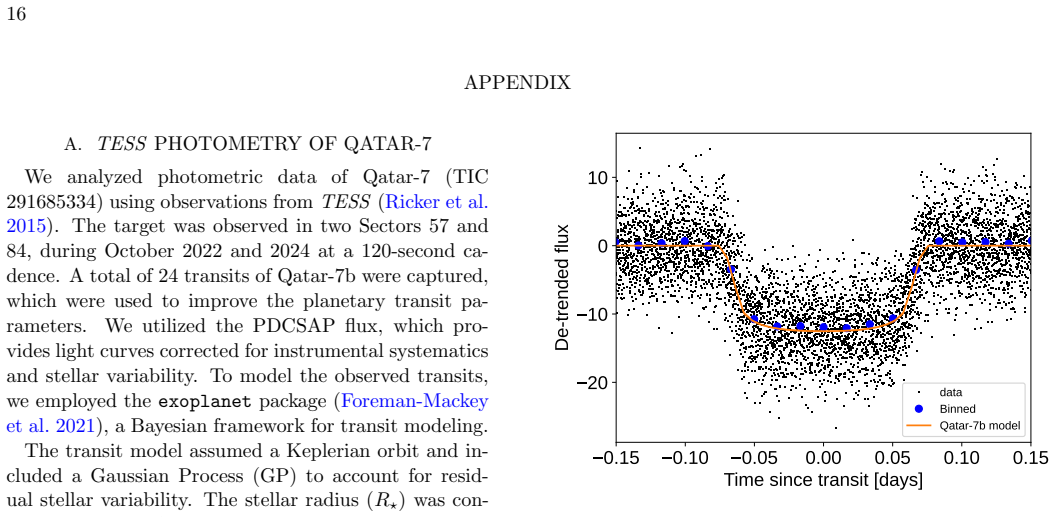
The paper reports ten first-time projected spin-orbit angles, all consistent with prograde, aligned orbits: $\lambda = -5 \pm 11^\circ$ for WASP-35b, $-18^{+20}_{-26}$ degrees for WASP-44b, $13^{+15}_{-10}$ degrees for WASP-45Ab, $12 \pm 10^\circ$ for WASP-54Ab, $-11 \pm 20^\circ$ for WASP-91b, $-1^{+16}_{-18}$ degrees for WASP-99b, $9 \pm 6^\circ$ for WASP-129Ab, $1^{+31}_{-32}$ degrees for WASP-162b, $-9 \pm 11^\circ$ for Qatar-7b, and $16^{+16}_{-15}$ degrees for EPIC 219388192b. For the brown dwarf EPIC 219388192b, a stellar rotation period of $12.29 \pm 0.20$ days detected in ASAS-SN photometry, matching the previously reported $12.6 \pm 2.1$ days, lets the authors compute the true spin-orbit angle $\psi = 25^{+11}_{-14}$ degrees using the spherical law of cosines: a prograde orbit with a slight but not significant misalignment. The authors interpret the aligned, mostly circular configurations as the signature of quiet disc migration, noting that tidal alignment timescales for these systems exceed their ages, so the low angles are probably primordial rather than tidally reset; the eccentric warm Jupiter WASP-162b ($e = 0.434$) on an aligned orbit is singled out as a case where coplanar high-eccentricity migration or disc-driven eccentricity growth, rather than Kozai-Lidov excitation, remains plausible. Finally, the paper's census of atmospheric targets finds the HST/JWST and Ariel samples statistically unbiased in spin-orbit angle, yet dynamically incomplete: only 41% of HST/JWST atmospheric targets and 29% of the full Ariel candidate list have published spin-orbit measurements, with 70% coverage for the high-priority Ariel Tier 3 subset.
Load-bearing premise
Section 3.1 concedes that for WASP-44b, WASP-99b, and WASP-162b the 'aligned' verdict rests on an assumed stellar rotation speed rather than one the data determine alone; for WASP-44b the adopted speed of $1.5 \pm 0.5$ km/s contradicts both the published $3.2 \pm 0.9$ km/s and the paper's own unconstrained fit of $0.8 \pm 0.5$ km/s, and if that assumption is wrong then the quoted uncertainties are too small, so those three systems may not be aligned at all.
Editorial extensions
If this is right
- If the ten alignments hold, these systems join the population of aligned, prograde short-period giants, and their numbers indicate that quiet disc migration, rather than violent scattering, built these particular orbits.
- EPIC 219388192b adds a rare brown-dwarf datapoint with both $\lambda$ and $\psi$ measured, reinforcing the trend that high mass-ratio companions orbit nearly aligned even around stars where tidal realignment is too slow to have erased a misalignment.
- WASP-162b, an eccentric ($e = 0.434$) warm Jupiter on an aligned orbit, becomes a test case where coplanar high-eccentricity migration or disc-driven eccentricity excitation, rather than the Kozai-Lidov mechanism, must be considered for the system's history.
- The completeness analysis shows that 70% of Ariel Tier 3 candidates already have spin-orbit measurements while the broader HST/JWST and Ariel samples lag at 41% and 29%, identifying where follow-up effort is most needed.
Reading between the lines
- A direct testable extension: if the ten alignments hold up, the fraction of aligned short-period giants may be higher than the roughly 62% seen in the general literature sample, because the archival HARPS dataset was not selected for known misalignment; a bias-accounted census of archival HARPS transits could test this without new observations.
- The three Gaussian-prior systems are the weak links in the 'ten aligned orbits' claim, so a campaign of one additional well-sampled transit per system on a larger telescope would either rescue or overturn the headline, a cheap and decisive follow-up.
- The paper's completeness argument implies a recommendation it does not quite make: atmospheric surveys should plan dynamical follow-up for their target lists, since the 130 HST/JWST targets lacking spin-orbit angles will otherwise be interpreted with half the information needed to separate formation channels.
Editorial analysis
A structured set of objections, weighed in public.
Referee Report
Summary. The paper analyzes archival HARPS and HARPS-N transit time series for nine gas giant exoplanets and one brown dwarf (EPIC 219388192b). Using the Rossiter-McLaughlin effect, the authors derive sky-projected spin-orbit angles λ for all ten systems, report that all are aligned (prograde), and additionally derive a true spin-orbit angle ψ = 25 (+11/−14) deg for the brown dwarf. The paper also compares the spin-orbit angle distribution of planets with HST/JWST atmospheric observations and Ariel Mission Candidate Sample targets, concluding that there is no statistically significant bias in spin-orbit alignment among current atmospheric targets, while noting the low completeness of dynamical measurements. The central quantitative claims are the ten first-time (claimed) aligned λ measurements and the secondary atmospheric-target completeness analysis.
Significance. If the measurements are robust, this paper adds ten first-time projected spin-orbit angles, including an important brown-dwarf datum with a true obliquity, and provides a useful catalog-level assessment of the overlap between spin-orbit measurements and current/future atmospheric characterization targets. The use of archival data, a published fitting pipeline (ARoMEpy), explicit MCMC convergence checks, and the public release of posterior figures are strengths. However, the headline claim 'aligned projected orbits for all nine gas giants as well as the brown dwarf' is not uniformly supported by the quoted 1σ posteriors, and for several systems the classification depends on Gaussian v sin i* priors that are not consistently justified. The atmospheric survey completeness analysis is a useful planning resource, but the claimed absence of bias would benefit from a formal statistical test.
major comments (3)
- [Section 3.1 and Table 3, with Section 5 threshold] The abstract and Section 6 state that all nine gas giants and the brown dwarf have aligned projected orbits, but using the paper's own Section 5 definition (aligned for |λ| < 20°, misaligned for |λ| > 30°), at least WASP-44b and WASP-162b are not robustly aligned even in the adopted Gaussian-prior solutions: WASP-44b has λ = −18 (+20/−26) deg, so its 1σ interval extends to −44°, and WASP-162b has λ = 1 (+32/−33) deg, extending to 33°. WASP-91b (λ = −11 ± 20 deg) is marginal. The claim 'aligned projected orbits for all nine gas giants' is therefore an overstatement; the authors should either report the posterior probability that |λ| < 20° for each target or reclassify these systems as 'consistent with alignment' rather than 'aligned'.
- [Section 3.1, WASP-44b, WASP-99b, WASP-162b paragraphs] The adopted Gaussian priors on v sin i* for these three targets are not consistently derived from the Table 2 literature values. For WASP-44b, Table 2 gives v sin i* = 3.2 ± 0.9 km/s, the uniform-prior fit gives 0.8 ± 0.5 km/s, and the adopted prior is N(1.5, 0.5) km/s from an iSpec stack that is described but not tabulated. For WASP-99b, Table 2 gives 6.8 ± 0.5 km/s while the adopted prior is N(5.9, 0.4) km/s; for WASP-162b, the prior N(1.0, 0.5) km/s narrows the Table 2 uncertainty of 1.0 ± 0.8 km/s. Because these priors were chosen after inspecting the uniform-prior posteriors, the quoted λ uncertainties do not reflect the systematic error from the prior choice, and the aligned classification for these systems is dependent on a data-informed prior that has no independent published basis. The authors should justify these prior centers or re-run the fits with the literature priors and report both sets of results.
- [Section 4.2, Eq. (2) and the subsequent τCE values] The numerical values reported for the tidal alignment timescale do not follow from Eq. (2) as written. For example, for WASP-35b, using Table 3 values (Mp/M* = 0.72/1.10, a/R* = 8.39) gives (Mp/M*)^2 (a/R* /40)^6 ≈ 0.429 × (0.2098)^6 ≈ 3.7 × 10^−5, so Eq. (2) yields τCE ≈ 3.7 × 10^5 yr, not the stated 2 × 10^12 yr. Similar discrepancies of several orders of magnitude appear for most of the listed targets. This error directly affects the conclusion in Section 4.2 that 'the current spin-orbit angles were likely not significantly changed from their initial values through tidal forces.' Please re-check the formula, the normalization, or the arithmetic, and revise the interpretation accordingly.
minor comments (4)
- [Section 5, 'no statistically significant bias'] The statement that the difference between 39% misaligned among atmospheric targets with measured λ and 30% in the general sample 'is not statistically significant' is made without a test statistic; please provide a p-value or a confidence interval for the difference in proportions (e.g., a two-proportion or Fisher's exact test).
- [Section 3.1, WASP-44b] The stacked-spectrum iSpec measurement of v sin i* = 1.5 ± 0.5 km/s is mentioned in the text but not displayed in a table or figure; please report the stacked spectrum, the S/N, and the analysis steps so that the prior can be assessed.
- [Table 3, header] The table header states that N denotes normal and U denotes uniform priors, but it is not immediately clear that in rows such as WASP-44b, WASP-99b, and WASP-162b the Gaussian priors apply only to v sin i* while λ retains a uniform prior; please make the prior association per parameter explicit.
- [Section 3.1, WASP-162b heading] There is an extra space in the target name ('W ASP-162 b') in the section heading; please correct it to 'WASP-162b'.
Circularity Check
No significant circularity: the projected and true spin-orbit angles are free MCMC fits to independent observables, not restatements of the adopted priors or of any self-cited result.
full rationale
The central result, λ for ten targets, is obtained by fitting the Rossiter-McLaughlin anomaly to archival HARPS/HARPS-N radial velocities with uniform priors on λ (Sect. 2.1, Table 3). No derived quantity is fed back into the model in a way that makes λ equal to its input by construction. The true spin-orbit angle ψ for EPIC 219388192b is computed from the spherical-law-of-cosines relation using the fitted λ, the transit inclination, and an independent stellar rotation period (12.29 ± 0.20 d from ASAS-SN photometry, consistent with the literature 12.6 ± 2.1 d), following the external Masuda & Winn (2020) method; this is a genuine combination of independent constraints, not a renamed prior. The only self-citations (Zak et al. 2024 methodology; Sedaghati et al. 2023 ARoMEpy) supply the fitting pipeline and are not load-bearing for the scientific conclusion. The migration interpretation is explicitly hedged in Sect. 4.3 and 4.4. The data-dependent adoption of Gaussian v sin i* priors for WASP-44b, WASP-99b, and WASP-162b is a robustness concern—the quoted λ posteriors for these systems still allow |λ| > 30° at 1σ despite the paper's own |λ| < 20° aligned threshold—but this is an accuracy/statistical-robustness issue, not circularity, because the alignment is not forced by the priors or by any equation identified in the paper. No specific reduction equating a prediction to an input was found, so the circularity score is 0.
Assumptions & free parameters
free parameters (5)
- v sin i* Gaussian prior center for WASP-44b =
1.5 km/s (adopted from iSpec stacking; literature 3.2 +/- 0.9 km/s)
- v sin i* Gaussian prior center for WASP-99b =
5.9 km/s (Hellier et al. 2014)
- v sin i* Gaussian prior center for WASP-162b =
1.0 km/s (Hellier et al. 2019)
- Stellar rotation period of EPIC 219388192 A =
12.29 +/- 0.20 d (ASAS-SN, Lomb-Scargle)
- Tidal quality factor Q'_P =
10^6 (assumed)
assumptions (6)
- domain assumption The CCF-based Rossiter-McLaughlin model of Boue et al. (2013) as implemented in ARoMEpy accurately describes the RV anomaly for these targets.
- domain assumption The literature orbital ephemerides and stellar parameters (period, Rp/Rs, eccentricity, transit time, inclination, a/R*) used as fixed values or Gaussian priors are correct.
- domain assumption The stellar rotation period of EPIC 219388192 A derived from ASAS-SN photometry (12.29 d) is the true rotation period, and the Masuda and Winn (2020) framework correctly propagates the v sin i* - Prot dependence.
- domain assumption The tidal timescale formulas of Adams and Laughlin (2006) and Albrecht et al. (2012) apply with Q'_P = 10^6.
- domain assumption The limb-darkening coefficients computed with ExoCTK/ATLAS9 in the 380-690 nm band are appropriate.
- domain assumption Gaia DR3 astrometry (34 months) is sufficient to derive the orbit-orbit angles gamma for WASP-45, WASP-54, WASP-129.
Cite this review
Pith. "Pith review of Ten Aligned Orbits: Planet Migration in the Era of JWST and Ariel." pith.science (2026). https://pith.science/paper/LYDSZBL6
@misc{pith2026250520516,
  author       = {Pith},
  title        = {Pith review of: Ten Aligned Orbits: Planet Migration in the Era of JWST and Ariel},
  year         = {2026},
  howpublished = {\url{https://pith.science/paper/LYDSZBL6}},
  note         = {Machine review of arXiv:2505.20516}
}
abstract
Understanding the diverse formation and migration pathways that shape exoplanetary systems requires characterizing both their atmospheric properties and their orbital dynamics. A key dynamical diagnostic is the projected spin-orbit angle - the alignment between the stellar spin and the planetary orbit-which provides crucial tests for theoretical models. This angle can be determined using the Rossiter-McLaughlin effect. Although measurements exist for over 200 planets, the overall distribution of these angles is not fully understood, motivating further observations across the full parameter space. We analyze archival HARPS and HARPS-N spectroscopic transit time series of nine gas giant exoplanets on short orbits and one brown dwarf. We derive their projected spin-orbit angle $\lambda$. We find aligned projected orbits for all nine gas giants as well as the brown dwarf. Furthermore, we are able to derive the true spin-orbit angle for the brown dwarf EPIC 219388192b, $\psi = $25$^{+11}_{-14}$ deg. These projected prograde orbits are consistent with quiet disc migration disfavoring violent events exciting the orbits in the history of these systems. Finally, we investigate the current overlap between spin-orbit angle measurements and atmospheric characterization targets. While we find no strong observational biases due to the spin-orbit angle, we note that the majority of planets with atmospheric data still lack spin-orbit measurements. This incompleteness of the dynamical information may limit the interpretation of upcoming atmospheric surveys.
Figures


Figures from the paper (1 more)
Forward citations
Cited by 1 Pith paper
-
PLATOSpec's first results: planets WASP-35b and TOI-622b are on aligned orbits, and K2-237b is on a polar orbit
New Rossiter-McLaughlin measurements show WASP-35b and TOI-622b are aligned and K2-237b is on a polar orbit, with the latter two measured for the first time.
Reference graph
Works this paper leans on
-
[1]
, " * write output.state after.block = add.period write newline
ENTRY address archivePrefix author booktitle chapter doi edition editor eprint howpublished institution journal key month number organization pages publisher school series title misctitle type volume year version url label extra.label sort.label short.list INTEGERS output.state before.all mid.sentence after.sentence after.block FUNCTION init.state.consts ...
-
[2]
write newline
" write newline "" before.all 'output.state := FUNCTION format.url url empty "" new.block "" url * "" * if FUNCTION format.eprint eprint empty "" archivePrefix empty "" archivePrefix "arXiv" = new.block " " eprint * " " * new.block " " eprint * " " * if if if FUNCTION format.doi doi empty "" " " doi * " " * if FUNCTION format.pid doi empty eprint empty ur...
-
[3]
cq IS^ lm
thebibliography [1] 20pt to REFERENCES 6pt =0pt -12pt 10pt plus 3pt =0pt =0pt =1pt plus 1pt =0pt =0pt -12pt =13pt plus 1pt =20pt =13pt plus 1pt \@M =10000 =-1.0em =0pt =0pt 0pt =0pt =1.0em @enumiv\@empty 10000 10000 `\.\@m \@noitemerr \@latex@warning Empty `thebibliography' environment \@ifnextchar \@reference \@latexerr Missing key on reference command E...
2021
-
[4]
Adams , F. C., & Laughlin , G. 2006, , 649, 1004, 10.1086/506145
doi:10.1086/506145 2006
-
[5]
Albrecht , S., Winn , J. N., Johnson , J. A., & et al. 2012, , 757, 18, 10.1088/0004-637X/757/1/18
-
[6]
Albrecht , S. H., Dawson , R. I., & Winn , J. N. 2022, , 134, 082001, 10.1088/1538-3873/ac6c09
-
[7]
Albrecht , S. H., Marcussen , M. L., Winn , J. N., & et al. 2021, , 916, L1, 10.3847/2041-8213/ac0f03
-
[8]
Alsubai , K., Tsvetanov , Z. I., Latham , D. W., & et al. 2019, , 157, 74, 10.3847/1538-3881/aaf80a
Show all 114 references
-
[9]
R., Collier Cameron , A., Delrez , L., & et al
Anderson , D. R., Collier Cameron , A., Delrez , L., & et al. 2017, , 604, A110, 10.1051/0004-6361/201730439
2017 doi
-
[10]
R., Collier Cameron , A., Gillon , M., & et al
Anderson , D. R., Collier Cameron , A., Gillon , M., & et al. 2012, , 422, 1988, 10.1111/j.1365-2966.2012.20635.x
2012
-
[11]
P., Tollerud , E
Astropy Collaboration , Robitaille , T. P., Tollerud , E. J., et al. 2013, , 558, A33, 10.1051/0004-6361/201322068
2013 doi
-
[12]
M., Lim , P
Astropy Collaboration , Price-Whelan , A. M., Lim , P. L., et al. 2022, , 935, 167, 10.3847/1538-4357/ac7c74
2022 doi
-
[13]
B., & et al
Attia , O., Bourrier , V., Delisle , J. B., & et al. 2023, , 674, A120, 10.1051/0004-6361/202245237
2023 doi
-
[14]
2022, , 163, 208, 10.3847/1538-3881/ac5b6a
Bai , L., Gu , S., Wang , X., et al. 2022, , 163, 208, 10.3847/1538-3881/ac5b6a
2022 doi
-
[15]
G., Mann , A
Barber , M. G., Mann , A. W., Vanderburg , A., et al. 2024, , 635, 574, 10.1038/s41586-024-08123-3
2024 doi
-
[16]
J., & et al
Baruteau , C., Crida , A., Paardekooper , S. J., & et al. 2014, in Protostars and Planets VI, ed. H. Beuther , R. S. Klessen , C. P. Dullemond , & et al., 667--689, 10.2458/azu_uapress_9780816531240-ch029
2014 doi
-
[17]
A., Sairam , L., Triaud , A
Baycroft , T. A., Sairam , L., Triaud , A. H. M. J., & Correia , A. C. M. 2025, arXiv e-prints, arXiv:2504.12209. 2504.12209
2025 arXiv
- [18]
-
[19]
S., & Lega , E
Bitsch , B., Crida , A., Libert , A. S., & Lega , E. 2013, , 555, A124, 10.1051/0004-6361/201220310
2013 doi
-
[20]
2019, , 486, 2075, 10.1093/mnras/stz549
Blanco-Cuaresma , S. 2019, , 486, 2075, 10.1093/mnras/stz549
2019 doi
-
[21]
2014, , 569, A111, 10.1051/0004-6361/201423945
Blanco-Cuaresma , S., Soubiran , C., Heiter , U., & et al. 2014, , 569, A111, 10.1051/0004-6361/201423945
2014 doi
-
[22]
2013, , 550, A53, 10.1051/0004-6361/201220146
Bou \'e , G., Montalto , M., Boisse , I., & et al. 2013, , 550, A53, 10.1051/0004-6361/201220146
2013 doi
-
[23]
2021, , 654, A152, 10.1051/0004-6361/202141527
Bourrier , V., Lovis , C., Cretignier , M., & et al. 2021, , 654, A152, 10.1051/0004-6361/202141527
2021 doi
-
[24]
L., Stef \'a nsson , G., & et al
Brady , M., Bean , J. L., Stef \'a nsson , G., & et al. 2025, , 169, 64, 10.3847/1538-3881/ad9c66
2025 doi
-
[25]
Brown , D. J. A., Triaud , A. H. M. J., Doyle , A. P., et al. 2017, , 464, 810, 10.1093/mnras/stw2316
2017 doi
-
[26]
W., Latham , D
Carmichael , T. W., Latham , D. W., & Vanderburg , A. M. 2019, , 158, 38, 10.3847/1538-3881/ab245e
2019 doi
- [27]
- [28]
- [29]
-
[30]
2012, in Society of Photo-Optical Instrumentation Engineers (SPIE) Conference Series, Vol
Cosentino , R., Lovis , C., Pepe , F., & et al. 2012, in Society of Photo-Optical Instrumentation Engineers (SPIE) Conference Series, Vol. 8446, Ground-based and Airborne Instrumentation for Astronomy IV, ed. I. S. McLean , S. K. Ramsay , & H. Takami , 84461V, 10.1117/12.925738
2012 doi
-
[31]
2016, in 19th Cambridge Workshop on Cool Stars, Stellar Systems, and the Sun (CS19), Cambridge Workshop on Cool Stars, Stellar Systems, and the Sun, 95, 10.5281/zenodo.58758
Curtis , J., Vanderburg , A., Montet , B., & et al. 2016, in 19th Cambridge Workshop on Cool Stars, Stellar Systems, and the Sun (CS19), Cambridge Workshop on Cool Stars, Stellar Systems, and the Sun, 95, 10.5281/zenodo.58758
2016 doi
-
[32]
I., & Johnson , J
Dawson , R. I., & Johnson , J. A. 2018, , 56, 175, 10.1146/annurev-astro-081817-051853
2018 doi
-
[33]
2021, , 500, 1621, 10.1093/mnras/staa3397
Debras , F., Baruteau , C., & Donati , J.-F. 2021, , 500, 1621, 10.1093/mnras/staa3397
2021 doi
-
[34]
2023, , 166, 112, 10.3847/1538-3881/ace105
Dong , J., & Foreman-Mackey , D. 2023, , 166, 112, 10.3847/1538-3881/ace105
2023 doi
-
[35]
I., Libby-Roberts , J
Doyle , L., Ca \ n as , C. I., Libby-Roberts , J. E., & et al. 2025, , 536, 3745, 10.1093/mnras/stae2819
2025 doi
-
[36]
2022, , 164, 15, 10.3847/1538-3881/ac6bf9
Edwards , B., & Tinetti , G. 2022, , 164, 15, 10.3847/1538-3881/ac6bf9
2022 doi
-
[37]
R., Barros , S
Enoch , B., Anderson , D. R., Barros , S. C. C., & et al. 2011, , 142, 86, 10.1088/0004-6256/142/3/86
2011 doi
-
[38]
I., Brahm , R., Petrovich , C., & et al
Espinoza-Retamal , J. I., Brahm , R., Petrovich , C., & et al. 2023, , 958, L20, 10.3847/2041-8213/ad096d
2023 doi
- [39]
-
[40]
2014, , 564, L13, 10.1051/0004-6361/201423735
Esposito , M., Covino , E., Mancini , L., et al. 2014, , 564, L13, 10.1051/0004-6361/201423735
2014 doi
-
[41]
2007, , 669, 1298, 10.1086/521702
Fabrycky , D., & Tremaine , S. 2007, , 669, 1298, 10.1086/521702
2007 doi
-
[42]
C., & Winn , J
Fabrycky , D. C., & Winn , J. N. 2009, , 696, 1230, 10.1088/0004-637X/696/2/1230
2009 doi
-
[43]
Faedi , F., Pollacco , D., Barros , S. C. C., & et al. 2013, , 551, A73, 10.1051/0004-6361/201220520
2013 doi
-
[44]
2024, , 168, 145, 10.3847/1538-3881/ad6b7f
Ferreira dos Santos , T., Rice , M., Wang , X.-Y., & et al. 2024, , 168, 145, 10.3847/1538-3881/ad6b7f
2024 doi
-
[45]
2018, Research Notes of the American Astronomical Society, 2, 31, 10.3847/2515-5172/aaaf6c
Foreman-Mackey , D. 2018, Research Notes of the American Astronomical Society, 2, 31, 10.3847/2515-5172/aaaf6c
2018 doi
-
[46]
2017, , 154, 220, 10.3847/1538-3881/aa9332
Foreman-Mackey , D., Agol , E., Ambikasaran , S., & Angus , R. 2017, , 154, 220, 10.3847/1538-3881/aa9332
2017 doi
-
[47]
2021, The Journal of Open Source Software, 6, 3285, 10.21105/joss.03285
Foreman-Mackey , D., Luger , R., Agol , E., et al. 2021, The Journal of Open Source Software, 6, 3285, 10.21105/joss.03285
2021 doi
-
[48]
J., Visscher , C., Marley , M
Fortney , J. J., Visscher , C., Marley , M. S., & et al. 2020, , 160, 288, 10.3847/1538-3881/abc5bd
2020 doi
-
[49]
J., Petigura , E
Fulton , B. J., Petigura , E. A., Blunt , S., & et al. 2018, , 130, 044504, 10.1088/1538-3873/aaaaa8
2018 doi
-
[50]
Gaia Collaboration , Vallenari , A., Brown , A. G. A., & et al. 2023, , 674, A1, 10.1051/0004-6361/202243940
2023 doi
-
[51]
Gelman , A., & Rubin , D. B. 1992, Statistical Science, 7, 457, 10.1214/ss/1177011136
1992
-
[52]
J., & et al
Giacalone , S., Dai , F., Zanazzi , J. J., & et al. 2024, , 168, 189, 10.3847/1538-3881/ad785a
2024 doi
-
[53]
Grether , D., & Lineweaver , C. H. 2006, , 640, 1051, 10.1086/500161
2006 doi
-
[54]
F., Millholland , S
Gupta , A. F., Millholland , S. C., Im , H., & et al. 2024, , 632, 50, 10.1038/s41586-024-07688-3
2024 doi
-
[55]
R., Millman, K
Harris, C. R., Millman, K. J., van der Walt, S. J., et al. 2020, Nature, 585, 357, 10.1038/s41586-020-2649-2
2020 doi
- [56]
-
[57]
R., Bouchy , F., & et al
Hellier , C., Anderson , D. R., Bouchy , F., & et al. 2019, , 482, 1379, 10.1093/mnras/sty2741
2019 doi
-
[58]
R., Collier Cameron , A., & et al
Hellier , C., Anderson , D. R., Collier Cameron , A., & et al. 2014, , 440, 1982, 10.1093/mnras/stu410
2014 doi
- [59]
-
[60]
2021, Proceedings of the National Academy of Science, 118, e2017418118, 10.1073/pnas.2017418118
Hjorth , M., Albrecht , S., Hirano , T., & et al. 2021, Proceedings of the National Academy of Science, 118, e2017418118, 10.1073/pnas.2017418118
2021 doi
-
[61]
Huang , C., Wu , Y., & Triaud , A. H. M. J. 2016, , 825, 98, 10.3847/0004-637X/825/2/98
2016 doi
-
[62]
2012, Source Code for Biology and Medicine, 7, 1, 10.1186/1751-0473-7-1
Hunter, A., Macgregor, A., Szabo, T., & others . 2012, Source Code for Biology and Medicine, 7, 1, 10.1186/1751-0473-7-1
2012 doi
-
[63]
Hunter, J. D. 2007, Computing in Science & Engineering, 9, 90, 10.1109/MCSE.2007.55
2007 doi
- [64]
-
[65]
K., Kuruwita , R
J rgensen , J. K., Kuruwita , R. L., Harsono , D., et al. 2022, , 606, 272, 10.1038/s41586-022-04659-4
2022 doi
-
[66]
2021, , 656, A90, 10.1051/0004-6361/202141548
Kawashima , Y., & Min , M. 2021, , 656, A90, 10.1051/0004-6361/202141548
2021 doi
-
[67]
Kipping , D. M. 2013, , 435, 2152, 10.1093/mnras/stt1435
2013 doi
- [68]
-
[69]
H., Winn , J
Knudstrup , E., Albrecht , S. H., Winn , J. N., & et al. 2024, , 690, A379, 10.1051/0004-6361/202450627
2024 doi
-
[70]
S., Shappee , B
Kochanek , C. S., Shappee , B. J., Stanek , K. Z., et al. 2017, , 129, 104502, 10.1088/1538-3873/aa80d9
2017 doi
-
[71]
Kraft , R. P. 1967, , 150, 551, 10.1086/149359
1967 doi
-
[72]
2023, , 956, 17, 10.3847/1538-4357/aced89
Li , J., & Lai , D. 2023, , 956, 17, 10.3847/1538-4357/aced89
2023 doi
-
[73]
Lomb , N. R. 1976, , 39, 447, 10.1007/BF00648343
1976 doi
-
[74]
2014, , 439, 2781, 10.1093/mnras/stu134
Ma , B., & Ge , J. 2014, , 439, 2781, 10.1093/mnras/stu134
2014 doi
-
[75]
2022, , 72, 1, 10.32023/0001-5237/72.1.1
Maciejewski , G. 2022, , 72, 1, 10.32023/0001-5237/72.1.1
2022 doi
-
[76]
Masuda , K., & Winn , J. N. 2020, , 159, 81, 10.3847/1538-3881/ab65be
2020 doi
-
[77]
Maxted , P. F. L., Anderson , D. R., Collier Cameron , A., & et al. 2016, , 591, A55, 10.1051/0004-6361/201628250
2016 doi
-
[78]
2003, The Messenger, 114, 20
Mayor , M., Pepe , F., Queloz , D., & et al. 2003, The Messenger, 114, 20
2003
-
[79]
2024, , 527, 3183, 10.1093/mnras/stad3196
Michel , K.-U., & Mugrauer , M. 2024, , 527, 3183, 10.1093/mnras/stad3196
2024 doi
-
[80]
2021, Astronomische Nachrichten, 342, 840, 10.1002/asna.202113972
Mugrauer , M., & Michel , K.-U. 2021, Astronomische Nachrichten, 342, 840, 10.1002/asna.202113972
2021 doi
-
[81]
2016, , 54, 441, 10.1146/annurev-astro-081915-023315
Naoz , S. 2016, , 54, 441, 10.1146/annurev-astro-081915-023315
2016 doi
- [82]
-
[83]
K., Kovacs , A., & Martlin , C
Nikolov , N. K., Kovacs , A., & Martlin , C. 2022, Research Notes of the American Astronomical Society, 6, 272, 10.3847/2515-5172/acabc7
2022 doi
-
[84]
2017, , 153, 131, 10.3847/1538-3881/aa5cb6
Nowak , G., Palle , E., Gandolfi , D., & et al. 2017, , 153, 131, 10.3847/1538-3881/aa5cb6
2017 doi
-
[85]
I., Murray-Clay , R., & Bergin , E
\"O berg , K. I., Murray-Clay , R., & Bergin , E. A. 2011, , 743, L16, 10.1088/2041-8205/743/1/L16
2011 doi
- [86]
-
[87]
M., Csizmadia , S., Mustill , A
Persson , C. M., Csizmadia , S., Mustill , A. J., & et al. 2019, , 628, A64, 10.1051/0004-6361/201935505
2019 doi
-
[88]
2015, , 805, 75, 10.1088/0004-637X/805/1/75
Petrovich , C. 2015, , 805, 75, 10.1088/0004-637X/805/1/75
2015 doi
- [89]
-
[90]
2024, , 167, 126, 10.3847/1538-3881/ad1bed
Rice , M., Gerbig , K., & Vanderburg , A. 2024, , 167, 126, 10.3847/1538-3881/ad1bed
2024 doi
-
[91]
R., Winn , J
Ricker , G. R., Winn , J. N., Vanderspek , R., & et al. 2015, Journal of Astronomical Telescopes, Instruments, and Systems, 1, 014003, 10.1117/1.JATIS.1.1.014003
2015 doi
- [92]
-
[93]
2024, , 274, 13, 10.3847/1538-4365/ad6a60
Saha , S. 2024, , 274, 13, 10.3847/1538-4365/ad6a60
2024 doi
-
[94]
Scargle , J. D. 1982, , 263, 835, 10.1086/160554
1982 doi
-
[95]
2023, , 166, 130, 10.3847/1538-3881/acea84
Sedaghati , E., Jord \'a n , A., Brahm , R., & et al. 2023, , 166, 130, 10.3847/1538-3881/acea84
2023 doi
-
[96]
C., Winn , J
Siegel , J. C., Winn , J. N., & Albrecht , S. H. 2023, , 950, L2, 10.3847/2041-8213/acd62f
2023 doi
-
[97]
J., Beatty , T
Siverd , R. J., Beatty , T. G., Pepper , J., & et al. 2012, , 761, 123, 10.1088/0004-637X/761/2/123
2012 doi
-
[98]
2022, , 666, A142, 10.1051/0004-6361/202244037
Skarka , M., Z \'a k , J., Fedurco , M., et al. 2022, , 666, A142, 10.1051/0004-6361/202244037
2022 doi
-
[99]
2011, , 417, 2166, 10.1111/j.1365-2966.2011.19399.x
Southworth , J. 2011, , 417, 2166, 10.1111/j.1365-2966.2011.19399.x
2011
-
[100]
Spalding , C., & Winn , J. N. 2022, , 927, 22, 10.3847/1538-4357/ac4993
2022 doi
-
[101]
2018, Experimental Astronomy, 46, 135, 10.1007/s10686-018-9598-x
Tinetti , G., Drossart , P., Eccleston , P., & et al. 2018, Experimental Astronomy, 46, 135, 10.1007/s10686-018-9598-x
2018 doi
-
[102]
Triaud , A. H. M. J., Hebb , L., Anderson , D. R., & et al. 2013, , 549, A18, 10.1051/0004-6361/201219643
2013 doi
-
[103]
Triaud , A. H. M. J., Queloz , D., Bouchy , F., & et al. 2009, , 506, 377, 10.1051/0004-6361/200911897
2009 doi
-
[104]
Tsai , S.-M., Lee , E. K. H., Powell , D., & et al. 2023, , 617, 483, 10.1038/s41586-023-05902-2
2023 doi
-
[105]
2021, , 909, 40, 10.3847/1538-4357/abd6e5
Turrini , D., Schisano , E., Fonte , S., & et al. 2021, , 909, 40, 10.3847/1538-4357/abd6e5
2021 doi
-
[106]
E., et al
Virtanen, P., Gommers, R., Oliphant, T. E., et al. 2020, Nature Methods, 17, 261, 10.1038/s41592-019-0686-2
2020 doi
-
[107]
W., & et al
S ubjak , J., Sharma , R., Carmichael , T. W., & et al. 2020, , 159, 151, 10.3847/1538-3881/ab7245
2020 doi
-
[108]
2024, , 973, L21, 10.3847/2041-8213/ad7469
Wang , X.-Y., Rice , M., Wang , S., et al. 2024, , 973, L21, 10.3847/2041-8213/ad7469
2024 doi
-
[109]
2025, , 536, 2046, 10.1093/mnras/stae2655
Yu , H., Garai , Z., Cretignier , M., & et al. 2025, , 536, 2046, 10.1093/mnras/stae2655
2025 doi
-
[110]
2024, , 686, A147, 10.1051/0004-6361/202349084
Zak , J., Bocchieri , A., Sedaghati , E., & et al. 2024, , 686, A147, 10.1051/0004-6361/202349084
2024 doi
-
[111]
Zak , J., Boffin , H. M. J., Sedaghati , E., et al. 2025, , 694, A91, 10.1051/0004-6361/202452171
2025 doi
- [112]
-
[113]
M., & et al
Zhang , J., Huber , D., Weiss , L. M., & et al. 2024, , 168, 295, 10.3847/1538-3881/ad86c4
2024 doi
-
[114]
\'A ., Bayliss , D., & et al
Zhou , G., Bakos , G. \'A ., Bayliss , D., & et al. 2019, , 157, 31, 10.3847/1538-3881/aaf1bb
2019 doi
Reviewed August 7, 2026 · model on record in the stance chip above.
Discussion (0). Sign in to comment.