REVIEW 3 major objections 5 minor 58 references
VisAlgae 2023: A Dataset and Challenge for Algae Detection in Microscopy Images
T0 review · 3 major / 5 minor · reviewed 2026-08-07 · deepseek-v4-flash
Pith's one-line read This paper introduces VisAlgae 2023, a public 1,000-image benchmark for detecting six microalgae genera in microscopy images, and reports that lightweight detectors outperform larger models while the winning challenge entry reaches 0.7604…
desk verdict A genuine dataset and challenge summary for a niche but real application; the numbers are less clean than they look, but the dataset itself deserves peer review with revisions. read the letter →
The pith
A machine-rendered reading of the paper's core claim, the machinery that carries it, and where it could break.
The reading
What carries the argument
The central object is the VisAlgae 2023 benchmark: a public set of 1,000 microscopy images of six microalgae genera, collected on a high-throughput microfluidic platform and manually annotated with bounding boxes, with a 700/300 train/test split and private test annotations. The evaluation protocol is mean average precision averaged over Intersection-over-Union thresholds from $0.5$ to $0.95$ (mAP$_{50:95}$), the metric used to rank all baselines and challenge submissions. This dataset-plus-metric machinery carries the argument because it lets models of different sizes, families, and training strategies be compared on the same fine-grained, small-object detection task, which is what makes the paper's claims about scale, domain shift, and augmentation concrete.
What would settle it
Run the top-ranked models on a fresh set of annotated algae images taken with the same microscope and platform but never released during the challenge, then recompute mAP$_{50:95}$; if the ordering of teams changes sharply or the scores fall well below the reported $0.7604$, the leaderboard numbers partly measure test-set adaptation rather than generalization.
Extended reading notes
Core claim
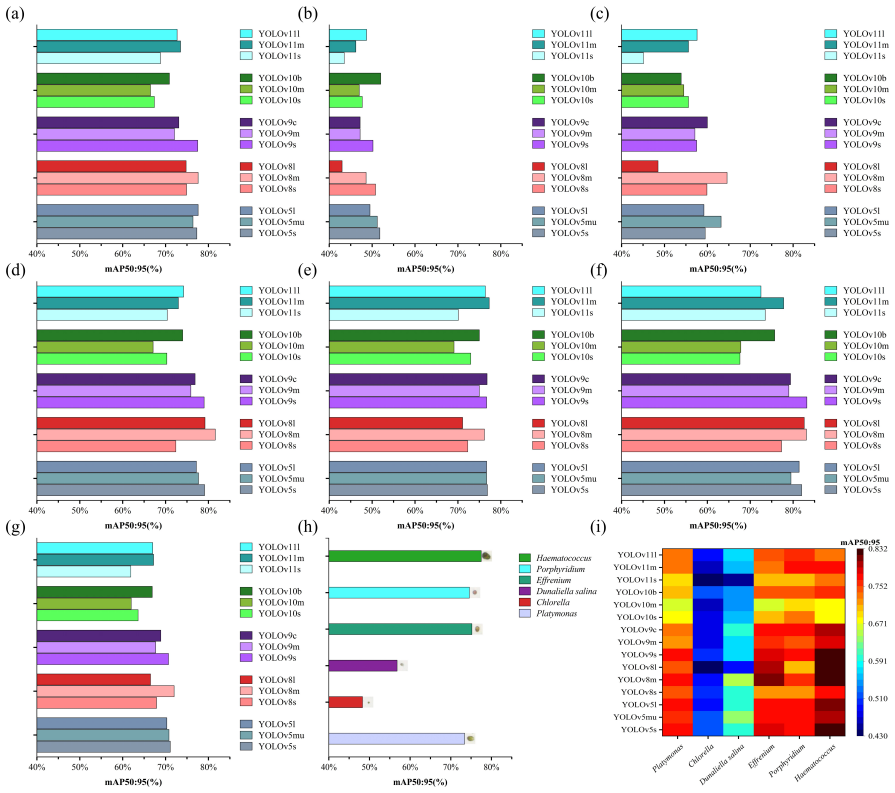
The paper's central claim is that the VisAlgae 2023 dataset exposes a real domain gap between natural-image object detection and microscopy-based algae counting, and that within this domain lightweight detectors can match or exceed much larger models. The authors demonstrate this with a systematic baseline sweep across YOLOv5, YOLOv8, YOLOv9, YOLOv10, and YOLOv11, where neither newer architecture nor larger parameter count consistently improves mAP$_{50:95}$; the best baseline behavior appears at intermediate or small scale, and all models perform worst on Chlorella, the class with the smallest annotation boxes. They further report that the top-performing competition entries, which reached $0.7604$, achieve their gains mostly through data-centric techniques—high input resolution, Poisson fusion and copy-paste augmentation, multi-scale training, test-time augmentation, and weighted box fusion—rather than through novel detection architectures. The paper states these findings as evidence that dataset-specific fine-tuning and small-object handling matter more than blind reliance on generic pretrained models.
Load-bearing premise
The load-bearing premise is that the public leaderboard scores measure real detection skill and not repeated peeking at the test set, because teams could submit many times and overwrite their results over a month.
Editorial extensions
If this is right
- On microscopy data, model size is not a reliable proxy for accuracy: a small YOLOv5 variant outperforms larger versions, so deployment choices should be made per-domain rather than by parameter count alone.
- Newer detectors optimized for natural images can underperform older ones on translucent, low-contrast microscopic targets, implying that benchmark progress on MS COCO does not automatically transfer to specialized imaging domains.
- Small-object handling—higher input resolution, P2 feature layers, and multi-scale training—is the most consistent lever for improving algae detection, especially for the tiny Chlorella class.
- Ensembling and test-time augmentation provide the largest accuracy gains in the reported solutions, but the paper also notes these are often too slow for real-time deployment, pointing to a trade-off between leaderboard score and practical use.
- The dataset is released under a permissive license, allowing other researchers to reuse and extend it for cross-modality adaptation and further benchmarking.
Reading between the lines
- Because the evaluation allowed up to five overwriting submissions per day for more than a month, the leaderboard probably includes some degree of adaptation to the public test set; testing the same models on a newly annotated batch would separate generalization from test-set feedback.
- The winning solution's dynamic cache of algae crops for Poisson blending suggests that treating the training set as a reusable pool of object appearances is a promising direction for other small-object microscopy tasks; a controlled study could test this recipe outside algae.
- The paper's finding that all models struggle most on the smallest class implies the benchmark may be better described as a small-object detection problem than an algae-classification problem; reporting size-stratified mAP would sharpen future comparisons.
- The challenge's emphasis on mAP alone, as the paper itself notes, leaves efficiency out of the ranking; a metric that includes latency would likely favor the lightweight detectors the baseline section highlights.
Editorial analysis
A structured set of objections, weighed in public.
Referee Report
Summary. The paper presents the VisAlgae 2023 challenge and dataset for microalgae detection in microscopy images: 1000 images, six algae classes, a 700/300 train/test split, and mAP50:95 as the evaluation metric. The authors report baseline experiments with YOLOv5/8/9/10/11 variants and summarize the top-10 leaderboard methods, emphasizing the role of high-resolution inputs, augmentation (Poisson fusion, copy-paste, Mixup), attention modules, Weighted Box Fusion, and Test-Time Augmentation. The central claims are that the dataset is a useful public benchmark for an under-explored domain and that lightweight detectors can match or outperform larger models on this task.
Significance. If the benchmark numbers are reliable, this is a valuable public resource for microalgae detection: the dataset is released under CC-BY-4.0, it covers six taxonomically meaningful classes with small-object and multi-scale challenges, and the challenge attracted 369 teams. The structured summary of the top-10 methods is a useful practical reference for practitioners. The paper's main weaknesses are that the baseline results are not computed on the same test set as the leaderboard and that the public-leaderboard protocol permits repeated feedback-driven submissions, so the headline comparisons are not yet fully trustworthy. The dataset contribution itself is solid and could support a strong revised version.
major comments (3)
- [Sections 4.1 and 4.2] The baseline results are computed on an 8:2 split of the 700 training images, while the leaderboard scores in Table 3 are computed on the 300-image test set described in Section 3.1.1. The claim in Section 4.2 that 'the lightweight variant YOLOv5 achieved better performance (0.711) compared to its larger counterparts (0.69–0.70)' is therefore a validation-split comparison, not a challenge-leaderboard comparison. The paper should either evaluate the baselines on the same hidden test set or explicitly state that the comparison is validation-only and not directly tied to Table 3. Additionally, no error bars or multiple-seed runs are reported, so the small differences between models could be within run-to-run variability.
- [Section 3.2 and Table 3] The evaluation protocol allows each team to submit up to five times per day between December 22, 2023, and January 25, 2024, with automatic overwriting and no described total-submission cap or final private test set. Because the leaderboard exposes the score after each submission, teams can iteratively probe the test set, and the final ranking may reflect selection over many attempts rather than a single held-out evaluation. The gap between rank 1 (0.7604) and rank 10 (0.7244) is only 0.036 mAP, so even modest selection bias could reorder the leaderboard. The paper needs to address this directly, for example by reporting the number of submissions per team, comparing early versus late scores, using a final hidden re-evaluation, or providing an analysis of the stability of the scores.
- [Section 5, Tables 5–10] The ablation studies and incremental gains reported by the top-10 teams (e.g., the 0.46% gain from AIFI and 0.66% gain from CARAFE in Table 9, or the RepCSPLayer results in Table 8) are self-reported with no checkpoints, code, or repeated-run statistics. The paper presents these numbers as evidence for the effectiveness of the described techniques. The text should explicitly state that these are unreviewed self-reports from participants and not independently verified, or the authors should provide reproducibility materials for the participant methods.
minor comments (5)
- [Section 5.2.2 and Table 9] The module name 'CAREFE' appears to be a typo for 'CARAFE'; the same typo occurs in the Table 9 header.
- [Section 5.1.3 and Figure 3 caption] The spelling 'Possion' should be 'Poisson', and the Figure 3 caption duplicates the phrase 'the team in solution of the team in 1st place'.
- [Section 4.2] The model name 'YOLOv5mu' is unusual; the YOLOv5 family uses sizes n/s/m/l/x, so 'YOLOv5m' is likely intended.
- [CRediT authorship statement] The contributor 'Qiu Guan' is listed twice with 'Methodology'; remove the duplicate entry.
- [References [52] and [53]] References [52] and [53] are duplicate entries for the same Mixup paper; they should be consolidated into a single reference.
Circularity Check
No circularity found: the paper reports direct empirical measurements on a new public dataset, with no fitted parameter, derivation, or prediction that reduces to its own inputs.
full rationale
The paper is a dataset-and-challenge summary rather than a derivation or modeling paper. Its central claims are (1) the VisAlgae 2023 dataset exists and is expert-annotated, (2) baseline detectors score a certain mAP50:95 on an 8:2 split of the training data, and (3) the top-10 leaderboard scores on the private test set are as listed in Table 3. None of these claims is defined in terms of the paper's own conclusions. The baseline numbers are direct measurements on a validation split; the leaderboard numbers are direct measurements by the Tianchi platform on the test set with private annotations. There is no parameter fitted to a subset and then renamed a prediction, no uniqueness theorem invoked from the authors' prior work, and no ansatz smuggled in via citation. The self-citations to [56, 57] are used only for details of the image-acquisition platform and prior challenge data, which are not load-bearing for the numerical results reported here; the dataset itself is released publicly and verified independently by expert annotators, so the citation is not the evidence for the dataset's properties. The protocol features that a skeptic might question — up to five submissions per day with automatic overwriting on a public leaderboard during a month-long window (Section 3.2), and the fact that the 'lightweight beats larger' baseline comparison in Section 4.2 is computed on the validation split rather than the private test set — are genuine correctness or generalizability risks, but they are not circularity. They concern whether the reported scores generalize or whether leaderboard probing inflated the top-10 results, not whether any claim is equivalent by construction to its inputs. Per the hard rules, concerns about benchmark validity without an exhibited definitional reduction belong to correctness risk, not circularity. Accordingly, no circular step can be quoted and exhibited, and the appropriate finding is no significant circularity with score 0.
Assumptions & free parameters
assumptions (4)
- domain assumption Domain experts correctly identified and annotated all six algae species in every image.
- domain assumption The 700/300 train and test splits contain no near-duplicate images, despite both being frames from the same video sequences.
- domain assumption Public leaderboard scores are not inflated by repeated submissions probing the test set.
- domain assumption Baseline results on the 8:2 training/validation split are representative of the official test set.
Cite this review
Pith. "Pith review of VisAlgae 2023: A Dataset and Challenge for Algae Detection in Microscopy Images." pith.science (2026). https://pith.science/paper/YAVIL35T
@misc{pith2026250520687,
  author       = {Pith},
  title        = {Pith review of: VisAlgae 2023: A Dataset and Challenge for Algae Detection in Microscopy Images},
  year         = {2026},
  howpublished = {\url{https://pith.science/paper/YAVIL35T}},
  note         = {Machine review of arXiv:2505.20687}
}
read the original abstract
Microalgae, vital for ecological balance and economic sectors, present challenges in detection due to their diverse sizes and conditions. This paper summarizes the second "Vision Meets Algae" (VisAlgae 2023) Challenge, aiming to enhance high-throughput microalgae cell detection. The challenge, which attracted 369 participating teams, includes a dataset of 1000 images across six classes, featuring microalgae of varying sizes and distinct features. Participants faced tasks such as detecting small targets, handling motion blur, and complex backgrounds. The top 10 methods, outlined here, offer insights into overcoming these challenges and maximizing detection accuracy. This intersection of algae research and computer vision offers promise for ecological understanding and technological advancement. The dataset can be accessed at: https://github.com/juntaoJianggavin/Visalgae2023/.
Figures


Figures from the paper (2 more)


Reference graph
Works this paper leans on
-
[1]
Yolov4: Optimal speed and accuracy of object detection.arXiv:2004.10934
Bochkovskiy, A., Wang, C.Y., Liao, H.Y.M., 2020. Yolov4: Optimal speed and accuracy of object detection.arXiv:2004.10934
arXiv 2020
-
[2]
Cai,Z.,Vasconcelos,N.,2018. Cascader-cnn:Delvingintohighqualityobjectdetection,in:ProceedingsoftheIEEEconferenceoncomputer vision and pattern recognition, pp. 6154–6162
work page 2018
-
[3]
Cai,Z.,Vasconcelos,N.,2019.Cascader-cnn:Highqualityobjectdetectionandinstancesegmentation.IEEETransactionsonPatternAnalysis and Machine Intelligence , 1–1URL:http://dx.doi.org/10.1109/tpami.2019.2956516, doi:10.1109/tpami.2019.2956516
arXiv 2019
-
[4]
Detection of microalgae objects based on the improved yolov3 model
Cao, M., Wang, J., Chen, Y., Wang, Y., 2021. Detection of microalgae objects based on the improved yolov3 model. Environmental Science: Processes & Impacts 23, 1516–1530
work page 2021
-
[5]
End-to-endobjectdetectionwithtransformers,in:ECCV
Carion,N.,Massa,F.,Synnaeve,G.,Usunier,N.,Kirillov,A.,Zagoruyko,S.,2020. End-to-endobjectdetectionwithtransformers,in:ECCV
work page 2020
-
[6]
MMDetection:Openmmlabdetectiontoolbox and benchmark
Chen,K.,Wang,J.,Pang,J.,Cao,Y.,Xiong,Y.,Li,X.,Sun,S.,Feng,W.,Liu,Z.,Xu,J.,Zhang,Z.,Cheng,D.,Zhu,C.,Cheng,T.,Zhao,Q., Li,B.,Lu,X.,Zhu,R.,Wu,Y.,Dai,J.,Wang,J.,Shi,J.,Ouyang,W.,Loy,C.C.,Lin,D.,2019. MMDetection:Openmmlabdetectiontoolbox and benchmark. arXiv preprint arXiv:1906.07155
arXiv 2019
-
[7]
Diffusiondet: Diffusion model for object detection
Chen, S., Sun, P., Song, Y., Luo, P., 2022. Diffusiondet: Diffusion model for object detection. arXiv preprint arXiv:2211.09788
arXiv 2022
-
[8]
Dalal, N., Triggs, B., 2005. Histograms of oriented gradients for human detection, in: 2005 IEEE computer society conference on computer vision and pattern recognition (CVPR’05), Ieee. pp. 886–893
work page 2005
Show all 58 references
-
[9]
Bioindicators in marine waters: benthic diatoms as a tool to assess water quality from eutrophic to oligotrophic coastal ecosystems
Desrosiers, C., Leflaive, J., Eulin, A., Ten-Hage, L., 2013. Bioindicators in marine waters: benthic diatoms as a tool to assess water quality from eutrophic to oligotrophic coastal ecosystems. Ecological indicators 32, 25–34
2013
-
[10]
An image is worth 16x16 words: Transformers for image recognition at scale
Dosovitskiy, A., Beyer, L., Kolesnikov, A., Weissenborn, D., Zhai, X., Unterthiner, T., Dehghani, M., Minderer, M., Heigold, G., Gelly, S., et al., 2020. An image is worth 16x16 words: Transformers for image recognition at scale. arXiv preprint arXiv:2010.11929
2020 arXiv
-
[11]
Data augmentation for object detection via controllable diffusion models, in: Proceedings of the IEEE/CVF winter conference on applications of computer vision, pp
Fang, H., Han, B., Zhang, S., Zhou, S., Hu, C., Ye, W.M., 2024. Data augmentation for object detection via controllable diffusion models, in: Proceedings of the IEEE/CVF winter conference on applications of computer vision, pp. 1257–1266
2024
-
[12]
Simple copy-paste is a strong data augmentation method for instance segmentation, in: Proceedings of the IEEE/CVF conference on computer vision and pattern recognition, pp
Ghiasi, G., Cui, Y., Srinivas, A., Qian, R., Lin, T.Y., Cubuk, E.D., Le, Q.V., Zoph, B., 2021. Simple copy-paste is a strong data augmentation method for instance segmentation, in: Proceedings of the IEEE/CVF conference on computer vision and pattern recognition, pp. 2918–2928
2021
-
[13]
Nas-fpn: Learning scalable feature pyramid architecture for object detection, in: Proceedings of the IEEE/CVF conference on computer vision and pattern recognition, pp
Ghiasi, G., Lin, T.Y., Le, Q.V., 2019. Nas-fpn: Learning scalable feature pyramid architecture for object detection, in: Proceedings of the IEEE/CVF conference on computer vision and pattern recognition, pp. 7036–7045
2019
-
[14]
Fast r-cnn, in: Proceedings of the IEEE international conference on computer vision, pp
Girshick, R., 2015. Fast r-cnn, in: Proceedings of the IEEE international conference on computer vision, pp. 1440–1448
2015
-
[15]
Rich feature hierarchies for accurate object detection and semantic segmentation, in: Proceedings of the IEEE conference on computer vision and pattern recognition, pp
Girshick, R., Donahue, J., Darrell, T., Malik, J., 2014. Rich feature hierarchies for accurate object detection and semantic segmentation, in: Proceedings of the IEEE conference on computer vision and pattern recognition, pp. 580–587. 14
2014
-
[16]
Deep residual learning for image recognition, in: Proceedings of the IEEE conference on computer vision and pattern recognition, pp
He, K., Zhang, X., Ren, S., Sun, J., 2016. Deep residual learning for image recognition, in: Proceedings of the IEEE conference on computer vision and pattern recognition, pp. 770–778
2016
-
[17]
Coordinate attention for efficient mobile network design, in: Proceedings of the IEEE/CVF conference on computer vision and pattern recognition, pp
Hou, Q., Zhou, D., Feng, J., 2021. Coordinate attention for efficient mobile network design, in: Proceedings of the IEEE/CVF conference on computer vision and pattern recognition, pp. 13713–13722
2021
-
[18]
Ultralytics yolov5
Jocher, G., 2020. Ultralytics yolov5. URL:https://github.com/ultralytics/yolov5, doi:10.5281/zenodo.3908559
2020 doi
-
[19]
Ultralytics yolov8
Jocher, G., Chaurasia, A., Qiu, J., 2023. Ultralytics yolov8. URL:https://github.com/ultralytics/ultralytics
2023
-
[20]
Ultralytics yolo11
Jocher, G., Qiu, J., 2024. Ultralytics yolo11. URL:https://github.com/ultralytics/ultralytics
2024
-
[21]
Deep learning
LeCun, Y., Bengio, Y., Hinton, G., 2015. Deep learning. nature 521, 436–444
2015
-
[22]
Yolov6 v3.0: A full-scale reloading
Li, C., Li, L., Geng, Y., Jiang, H., Cheng, M., Zhang, B., Ke, Z., Xu, X., Chu, X., 2023. Yolov6 v3.0: A full-scale reloading. arXiv:2301.05586
2023 arXiv
-
[23]
An improved algae-yolo model based on deep learning for object detection of ocean microalgae considering aquacultural lightweight deployment
Liu, D., Wang, P., Cheng, Y., Bi, H., 2022. An improved algae-yolo model based on deep learning for object detection of ocean microalgae considering aquacultural lightweight deployment. Frontiers in Marine Science 9, 2378
2022
-
[24]
Path aggregation network for instance segmentation, in: Proceedings of the IEEE conference on computer vision and pattern recognition, pp
Liu, S., Qi, L., Qin, H., Shi, J., Jia, J., 2018. Path aggregation network for instance segmentation, in: Proceedings of the IEEE conference on computer vision and pattern recognition, pp. 8759–8768
2018
-
[25]
Ssd: Single shot multibox detector
Liu, W., Anguelov, D., Erhan, D., Szegedy, C., Reed, S., Fu, C.Y., Berg, A.C., 2016. Ssd: Single shot multibox detector. ECCV
2016
-
[26]
Swin transformer: Hierarchical vision transformer using shifted windows, in: Proceedings of the IEEE/CVF international conference on computer vision, pp
Liu, Z., Lin, Y., Cao, Y., Hu, H., Wei, Y., Zhang, Z., Lin, S., Guo, B., 2021. Swin transformer: Hierarchical vision transformer using shifted windows, in: Proceedings of the IEEE/CVF international conference on computer vision, pp. 10012–10022
2021
-
[27]
Detrs beat yolos on real-time object detection
Lv, W., Xu, S., Zhao, Y., Wang, G., Wei, J., Cui, C., Du, Y., Dang, Q., Liu, Y., 2023. Detrs beat yolos on real-time object detection. arXiv preprint arXiv:2304.08069
2023 arXiv
-
[28]
Rtmdet: An empirical study of designing real-time object detectors
Lyu, C., Zhang, W., Huang, H., Zhou, Y., Wang, Y., Liu, Y., Zhang, S., Chen, K., 2022. Rtmdet: An empirical study of designing real-time object detectors. arXiv preprint arXiv:2212.07784
2022 arXiv
-
[29]
Science of the Total Environment 802, 149800
O’Neill,E.A.,Rowan,N.J.,2022.Microalgaeasanaturalecologicalbioindicatorforthesimplereal-timemonitoringofaquaculturewastewater qualityincludingprovisionforassessingimpactofextremesinclimatevariance–acomparativecasestudyfromtherepublicofireland. Science of the Total Environment ...
2022
-
[30]
Onthe integration of self-attentionand convolution, in:Proceedings of the IEEE/CVF conference on computer vision and pattern recognition, pp
Pan, X.,Ge, C., Lu, R.,Song, S., Chen, G.,Huang, Z., Huang, G.,2022. Onthe integration of self-attentionand convolution, in:Proceedings of the IEEE/CVF conference on computer vision and pattern recognition, pp. 815–825
2022
-
[31]
Microalgae detection using a deep learning object detection algorithm, yolov3
Park, J., Baek, J., You, K., Nam, S.W., Kim, J., 2021. Microalgae detection using a deep learning object detection algorithm, yolov3. Journal of Korean Society on Water Environment 37, 275–285
2021
-
[32]
Youonlylookonce:Unified,real-timeobjectdetection,in:ProceedingsoftheIEEE conference on computer vision and pattern recognition, pp
Redmon,J.,Divvala,S.,Girshick,R.,Farhadi,A.,2016. Youonlylookonce:Unified,real-timeobjectdetection,in:ProceedingsoftheIEEE conference on computer vision and pattern recognition, pp. 779–788
2016
-
[33]
Yolo9000: better, faster, stronger, in: Proceedings of the IEEE conference on computer vision and pattern recognition, pp
Redmon, J., Farhadi, A., 2017. Yolo9000: better, faster, stronger, in: Proceedings of the IEEE conference on computer vision and pattern recognition, pp. 7263–7271
2017
-
[34]
Yolov3: An incremental improvement
Redmon, J., Farhadi, A., 2018. Yolov3: An incremental improvement. arXiv preprint arXiv:1804.02767
2018 arXiv
-
[35]
Faster r-cnn: Towards real-time object detection with region proposal networks
Ren, S., He, K., Girshick, R., Sun, J., 2015. Faster r-cnn: Towards real-time object detection with region proposal networks. Advances in neural information processing systems 28
2015
-
[36]
Weighted boxes fusion: Ensembling boxes from different object detection models
Solovyev, R., Wang, W., Gabruseva, T., 2021. Weighted boxes fusion: Ensembling boxes from different object detection models. Image and Vision Computing , 1–6
2021
-
[37]
Commercial applications of microalgae
Spolaore, P., Joannis-Cassan, C., Duran, E., Isambert, A., 2006. Commercial applications of microalgae. Journal of bioscience and bioengineering 101, 87–96
2006
-
[38]
Efficientdet: Scalable and efficient object detection, in: Proceedings of the IEEE/CVF conference on computer vision and pattern recognition, pp
Tan, M., Pang, R., Le, Q.V., 2020. Efficientdet: Scalable and efficient object detection, in: Proceedings of the IEEE/CVF conference on computer vision and pattern recognition, pp. 10781–10790
2020
-
[39]
Yolov12: Attention-centric real-time object detectors
Tian, Y., Ye, Q., Doermann, D., 2025. Yolov12: Attention-centric real-time object detectors. arXiv preprint arXiv:2502.12524
2025 arXiv
-
[40]
Effective data augmentation with diffusion models
Trabucco, B., Doherty, K., Gurinas, M., Salakhutdinov, R., 2023. Effective data augmentation with diffusion models. arXiv preprint arXiv:2302.07944
2023 arXiv
-
[41]
Rapid object detection using a boosted cascade of simple features, in: Proceedings of the 2001 IEEE computer society conference on computer vision and pattern recognition
Viola, P., Jones, M., 2001. Rapid object detection using a boosted cascade of simple features, in: Proceedings of the 2001 IEEE computer society conference on computer vision and pattern recognition. CVPR 2001, Ieee. pp. I–I
2001
-
[42]
Yolov10: Real-time end-to-end object detection
Wang, A., Chen, H., Liu, L., et al., 2024. Yolov10: Real-time end-to-end object detection. arXiv preprint arXiv:2405.14458
2024 arXiv
-
[43]
YOLOv7:Trainablebag-of-freebiessetsnewstate-of-the-artforreal-timeobjectdetectors
Wang,C.Y.,Bochkovskiy,A.,Liao,H.Y.M.,2022. YOLOv7:Trainablebag-of-freebiessetsnewstate-of-the-artforreal-timeobjectdetectors. arXiv preprint arXiv:2207.02696
2022 arXiv
-
[44]
YOLOv9: Learning what you want to learn using programmable gradient information
Wang, C.Y., Liao, H.Y.M., 2024. YOLOv9: Learning what you want to learn using programmable gradient information
2024
-
[45]
Carafe:Content-awarereassemblyoffeatures,in:ProceedingsoftheIEEE/CVF International Conference on Computer Vision (ICCV)
Wang,J.,Chen,K.,Xu,R.,Liu,Z.,Loy,C.C.,Lin,D.,2019. Carafe:Content-awarereassemblyoffeatures,in:ProceedingsoftheIEEE/CVF International Conference on Computer Vision (ICCV)
2019
-
[46]
Internimage: Exploring large-scale vision foundation models with deformable convolutions, in: Proceedings of the IEEE/CVF conference on computer vision and pattern recognition, pp
Wang, W., Dai, J., Chen, Z., Huang, Z., Li, Z., Zhu, X., Hu, X., Lu, T., Lu, L., Li, H., et al., 2023. Internimage: Exploring large-scale vision foundation models with deformable convolutions, in: Proceedings of the IEEE/CVF conference on computer vision and pattern recognitio...
2023
-
[47]
Convnext v2: Co-designing and scaling convnets with masked autoencoders, in: Proceedings of the IEEE/CVF conference on computer vision and pattern recognition, pp
Woo, S., Debnath, S., Hu, R., Chen, X., Liu, Z., Kweon, I.S., Xie, S., 2023. Convnext v2: Co-designing and scaling convnets with masked autoencoders, in: Proceedings of the IEEE/CVF conference on computer vision and pattern recognition, pp. 16133–16142
2023
-
[48]
Cbam: Convolutional block attention module, in: Proceedings of the European conference on computer vision (ECCV), pp
Woo, S., Park, J., Lee, J.Y., Kweon, I.S., 2018. Cbam: Convolutional block attention module, in: Proceedings of the European conference on computer vision (ECCV), pp. 3–19
2018
-
[49]
Aggregated residual transformations for deep neural networks.arXiv:1611.05431
Xie, S., Girshick, R., Dollár, P., Tu, Z., He, K., 2017. Aggregated residual transformations for deep neural networks.arXiv:1611.05431
2017 arXiv
-
[50]
Yolox model-based object detection for microalgal bioprocess
Yan, H., Peng, X., Chen, C., Xia, A., Huang, Y., Zhu, X., Zhu, X., Liao, Q., 2023. Yolox model-based object detection for microalgal bioprocess. Algal Research , 103178
2023
-
[51]
Focal modulation networks
Yang, J., Li, C., Dai, X., Gao, J., 2022. Focal modulation networks. Advances in Neural Information Processing Systems 35, 4203–4217. 15
2022
-
[53]
mixup: Beyond empirical risk minimization.arXiv:1710.09412
Zhang, H., Cisse, M., Dauphin, Y.N., Lopez-Paz, D., 2018. mixup: Beyond empirical risk minimization.arXiv:1710.09412
2018 arXiv
-
[54]
Enhancingrareobjectdetectiononroadwaysthroughconditionaldiffusion models for data augmentation
Zhang,H.,Hu,Y.,Qian,Z.,Sha,J.,Xie,M.,Wan,Y.,Liu,P.,2024. Enhancingrareobjectdetectiononroadwaysthroughconditionaldiffusion models for data augmentation. IEEE Transactions on Intelligent Transportation Systems
2024
-
[55]
Computer vision meets microfluidics: a label-free method for high-throughput cell analysis
Zhou, S., Chen, B., Fu, E.S., Yan, H., 2023a. Computer vision meets microfluidics: a label-free method for high-throughput cell analysis. Microsystems & Nanoengineering 9, 116
-
[56]
A microfluidic microalgae detection system for cellular physiological response based on an object detection algorithm
Zhou, S., Chen, T., Fu, E.S., Zhou, T., Shi, L., Yan, H., 2024. A microfluidic microalgae detection system for cellular physiological response based on an object detection algorithm. Lab on a Chip 24, 2762–2773
2024
-
[57]
Vision meets algae: A novel way for microalgae recognization and health monitor
Zhou, S., Jiang, J., Hong, X., Fu, P., Yan, H., 2023b. Vision meets algae: A novel way for microalgae recognization and health monitor. Frontiers in Marine Science 10, 1105545
-
[58]
Deformable detr: Deformable transformers for end-to-end object detection, in: International Conference on Learning Representations
Zhu, X., Su, W., Lu, L., Li, B., Wang, X., Dai, J., 2021. Deformable detr: Deformable transformers for end-to-end object detection, in: International Conference on Learning Representations. URL:https://openreview.net/forum?id=gZ9hCDWe6ke
2021
-
[59]
Detrs with collaborative hybrid assignments training, in: Proceedings of the IEEE/CVF international conference on computer vision, pp
Zong, Z., Song, G., Liu, Y., 2023. Detrs with collaborative hybrid assignments training, in: Proceedings of the IEEE/CVF international conference on computer vision, pp. 6748–6758. 16
2023
Reviewed August 7, 2026 · model on record in the stance chip above.
Discussion (0). Sign in to comment.