REVIEW 5 major objections 4 minor 1 cited by
AdParaphrase v2.0: Generating Attractive Ad Texts Using a Preference-Annotated Paraphrase Dataset
T0 review · 5 major / 4 minor · reviewed 2026-08-07 · deepseek-v4-flash
Pith's one-line read By releasing a 20-fold larger preference-annotated ad-paraphrase dataset of 16,460 Japanese pairs, this paper claims that attractive ad text is tied to specific linguistic features — length, noun density, low perplexity, specificity, and…
desk verdict The dataset is the real contribution; the analytic claims on top need tightening before you trust the feature findings. read the letter →
The pith
A machine-rendered reading of the paper's core claim, the machinery that carries it, and where it could break.
The reading
What carries the argument
The load-bearing object is a paraphrase pair (source ad text, rewritten ad text) that passes a crowd paraphrase-identification filter and carries a preference score from ten evaluators, with "skip" allowed when the two texts feel equally attractive. Because both texts share the same meaning, any preference difference is attributed to how-to-say rather than what-to-say. The dataset's strong-preference subset (3,570 pairs where at least eight of ten judges agree) is the engine of the feature analysis; the 8,721 triplets formed from source, preferred, and dispreferred paraphrases provide the DPO training signal. The pCTR alignment and reference-free LLM-as-judge correlations are supporting mechanisms linking the preference signal to ad performance and to cheaper evaluation.
What would settle it
Re-annotate a random sample of the 3,570 high-agreement pairs with a fresh panel of ten judges: if the majority preference flips or the kappa on that subset drops toward zero, the feature rankings and the DPO training signal rest on unstable labels. A second check is to confirm that the source ad text of no training triplet appears in the test split of the 8,721 triplets; same-source leakage would inflate the DPO evaluation.
Extended reading notes
Core claim
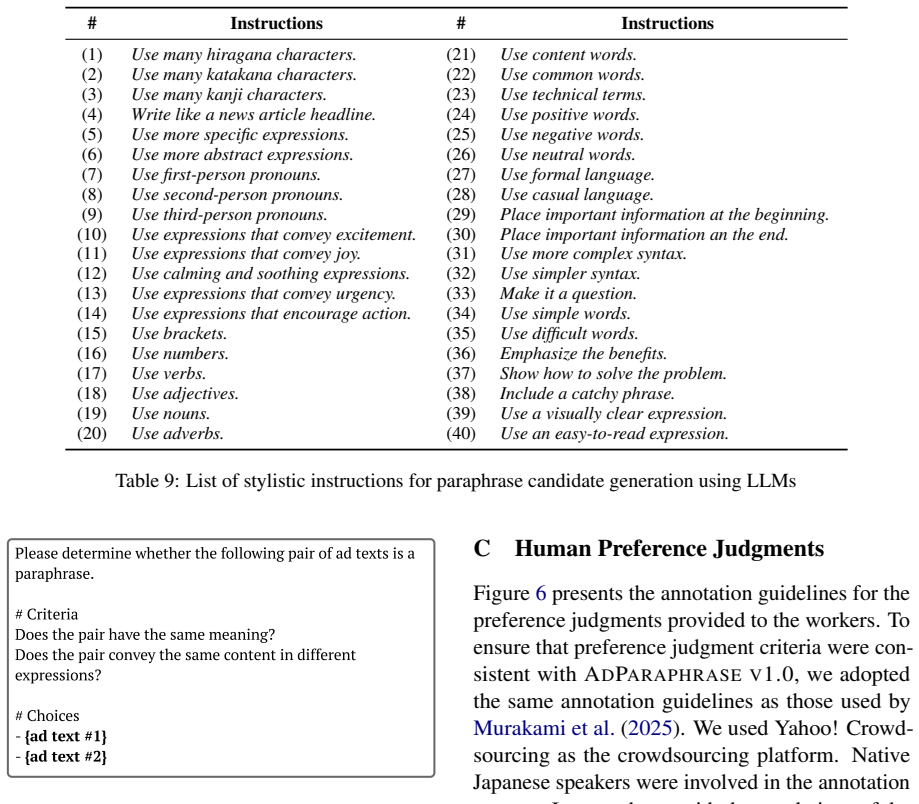
AdParaphrase v2.0 is large enough (16,460 pairs, 10 judgments each; 3,570 pairs with at least eight of ten judges agreeing) to support reliable linguistic analysis and model training. Using chi-square tests on the high-agreement subset, the paper claims attractive ad texts are longer, contain more nouns and noun phrases, more kanji and symbols, lower perplexity and shallower dependency trees, higher specificity, and brackets — whereas features such as adjective counts and dependency link length show no significant effect. Preference-tuned models (DPO) produce the most attractive outputs, but often violate the 30-character ad limit; feeding the feature findings into prompts raises attractiveness while respecting length. Human preference correlates with predicted CTR (Pearson coefficient 0.946) and, in a Google Ads A/B test, paraphrased headlines from two companies improve conversion metrics relative to baseline. Reference-free GPT-4o judgment correlates positively with human attractiveness evaluations, while BLEU and BERTScore correlate negatively, so the paper argues reference-free LLM metrics are better suited to evaluating ad appeal.
Load-bearing premise
The analysis depends on the assumption that crowd preference is a stable signal: although agreement is low overall (kappa = 0.167), the paper treats the 3,570 pairs with at least eight of ten judges on one side as capturing genuine attractiveness rather than noise or selection bias.
Editorial extensions
If this is right
- Researchers can now train ad-text rewriting models on 8,721 preference triplets; the paper's DPO results promise gains in attractiveness, with instruction tuning remaining the safer choice when length constraints matter.
- Prompt writers can apply the discovered features directly: longer text, more nouns, lower perplexity, higher specificity, and brackets are the paper's recipe for preferred ad copy.
- Human preference is a proxy for performance: majority-preferred texts align with predicted CTR at r = 0.946 and with improved conversion metrics in live ads, so preference labels can serve as a development target when CTR data is unavailable.
- Reference-free LLM evaluation can replace human attractiveness judgments at the system level; BLEU and BERTScore should not be used to rank ad appeal because they correlate negatively with human preference.
Reading between the lines
- If the at-least-eight-of-ten agreement threshold is what makes the analysis work, an immediate test is whether DPO trained only on those 3,570 high-agreement pairs outperforms DPO trained on all 8,721 triplets; the paper does not report this comparison, and it would separate genuine signal from label noise.
- The finding that human preference predicts pCTR only about 60 percent of the time even when all ten evaluators agree suggests an upper bound on how much copy style alone can move ad performance; content and placement presumably account for the rest, a consequence the paper states only implicitly.
- The Japanese-specific features (hiragana, kanji, katakana, brackets) invite a cross-lingual version: building an English or Chinese dataset from scratch and testing whether length, specificity, and noun density replicate would show whether these are general copywriting principles or language-specific conventions.
Editorial analysis
A structured set of objections, weighed in public.
Referee Report
Summary. The paper introduces AdParaphrase v2.0, a Japanese ad-text paraphrase dataset containing 16,460 paraphrase pairs, each with preference judgments from ten crowd workers. The dataset is constructed from CAMERA source ads via LLM and crowdworker paraphrasing, followed by paraphrase identification and preference annotation. The authors use the dataset to analyze linguistic features associated with human preference, to train and evaluate ICL, instruction-tuned, and DPO-based ad-text generators, and to relate human preferences to predicted and real ad performance. They also evaluate reference-free LLM-based metrics against human judgments. The central claims are that the dataset enables a more comprehensive and reliable analysis than v1.0, that several new linguistic features of attractive ad texts are identified, and that preference signals correlate with ad performance.
Significance. If the claims hold, AdParaphrase v2.0 is a valuable public resource: it is roughly 20 times larger than v1.0, is released under a permissive research license, and is constructed with a documented pipeline. The paper also contributes an interesting comparison of ICL, instruction tuning, and DPO for ad-text rewriting, and the finding that reference-free LLM judgments track human attractiveness ratings better than reference-based metrics is useful. However, the strength of the linguistic-feature findings is undercut by the low inter-annotator agreement on preference judgments and by the outcome-dependent manner in which the analysis subset is selected. The dataset release itself is the most solid contribution; the analytical conclusions require substantial additional validation.
major comments (5)
- [§4.2, §4.4, §5.1] The core feature analysis is built on an outcome-dependent subset. Overall preference judgments have a Fleiss' kappa of only 0.167 (§4.2), and the analysis then restricts to 3,570 pairs with at least 8 of 10 evaluators agreeing (§4.4). Because this agreement threshold is defined by the same preference votes that serve as the dependent variable in the chi-square tests of Table 4, the selection induces a truncation-on-outcome bias: features that make agreement easier, such as text length or bracket use, will appear associated with preference even if they have no effect on attractiveness. The paper does not address this bias, and Section 8 (Limitations) does not mention it. The authors should analyze the full 16,460 pairs with a model that accounts for rater disagreement, or validate the high-agreement subset on held-out preference labels.
- [Table 4 / Appendix F] The significance claims rest on 26 separate chi-square tests with a fixed p<0.01 threshold and no multiple-testing correction. Several tests also use very small samples, such as sadness with N=17 and question marks with N=78. With 26 comparisons, multiple 'significant' results would be expected by chance even if no feature truly mattered. Report corrected p-values (for example, Benjamini-Hochberg) or use a hierarchical model that pools information across features, and provide confidence intervals for the phi effect sizes.
- [§5.2] The finding-condition prompts (zeroshot-findings and fewshot-findings) are constructed directly from the outcome-selected analysis in §5.1. The improved attractiveness of these conditions over zeroshot in Table 5 can therefore reflect the selection mechanism rather than a genuine improvement in preference, because the prompts instruct the model to use brackets and longer text, which are exactly the features that drive agreement-based selection. The authors should evaluate the finding-condition generations against held-out human preference judgments from the full dataset, and compare against a control prompt that injects features selected identically but from a random split of the data.
- [§5.2.1 (Dataset)] The paper does not state whether the source ad text x is disjoint across the 9:0.5:0.5 train/dev/test split of the 8,721 DPO triplets. If the same source text appears in more than one partition, the DPO evaluation is contaminated by data leakage. The authors should clarify the splitting criterion; if the split is triplet-level only, they should re-split at the source-ad level.
- [§6.1–§6.2, Table 7] The online A/B evidence is mixed: for fitness ads, CTR decreased to 91.5 and CPC increased to 110.7 relative to baseline while CVR and CTVR improved; for education, the two-week run shows CTR 77.7 and the one-month run shows CTR 93.4, and only a subset of metrics is marked significant. Additionally, the pCTR analysis (§6.1) uses a model prediction rather than observed CTR, so the wording 'achieved higher CTRs' overstates what is measured. Please report confidence intervals and impression/click counts for all online metrics, and temper the conclusion to 'suggest' rather than 'demonstrate' a relationship between human preference and ad performance.
minor comments (4)
- [Figure 1] The x-axis labels and tick labels in Figure 1 appear garbled in the submitted PDF; please regenerate the figure so that the preference-vote values are readable.
- [§5.2.1] The split ratio '9 : 0.5 : 0.5' is non-standard; please state the actual numbers of triplets in the training, development, and test sets, or express the ratio as percentages.
- [Table 5] Human evaluation results are reported as point estimates without confidence intervals or significance tests, making comparisons such as CALM3-22B dpo-zeroshot 84.4 versus Swallow70B dpo-zeroshot 71.2 difficult to interpret; add error bars or significance tests, or state explicitly that the comparisons are descriptive only.
- [Table 8] The negative correlations of BLEU and BERTScore with attractiveness deserve a sentence of interpretation; as written, readers may not understand that reference-based metrics reward similarity to a reference paraphrase rather than attractiveness.
Circularity Check
No significant circularity; the dataset construction, feature analyses, and ATG evaluations are self-contained and externally evaluated.
full rationale
The paper makes no derivation claim in which a predicted quantity equals an input by construction. The linguistic-feature analysis in Section 5.1 is a descriptive chi-square association computed on the released preference data itself, not a prediction from a fitted parameter to a held-out quantity, so it cannot reduce to its inputs. The ATG experiment is an intervention: Section 5.2.2 compares zeroshot with zeroshot-findings, where the latter prompt incorporates findings from Section 5.1; the generated texts are then judged by independent human evaluators on PI and attractiveness. This comparison is not forced because the prompted model could fail to produce preferred outputs, and therefore it is not circular. The online A/B test in Section 6.2 uses actual platform metrics, and the pCTR analysis in Section 6.1 uses an independent in-house CTR prediction model. Self-citations to AdParaphrase v1.0 (Murakami et al., 2025) are used for annotation guidelines and few-shot paraphrase examples during construction and as a comparison baseline; they are not invoked to justify the new findings, so this same-author citation is not load-bearing. The paper itself discloses relevant limitations, including low preference IAA (kappa = 0.167 in Section 4.2), LLM-generated texts, and limited participant diversity. Methodological concerns such as restricting the feature analysis to the 3,570 high-agreement pairs selected on the preference outcome, and using GPT-4o both as a generator and as an automatic judge, are validity risks rather than definitional circularity: there is no equation-level identity between the selection rule and the chi-square results, nor between GPT-4o's generated outputs and the human preference labels used for evaluation. Under the stated standard of exhibiting a specific reduction, no circular step is present.
Assumptions & free parameters
free parameters (4)
- High-agreement threshold for feature analysis =
at least 8 of 10 evaluators
- Preference pass threshold for judging generated texts =
at least 8 of 10
- Significance level for chi-square tests =
p < 0.01
- Train/dev/test split ratio =
9:0.5:0.5
assumptions (5)
- domain assumption Crowd preferences are meaningful signals of ad attractiveness
- domain assumption Paraphrase identification by majority of five workers preserves meaning
- domain assumption External classifiers provide valid emotion and specificity labels
- domain assumption Chi-square tests on selected high-agreement pairs identify causal factors
- domain assumption In-house pCTR model is a valid proxy for ad performance
Cite this review
Pith. "Pith review of AdParaphrase v2.0: Generating Attractive Ad Texts Using a Preference-Annotated Paraphrase Dataset." pith.science (2026). https://pith.science/paper/DGURRXWZ
@misc{pith2026250520826,
  author       = {Pith},
  title        = {Pith review of: AdParaphrase v2.0: Generating Attractive Ad Texts Using a Preference-Annotated Paraphrase Dataset},
  year         = {2026},
  howpublished = {\url{https://pith.science/paper/DGURRXWZ}},
  note         = {Machine review of arXiv:2505.20826}
}
read the original abstract
Identifying factors that make ad text attractive is essential for advertising success. This study proposes AdParaphrase v2.0, a dataset for ad text paraphrasing, containing human preference data, to enable the analysis of the linguistic factors and to support the development of methods for generating attractive ad texts. Compared with v1.0, this dataset is 20 times larger, comprising 16,460 ad text paraphrase pairs, each annotated with preference data from ten evaluators, thereby enabling a more comprehensive and reliable analysis. Through the experiments, we identified multiple linguistic features of engaging ad texts that were not observed in v1.0 and explored various methods for generating attractive ad texts. Furthermore, our analysis demonstrated the relationships between human preference and ad performance, and highlighted the potential of reference-free metrics based on large language models for evaluating ad text attractiveness. The dataset is publicly available at: https://github.com/CyberAgentAILab/AdParaphrase-v2.0.
Figures


Figures from the paper (4 more)



Forward citations
Cited by 1 Pith paper
-
AI-Generated Content in Cross-Domain Applications: Research Trends, Challenges and Propositions
A cross-domain vision paper that surveys AI-generated content and proposes research directions, without introducing new empirical results.
Reference graph
Works this paper leans on
-
[1]
online" 'onlinestring :=
ENTRY address archivePrefix author booktitle chapter edition editor eid eprint eprinttype howpublished institution journal key month note number organization pages publisher school series title type volume year doi pubmed url lastchecked label extra.label sort.label short.list INTEGERS output.state before.all mid.sentence after.sentence after.block STRING...
-
[2]
write newline
" write newline "" before.all 'output.state := FUNCTION n.dashify 't := "" t empty not t #1 #1 substring "-" = t #1 #2 substring "--" = not "--" * t #2 global.max substring 't := t #1 #1 substring "-" = "-" * t #2 global.max substring 't := while if t #1 #1 substring * t #2 global.max substring 't := if while FUNCTION word.in bbl.in capitalize " " * FUNCT...
- [3]
-
[4]
Tom Brown, Benjamin Mann, Nick Ryder, Melanie Subbiah, Jared D Kaplan, Prafulla Dhariwal, Arvind Neelakantan, Pranav Shyam, Girish Sastry, Amanda Askell, Sandhini Agarwal, Ariel Herbert-Voss, Gretchen Krueger, Tom Henighan, Rewon Child, Aditya Ramesh, Daniel Ziegler, Jeffrey Wu, Clemens Winter, Chris Hesse, Mark Chen, Eric Sigler, Mateusz Litwin, Scott Gr...
work page 2020
-
[5]
Jan Cegin, Jakub Simko, and Peter Brusilovsky. 2023. https://doi.org/10.18653/v1/2023.emnlp-main.117 C hat GPT to replace crowdsourcing of paraphrases for intent classification: Higher diversity and comparable model robustness . In Proceedings of the 2023 Conference on Empirical Methods in Natural Language Processing, pages 1889--1905
-
[6]
Jacob Cohen. 1988. Statistical Power Analysis for the Behavioral Sciences, 2nd edition. Lawrence Erlbaum Associates, Hillsdale, NJ
1988
-
[7]
Tim Dettmers, Artidoro Pagnoni, Ari Holtzman, and Luke Zettlemoyer. 2023. Qlora: efficient finetuning of quantized llms. In Advances in Neural Information Processing Systems 36
work page 2023
-
[8]
J.L. Fleiss et al. 1971. Measuring nominal scale agreement among many raters . Psychological Bulletin, 76(5):378--382
work page 1971
Show all 48 references
-
[9]
Kazuki Fujii, Taishi Nakamura, Mengsay Loem, Hiroki Iida, Masanari Ohi, Kakeru Hattori, Hirai Shota, Sakae Mizuki, Rio Yokota, and Naoaki Okazaki. 2024. https://openreview.net/forum?id=TQdd1VhWbe Continual pre-training for cross-lingual LLM adaptation: Enhancing japanese langu...
2024
-
[10]
Jiawei Gu, Xuhui Jiang, Zhichao Shi, Hexiang Tan, Xuehao Zhai, Chengjin Xu, Wei Li, Yinghan Shen, Shengjie Ma, Honghao Liu, Yuanzhuo Wang, and Jian Guo. 2025. https://arxiv.org/abs/2411.15594 A survey on llm-as-a-judge . Preprint, arXiv:2411.15594
2025 arXiv
-
[11]
Weston Hughes, Keng-hao Chang, and Ruofei Zhang
J. Weston Hughes, Keng-hao Chang, and Ruofei Zhang. 2019. https://doi.org/10.1145/3292500.3330754 Generating better search engine text advertisements with deep reinforcement learning . In Proceedings of the 25th ACM SIGKDD International Conference on Knowledge Discovery and Da...
2019
-
[12]
Ryosuke Ishigami. 2024. https://huggingface.co/cyberagent/calm3-22b-chat cyberagent/calm3-22b-chat . Hugging Face
2024
-
[13]
Aditi Jha, Sam Havens, Jeremy Dohmann, Alex Trott, and Jacob Portes. 2023. Limit: Less is more for instruction tuning across evaluation paradigms. arXiv preprint arXiv:2311.13133
2023 arXiv
-
[14]
Tomoyuki Kajiwara, Chenhui Chu, Noriko Takemura, Yuta Nakashima, and Hajime Nagahara. 2021. https://doi.org/10.18653/v1/2021.naacl-main.169 WRIME : A new dataset for emotional intensity estimation with subjective and objective annotations . In Proceedings of the 2021 Conferenc...
2021 doi
-
[15]
Hidetaka Kamigaito, Peinan Zhang, Hiroya Takamura, and Manabu Okumura. 2021. https://aclanthology.org/2021.naacl-industry.32/ An empirical study of generating texts for search engine advertising . In Proceedings of the 2021 Conference of the North American Chapter of the Assoc...
2021
-
[16]
Jan-Christoph Klie, Richard Eckart de Castilho, and Iryna Gurevych. 2024. https://doi.org/10.1162/coli_a_00516 Analyzing dataset annotation quality management in the wild . Computational Linguistics, 50(3):817--866
2024 doi
-
[17]
Wuwei Lan, Siyu Qiu, Hua He, and Wei Xu. 2017. https://doi.org/10.18653/v1/D17-1126 A continuously growing dataset of sentential paraphrases . In Proceedings of the 2017 Conference on Empirical Methods in Natural Language Processing, pages 1224--1234, Copenhagen, Denmark. Asso...
2017 doi
-
[18]
Richard Landis and Gary G
J. Richard Landis and Gary G. Koch. 1977. http://www.jstor.org/stable/2529310 The measurement of observer agreement for categorical data . Biometrics, 33(1):159--174
1977
-
[19]
Vladimir I Levenshtein. 1966. Binary codes capable of correcting deletions, insertions and reversals. Soviet Physics Doklady, 10:707
1966
-
[20]
Chin-Yew Lin. 2004. https://aclanthology.org/W04-1013 ROUGE : A package for automatic evaluation of summaries . In Proceedings of the ACL Workshop: Text Summarization Branches Out , pages 74--81
2004
-
[21]
Yang Liu, Dan Iter, Yichong Xu, Shuohang Wang, Ruochen Xu, and Chenguang Zhu. 2023. https://doi.org/10.18653/v1/2023.emnlp-main.153 G -eval: NLG evaluation using gpt-4 with better human alignment . In Proceedings of the 2023 Conference on Empirical Methods in Natural Language ...
2023 doi
-
[22]
Kikuo Maekawa, Makoto Yamazaki, Takehiko Maruyama, Masaya Yamaguchi, Hideki Ogura, Wakako Kashino, Toshinobu Ogiso, Hanae Koiso, and Yasuharu Den. 2010. http://www.lrec-conf.org/proceedings/lrec2010/pdf/99_Paper.pdf Design, compilation, and preliminary analyses of B alanced C ...
2010
-
[23]
Shaunak Mishra, Manisha Verma, Yichao Zhou, Kapil Thadani, and Wei Wang. 2020. https://doi.org/10.1145/3340531.3412720 Learning to create better ads: Generation and ranking approaches for ad creative refinement . In Proceedings of the 29th ACM International Conference on Infor...
2020
-
[24]
Masato Mita, Soichiro Murakami, Akihiko Kato, and Peinan Zhang. 2024. https://doi.org/10.18653/v1/2024.acl-long.54 Striking gold in advertising: Standardization and exploration of ad text generation . In Proceedings of the 62th Annual Meeting of the Association for Computation...
2024 doi
-
[25]
Soichiro Murakami, Sho Hoshino, and Peinan Zhang. 2023. https://arxiv.org/abs/2306.12719 Natural language generation for advertising: A survey . Preprint, arXiv:2306.12719
2023 arXiv
-
[26]
Soichiro Murakami, Peinan Zhang, Sho Hoshino, Hidetaka Kamigaito, Hiroya Takamura, and Manabu Okumura. 2022. https://doi.org/10.18653/v1/2022.naacl-industry.9 Aspect-based analysis of advertising appeals for search engine advertising . In Proceedings of the 2022 Conference of ...
2022 doi
-
[27]
Soichiro Murakami, Peinan Zhang, Hidetaka Kamigaito, Hiroya Takamura, and Manabu Okumura. 2025. https://arxiv.org/abs/2502.04674 A d P araphrase: Paraphrase dataset for analyzing linguistic features toward generating attractive ad texts . Preprint, arXiv:2502.04674
2025 arXiv
-
[28]
OpenAI. 2024. https://openai.com/index/hello-gpt-4o/ Hello gpt-4o . Accessed: 2025-01-03
2024
-
[29]
Kishore Papineni, Salim Roukos, Todd Ward, and Wei-Jing Zhu. 2002. https://aclanthology.org/P02-1040 BLEU : A method for automatic evaluation of machine translation . In Proceedings of the 40th Annual Meeting of the Association for Computational Linguistics, pages 311--318
2002
-
[30]
Ryan Park, Rafael Rafailov, Stefano Ermon, and Chelsea Finn. 2024. https://doi.org/10.18653/v1/2024.findings-acl.297 Disentangling length from quality in direct preference optimization . In Findings of the Association for Computational Linguistics: ACL 2024, pages 4998--5017
2024 doi
-
[31]
Reid Pryzant, Sugato Basu, and Kazoo Sone. 2018. https://doi.org/10.18653/v1/W18-5415 Interpretable neural architectures for attributing an ad ' s performance to its writing style . In Proceedings of the 2018 EMNLP Workshop B lackbox NLP : Analyzing and Interpreting Neural Net...
2018 doi
-
[32]
Manning, and Chelsea Finn
Rafael Rafailov, Archit Sharma, Eric Mitchell, Stefano Ermon, Christopher D. Manning, and Chelsea Finn. 2023. Direct preference optimization: your language model is secretly a reward model. In Advances in Neural Information Processing Systems 36
2023
-
[33]
Satoshi Sato, Suguru Matsuyoshi, and Yohsuke Kondoh. 2008. http://www.lrec-conf.org/proceedings/lrec2008/pdf/165_paper.pdf Automatic assessment of J apanese text readability based on a textbook corpus . In Proceedings of the Sixth International Conference on Language Resources...
2008
-
[34]
Victor O. Schwab. 2013. How to Write a Good Advertisement: A Short Course in Copywriting, illustrated edition edition. Echo Point Books & Media
2013
-
[35]
Chantal Shaib, Yanai Elazar, Junyi Jessy Li, and Byron C Wallace. 2024. https://doi.org/10.18653/v1/2024.emnlp-main.368 Detection and measurement of syntactic templates in generated text . In Proceedings of the 2024 Conference on Empirical Methods in Natural Language Processin...
2024 doi
-
[36]
Kazuma Takaoka, Sorami Hisamoto, Noriko Kawahara, Miho Sakamoto, Yoshitaka Uchida, and Yuji Matsumoto. 2018. Sudachi: a japanese tokenizer for business. In Proceedings of the Eleventh International Conference on Language Resources and Evaluation
2018
-
[37]
Hsueh-Cheng Wang and Marc Pomplun. 2012. https://doi.org/10.1167/12.6.26 The attraction of visual attention to texts in real-world scenes . Journal of Vision, 12(6):26--26
2012 doi
-
[38]
Peiyi Wang, Lei Li, Liang Chen, Zefan Cai, Dawei Zhu, Binghuai Lin, Yunbo Cao, Lingpeng Kong, Qi Liu, Tianyu Liu, and Zhifang Sui. 2024. https://doi.org/10.18653/v1/2024.acl-long.511 Large language models are not fair evaluators . In Proceedings of the 62nd Annual Meeting of t...
2024 doi
-
[39]
Xiting Wang, Xinwei Gu, Jie Cao, Zihua Zhao, Yulan Yan, Bhuvan Middha, and Xing Xie. 2021. https://doi.org/10.1145/3447548.3467105 Reinforcing pretrained models for generating attractive text advertisements . In Proceedings of the 27th ACM SIGKDD International Conference on Kn...
2021
-
[40]
Jason Wei, Maarten Paul Bosma, Vincent Zhao, Kelvin Guu, Adams Wei Yu, Brian Lester, Nan Du, Andrew Mingbo Dai, and Quoc V. Le. 2022. https://openreview.net/forum?id=gEZrGCozdqR Finetuned language models are zero-shot learners . In The Tenth International Conference on Learnin...
2022
-
[41]
Thomas Wolf, Lysandre Debut, Victor Sanh, Julien Chaumond, Clement Delangue, Anthony Moi, Pierric Cistac, Tim Rault, Remi Louf, Morgan Funtowicz, Joe Davison, Sam Shleifer, Patrick von Platen, Clara Ma, Yacine Jernite, Julien Plu, Canwen Xu, Teven Le Scao, Sylvain Gugger, Mari...
2020 doi
-
[42]
Ikuya Yamada, Akari Asai, Hiroyuki Shindo, Hideaki Takeda, and Yuji Matsumoto. 2020. https://doi.org/10.18653/v1/2020.emnlp-main.523 LUKE : Deep contextualized entity representations with entity-aware self-attention . In Proceedings of the 2020 Conference on Empirical Methods ...
2020 doi
-
[43]
Brit Youngmann, Elad Yom-Tov, Ran Gilad-Bachrach, and Danny Karmon. 2020. https://doi.org/10.1145/3366423.3380211 The automated copywriter: Algorithmic rephrasing of health-related advertisements to improve their performance . In Proceedings of The Web Conference 2020, pages 1...
2020
-
[44]
Yuan Yuan, Fengli Xu, Hancheng Cao, Guozhen Zhang, Pan Hui, Yong Li, and Depeng Jin. 2023. https://doi.org/10.1109/TKDE.2021.3110724 Persuade to click: Context-aware persuasion model for online textual advertisement . IEEE Transactions on Knowledge and Data Engineering, 35(2):...
2023
-
[45]
Weinberger, and Yoav Artzi
Tianyi Zhang, Varsha Kishore, Felix Wu, Kilian Q. Weinberger, and Yoav Artzi. 2020. https://openreview.net/forum?id=SkeHuCVFDr Bertscore: Evaluating text generation with bert . In The Eighth International Conference on Learning Representations
2020
-
[46]
Yuan Zhang, Jason Baldridge, and Luheng He. 2019. https://doi.org/10.18653/v1/N19-1131 PAWS : Paraphrase adversaries from word scrambling . In Proceedings of the 2019 Conference of the North American Chapter of the Association for Computational Linguistics: Human Language Tech...
2019 doi
-
[47]
Jianing Zhou and Suma Bhat. 2021. https://doi.org/10.18653/v1/2021.emnlp-main.414 Paraphrase generation: A survey of the state of the art . In Proceedings of the 2021 Conference on Empirical Methods in Natural Language Processing, pages 5075--5086. Association for Computationa...
2021 doi
-
[48]
Yaoming Zhu, Sidi Lu, Lei Zheng, Jiaxian Guo, Weinan Zhang, Jun Wang, and Yong Yu. 2018. https://doi.org/10.1145/3209978.3210080 Texygen: A benchmarking platform for text generation models . In Proceedings of the 41st International ACM SIGIR Conference on Research and Developm...
2018
Reviewed August 7, 2026 · model on record in the stance chip above.
Discussion (0). Sign in to comment.