REVIEW 4 major objections 6 minor 22 references
YOLO-FireAD: Efficient Fire Detection via Attention-Guided Inverted Residual Learning and Dual-Pooling Feature Preservation
T0 review · 4 major / 6 minor · reviewed 2026-08-07 · deepseek-v4-flash
Pith's one-line read YOLO-FireAD claims a 1.8-point mAP gain over YOLOv8n with 51.8% fewer parameters.
desk verdict A lighter YOLO with a real efficiency win, but the accuracy gain is fragile and the prose contradicts its own recall table. read the letter →
The pith
A machine-rendered reading of the paper's core claim, the machinery that carries it, and where it could break.
The reading
What carries the argument
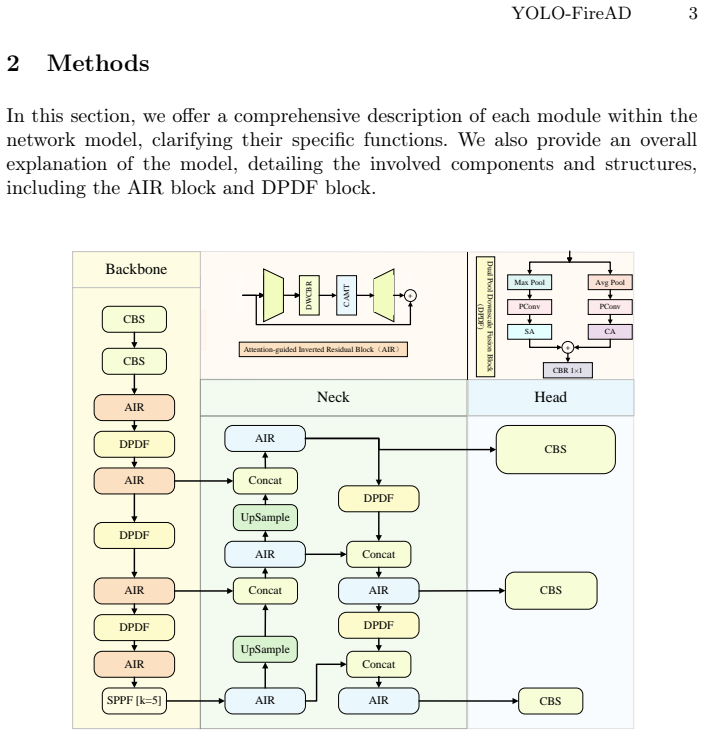
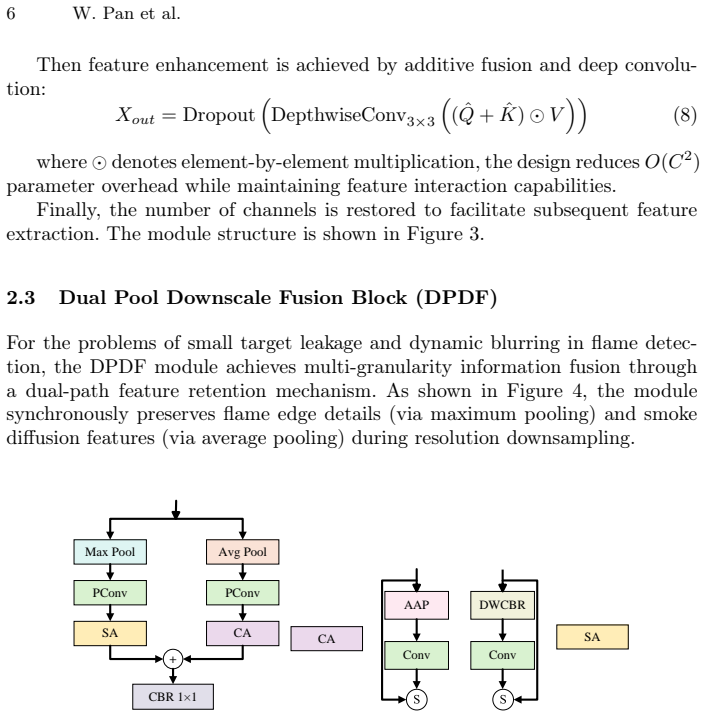
The two load-bearing modules are AIR and DPDF. AIR (Attention-guided Inverted Residual Block) is an inverted residual block whose expansion is a depthwise separable convolution followed by convolutional additive self-attention: features split into Q, K, V, each refined by a gated spatial branch and a channel-reweighting branch, then merged as $\text{DepthwiseConv}_{3\times3}((\hat{Q} + \hat{K}) \odot V)$, with a 0.25 channel-reduction rate. DPDF (Dual Pool Downscale Fusion Block) is a downsampling block that runs 2x2 max pooling and 2x2 average pooling in parallel, passes each through partial convolution (PConv) plus spatial and channel attention, and fuses them with one learnable coefficient: $X_{\text{fusion}} = \alpha X''_{\max} + (1-\alpha) X''_{\text{avg}}$. AIR does the heavy lifting on parameter reduction (about 39% vs the baseline), while DPDF preserves flame-edge and smoke-diffusion detail during resolution reduction, and their interaction is what the paper claims produces 34.6% mAP50-95 at 4.6 GFLOPs.
What would settle it
Retrain YOLOv8n and YOLO-FireAD on the same data split with identical hyperparameters (e.g., AdamW, learning rate 0.002, batch size 128, 200 epochs) across several seeds; if YOLOv8n reaches or exceeds 34.6% mAP50-95, the reported gain is a training-recipe artifact rather than an architectural benefit.
Extended reading notes
Core claim
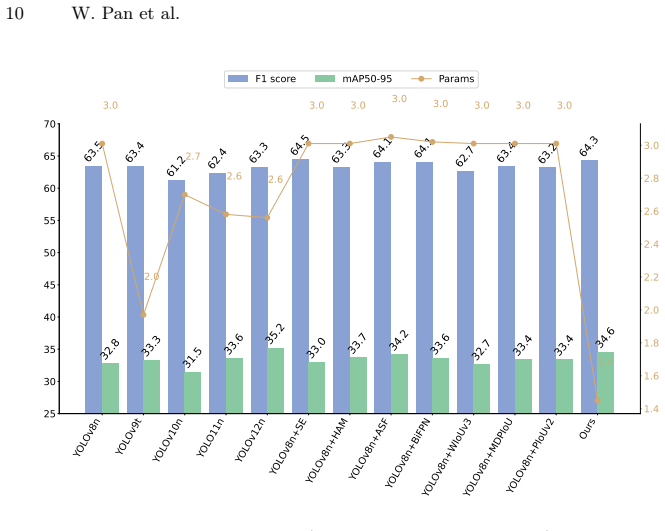
The paper's central claim is that two architectural changes to the YOLOv8n backbone and neck deliver both higher accuracy and lower cost on fire detection. AIR embeds a lightweight channel-spatial attention mechanism inside inverted residual blocks, so the network can amplify flame-core responses and suppress reflections and glare; it accounts for most of the parameter reduction. DPDF replaces plain downsampling with a learnable fusion of 2x2 max and average pooling, preserving flame-edge highlights and smoke continuity so small fires survive resolution reduction. Together they reach 34.6% mAP50-95 (1.8 points over YOLOv8n), the best mAP75 among twelve compared baselines, and the smallest model at 1.45M parameters and 4.6 GFLOPs. The paper also reports the best mAP50-95, 8.12%, when all models are tested on a second fire dataset.
Load-bearing premise
The claimed accuracy edge assumes every compared model was trained under the same optimally tuned protocol, but the paper reports only that all algorithms ran in the same computational setup, without per-model hyperparameters, seeds, or test splits.
Editorial extensions
If this is right
- If the reported numbers hold, YOLO-FireAD gives a roughly 52% parameter reduction and 43% FLOPs reduction over YOLOv8n while improving mAP50-95 by 1.8 points, easing deployment on edge devices.
- The DPDF dual-pooling fusion should specifically help small and occluded fire instances; the paper attributes its mAP50 improvement of about 1.7% to this mechanism.
- mAP75 of 35.5% is 1.3 to 5.5 points higher than the compared mainstream YOLO variants, indicating the gain persists at stricter IoU thresholds used to assess localization quality.
- On a second dataset, YOLO-FireAD again reports the highest mAP50-95 at 8.12%, suggesting the modules generalize rather than overfit a single split.
- The ablation shows both modules are needed: AIR alone cuts parameters but slightly lowers mAP50-95 to 32.6, while DPDF alone raises it to 34.5; the combination reaches 34.6 with the fewest parameters.
Reading between the lines
- Inference: because DPDF's max-average fusion is not fire-specific, the architecture could transfer to other small-object detection tasks such as smoke, drones, or potholes, but the paper only tests fire datasets.
- Inference: the ablation suggests DPDF is the accuracy driver while AIR is the efficiency driver, so a testable extension is making the DPDF fusion coefficient scale-dependent or learned per channel rather than a single global weight.
- Inference: since only one training protocol is reported, an equally tuned YOLOv8n baseline could close part of the gap; the paper's own ablation shows AIR alone slightly hurts mAP50-95, so the headline gain depends on the pairing of both modules.
Editorial analysis
A structured set of objections, weighed in public.
Referee Report
Summary. This manuscript proposes YOLO-FireAD, a YOLOv8-based fire detection model whose two main contributions are the Attention-guided Inverted Residual Block (AIR) and the Dual Pool Downscale Fusion Block (DPDF). The paper reports experiments on two Paddle-derived datasets (fire_detection and fire) and claims that YOLO-FireAD reaches 34.6 mAP50-95 on fire_detection, which is 1.8 points above YOLOv8n, while reducing parameters from 3.01M to 1.45M. A cross-dataset test and an ablation study are also reported. The central efficiency claim is plausible, but the accuracy claim is complicated by internal contradictions in the reported tables.
Significance. The efficiency numbers are the strongest part of the paper: a 51.8% parameter reduction and 43.2% FLOPs reduction relative to YOLOv8n with a small mAP75 gain would be practically useful for edge fire detection. The authors make a good-faith effort at cross-dataset validation, which is more than many detection papers do. However, the headline 'outperforms YOLOv8' is not yet supported by the evidence as presented: the model's recall is the lowest in Table 1, its mAP50-95 is below YOLOv12n, and the ablation table does not show that both modules contribute positively to accuracy. These issues are fixable with additional experiments and more careful claims, so the work is of moderate significance at this stage.
major comments (4)
- [Section 4.1, Table 1] The prose in Section 4.1 states that YOLO-FireAD's P, R, F1, and mAP are 'significantly better than the other models,' but Table 1 shows the opposite for several headline metrics: recall is 53.3, the lowest of all 13 rows; mAP50 is 64.9, below YOLOv12n's 66.1; and mAP50-95 is 34.6, below YOLOv12n's 35.2. This contradicts the abstract and Section 5 conclusion that the model 'outperforms YOLOv8 by 1.8% mAP' and the 'good precision-efficiency balance' framing. Please restrict the outperformance claim to the metrics that actually support it (mAP75, precision, GFLOPs, parameters) and explicitly discuss why the precision gain comes with the lowest recall.
- [Section 3.2, Table 1] The comparison uses one fixed training recipe for all models (batch 128, AdamW lr 0.002, momentum 0.9, 200 epochs) with no per-baseline hyperparameter adjustment, no number of seeds, and no train/validation split definition. Because the claimed mAP50-95 advantage over YOLOv8n is only 1.8 points, which is the same order as seed-to-seed variation on small datasets, the current Table 1 cannot distinguish an architectural benefit from training-recipe or initialization luck. Please report mean and standard deviation over at least three seeds, specify the split, and justify the single-recipe protocol for baselines whose standard training recipes differ (e.g., SGD for YOLOv8n).
- [Table 3] The ablation data do not support the statement that 'both AIR and DPDF play an indispensable role in YOLO-FireAD.' Relative to the YOLOv8n baseline, AIR alone decreases mAP50-95 from 32.8 to 32.6 and mAP50 from 64.2 to 63.0; the full model has mAP50 64.9, lower than DPDF-only 65.9, and its recall collapses from 63.8 to 53.3. The paper should either reinterpret AIR as primarily a parameter-reduction mechanism (which Table 3 does show) or provide evidence that the accuracy loss is compensated elsewhere; as written, the module-level contribution claims in Section 2 and Contribution 2 are not supported by the ablation.
- [Section 4.1, Table 2] The generalization claim based on the fire dataset is also only partially supported. YOLO-FireAD reaches the best mAP50-95 (8.12), but its mAP50 (25.0) is below YOLOv8n (25.6) and YOLO11n (27.2), and its recall (25.7) is among the lowest in the table. The near-tie with YOLOv12n (8.00) should be discussed, as should the consistency of the single-run protocol applied to this second dataset.
minor comments (6)
- [Abstract and Section 4.1] The abstract contains the typo 'YOL-Ov9t' for 'YOLOv9t', and Section 4.1 refers to 'mAP50-90' where 'mAP50-95' is meant.
- [Section 4.2, Table 3] The text says the combined model's Model Size is 6.1MB, but Table 3 reports 3.3 for the full model; the numbers should be reconciled.
- [Section 2.2, Eq. (3)] Equation (3) uses X after Eq. (2) introduced Xdw; state explicitly that X in Eq. (3) is Xdw, or rename the variable.
- [Section 2.3, Eq. (11)] The slicing notation X[r::] in Eq. (11) is ambiguous without a channel-dimension specification; please define the split explicitly.
- [Section 2.2 and Section 2.3] The hyperparameters r=0.25 in AIR and r=4 in DPDF are described as 'experimentally optimised'; clarify whether these were selected on the same test set, since that would inflate the reported numbers.
- [Section 6] The acknowledgement states that this is a corrected version of an ICIC 2025 paper; the relationship to that prior publication should be stated in the introduction, not only in the acknowledgement.
Circularity Check
No significant circularity: reported gains are direct benchmark measurements, not derived from assumed equations.
full rationale
The paper's central claims are empirical measurements summarized in Tables 1-3; the headline comparisons (34.6 vs 32.8 mAP50-95 and 1.45M vs 3.01M parameters) are arithmetic relations on those reported numbers, not quantities obtained by deriving a result from an equation that already contains it. The AIR and DPDF modules are constructive architectural proposals with stated hyperparameters; the text explicitly says r=0.25 was 'experimentally optimised' (Sec. 2.2), which is hyperparameter selection rather than a fitted parameter being renamed as a prediction. The self-citations (refs. [3] and [7]) appear only in background discussion of existing YOLO-based solutions and attention/multi-scale attempts; they are not used as a load-bearing uniqueness theorem or as the sole justification for the proposed architecture. The cross-dataset test in Table 2 provides an external check. Under the specified circularity rubric, there is no step where a prediction reduces by construction to its own input, so the appropriate finding is no significant circularity.
Assumptions & free parameters
free parameters (3)
- AIR channel reduction rate r =
0.25
- DPDF channel reduction rate r =
4
- DPDF fusion weight alpha =
not reported
assumptions (3)
- domain assumption The fire_detection and fire datasets, described only as from the Paddle community, have fixed train and test splits and reliable fire annotations.
- domain assumption All baseline models were trained under identical, comparably tuned settings.
- standard math Convolutional additive self attention (CAS-ViT) and partial convolution behave as described in refs 11 and 12 and can be reimplemented as claimed.
Cite this review
Pith. "Pith review of YOLO-FireAD: Efficient Fire Detection via Attention-Guided Inverted Residual Learning and Dual-Pooling Feature Preservation." pith.science (2026). https://pith.science/paper/V35Z56FP
@misc{pith2026250520884,
  author       = {Pith},
  title        = {Pith review of: YOLO-FireAD: Efficient Fire Detection via Attention-Guided Inverted Residual Learning and Dual-Pooling Feature Preservation},
  year         = {2026},
  howpublished = {\url{https://pith.science/paper/V35Z56FP}},
  note         = {Machine review of arXiv:2505.20884}
}
read the original abstract
Fire detection in dynamic environments faces continuous challenges, including the interference of illumination changes, many false detections or missed detections, and it is difficult to achieve both efficiency and accuracy. To address the problem of feature extraction limitation and information loss in the existing YOLO-based models, this study propose You Only Look Once for Fire Detection with Attention-guided Inverted Residual and Dual-pooling Downscale Fusion (YOLO-FireAD) with two core innovations: (1) Attention-guided Inverted Residual Block (AIR) integrates hybrid channel-spatial attention with inverted residuals to adaptively enhance fire features and suppress environmental noise; (2) Dual Pool Downscale Fusion Block (DPDF) preserves multi-scale fire patterns through learnable fusion of max-average pooling outputs, mitigating small-fire detection failures. Extensive evaluation on two public datasets shows the efficient performance of our model. Our proposed model keeps the sum amount of parameters (1.45M, 51.8% lower than YOLOv8n) (4.6G, 43.2% lower than YOLOv8n), and mAP75 is higher than the mainstream real-time object detection models YOLOv8n, YOL-Ov9t, YOLOv10n, YOLO11n, YOLOv12n and other YOLOv8 variants 1.3-5.5%. For more details, please visit our repository: https://github.com/JEFfersusu/YOLO-FireAD
Figures


Figures from the paper (5 more)



Reference graph
Works this paper leans on
-
[1]
T. Wang, J. Wang, C. Wang, et al.,Improving YOLOX network for multi-scale fire detection, Vis. Comput., vol. 40, pp. 6493–6505, 2024. [doi: 10.1007/s00371-023- 03178-1]
-
[2]
L. Cao, Z. Shen, and S. Xu,Efficient forest fire detection based on an improved YOLO model, Vis. Intell., vol. 2, p. 20, 2024. [doi: 10.1007/s44267-024-00053-y]
-
[3]
W. Pan, X. Wang, and W. Huan,Real-time dynamic scale-aware fusion detection network: take road damage detection as an example, J. Real-Time Image Proc., vol. 22, p. 55, 2025. [doi: 10.1007/s11554-025-01634-w]
-
[4]
W. Liu, Z. Shen, and S. Xu,CF-YOLO: a capable forest fire identification algo- rithm founded on YOLOv7 improvement, SIViP, vol. 18, pp. 6007–6017, 2024. [doi: 10.1007/s11760-024-03288-w]
-
[5]
X. Cao, J. Wu, J. Chen, et al.,Complex Scenes Fire Object Detection Based on Fea- ture Fusion and Channel Attention, Arab J. Sci. Eng., 2024. [doi: 10.1007/s13369- 024-09471-y]
doi:10.1007/s13369- 2024
-
[6]
J. Yao, J. Lei, J. Zhou, et al.,FG-YOLO: an improved YOLOv8 algorithm for real- time fire and smoke detection, SIViP, vol. 19, p. 346, 2025. [doi: 10.1007/s11760- 025-03894-2]
doi:10.1007/s11760- 2025
-
[7]
W. Pan, X. Wang, and W. Huan,EFA-YOLO: An Efficient Feature Attention Model for Fire and Flame Detection, arXiv, 2024. [eprint: 2409.12635]. [Online]. Available: https://arxiv.org/abs/2409.12635
work page Pith review arXiv 2024
- [8]
Show all 22 references
-
[9]
Zheng, P
Z. Zheng, P. Wang, W. Liu, J. Li, R. Ye, and D. Ren, Distance-IoU Loss: Faster and Better Learning for Bounding Box Regression , Pro- ceedings of the AAAI Conference on Artificial Intelligence, vol. 34, pp. 12993–13000, 2020. [doi: 10.1609/aaai.v34i07.6999]. [Online]. Availabl...
2020 doi
-
[10]
Chollet, Xception: Deep Learning with Depthwise Separable Convolutions, in 2017 IEEE Conference on Computer Vision and Pattern Recognition (CVPR), 2017, pp
F. Chollet, Xception: Deep Learning with Depthwise Separable Convolutions, in 2017 IEEE Conference on Computer Vision and Pattern Recognition (CVPR), 2017, pp. 1800–1807. [doi: 10.1109/CVPR.2017.195]
2017 doi
-
[11]
Zhang, L
T. Zhang, L. Li, Y. Zhou, W. Liu, J.-N. Hwang, and X. Ji, CAS- ViT: Convolutional Additive Self-attention Vision Transformers for Efficient Mobile Applications , arXiv, 2024. [eprint: 2408.03703]. [Online]. Available: https://arxiv.org/abs/2408.03703
2024 arXiv
-
[12]
Chen, S.-h
J. Chen, S.-h. Kao, H. He, W. Zhuo, S. Wen, C.-H. Lee, and S.-H. G. Chan, Run, Don’t Walk: Chasing Higher FLOPS for Faster Neural Networks, in 2023 IEEE/CVF Conference on Computer Vision and Pattern Recognition (CVPR), 2023, pp. 12021–12031. [doi: 10.1109/CVPR52729.2023.01157]
2023
-
[13]
W. Chen, J. Luo, F. Zhang, et al.,A review of object detection: Datasets, per- formance evaluation, architecture, applications and current trends, Multimed. Tools Appl., vol. 83, pp. 65603–65661, 2024. [doi: 10.1007/s11042-023-17949-4]
2024 doi
-
[14]
Wang, I.H
C.Y. Wang, I.H. Yeh, and M.H.Y. Liao,YOLOv9: Learning What You Want to Learn Using Programmable Gradient Information, in Computer Vision – ECCV 2024, A. Leonardis, E. Ricci, S. Roth, O. Russakovsky, T. Sattler, G. Varol, Eds., Lecture Notes in Computer Science, vol. 15089, Spr...
2024 doi
-
[15]
A. Wang, H. Chen, L. Liu, K. Chen, Z. Lin, J. Han, and G. Ding,YOLOv10: Real-Time End-to-End Object Detection , in Advances in Neural Information YOLO-FireAD 15 Processing Systems, vol. 37, 2024, pp. 107984–108011. [Online]. Available: https://proceedings.neurips.cc/paper_file...
2024
-
[16]
J. Hu, L. Shen, and G. Sun,Squeeze-and-Excitation Networks, in 2018 IEEE/CVF Conference on Computer Vision and Pattern Recognition, 2018, pp. 7132–7141. [doi: 10.1109/CVPR.2018.00745]
2018
-
[17]
G. Li, Q. Fang, L. Zha, X. Gao, and N. Zheng,HAM: Hybrid attention module in deep convolutional neural networks for image classification, Pattern Recognition, vol. 129, p. 108785, 2022. [doi: 10.1016/j.patcog.2022.108785]. [Online]. Available: https://www.sciencedirect.com/sci...
2022
-
[18]
Kang, C.-M
M. Kang, C.-M. Ting, F.F. Ting, and R.C.-W. Phan, ASF-YOLO: A novel YOLO model with attentional scale sequence fusion for cell instance segmentation , Image and Vision Computing, vol. 147, p. 105057, 2024. [doi: 10.1016/j.imavis.2024.105057]. [Online]. Available: https://www.s...
2024
-
[19]
Z. Tong, Y. Chen, Z. Xu, and R. Yu,Wise-IoU: Bounding Box Regression Loss with Dynamic Focusing Mechanism, arXiv, 2023. [eprint: 2301.10051]. [Online]. Available: https://arxiv.org/abs/2301.10051
2023 arXiv
-
[20]
Ma and Y
S. Ma and Y. Xu, MPDIoU: A Loss for Efficient and Accurate Bound- ing Box Regression , arXiv, 2023. [eprint: 2307.07662]. [Online]. Available: https://arxiv.org/abs/2307.07662
2023 arXiv
-
[21]
C. Liu, K. Wang, Q. Li, F. Zhao, K. Zhao, and H. Ma, Powerful- IoU: More straightforward and faster bounding box regression loss with a nonmonotonic focusing mechanism , Neural Networks, vol. 170, pp. 276–284, 2024. [doi: 10.1016/j.neunet.2023.11.041]. [Online]. Available: htt...
2024 doi
-
[22]
Doherty, B
J. Doherty, B. Gardiner, E. Kerr, and N. Siddique,BiFPN-YOLO: One-stage ob- ject detection integrating Bi-Directional Feature Pyramid Networks, Pattern Recog- nition, vol. 160, p. 111209, 2025. [doi: 10.1016/j.patcog.2024.111209]. [Online]. Avail- able: https://www.sciencedire...
2025
Reviewed August 7, 2026 · model on record in the stance chip above.
Discussion (0). Sign in to comment.