REVIEW 4 major objections 6 minor 26 references
Reinforcement Learning-based Sequential Route Recommendation for System-Optimal Traffic Assignment
T0 review · 4 major / 6 minor · reviewed 2026-08-07 · deepseek-v4-flash
Pith's one-line read A central reinforcement-learning agent that sequentially assigns routes to travelers can converge to the system-optimal traffic assignment, reaching the theoretical optimum on a small paradox-prone network and coming within 0.35% on a…
desk verdict A clever reformulation of SO assignment as sequential RL, but the discount factor makes the stated objective inconsistent with the reported results, and the performance doesn't beat classical MSA. read the letter →
The pith
A machine-rendered reading of the paper's core claim, the machinery that carries it, and where it could break.
The reading
What carries the argument
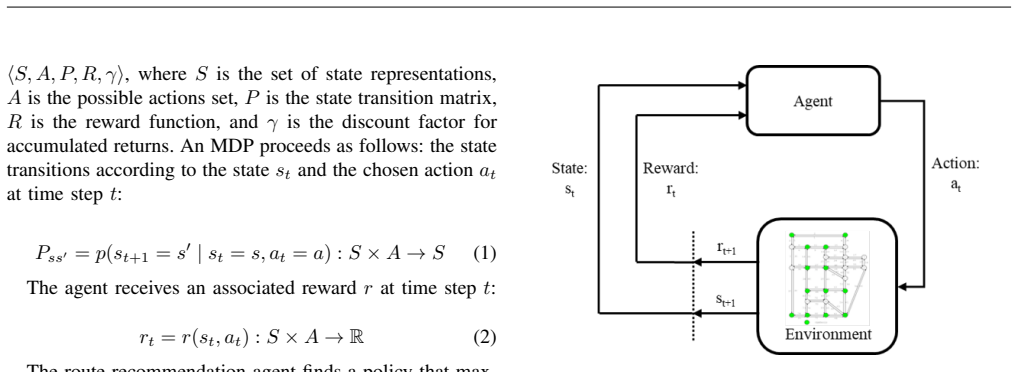
The load-bearing mechanism is a Markov decision process whose reward and action selection are both aligned with the system-optimum objective. The reward for assigning a traveler to route $p$ is built from the marginal travel time $\sum_{e\in p}\left(c_e(v_e)+v_e\frac{dc_e}{dv_e}\right)$, the traveler's own link travel time plus the extra delay imposed on everyone already using the route; maximizing this quantity aligns the sequential policy with system-optimal assignment. The MSA guidance works on the action set: at the end of each episode the agent computes an all-or-nothing assignment from the current flows and averages it into the route-choice distribution, so the candidate route set grows and the sampling distribution is steered toward good assignments. The route set is the feasible region of the policy: Algorithm 1's incremental addition of routes is what lets the agent discover routes that a fixed k-shortest-path set would miss, and the RL-10-SP ablation shows what happens when such a route is absent.
What would settle it
Inspect the final route set produced by Algorithm 1 on the 13-node network and check whether every route carrying positive flow in the SO-MSA solution is present; the route-completeness premise would be overturned if the set omits an SO-used route while the agent still lands near the 0.35% gap, and the convergence claim would fail if the gap grows whenever such a route is absent. The RL-10-SP ablation already provides a partial check, since its route set omits SO-used routes and the gap jumps to 3.49%.
Extended reading notes
Core claim
On its own terms, the paper's central claim is that a static system-optimal traffic assignment can be reached by a single deep-Q-learning agent acting sequentially, one traveler at a time, when the agent's exploration is steered by the method of successive averages. In the small diamond-shaped network, the trained agent stabilizes at a total travel time of 498 minutes, with three travelers on each of the two uncongested routes and none on the added route, which is exactly the theoretical system-optimal solution. In the larger 13-node, 48-link network with 1,700 travelers, the MSA-guided agent reaches 55,000 minutes of total travel time, a 0.35% deviation from the 54,809.8-minute SO-MSA benchmark. The ablation results make the mechanism explicit: a 10-shortest-path action set omits routes used by the optimum and leaves a 3.49% gap, a 15-shortest-path set cuts this to 0.75%, an SO-derived route set achieves 0.26%, and the MSA-guided agent achieves its 0.35% without knowing the SO route set in advance. The authors therefore claim that action-set design, not the RL exploration schedule, is the dominant factor separating sequential assignment from system optimum.
Load-bearing premise
The central agent's candidate route set, expanded incrementally by the MSA step, must contain the routes the system-optimal solution actually uses; the RL-10-SP ablation shows that when a route is missing, the agent cannot reach the optimum.
Editorial extensions
If this is right
- Sequential, one-at-a-time route recommendations can reproduce a one-shot centralized system-optimal assignment, so the online interaction itself is not a barrier to system efficiency under full compliance.
- A route recommendation system must treat its candidate route set as part of its solution: expanding the set from 10 to 15 shortest paths cuts the deviation from the system optimum from 3.49% to 0.75%.
- An MSA-guided learner can approach the system optimum without knowing the optimal route set in advance, reaching 0.35% instead of the 0.26% gap obtained with an oracle route set.
- Because the agent converges quickly on the small network, in roughly 240 episodes, and avoids the paradox-inducing route, the approach offers a template for steering demand away from configurations that are good individually but bad collectively.
Reading between the lines
- An extension the paper leaves for future work is partial compliance: if travelers sometimes ignore recommendations, the 0.35% gap could degrade, and the paper's own framing suggests this is the first stress test worth running.
- The marginal-cost reward is the same signal used in marginal-cost pricing, so the learned policy is implicitly computing flows that should match a tolled user equilibrium; a direct comparison of the RL assignment against the toll pattern on the same networks would be a cheap, decisive check.
- The MSA-guided route expansion functions as a curriculum over actions; comparing it against other route-generation heuristics, such as randomized path sampling or column generation, on city-scale networks would show whether route-set completeness remains the controlling factor as the network grows.
Editorial analysis
A structured set of objections, weighed in public.
Referee Report
Summary. The paper reformulates the static system-optimal (SO) traffic assignment problem as a single-agent Markov decision process in which a central agent sequentially recommends routes to travelers, and proposes an MSA-guided deep Q-learning algorithm that uses the Method of Successive Averages both to guide action selection and to incrementally expand the route set. Experiments on the Braess network and the Ortuzar-Willumsen (OW) network report convergence to the theoretical SO solution on Braess and a 0.35% deviation from an SO-MSA benchmark on OW, together with ablations comparing k-shortest-path and SO-informed action sets.
Significance. If the results hold, the paper would offer a practical bridge between sequential personalized route recommendation and classical system-optimal traffic assignment, and would provide an analytical testbed for RL in a well-studied transportation problem. The paper deserves credit for using analytical networks with known link performance functions, for comparing against classical MSA and Frank-Wolfe benchmarks, and for explicitly isolating the effect of action-set design through ablations. However, several load-bearing inconsistencies in the objective specification and the close coupling between the proposed algorithm and the classical MSA solution mean that the central empirical claims are not yet established as reported.
major comments (4)
- [§III-D, Eq. (9), and Table 2] The reward in Eq. (9) is written as the negative of the marginal social cost, but the surrounding text calls it the 'marginal travel time' and does not explain the sign. If the intended equivalence is that maximizing cumulative reward minimizes total system travel time, that equivalence holds for the undiscounted sum of these rewards, not for the discounted return in Eq. (3). With γ=0.95 in Table 2 and N=1700 travelers, γ^99≈0.006 for the 100th traveler and later travelers receive essentially zero weight in the return, so the algorithm as specified optimizes a heavily time-weighted sum of marginal costs rather than total system travel time. The reported 0.35% gap on the OW network therefore cannot be explained by the stated objective. The authors should either set γ=1 (or otherwise formulate a total-return objective), report experiments with that objective, or provide a proof or controlled experiment showing that the discounting does not affect the final assignment.
- [§III, §IV, and Abstract] The central claim that the RL agent 'converges to the theoretical SO solution' is supported only by empirical training curves (Figures 3 and 5). No proof or formal argument is given that sequential minimization of marginal travel time, with or without MSA guidance, converges to SO for discrete travelers and non-linear BPR cost functions. Given the title and abstract, the paper should either supply a convergence theorem (for example, showing that the undiscounted reward sum telescopes to total system travel time and that the MSA-guided action-selection scheme preserves the optimality of the fixed point) or explicitly limit the claim to an empirical approximation.
- [§IV-B, Table 4, and Algorithm 1] The comparison is confounded by the fact that the SO-MSA benchmark is itself computed by MSA, while the proposed MSA-guided RL uses MSA for both route-set expansion (Algorithm 1, lines 9-10) and action sampling (Algorithm 2, line 3). The RL-SO ablation, which uses the route set extracted from the analytical SO solution, achieves the best result (0.26% gap), so part of the performance of MSA-guided RL may be inherited from the classical MSA solution rather than from the learned policy. To identify the marginal contribution of RL, the paper should add ablations with pure MSA using the same route-set update but no RL, with a fixed non-MSA action set, and should report the fraction of actions selected by argmax Q versus by sampling from M, along with the evolution of M over training.
- [§IV-B-3 and Algorithm 1] The paper's own ablation RL-10-SP shows a 3.49% deviation from SO because the 10-shortest-path action set omits routes that appear in the SO solution. This makes the central result depend on the MSA-guided incremental route expansion in Algorithm 1, lines 9-10, producing an action set that contains all optimal routes for each OD pair. No evidence is provided that this occurs on the OW network. The authors should report the final route set generated by the MSA-guided method, verify that it contains the routes used in the SO-MSA solution, and discuss conditions under which the incremental all-or-nothing update is guaranteed (or empirically shown) to add the missing optimal routes. If the action set is incomplete, even an optimal RL policy cannot reach SO.
minor comments (6)
- [§IV-A] The text says 'the network provides three routes from A to B, namely ACB and ADB,' but before the dashed link is added there are only two routes; the third route, ACDB, appears only after the new segment is introduced.
- [§V] The conclusion contains a typo: 'Baress paradox network' should read 'Braess paradox network.'
- [§III-B, Eq. (8)] The notation in Eq. (8), 'tte^t', is confusing; it would be clearer to use a consistent notation such as c_e(x_e) for the link travel time function and to define whether x_e is the flow before or after the current traveler is added.
- [§III-D, Eq. (9)] In the text following Eq. (9), 'link a' should be 'link e', and the formula should make explicit that v_e is the flow before the marginal traveler is assigned; the current typesetting of v_e dce(ve)/dve omits a parenthesis.
- [§IV-B, Table 4] The RL results are reported as single numbers without standard deviations or confidence intervals across random seeds; given the stochastic nature of DQN training, this makes it difficult to judge whether the small differences between MSA-guided RL, RL-SO, and RL-15-SP are significant.
- [General] No code or data availability statement is provided. For an empirical RL paper, releasing the implementation and the exact network data would substantially improve reproducibility and would help resolve the ambiguities about the training objective and hyperparameters.
Circularity Check
The MSA-guided RL result is partially circular: the action distribution is updated by the same MSA used to create the SO-MSA benchmark, so the 0.35% gap is partly an MSA-variant self-comparison.
-
fitted input called prediction
[Algorithm 1 lines 9-10; Section III-F; Section IV-B3, Tables 3-4]
"M∗ ← all or nothing(V); M←(1− 1/i )·M+ 1/i M∗ ... The utilization of the MSA method effectively guides the RL agent to explore towards SO traffic assignment and update the action (route) set."
The route-choice distribution M is updated by the classical MSA all-or-nothing operator, and the SO-MSA benchmark (Table 3: 54809.8) is computed by the same MSA. In Algorithm 2, actions are sampled from M with probability epsilon, so the MSA solution is injected directly into the policy's action distribution. The reported 0.35% gap is therefore a comparison of an MSA-guided iterate against an MSA fixed point, not an independent RL prediction. The ablations confirm the injection: removing MSA guidance gives RL-10-SP 3.49% and RL-15-SP 0.75% gaps, while injecting the SO route set gives 0.26%. The central quantitative claim is largely inherited from the embedded classical solver.
-
fitted input called prediction
[Section IV-B2 (Compared Methods) and Table 4]
"RL with system-optimum route paths (RL-SO): RL model using action sets derived from the analytical SO solution, i.e., the route set generated from a traditional traffic assignment algorithm."
RL-SO is constructed from the very SO solution used as the performance benchmark (SO-MSA), so its 0.26% deviation is not a prediction but a constrained construction: the action set already contains the optimal routes, leaving only flow proportions to be learned. The paper uses this result to support the claim that 'SO-informed route sets lead to faster learning and better outcomes,' which holds by construction and is presented as an ablation, not as independent validation of the sequential-learning approach. Because this is an ablation rather than the main claim, it contributes to but does not fully determine the circularity score.
full rationale
The paper's main claim has independent content, so this is only partial circularity. RL-15-SP, which does not use MSA guidance or SO-informed routes, still reaches a 0.75% gap, showing that the RL formulation can learn a reasonable SO approximation on its own. The central circularity is the MSA-guided variant: its action-selection distribution is an MSA iterate (Algorithm 1 lines 9-10), and the SO-MSA benchmark is also an MSA solution. Measuring one MSA-based procedure against another is a self-comparison rather than a test of whether sequential RL recovers the theoretical optimum from first principles. The strongest independent evidence for the paper's thesis is therefore the no-MSA RL-15-SP ablation, which is not circular. No load-bearing self-citations or imported uniqueness theorems are present; Refs. [16] and [9] are background and unrelated to the central derivation. The discount-factor inconsistency (gamma=0.95 with a 1700-traveler horizon) is a correctness/consistency concern, not a circularity, and is not scored here. Overall, the result is partially fitted by construction via the embedded MSA, but the existence of a non-MSA RL variant that approaches SO keeps the score below 6.
Assumptions & free parameters
free parameters (6)
- Learning rate =
2e-5
- Discount factor gamma =
0.95
- Mini-batch size =
128
- Hidden layer sizes =
512, 256
- k in k-shortest paths =
10 and 15
- Epsilon in MSA-guided selection =
not specified
assumptions (4)
- domain assumption All travelers follow the recommended route (full compliance)
- domain assumption Network is static with known link performance functions and known sequential OD demand
- ad hoc to paper Minimizing the negative marginal travel time reward at each step leads to a system-optimal assignment
- ad hoc to paper The MSA update and incremental route expansion produce an action set that contains the optimal routes
Cite this review
Pith. "Pith review of Reinforcement Learning-based Sequential Route Recommendation for System-Optimal Traffic Assignment." pith.science (2026). https://pith.science/paper/OA6EC352
@misc{pith2026250520889,
  author       = {Pith},
  title        = {Pith review of: Reinforcement Learning-based Sequential Route Recommendation for System-Optimal Traffic Assignment},
  year         = {2026},
  howpublished = {\url{https://pith.science/paper/OA6EC352}},
  note         = {Machine review of arXiv:2505.20889}
}
read the original abstract
Modern navigation systems and shared mobility platforms increasingly rely on personalized route recommendations to improve individual travel experience and operational efficiency. However, a key question remains: can such sequential, personalized routing decisions collectively lead to system-optimal (SO) traffic assignment? This paper addresses this question by proposing a learning-based framework that reformulates the static SO traffic assignment problem as a single-agent deep reinforcement learning (RL) task. A central agent sequentially recommends routes to travelers as origin-destination (OD) demands arrive, to minimize total system travel time. To enhance learning efficiency and solution quality, we develop an MSA-guided deep Q-learning algorithm that integrates the iterative structure of traditional traffic assignment methods into the RL training process. The proposed approach is evaluated on both the Braess and Ortuzar-Willumsen (OW) networks. Results show that the RL agent converges to the theoretical SO solution in the Braess network and achieves only a 0.35% deviation in the OW network. Further ablation studies demonstrate that the route action set's design significantly impacts convergence speed and final performance, with SO-informed route sets leading to faster learning and better outcomes. This work provides a theoretically grounded and practically relevant approach to bridging individual routing behavior with system-level efficiency through learning-based sequential assignment.
Figures


Figures from the paper (1 more)

Reference graph
Works this paper leans on
-
[1]
Patriksson,The traffic assignment problem: models and methods
M. Patriksson,The traffic assignment problem: models and methods. Courier Dover Publications, 2015
work page 2015
-
[2]
Road paper. some theoretical aspects of road traffic research
J. G. Wardrop, “Road paper. some theoretical aspects of road traffic research.”Proceedings of the institution of civil engineers, vol. 1, no. 3, pp. 325–362, 1952
1952
-
[3]
Urban transportation networks: Equilibrium analysis with mathematical programming methods,
M. S. Daskin, “Urban transportation networks: Equilibrium analysis with mathematical programming methods,” 1985
work page 1985
-
[4]
Bridging the user equilibrium and the system optimum in static traffic assignment: a review,
V . Morandi, “Bridging the user equilibrium and the system optimum in static traffic assignment: a review,”4OR, vol. 22, no. 1, pp. 89–119, 2024
work page 2024
-
[5]
Studies in the economics of transportation,
M. Beckmann, C. B. McGuire, and C. B. Winsten, “Studies in the economics of transportation,” Tech. Rep., 1956
1956
-
[6]
Origin-based algorithm for the traffic assignment prob- lem,
H. Bar-Gera, “Origin-based algorithm for the traffic assignment prob- lem,”Transportation Science, vol. 36, no. 4, pp. 398–417, 2002
work page 2002
-
[7]
Z. Ke, Q. Zou, J. Liu, and S. Qian, “Real-time system optimal traffic routing under uncertainties—can physics models boost reinforcement learning?”Transportation Research Part C: Emerging Technologies, vol. 173, p. 105040, 2025
work page 2025
-
[8]
Multi-agent deep reinforce- ment learning for large-scale traffic signal control,
T. Chu, J. Wang, L. Codec `a, and Z. Li, “Multi-agent deep reinforce- ment learning for large-scale traffic signal control,”IEEE transactions on intelligent transportation systems, vol. 21, no. 3, pp. 1086–1095, 2019
work page 2019
Show all 26 references
-
[9]
Human-centric multimodal deep (hmd) traffic signal control,
L. Wang, Z. Ma, C. Dong, and H. Wang, “Human-centric multimodal deep (hmd) traffic signal control,”IET Intelligent Transport Systems, vol. 17, no. 4, pp. 744–753, 2023
2023
-
[10]
Deep reinforcement learning for autonomous driving: A survey,
B. R. Kiran, I. Sobh, V . Talpaert, P. Mannion, A. A. Al Sallab, S. Yo- gamani, and P. P ´erez, “Deep reinforcement learning for autonomous driving: A survey,”IEEE transactions on intelligent transportation systems, vol. 23, no. 6, pp. 4909–4926, 2021
2021
-
[11]
Reinforcement learning-based real-time energy management for a hybrid tracked vehicle,
Y . Zou, T. Liu, D. Liu, and F. Sun, “Reinforcement learning-based real-time energy management for a hybrid tracked vehicle,”Applied energy, vol. 171, pp. 372–382, 2016
2016
-
[12]
A reinforcement learning scheme for the equilibrium of the in-vehicle route choice problem based on congestion game,
B. Zhou, Q. Song, Z. Zhao, and T. Liu, “A reinforcement learning scheme for the equilibrium of the in-vehicle route choice problem based on congestion game,”Applied Mathematics and Computation, vol. 371, p. 124895, 2020
2020
-
[13]
Using topological statistics to bias and accelerate route choice: Preliminary findings in synthetic and real-world road networks
F. Stefanello, B. C. da Silva, and A. L. Bazzan, “Using topological statistics to bias and accelerate route choice: Preliminary findings in synthetic and real-world road networks.” inATT@ IJCAI, 2016
2016
-
[14]
Individual versus difference rewards on reinforcement learning for route choice,
R. Grunitzki, G. de Oliveira Ramos, and A. L. C. Bazzan, “Individual versus difference rewards on reinforcement learning for route choice,” in2014 Brazilian Conference on Intelligent Systems. IEEE, 2014, pp. 253–258
2014
-
[15]
A reinforcement learning framework for the adaptive routing problem in stochastic time-dependent network,
C. Mao and Z. Shen, “A reinforcement learning framework for the adaptive routing problem in stochastic time-dependent network,” Transportation Research Part C: Emerging Technologies, vol. 93, pp. 179–197, 2018
2018
-
[16]
Ai-driven day-to-day route choice,
L. Wang, P. Duan, Z. He, C. Lyu, X. Chen, N. Zheng, L. Yao, and Z. Ma, “Ai-driven day-to-day route choice,”arXiv preprint arXiv:2412.03338, 2024
2024
-
[17]
Navigating the non-compliance effects on system optimal route guidance using re- inforcement learning,
H. Yun, E.-j. Kim, S. W. Ham, and D.-K. Kim, “Navigating the non-compliance effects on system optimal route guidance using re- inforcement learning,”Transportation Research Part C: Emerging Technologies, vol. 165, p. 104721, 2024
2024
-
[18]
Route rec- ommendations for traffic management under learned partial driver compliance,
H. Bang, J.-H. Cho, C. Wu, and A. A. Malikopoulos, “Route rec- ommendations for traffic management under learned partial driver compliance,”arXiv preprint arXiv:2504.02993, 2025
2025 arXiv
-
[19]
The braess’s paradox in dynamic traffic,
D. Zhuang, Y . Huang, V . Jayawardana, J. Zhao, D. Suo, and C. Wu, “The braess’s paradox in dynamic traffic,” in2022 IEEE 25th In- ternational Conference on Intelligent Transportation Systems (ITSC). IEEE, 2022, pp. 1018–1023
2022
-
[20]
de Dios Ort ´uzar and L
J. de Dios Ort ´uzar and L. G. Willumsen,Modelling transport. John wiley & sons, 2024
2024
-
[21]
Multi-agent reinforcement learning for markov routing games: A new modeling paradigm for dynamic traffic assignment,
Z. Shou, X. Chen, Y . Fu, and X. Di, “Multi-agent reinforcement learning for markov routing games: A new modeling paradigm for dynamic traffic assignment,”Transportation Research Part C: Emerg- ing Technologies, vol. 137, p. 103560, 2022
2022
-
[22]
Human-level control through deep reinforcement learning,
V . Mnih, K. Kavukcuoglu, D. Silver, A. A. Rusu, J. Veness, M. G. Bellemare, A. Graves, M. Riedmiller, A. K. Fidjeland, G. Ostrovski et al., “Human-level control through deep reinforcement learning,” nature, vol. 518, no. 7540, pp. 529–533, 2015
2015
-
[23]
Deep reinforcement learning with double q-learning,
H. Van Hasselt, A. Guez, and D. Silver, “Deep reinforcement learning with double q-learning,” inProceedings of the AAAI conference on artificial intelligence, vol. 30, no. 1, 2016
2016
-
[24]
Dueling network architectures for deep reinforcement learning,
Z. Wang, T. Schaul, M. Hessel, H. Hasselt, M. Lanctot, and N. Freitas, “Dueling network architectures for deep reinforcement learning,” in International conference on machine learning. PMLR, 2016, pp. 1995–2003
2016
-
[25]
Transportation network analysis,
S. D. Boyles, N. E. Lownes, and A. Unnikrishnan, “Transportation network analysis,”Vol. I: Static and Dynamic Traffic Assignment, 2020
2020
-
[26]
Finding the k shortest loopless paths in a network,
J. Y . Yen, “Finding the k shortest loopless paths in a network,” management Science, vol. 17, no. 11, pp. 712–716, 1971. VOLUME , 7
1971
Reviewed August 7, 2026 · model on record in the stance chip above.
Discussion (0). Sign in to comment.