REVIEW 4 major objections 6 minor 69 references
ISAC: Training-Free Instance-to-Semantic Attention Control for Multi-Instance Generation
T0 review · 4 major / 6 minor · reviewed 2026-08-07 · deepseek-v4-flash
Pith's one-line read The paper claims that separating instance formation from semantic assignment fixes multi-object generation in diffusion models without retraining.
desk verdict A genuinely novel instance-first attention-control method with broad empirical gains, held back by an unvalidated K-means clustering step and a self-built benchmark supplying headline numbers. read the letter →
The pith
A machine-rendered reading of the paper's core claim, the machinery that carries it, and where it could break.
The reading
What carries the argument
The central object is the hierarchical two-phase loss $L_t(X_t)=\lambda_{\mathrm{ins}}(t)L_{\mathrm{ins}}(X_t)+\lambda_{\mathrm{sem}}(t)L_{\mathrm{sem}}(X_t)$. In Phase 1, an averaged self-attention map is clustered on foreground-gated rows (with optional coordinate concatenation) into $N$ class-agnostic instance masks, and the worst pairwise pixel overlap is penalized by the maximum pixel-wise overlap (MPO), yielding clean instance boundaries. In Phase 2, the stabilized self-attention is multiplied into cross-attention to form instance-aware semantic masks $CA^{\mathrm{ins}}_t = SA_t CA_t$, and a repel-and-bind loss pushes apart tokens that belong to different instances while pulling together tokens that describe the same instance. The schedule $\lambda_{\mathrm{ins}}(t)=t/T$, $\lambda_{\mathrm{sem}}(t)=1-t/T$ makes instance formation dominate early denoising and semantic refinement dominate later.
What would settle it
Take a prompt with N objects, extract ISAC's Phase 1 masks in the earliest denoising steps, and compare them pixel-wise to ground-truth instance segmentation from a scene with known object counts; if the masks frequently merge or split objects before semantic maps become clear, the premise that self-attention can be clustered into clean instance layouts fails and the whole two-phase control inherits that failure.
Extended reading notes
Core claim
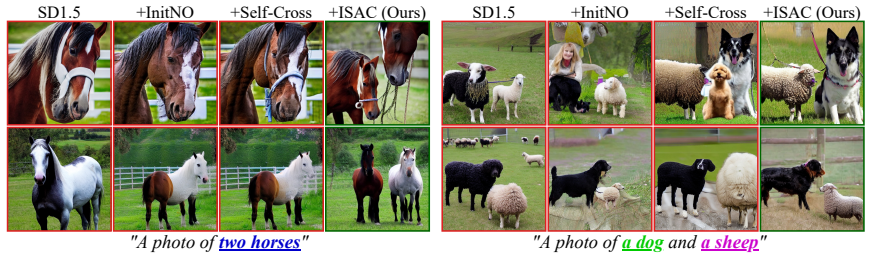
ISAC claims that multi-object generation in diffusion models fails because semantic signals are separated before instance boundaries exist, and that the correct order is instance-first. It shows that self-attention maps already expose class-agnostic instance layouts in early denoising, while cross-attention semantic maps remain overlapping blobs, and builds a two-phase guidance that first clusters self-attention into the requested N instance masks and repels their overlaps, then injects those stabilized masks into cross-attention to repel incompatible tokens and bind attributes within each instance. With the instance-to-semantic schedule $\lambda_{\mathrm{ins}}(t)=t/T$, $\lambda_{\mathrm{sem}}(t)=1-t/T$, ISAC reports consistent gains on T2I-CompBench, HRS-Bench, and its new IntraCompBench across five backbones, including at least 50% relative multi-class improvement on IntraCompBench, and refines overlapping box layouts in layout-to-image models.
Load-bearing premise
The load-bearing premise is that K-means clustering of early self-attention maps, restricted to a semantic foreground gate, reliably yields exactly one clean region per requested instance, because Phase 2 only assigns semantics to the regions Phase 1 creates.
Editorial extensions
If this is right
- On the authors' IntraCompBench, ISAC raises multi-class accuracy to 36% on SD1.5 (from 20% for the strongest prior training-free baseline) and to 52% on SD3.5-M (from 34% for Self-Cross).
- ISAC beats count-supervised methods on instance-counting accuracy without fine-tuning: 70% versus 49% on SD1.4 and 76% versus 69% on SDXL.
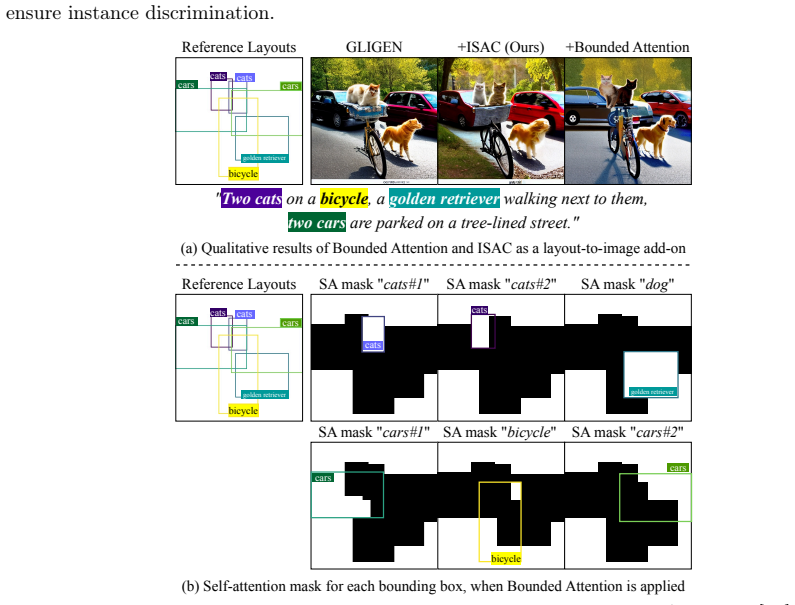
- ISAC improves layout-to-image controllers under overlapping boxes by refining coarse box layouts into dense instance masks, rather than only constraining attention inside each box.
- The instance-to-semantic ordering is essential: reversing the schedule to semantic-to-instance drops multi-class accuracy from 36% to 21%, and removing either phase degrades performance.
- A latent-selection variant carries the same scoring to very large diffusion backbones without backpropagation, trading a larger sample batch for lower memory overhead.
Reading between the lines
- Implicit in the results is that the method's transfer to very large diffusion transformers depends on self-attention staying class-agnostic early in denoising; a testable extension is measuring cluster-consistency across timesteps on large-scale backbones.
- Because the foreground gate is built from the very cross-attention maps that Phase 2 must correct, a wrong gate can silently drop an object before clustering; replacing the semantic gate with a purely class-agnostic saliency signal would isolate this risk.
- MPO's max-over-pixels form means one stubbornly touching pair sets the entire loss, so a top-k or area-weighted overlap penalty is a natural variant that might spread the gradient more evenly across crowded scenes.
Editorial analysis
A structured set of objections, weighed in public.
Referee Report
Summary. The paper proposes ISAC, a training-free, model-agnostic guidance for multi-instance text-to-image generation. The method performs a two-phase latent optimization: Phase 1 clusters the averaged self-attention map into N instance masks (after an LLM-based parser extracts N, class tokens, and attributes) and penalizes overlap between masks; Phase 2 injects these instance-aware masks into cross-attention and applies a repel-and-bind loss to separate incompatible tokens and bind attributes within each instance. An instance-to-semantic schedule shifts weight from Phase 1 to Phase 2 over the denoising trajectory. The method is evaluated on T2I-CompBench, HRS-Bench, and a newly introduced IntraCompBench across nine diffusion backbones, with consistent gains over prior training-free methods and competitive or better results than count-supervised approaches. The paper also demonstrates improvements when ISAC is applied to layout-to-image controllers and fine-tuned models.
Significance. If the central claim holds, ISAC is a valuable contribution: it identifies a concrete mechanism (early self-attention instance layouts) and turns it into a simple, training-free objective that improves multi-instance and multi-class generation across many backbones. The new IntraCompBench fills a real gap in evaluating intra-category compositions, and the paper is unusually thorough: ablations for the loss schedule, the overlap metric, the clustering algorithm, the gradient step size, and a best-of-N latent-selection variant, plus extensions to layout-to-image and fine-tuned models. The quantitative gains are large and consistent on external benchmarks (T2I-CompBench, HRS-Bench), which supports the general direction. The main weakness is that the load-bearing premise—that K-means on self-attention rows yields clean, exactly-N instance masks—is never directly validated, and the headline numbers come from a benchmark that the authors constructed and used for design choices.
major comments (4)
- [Sec. 3.2, Eq. (5)] The central mechanism of ISAC is Phase 1's clustering of self-attention into N instance masks, but the paper does not directly measure the quality of these masks. The qualitative PCA visualizations and the clustering-algorithm ablation (Tab. 7) show that the choice of clustering algorithm does not affect final accuracy, but they do not establish that the masks correspond to true instances. Since Phase 2 binds semantics to these masks (Eq. 8), any split/merge error propagates, and the reported gains could partly arise from the additional gradient signal rather than from accurate instance layouts. Please add a quantitative mask-quality metric (e.g., IoU between Phase-1 masks and masks from a detector such as Grounding DINO or SAM on a sample of IntraCompBench prompts) and report split/merge statistics as a function of timestep.
- [Tables 2, 3, 15] The headline comparisons report single-point accuracies without confidence intervals. Since IntraCompBench uses 10 images per prompt, standard errors are computable and should be reported. This is needed to assess small margins such as Table 2's SD3.5-M #3 row (ISAC 40% vs. Self-Cross 38%) and Table 3's SDXL #2 row (ISAC 96% vs. CountGen 97%). The variance-reduction claim in Appendix C.4 (Tab. 16) covers only T2I-CompBench Numeracy; the IntraCompBench metrics that support the abstract's claims should also include seed variance.
- [IntraCompBench and Tabs. 5, 6] The loss components (MPO, the instance-to-semantic schedule, and the schedule balance) appear to have been selected using IntraCompBench, and the same benchmark provides the headline numbers in the abstract. While external benchmarks (T2I-CompBench, HRS-Bench) provide some validation, the paper should explicitly state which design choices were tuned on IntraCompBench and provide a held-out split or an additional external validation for the final configuration. Without this, the magnitude of the claimed gains (e.g., 'at least 50%' in the abstract) cannot be independently interpreted.
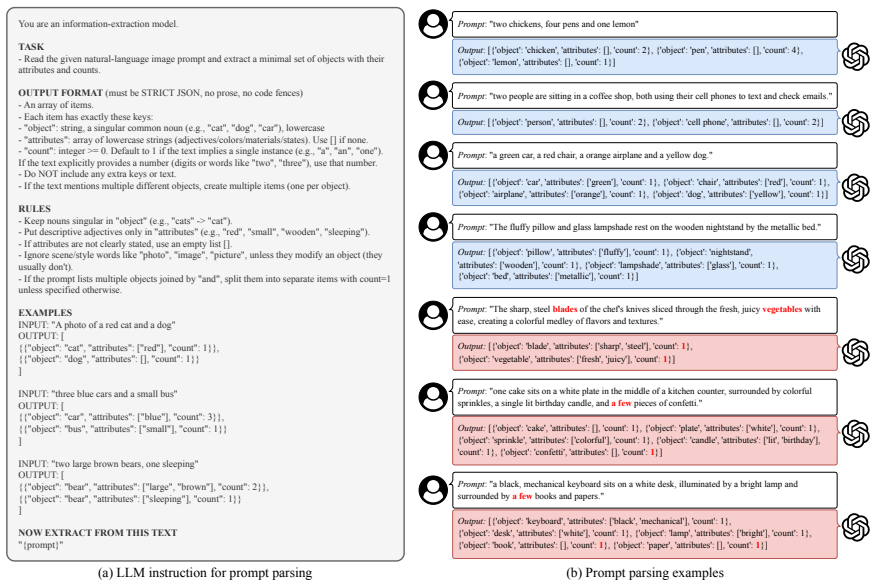
- [Appendix A, parser robustness] The method depends on the LLM parser for N and token relations, and the authors acknowledge that ambiguous counts are not resolved. However, no experiment quantifies the effect of parser errors on the end-to-end results. Because N determines the number of K-means clusters, a robustness study with perturbed or manually corrected counts would strengthen the practical-utility claim. As a separate point, the paper is explicit in Tab. 1 that instance counts are required, so I do not see a claim of count-independence; the concern about a contradiction with the algorithm does not land.
minor comments (6)
- [Abstract] The paper's abstract states 'Code will be released upon publication' while the arXiv abstract states 'Code and IntraCompBench are available at https://shjo-april.github.io/ISAC.' Please harmonize these statements.
- [Abstract and throughout] There are many missing spaces in the typeset text (e.g., 'introduceISAC(Instance-to-SemanticAttentionControl)', 'Lins', 'Lsem'), which makes the abstract and some sections hard to read. Please proofread the final version.
- [Tables 2 and 15] The latency/VRAM numbers for the same method and backbone differ between the two tables (e.g., SD1.5 + ISAC is 21s/9.7 GB in Table 2 but 30s/9.6 GB in Table 15; SD1.5 + A&E is 17s/9.2 GB in Table 2 but 24s/9.1 GB in Table 15). Please reconcile these values or explain the discrepancy.
- [Eq. (12)] The notation for softmax normalization 'CAsoftmax_t = softmax(β·CA_t[1:])' is informal with respect to the token dimension; please clarify that the softmax is applied along the token dimension excluding the SOT token.
- [Sec. 4.1 and Appendix A.1] The parser is described as 'GPT-OSS [44]' in the main text and 'GPT-OSS-20B' in the appendix; please use a consistent name.
- [Contributions list] The contribution states 'improves multi-object metrics by at least 1.9× over baseline [1]', but it is not clear which metric this refers to; please specify the metric and the comparison basis.
Circularity Check
The central premise that early self-attention rows form instance clusters is anchored to a co-authored DiffEgg preprint; no equation-level reduction appears, and the benchmark evidence is otherwise external.
-
self citation load bearing
[Section 1 (introduction paragraph after Fig. 1); operationalized in Section 3.2, Eq. (5).]
"In contrast, self-attention maps capture 'where' instance structures emerge, and already exhibit instance-like clustering early in the diffusion process [11]. ... We hypothesize that pixels belonging to the same instance exhibit higher mutual attention, whereas pixels from different instances attend to each other less."
Reference [11] is DiffEgg (Jo, Lee, Lee, Kim), a preprint by four of the six authors of this paper. It is the only external citation offered for the load-bearing premise that early self-attention rows already encode N instance-like clusters; Phase 1 turns this premise into K-means masks in Eq. (5), M = SAt[I,I] stopgrad(K), and Phase 2 binds semantics to those masks. The paper reports no direct mask-quality metric (no IoU or instance-segmentation agreement with ground truth), so the premise is supported mainly by a same-author preprint plus qualitative PCA visualizations rather than by independent evidence. This makes the self-citation load-bearing, although it does not reduce any equation to its own input.
full rationale
No definitional circularity was found: ISAC's losses in Eqs. (7)-(9) are optimization objectives over attention maps, not fitted parameters, and the headline accuracies come from external open-vocabulary detectors on T2I-CompBench, HRS-Bench, and IntraCompBench, so the numbers are not equal to the objective by construction. The main circularity burden is the early-self-attention instance-clustering hypothesis, which is cited to the authors' own DiffEgg preprint and is never validated with a direct segmentation-quality measurement; this raises the score to 4. Ablations in Tables 5 and 6 select the MPO metric and the instance-to-semantic schedule on IntraCompBench, which is a test-set selection risk rather than a forced reduction. Explicit limitations acknowledged by the paper, such as unresolved ambiguous count expressions (Appendix A) and the lack of 3D-aware reasoning (Appendix C.5), do not create circularity but should bound interpretation of the claimed gains.
Assumptions & free parameters
free parameters (2)
- gradient step size eta =
0.01
- loss schedule lambda_ins/lambda_sem =
t/T and 1-t/T
assumptions (4)
- domain assumption Pixels belonging to the same instance exhibit higher mutual self-attention than pixels from different instances, allowing K-means to recover N instance masks.
- domain assumption A foreground gate formed by binarizing CAins columns covers all relevant instance pixels and excludes background.
- domain assumption The GPT-OSS-20B LLM parser extracts correct class tokens, counts, and token relations from arbitrary prompts.
- domain assumption Averaging attention maps over all layers and heads preserves the instance structure needed for clustering.
Cite this review
Pith. "Pith review of ISAC: Training-Free Instance-to-Semantic Attention Control for Multi-Instance Generation." pith.science (2026). https://pith.science/paper/QOUUIX2S
@misc{pith2026250520935,
  author       = {Pith},
  title        = {Pith review of: ISAC: Training-Free Instance-to-Semantic Attention Control for Multi-Instance Generation},
  year         = {2026},
  howpublished = {\url{https://pith.science/paper/QOUUIX2S}},
  note         = {Machine review of arXiv:2505.20935}
}
abstract
Recent open-weight text-to-image (T2I) diffusion models still struggle with multi-instance prompts, often omitting or merging instances and mixing semantics among similar objects. We trace these failures to early denoising steps, before instance boundaries are reliably stabilized. Existing training-free guidance is largely driven by cross-attention or other token-conditioned semantic signals. Such guidance can separate concepts at the token level, but largely assumes that distinct instance regions have already emerged. In early denoising steps, it cannot reliably carve out these regions, so count failures and semantic mixing persist. By contrast, self-attention exposes class-agnostic instance layouts during early denoising. To exploit this asymmetry, we propose $\textbf{ISAC}$ ($\textbf{I}$nstance-to-$\textbf{S}$emantic $\textbf{A}$ttention $\textbf{C}$ontrol), a training-free, model-agnostic objective that first stabilizes self-attention layouts and then binds cross-attention semantics within them, without fine-tuning or external vision models. Across T2I-CompBench, HRS-Bench, and our newly curated IntraCompBench, ISAC consistently outperforms prior training-free methods. Furthermore, ISAC enhances layout-to-image controllers by refining coarse, overlapping bounding boxes into dense instance masks. Code and IntraCompBench are available at https://shjo-april.github.io/ISAC.
Figures


Figures from the paper (19 more)




Reference graph
Works this paper leans on
-
[1]
High-resolution image synthesis with latent diffusion models,
R. Rombach, A. Blattmann, D. Lorenz, P. Esser, and B. Ommer, “High-resolution image synthesis with latent diffusion models,” inProceedings of the IEEE/CVF conference on computer vision and pattern recognition, pp. 10684–10695, 2022
2022
-
[2]
Initno: Boosting text-to-image diffusion models via initial noise optimization,
X. Guo, J. Liu, M. Cui, J. Li, H. Yang, and D. Huang, “Initno: Boosting text-to-image diffusion models via initial noise optimization,” inCVPR, 2024
work page 2024
-
[3]
Self-cross diffusion guidance for text-to-image synthesis of similar subjects,
W. Qiu, J. Wang, and M. Tang, “Self-cross diffusion guidance for text-to-image synthesis of similar subjects,” inProceedings of the Computer Vision and Pattern Recognition Conference, pp. 23528–23538, 2025
work page 2025
-
[4]
Sdxl: Improving latent diffusion models for high-resolution image synthesis,
D. Podell, Z. English, K. Lacey, A. Blattmann, T. Dockhorn, J. Müller, J. Penna, and R. Rom- bach, “Sdxl: Improving latent diffusion models for high-resolution image synthesis,”arXiv preprint arXiv:2307.01952, 2023
arXiv 2023
-
[5]
Scaling rectified flow transformers for high-resolution image synthesis,
P. Esser, S. Kulal, A. Blattmann, R. Entezari, J. Müller, H. Saini, Y. Levi, D. Lorenz, A. Sauer, F. Boesel,et al., “Scaling rectified flow transformers for high-resolution image synthesis,” in Forty-first international conference on machine learning, 2024
work page 2024
-
[6]
Pixart-α: Fast training of diffusion transformer for photorealistic text-to-image synthesis,
J. Chen, J. Yu, C. Ge, L. Yao, E. Xie, Y. Wu, Z. Wang, J. Kwok, P. Luo, H. Lu, and Z. Li, “Pixart-α: Fast training of diffusion transformer for photorealistic text-to-image synthesis,” 2023
work page 2023
-
[7]
B. F. Labs, “Flux.”https://github.com/black-forest-labs/flux, 2024
work page 2024
-
[8]
Token merging for training-free semantic binding in text-to-image synthesis,
T. Hu, L. Li, J. van de Weijer, H. Gao, F. Shahbaz Khan, J. Yang, M.-M. Cheng, K. Wang, and Y. Wang, “Token merging for training-free semantic binding in text-to-image synthesis,” Advances in Neural Information Processing Systems, vol. 37, pp. 137646–137672, 2024
work page 2024
Show all 69 references
-
[9]
A cat is a cat (not a dog!): Unraveling infor- mation mix-ups in text-to-image encoders through causal analysis and embedding optimization,
C.-Y. Chen, C. Tseng, L.-W. Tsao, and H.-H. Shuai, “A cat is a cat (not a dog!): Unraveling infor- mation mix-ups in text-to-image encoders through causal analysis and embedding optimization,” Advances in Neural Information Processing Systems, 2024
2024
-
[10]
Attend-and-excite: Attention-based semantic guidance for text-to-image diffusion models,
H. Chefer, Y. Alaluf, Y. Vinker, L. Wolf, and D. Cohen-Or, “Attend-and-excite: Attention-based semantic guidance for text-to-image diffusion models,” 2023
2023
-
[11]
Diffegg: Diffusion-driven edge generation as a pixel- annotation-free alternative for instance annotation,
S. Jo, Z. Lee, W. Lee, and K. Kim, “Diffegg: Diffusion-driven edge generation as a pixel- annotation-free alternative for instance annotation,” 2025
2025
-
[12]
Gligen: Open-set grounded text-to-image generation,
Y. Li, H. Liu, Q. Wu, F. Mu, J. Yang, J. Gao, C. Li, and Y. J. Lee, “Gligen: Open-set grounded text-to-image generation,”CVPR, 2023
2023
-
[13]
T2i-compbench++: An enhanced and comprehensive benchmark for compositional text-to-image generation,
K. Huang, C. Duan, K. Sun, E. Xie, Z. Li, and X. Liu, “T2i-compbench++: An enhanced and comprehensive benchmark for compositional text-to-image generation,”IEEE Transactions on Pattern Analysis and Machine Intelligence, vol. 47, no. 5, pp. 3563–3579, 2025
2025
-
[14]
Hrs-bench: Holistic, reliable and scalable benchmark for text-to-image models,
E. M. Bakr, P. Sun, X. Shen, F. F. Khan, L. E. Li, and M. Elhoseiny, “Hrs-bench: Holistic, reliable and scalable benchmark for text-to-image models,” inProceedings of the IEEE/CVF International Conference on Computer Vision, pp. 20041–20053, 2023
2023
-
[15]
Make it count: Text- to-image generation with an accurate number of objects,
L. Binyamin, Y. Tewel, H. Segev, E. Hirsch, R. Rassin, and G. Chechik, “Make it count: Text- to-image generation with an accurate number of objects,”arXiv preprint arXiv:2406.10210, 2024
2024 arXiv
-
[16]
Counting guidance for high fidelity text-to-image synthesis,
W. Kang, K. Galim, H. I. Koo, and N. I. Cho, “Counting guidance for high fidelity text-to-image synthesis,” in2025 IEEE/CVF Winter Conference on Applications of Computer Vision (WACV), pp. 899–908, IEEE, 2025
2025
-
[17]
Linguistic binding in diffusion models: Enhancing attribute correspondence through attention map alignment,
R. Rassin, E. Hirsch, D. Glickman, S. Ravfogel, Y. Goldberg, and G. Chechik, “Linguistic binding in diffusion models: Enhancing attribute correspondence through attention map alignment,” Advances in Neural Information Processing Systems, vol. 36, 2024
2024
-
[18]
Conform: Contrast is all you need for high-fidelity text-to-image diffusion models,
T. H. S. Meral, E. Simsar, F. Tombari, and P. Yanardag, “Conform: Contrast is all you need for high-fidelity text-to-image diffusion models,” inProceedings of the IEEE/CVF Conference on Computer Vision and Pattern Recognition, pp. 9005–9014, 2024. 33
2024
-
[19]
Grounding dino: Marrying dino with grounded pre-training for open-set object detection,
S. Liu, Z. Zeng, T. Ren, F. Li, H. Zhang, J. Yang, Q. Jiang, C. Li, J. Yang, H. Su,et al., “Grounding dino: Marrying dino with grounded pre-training for open-set object detection,” in European Conference on Computer Vision, pp. 38–55, Springer, 2024
2024
-
[20]
Prompt-to- prompt image editing with cross attention control,
A. Hertz, R. Mokady, J. Tenenbaum, K. Aberman, Y. Pritch, and D. Cohen-Or, “Prompt-to- prompt image editing with cross attention control,”arXiv preprint arXiv:2208.01626, 2022
2022 arXiv
-
[21]
Training-free structured diffusion guidance for compositional text-to-image synthesis,
W. Feng, X. He, T.-J. Fu, V. Jampani, A. R. Akula, P. Narayana, S. Basu, X. E. Wang, and W. Y. Wang, “Training-free structured diffusion guidance for compositional text-to-image synthesis,” inThe Eleventh International Conference on Learning Representations, 2023
2023
-
[22]
Llm-grounded diffusion: Enhancing prompt un- derstanding of text-to-image diffusion models with large language models,
L. Lian, B. Li, A. Yala, and T. Darrell, “Llm-grounded diffusion: Enhancing prompt un- derstanding of text-to-image diffusion models with large language models,”arXiv preprint arXiv:2305.13655, 2023
2023 arXiv
-
[23]
Realcompo: Balancing realism and compositionality improves text-to-image diffusion models,
X. Zhang, L. Yang, Y. Cai, Z. Yu, K. Wang, J. Xie, Y. Tian, M. Xu, Y. Tang, Y. Yang, and B. Cui, “Realcompo: Balancing realism and compositionality improves text-to-image diffusion models,”Advances in Neural Information Processing Systems, 2024
2024
-
[24]
Migc: Multi-instance generation controller for text-to-image synthesis,
D. Zhou, Y. Li, F. Ma, X. Zhang, and Y. Yang, “Migc: Multi-instance generation controller for text-to-image synthesis,” inProceedings of the IEEE/CVF Conference on Computer Vision and Pattern Recognition, pp. 6818–6828, 2024
2024
-
[25]
Instancediffusion: Instance-level control for image generation,
X. Wang, T. Darrell, S. S. Rambhatla, R. Girdhar, and I. Misra, “Instancediffusion: Instance-level control for image generation,” 2024
2024
-
[26]
Hico: Hierarchical controllable diffusion model for layout-to-image generation,
B. Cheng, Y. Ma, L. Wu, S. Liu, A. Ma, X. Wu, D. Leng, and Y. Yin, “Hico: Hierarchical controllable diffusion model for layout-to-image generation,” 2024
2024
-
[27]
3dis: Depth-driven decoupled instance synthesis for text-to-image generation,
D. Zhou, J. Xie, Z. Yang, and Y. Yang, “3dis: Depth-driven decoupled instance synthesis for text-to-image generation,”arXiv preprint arXiv:2410.12669, 2024
2024
-
[28]
Creatilayout: Siamese multimodal diffusion transformer for creative layout-to-image generation,
H. Zhang, D. Hong, Y. Wang, J. Shao, X. Wu, Z. Wu, and Y.-G. Jiang, “Creatilayout: Siamese multimodal diffusion transformer for creative layout-to-image generation,” inProceedings of the IEEE/CVF International Conference on Computer Vision, pp. 18487–18497, 2025
2025
-
[29]
Overlaybench: A benchmark for layout-to-image generation with dense overlaps,
B. Li, C.-Y. Wang, H. Xu, X. Zhang, E. Armand, D. Srivastava, S. Xiaojun, Z. Chen, J. Xie, and Z. Tu, “Overlaybench: A benchmark for layout-to-image generation with dense overlaps,” in Proceedings of the 39th Conference on Neural Information Processing Systems (NeurIPS 2025), ...
2025
-
[30]
Mastering text-to-image diffusion: Recaptioning, planning, and generating with multimodal llms,
L. Yang, Z. Yu, C. Meng, M. Xu, S. Ermon, and B. Cui, “Mastering text-to-image diffusion: Recaptioning, planning, and generating with multimodal llms,” inInternational Conference on Machine Learning, 2024
2024
-
[31]
Multidiffusion: Fusing diffusion paths for controlled image generation,
O. Bar-Tal, L. Yariv, Y. Lipman, and T. Dekel, “Multidiffusion: Fusing diffusion paths for controlled image generation,”arXiv preprint arXiv:2302.08113, 2023
2023 arXiv
-
[32]
Noisecollage: A layout-aware text-to-image diffusion model based on noise cropping and merging,
T. Shirakawa and S. Uchida, “Noisecollage: A layout-aware text-to-image diffusion model based on noise cropping and merging,” inProceedings of the IEEE/CVF Conference on Computer Vision and Pattern Recognition, 2024
2024
-
[33]
Boxdiff: Text-to- image synthesis with training-free box-constrained diffusion,
J. Xie, Y. Li, Y. Huang, H. Liu, W. Zhang, Y. Zheng, and M. Z. Shou, “Boxdiff: Text-to- image synthesis with training-free box-constrained diffusion,” inProceedings of the IEEE/CVF International Conference on Computer Vision (ICCV), pp. 7452–7461, 2023
2023
-
[34]
Training-free layout control with cross-attention guidance,
M. Chen, I. Laina, and A. Vedaldi, “Training-free layout control with cross-attention guidance,” arXiv preprint arXiv:2304.03373, 2023
2023 arXiv
-
[35]
R&b: Region and boundary aware zero-shot grounded text-to-image generation,
J. Xiao, L. Li, H. Lv, S. Wang, and Q. Huang, “R&b: Region and boundary aware zero-shot grounded text-to-image generation,” 2023
2023
-
[36]
Groundit: Grounding diffusion transformers via noisy patch transplantation,
P. Y. Lee, T. Yoon, and M. Sung, “Groundit: Grounding diffusion transformers via noisy patch transplantation,” inAdvances in Neural Information Processing Systems, 2024
2024
-
[37]
Grounded text-to-image synthesis with attention refocusing,
Q. Phung, S. Ge, and J.-B. Huang, “Grounded text-to-image synthesis with attention refocusing,” inProceedings of the IEEE/CVF Conference on Computer Vision and Pattern Recognition, pp. 7932–7942, 2024. 34
2024
-
[38]
Be yourself: Bounded attention for multi-subject text-to-image generation,
O. Dahary, O. Patashnik, K. Aberman, and D. Cohen-Or, “Be yourself: Bounded attention for multi-subject text-to-image generation,” 2024
2024
-
[39]
Be decisive: Noise-induced layouts for multi-subject generation,
O. Dahary, Y. Cohen, O. Patashnik, K. Aberman, and D. Cohen-Or, “Be decisive: Noise-induced layouts for multi-subject generation,” inProceedings of the Special Interest Group on Computer Graphics and Interactive Techniques Conference Conference Papers, pp. 1–12, 2025
2025
-
[40]
Tifa: Accurate and interpretable text-to-image faithfulness evaluation with question answering,
Y. Hu, B. Liu, J. Kasai, Y. Wang, M. Ostendorf, R. Krishna, and N. A. Smith, “Tifa: Accurate and interpretable text-to-image faithfulness evaluation with question answering,” inProceedings of the IEEE/CVF International Conference on Computer Vision, pp. 20406–20417, 2023
2023
-
[41]
Beta sampling is all you need: Efficient image generation strategy for diffusion models using stepwise spectral analysis,
H. Lee, H. Lee, S. Gye, and J. Kim, “Beta sampling is all you need: Efficient image generation strategy for diffusion models using stepwise spectral analysis,” in2025 IEEE/CVF Winter Conference on Applications of Computer Vision (WACV), pp. 4215–4224, IEEE, 2025
2025
-
[42]
Yoloe: Real-time seeing anything,
A. Wang, L. Liu, H. Chen, Z. Lin, J. Han, and G. Ding, “Yoloe: Real-time seeing anything,” 2025
2025
-
[43]
Qwen-image technical report,
C. Wu, J. Li, J. Zhou, J. Lin, K. Gao, K. Yan, S. ming Yin, S. Bai, X. Xu, Y. Chen, Y. Chen, Z. Tang, Z. Zhang, Z. Wang, A. Yang, B. Yu, C. Cheng, D. Liu, D. Li, H. Zhang, H. Meng, H. Wei, J. Ni, K. Chen, K. Cao, L. Peng, L. Qu, M. Wu, P. Wang, S. Yu, T. Wen, W. Feng, X. Xu, Y...
2025
-
[44]
gpt-oss-120b & gpt-oss-20b model card,
OpenAI, “gpt-oss-120b & gpt-oss-20b model card,” 2025
2025
-
[45]
Learning to count anything: Reference-less class-agnostic counting with weak supervision,
M. Hobley and V. Prisacariu, “Learning to count anything: Reference-less class-agnostic counting with weak supervision,”arXiv preprint arXiv:2205.10203, 2022
2022 arXiv
-
[46]
U-net: Convolutional networks for biomedical image segmentation,
O. Ronneberger, P. Fischer, and T. Brox, “U-net: Convolutional networks for biomedical image segmentation,” inInternational Conference on Medical image computing and computer-assisted intervention, pp. 234–241, Springer, 2015
2015
-
[47]
Pixart-σ: Weak-to-strong training of diffusion transformer for 4k text-to-image generation,
J. Chen, C. Ge, E. Xie, Y. Wu, L. Yao, X. Ren, Z. Wang, P. Luo, H. Lu, and Z. Li, “Pixart-σ: Weak-to-strong training of diffusion transformer for 4k text-to-image generation,” inEuropean Conference on Computer Vision, pp. 74–91, Springer, 2024
2024
-
[48]
Mean shift: A robust approach toward feature space analysis,
D. Comaniciu and P. Meer, “Mean shift: A robust approach toward feature space analysis,” IEEE Transactions on pattern analysis and machine intelligence, vol. 24, no. 5, pp. 603–619, 2002
2002
-
[49]
Seg- sort: Segmentation by discriminative sorting of segments,
J.-J. Hwang, S. X. Yu, J. Shi, M. D. Collins, T.-J. Yang, X. Zhang, and L.-C. Chen, “Seg- sort: Segmentation by discriminative sorting of segments,” inProceedings of the IEEE/CVF international conference on computer vision, pp. 7334–7344, 2019
2019
-
[50]
An intriguing failing of convolutional neural networks and the coordconv solution,
R. Liu, J. Lehman, P. Molino, F. Petroski Such, E. Frank, A. Sergeev, and J. Yosinski, “An intriguing failing of convolutional neural networks and the coordconv solution,”Advances in neural information processing systems, vol. 31, 2018
2018
-
[51]
Tokencompose: Text-to-image diffusion with token-level supervision,
Z. Wang, Z. Sha, Z. Ding, Y. Wang, and Z. Tu, “Tokencompose: Text-to-image diffusion with token-level supervision,” inProceedings of the IEEE/CVF Conference on Computer Vision and Pattern Recognition (CVPR), pp. 8553–8564, June 2024
2024
-
[52]
Microsoft COCO: Common objects in context,
T.-Y. Lin, M. Maire, S. Belongie, J. Hays, P. Perona, D. Ramanan, P. Dollár, and C. L. Zitnick, “Microsoft COCO: Common objects in context,” inECCV, pp. 740–755, Springer, 2014
2014
-
[53]
Yolov12: Attention-centric real-time object detectors,
Y. Tian, Q. Ye, and D. Doermann, “Yolov12: Attention-centric real-time object detectors,” arXiv preprint arXiv:2502.12524, 2025
2025 arXiv
-
[54]
Rethinking the spatial inconsistency in classifier-free diffusion guidance,
D. Shen, G. Song, Z. Xue, F.-Y. Wang, and Y. Liu, “Rethinking the spatial inconsistency in classifier-free diffusion guidance,” inProceedings of the IEEE/CVF Conference on Computer Vision and Pattern Recognition, pp. 9370–9379, 2024
2024
-
[55]
Classifier-free diffusion guidance,
J. Ho and T. Salimans, “Classifier-free diffusion guidance,”arXiv preprint arXiv:2207.12598, 2022
2022 arXiv
-
[56]
Training-free dense-aligned diffusion guidance for modular conditional image synthesis,
Z. Wang, D. Peng, F. Chen, Y. Yang, and Y. Lei, “Training-free dense-aligned diffusion guidance for modular conditional image synthesis,” inProceedings of the Computer Vision and Pattern Recognition Conference, pp. 13135–13145, 2025. 35
2025
-
[57]
Universal guidance for diffusion models,
A. Bansal, H.-M. Chu, A. Schwarzschild, S. Sengupta, M. Goldblum, J. Geiping, and T. Goldstein, “Universal guidance for diffusion models,” inProceedings of the IEEE/CVF Conference on Computer Vision and Pattern Recognition, pp. 843–852, 2023
2023
-
[58]
Noise2score: tweedie’s approach to self-supervised image denoising without clean images,
K. Kim and J. C. Ye, “Noise2score: tweedie’s approach to self-supervised image denoising without clean images,”Advances in Neural Information Processing Systems, vol. 34, pp. 864–874, 2021
2021
-
[59]
Flow matching for generative modeling,
Y. Lipman, R. T. Chen, H. Ben-Hamu, M. Nickel, and M. Le, “Flow matching for generative modeling,”arXiv preprint arXiv:2210.02747, 2022
2022 arXiv
-
[60]
Rare-to-frequent: Unlocking composi- tional generation power of diffusion models on rare concepts with llm guidance,
D. Park, S. Kim, T. Moon, M. Kim, K. Lee, and J. Cho, “Rare-to-frequent: Unlocking composi- tional generation power of diffusion models on rare concepts with llm guidance,”The Thirteenth International Conference on Learning Representations, 2025
2025
-
[61]
Comat: Aligning text- to-image diffusion model with image-to-text concept matching,
D. Jiang, G. Song, X. Wu, R. Zhang, D. Shen, Z. Zong, Y. Liu, and H. Li, “Comat: Aligning text- to-image diffusion model with image-to-text concept matching,”arXiv preprint arXiv:2404.03653, 2024
2024 arXiv
-
[62]
Grounded sam: Assembling open-world models for diverse visual tasks,
T. Ren, S. Liu, A. Zeng, J. Lin, K. Li, H. Cao, J. Chen, X. Huang, Y. Chen, F. Yan, et al., “Grounded sam: Assembling open-world models for diverse visual tasks,”arXiv preprint arXiv:2401.14159, 2024
2024 arXiv
-
[63]
Itercomp: Iterative composition-aware feedback learning from model gallery for text-to-image generation,
X. Zhang, L. Yang, G. Li, Y. Cai, J. Xie, Y. Tang, Y. Yang, M. Wang, and B. Cui, “Itercomp: Iterative composition-aware feedback learning from model gallery for text-to-image generation,” arXiv preprint arXiv:2410.07171, 2024
-
[64]
Gans trained by a two time-scale update rule converge to a local nash equilibrium,
M. Heusel, H. Ramsauer, T. Unterthiner, B. Nessler, and S. Hochreiter, “Gans trained by a two time-scale update rule converge to a local nash equilibrium,”Advances in neural information processing systems, vol. 30, 2017
2017
-
[65]
Learning transferable visual models from natural language supervi- sion,
A. Radford, J. W. Kim, C. Hallacy, A. Ramesh, G. Goh, S. Agarwal, G. Sastry, A. Askell, P. Mishkin, J. Clark,et al., “Learning transferable visual models from natural language supervi- sion,” inInternational conference on machine learning, pp. 8748–8763, PmLR, 2021
2021
-
[66]
Rethinking fid: Towards a better evaluation metric for image generation,
S. Jayasumana, S. Ramalingam, A. Veit, D. Glasner, A. Chakrabarti, and S. Kumar, “Rethinking fid: Towards a better evaluation metric for image generation,” inProceedings of the IEEE/CVF Conference on Computer Vision and Pattern Recognition, pp. 9307–9315, 2024
2024
-
[67]
Imagereward: Learning and evaluating human preferences for text-to-image generation,
J. Xu, X. Liu, Y. Wu, Y. Tong, Q. Li, M. Ding, J. Tang, and Y. Dong, “Imagereward: Learning and evaluating human preferences for text-to-image generation,”Advances in Neural Information Processing Systems, vol. 36, pp. 15903–15935, 2023
2023
-
[68]
All seeds are not equal: Enhancing compositional text-to-image generation with reliable random seeds,
S. Li, H. Le, J. Xu, and M. Salzmann, “All seeds are not equal: Enhancing compositional text-to-image generation with reliable random seeds,”arXiv preprint arXiv:2411.18810, 2024
2024 arXiv
-
[69]
Self-rectifying diffusion sampling with perturbed-attention guidance,
D. Ahn, H. Cho, J. Min, W. Jang, J. Kim, S. Kim, H. H. Park, K. H. Jin, and S. Kim, “Self-rectifying diffusion sampling with perturbed-attention guidance,” inEuropean Conference on Computer Vision, pp. 1–17, Springer, 2024. 36
2024
Reviewed August 7, 2026 · model on record in the stance chip above.
Discussion (0). Sign in to comment.