REVIEW 3 major objections 4 minor 5 references
OrienText: Surface Oriented Textual Image Generation
T0 review · 3 major / 4 minor · reviewed 2026-08-07 · deepseek-v4-flash
Pith's one-line read The paper claims that feeding region-specific surface normals to a ControlNet-augmented text-to-image diffusion model, together with a surface-projected character mask, makes generated text correctly follow the orientation of angled…
desk verdict Promising idea, broken write-up: the mask alignment equations don't actually orient text, and the metric is self-contradictory. read the letter →
The pith
A machine-rendered reading of the paper's core claim, the machinery that carries it, and where it could break.
The reading
What carries the argument
The central object is the surface-aligned character mask $C^a_{\text{mask}}$, produced by projecting the original character mask onto the plane perpendicular to the estimated surface normal $\mathbf{N}=(n_x,n_y,n_z)$. Surface normals are estimated per-pixel from the single input image by learning the rotation between neighboring pixels; then, for each character bounding box, the center $\mathbf{C}$ is translated by a unit depth $d=1$ along the normal and projected onto the plane through the origin, and the four corners are placed at $\pm w/2$ and $\pm h/2$ around the projected center. This transformed mask tells the diffusion model where and how to paint characters. The second mechanism is the ControlNet-augmented text-to-image model, which takes the surface normal map $\mathbf{N}$ as an additional control input alongside the source image, the ROI mask, and $C^a_{\text{mask}}$, conditioning the base text-generation model on the surface geometry.
What would settle it
Render a checkerboard texture on a plane at a known grazing angle, estimate its surface normal, apply the Eqs. 1-5 projection to a text bounding box, and check whether the projected corners coincide with the perspective-mapped ground-truth corners; if the projected box stays axis-aligned at large slant angles, the projection step is not performing the orientation work attributed to it.
Extended reading notes
Core claim
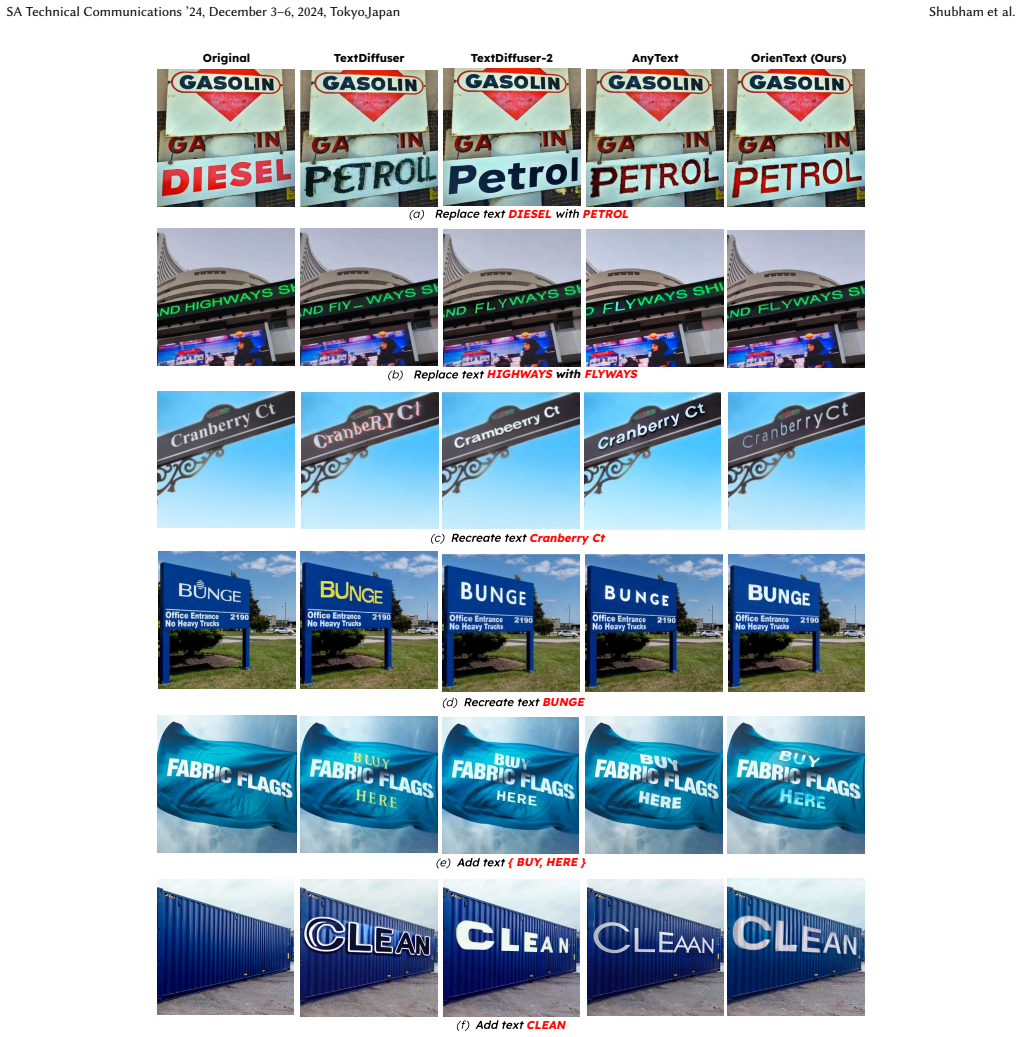
The paper's core claim is that region-specific surface normals are a sufficient conditioning signal for a text-to-image diffusion model to orient generated text correctly on non-frontal surfaces. Given a source image, a region of interest, and a character mask, OrienText estimates the surface normal map of the masked region, projects each character bounding box onto the plane perpendicular to the normal (assuming unit depth because no depth map is available), and feeds both the normal map and the projected mask into a ControlNet-augmented version of a base text-generation diffusion model. The projection equations (1)-(5) translate each box's center onto the plane through the origin with normal $\mathbf{N}$ and redraw the box as an axis-aligned rectangle of the same width and height around the projected center. The authors report that this mask alignment lowers the surface-normal consistency error for every method they compare, with OrienText achieving the lowest mean angular error (MAE-N $=1.7411$) and the highest human ratings on harmonization, text rendering, and perspective blending.
Load-bearing premise
The load-bearing premise is that the estimated surface normal, combined with the unit-depth plane projection in Eqs. 1-5, faithfully describes how a text rectangle should lie on the photographed surface; if the normal estimate is off or the projection is too crude to rotate characters, the aligned mask will mislead the diffusion model rather than help it.
Editorial extensions
If this is right
- Text painted onto angled surfaces no longer needs a manual perspective-warping step: the aligned-mask pipeline handles billboards, walls, banners, and packaging in one pass.
- The proposed MAE-N metric gives an automatic, surface-normal-based way to score orientation quality, which can be applied to any text generation method.
- Mask alignment improves surface-normal consistency for all compared baselines, not just OrienText, so the projection step is a transferable improvement.
- OrienText works as a post-processing stage for diffusion-generated content, producing product-advertisement images with multi-line text.
- Very small fonts and 3D engraved text remain failure cases, as the authors state in the conclusion.
Reading between the lines
- Because the projection assumes a single unit-depth plane, strongly curved surfaces (soda cans, car bodies) will likely need a depth-aware or per-pixel projection before the mask alignment generalizes.
- The current axis-aligned redraw of boxes around projected centers does not rotate or shear glyphs; feeding per-character quad corner coordinates into the mask would be a direct test of how much perspective cue the diffusion model actually needs.
- The MAE-N metric is only as trustworthy as the underlying surface normal estimator, so orientation scores on images with weak normal estimates should be read cautiously.
- A natural extension is to condition on region-specific normal maps rather than one global plane, which would let a single image contain text on multiple differently angled surfaces.
Editorial analysis
A structured set of objections, weighed in public.
Referee Report
Summary. The paper introduces OrienText, a method for text-to-image generation on perspectively angled surfaces. The authors propose conditioning a ControlNet-augmented diffusion model on surface normals estimated by the method of Bae and Davison (2024), and transforming the input character mask via a projection onto a surface-normal-defined plane. They evaluate on a self-curated 60-image dataset with a proposed surface-normal consistency metric (MAE-N) and a human study, reporting improvements over TextDiffuser, TextDiffuser-2, and AnyText.
Significance. The problem is real and timely: generating or editing text on surfaces such as billboards, packaging, and building facades requires perspective-aware rendering, and current text diffusion models often overlay frontal text. The core idea of conditioning on surface normals is reasonable, and the paper identifies a useful evaluation axis (perspective blending) that is typically neglected. However, the paper's central geometric construction is flawed, and the quantitative metric is confounded with the conditioning input. If the projection and metric were corrected, the approach might still be of interest, but as written the evidence does not support the claimed contribution. No code or data are released, limiting reproducibility.
major comments (3)
- [Sec. 3.2, Eqs. (1)-(5)] The character-mask alignment procedure is internally inconsistent and does not perform the claimed perspective alignment. First, the corner points of the bounding box are computed by translating the projected center C_p by ±w/2 in x and ±h/2 in y, which produces axis-aligned rectangles in image coordinates; no rotation, shear, or foreshortening is applied, so the transformed mask C^a_mask cannot encode the orientation of a slanted surface. Second, the equations are inconsistent: with n=(0,0,1) and c_z=0, Eq. (3) gives C'=(c_x,c_y,-1), and Eq. (5) with t = n_x c_x + n_y c_y + n_z c_z over ||n||^2 gives t=0, so Eq. (4) yields C_p=(c_x,c_y,-1), not the orthogonal projection (c_x,c_y,0) onto the plane through the origin. The text in Section 3.2 says the projection is onto the plane defined by n and the origin, but the formula uses the original C rather than C' in the numerator, leading to the inconsistency. Since the paper's central claim is that OrienText orients text correctly via this mask alignment, this is a load-bearing error that invalidates the described mechanism.
- [Sec. 4.2.1 and Table 1] The MAE-N metric is circular: it computes surface normals with the same estimator [Bae and Davison 2024] that is used as conditioning input to the model, and then compares normals before and after generation. Thus the metric largely measures whether the model preserved its own conditioning signal, which inherently favors normal-conditioned methods such as OrienText and does not provide an independent measure of text-surface alignment. Additionally, the definition 'MAE-Normal = mean(cosine_similarity(N, N'))' is not a mean angular error; cosine similarity is a similarity where higher values indicate better agreement, but the paper claims 'A lower MAE-N indicates that the surface normals remain similar.' The numerical values in Table 1 (e.g., 4.5243, 1.8937) are outside the range of cosine similarity, so either the equation is wrong or the table reports a different quantity. The metric as presented cannot support the quantitative conclusions.
- [Table 1, 'Anytext' row] The text in Section 4.3 states that 'aligning character masks with surface normals improves performance across all methods,' but the AnyText row in Table 1 shows a worsening from 1.8937 (w/o mask alignment) to 1.8955 (w/ mask alignment). This direct contradiction undermines the universal-improvement claim, and the paper does not discuss or explain this exception. No confidence intervals or significance tests are reported, so even the improvements that are in the expected direction are not established statistically.
minor comments (4)
- [Sec. 3.2] The symbol N is used both for the surface normal vector (Eq. 1) and for the full surface-normal map (Fig. 1), which is confusing; a distinct symbol such as N_map would clarify the presentation.
- [Sec. 4.1] The training dataset (2,320 images) is derived from SCUT with affine augmentations, but the paper does not specify whether the surface-normal maps are computed on the original or augmented images, nor does it report the train/validation split or any hyperparameter sensitivity.
- [References] TextDiffuser appears as both [Chen et al. 2024] and [Chen et al. 2023] with nearly identical titles; this duplication should be resolved, and the paper should clarify which version is used for comparison and as the base model.
- [Supplementary, Fig. 2] The supplementary example explicitly shows failures for 3D and small text, which is consistent with the limitations mentioned in the conclusion, but the main paper does not discuss these failure cases in the quantitative evaluation.
Circularity Check
The quantitative MAE-N metric uses the same surface-normal estimator (Bae & Davison 2024) that supplies the model's conditioning input, making the metric partly a check that the model preserved its own input; the human study is small, so the central orientation claim is not independently supported by the reported numbers.
-
self definitional
[Sec. 3.1 and Sec. 4.2.1 (Automated Evaluation; MAE-Normal definition)]
"We first compute the surface normals [Bae and Davison 2024] of the image before and after text generation using our proposed OrienText method. ... We then calculate the Mean Angular Error between the surface normals of the input and generated images, denoted as: MAE-Normal = mean( cosine_similarity(N, N’)), where N∈ R^{h×w×3} and N′∈ R^{h×w×3} represent the surface normals before and after the image generation, respectively. A lower MAE-N indicates that the surface normals remain similar, implying that the text characters are well-aligned with the underlying surface geometry."
The conditioning input is the surface-normal map N from Bae & Davison (Sec. 3.1). The metric defines good alignment as low difference between input and output normals, both computed by that same estimator (Sec. 4.2.1). So MAE-N largely measures whether the output preserved the conditioning map it was given. A model that leaves the background unchanged and does not perturb the estimator would score well regardless of actual character orientation. Since the model is trained with normal maps from this estimator (Sec. 4.1), the reported improvement partly verifies that the model kept its own input, not that text is correctly oriented against an external ground truth. The human study is independent but small (15 raters, 60 images).
full rationale
The central geometric projection in Sec. 3.2 is not circular, though it is a correctness risk: the corners are computed by translating the projected center by ±w/2 and ±h/2, leaving axis-aligned boxes, and Eq. 5 appears inconsistent with the projection described. Those issues are not self-referential reductions and do not raise the circularity score. The one genuine circularity is the MAE-N metric: the same surface-normal estimator both conditions the model and scores the result, so the metric is partly a check of input preservation. The human evaluation provides some independent evidence, which keeps the score moderate. No load-bearing self-citations or uniqueness imports are present; the self-citation to the authors' CustomText work is only a related-work enumeration.
Assumptions & free parameters
free parameters (3)
- Unit depth d =
1
- Projection plane origin =
origin (0,0,0)
- Bounding box center z-coordinate cz =
unspecified (implicitly 0)
assumptions (4)
- domain assumption Bae and Davison (2024) surface normal estimator is accurate for the target surfaces.
- ad hoc to paper Unit depth d=1 can stand in for missing depth information.
- ad hoc to paper The projection plane passes through the world origin and the text lies on that plane.
- domain assumption Characters remain rectangular after projection.
Cite this review
Pith. "Pith review of OrienText: Surface Oriented Textual Image Generation." pith.science (2026). https://pith.science/paper/NPWY7U2F
@misc{pith2026250520958,
  author       = {Pith},
  title        = {Pith review of: OrienText: Surface Oriented Textual Image Generation},
  year         = {2026},
  howpublished = {\url{https://pith.science/paper/NPWY7U2F}},
  note         = {Machine review of arXiv:2505.20958}
}
read the original abstract
Textual content in images is crucial in e-commerce sectors, particularly in marketing campaigns, product imaging, advertising, and the entertainment industry. Current text-to-image (T2I) generation diffusion models, though proficient at producing high-quality images, often struggle to incorporate text accurately onto complex surfaces with varied perspectives, such as angled views of architectural elements like buildings, banners, or walls. In this paper, we introduce the Surface Oriented Textual Image Generation (OrienText) method, which leverages region-specific surface normals as conditional input to T2I generation diffusion model. Our approach ensures accurate rendering and correct orientation of the text within the image context. We demonstrate the effectiveness of the OrienText method on a self-curated dataset of images and compare it against the existing textual image generation methods.
Figures


Figures from the paper (3 more)


Reference graph
Works this paper leans on
-
[1]
Jingye Chen, Yupan Huang, Tengchao Lv, Lei Cui, and Qifeng Chen. 2024. Textdif- fuser: Diffusion models as text painters. Advances in NeurIPS 36 (2024)
work page 2024
-
[2]
Jingye Chen, Yupan Huang, Tengchao Lv, Lei Cui, Qifeng Chen, and Furu Wei
-
[3]
Yuxiang Tuo, Wangmeng Xiang, Jun-Yan He, Yifeng Geng, and Xuansong Xie
-
[5]
arXiv preprint arXiv:2311.03054 (2023)
Anytext: Multilingual visual text generation and editing. arXiv preprint arXiv:2311.03054 (2023). Permission to make digital or hard copies of all or part of this work for personal or classroom use is granted without fee provided that copies are not made or distributed for profit or commercial advantage and that copies bear this notice and the full citati...
arXiv 2023
- [2023]
Reviewed August 7, 2026 · model on record in the stance chip above.
Discussion (0). Sign in to comment.