REVIEW 2 major objections 4 minor 9 references
Superstability of micrometer jets surrounded by a polymeric shell
T0 review · 2 major / 4 minor · reviewed 2026-08-07 · deepseek-v4-flash
Pith's one-line read Surrounding an aqueous microjet with a thin shell of a low-concentration polymer solution lowers the minimum stable flow rate by an order of magnitude, yielding jets about 2 µm wide and over 2 mm long.
desk verdict The polymer-shell compound jets are a real and useful result, but the 'few hundred nanometers' shell thickness is inferred from a plug-flow assumption that the paper's own entrance-length argument undermines. read the letter →
The pith
A machine-rendered reading of the paper's core claim, the machinery that carries it, and where it could break.
The reading
What carries the argument
The load-bearing pieces are the coaxial flow-focusing ejector and the equal-velocity core-shell identity. The ejector is a 3D-printed concentric nozzle in which an inner capillary delivers the sample core and an outer capillary delivers the shell, both focused by a helium stream. The shell thickness is not measured directly but inferred from $d_i = d_j\sqrt{Q_i/Q_t}$ and $t=(d_j-d_i)/2$, assuming the core and shell move at the same speed. The stabilization mechanism is the coil–stretch transition: the strong extensional flow in the tapering meniscus stretches the polymer chains, producing elastic stresses that shrink and stabilize the meniscus, reducing the minimum flow rate needed for steady jetting.
What would settle it
Measure the core diameter directly in the jet, for instance by imaging a fluorescently labeled core liquid, and compare it with the value inferred from $d_i = d_j\sqrt{Q_i/Q_t}$; any systematic mismatch would invalidate the reported shell thicknesses and the thin-shell conclusion.
Extended reading notes
Core claim
On the paper's own terms, the central discovery is that a few-hundred-nanometer shell of a low-concentration PEO solution can 'armor' an aqueous microjet and make it superstable. In a coaxial flow-focusing injector, the polymer shell reduces the minimum outer flow rate by an order of magnitude compared with water or buffer shells, even though its zero-shear viscosity is close to water's; the effect is therefore attributed to viscoelasticity via the coil–stretch transition of the polymer in the tapering meniscus. As a result, buffer jets with diameters around 2 µm and lengths over 2 mm were steadily emitted, whereas without the shell the minimum jet diameter was about 4.5 µm. The authors further hypothesize that stretched polymers in the shell may entangle or self-assemble, slowing relaxation and delaying capillary breakup.
Load-bearing premise
The shell-thickness numbers rest on the assumption that the core and shell fluids travel at exactly the same speed; if they slip relative to each other, the reported thicknesses are wrong and the claim that such a thin shell stabilizes the jet is weakened.
Editorial extensions
If this is right
- The minimum total flow rate for stable buffer-fluid jets drops by an order of magnitude, enabling jets about 2 µm in diameter and longer than 2 mm.
- The stabilizing effect is viscoelastic rather than viscous: a PEO shell with a zero-shear viscosity close to water's outperforms Newtonian shells of water or buffer.
- The polymer shell remains effective even when its thickness is much smaller than the jet diameter, so the sample buffer can stay in the core while the thin shell controls stability.
- Nozzle orifices large enough to pass protein microcrystals can still produce stable thin jets; C-phycocyanin crystals were jetted at a total flow rate of 12 µl/min with a jet diameter around 3 µm and length over 800 µm.
- Longer stable jets extend the pump–probe time delays reachable in serial crystallography: a 1.5 mm jet moving at 45 m/s corresponds to delays around 25 µs.
Reading between the lines
- The armoring strategy probably generalizes to other sample liquids: any miscible, low-concentration polymer solution with a fast coil–stretch response could stabilize jets of solvents, ionic liquids, or dense slurries, separating sample formulation from jet stability.
- Because the shell thickness follows from the flow-rate ratio, tuning $Q_i/Q_t$ could push the shell below the few-hundred-nanometer range, so the stability limit demonstrated here may not be the practical floor.
- If the authors' entanglement hypothesis is correct, higher molecular weights or polymer concentrations just below the pull-out instability should extend jet length further—a testable prediction the paper does not itself make.
Editorial analysis
A structured set of objections, weighed in public.
Referee Report
Summary. The manuscript reports an experimental study of coaxial flow-focusing of compound liquid jets. An inner aqueous core (water or a protein-crystallography buffer) is surrounded by a shell of a dilute PEO solution, and the stability of the jet is compared with Newtonian shells (water, buffer). For each inner flow rate, the outer flow rate is decreased until a 40 s uninterrupted jet is no longer obtained, and the jet diameter and length are measured at this stability limit. The main claims are that the polymeric shell reduces the minimum outer flow rate by about an order of magnitude, produces jets as thin as about 2 µm and longer than 2 mm, and achieves this with a shell only a few hundred nanometers thick. A demonstration with C-phycocyanin microcrystals is included, and implications for serial femtosecond crystallography are discussed.
Significance. If the quantitative claims survive scrutiny, the paper offers a practically useful route to long, thin, stable jets for SFX without altering the sample buffer. The experimental work is systematic: eight nozzle geometries are screened, stability criteria are explicit, and the crystal-laden jet demonstration is a useful proof of principle. The central qualitative effect, a strong stabilizing action of a dilute PEO shell, is clearly supported by the data. The main weaknesses are in the interpretation of derived quantities (shell thickness, minimum liquid flow rate) rather than in the raw stability measurements.
major comments (2)
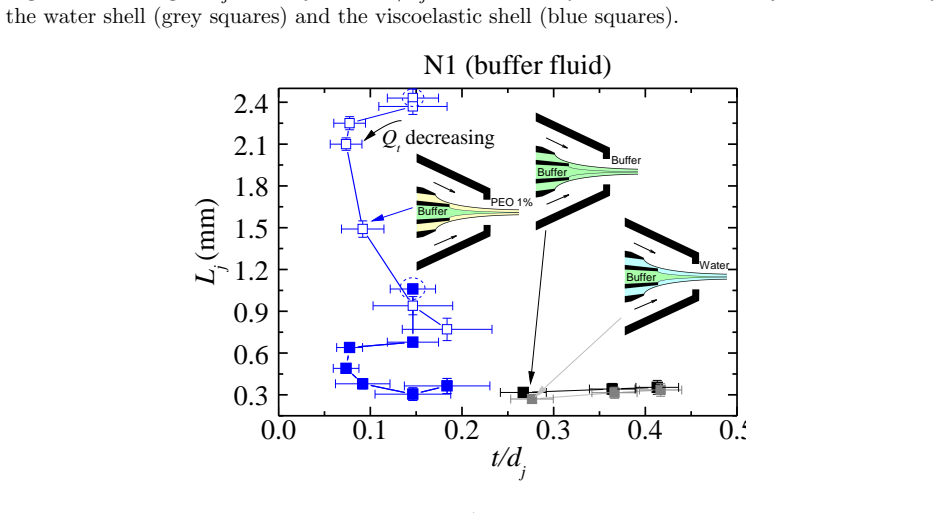
- [Section 2, core-diameter estimate] The relation di = dj sqrt(Qi/Qt) assumes that the flow-rate ratio equals the area ratio. The sentence 'we have assumed that the core and shell moved at the same velocity, which is an accurate approximation given the small size of the laminar entrance length Le/dj ≈ 0.0575 Re ∼ 10' is not a valid justification: a short entrance length means the profile becomes fully developed over a small fraction of the jet, and the measured jets are hundreds to thousands of diameters long. In fully developed coaxial laminar flow of equal-viscosity Newtonian fluids, Qi/Qt = 2x² − x⁴ with x = di/dj, not x². For the buffer-fluid stability limit with Qi = 5 µl/min and Qo = 2 µl/min, plug flow gives x = 0.845 and t/dj = 0.077, while the fully developed relation gives x ≈ 0.682 and t/dj ≈ 0.159. Thus all t and t/dj values in Figs. 7–8, and the abstract's 'few hundred nanometers' thickness, are not robust as stated. The authors should either measure the shell thickness directly, supply a model of the actual velocity profile (including the viscosity ratio), or remove the quantitative shell-thickness claims.
- [Abstract and Section 4] The abstract's statement that the minimum liquid flow rate leading to stable flow-focusing is decreased by one order of magnitude is an overstatement for the total liquid flow rate. The one-order-of-magnitude reduction documented in Section 4 is for the outer stream Qo at a given inner flow rate Qi. For example, the buffer-fluid case with Qi = 5 µl/min and minimum Qo = 2 µl/min has Qt = 7 µl/min, and the corresponding reduction in Qt relative to the Newtonian-shell case is not an order of magnitude. The same overstatement appears in the final paragraph of Section 4 ('reducing the liquid flow rate by one order of magnitude'). Please rephrase the abstract to say 'minimum outer flow rate' or present data demonstrating an order-of-magnitude reduction in the minimum total liquid flow rate.
minor comments (4)
- [Section 4 and Figs. 6 and 8 captions] The open symbols in Figs. 6 and 8 are said to correspond to results without considering jet whipping; please clarify how the jet length and diameter are defined when whipping is excluded and why those cases are separated from the main trend.
- [Section 2, experimental uncertainty] The text states that the jet diameter uncertainty is about one pixel (0.222 µm). For jet diameters near 2 µm, this is a relative uncertainty of about 10%, and the inferred core diameter and shell thickness inherit a larger relative error; please propagate this uncertainty into the reported t/dj values in Figs. 7–8.
- [Abstract] The term 'superstable' is used in the title and abstract but is not defined there; the 40 s stability criterion is introduced only in Section 2. Consider defining the criterion in the abstract or using a less absolute term.
- [Section 4, causal attribution] The sentence 'This confirms that the meniscus stabilization must be attributed to viscoelasticity' is stronger than the comparison supports, because the PEO shell has a different zero-shear viscosity (2.33 mPa·s) from water (1 mPa·s) and only one polymer chemistry and concentration is tested; consider softening the causal language and treating the entanglement explanation as a hypothesis.
Circularity Check
No significant circularity: the stabilizing effect of the polymeric shell is measured directly, and the shell-thickness estimate is an explicit modeling assumption rather than a fitted input relabeled as a prediction.
full rationale
The paper's central claim—that a dilute PEO shell reduces the minimum outer flow rate by about an order of magnitude and permits thinner and longer jets—is established by direct experimental stability-limit measurements (Figs. 3 and 4) and by measured jet diameters and lengths (Figs. 5 and 6), not by any fitted parameter that is subsequently relabeled as a prediction. The shell thickness is inferred via di = dj sqrt(Qi/Qt) under an explicitly stated equal-velocity assumption; this is a modeling assumption, and while it may be questioned on fully-developed-flow grounds, it is not circular because t/dj is not an input to the measured stability threshold and no claim is derived from the assumption by definition. Polymer viscosity and relaxation time are taken from prior work by the same group (Rubio et al., 2022a), but those are external measurements of the same fluid, not outputs of this paper's fit, and they enter only a supporting hypothesis about entanglement. The optimization of PEO concentration is a direct experimental scan, not an inverse reconstruction. No self-citation is load-bearing for the main result; the cited coil-stretch transition is a standard physical mechanism invoked for interpretation. Thus no circular step satisfies the standard of Eq. X reducing to Eq. Y by construction.
Assumptions & free parameters
assumptions (5)
- domain assumption The core and shell move at the same velocity, so the core diameter is di = dj * sqrt(Qi/Qt).
- domain assumption The polymer solution properties (shear viscosity 2.33 mPa·s, extensional relaxation time 26.2 µs) are taken from prior work by the same group (Rubio et al., 2022a).
- domain assumption A stable jet is defined as no interruption for more than 40 s.
- domain assumption Nozzle fabrication reproducibility does not affect results because slicing/hatching distances are much smaller than the nozzle lengths.
- domain assumption Jet temperature does not change significantly around the nozzle, based on prior numerical simulations (Rubio et al., 2021).
Cite this review
Pith. "Pith review of Superstability of micrometer jets surrounded by a polymeric shell." pith.science (2026). https://pith.science/paper/GCOZXFOX
@misc{pith2026250520965,
  author       = {Pith},
  title        = {Pith review of: Superstability of micrometer jets surrounded by a polymeric shell},
  year         = {2026},
  howpublished = {\url{https://pith.science/paper/GCOZXFOX}},
  note         = {Machine review of arXiv:2505.20965}
}
read the original abstract
We have produced superstable compound liquid microjets with a three-dimensional printed coaxial flow-focusing injector. The aqueous jet core is surrounded by a shell, a few hundred nanometers in thickness, of a low-concentration aqueous solution of a low-molecular-weight polymer. Due to the stabilizing effect of the polymeric shell, the minimum liquid flow rate leading to stable flow-focusing is decreased by one order of magnitude, resulting in much thinner and longer jets. Possible applications of this technique for Serial Femtosecond X-ray Crystallography are discussed.
Figures


Figures from the paper (6 more)


Reference graph
Works this paper leans on
-
[1]
Acero, A. J., Ferrera, C., Montanero, J. M. & Ga˜ n´ an-Calvo, A. M. (2012).J. Micromech. Microeng. 22, 065011. Arnlund, D., Johansson, L. C., Wickstrand, C., Barty, A., Williams, G. J., Malmerberg, E., Davids- son, J., Milathianaki, D., DePonte, D. P., Shoeman, R. L., Wang, D., James, D., Katona, G., Westenhoff, S., White, T. A., Aquila, A., Bari, S., Be...
work page 2012
-
[10]
Schulz, E. C., Yorke, B. A., Pearson, A. R. & Mehrabi, P. (2022). Acta Crystallogr. D: Struct. Biol. 78, 14–29. Vakili, M., Bielecki, J., Knoˇ ska, J., Otte, F., Han, H., Kloos, M., Schubert, R., Delmas, E., Mills, G., de Wijn, R., Letrun, R., Dold, S., Bean, R., Round, A., Kim, Y., Lima, F. A., D¨ orner, K., Valerio, J., Heymann, M., Mancuso, A. P. & Sch...
work page 2022
-
[640]
Rubio, A., Galindo, F., Vega, E. J., Montanero, J. M. & Cabezas, M. G. (2022a). Phys. Rev. Fluids, 7, 074201. Rubio, A., Vega, E. J., Ga˜ n´ an-Calvo, A. M. & Montanero, J. M. (2022b). Phys. Fluids, 34, 062014. Rubio, M., Rubio, A., Cabezas, M. G., Herrada, M. A., Ga˜ n´ an-Calvo, A. M. & Montanero, J. M. (2021). Int. J. Multiphase Flow, 142, 103720. Schm...
work page 2022
-
[657]
E., You, T., Bielecki, J., Valerio, J., Kloos, M., Westphal, D., Bellisario, A., Yenupuri, T
Konold, P. E., You, T., Bielecki, J., Valerio, J., Kloos, M., Westphal, D., Bellisario, A., Yenupuri, T. V., Wollter, A., Koliyadu, J. C., Koua, F. H., Letrun, R., Round, A., Sato, T., M´ esz´ aros, P., Monrroy, L., Mutisya, J., B´ odizs, S., Larkiala, T., Nimmrich, A., Alvarez, R., Adams, P., Bean, R., Ekeberg, T., Kirian, R. A., Martin, A. V., Westenhof...
work page 2023
-
[670]
Lemke, H. T., Kjær, K. S., Hartsock, R., van Driel, T. B., Chollet, M., Glownia, J. M., Song, S., Zhu, D., Pace, E., Matar, S. F., Nielsen, M. M., Benfatto, M., Gaffney, K. J., Collet, E. & Cammarata, M. (2017). Nature Comm. 8(1), 15342. 13 Montanero, J. M. & Ga˜ n´ an-Calvo, A. M. (2020).Rep. Prog. Phys. 83, 097001. Oberthuer, D., Knoˇ ska, J., Wiedorn, ...
work page 2017
-
[1057]
Bostedt, C., Boutet, S., Fritz, D. M., Huang, Z., Lee, H. J., Lemke, H. T., Robert, A., Schlotter, W. F., Turner, J. J. & Williams, G. J. (2016). Rev. Mod. Phys. 88, 015007. Br¨ and´ en, G. & Neutze, R. (2021).Science, 373(6558), eaba0954. Chapman, H. N., Fromme, P., Barty, A., White, T. A., Kirian, R. A., Aquila, A., Hunter, M. S., Schulz, J., DePonte, D...
work page 2016
-
[3033]
Ga˜ n´ an-Calvo, A. M. (1998).Phys. Rev. Lett. 80, 285–288. Gennes, P. G. D. (1974). J. Chem. Phys. 60,
work page 1998
-
[4025]
Williamson, L. J., Galchenkova, M., Best, H. L., Bean, R. J., Munke, A., Awel, S., Pena, G., Knoska, J., Schubert, R., D¨ orner, K., Park, H.-W., Bideshi, D. K., Henkel, A., Kremling, V., Klopprogge, B., Lloyd-Evans, E., Young, M. T., Valerio, J., Kloos, M., Sikorski, M., Mills, G., Bielecki, J., Kirkwood, H., Kim, C., de Wijn, R., Lorenzen, K., Xavier, P...
work page 2023
Show all 9 references
-
[5030]
& Shinnar, R
Goldin, M., Yerushalmi, J., Pfeffer, R. & Shinnar, R. (1969). J. Fluid Mech. 38, 689–711. Knoˇ ska, J., Adriano, L., Awel, S., Beyerlein, K. R., Yefanov, O., Oberthuer, D., Pe˜ na Murillo, G. E., Roth, N., Sarrou, I., Villanueva-Perez, P., Wiedorn, M. O., Wilde, F., Bajt, S., ...
1969
Reviewed August 7, 2026 · model on record in the stance chip above.
Discussion (0). Sign in to comment.