REVIEW 3 major objections 4 minor 1 cited by
Personalized Query Auto-Completion for Long and Short-Term Interests with Adaptive Detoxification Generation
T0 review · 3 major / 4 minor · reviewed 2026-08-07 · deepseek-v4-flash
Pith's one-line read LaD claims to cut toxic query completions to a 6.55% probability with comparable generation quality, and in an online A/B test it lifted CTR by 4.08%.
desk verdict Solid industrial QAC paper with a genuinely new [Reject]-token mechanism, but the offline detoxification numbers on KSQAC may be self-measured because the evaluation scorer is never identified. read the letter →
The pith
A machine-rendered reading of the paper's core claim, the machinery that carries it, and where it could break.
The reading
What carries the argument
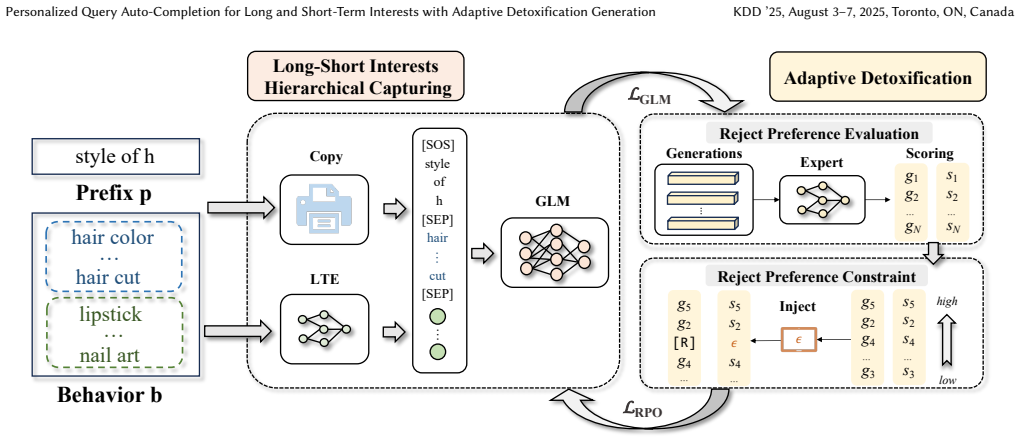
The load-bearing machinery is a pair of training-time mechanisms. A Long-term interests Transformer Encoder (LTE) compresses each of the user's past queries into a single embedding vector, so long-term interests enter the sequence as coarse tokens; short-term interests are copied verbatim as token sequences, preserving spelling and word boundaries. These are prefixed to the query prefix and fed to a Generative Language Model (GLM), which is trained with the standard cross-entropy generation loss. The second mechanism is Reject Preference Optimization (RPO): a Detoxification Expert—a 48-layer discriminative transformer trained on hundreds of millions of search logs plus tens of thousands of manual annotations—scores each generated completion; when a score falls below a threshold epsilon of 0.6, the special token [Reject] is inserted into the ranked list during training. The RPO loss pushes the probability of [Reject] above that of any rejected toxic completion and below the accepted ones, so at inference the model emits [Reject] itself and everything ranked below it is discarded. The online serving pipeline uses a daily-updated Memory Bank for long-term representations and a real-time module for recent queries, keeping latency at 20 ms, under the 30 ms budget.
What would settle it
Re-run the KSQAC detoxification evaluation with an independent toxicity classifier, for example a publicly available toxic-comment model of the kind the paper's own public-dataset appendix uses, instead of the in-house Detoxification Expert; if the UAmaxT and UProb gaps between LaD and the stronger baselines shrink or disappear, the adaptive-detoxification claim would be a self-measure artifact.
Extended reading notes
Core claim
LaD's central claim is that the two failures of current QAC systems—flat, single-vector user representations and toxic generation—can be attacked in one architecture. The paper claims that a hierarchical interest representation, with a Long-term interests Transformer Encoder (LTE) compressing seven past queries into sentence-level embeddings and three recent queries kept at token level for direct copying, preserves enough personalization for online inference while outperforming single-representation baselines on recall, BLEU, and MRR. On detoxification, the paper claims that Reject Preference Optimization (RPO) makes the model adaptive: for a benign prefix (even one with typos like 'fruit strwab') it generates relevant clean completions, while for a sensitive prefix it places the [Reject] token first and returns nothing. The paper reports that LaD achieves the best UAmaxT and UProb scores among detoxified models on the KSQAC test set and on a public search-log test set, and that the full model deployed on the authors' production search system raised CTR by 4.08% over the production baseline—the largest single-experiment gain in nearly two years.
Load-bearing premise
The detoxification claims rest on trusting the Detoxification Expert's own toxicity scores during training, and on the test-time toxicity metrics (UAmaxT, UProb) being computed by an independent judge rather than by that same expert.
Editorial extensions
If this is right
- If RPO works as described, generative systems can learn a default 'say nothing' response for unsafe inputs without an extra filter, cutting latency and maintenance cost.
- The hierarchical representation—coarse cached long-term vectors plus fine-grained short-term tokens—offers a template for balancing personalization and online latency in other sequence-generation tasks.
- Because the model's generations are used as a new recall source, it can surface completions that no index-based candidate pool contains.
- The unbiased toxicity metrics UAmaxT and UProb, which penalize adaptive refusal that simply generates fewer queries, give a fairer way to evaluate detoxification in QAC.
Reading between the lines
- The [Reject]-token trick likely generalizes beyond QAC to any short-form generation task with a safety constraint, such as chat suggestions or headline generation, whenever a reliable quality judge is available at training time.
- A cleaner test of RPO would separate the expert that ranks completions during training from the evaluator that scores test outputs; the paper does not state that separation, so re-benchmarking with an independent toxicity judge is a natural next step.
- The reported 4.08% CTR gain combines hierarchical personalization and adaptive detoxification; an online ablation that switches off only RPO would reveal which component drives the uplift.
- Cold-start users could be served by seeding the daily-updated Memory Bank with aggregate or demographic priors, since the current design depends on an individual's historical long-term representations.
Editorial analysis
A structured set of objections, weighed in public.
Referee Report
Summary. The paper proposes LaD, a generative query auto-completion (QAC) model deployed on Kuaishou search. It represents user interests hierarchically: long-term interests are encoded by a transformer encoder into coarse sentence-level vectors, while short-term interests are included as raw token sequences. These representations are fed, along with the typed prefix, into a generative language model. For detoxification, the paper introduces Reject Preference Optimization (RPO): a 48-layer Detoxification Expert scores sampled completions, a special [Reject] token is inserted below a learned threshold during training, and at inference any completion ranked below [Reject] is discarded. Experiments on a new industrial KSQAC dataset and the public AOL dataset report generation and detoxification metrics, and a 15-day online A/B test shows a 4.08% CTR increase over the production baseline. The paper claims this is the largest single-experiment metric improvement in nearly two years and that LaD has been deployed to primary traffic.
Significance. If the claims hold, LaD is a substantial industrial contribution: it demonstrates that a fully generative QAC model with hierarchical personalization can serve live traffic at 20 ms latency, and that a [Reject] token can implement adaptive refusal without a separate post-filtering model. The online A/B results and the AOL appendix, which uses the external Detoxify toxicity classifier, provide evidence that is independent of the in-house training signal. The code release is a further strength. The main risks are that the KSQAC detoxification metrics may be computed by the same Detoxification Expert used as the training signal, that configuration choices appear to be made on the test set, and that no error bars or significance tests are reported. These issues do not undermine the online business metrics or the AOL experiments, but they do affect the strength of the central offline detoxification claim.
major comments (3)
- [§3.2, §4.1, Tables 2-3] The KSQAC toxicity evaluation is not specified as independent from the training signal. Section 3.2 introduces a 48-layer Detoxification Expert that scores generated completions and injects [Reject] during RPO training, while Section 4.1 reports UAmaxT and UProb for KSQAC without stating which model computes those toxicity scores. If the same Detoxification Expert is used, the large detoxification gains in Tables 2 and 3 are partly a self-measure, because the model is directly trained to satisfy that scorer. Please state explicitly what model scored the KSQAC generations for evaluation and, if it is the same expert, re-benchmark with an independently trained or public toxicity classifier (for example, the Detoxify tool used in the AOL appendix). Also specify how the Toxic Test Set in Section 4.2 was constructed; if it was filtered by the same expert, the evaluation subset is confounded as well.
- [§4.3, Table 4] The choice of L=7 and S=3 appears to be made on the KSQAC test set. Table 4 reports R@4, BLEU, and MRR for different S/L configurations on the test split, and SL-37 is then selected as 'optimal' from this table; no validation split is described. This test-set-based model selection can overstate the advantage of SL-37 over the alternatives and of LaD over baselines. Please add a validation split for configuration selection and report the selected configuration's test performance, or at least disclose that the reported test numbers are post-selection and provide standard deviations across multiple runs. Similarly, Section 4.1 states that epsilon=0.6 is calibrated to the Detoxification Expert's precision/recall; please clarify whether this calibration was performed on a held-out set and whether it influenced the reported test metrics.
- [§4.2, Table 3] The generation metrics on the Toxic Test Set are difficult to interpret across models with different rejection rates. R@4 and MRR are computed on the completions that survive after [Reject] filtering, so LaD's drop to 4.18% R@4, compared with 13.58% for LaD w/o AD, largely reflects refusal behavior rather than ranking quality. This is expected for an adaptive detoxification system, but the paper should either report recall/precision at a fixed output count for all models or explicitly state that these generation metrics are descriptive of the filtered output and are not comparable quality measures.
minor comments (4)
- [Throughout] There are several typographical errors, including 'futher' in the Abstract and Section 3.2, 'Tabel 7' in Section 4.5, 'imcomplete' in Section 1, 'inplemented' in the Appendix, and 'the length of long-term interests S is 3' in Section 4.1, which should read 'short-term'. These should be corrected.
- [§4.1, Eq. (12)] Please define N_gi and N_G precisely; as written, 'length of generations' is ambiguous (number of surviving completions versus total tokens). Also clarify how the ratio N_G / (1/N \sum N_gi) penalizes fewer generations, and specify how the edge case of zero surviving generations is handled.
- [§3.1, Eq. (2)] The 'Copy' operation for short-term interests is the identity, so short-term interests are not learned representations. The paper should state this explicitly and explain why raw token sequences are preferred over learned encodings for short-term interests.
- [§4.5, Table 7] The online A/B test reports relative improvements without confidence intervals or significance levels; some values are marked as 'not significant' in gray but the testing procedure is not described. Please report the statistical testing method and confidence intervals for all metrics in Table 7.
Circularity Check
KSQAC detoxification metrics are computed by a scorer the paper never identifies, while the only toxicity model named in the KSQAC pipeline is the Detoxification Expert that creates the RPO training signal; the headline offline detoxification gains are a plausible self-measure, though the human evaluation and external-Detoxify AOL results provide independent support.
-
fitted input called prediction
[Section 3.2 (Reject Preference Evaluation / Reject Preference Constraint, Eq. 8); Section 4.1 (Implementation Details and Evaluation Metrics: Detoxification Metrics); Tables 2, 3 and 5 (KSQAC results)]
""In each training step, the Detoxification Expert ranks the generated list 𝐺 = {𝑔1,...,𝑔 𝑁} in descending order... The special token [Reject] is injected into the sorted generations 𝐺 when they fall below the threshold 𝜖... where 𝑦𝑟 is the notation of [Reject] and 𝑦− (𝑦+) is the generations discarded (boosted) by the Detoxification Expert. ... To assess the performance of detoxification, we introduce the Average Max Toxicity (AmaxT, ...) [12] and the Empirical Toxicity Probability (Prob, ...) [12].""
The RPO loss (Eq. 8) is defined entirely by the Detoxification Expert: y− are the generations the expert ranks below threshold ε, and the loss forces P(y+) > P([Reject]) > P(y−), so outputs kept above [Reject] are trained to be exactly those the expert scores as non-toxic; at inference, "any sequence sorted lower than the [Reject] token is discarded" (Section 1). The KSQAC detoxification tables (Tables 2, 3, 5) report UAmaxT/UProb computed by a scorer Section 4.1 never identifies, and the only toxicity model named in the KSQAC pipeline is the same 48-layer Detoxification Expert. Appendix A.1, by contrast, explicitly names the external Detoxify tool for AOL, showing the identity of the scorer is reportable where the authors chose to report it.
full rationale
I walked both derivation chains. The personalization half (LTE encoding, Eq. 1; short-term copying, Eq. 2; GLM generation, Eq. 6; cross-entropy loss, Eq. 7) is a standard encoder-decoder construction with no self-referential step: nothing in Eqs. 1-7 presumes the results reported in Table 2. The detoxification half is where the chain can close on itself: the Detoxification Expert supplies the ranking, the threshold ε, and the y+/y− partition of Eq. 8, while Section 4.1 reports UAmaxT/UProb on KSQAC without naming the scorer. Since the paper never states which model computes the KSQAC toxicity scores, and the only toxicity model it names for KSQAC is that same expert, the headline offline detoxification results (Table 2, Toxic Test Set Table 3, ablations Table 5) are at risk of being the training objective re-scored; this is the one flagged step. Two facts keep the verdict partial, not total: (i) the human evaluation in Table 6 (3,000 displayed samples, -0.81% bad-case rate) is scorer-independent, and (ii) the AOL experiments in Appendix A.1 explicitly use the external Detoxify tool and LaD still ranks best there, showing the method generalizes beyond its training scorer. The single self-citation, [19] (author Xiaoze Jiang's XLM-K, cited alongside Vaswani [39] for attention mechanism), is not load-bearing. A compounding methodology flaw, not circularity per se, is also in evidence: Section 4.3 states "we conduct extensive experiments on KSQAC Test datasets" and selects SL-37 ("SL-37, meticulously crafted by us, delivers optimal results") and the ε threshold without a described validation split, then Table 2 reports final numbers on the same test set, so any scorer confounding could also steer configuration choices. Overall the central claim has independent content, but the KSQAC offline detoxification evidence is plausibly self-measured and needs the scorer disclosed and a validation split added.
Assumptions & free parameters
free parameters (4)
- detoxification threshold epsilon =
0.6
- long-term interest count L =
7
- short-term interest count S =
3
- maximum generation count N =
4
assumptions (5)
- standard math Multi-head attention and Transformer architectures are effective for encoding mixed prefix, long-term, and short-term inputs.
- domain assumption Long-term interests can be compressed into sentence-level representations without loss of information needed for generation.
- ad hoc to paper Short-term interests are best represented by raw token sequences through an identity 'Copy' operation.
- domain assumption The Detoxification Expert's scores are a reliable measure of textual quality and toxicity for both training and evaluation.
- domain assumption A single special token [Reject] can serve as an absolute threshold in beam search such that lower-ranked candidates are discarded.
invented entities (1)
-
[Reject] special token
Cite this review
Pith. "Pith review of Personalized Query Auto-Completion for Long and Short-Term Interests with Adaptive Detoxification Generation." pith.science (2026). https://pith.science/paper/UMJZFT2P
@misc{pith2026250520966,
  author       = {Pith},
  title        = {Pith review of: Personalized Query Auto-Completion for Long and Short-Term Interests with Adaptive Detoxification Generation},
  year         = {2026},
  howpublished = {\url{https://pith.science/paper/UMJZFT2P}},
  note         = {Machine review of arXiv:2505.20966}
}
read the original abstract
Query auto-completion (QAC) plays a crucial role in modern search systems. However, in real-world applications, there are two pressing challenges that still need to be addressed. First, there is a need for hierarchical personalized representations for users. Previous approaches have typically used users' search behavior as a single, overall representation, which proves inadequate in more nuanced generative scenarios. Additionally, query prefixes are typically short and may contain typos or sensitive information, increasing the likelihood of generating toxic content compared to traditional text generation tasks. Such toxic content can degrade user experience and lead to public relations issues. Therefore, the second critical challenge is detoxifying QAC systems. To address these two limitations, we propose a novel model (LaD) that captures personalized information from both long-term and short-term interests, incorporating adaptive detoxification. In LaD, personalized information is captured hierarchically at both coarse-grained and fine-grained levels. This approach preserves as much personalized information as possible while enabling online generation within time constraints. To move a futher step, we propose an online training method based on Reject Preference Optimization (RPO). By incorporating a special token [Reject] during both the training and inference processes, the model achieves adaptive detoxification. Consequently, the generated text presented to users is both non-toxic and relevant to the given prefix. We conduct comprehensive experiments on industrial-scale datasets and perform online A/B tests, delivering the largest single-experiment metric improvement in nearly two years of our product. Our model has been deployed on Kuaishou search, driving the primary traffic for hundreds of millions of active users. The code is available at https://github.com/JXZe/LaD.
Figures


Figures from the paper (3 more)


Forward citations
Cited by 1 Pith paper
-
OneSug: The Unified End-to-End Generative Framework for E-commerce Query Suggestion
A unified encoder-decoder model with prefix representation enhancement and reward-weighted DPO outperforms Kuaishou's online multi-stage query suggestion system in offline and live A/B evaluations.
Reference graph
Works this paper leans on
-
[1]
Jinheon Baek, Nirupama Chandrasekaran, Silviu Cucerzan, Allen Herring, and Sujay Kumar Jauhar. 2024. Knowledge-Augmented Large Language Models for Personalized Contextual Query Suggestion. In Proceedings of the ACM Web Conference 2024 (WWW ’24) . Association for Computing Machinery, 3355–3366
work page 2024
-
[2]
Wei Bao, Mi Zhang, Tao Zhang, and Chengfu Huo. 2024. Search Intenion Net- work for Personalized Query Auto-Completion in E-Commerce. arXiv preprint arXiv:2403.02609 (2024)
work page Pith review arXiv 2024
-
[3]
Ziv Bar-Yossef and Naama Kraus. 2011. Context-Sensitive Query Auto- Completion. In Proceedings of the 20th International Conference on World Wide Web. 107–116
work page 2011
-
[4]
Aleksandr Chuklin and Alisa Lavrentyeva. 2013. Adult Query Classification for Web Search and Recommendation. In Proceedings of Workshop on Search and Exploration of X-rated Information
work page 2013
-
[5]
Sumanth Dathathri, Andrea Madotto, Janice Lan, Jane Hung, Eric Frank, Piero Molino, Jason Yosinski, and Rosanne Liu. 2020. Plug and Play Language Models: A Simple Approach to Controlled Text Generation. In International Conference on Learning Representations
work page 2020
-
[6]
Thomas Davidson, Dana Warmsley, Michael Macy, and Ingmar Weber. 2017. Automated Hate Speech Detection and the Problem of Offensive Language. In Proceedings of the International AAAI Conference on Web and Social Media , Vol. 11. 512–515
work page 2017
-
[7]
Dante Everaert, Rohit Patki, Tianqi Zheng, and Christopher Potts. 2024. Amazon- QAC: A Large-Scale, Naturalistic Query Autocomplete Dataset. In Proceedings of the 2024 Conference on Empirical Methods in Natural Language Processing: Industry Track. 1046–1055
work page 2024
-
[8]
Nicolas Fiorini and Zhiyong Lu. 2018. Personalized neural language models for real-world query auto completion. In Proceedings of the 2018 Conference of the North American Chapter of the Association for Computational Linguistics: Human Language Technologies, Volume 3 (Industry Papers) . 208–215
work page 2018
Show all 50 references
-
[9]
Luciano Floridi and Massimo Chiriatti. 2020. GPT-3: Its Nature, Scope, Limits, and Consequences. Minds and Machines 30 (2020), 681–694
2020
-
[10]
Bruno M Fonseca, Paulo Golgher, Bruno Pôssas, Berthier Ribeiro-Neto, and Nivio Ziviani. 2005. Concept-Based Interactive Query Expansion. In Proceedings of the 14th ACM International Conference on Information and Knowledge Management . 696–703
2005
-
[11]
Bruno M Fonseca, Paulo Braz Golgher, Edleno Silva de Moura, and Nivio Ziviani
-
[12]
Samuel Gehman, Suchin Gururangan, Maarten Sap, Yejin Choi, and Noah A Smith. 2020. RealToxicityPrompts: Evaluating Neural Toxic Degeneration in Language Models. In Findings of the Association for Computational Linguistics: EMNLP 2020. 3356–3369
2020
-
[13]
are Jews evil
Samuel Gibbs. 2016. Google alters search autocomplete to remove “are Jews evil” suggestion. The Guardian 5 (2016)
2016
-
[14]
Manish Gupta, Meghana Joshi, and Puneet Agrawal. 2023. Deep Learning Meth- ods for Query Auto Completion. In European Conference on Information Retrieval . Springer, 341–348
2023
-
[15]
Suchin Gururangan, Ana Marasović, Swabha Swayamdipta, Kyle Lo, Iz Beltagy, Doug Downey, and Noah A Smith. 2020. Don’t Stop Pretraining: Adapt Language Models to Domains and Tasks. In Proceedings of the 58th Annual Meeting of the Association for Computational Linguistics . 8342–8360
2020
-
[16]
Timothy J Hazen, Alexandra Olteanu, Gabriella Kazai, Fernando Diaz, and Michael Golebiewski. 2020. On the Social and Technical Challenges of Web Search Autosuggestion Moderation. arXiv preprint arXiv:2007.05039 (2020)
2020 arXiv
-
[17]
Chien-Kang Huang, Lee-Feng Chien, and Yen-Jen Oyang. 2003. Relevant Term Suggestion in Interactive Web Search Based on Contextual Information in Query Session Logs. Journal of the American Society for Information Science and Tech- nology 54, 7 (2003), 638–649
2003
-
[18]
Po-Sen Huang, Xiaodong He, Jianfeng Gao, Li Deng, Alex Acero, and Larry Heck. 2013. Learning Deep Structured Semantic Models for Web Search using Clickthrough Data. In Proceedings of the 22nd ACM International Conference on Information & Knowledge Management . 2333–2338
2013
-
[19]
Xiaoze Jiang, Yaobo Liang, Weizhu Chen, and Nan Duan. 2022. XLM-K: Improving Cross-Lingual Language Model Pre-training with Multilingual Knowledge. In Proceedings of the AAAI Conference on Artificial Intelligence, Vol. 36. 10840–10848
2022
-
[20]
Anisia Katinskaia and Roman Yangarber. 2023. Grammatical Error Correction for Sentence-level Assessment in Language Learning. In Proceedings of the 18th Workshop on Innovative Use of NLP for Building Educational Applications (BEA 2023). 488–502
2023
-
[21]
Anisia Katinskaia and Roman Yangarber. 2024. GPT-3.5 for Grammatical Error Correction. In Proceedings of the 2024 Joint International Conference on Compu- tational Linguistics, Language Resources and Evaluation (LREC-COLING 2024) . 7831–7843
2024
-
[22]
Saeed Khaki, JinJin Li, Lan Ma, Liu Yang, and Prathap Ramachandra. 2024. RS- DPO: A Hybrid Rejection Sampling and Direct Preference Optimization Method for Alignment of Large Language Models. In Findings of the Association for KDD ’25, August 3–7, 2025, Toronto, ON, Canada Zhi...
2024
-
[23]
Diederik P Kingma and Jimmy Ba. 2015. Adam: A Method for Stochastic Opti- mization. In International Conference on Learning Representations
2015
-
[24]
Ben Krause, Akhilesh Deepak Gotmare, Bryan McCann, Nitish Shirish Keskar, Shafiq Joty, Richard Socher, and Nazneen Fatema Rajani. 2021. GeDi: Generative Discriminator Guided Sequence Generation. In Findings of the Association for Computational Linguistics: EMNLP 2021 . 4929–4952
2021
-
[25]
Mike Lewis, Yinhan Liu, Naman Goyal, Marjan Ghazvininejad, Abdelrahman Mohamed, Omer Levy, Veselin Stoyanov, and Luke Zettlemoyer. 2020. BART: Denoising Sequence-to-Sequence Pre-training for Natural Language Generation, Translation, and Comprehension. In Proceedings of the 58t...
2020
-
[26]
Zhipeng Li, Shuang Zheng, Jiaping Xiao, Xianneng Li, and Lei Wang. 2025. UCTG: A Unified Controllable Text Generation Framework for Query Auto-Completion. In Proceedings of the 31st International Conference on Computational Linguistics: Industry Track. 679–688
2025
-
[27]
Ximing Lu, Sean Welleck, Jack Hessel, Liwei Jiang, Lianhui Qin, Peter West, Prithviraj Ammanabrolu, and Yejin Choi. 2022. Quark: Controllable Text Gen- eration with Reinforced Unlearning. Advances in Neural Information Processing Systems 35 (2022), 27591–27609
2022
-
[28]
Aishwarya Maheswaran, Kaushal Kumar Maurya, Manish Gupta, and Maunen- dra Sankar Desarkar. 2024. DAC: Quantized Optimal Transport Reward-based Reinforcement Learning Approach to Detoxify Query Auto-Completion. In Pro- ceedings of the 47th International ACM SIGIR Conference on ...
2024
-
[29]
Aishwarya Maheswaran, Kaushal Kumar Maurya, Manish Gupta, and Maunen- dra Sankar Desarkar. 2024. DQAC: Detoxifying Query Auto-completion with Adapters. In Pacific-Asia Conference on Knowledge Discovery and Data Mining . Springer, 108–120
2024
-
[30]
Ankita Maity, Anubhav Sharma, Rudra Dhar, Tushar Abhishek, Manish Gupta, and Vasudeva Varma. 2024. Multilingual Bias Detection and Mitigation for Indian Languages. In Proceedings of the 7th Workshop on Indian Language Data: Resources and Evaluation. 24–29
2024
-
[31]
Kaushal Kumar Maurya, Maunendra Sankar Desarkar, Manish Gupta, and Puneet Agrawal. 2023. TRIE-NLG: Trie Context Augmentation to Improve Personal- ized Query Auto-Completion for Short and Unseen Prefixes. Data Mining and Knowledge Discovery 37, 6 (2023), 2306–2329
2023
-
[32]
Agnès Mustar, Sylvain Lamprier, and Benjamin Piwowarski. 2020. Using BERT and BART for Query Suggestion. In Joint Conference of the Information Retrieval Communities in Europe, Vol. 2621. CEUR-WS. org
2020
-
[33]
Long Ouyang, Jeffrey Wu, Xu Jiang, Diogo Almeida, Carroll Wainwright, Pamela Mishkin, Chong Zhang, Sandhini Agarwal, Katarina Slama, Alex Ray, et al. 2022. Training language models to follow instructions with human feedback. Advances in Neural Information Processing Systems 35...
2022
-
[34]
Kishore Papineni, Salim Roukos, Todd Ward, and Wei-Jing Zhu. 2002. BLEU: a Method for Automatic Evaluation of Machine Translation. In Proceedings of the 40th Annual Meeting of the Association for Computational Linguistics . 311–318
2002
-
[35]
Greg Pass, Abdur Chowdhury, and Cayley Torgeson. 2006. A Picture of Search. In Proceedings of the 1st International Conference on Scalable Information Systems . 1–es
2006
-
[36]
Rafael Rafailov, Archit Sharma, Eric Mitchell, Christopher D Manning, Stefano Ermon, and Chelsea Finn. 2024. Direct Preference Optimization: Your Language Model is Secretly a Reward Model. Advances in Neural Information Processing Systems 36 (2024)
2024
-
[37]
Burr Settles. 2009. Active Learning Literature Survey. (2009)
2009
-
[38]
Leandro Silva, Mainack Mondal, Denzil Correa, Fabrício Benevenuto, and Ingmar Weber. 2016. Analyzing the Targets of Hate in Online Social Media. InProceedings of the International AAAI Conference on Web and Social Media , Vol. 10. 687–690
2016
-
[39]
A Vaswani. 2017. Attention Is All You Need. Advances in Neural Information Processing Systems (2017)
2017
-
[40]
Po Wei Wang, Huan Zhang, Vijai Mohan, Inderjit S Dhillon, and J Zico Kolter
-
[41]
Zeqiu Wu, Yushi Hu, Weijia Shi, Nouha Dziri, Alane Suhr, Prithviraj Am- manabrolu, Noah A Smith, Mari Ostendorf, and Hannaneh Hajishirzi. 2023. Fine- Grained Human Feedback Gives Better Rewards for Language Model Training. Advances in Neural Information Processing Systems 36 (...
2023
-
[42]
Mingze Xu, Yuanjun Xiong, Hao Chen, Xinyu Li, Wei Xia, Zhuowen Tu, and Stefano Soatto. 2021. Long Short-Term Transformer for Online Action Detection. Advances in Neural Information Processing Systems 34 (2021), 1086–1099
2021
-
[43]
Muchao Ye, Junyu Luo, Cao Xiao, and Fenglong Ma. 2020. LSAN: Modeling Long- term Dependencies and Short-term Correlations with Hierarchical Attention for Risk Prediction. In Proceedings of the 29th ACM International Conference on Information & Knowledge Management . 1753–1762
2020
-
[44]
Harish Yenala, Manoj Chinnakotla, and Jay Goyal. 2017. Convolutional Bi- directional LSTM for Detecting Inappropriate Query Suggestions in Web Search. In Advances in Knowledge Discovery and Data Mining: 21st Pacific-Asia Conference, PAKDD 2017, Jeju, South Korea, May 23-26, 20...
2017
-
[45]
Di Yin, Jiwei Tan, Zhe Zhang, Hongbo Deng, Shujian Huang, and Jiajun Chen
-
[46]
Jianling Zhong, Weiwei Guo, Huiji Gao, and Bo Long. 2020. Personalized Query Suggestions. In Proceedings of the 43rd International ACM SIGIR Conference on Research and Development in Information Retrieval . 1645–1648
2020
-
[47]
black stockings with exposed private parts
Daniel M Ziegler, Nisan Stiennon, Jeffrey Wu, Tom B Brown, Alec Radford, Dario Amodei, Paul Christiano, and Geoffrey Irving. 2019. Fine-Tuning Language Models from Human Preferences. arXiv preprint arXiv:1909.08593 (2019). A Appendix A.1 Results on Public Dataset We also inple...
2019 arXiv
-
[2003]
In 2003 First Latin American Web Congress
Using Association Rules to Discover Search Engines Related Queries. In 2003 First Latin American Web Congress. IEEE, 66–71
2003
-
[2018]
In CEUR Workshop Proceedings, Vol
Realtime query completion via deep language models. In CEUR Workshop Proceedings, Vol. 2319. CEUR-WS
-
[2020]
In Proceedings of the 26th ACM SIGKDD International Conference on Knowledge Discovery & Data Mining
Learning to Generate Personalized Query Auto-Completions via a Multi- View Multi-Task Attentive Approach. In Proceedings of the 26th ACM SIGKDD International Conference on Knowledge Discovery & Data Mining . 2998–3007
Reviewed August 7, 2026 · model on record in the stance chip above.
Discussion (0). Sign in to comment.