REVIEW 3 major objections 8 minor 47 references
Advancing high-fidelity 3D and Texture Generation with 2.5D latents
T0 review · 3 major / 8 minor · reviewed 2026-08-07 · deepseek-v4-flash
Pith's one-line read The paper claims that a '2.5D latent' — a stack of multiview RGB, normal, and coordinate images — lets a single pretrained 2D diffusion model generate coherent 3D geometry and texture from text or image input, and that the same latent…
desk verdict A competent, data-efficient 3D generation system that deserves a serious referee, but the evaluation needs error bars, human judgements, and a quantitative check of the coordinate-correction step that its geometry claim rests on. read the letter →
The pith
A machine-rendered reading of the paper's core claim, the machinery that carries it, and where it could break.
The reading
What carries the argument
The 2.5D latent is the central object: a six-view stack of 512-by-512 RGB, normal, and coordinate images per view, each encoded by the Flux VAE into 16-channel latents that are concatenated and projected along rays into a 64-cubed voxel grid. The projection uses the coordinate maps to place each pixel's feature at its world position; a Mixture-of-LoRA fine-tuning scheme adds a shared 'general' LoRA plus per-modality 'normal' and 'coord' LoRAs to the pretrained Flux.1-dev transformer, with per-modality rotary positional embedding biases, so the same base model can emit all three modalities consistently. A 3D residual UNet then predicts refined features and an occupancy bias over the voxel grid, and a sparse transformer decoder (following the structured-latent design of Trellis) outputs either 3D Gaussian attributes or signed-distance cubes for mesh extraction via FlexiCubes. The post-generation coordinate correction in Appendix B — bilateral filtering plus projection onto camera rays — is what makes the projection step reliable, as Figure 12 shows the structural misalignment that occurs without it.
What would settle it
Generate a diverse set of novel objects from text prompts, decode their coordinate maps, and project them into voxel space both with and without the Appendix B ray-regularized bilateral correction; if removing the correction sharply degrades reconstructed Chamfer distance, or if a non-trivial fraction of corrected point clouds deviates from the same objects' rendered silhouettes by more than a few voxels, the pipeline's dependence on that hand-tuned step is exposed and its robustness to novel geometry is not established.
Extended reading notes
Core claim
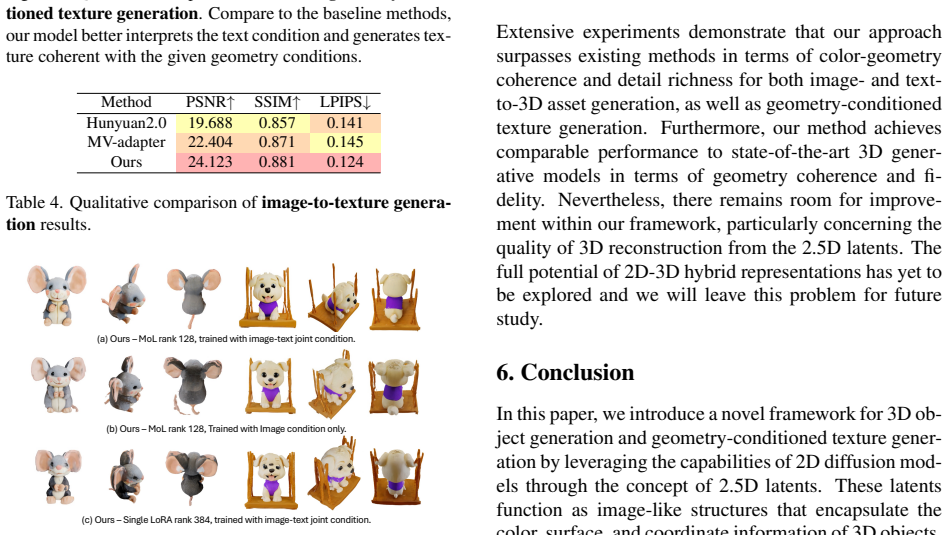
The central claim is that the 2.5D latent — multiview RGB, normal, and coordinate images of an object — is a sufficient and convenient bridge between 2D diffusion priors and 3D reconstruction. Because the representation is image-like, a pretrained 2D diffusion model (Flux.1-dev) can be adapted to generate it; because it contains coordinate maps, the generated latents can be projected into a 3D voxel grid with known camera geometry. A 3D residual UNet refines this grid and a sparse transformer decoder turns it into 3D Gaussian splats or a FlexiCubes mesh. Trained on a curated set of 26K objects, the framework reports image-to-3D results comparable to Trellis (trained on 500K) in geometry and better in texture fidelity, and reports the best CLIP, quality, and aesthetic scores among the compared text-to-3D baselines. For geometry-conditioned texture generation, the same LoRA adapters are fine-tuned with the geometry as a condition, and the paper reports it clearly outperforms dedicated texture baselines such as MV-Adapter, Hunyuan3D-Paint-v2, TexGaussian, and SyncMVD.
Load-bearing premise
The decoded coordinate maps must be accurate enough that the ray-regularized bilateral-filter post-processing can place features into the correct voxels; if that correction fails for some object, the 3D structure misaligns no matter how good the RGB and normal channels look.
Editorial extensions
If this is right
- A single data-efficient pipeline (26K objects) can produce geometry and texture together, so 3D generation no longer needs separate stage-specific models whose outputs often disagree.
- Geometry-conditioned texture generation inherits the 2D diffusion prior: textures stay sharp and semantically aligned because the same 2.5D latents that defined the shape also condition appearance.
- Because the 2.5D latent is image-like, improvements in 2D diffusion models (new base models, conditioning, control) transfer directly to 3D generation without re-architecting the 3D side.
- Mixture-of-LoRA with per-modality adapters is a general recipe for teaching a pretrained 2D model to output multiple aligned modalities with limited data.
Reading between the lines
- If the 2.5D latent proves robust, the same recipe could generate other aligned multiview modalities (albedo, roughness, PBR maps) by adding more LoRA branches, moving toward full material generation from text — a direction the paper does not explore.
- The sensitive step is the coordinate correction; a learned coordinate refiner trained on rendered coordinate-map pairs might replace the hand-tuned bilateral ray-projection pipeline and reduce failure cases for unusual geometry.
- The approach suggests that per-object 3D training data may matter less than strong 2D priors for texture and semantics, but geometry fidelity likely remains bounded by voxel resolution and coordinate decoding accuracy, a trade-off the paper does not quantify.
Editorial analysis
A structured set of objections, weighed in public.
Referee Report
Summary. The paper proposes a unified framework for text/image-to-3D generation and geometry-conditioned texture generation built on a 2.5D latent representation. Multiview RGB, normal, and coordinate images are encoded with a Flux VAE, projected into a 64^3 voxel latent, refined by a 3D UNet, and decoded into 3D Gaussian splats or mesh. A Mixture-of-LoRA adapter set is used to adapt Flux.1 for joint text/image-conditioned generation of these 2.5D latents, and a fine-tuned variant handles geometry-conditioned texture generation. Experiments on GSO subsets report texture metrics better than several baselines and geometry metrics competitive with Trellis using a 26K training set. The central claim is that the 2.5D representation couples geometry and texture well enough to outperform prior work while being far more data-efficient.
Significance. If the central claim holds, the paper's main contribution is a data-efficient way to reuse 2D diffusion priors for joint geometry and texture generation, with a unified image-like representation that is easy to condition on. The Mixture-of-LoRA design is a reasonable extension of prior LoRA-based multiview generation, and the reported image-to-3D numbers are competitive with Trellis at roughly 5% of the training data, which is a meaningful result if the evaluation is sound. However, the load-bearing coordinate-to-voxel projection currently rests on an unvalidated post-processing heuristic, and the texture-generation claim is supported mainly by automated metrics without uncertainty quantification. With those gaps addressed, the paper would be a solid systems contribution.
major comments (3)
- [Appendix B / Fig. 12 / Table 1] The coordinate-map post-processing is load-bearing for the paper's central 3D claim, but it is validated only qualitatively. The paper states that decoded coordinate maps are usually noisy due to the lossy, uncertain VAE decoding process, and the correction pipeline applies bilateral filtering and ray projection; Fig. 12 shows only a qualitative comparison, and no ablation row such as Ours w/o coordinate correction appears in Table 1. Because the ray projection moves points only onto the correct viewing ray and cannot correct depth errors along the ray, and because the refiner and decoder are trained on clean rendered coordinate maps, residual errors at test time are out-of-distribution for the learned modules. To support the claim of coherent structure and color, the authors should provide a quantitative error analysis of the correction on held-out objects with ground truth, such as point-to-mesh distance before and after correction, and a quantitative ablation in the main table.
- [Sec. 4.3.1 / Tables 2-4] The claim of significantly outperforming existing methods in geometry-conditioned texture generation is not established by the reported evidence. Text-conditioned texture and 3D results are measured with CLIP score and Q-Align, which are automated proxies, and no error bars, significance tests, or human evaluation are provided; the margins in Table 3 are small on CLIP (0.803 vs. 0.798) and Aesthetic (2.224 vs. 2.180). The authors should report means over multiple generations with standard deviations, run significance tests where appropriate, and add a human perceptual study for the text-conditioned tasks.
- [Sec. 4.2 / Sec. 4.3] The evaluation setup makes the generalization and reproducibility claims hard to assess. The training set is a manually curated, unreleased collection of 26K objects, and the quantitative evaluation uses only 100 or 200 GSO objects. It is therefore unclear how the method performs on a broader distribution, and the manual curation is an uncontrolled variable when comparing against baselines trained on larger public datasets. The authors should release at least the curation list or the dataset, evaluate on additional public benchmarks, and report per-category results so that the data-efficiency claim can be checked.
minor comments (8)
- [Sec. 3.2 / Sec. 4.1 / App. A.1] Section 3.2 says the general LoRA adapter uses lower ranks (e.g., 64) for better preservation of the RGB prior, but Section 4.1 and Appendix A.1 state that all adapters use rank 128; the final configuration should be stated consistently.
- [Fig. 11 caption] The caption attributes the extra refinement to ISOMER [40], but reference [40] is Unique3D; this citation needs to be corrected.
- [Tables 3 and 4] Tables 3 and 4 should be captioned Quantitative comparison, not Qualitative comparison, because they contain numerical metrics.
- [Table 1] There is a typo in the header Trellis lmage-to-3D, which should be Trellis Image-to-3D.
- [Sec. 4.5 / Sec. 4.1 / Sec. 4.2] Several typos should be fixed: exanimate should be examine, we we should be we, and combing should be combining.
- [Fig. 3] The label COOMixture-of-Lora is unclear; it should be Coord + Mixture-of-LoRA.
- [Sec. 5] The limitation paragraph is vague about the quality of 3D reconstruction from 2.5D latents and should explicitly mention the coordinate-map correction issue described in Appendix B.
- [Fig. 6 / Table 2] The text-to-3D qualitative comparison mentions Kiss3DGen in Fig. 6, but Kiss3DGen is not included in the quantitative table (Table 2); adding it or removing it from the comparison would help.
Circularity Check
No load-bearing circularity: the 2.5D pipeline is an empirical system validated against external baselines; self-citations are prior art, not derivation inputs.
full rationale
The paper's central claim, joint high-fidelity 3D and texture generation from 2.5D latents, is an empirical system claim supported by quantitative comparisons against external baselines (Trellis, Hunyuan3D, Unique3D, MV-Adapter, etc.) on the external GSO benchmark. The 2.5D-to-3D projection decodes coordinate maps and projects them into a voxel grid using known camera parameters; Appendix B's ray regularization is a post-processing correction, not a re-import of the target output, and its failure mode (unfixable depth error) is a robustness limitation, not a circular reduction. The refiner and decoder are trained from scratch with rendering loss on a curated 26K-object dataset and are evaluated on unseen GSO objects, so the reported PSNR/SSIM/LPIPS/CD/FS numbers are genuine external measurements. The authors do cite their own prior works (Kiss3DGen [21], FlexGen [44]) for LoRA fine-tuning and multiview generation foundations, and these citations involve overlapping authors; however, the core diffusion backbone is the external Flux.1-dev model, the Mixture-of-LoRA design is ablated against a single-LoRA baseline, and the sparse decoder follows the external Trellis architecture. No uniqueness theorem, fitted-parameter-as-prediction, ansatz-smuggling, or renaming pattern is present. The explicit Limitation section and the unquantified coordinate-correction pipeline in Appendix B are legitimate correctness concerns, but they do not make the derivation circular. Overall, the paper is self-contained against external benchmarks, and the minor self-citations are not load-bearing. Score 2 reflects the presence of those self-citations, not circularity of the central claim.
Assumptions & free parameters
free parameters (4)
- LoRA ranks =
128 for general/normal/coord adapters; 384 for single-LoRA baseline
- RoPE modality biases =
0, 32, 64 for RGB, normal, coordinate
- Condition dropout rates =
image 80%, text 50%, both 8%; texture model image 50%
- Voxel resolution and training hyperparameters =
64^3 voxels, LR 2e-4 for refiner/decoder, 5e-5 for LoRA, 150k/100k steps
assumptions (4)
- domain assumption Flux.1-dev provides a strong 2D prior that transfers to 2.5D generation via LoRA fine-tuning.
- domain assumption Multiview RGB, normal, and coordinate images are sufficient to reconstruct a full 3D asset when aggregated into a 3D latent.
- domain assumption Trellis-style structured latent and sparse decoder can be trained from scratch on 26k objects to decode the aggregated latents.
- ad hoc to paper The manually curated dataset of 26k objects is representative enough for benchmarking.
Cite this review
Pith. "Pith review of Advancing high-fidelity 3D and Texture Generation with 2.5D latents." pith.science (2026). https://pith.science/paper/4IDV73RS
@misc{pith2026250521050,
  author       = {Pith},
  title        = {Pith review of: Advancing high-fidelity 3D and Texture Generation with 2.5D latents},
  year         = {2026},
  howpublished = {\url{https://pith.science/paper/4IDV73RS}},
  note         = {Machine review of arXiv:2505.21050}
}
read the original abstract
Despite the availability of large-scale 3D datasets and advancements in 3D generative models, the complexity and uneven quality of 3D geometry and texture data continue to hinder the performance of 3D generation techniques. In most existing approaches, 3D geometry and texture are generated in separate stages using different models and non-unified representations, frequently leading to unsatisfactory coherence between geometry and texture. To address these challenges, we propose a novel framework for joint generation of 3D geometry and texture. Specifically, we focus in generate a versatile 2.5D representations that can be seamlessly transformed between 2D and 3D. Our approach begins by integrating multiview RGB, normal, and coordinate images into a unified representation, termed as 2.5D latents. Next, we adapt pre-trained 2D foundation models for high-fidelity 2.5D generation, utilizing both text and image conditions. Finally, we introduce a lightweight 2.5D-to-3D refiner-decoder framework that efficiently generates detailed 3D representations from 2.5D images. Extensive experiments demonstrate that our model not only excels in generating high-quality 3D objects with coherent structure and color from text and image inputs but also significantly outperforms existing methods in geometry-conditioned texture generation.
Figures


Figures from the paper (9 more)




Reference graph
Works this paper leans on
-
[1]
Albergo and Eric Vanden-Eijnden
Michael S. Albergo and Eric Vanden-Eijnden. Building normalizing flows with stochastic interpolants, 2022. 3
work page 2022
- [2]
-
[3]
Stable video diffusion: Scaling latent video diffusion models to large datasets
Andreas Blattmann, Tim Dockhorn, Sumith Kulal, Daniel Mendelevitch, Maciej Kilian, Dominik Lorenz, Yam Levi, Zion English, Vikram V oleti, Adam Letts, et al. Stable video diffusion: Scaling latent video diffusion models to large datasets. arXiv preprint arXiv:2311.15127, 2023. 2
arXiv 2023
-
[4]
Align your latents: High-resolution video synthe- sis with latent diffusion models
Andreas Blattmann, Robin Rombach, Huan Ling, Tim Dockhorn, Seung Wook Kim, Sanja Fidler, and Karsten Kreis. Align your latents: High-resolution video synthe- sis with latent diffusion models. In Proceedings of the IEEE/CVF conference on computer vision and pattern recognition, pages 22563–22575, 2023. 2
work page 2023
-
[5]
3d-adapter: Geometry- consistent multi-view diffusion for high-quality 3d gen- eration
Hansheng Chen, Bokui Shen, Yulin Liu, Ruoxi Shi, Linqi Zhou, Connor Z Lin, Jiayuan Gu, Hao Su, Gordon Wetzstein, and Leonidas Guibas. 3d-adapter: Geometry- consistent multi-view diffusion for high-quality 3d gen- eration. arXiv preprint arXiv:2410.18974, 2024. 3
-
[6]
Google scanned ob- jects: A high-quality dataset of 3d scanned household items
Laura Downs, Anthony Francis, Nate Koenig, Brandon Kinman, Ryan Hickman, Krista Reymann, Thomas B McHugh, and Vincent Vanhoucke. Google scanned ob- jects: A high-quality dataset of 3d scanned household items. In ICRA, 2022. 5
work page 2022
-
[7]
Scaling recti- fied flow transformers for high-resolution image synthe- sis
Patrick Esser, Sumith Kulal, Andreas Blattmann, Rahim Entezari, Jonas M¨uller, Harry Saini, Yam Levi, Dominik Lorenz, Axel Sauer, Frederic Boesel, et al. Scaling recti- fied flow transformers for high-resolution image synthe- sis. In Forty-first international conference on machine learning, 2024. 3
work page 2024
-
[8]
Disenvisioner: Disentangled and enriched visual prompt for customized image generation
Jing He, Haodong Li, Yongzhe Hu, Guibao Shen, Yingjie Cai, Weichao Qiu, and Ying-Cong Chen. Disenvisioner: Disentangled and enriched visual prompt for customized image generation. arXiv preprint arXiv:2410.02067 ,
Show all 47 references
-
[9]
Lotus: Diffusion-based visual foundation model for high-quality dense prediction
Jing He, Haodong Li, Wei Yin, Yixun Liang, Leheng Li, Kaiqiang Zhou, Hongbo Zhang, Bingbing Liu, and Ying- Cong Chen. Lotus: Diffusion-based visual foundation model for high-quality dense prediction. arXiv preprint arXiv:2409.18124, 2024. 2
2024 arXiv
-
[10]
Clipscore: A reference-free eval- uation metric for image captioning
Jack Hessel, Ari Holtzman, Maxwell Forbes, Ronan Le Bras, and Yejin Choi. Clipscore: A reference-free eval- uation metric for image captioning. In EMNLP, 2021. 6
2021
-
[11]
Denoising diffusion probabilistic models
Jonathan Ho, Ajay Jain, and Pieter Abbeel. Denoising diffusion probabilistic models. Advances in neural infor- mation processing systems, 33:6840–6851, 2020. 2
2020
-
[12]
Kingma, Ben Poole, Mohammad Norouzi, David J
Jonathan Ho, William Chan, Chitwan Saharia, Jay Whang, Ruiqi Gao, Alexey Gritsenko, Diederik P. Kingma, Ben Poole, Mohammad Norouzi, David J. Fleet, and Tim Salimans. Imagen video: High definition video generation with diffusion models, 2022. 2
2022
-
[13]
Video diffusion models
Jonathan Ho, Tim Salimans, Alexey Gritsenko, William Chan, Mohammad Norouzi, and David J Fleet. Video diffusion models. Advances in Neural Information Pro- cessing Systems, 35:8633–8646, 2022. 2
2022
-
[14]
3dtopia: Large text-to-3d generation model with hybrid diffusion priors
Fangzhou Hong, Jiaxiang Tang, Ziang Cao, Min Shi, Tong Wu, Zhaoxi Chen, Tengfei Wang, Liang Pan, Dahua Lin, and Ziwei Liu. 3dtopia: Large text-to-3d generation model with hybrid diffusion priors. arXiv preprint arXiv:2403.02234, 2024. 6
2024 arXiv
-
[15]
LoRA: Low-rank adaptation of large language models
Edward J Hu, Yelong Shen, Phillip Wallis, Zeyuan Allen- Zhu, Yuanzhi Li, Shean Wang, Lu Wang, and Weizhu Chen. LoRA: Low-rank adaptation of large language models. In International Conference on Learning Rep- resentations, 2022. 4
2022
-
[16]
Mv- adapter: Multi-view consistent image generation made easy
Zehuan Huang, Yuanchen Guo, Haoran Wang, Ran Yi, Lizhuang Ma, Yan-Pei Cao, and Lu Sheng. Mv- adapter: Multi-view consistent image generation made easy. arXiv, 2024. 2, 6
2024
-
[17]
Elucidating the design space of diffusion-based genera- tive models
Tero Karras, Miika Aittala, Timo Aila, and Samuli Laine. Elucidating the design space of diffusion-based genera- tive models. ArXiv, abs/2206.00364, 2022. 3
2022 arXiv
-
[18]
3d gaussian splatting for real-time radiance field rendering
Bernhard Kerbl, Georgios Kopanas, Thomas Leimk¨uhler, and George Drettakis. 3d gaussian splatting for real-time radiance field rendering. ACM Trans. Graph., 42(4):139–1, 2023. 3
2023
-
[19]
Craftsman: High-fidelity mesh generation with 3d native genera- tion and interactive geometry refiner
Weiyu Li, Jiarui Liu, Rui Chen, Yixun Liang, Xuelin Chen, Ping Tan, and Xiaoxiao Long. Craftsman: High-fidelity mesh generation with 3d native genera- tion and interactive geometry refiner. arXiv preprint arXiv:2405.14979, 2024. 2, 3, 6
2024 arXiv
-
[20]
Triposg: High- fidelity 3d shape synthesis using large-scale rectified flow models
Yangguang Li, Zi-Xin Zou, Zexiang Liu, Dehu Wang, Yuan Liang, Zhipeng Yu, Xingchao Liu, Yuan-Chen Guo, Ding Liang, Wanli Ouyang, et al. Triposg: High- fidelity 3d shape synthesis using large-scale rectified flow models. arXiv, 2025. 2, 6
2025
-
[21]
Kiss3dgen: Repurposing image dif- fusion models for 3d asset generation
Jiantao Lin, Xin Yang, Meixi Chen, Yingjie Xu, Dongyu Yan, Leyi Wu, Xinli Xu, Lie Xu, Shunsi Zhang, and Ying-Cong Chen. Kiss3dgen: Repurposing image dif- fusion models for 3d asset generation. CVPR, 2025. 2, 3, 4, 6
2025
-
[22]
Yaron Lipman, Ricky T. Q. Chen, Heli Ben-Hamu, Max- imilian Nickel, and Matthew Le. Flow matching for gen- erative modeling. In The Eleventh International Confer- ence on Learning Representations, 2023. 3
2023
-
[23]
Flow straight and fast: Learning to generate and transfer data with rectified flow, 2022
Xingchao Liu, Chengyue Gong, and Qiang Liu. Flow straight and fast: Learning to generate and transfer data with rectified flow, 2022. 3
2022
-
[24]
Text-guided texturing by synchronized multi- view diffusion
Yuxin Liu, Minshan Xie, Hanyuan Liu, and Tien-Tsin Wong. Text-guided texturing by synchronized multi- view diffusion. In SIGGRAPH Asia 2024 Conference Papers, 2024. 6
2024
-
[25]
Meshd- iffusion: Score-based generative 3d mesh modeling
Zhen Liu, Yao Feng, Michael J Black, Derek Nowrouzezahrai, Liam Paull, and Weiyang Liu. Meshd- iffusion: Score-based generative 3d mesh modeling. arXiv preprint arXiv:2303.08133, 2023. 3
2023 arXiv
-
[26]
Wonder3d: Single image to 3d using cross-domain diffusion
Xiaoxiao Long, Yuan-Chen Guo, Cheng Lin, Yuan Liu, Zhiyang Dou, Lingjie Liu, Yuexin Ma, Song-Hai Zhang, Marc Habermann, Christian Theobalt, et al. Wonder3d: Single image to 3d using cross-domain diffusion. arXiv,
-
[27]
Yuanxun Lu, Jingyang Zhang, Shiwei Li, Tian Fang, David McKinnon, Yanghai Tsin, Long Quan, Xun Cao, and Yao Yao. Direct2. 5: Diverse text-to-3d generation via multi-view 2.5 d diffusion. In Proceedings of the IEEE/CVF Conference on Computer Vision and Pattern Recognition, page...
2024
-
[28]
Dsplats: 3d generation by denoising splats- based multiview diffusion models
Kevin Miao, Harsh Agrawal, Qihang Zhang, Federico Semeraro, Marco Cavallo, Jiatao Gu, and Alexander Toshev. Dsplats: 3d generation by denoising splats- based multiview diffusion models. arXiv preprint arXiv:2412.09648, 2024. 3
2024 arXiv
-
[29]
Distilling multi-view diffusion models into 3d generators
Hao Qin, Luyuan Chen, Ming Kong, Mengxu Lu, and Qiang Zhu. Distilling multi-view diffusion models into 3d generators. arXiv preprint arXiv:2504.00457, 2025. 3
2025 arXiv
-
[30]
Zero-shot text-to-image generation
Aditya Ramesh, Mikhail Pavlov, Gabriel Goh, Scott Gray, Chelsea V oss, Alec Radford, Mark Chen, and Ilya Sutskever. Zero-shot text-to-image generation. In Inter- national Conference on Machine Learning, pages 8821–
-
[31]
High-resolution image synthesis with latent diffusion models
Robin Rombach, Andreas Blattmann, Dominik Lorenz, Patrick Esser, and Bj¨orn Ommer. High-resolution image synthesis with latent diffusion models. In Proceedings of the IEEE/CVF conference on computer vision and pat- tern recognition, pages 10684–10695, 2022
2022
-
[32]
Photorealistic text-to-image diffusion models with deep language understanding
Chitwan Saharia, William Chan, Saurabh Saxena, Lala Li, Jay Whang, Emily L Denton, Kamyar Ghasemipour, Raphael Gontijo Lopes, Burcu Karagol Ayan, Tim Sali- mans, et al. Photorealistic text-to-image diffusion models with deep language understanding. Advances in Neu- ral Informa...
-
[33]
Flexible isosurface extraction for gradient-based mesh optimiza- tion
Tianchang Shen, Jacob Munkberg, Jon Hasselgren, Kangxue Yin, Zian Wang, Wenzheng Chen, Zan Goj- cic, Sanja Fidler, Nicholas Sharp, and Jun Gao. Flexible isosurface extraction for gradient-based mesh optimiza- tion. ACM Transactions on Graphics (TOG), 42(4):1–16,
-
[34]
Mvdream: Multi-view diffusion for 3d generation
Yichun Shi, Peng Wang, Jianglong Ye, Mai Long, Kejie Li, and Xiao Yang. Mvdream: Multi-view diffusion for 3d generation. arXiv preprint arXiv:2308.16512, 2023. 3
2023 arXiv
-
[35]
Weiss, Niru Ma- heswaranathan, and Surya Ganguli
Jascha Narain Sohl-Dickstein, Eric A. Weiss, Niru Ma- heswaranathan, and Surya Ganguli. Deep unsupervised learning using nonequilibrium thermodynamics. ArXiv, abs/1503.03585, 2015. 2
2015 arXiv
-
[36]
Hunyuan3d 1.0: A uni- fied framework for text-to-3d and image-to-3d genera- tion, 2024
Tencent Hunyuan3D Team. Hunyuan3d 1.0: A uni- fied framework for text-to-3d and image-to-3d genera- tion, 2024. 6
2024
-
[37]
Hunyuan3d 2.0: Scaling dif- fusion models for high resolution textured 3d assets gen- eration, 2025
Tencent Hunyuan3D Team. Hunyuan3d 2.0: Scaling dif- fusion models for high resolution textured 3d assets gen- eration, 2025. 2, 6
2025
-
[38]
Crm: Single image to 3d textured mesh with convolutional reconstruction model
Zhengyi Wang, Yikai Wang, Yifei Chen, Chendong Xi- ang, Shuo Chen, Dajiang Yu, Chongxuan Li, Hang Su, and Jun Zhu. Crm: Single image to 3d textured mesh with convolutional reconstruction model. arXiv, 2024. 3
2024
-
[39]
Q-align: Teaching lmms for visual scor- ing via discrete text-defined levels
Haoning Wu, Zicheng Zhang, Weixia Zhang, Chaofeng Chen, Chunyi Li, Liang Liao, Annan Wang, Erli Zhang, Wenxiu Sun, Qiong Yan, Xiongkuo Min, Guangtai Zhai, and Weisi Lin. Q-align: Teaching lmms for visual scor- ing via discrete text-defined levels. arXiv, 2023. 6
2023
-
[40]
Unique3d: High-quality and efficient 3d mesh genera- tion from a single image, 2024
Kailu Wu, Fangfu Liu, Zhihan Cai, Runjie Yan, Hanyang Wang, Yating Hu, Yueqi Duan, and Kaisheng Ma. Unique3d: High-quality and efficient 3d mesh genera- tion from a single image, 2024. 2, 3, 6, 12
2024
-
[41]
Structured 3d latents for scalable and versatile 3d generation
Jianfeng Xiang, Zelong Lv, Sicheng Xu, Yu Deng, Ruicheng Wang, Bowen Zhang, Dong Chen, Xin Tong, and Jiaolong Yang. Structured 3d latents for scalable and versatile 3d generation. arXiv, 2024. 2, 3, 4, 5, 6
2024
-
[42]
Florence-2: Advancing a unified representation for a variety of vision tasks
Bin Xiao, Haiping Wu, Weijian Xu, Xiyang Dai, Houdong Hu, Yumao Lu, Michael Zeng, Ce Liu, and Lu Yuan. Florence-2: Advancing a unified representation for a variety of vision tasks. arXiv, 2023. 5
2023
-
[43]
Texgaussian: Generating high-quality pbr material via octree-based 3d gaussian splatting
Bojun Xiong, Jialun Liu, Jiakui Hu, Chenming Wu, Jinbo Wu, Xing Liu, Chen Zhao, Errui Ding, and Zhouhui Lian. Texgaussian: Generating high-quality pbr material via octree-based 3d gaussian splatting. arXiv,
-
[44]
Flexgen: Flexible multi-view generation from text and image inputs
Xinli Xu, Wenhang Ge, Jiantao Lin, Jiawei Feng, Lie Xu, HanFeng Zhao, Shunsi Zhang, and Ying-Cong Chen. Flexgen: Flexible multi-view generation from text and image inputs. arXiv preprint arXiv:2410.10745, 2024. 3
2024 arXiv
-
[45]
Sigmoid loss for language image pre- training, 2023
Xiaohua Zhai, Basil Mustafa, Alexander Kolesnikov, and Lucas Beyer. Sigmoid loss for language image pre- training, 2023. 4, 5
2023
-
[46]
Clay: A controllable large-scale generative model for creating high-quality 3d assets
Longwen Zhang, Ziyu Wang, Qixuan Zhang, Qiwei Qiu, Anqi Pang, Haoran Jiang, Wei Yang, Lan Xu, and Jingyi Yu. Clay: A controllable large-scale generative model for creating high-quality 3d assets. ACM Transactions on Graphics (TOG), 43(4):1–20, 2024. 2, 3
2024
-
[47]
Mvdˆ 2: Efficient multiview 3d reconstruc- tion for multiview diffusion
Xin-Yang Zheng, Hao Pan, Yu-Xiao Guo, Xin Tong, and Yang Liu. Mvdˆ 2: Efficient multiview 3d reconstruc- tion for multiview diffusion. In ACM SIGGRAPH 2024 Conference Papers, 2024. 2, 3 A. Model Details A.1. Mixture-of-LoRA In our paper, we present a new strategy for fine-tuni...
2024
Reviewed August 7, 2026 · model on record in the stance chip above.
Discussion (0). Sign in to comment.