REVIEW 2 major objections 4 minor 90 references
Possible wormholes in generalized geometry-matter coupling gravity induced by the Dekel-Zhao dark matter profile
T0 review · 2 major / 4 minor · reviewed 2026-08-07 · deepseek-v4-flash
Pith's one-line read Traversable wormhole solutions are derived from the Dekel-Zhao dark matter halo profile in f(R,L_m,T) gravity, with a shape function that can satisfy traversability and energy conditions in some parameter ranges.
desk verdict The reader's chi-cancellation objection is wrong; the real flaw is that the 'ordinary matter' branch violates the flaring-out condition at the throat, so the central claim is unsupported. read the letter →
The pith
A machine-rendered reading of the paper's core claim, the machinery that carries it, and where it could break.
The reading
What carries the argument
The central object is the wormhole shape function S(r), constructed by integrating the Dekel-Zhao double power-law dark matter density profile through the simplified field equations (38)-(40) under a constant redshift. This shape function simultaneously determines the metric and the matter content of the wormhole, and it is what carries the traversability, energy condition, and lensing analyses.
What would settle it
Substitute the explicit matter expressions (46)-(48) and the shape function (44) into the full field equations (34)-(36) with \chi=0.3, r_0=0.85, and r_c=0.5, and check whether the equations are satisfied identically; any nonzero residual term contradicts the claim that these are solutions of the stated f(R,L_m,T) theory.
Extended reading notes
Core claim
For the additive model f(R,L_m,T)=R+\$\lambda$ L_m+\chi T with a constant redshift function, the paper derives a family of traversable wormhole solutions whose shape function is obtained directly from the Dekel-Zhao dark matter density profile. The central result is the explicit shape function, Eq. (44), which satisfies the throat condition S(r_0)=r_0, the flaring-out condition, and asymptotic flatness for suitable couplings. The associated matter content can respect or violate the null and dominant energy conditions depending on the parameters, leading the authors to conclude that wormholes in this gravity theory can sustain both exotic and ordinary matter.
Load-bearing premise
The load-bearing premise is that the simplified field equations (38)-(40) are equivalent to the full field equations (34)-(36) for the parameter values used, including \chi=0.3, even though the reduction appears to require \chi=0.
Editorial extensions
If this is right
- Wormhole solutions can be embedded naturally in dark matter halos described by realistic density profiles such as Dekel-Zhao.
- The energy conditions can be satisfied in certain parameter regions, suggesting that ordinary matter may suffice to support these wormholes.
- The deflection angle can be negative, implying a repulsive gravitational force that could be probed through lensing observations.
- The Tolman-Oppenheimer-Volkoff equilibrium condition is satisfied, supporting the stability of the solutions.
- The coupling parameters \lambda and \chi are constrained by requiring the shape function to meet the traversability conditions.
Reading between the lines
- The same construction could be applied to other dark matter profiles, such as Navarro-Frenk-White or Einasto, to test whether traversable wormholes are generic features of halo models in this gravity theory.
- If the negative deflection angle is a robust prediction, high-resolution lensing observations of galaxy halos could in principle distinguish such wormholes from ordinary compact objects.
- A direct check of whether the simplified field equations (38)-(40) exactly solve the full field equations (34)-(36) for the plotted value \chi=0.3 would settle whether the solutions satisfy the theory as stated.
- The parameter regions where ordinary matter supports the wormhole could be used to constrain the allowed values of \lambda and \chi in f(R,L_m,T) gravity.
Editorial analysis
A structured set of objections, weighed in public.
Referee Report
Summary. The paper constructs static, constant-redshift wormhole solutions in f(R,L_m,T) gravity with f = R + λL_m + χT, using the Dekel-Zhao dark matter density profile as input. By integrating Eq. (38) (S' = ω r² ρ) with a double power-law density, the authors obtain a shape function S(r), impose S(r0)=r0, and then evaluate the energy conditions, gravitational lensing, and the TOV balance equation for the resulting matter content. The abstract claims that the construction yields traversable wormholes that can be supported by both exotic and ordinary matter, depending on parameters (e.g., the scale radius rc). The paper also claims stability from the TOV equation and reports repulsive gravitational lensing for positive couplings.
Significance. If the central claim were sound, the existence of traversable wormhole solutions supported by ordinary matter (i.e., matter satisfying the null energy condition) in a well-defined extension of GR would be a noteworthy result, and the analytic shape function derived from an observationally motivated dark-matter profile would be a useful addition to the wormhole literature. The paper provides explicit analytic expressions and parameter studies, which is a strength. However, the central claim fails: as shown in the major comments, the branch of solutions that satisfies the NEC at the throat violates the Morris-Thorne flaring-out condition S'(r0)<1, so that branch does not describe a traversable wormhole. In addition, the energy-condition results are effectively imposed by the chosen input density rather than being dynamical predictions of the gravity theory, and the TOV 'stability' check is an identity. I also verified that the reduction from Eqs. (34)-(36) to Eqs. (38)-(40) is algebraically exact (the residual χ-terms vanish identically because ρ+Pr+2Pt=0 for these solutions), so the submitted reader-report concern about the χ-reduction is not a valid defect.
major comments (2)
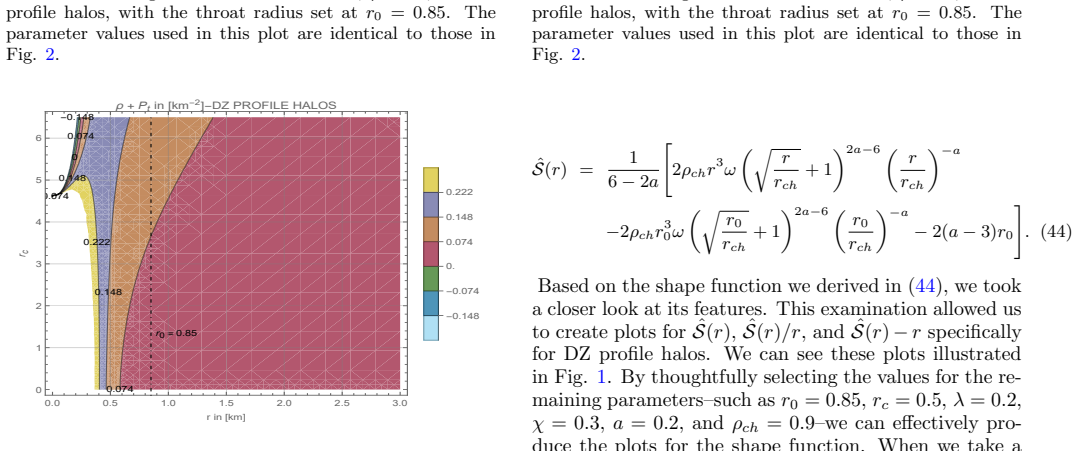
- [Sec. IV, Eq. (32) with Eqs. (38)-(40)] The ordinary-matter branch cannot satisfy the Morris-Thorne throat condition. From (38) and (39), at the throat r0, where S(r0)=r0, one obtains ρ+Pr = (S' − S/r)/(ω r²), so at r0 the sign of ρ+Pr equals the sign of S'(r0)−1 for the positive coupling ω used in the plots. The paper reports in Sec. IV that ρ+Pr is satisfied for rc > 2.492 and violated for rc < 2.492. In the satisfied ('ordinary matter') branch, S'(r0)>1, which violates the flaring-out condition (32), S' < S/r, at the throat. Thus the NEC-satisfying branch is not a traversable wormhole throat; only the NEC-violating branch is traversable. This contradicts the abstract's claim that the solutions can 'sustain both exotic as well as ordinary matter.'
- [Sec. IV, derivation of the shape function from Eq. (38)] The energy-condition results are not independent predictions of the modified gravity theory. The shape function is obtained by integrating Eq. (38), S' = ω r² ρ, where ρ is the externally assumed Dekel-Zhao density (42) [or (46)]. Therefore the signs of ρ+Pr and ρ+Pt follow directly from the chosen input profile, not from the dynamics of f(R,L_m,T). In particular, the dichotomy between a NEC-satisfying branch and a flaring-out-satisfying branch is a kinematic consequence of the throat geometry, as shown in the previous comment. The paper should state this circularity explicitly and should not present the energy-condition plots as evidence that the gravity theory can support traversable wormholes with ordinary matter.
minor comments (4)
- [Sec. IV, Eq. (42)] Equation (42) as printed has positive exponents and grows as r^{3.5} at large radius, which is inconsistent with the Dekel-Zhao halo profile and with the density expression (46) actually used in the paper; the intended Zhao profile presumably has negative exponents in (42).
- [Sec. III, references] The citation [75] appears in the text of Sec. III but is missing from the reference list, and the reference entry [75] in the bibliography is empty.
- [Sec. VI, Eqs. (56)-(58)] With constant redshift, the TOV equation (56) reduces to dPr/dr + (2/r)(Pr−Pt) = 0, which is identically satisfied by the field equations (39)-(40). Thus the statement that the solutions are stable is an overstatement; the computation is a consistency check, not a stability analysis.
- [Sec. IV, SEC discussion] The observation that ρ+Pr+2Pt=0 is an algebraic identity following from (38)-(40); presenting it as showing that the SEC is satisfied is correct only in the marginal sense of equality, and it carries no independent physical content.
Circularity Check
No circularity: the wormhole solution is constructed from the assumed Dekel-Zhao density profile, and the energy-condition results are consequences of that input rather than disguised inputs.
full rationale
The paper's derivation chain is a standard solution-generating exercise. It assumes the Dekel-Zhao form for rho (Eq. 42), substitutes it into the constant-redshift field equations (38)-(40), integrates to obtain the shape function S(r) (Eq. 44), fixes the integration constant with the throat condition S(r0)=r0, and then evaluates energy conditions and lensing as consequences. The simplified equations (38)-(40) are exactly equivalent to the full system (34)-(36): substituting the simplified expressions into (34)-(36) cancels the chi terms identically because the simplified equations imply rho+Pr+2Pt=0. Thus there is no hidden reduction of the field equations. No parameter is fitted to a target dataset and then renamed a prediction; no uniqueness theorem from the authors' prior work is invoked; the f(R,L_m,T) framework is cited to Haghani & Harko (2021), which has no author overlap with the present paper. The self-citation [53] (Errehymy et al. 2023) is a literature pointer in the introduction and is not load-bearing. The central objects (S, rho, Pr, Pt) are outputs determined by the stated input profile and couplings, not restatements of the conclusions. A separate internal-consistency concern exists: the branch with rho+Pr >= 0 at the throat is incompatible with the Morris-Thorne flaring-out inequality S'(r0)<1, since Eqs. (38)-(40) imply rho+Pr = (S'-1)/(omega r0^2). That is a physical/correctness problem, not a circularity, and therefore does not raise the circularity score.
Assumptions & free parameters
free parameters (6)
- r0 (throat radius) =
0.85 km
- rc (scale radius) =
varied over [0,6.5] km, e.g. 0.5
- rho_ch (characteristic density) =
0.9 km^-2
- a (inner slope) =
0.2
- lambda =
0.2
- chi =
0.3
assumptions (7)
- domain assumption The Haghani-Harko f(R,L_m,T) field equations (Eq. 9) are the correct equations of motion.
- domain assumption The matter Lagrangian is L_m = -rho, with rho independent of metric derivatives.
- ad hoc to paper Equations (38)-(40) are equivalent to the field equations (34)-(36) for the plotted couplings.
- domain assumption The Dekel-Zhao double power-law profile (Eq. 42) is the actual matter density of the wormhole halo.
- domain assumption The wormhole matter is an anisotropic perfect fluid with diagonal stress-energy tensor (Eq. 15).
- domain assumption The redshift function is constant.
- standard math Morris-Thorne conditions (30)-(33) define traversability and flaring-out.
Cite this review
Pith. "Pith review of Possible wormholes in generalized geometry-matter coupling gravity induced by the Dekel-Zhao dark matter profile." pith.science (2026). https://pith.science/paper/FKBRAAX5
@misc{pith2026250521081,
  author       = {Pith},
  title        = {Pith review of: Possible wormholes in generalized geometry-matter coupling gravity induced by the Dekel-Zhao dark matter profile},
  year         = {2026},
  howpublished = {\url{https://pith.science/paper/FKBRAAX5}},
  note         = {Machine review of arXiv:2505.21081}
}
abstract
In the late 1980s, Morris and Thorne led in theoretical physics by creating solutions to wormholes and formulating the crucial requirements for safe traversability of wormholes. They found that exotic matter must meet the requirement $P_r + \rho < 0$, where $P_r$ is radial pressure and $\rho$ is energy density. This is a rudimentary grasp of our understanding of general relativity. In this paper, we continue their excellent work by looking at how to build traversable wormhole solutions in an extended theory of gravity. We adopt a process of linearly modifying the matter Lagrangian and the energy-momentum tensor with some coupling strengths $\lambda$ and $\chi$. This may be considered as a special case of linear $f(R, T)$ gravity with matter coupling variability or as an additively separable simple $f(R, L_m, T)$ model. We undertake a detailed analysis of static wormhole solutions with a constant redshift function. This allows us to present our results as a first-order approximation in the $f(R, L_m, T)$ scenario. We derive the wormhole shape function from the Dekel-Zhao dark matter distribution in such a way that our solutions satisfy the needed conditions for traversability as well as the requirement of exotic matter. This is particularly exciting as it shows that wormholes in $f(R, L_m, T)$ gravity can sustain both exotic as well as ordinary matter. To ensure that the shape function meets the requirement of flaring-out and is asymptotically flat, we place some constraints on the couplings. We also examine the gravitational lensing effects, which exhibit a repulsive gravitational force that appears in our extended gravity for positive couplings.
Figures


Figures from the paper (3 more)


Reference graph
Works this paper leans on
-
[1]
NEC: The sum of pressure pi and energy density ρ must be greater than or equal to zero: (pi + ρ) ≥ 0. (23)
-
[2]
WEC: The energy density ρ must be non-negative, and the sum of pressure and energy density must also be non-negative: ρ ≥ 0, (pi + ρ) ≥ 0. (24)
-
[3]
DEC: The difference between energy density and the absolute value of pressure must be non- negative: (ρ − |pi|) ≥ 0, (25)
-
[4]
fictitious
SEC: The sum of energy density and the total pres- sure must be non-negative, along with the previous condition: (ρ + 3X i=1 pi) ≥ 0, (pi + ρ) ≥ 0. (26) where i refers to spatial indices. 5 When we encounter violations of energy conditions, it often points to the existence of exotic matter. For instance, wormhole configurations specifically require a brea...
-
[5]
At the throat r0, the shape function should equal the radial coordinate: ˆS(r0) = r0. (30)
-
[6]
The rate at which the shape function changes at this point must not exceed 1: ˆS ′(r0) ≤ 1. (31) (Here, the prime symbol indicates we’re talking about the derivative with respect to the radial coordinate.) Additionally, there’s an important inequality that the shape function must satisfy: ˆS ′(r) < ˆS(r) r . (32) This condition ensures that the ratio of t...
-
[7]
These visualizations not only provide a clear picture of the wormholes but also illustrate the complex relation- ships between different regions of spacetime
This figure includes embedding diagrams that show the wormholes with DZ profile halos, generated by ro- tating them around the z-axis through a full 2 π angle. These visualizations not only provide a clear picture of the wormholes but also illustrate the complex relation- ships between different regions of spacetime. In Fig. 1, we can observe the embeddin...
-
[8]
Riess, et al., Astron
A.G. Riess, et al., Astron. J. 116, 1009, (1998)
1998
Show all 90 references
-
[9]
Perlmutter, et al., Astrophys
S. Perlmutter, et al., Astrophys. J. 517, 565, (1999)
1999
-
[10]
Hobson, et al., General Relativity: an Introduction for Physicists, Cambridge University Press, Cambridge, UK, (2006)
M.P. Hobson, et al., General Relativity: an Introduction for Physicists, Cambridge University Press, Cambridge, UK, (2006)
2006
-
[11]
Weinberg, Rev
S. Weinberg, Rev. Mod. Phys. 61, 1, (1989)
1989
-
[12]
Salucci, Astron
P. Salucci, Astron. Astrophys. Rev. 27, 2, (2019)
2019
-
[13]
Limousin, et al., Astron
M. Limousin, et al., Astron. Astrophys. 664, A90, (2022)
2022
-
[14]
Montes, I
M. Montes, I. Trujillo, Mon. Not. R. Astron. Soc. 482, 2838, (2019)
2019
-
[15]
Smith, J.D
P.F. Smith, J.D. Lewin, Phys. Rep. 187, 203, (1990)
1990
-
[16]
C. G. Boehmer, et al., Phys. Rev. Lett. 92, 101301, (2004)
2004
-
[17]
Mayet, Phys
F. Mayet, Phys. Rep. 627, 1, (2016)
2016
-
[18]
Astrophys
Planck Collaboration, Astron. Astrophys. 641, A6, (2020)
2020
-
[19]
Klypin, et al., Astrophys
A. Klypin, et al., Astrophys. J. 522, 82, (1999)
1999
-
[20]
Moore, et al., Astrophys
B. Moore, et al., Astrophys. J. Lett. 524, L19, (1999)
1999
-
[21]
Dubinski, R.G
J. Dubinski, R.G. Carlberg, Astrophys. J. 378, 496, (1991)
1991
-
[22]
Walker, J
M.G. Walker, J. Pe˜ narrubia, Astrophys. J. 742, 20, (2011)
2011
-
[23]
Bull, et al., Phys
P. Bull, et al., Phys. Dark Universe 12, 56, (2016)
2016
-
[24]
De Felice, S
A. De Felice, S. Tsujikawa, Living Rev. Relativ. 13, 3, (2010)
2010
-
[25]
Amendola, et al., Phys
L. Amendola, et al., Phys. Rev. D 75, 083504, (2007)
2007
-
[26]
Nojiri, S.D
S. Nojiri, S.D. Odintsov, Phys. Rev. D 74, 086005, (2006)
2006
-
[27]
Capozziello, et al., Phys
S. Capozziello, et al., Phys. Rev. D 71, 043503, (2005)
2005
-
[28]
Capozziello, M
S. Capozziello, M. De Laurentis, Ann. Astrophys. 524, 545, (2012)
2012
-
[29]
Boehmer, et al., Astropart
C.G. Boehmer, et al., Astropart. Phys. 29, 386, (2008)
2008
-
[30]
Casado-Turrion, et al., Phys
A. Casado-Turrion, et al., Phys. Rev. D 108, 064006, (2023)
2023
-
[31]
H. Aman, Z. Yousaf, JHEAp 47, 100380 (2025)
2025
-
[32]
Khan and Z
S. Khan and Z. Yousaf, Phys. Scripta 99, no.9, 095304 (2024)
2024
-
[33]
S. Khan, A. Adeel, Z. Yousaf, Eur. Phys. J. C 84, no.6, 572 (2024)
2024
-
[34]
A. M. Albalahi, M. Z. Bhatti, A. Ali, S. Khan, Eur. Phys. J. C 84, no.3, 293 (2024)
2024
-
[35]
Yousaf, S
Z. Yousaf, S. Khan, N. B. Turki, T. Suzuki, Chin. J. Phys. 89, 1595-1610 (2024)
2024
-
[36]
Yousaf, Ind
Z. Yousaf, Ind. J. Phys. 99, 1-13 (2025)
2025
-
[37]
Yousaf, K
Z. Yousaf, K. Bamba, B. Almutairi, Y. Hashimoto and S. Khan, Phys. Dark Univ. 46, 101629 (2024)
2024
-
[38]
Yousaf, Phys
Z. Yousaf, Phys. Dark Univ. 48, 101884 (2025)
2025
-
[39]
M. Z. Bhatti, Z. Yousaf and Z. Tariq, Chin. J. Phys. 72, 18-37 (2021)
2021
-
[40]
Malik, T
A. Malik, T. Naz, A. Qadeer, M. F. Shamir and Z. Yousaf, Eur. Phys. J. C 83, no.6, 522 (2023)
2023
-
[41]
F. S. N. Lobo and M. A. Oliveira, Phys. Rev. D 80, 104012 (2009)
2009
-
[42]
Bahamonde, M
S. Bahamonde, M. Jamil, P. Pavlovic and M. Sossich, Phys. Rev. D 94, no.4, 044041 (2016)
2016
-
[43]
Karakasis, E
T. Karakasis, E. Papantonopoulos and C. Vlachos, Phys. Rev. D 105, no.2, 024006 (2022)
2022
-
[44]
Capozziello and M
S. Capozziello and M. De Laurentis, Phys. Rept. 509, 167-321 (2011)
2011
-
[45]
S. E. Perez Bergliaffa, Phys. Lett. B 642, 311-314 (2006)
2006
-
[48]
N. M. Garcia and F. S. N. Lobo, Phys. Rev. D 82, 104018 (2010)
2010
-
[49]
N. M. Garcia, T. Harko, F. S. N. Lobo and J. P. Mimoso, Phys. Rev. D 83, 104032 (2011)
2011
-
[50]
Harko, F
T. Harko, F. S. N. Lobo, S. Nojiri and S. D. Odintsov, Phys. Rev. D 84, 024020 (2011)
2011
-
[51]
S. D. Odintsov and D. S´ aez-G´ omez, Phys. Lett. B725, 437-444 (2013)
2013
-
[52]
Liu and M
D. Liu and M. J. Reboucas, Phys. Rev. D 86, 083515 (2012) 12
2012
-
[53]
Baccetti, P
V. Baccetti, P. Martin-Moruno and M. Visser, JHEP 08, 148 (2012)
2012
-
[54]
Haghani, T
Z. Haghani, T. Harko, Eur. Phys. J. C 81, 615, (2021)
2021
-
[55]
Morris, K.S
M.S. Morris, K.S. Thorne, Am. J. Phys. 56, 395, (1988)
1988
-
[56]
Curiel, A primer on energy conditions, Springer, New York, (2017)
E. Curiel, A primer on energy conditions, Springer, New York, (2017)
2017
-
[57]
Luis Rosa, P.M
J. Luis Rosa, P.M. Kull, Eur. Phys. J. C82, 1154, (2022)
2022
-
[58]
Carr, et al., Class
B.J. Carr, et al., Class. Quantum Gravity 27, 183101, (2010)
2010
-
[59]
Bronnikov, et al., Symmetry 12, 1306, (2020)
K.A. Bronnikov, et al., Symmetry 12, 1306, (2020)
2020
-
[60]
Errehymy, et al., Phys
A. Errehymy, et al., Phys. Dark Univ. 41, 101258 (2023)
2023
-
[61]
Nandi, et al., Phys
K.K. Nandi, et al., Phys. Rev. D 95, 104011, (2017)
2017
-
[62]
Ohgami, N
T. Ohgami, N. Sakai, Phys. Rev. D 91, 124020, (2015)
2015
-
[63]
Paul, et al., JCAP 03, 055, (2020)
S. Paul, et al., JCAP 03, 055, (2020)
2020
-
[64]
Harko, Phys
T. Harko, Phys. Rev. D 90, no.4, 044067 (2014)
2014
-
[65]
S. I. dos Santos, G. A. Carvalho, P. H. R. S. Moraes, C. H. Lenzi and M. Malheiro, Eur. Phys. J. Plus 134, no.8, 398 (2019)
2019
-
[66]
Hochberg, M
D. Hochberg, M. Visser, Phys. Rev. D 58, 044021 (1998)
1998
-
[67]
Hochberg, D., Visser, M.: Phys. Rev. Lett. 81 746 (1998)
1998
-
[68]
M. S. Morris, K. S. Thorne, Am. J. Phys. 56, 395-412 (1988)
1988
-
[69]
Capozziello, F
S. Capozziello, F. S. N. Lobo and J. P. Mimoso, Phys. Lett. B 730, 280-283 (2014)
2014
-
[70]
Santos, J
J. Santos, J. S. Alcaniz, M. J. Reboucas and F. C. Car- valho, Phys. Rev. D 76, 083513 (2007)
2007
-
[71]
Bertolami and M
O. Bertolami and M. C. Sequeira, Phys. Rev. D 79, 104010 (2009)
2009
-
[72]
Akramov, et al., Europhysics Letters, 147, 62001 (2024)
M. Akramov, et al., Europhysics Letters, 147, 62001 (2024)
2024
-
[73]
Rakhmanov, et al., Optical high harmonic generation in Dirac materials
S. Rakhmanov, et al., Optical high harmonic generation in Dirac materials. The Eur. Phys. J. B, 98, 35 (2025)
2025
-
[74]
Turimov, et al., Phys
B. Turimov, et al., Phys. Dark Univ. 48, 101876 (2025)
2025
-
[75]
Razina, et al., Eur
O. Razina, et al., Eur. Phys. J. Plus 126, 85 (2011)
2011
-
[76]
Kumar, et al., Eur
A. Kumar, et al., Eur. Phys. J. Plus 138, no.12, 1071 (2023)
2023
-
[77]
F. J. Tipler, Phys. Rev. D 17, 2521-2528 (1978)
1978
-
[78]
M. S. Morris, K. S. Thorne and U. Yurtsever, Phys. Rev. Lett. 61, 1446-1449 (1988)
1988
-
[79]
Wang and K
J. Wang and K. Liao, Class. Quant. Grav. 29, 215016 (2012)
2012
-
[80]
Atazadeh, et al., Int
K. Atazadeh, et al., Int. J. Mod. Phys. D 18, 1101-1111 (2009)
2009
-
[81]
F. D. Albareti, J. A. R. Cembranos, A. de la Cruz- Dombriz and A. Dobado, JCAP 07, 009 (2013) [75]
2013
-
[82]
Chatterjee, D
S. Chatterjee, D. A. Easson and M. Parikh, Class. Quant. Grav. 30, 235031 (2013)
2013
-
[83]
Zhao, Mon
H. Zhao, Mon. Not. Roy. Astron. Soc. 278, 488-496 (1996)
1996
-
[84]
Zhao, Mon
H. Zhao, Mon. Not. Roy. Astron. Soc. 287, 525 (1997)
1997
-
[85]
Freundlich et al., Mon
J. Freundlich et al., Mon. Not. Roy. Astron. Soc. 499, 2912-2933 (2020)
2020
-
[86]
Shaikh et al., JCAP 07, 028 (2019)
R. Shaikh et al., JCAP 07, 028 (2019)
2019
-
[87]
Virbhadra, G.F.R
K.S. Virbhadra, G.F.R. Ellis, Phys. Rev. D 62, 084003 (2000)
2000
-
[88]
Virbhadra, G.F.R
K.S. Virbhadra, G.F.R. Ellis,, Phys. Rev. D 65, 103004 (2002)
2002
-
[89]
Claudel, K.S
C.M. Claudel, K.S. Virbhadra, G.F.R. Ellis, J. Math. Phys. 42, 818-838 (2001)
2001
-
[90]
Oppenheimer, G.M
J.R. Oppenheimer, G.M. Volkoff, Phys. Rev. 55, 374 (1939)
1939
-
[91]
Gorini et al., Phys
V. Gorini et al., Phys. Rev. D 78, 064064 (2008)
2008
-
[92]
Kuhfittig, Fundamental J
P.K.F. Kuhfittig, Fundamental J. Mod. Phys. 14, 23-31 (2020)
2020
Reviewed August 7, 2026 · model on record in the stance chip above.
Discussion (0). Continue with ORCID to comment.